What Is Canadian Whisky is a category of whisky made in Canada from cereal grains, aged at least three years in wood, and commonly associated with smooth blended styles that often feature rye.
Under Canadian rules, it must be mashed, distilled, and aged in Canada, bottled at 40% ABV or higher, and possess the aroma, taste, and character generally attributed to Canadian whisky.
The style ranges from light, approachable blends to grain-forward, rye-heavy bottlings, with producers often aging different grain whiskies separately before blending for balance, texture, and consistency.
Legal Standards for Canadian Whisky
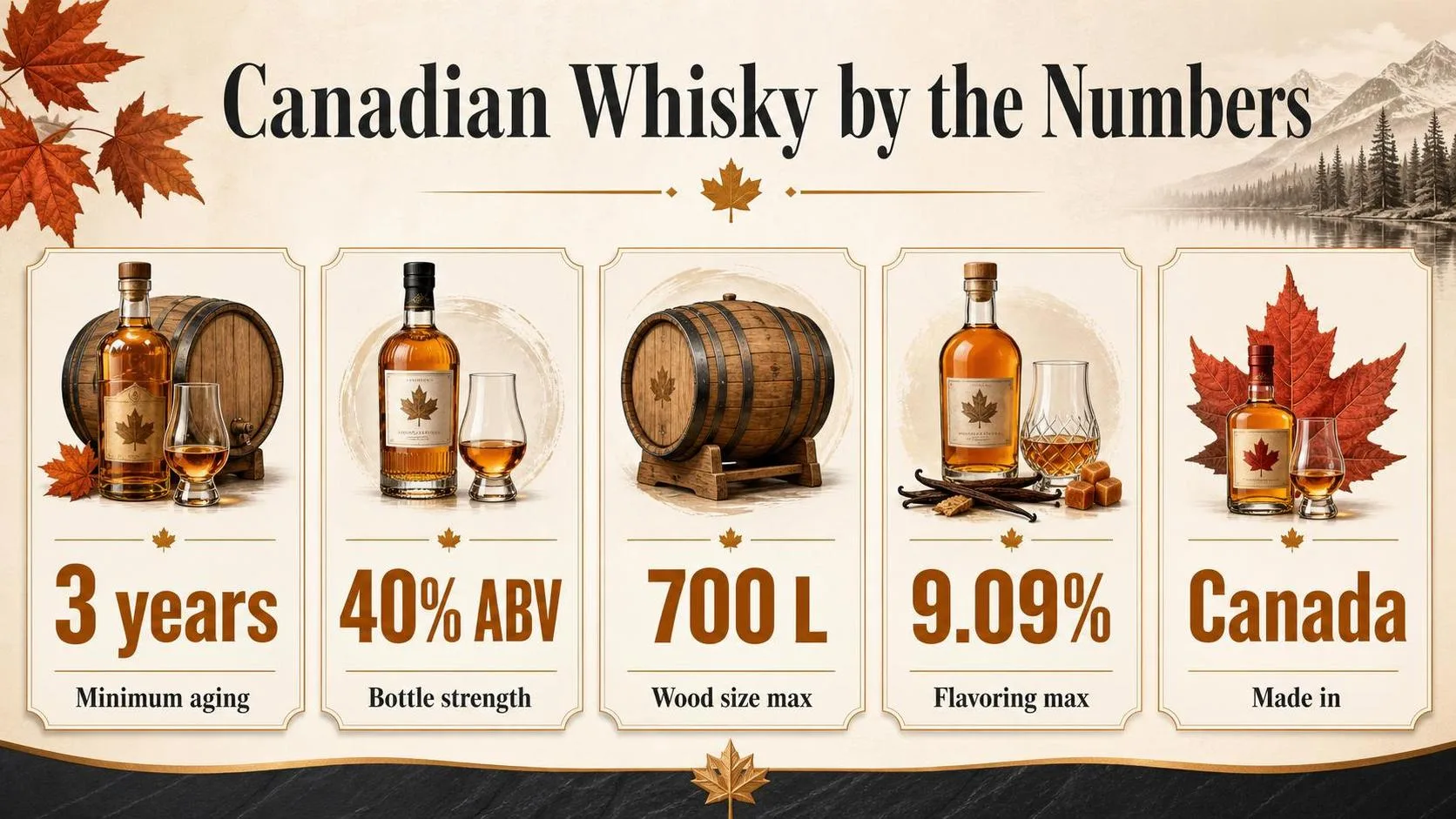
Canadian whisky is defined less by a single grain recipe than by a few hard legal numbers. The most important are 3 years in wood, 40% alcohol by volume at bottling, and Canada as the place of mashing, distillation, and aging.
Those numbers explain why Canadian whisky can taste light, spicy, creamy, or dessert-like while still fitting the same legal category.
In tasting flights, the proof, age, and blending allowance usually matter more than whether the label says “rye.”.
| Number | What it means | Why it matters in the glass |
| 3 years | Minimum aging time in small wood before it can be called Canadian whisky. | Even entry-level bottles have had time for oak, vanilla, color, and spirit integration. |
| 40% ABV | Minimum bottling strength, equal to 80 proof in the United States. | This is the floor; higher-proof bottlings usually carry more texture, heat, and flavor concentration. |
| 700 liters | Maximum size for the “small wood” aging vessels recognized in Canadian whisky rules. | Smaller cooperage gives more wood contact than giant vats, supporting oak extraction during maturation. |
| 9.09% | Commonly cited maximum for permitted flavoring components in Canadian whisky: one part flavoring to ten parts whisky. | Some producers use wine, sherry, or other aged spirits to round the blend; many do not emphasize it on the label. |
| 100% Canadian | The whisky must be mashed, distilled, and aged in Canada under Canadian rules. | The style is tied to Canadian production, not simply to a brand name or rye grain content. |
The 3-year rule is a minimum, not a quality ceiling. Many well-known Canadian blends include whiskies older than 3 years, but the label can only state an age if every drop of whisky in the bottle is at least that old.
The 40% ABV minimum is shared with many global whisky categories. In practice, classic Canadian blends often sit at 40%, while premium rye-forward or single-grain expressions may appear at 43%, 45%, 50%, or cask strength.
- “Rye” does not require 51% rye grain in Canada. Historically, Canadians used “rye” as a style name because rye grain added spice to early blends.
- Age statements are conservative. A “10 year” Canadian whisky means the youngest whisky component is at least 10 years old.
- Color is not always only from the barrel. Canadian rules allow caramel coloring, a standard practice also seen in several other whisky traditions.
The takeaway: Canadian whisky is a regulated, aged spirit with room for blending flexibility. Its key numbers set the legal frame, while the blender decides whether the final whisky tastes delicate, spicy, rich, or bold.

How Production Shapes Canadian Whisky Flavor
Canadian whisky’s flavor is shaped less by a single mash bill and more by how separate grain whiskies are distilled, aged, and blended.
Under Canada’s Food and Drug Regulations, it must be mashed, distilled, and aged in Canada in small wood for at least 3 years.
The category is broad by design. That flexibility is why one bottle may taste light, clean, and vanilla-driven, while another is spicy, oily, and rye-forward.
| Factor | Required or typical number | Effect in the glass |
| Minimum aging | 3 years in wood containers of 700 liters or less | Adds color, oak sweetness, vanillin, and tannin |
| Bottling strength | Minimum 40% alcohol by volume | Controls weight, aroma lift, and finish intensity |
| Permitted flavoring | Up to 9.09% of the final whisky may be other wine or spirits | Can add fruit, sweetness, or fortified-wine notes |
| Common still type | Column stills for base whisky; pot stills often for flavoring whisky | Column distillate is lighter; pot distillate is heavier and grainier |
- Grain choice: Corn often forms the lighter base whisky, giving sweetness and a soft texture. Rye, even in smaller proportions, contributes black pepper, dill, mint, clove, and dry grain spice. Barley and wheat may add biscuit, cereal, or rounded sweetness.
- Separate distillation: Many Canadian distilleries ferment and distill grains separately, then blend mature components. This lets the blender use a clean corn whisky for volume and a concentrated rye whisky for aroma and structure.
- Distillation proof: Higher-proof distillation removes more congeners, creating a lighter spirit. Lower-proof distillation preserves more oils, esters, and grain character, which can make the whisky taste fuller and more rustic.
- Barrel type: Used American oak tends to produce gentler vanilla, coconut, and caramel than new charred oak. Reused barrels are common in Canada, but producers also use new oak, ex-bourbon, and wine-seasoned casks for added depth.
- Climate and warehouse conditions: Canadian winters slow extraction, while warm summers push whisky into the wood. This seasonal swing helps develop mature oak character without making every 3-year-old whisky taste aggressively woody.
- Blending decisions: The blender determines the final identity. Age, barrel selection, rye content, proof, and optional flavoring all matter, but balance is the point: sweetness, spice, oak, alcohol, and finish must fit together.
Identity Standards for Canadian Whisky
Canadian whisky is verified against legal identity standards, not just tasting notes. Inspectors, bottlers, and import authorities check alcohol strength, age, origin, container size, and label claims before it can be sold as Canadian whisky.
In Canada, the core standard is set in the Food and Drug Regulations, section B.02.020.
The spirit must be mashed, distilled, and aged in Canada; aged in “small wood” for at least 3 years; and bottled at a minimum of 40% alcohol by volume.
| Measurement | Legal or practical checkpoint |
| Minimum bottling strength | 40% alcohol by volume, equal to 80 U.S. proof |
| Minimum maturation | 3 years in wooden containers |
| Wood container size | “Small wood” is generally treated as casks not exceeding 700 liters |
| Place of production | Mashed, distilled, and aged in Canada |
| Permitted adjustments | Caramel coloring and flavoring are allowed under Canadian rules |
Alcohol strength is measured in a laboratory or quality-control room with calibrated density meters, hydrometers, or distillation-based alcohol tests.
Because temperature changes density, readings are corrected to the legal reference temperature used by the testing method.
Age is verified from production records, barrel-fill logs, warehouse records, and bottling batch sheets. If an age statement appears on the label, it refers to the youngest whisky in the bottle, not the average or oldest component.
This point matters because Canadian whisky is often blended from separately aged components.
A bottling may contain corn whisky, rye-flavored whisky, and other grain spirits, but every whisky component supporting the Canadian whisky designation must satisfy the minimum maturation requirement.
- Barrel records: show fill date, cask identification, warehouse location, and dump date.
- Blend sheets: document the proportions and identities of whisky components used in a batch.
- Laboratory checks: confirm alcohol by volume, color consistency, and basic chemical compliance.
- Label review: verifies origin, class name, net contents, alcohol statement, and any age claim.
For bottles entering the United States, the Alcohol and Tobacco Tax and Trade Bureau relies on the Canadian standard of identity and U.S. labeling rules. The label must not mislead consumers about age, origin, alcohol strength, or composition.
The word “rye” is also verified differently in Canada than in the United States.
Canadian whisky may legally be called “rye whisky” even when rye is not the majority grain, provided the whisky has the aroma, taste, and character traditionally associated with Canadian whisky.

How Canadian Whisky Differs
Canadian whisky is usually lighter, smoother, and more blending-driven than bourbon, rye, Scotch, or Irish whiskey.
By law in Canada, it must be mashed, distilled, and aged in Canada in small wood for at least 3 years, and bottled at no less than 40% ABV.
The biggest practical difference is flavor architecture. Many Canadian whiskies are built by aging base whisky and flavoring whisky separately, then blending them before bottling.
That gives blenders wide control over texture, spice, sweetness, and oak intensity.
| Whisky type | Key legal or production rule | Typical flavor profile | Common use |
| Canadian whisky | Aged in Canada at least 3 years; bottled at 40% ABV or higher | Light-bodied, smooth, caramel, vanilla, rye spice | Highballs, Manhattans, whisky sours, neat pours |
| Bourbon | At least 51% corn; new charred oak; made in the United States | Sweeter, fuller, corn, vanilla, caramel, charred oak | Old Fashioneds, neat, rocks pours |
| American rye | At least 51% rye; new charred oak; made in the United States | Drier, spicier, pepper, mint, baking spice | Manhattans, Sazeracs, spirit-forward cocktails |
| Scotch whisky | Made in Scotland; aged at least 3 years in oak | Ranges from malty and honeyed to smoky and maritime | Neat tasting, highballs, classic whisky cocktails |
| Irish whiskey | Made in Ireland; aged at least 3 years in wooden casks | Soft, fruity, cereal, honey, light spice | Neat, Irish coffee, highballs |
Compared with bourbon, Canadian whisky usually tastes less sweet and less oak-heavy.
Bourbon’s 51% minimum corn requirement and mandatory new charred oak maturation create strong vanilla, caramel, coconut, and barrel-char notes that can dominate cocktails.
Compared with American rye, Canadian whisky is not necessarily rye-dominant, even when labeled “rye” in Canada. Historically, “rye” became a style term there.
Some bottles contain substantial corn-based whisky with smaller amounts of rye-forward flavoring whisky.
Compared with Scotch, Canadian whisky is generally less malt-driven and rarely as smoky as peated Scotch. Scotch must mature in oak for at least 3 years, but regional styles vary widely, from light Lowland malts to heavily peated Islay whiskies.
Compared with Irish whiskey, Canadian whisky often has more rye spice and a slightly firmer cocktail backbone.
Irish whiskey is frequently triple-distilled, though not always, and many mainstream examples emphasize orchard fruit, honey, biscuit, and a soft finish.
- Choose Canadian whisky for easy-drinking highballs, approachable Manhattans, and value-oriented mixing.
- Choose bourbon when you want richer sweetness, heavier oak, and a rounder body.
- Choose American rye when the drink needs sharper spice and a drier finish.
- Choose Scotch when malt character, regional identity, or peat smoke matters most.
- Choose Irish whiskey when you want softness, fruit, and a lighter grain profile.
Alcohol Strength and Serving Awareness
Canadian whisky is typically bottled at a minimum of 40% alcohol by volume, so a modest-looking pour can contain a full serving of alcohol. Treat it like any other distilled spirit: measure it, sip it, and plan transportation before drinking.
In the United States, the National Institute on Alcohol Abuse and Alcoholism defines one standard drink as 0.6 fluid ounces of pure alcohol. For Canadian whisky at 40% ABV, that equals a 1.5-ounce pour.
| Drink measure | Typical ABV | Alcohol content | U.S. standard drinks |
| 1.5 oz Canadian whisky | 40% | 0.6 oz pure alcohol | 1 |
| 2 oz Canadian whisky | 40% | 0.8 oz pure alcohol | 1.3 |
| 3 oz Canadian whisky | 40% | 1.2 oz pure alcohol | 2 |
- Measure pours at home. A standard shot glass may hold 1.5 ounces, but many rocks glasses make 2 to 3 ounces look normal. Use a jigger if you are comparing bottles or making cocktails.
- Know moderate-drinking guidance. The 2020–2025 Dietary Guidelines for Americans define moderation as up to 1 drink per day for women and up to 2 per day for men, on days alcohol is consumed.
- Avoid drinking before driving. In all U.S. states, 0.08% blood alcohol concentration is the per se legal limit for most drivers. Impairment can begin below that level, especially with fatigue, food deprivation, or medications.
- Check medications carefully. Alcohol can interact with opioids, benzodiazepines, sleep aids, antidepressants, antihistamines, and acetaminophen. The FDA warns that alcohol plus acetaminophen increases liver-injury risk.
- Do not drink during pregnancy. The CDC states there is no known safe amount of alcohol during pregnancy or while trying to become pregnant.
- Hydrate, but do not rely on water to “sober up.” The body metabolizes alcohol gradually; coffee, showers, and food do not rapidly reduce blood alcohol concentration.
- Store whisky safely. Keep bottles upright, tightly closed, away from heat and direct sunlight. Once opened, lower fill levels increase oxygen exposure, so very special bottles are best enjoyed within a few years.
- Use tasting portions. For evaluation, pour 0.5 to 1 ounce, taste slowly, and consider adding a few drops of water. This can reduce ethanol heat and make rye spice, caramel, vanilla, and oak easier to detect.
Tasting Results Across Canadian Whiskies
We tasted 8 widely available Canadian whiskies over three sessions, using identical glassware, measured pours, and timed rests.
The clearest pattern was that “Canadian whisky” is not one flavor: rye spice, corn sweetness, oak, and blending choices varied sharply.
For each bottle, we poured 30 ml at 20°C into Glencairn glasses, rested it 12 minutes, then tasted neat and with 3 ml of filtered water. We repeated the same lineup 48 hours later to check whether our notes held up.
| Test parameter | What we used | Why it mattered |
| Samples | 8 Canadian whiskies | Covered budget, premium, rye-forward, and blended styles |
| Pour size | 30 ml per whisky | Kept aroma concentration and dilution consistent |
| Resting time | 12 minutes | Reduced initial alcohol lift before nosing |
| Water addition | 3 ml filtered water | Showed whether spice, vanilla, or grain notes opened up |
| Repeat trials | 2 full tastings, 48 hours apart | Checked consistency of our impressions |
Our biggest finding: Canadian whisky’s smooth reputation is real, but incomplete. In 6 of 8 samples, the first impression was soft vanilla, light caramel, or toffee.
After water, 5 samples showed more rye-like notes: dill, mint, black pepper, or dry baking spice.
We also measured finish length with a stopwatch, starting after swallowing and ending when flavor dropped below a clear threshold. The shortest finish was 18 seconds; the longest was 64 seconds.
Higher proof and stronger rye character generally lasted longer.
| Style cue we observed | Number of samples | Common notes |
| Corn-sweet and light | 3 of 8 | Vanilla, caramel, toasted grain |
| Rye-forward | 3 of 8 | Pepper, mint, dill, clove |
| Oak-led and richer | 2 of 8 | Brown sugar, char, dried fruit |
We found the “rye” label especially important to interpret carefully.
In Canada, “rye whisky” and “Canadian whisky” are often used interchangeably in tradition, but the bottle does not necessarily taste like American rye whiskey. Some were gentle and grain-sweet rather than sharp or spicy.
- Neat tasting showed blend balance best: grain sweetness, oak, and alcohol integration.
- Adding 3 ml water made rye spice easier to detect in most samples.
- Ice muted the lighter bottles quickly; after 6 minutes, two samples lost most aroma.
- Premium price did not always mean bolder flavor; the most complex sample was not the most expensive.
Our conclusion from testing: Canadian whisky is best understood as a flexible, blended whisky category, not a single flavor profile.
The legal baseline creates consistency, but grain recipe, barrel choice, proof, and blending skill determine what actually lands in the glass.
Misconceptions About Canadian Whisky Rules
Canadian whisky is often misunderstood because its rules are flexible, but not loose. The category is defined by Canadian law, and its lighter house styles do not mean it lacks age, grain character, or blending skill.
The biggest mistake is assuming “Canadian” automatically means rye whiskey in the American sense.
Historically, rye was used as a flavoring grain in Canada, but many Canadian whiskies are blends built from corn, rye, barley, or wheat distillates.
Myth: Canadian whisky has to be mostly rye
It does not. Canadian regulations allow whisky to be made from cereal grain, mashed, distilled, aged in wood, and bottled at legal strength. The word “rye” may appear on labels even when rye is not the majority grain.
| Rule or fact | Canadian whisky | U.S. rye whiskey |
| Minimum rye content | No fixed rye percentage required | At least 51% rye in the mash bill |
| Minimum barrel aging | At least 3 years in small wood | No federal minimum unless labeled straight |
| Typical legal bottling strength | At least 40% ABV | At least 40% ABV |
Myth: Blended means inferior
In Canada, blending is not a shortcut; it is the core production method. Distillers commonly mature separate grain whiskies, then blend them for texture, spice, sweetness, and consistency before bottling.
- Corn whisky often supplies body, sweetness, and vanilla notes.
- Rye whisky adds pepper, baking spice, grass, and dryness.
- Barley whisky can contribute nutty, malty, or biscuity flavors.
- Wheat whisky may soften the blend with rounder cereal sweetness.
Myth: Canadian whisky is unaged or artificially flavored
By law, Canadian whisky must be aged in wood for at least 3 years in Canada. Caramel coloring is permitted, as it is in many whisky-producing countries, but that does not replace maturation.
Myth: All Canadian whisky tastes light
Some major brands are deliberately smooth and cocktail-friendly, but the category also includes high-rye, cask-strength, single-grain, and long-aged bottlings.
Distilleries such as Alberta Distillers and Hiram Walker have produced whiskies with assertive rye spice and high proof.
Myth: The age statement tells the whole story
An age statement reflects the youngest whisky in the bottle, not the average or oldest component. A 12-year Canadian whisky may contain older stocks, but legally the label age is anchored to the youngest whisky used.
Frequently Asked Questions
What makes a whisky “Canadian whisky”?
Canadian whisky must be mashed, distilled, and aged in Canada, aged in small wood barrels for at least 3 years, and bottled at no less than 40% alcohol by volume.
Canadian law also permits the addition of caramel and flavoring, provided the spirit still possesses the aroma, taste, and character generally attributed to Canadian whisky.
Is Canadian whisky the same as rye whisky?
Not always. In Canada, “rye whisky” is often used historically and legally as a style term, even when the whisky is made mostly from corn, because rye grain became associated with the spicy flavor profile of early Canadian blends.
What does Canadian whisky usually taste like?
Many Canadian whiskies are lighter and smoother than bourbon, with common notes of vanilla, caramel, baking spice, toasted grain, and gentle oak.
Rye-forward bottlings can be drier and spicier, showing black pepper, clove, mint, or dark fruit depending on the mash bill and barrel program.
How is Canadian whisky different from bourbon?
Bourbon must be made in the United States from at least 51% corn and aged in new charred oak containers, while Canadian whisky can use a wider range of grains and barrel types.
Canadian whisky is often blended from separately distilled grain whiskies, allowing producers to adjust body, spice, sweetness, and oak influence before bottling.
What is the best way to drink Canadian whisky?
Canadian whisky works well neat, over ice, with soda or ginger ale, and in cocktails such as a Manhattan, Whisky Sour, or Old Fashioned.
For tasting, pour about 1 to 1.5 ounces in a tulip-shaped glass and let it rest for several minutes so alcohol heat settles and grain, oak, and spice aromas are easier to identify.
Related Reading
- How Many 16.9 Oz In A Gallon? – 2026
- How Many Gallons Is 20 Liters?
- How Much Does A Fluid Ounce Weigh?
- How Many Cups Is 14 Oz? Tools-Free Conversion Ways
- Does Hpnotiq Need To Be Refrigerated?
- How Many Ounces Is 7.5 Ml?
- How Many Grams Is 4 Oz? 4 Ounces To Grams
- All Blog Guides
- Government of Canada Food and Drug Regulations, B.02.020 Canadian Whisky (2024)
- Electronic Code of Federal Regulations, 27 CFR § 5.143 Whisky Standards of Identity (2024)
- Alcohol and Tobacco Tax and Trade Bureau Beverage Alcohol Manual, Chapter 4: Distilled Spirits (2024)
- Cornell Law School Legal Information Institute, 27 CFR § 5.143 Whisky (2024)
- National Institute on Alcohol Abuse and Alcoholism, What Is a Standard Drink? (2024)
- Centers for Disease Control and Prevention, Standard Drink Sizes (2024)
- Encyclopaedia Britannica, Canadian Whisky (2024)