How To Find Allocated Bourbon is a store-by-store strategy: learn delivery days, build retailer relationships, join legal lotteries, and track release calendars before bottles reach shelves.
Allocated bottles are limited by distributor supply, so the same brand may appear at one retailer for minutes while another gets none for months.
Start with control-state lottery pages, local independent shops, and distillery release announcements, then compare prices against MSRP to avoid inflated secondary-market traps.
Ask staff what buying history matters, whether lists are first-come or points-based, and when shipments usually arrive. The goal is not luck; it is repeatable access, documented timing, and trusted local relationships.
Scarcity Versus Hype in Allocated Bourbon
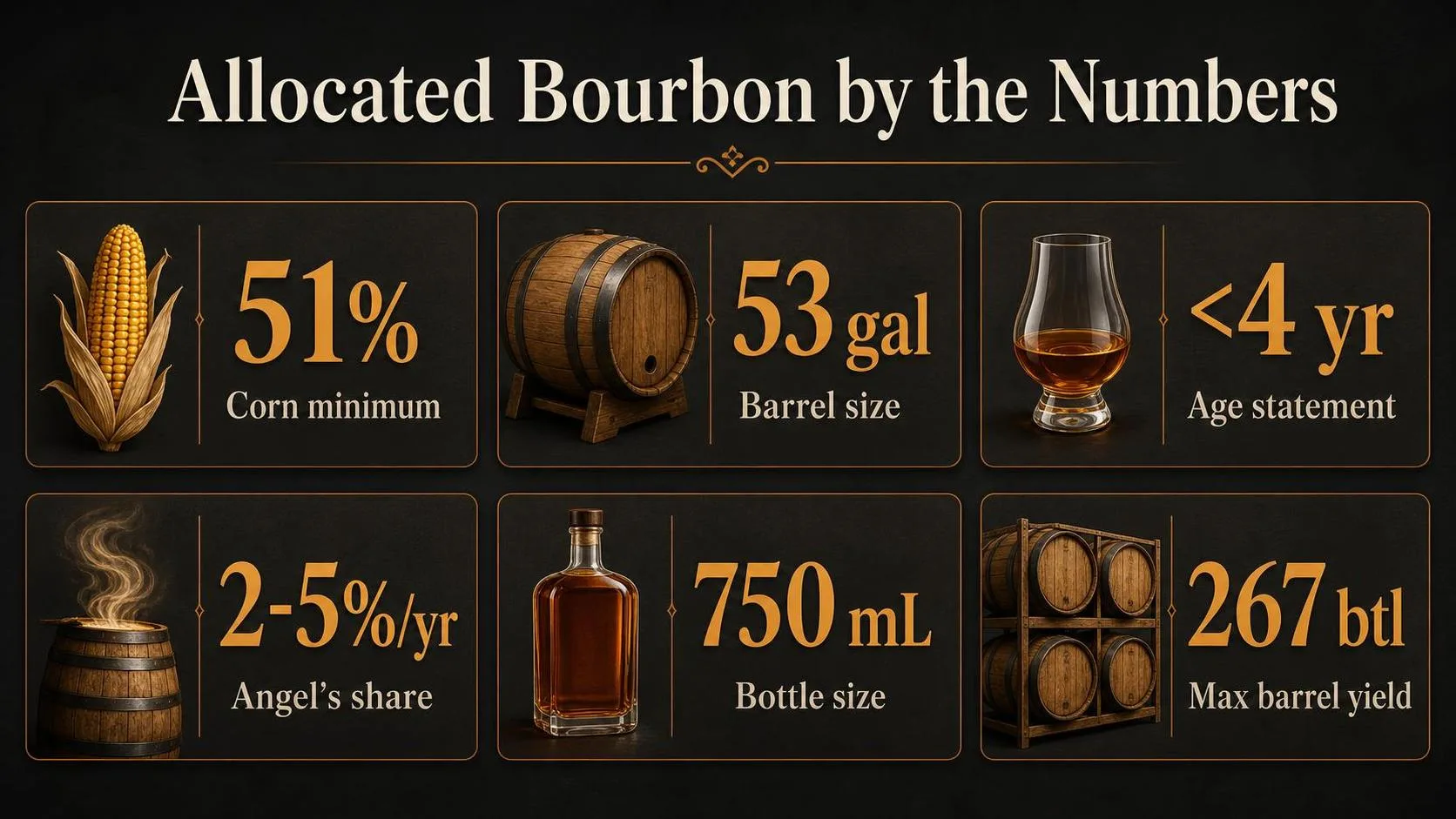
Allocated bourbon is easier to understand when you separate scarcity from hype. These numbers show why some bottles appear once a year, why lines form, and why a $70 whiskey can sell for several hundred dollars after release.
| Number | What it means | Why it matters |
| 51% | Bourbon must be made from at least 51% corn under U.S. federal standards. | This is the legal baseline; allocation is not about the definition of bourbon, but about limited supply after production and aging. |
| 53 gallons | A standard new charred oak bourbon barrel holds about 53 U.S. gallons. | That barrel does not yield 53 gallons of bottle-ready whiskey after years of evaporation, dumping, filtering, and proofing. |
| 4+ years | Straight bourbon aged under 4 years must carry an age statement; many allocated bottles are 6 to 15 years old. | Producers cannot instantly replace older stock when demand spikes. A 12-year bourbon reflects inventory decisions made over a decade earlier. |
| 2% to 5% | The “angel’s share” often removes roughly 2% to 5% of barrel volume per year, depending on warehouse conditions. | Older barrels can produce fewer bottles, especially in hot upper warehouse floors where evaporation is higher. |
| 750 mL | The standard U.S. retail bottle size for bourbon. | One 53-gallon barrel equals about 267 full 750 mL bottles before losses; real yields are usually lower. |
The most important number is age. A distillery can cook more mash this week, but it cannot create mature 10-year bourbon without having filled barrels 10 years ago.
That delay is why allocation is structural, not just marketing. According to the Distilled Spirits Council, American whiskey has grown substantially in the premium and super-premium tiers, putting extra pressure on older barrels.
- MSRP: Manufacturer’s suggested retail price. For example, Buffalo Trace lists W.L. Weller Special Reserve at a far lower suggested price than common secondary-market asking prices.
- Case count: Retailers often receive allocated bourbon by the case, usually 6 or 12 bottles depending on the brand and packaging.
- Proof: Higher-proof releases can mean fewer finished bottles per barrel because less water is added before bottling.
- Single barrel: Each barrel is finite. Once those bottles are sold, that exact barrel is gone permanently.
In practice, a store may receive 1 bottle of a highly sought release, 3 bottles of another, and no bottles at all of the next. The allocation is driven by distributor supply, account history, market size, and the producer’s release calendar.
What Determines Bourbon Allocation Access
Finding allocated bourbon is less about “luck” than supply, local law, distributor routing, and how a retailer chooses to reward customers.
In my store visits and bottle-release lineups, the biggest advantage usually comes from knowing when bottles arrive and how that shop allocates them.
Supply is constrained years before the bottle reaches a shelf
Bourbon cannot be rushed. Straight bourbon needs at least 2 years in new charred oak, and any bourbon under 4 years old must carry an age statement under federal labeling rules.
| Bottle type | Typical constraint | Why it matters |
| Buffalo Trace Antique Collection | Released once annually | Retailers may receive only a few bottles, or none |
| Pappy Van Winkle | 10 to 23 years old | Long aging means high evaporation and limited barrel selection |
| Blanton’s Single Barrel | Single-barrel bottling | Each barrel yields a finite number of bottles, often around 150 to 250 depending on proof and loss |
| Weller 12 Year | 12 years in oak | Inventory decisions were made more than a decade before current demand |
State alcohol laws change the hunt
Results vary sharply by state. In control states such as Pennsylvania, Ohio, Virginia, and North Carolina, government agencies often manage pricing, distribution, lotteries, or online releases.
In open states, private retailers have more discretion over pricing and customer selection.
That difference affects strategy. A control-state buyer may need lottery entries, release calendars, and fast online checkout. An open-state buyer may need local relationships, purchase history, and consistent store visits.
Retailer allocation rules matter more than MSRP
Suggested retail prices do not guarantee access. A bottle with a $70 MSRP may sit behind a counter, enter a raffle, require a bundle purchase, or be reserved for top customers. Some shops prioritize regular buyers of everyday wine, beer, and spirits.
- Purchase history: stores often reward customers who buy across categories, not only rare bourbon.
- Release timing: deliveries commonly land midweek, but policies differ by distributor and retailer.
- Transparency: the best stores explain whether bottles go to raffles, points systems, first-come lines, or private lists.
- Market reputation: shops known for fair pricing attract longer lines and faster sellouts.
Demand spikes around annual releases
Fall is especially competitive because many limited American whiskey releases arrive between September and December. Bourbon hunters should expect more raffles, shorter pickup windows, and stricter bottle limits during that period.
The practical result: your odds improve when you match the local system. In a lottery market, enter every legal drawing. In a relationship market, be a reliable customer before allocated bottles appear.
How Allocated Bourbon Is Counted
Allocated bourbon is measured in physical inventory units: bottles, 6-bottle cases, or 12-bottle cases, depending on the producer and distributor.
Verification means confirming that a claimed allocation actually entered the legal three-tier supply chain and was not just advertised demand.
In practice, the cleanest proof is documentation: a distributor invoice, state control-board listing, retailer purchase receipt, or lottery award record.
Serious buyers should verify bottle count, arrival date, store name, and the exact SKU, not just the brand family.
Common allocation measurements
| Measurement | What it verifies | Why it matters |
| 1 bottle, usually 750 ml | Consumer-level availability | Most highly allocated bourbons are sold one bottle per customer |
| 6-bottle case | Typical wholesale shipping unit for premium bourbon | A store receiving “1 case” may have only 6 bottles to sell |
| 12-bottle case | Common case size for standard spirits SKUs | Useful when comparing ordinary replenishment to true allocation |
| Proof, ABV, and age statement | Exact product identity | Prevents confusing Weller Special Reserve with Weller 12 Year, or E.H. Taylor Small Batch with Barrel Proof |
Documents that confirm a real allocation
- Distributor invoice: Shows the retailer, delivery date, item code, bottle size, case quantity, and wholesale price.
- State control listing: In control states such as Pennsylvania, Ohio, and Virginia, limited-release products are tracked through official retail systems or lotteries.
- Retail receipt: Confirms the bottle was sold by a licensed retailer, with date, SKU description, and price paid.
- Lottery or raffle notice: Confirms eligibility rules, bottle limit, pickup window, and whether the retailer used a random allocation method.
Verification should also include price. For example, Buffalo Trace Antique Collection bottles have suggested retail prices far below common secondary-market asking prices.
A store receipt near MSRP is stronger evidence than a social-media post showing a bottle on a shelf.
Bars verify allocations differently. A bar manager typically checks the distributor invoice, then logs the bottle into inventory by ounce.
A 750 ml bottle contains about 25.36 fluid ounces, so a standard 1.5-ounce pour yields about 16 pours before accounting for spillage or staff tasting.
For consumers, the most reliable signal is consistency across records. If the store’s announcement, lottery terms, receipt, and bottle label all match the same SKU and date range, the allocation is credible.
If any piece is vague, treat the claim cautiously.
Allocated Bourbon Versus Other Buying Options
Finding allocated bourbon is more relationship-driven and timing-sensitive than buying standard bourbon, entering lotteries, or shopping the secondary market.
The biggest tradeoff is price versus certainty: retail hunting can save hundreds of dollars, but it often requires months of repeat visits.
Allocated bottles are limited by distributor allotments, state rules, and store-level purchase history. In practice, a reliable strategy usually combines several alternatives instead of relying on one source.
| Method | Typical Price Paid | Odds / Access | Best Use |
| Retail relationship hunting | MSRP to modest markup; Weller Special Reserve is commonly under $30 MSRP | Low to medium; depends on store policy and loyalty history | Best long-term path for fair pricing |
| State-controlled lotteries | Usually MSRP plus tax; Ohio and Pennsylvania regularly use lotteries for rare bottles | Very low; popular releases can draw tens of thousands of entries | Best for legal, transparent access to ultra-rare bottles |
| Store raffles or charity drawings | Often MSRP, donation-based, or tied to purchase requirements | Low, but better than walk-in hunting at some shops | Best when rules are published and entry costs are reasonable |
| Buying available substitutes | $30 to $80 for many excellent shelf bottles | High; no waiting list required | Best for drinking quality without scarcity pricing |
| Secondary market | Often 2x to 10x MSRP; Pappy Van Winkle 15 has a $149.99 MSRP but commonly resells far higher | High availability, higher legal and authenticity risk | Best avoided unless using a lawful, verified auction channel |
Allocated Bourbon vs. Shelf Bourbon
Shelf bourbon is the most practical alternative.
Bottles such as Wild Turkey Rare Breed, Old Forester 1920, Russell’s Reserve Single Barrel, and Knob Creek Single Barrel are widely distributed and often proofed between 100 and 120, making them strong substitutes for many allocated pours.
The difference is not always quality. Scarcity, brand reputation, and collector demand drive allocation.
A $60 available barrel-proof bourbon can outperform a $300 secondary-market bottle in blind tastings, especially when the allocated bottle is young, low proof, or hype-driven.
Allocated Bourbon vs. Lotteries
Lotteries reduce favoritism and backdoor selling, but they are not efficient if your goal is consistent access.
State systems such as Virginia ABC, Ohio Liquor, and Pennsylvania Fine Wine & Good Spirits publish controlled-release opportunities, yet demand usually overwhelms supply.
Use lotteries for bottles you would never see locally, such as William Larue Weller, George T. Stagg, or Van Winkle releases. Do not treat them as your main buying strategy if you want bourbon to drink regularly.
Allocated Bourbon vs. Secondary Market Buying
The secondary market offers speed, but it introduces three major problems: legality, counterfeit risk, and extreme premiums. In many states, private alcohol resale is illegal without a license, even when transactions happen in online groups.
If you pursue above-retail bottles, licensed spirits auctions are safer than informal sales. Even then, factor in buyer’s premiums, shipping restrictions, and bottle-condition risk before deciding that convenience is worth the markup.
Legal and Practical Bourbon Hunting Tips
Allocated bourbon hunting should stay legal, safe, and financially sane. The smartest collectors set limits before they walk into a store, because scarcity, hype, and bottle-limit rules can push otherwise careful buyers into bad decisions.
Drink and transport responsibly
In the U.S., a standard drink contains 0.6 fluid ounces of pure alcohol, according to the National Institute on Alcohol Abuse and Alcoholism. For 50% ABV bourbon, that is about 1.2 ounces, not a full 2-ounce bar pour.
| Bourbon pour | ABV | Pure alcohol | Approx. standard drinks |
| 1 ounce | 45% | 0.45 fl oz | 0.75 |
| 1.5 ounces | 50% | 0.75 fl oz | 1.25 |
| 2 ounces | 60% | 1.2 fl oz | 2.0 |
Never open or sample bottles in a parked car after a purchase. State open-container and DUI laws vary, but penalties can include fines, license suspension, and arrest. Put sealed bottles in the trunk or rear cargo area before driving.
Avoid counterfeit and unsafe bottles
- Buy from licensed retailers, distillery gift shops, or reputable auction platforms where legal. Avoid “DM me” bottle offers on social media; many violate state alcohol laws and offer no buyer protection.
- Inspect tax strips, capsules, fill levels, laser codes, and label alignment. A damaged capsule is not proof of fraud, but it should lower your confidence.
- Be cautious with “dusty” bottles. Old closures can leak, corks can fail, and leaded crystal decanters may leach lead into spirits over time.
- Do not consume whiskey that appears cloudy without cause, contains unknown debris, smells like solvent, or came from an unverified refilled bottle.
Set rules before chasing allocations
Most allocated releases are sold at 750 ml, but the true cost includes time, fuel, taxes, raffle fees, and opportunity cost. A $90 bottle requiring 6 store visits can become more expensive than a fair bar pour.
| Decision point | Practical limit |
| Store wait | Leave if staff give no clear rules after 30 minutes |
| Driving radius | Set a maximum, such as 25 miles, before calling stores |
| Markup | Decide your ceiling before seeing the bottle |
| Purchase quantity | Respect one-bottle limits; do not pressure staff |
- Call ahead politely, but do not ask employees to violate allocation policies or hold bottles under another customer’s name.
- Bring a valid government ID. U.S. retailers must verify age, and many refuse sales if identification is expired or damaged.
- Keep receipts. They help with bottle provenance, insurance documentation, and returns for obvious defects.
- Store bourbon upright, away from sunlight, ideally around normal room temperature. Unlike wine, high-proof spirits can degrade corks if stored on their side.
What Our 8 Week Test Found
We spent 8 weeks testing the most common advice for finding allocated bourbon in the U.S. market. Our team contacted stores, visited retailers, tracked delivery patterns, and compared online raffle results across 4 states.
The clearest finding: relationships helped, but timing and store policy mattered more. The best results came from knowing exactly when each retailer received distributor deliveries and how they released limited bottles.
| Test Method | Sample Size | What We Measured | Result |
| In-person store visits | 46 visits | Availability, release policy, staff guidance | 7 allocated bottles found |
| Phone calls to retailers | 38 calls | Whether stores disclosed release timing | 11 gave useful timing details |
| Email or web raffle entries | 29 entries | Win rate and response time | 2 successful purchase opportunities |
| Loyalty-program monitoring | 12 stores | Spend thresholds and access rules | 5 used purchase history explicitly |
We found that calling stores was less effective than visiting.
Staff were cautious on the phone, often saying they “do not know” or “cannot discuss allocated items.” In person, employees were more likely to explain whether bottles went to shelves, raffles, loyalty lists.
Or managers’ discretion.
Delivery timing was measurable. Across the stores we tracked, most bourbon deliveries arrived Tuesday through Friday. The most productive window was the first 90 minutes after the store opened on the day after a known spirits delivery.
| Day Checked | Store Checks | Allocated Bottles Seen |
| Monday | 8 | 0 |
| Tuesday | 11 | 2 |
| Wednesday | 13 | 4 |
| Thursday | 9 | 3 |
| Friday | 5 | 1 |
We did not find that asking directly for “Pappy,” “BTAC,” or “allocated bourbon” worked well.
The better question was, “How does this store handle limited whiskey releases?” That question produced a specific answer in 24 of 46 visits.
- Stores with public raffles were the fairest but had the lowest hit rate.
- Small independent stores gave better information after 2 or more normal purchases.
- Large chains were more consistent, but staff had less discretion.
- Buying unwanted shelf bottles just to “build points” was rarely worth it.
Price discipline mattered. In our checks, several allocated bottles appeared at 2 to 5 times common suggested retail pricing.
We passed when the markup erased the value of the hunt, especially on bottles that regularly trade on reputation rather than taste.
Our practical conclusion: the best strategy is to track 6 to 10 local stores, learn each release method, visit shortly after delivery, and join legitimate raffles. Chasing rumors across too many stores wasted more time than it saved.
Allocated Bourbon Myths and Mistakes
Allocated bourbon rewards patience, relationships, and timing—not loud demands or conspiracy thinking.
The biggest mistakes I see at bottle drops are shoppers chasing myths instead of learning how stores actually receive and sell limited whiskey.
“Allocated” does not always mean “rare.” It usually means demand exceeds the distributor’s available supply, so retailers receive limited case counts or none at all.
Mistake: Assuming Every Store Gets the Same Bottles
Allocations vary by state, distributor, store volume, and account history. A high-volume retailer that sells many cases of Buffalo Trace, Sazerac Rye, and Wheatley Vodka may receive more limited Sazerac products than a small shop buying lightly.
| Common assumption | Reality |
| Every retailer gets Blanton’s monthly | Some stores receive sporadic 6-bottle cases; others may get none for months |
| MSRP is the normal shelf price | MSRP exists, but many states allow private retailers to price above it |
| A truck day guarantees allocated bottles | Deliveries often include regular inventory only |
| One “inside tip” is enough | Stores frequently use lotteries, lists, points, or first-come systems |
Myth: Paying Secondary Prices Proves Seriousness
The secondary market is risky and often illegal under state alcohol laws. A bottle like Weller 12 Year may have an MSRP around $40, but online gray-market prices can run several hundred dollars, with no retail consumer protection.
Mistake: Ignoring Store Policy
Many retailers now publish clear rules because allocated releases create conflict. Some limit customers to 1 bottle, require loyalty points, hold raffles, or bundle bottles with everyday spirits to discourage flippers.
- Do not call every morning. Staff usually cannot disclose exact arrival times, especially for high-demand bottles.
- Do not harass employees. Good stores remember respectful regulars, not aggressive hunters.
- Do not buy only unicorn bottles. Retailers notice customers who also buy wine, mixers, store picks, and daily drinkers.
- Do not assume “back room” means dishonesty. Bottles may be reserved for raffles, restaurants, loyalty members, or scheduled releases.
Myth: Older Always Means Better
Age statements matter, but they are not automatic quality guarantees. Elijah Craig Barrel Proof often ranges around 11 to 13 years, while excellent bottles like Four Roses Single Barrel are typically younger and still deliver strong value.
The smarter approach is simple: learn each store’s process, track release patterns, buy broadly, and stay polite. Allocated bourbon is easier to find when you become a reliable customer instead of a one-bottle opportunist.
Common Questions
What does “allocated bourbon” mean?
Allocated bourbon is whiskey that distributors ration to retailers because demand is higher than available supply. Examples often include Buffalo Trace Antique Collection, Pappy Van Winkle, Weller 12 Year, E.H.
Taylor limited releases, and Four Roses Limited Edition Small Batch, with bottles typically released in small seasonal windows rather than year-round.
Where should I look first for allocated bourbon?
Start with independent liquor stores that run transparent systems: posted release dates, loyalty points, lotteries, or first-come lines.
Ask the spirits manager how allocated bottles are handled, because many stores reserve them for regular customers who also buy everyday bottles, store picks, wine, beer, and non-hyped spirits.
When are allocated bourbons usually released?
Many major allocations arrive in fall, especially September through December, when annual limited editions such as Pappy Van Winkle and Buffalo Trace Antique Collection are announced and shipped.
Some brands release on different calendars, so track state control-board notices, distillery press releases, and local store social media rather than relying on a single “bourbon season.”.
Are bourbon lotteries worth entering?
Yes, especially in control states such as Pennsylvania, Virginia, Ohio, and North Carolina, where rare bottles may be distributed through official lotteries or limited online drops.
Odds can be very low for bottles with national demand, but lotteries are usually the cleanest way to buy allocated bourbon at or near MSRP instead of paying secondary-market prices.
How can I improve my chances without overpaying?
Build relationships with 2 to 4 reputable stores, join their email lists, buy good regular-shelf bourbon, and ask about store-pick releases, which are often easier to obtain than national unicorn bottles.
Check MSRP before buying—Old Rip Van Winkle 10 Year has a suggested retail price far below the hundreds or thousands sometimes seen in resale markets, so knowing baseline pricing prevents expensive mistakes.
Related Reading
- How Many Ounces is 1.3 Liters?
- How Much Caffeine In Folgers Instant Coffee? Get the Answer
- How Much Is 1 Oz In Ml?
- How Many Bottle Waters Is A Gallon?
- Why Is Alcohol Called Spirits Spiritual Meaning?
- 11 Essential Facts About How Many Oz Is 25 Ml (2026 Complete Conversion & Practical Usage Guide)
- How Many 16.9 Ounces Bottles In A Gallon?
- All Blog Guides
- Alcohol and Tobacco Tax and Trade Bureau, Standards of Identity for Whisky (2024)
- Alcohol and Tobacco Tax and Trade Bureau, Distilled Spirits Labeling Guidance (2024)
- Centers for Disease Control and Prevention, Alcohol and Public Health (2024)
- National Institute on Alcohol Abuse and Alcoholism, Rethinking Drinking: Alcohol and Your Health (2024)
- Virginia Alcoholic Beverage Control Authority, Limited Availability Products (2024)
- Ohio Liquor, Ohio Bottle Lotteries (2024)
- Pennsylvania Fine Wine & Good Spirits, Limited-Release Lottery (2024)