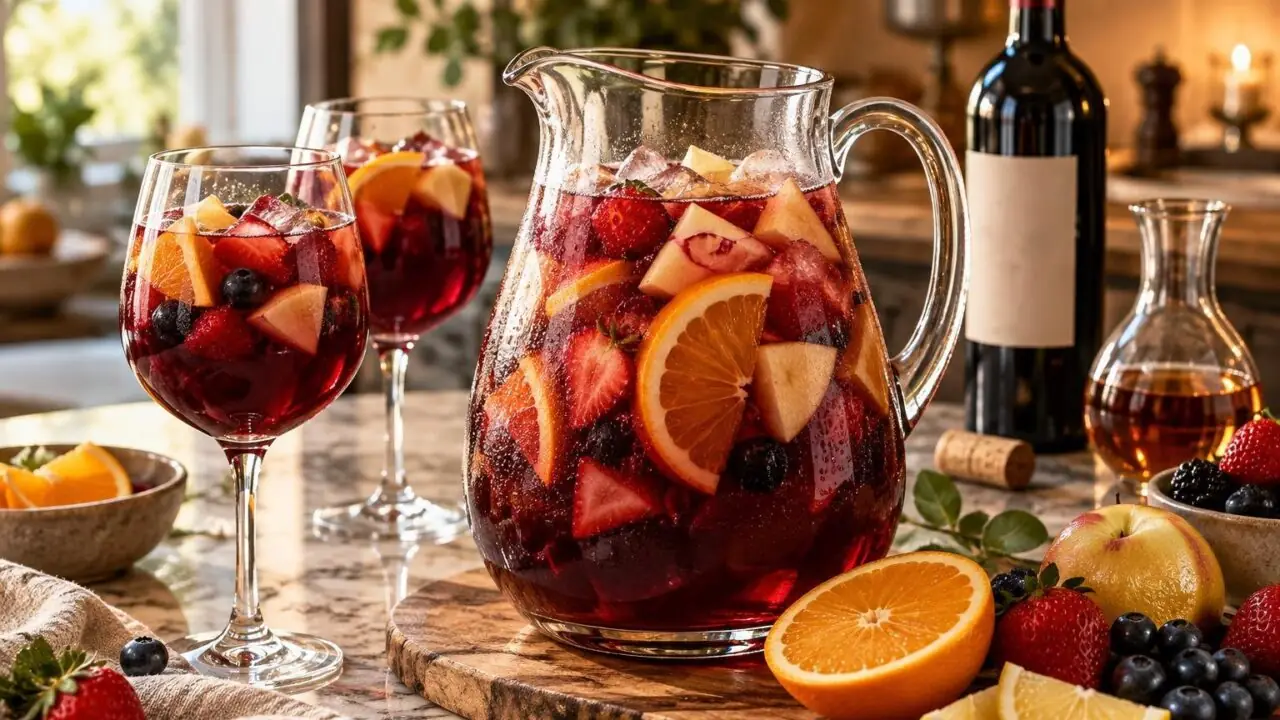
The alcohol content in sangria is typically 5–12% alcohol by volume (ABV), depending on the wine, added spirits, and dilution. A pitcher made with juice and sparkling water can be considerably weaker than one fortified with brandy.
Sweetness alone does not reliably indicate its strength.
For example, mixing 750 milliliters of wine at 12% ABV with 750 milliliters of nonalcoholic ingredients produces approximately 6% ABV before ice melts.
This guide explains how ingredients change sangria’s strength, how to estimate your recipe’s ABV, and why serving size matters when comparing glasses and tracking alcohol intake.
How Much Alcohol Is in Sangria
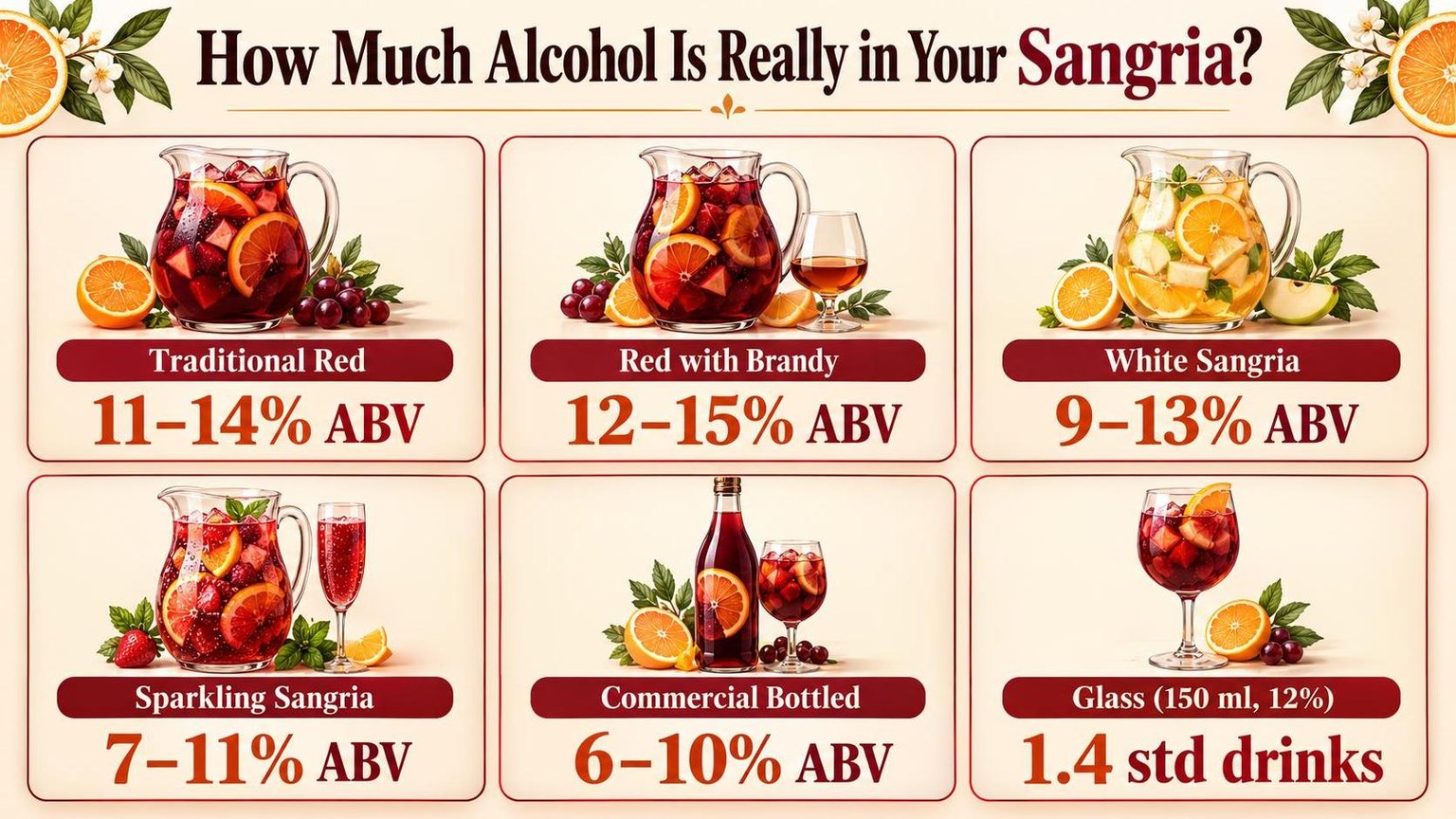
Sangria typically contains between 8% and 14% alcohol by volume (ABV), depending on the base wine, added spirits, and how much fruit juice or soda dilutes the mix. A standard homemade pitcher averages around 10–12% ABV before dilution with ice.
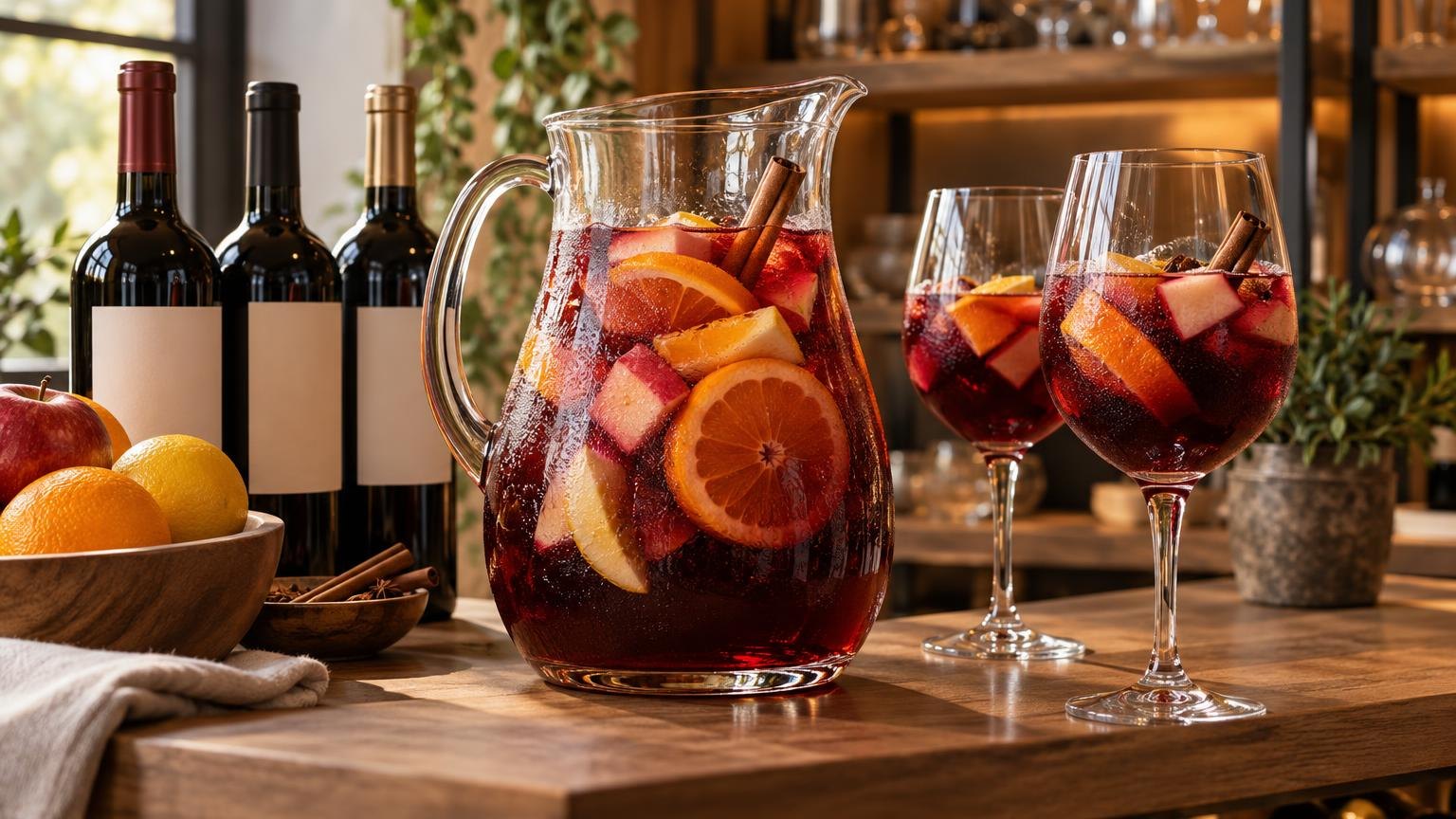
ABV Breakdown by Sangria Type
The alcohol content shifts significantly based on the recipe style and whether spirits are added. Here is how common variations compare.
| Sangria Type | Typical ABV Range | Key Factor |
| Traditional red (wine only) | 11–14% | No added spirits; ABV mirrors the base wine |
| Red with brandy | 12–15% | 30–60 ml brandy (40% ABV) per 750 ml bottle |
| White sangria (sangría blanca) | 9–13% | Lighter wines; often more juice or soda added |
| Sparkling sangria | 7–11% | Cava or Prosecco base plus significant mixer volume |
| Commercial bottled sangria | 6–10% | Produced at lower ABV for mass-market appeal |
What Determines the Final ABV
Base wine is the single largest factor. A Spanish Garnacha at 14.5% ABV produces a stronger sangria than a Vinho Verde at 9.5% ABV. The choice of red versus white matters less than the specific grape and region.
Added spirits raise the number. A typical recipe calls for 60 ml of brandy or triple sec per bottle. That 40% ABV addition increases the pitcher’s overall strength by roughly 1.5–2 percentage points.
Dilution lowers it. Orange juice, lemonade, ginger ale, or club soda each contribute non-alcoholic volume. A recipe using 250 ml of mixer per 750 ml bottle can reduce ABV by 25–30% from the starting wine strength.
Calorie and Standard Drink Reference
- One 150 ml glass of homemade sangria at 12% ABV contains approximately 1.4 standard US drinks (one standard drink = 14 g pure alcohol).
- That same glass delivers roughly 130–180 calories, depending on added sugar and fruit syrup.
- Bottled commercial brands like Eppa or Lolea typically clock in at 7–8% ABV and around 110–130 calories per 150 ml serving.
Sangria’s fruit and sweetness can mask its strength. Tracking your pour size against ABV keeps intake predictable, especially with spirit-fortified batches.
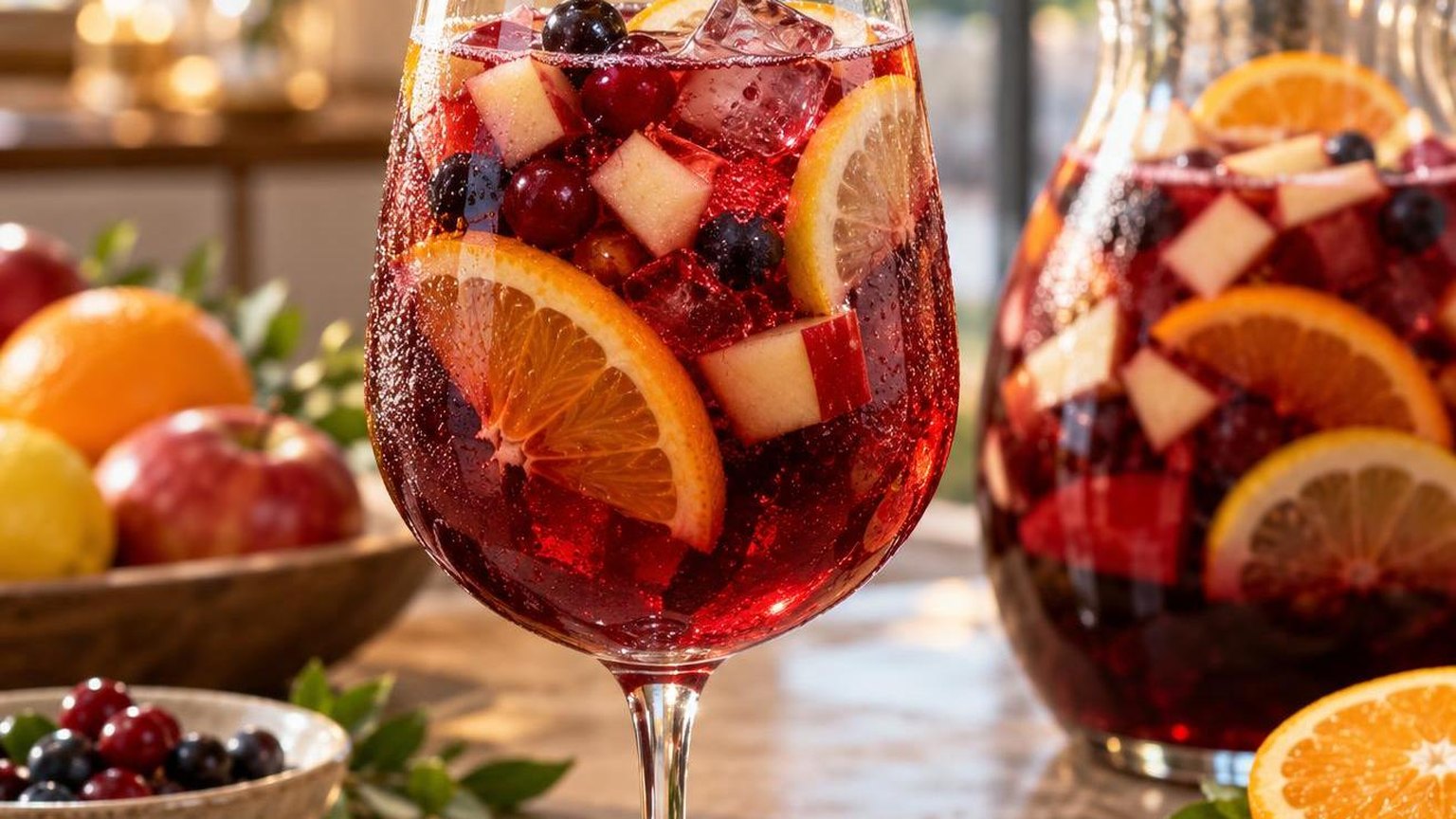
Homemade Versus Bottled Sangria Alcohol Content
Homemade and bottled sangria differ significantly in alcohol content due to ingredients, dilution, and regulatory standards. Understanding these differences helps you gauge how much you’re actually consuming per glass.
Bottled Sangria: Standardized ABV
Commercial bottled sangria in the United States typically ranges from 6% to 10% ABV. Spanish regulations require traditional sangria to contain between 4.5% and 12% ABV under EU wine product rules established in Regulation (EU) No 251/2014.
| Sangria Type | Typical ABV Range | Standard Serving (5 oz) |
| Bottled sangria (US market) | 6%–10% | 0.5–0.8 standard drinks |
| Homemade with wine only | 8%–11% | 0.7–0.9 standard drinks |
| Homemade with added spirits | 12%–16% | 1.0–1.3 standard drinks |
| Homemade with juice and fruit dilution | 5%–8% | 0.4–0.7 standard drinks |
Homemade Sangria: Variable by Recipe
A standard 750 mL bottle of red wine at 13.5% ABV forms the base of most homemade recipes. Adding 2–3 oz of brandy (40% ABV) raises the total alcohol concentration measurably before any dilution occurs.
Fruit juice, sliced fruit, sweetener, and ice dilute the final ABV. A typical batch yielding roughly 40 oz of sangria from one bottle of wine plus 3 oz of brandy and 8 oz of juice lands near 12%–14% ABV.
Recipes omitting spirits and adding sparkling water or soda can drop below 7% ABV. This makes them comparable to many commercial bottled options on store shelves.
Why the Gap Matters
- Calorie impact: A 5 oz pour of 14% homemade sangria contains approximately 130–150 calories versus 90–110 calories for a 7% bottled version.
- Pacing risk: Fruit and sweetness mask alcohol perception, making spirit-fortified homemade sangria deceptively strong.
- Consistency: Bottled sangria delivers a predictable ABV printed on the label; homemade batches vary with every preparation.
Measuring ingredients by volume and calculating total alcohol against total liquid volume gives you a reliable ABV estimate for any homemade batch.
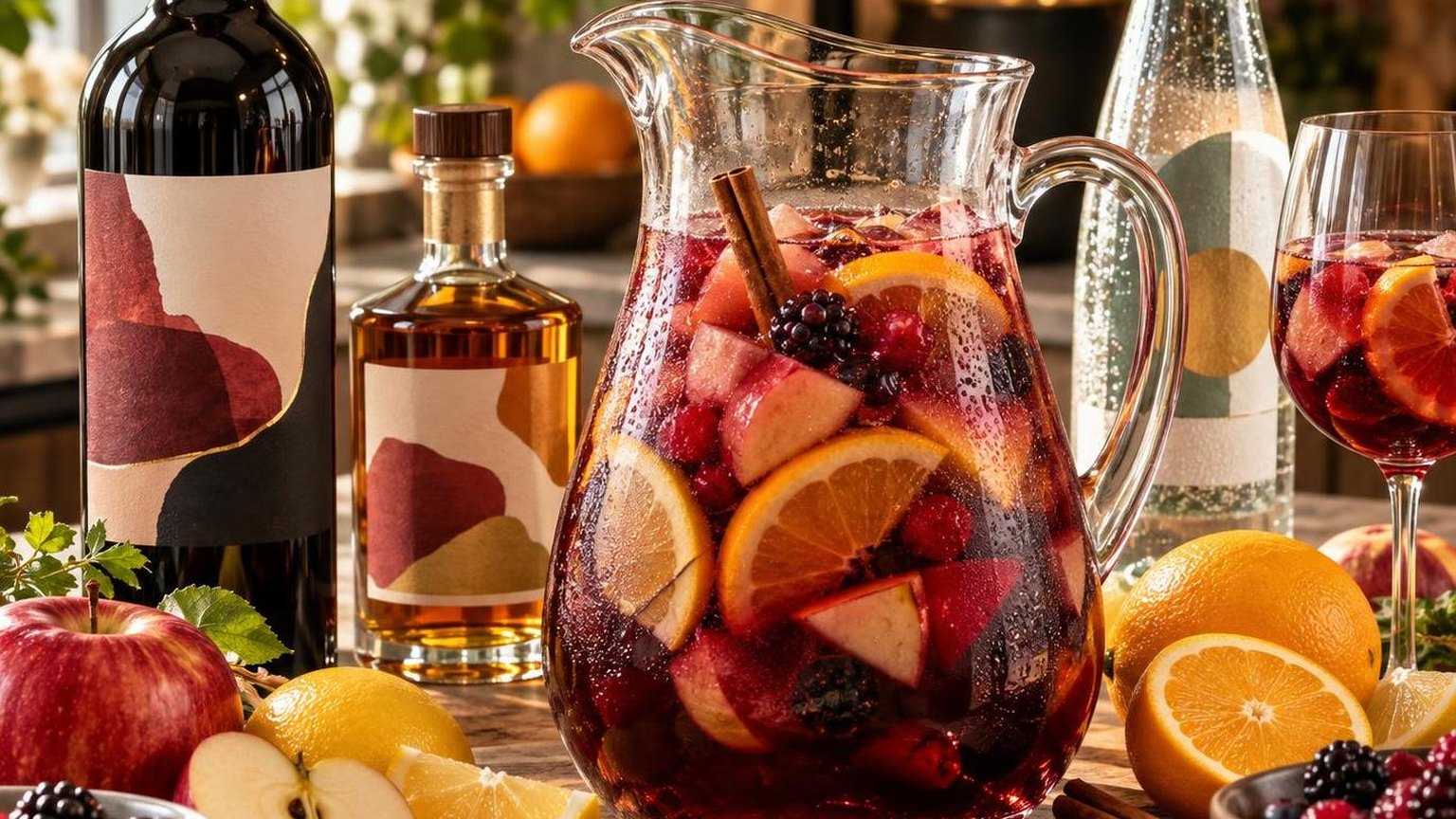
How Wine ABV Shapes Sangria Strength
The base wine accounts for roughly 75% of a traditional sangria’s volume, making its ABV the single biggest driver of final alcohol content.
Choosing a 11% ABV Vinho Verde versus a 15% Zinfandel shifts the finished drink’s strength by approximately 2–3 percentage points.
Common Base Wine ABV Ranges
| Wine Type | Typical ABV | Estimated Sangria ABV (after dilution) |
| Vinho Verde | 9–11% | 5–7% |
| Pinot Grigio | 11.5–13% | 7–8% |
| Spanish Tempranillo (Rioja Joven) | 13–14% | 8–9% |
| Garnacha | 13.5–15% | 8.5–10% |
| California Zinfandel | 14–15.5% | 9–11% |
Estimates assume a standard recipe: 750 mL wine, 120 mL brandy (40% ABV), 240 mL juice, and 120 mL soda water with ice melt factored in.
Why the Math Matters
A 750 mL bottle at 14% ABV contains approximately 105 mL of pure ethanol. The same bottle at 11% holds about 82.5 mL. That 22.5 mL difference equals roughly 1.5 standard U.S. drinks spread across the pitcher.
- Lower-ABV wines (9–12%) produce sangrias that stay near light-beer territory, around 5–7% ABV.
- Mid-range wines (12.5–14%) land the drink between a strong beer and a light cocktail, roughly 7–9%.
- High-ABV wines (14–15.5%) push sangria above 9%, approaching the potency of a standard mixed drink.
Practical Selection Tips
Spanish Garnacha and Tempranillo are traditional choices that balance body with moderate alcohol. They keep sangria flavorful without excessive strength.
Avoid fortified wines like Sherry (15–22% ABV) as your primary base. Reserve them for a measured splash — 30 mL or less — if you want oxidative complexity without spiking the ABV past safe sipping range.
Always check the label. Within a single grape variety, ABV can swing 2–3 points depending on region and vintage. A warm-climate Tempranillo from Jumilla may hit 14.5%, while one from Rioja Alta sits closer to 13%.
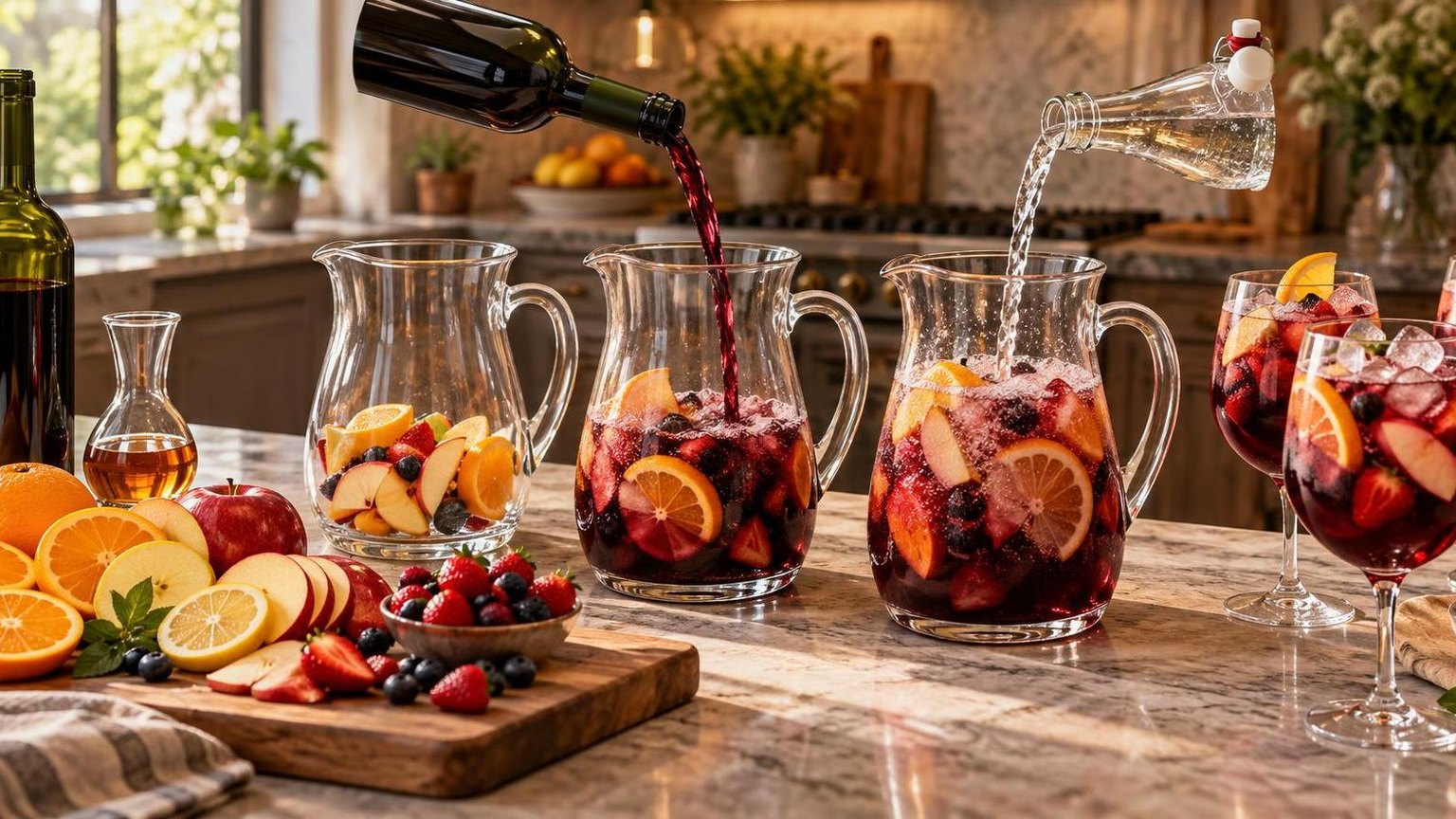
How Brandy and Liqueurs Increase Alcohol
Brandy and liqueurs are the primary drivers that push sangria’s ABV above that of wine alone. A standard sangria recipe calling for 60–120 ml of brandy can raise the final drink’s alcohol content by 2–4 percentage points.
Typical ABV of Common Sangria Additions
| Spirit/Liqueur | Typical ABV | Common Pour per Pitcher |
| Spanish brandy (e.g., Torres 10) | 38–40% | 60–120 ml |
| Triple sec (e.g., Cointreau) | 40% | 30–60 ml |
| Grand Marnier | 40% | 30–60 ml |
| Peach schnapps | 20–24% | 30–60 ml |
| Amaretto | 24–28% | 30–45 ml |
| St-Germain (elderflower) | 20% | 30–60 ml |
The Math Behind the ABV Increase
A standard pitcher holds roughly 1.5 liters. One 750 ml bottle of 13.5% ABV red wine contributes about 101 ml of pure alcohol. Adding 90 ml of 40% brandy introduces another 36 ml of pure alcohol.
Combined pure alcohol totals approximately 137 ml. Diluted across a 1.5-liter pitcher (including juice and fruit), the resulting ABV lands near 9–11%, compared to 6–8% without spirits.
How Multiple Liqueurs Stack Up
Many modern recipes call for both brandy and a liqueur. This double addition compounds the alcohol effect significantly.
- Wine only + juice + fruit: yields roughly 6–8% ABV per pitcher
- Wine + 90 ml brandy: pushes ABV to approximately 9–11%
- Wine + 90 ml brandy + 60 ml triple sec: reaches 11–13% ABV
- Wine + 90 ml brandy + 60 ml triple sec + 60 ml Grand Marnier: can exceed 14% ABV, matching or surpassing undiluted wine
Why This Matters for Responsible Serving
Sangria’s fruit and sweetness mask alcohol perception.
Research published in Alcoholism: Clinical and Experimental Research confirms that sweet flavors reduce the subjective sensation of alcohol strength, leading drinkers to underestimate intake.
A 250 ml glass of spirit-fortified sangria at 12% ABV delivers roughly 2.4 standard drinks (at 10 ml pure alcohol per unit, EU standard). Hosts should calculate total pure alcohol per pitcher and communicate serving sizes clearly.
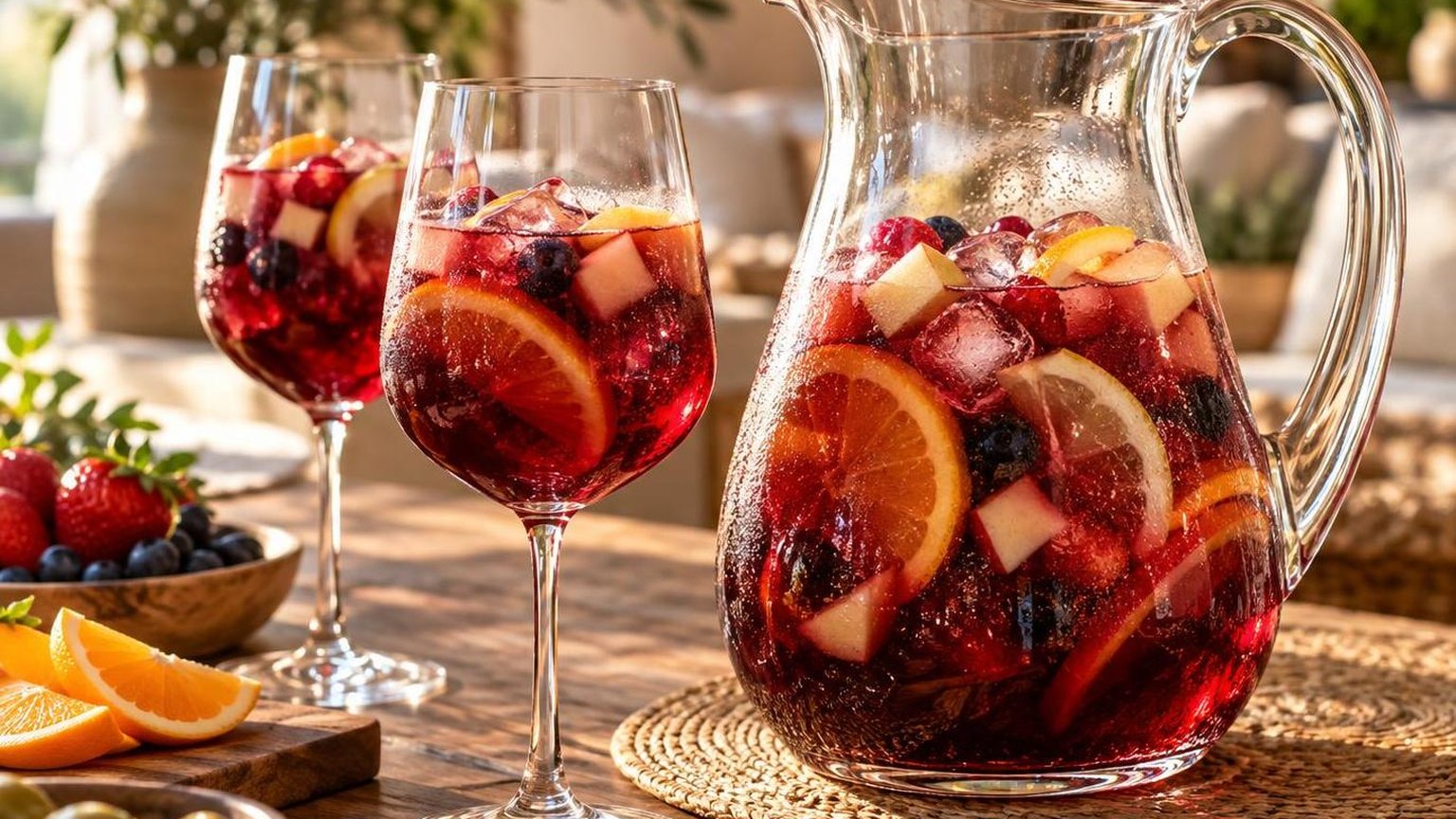
How Juice and Ice Dilute Sangria
Every non-alcoholic ingredient added to sangria lowers the overall ABV by increasing total liquid volume without contributing ethanol.
Understanding exactly how much each component dilutes the drink helps you control the final alcohol content with precision.
ABV Impact of Common Diluters
Orange juice, lemonade, and sparkling water each carry 0% ABV. Adding them to a wine base of 12–14% ABV reduces strength proportionally to volume added.
| Sangria Component | Typical Volume per Pitcher (1.5 L) | ABV Contribution |
| Red wine | 750 mL | 12–14% |
| Brandy or triple sec | 60–90 mL | 30–40% |
| Orange juice | 240 mL | 0% |
| Lemon-lime soda or lemonade | 240 mL | 0% |
| Ice (melted equivalent) | 150–200 mL | 0% |
In this standard pitcher, the total liquid volume reaches roughly 1,440–1,530 mL. The alcohol comes from approximately 810–840 mL of booze-containing ingredients, pushing the blended ABV to around 8–10%.
The Ice Factor
Ice contributes dilution in two phases. It chills the drink on contact, then melts progressively. A standard 200 g serving of ice melts into 200 mL of water over 20–30 minutes at room temperature.
A pitcher sitting out for 30 minutes can gain 150–200 mL of meltwater. That alone drops a 10% ABV sangria to roughly 8.5–9%, a reduction of 1–1.5 percentage points.
Maximizing or Minimizing Dilution
- More dilution: Use crushed ice (faster melt rate), add extra fruit juice, or top with club soda — brings ABV closer to 5–7%.
- Less dilution: Use large ice cubes (slower melt), reduce juice volume, and serve immediately — keeps ABV near 9–11%.
- Pre-chill ingredients instead of relying on ice to minimize meltwater dilution entirely.
Frozen fruit serves a dual purpose: it chills sangria like ice but releases sugar-rich juice rather than plain water, maintaining flavor intensity while still lowering ABV modestly.
Tracking the ratio of alcoholic to non-alcoholic volume remains the single most reliable method for estimating sangria’s final strength at the glass.
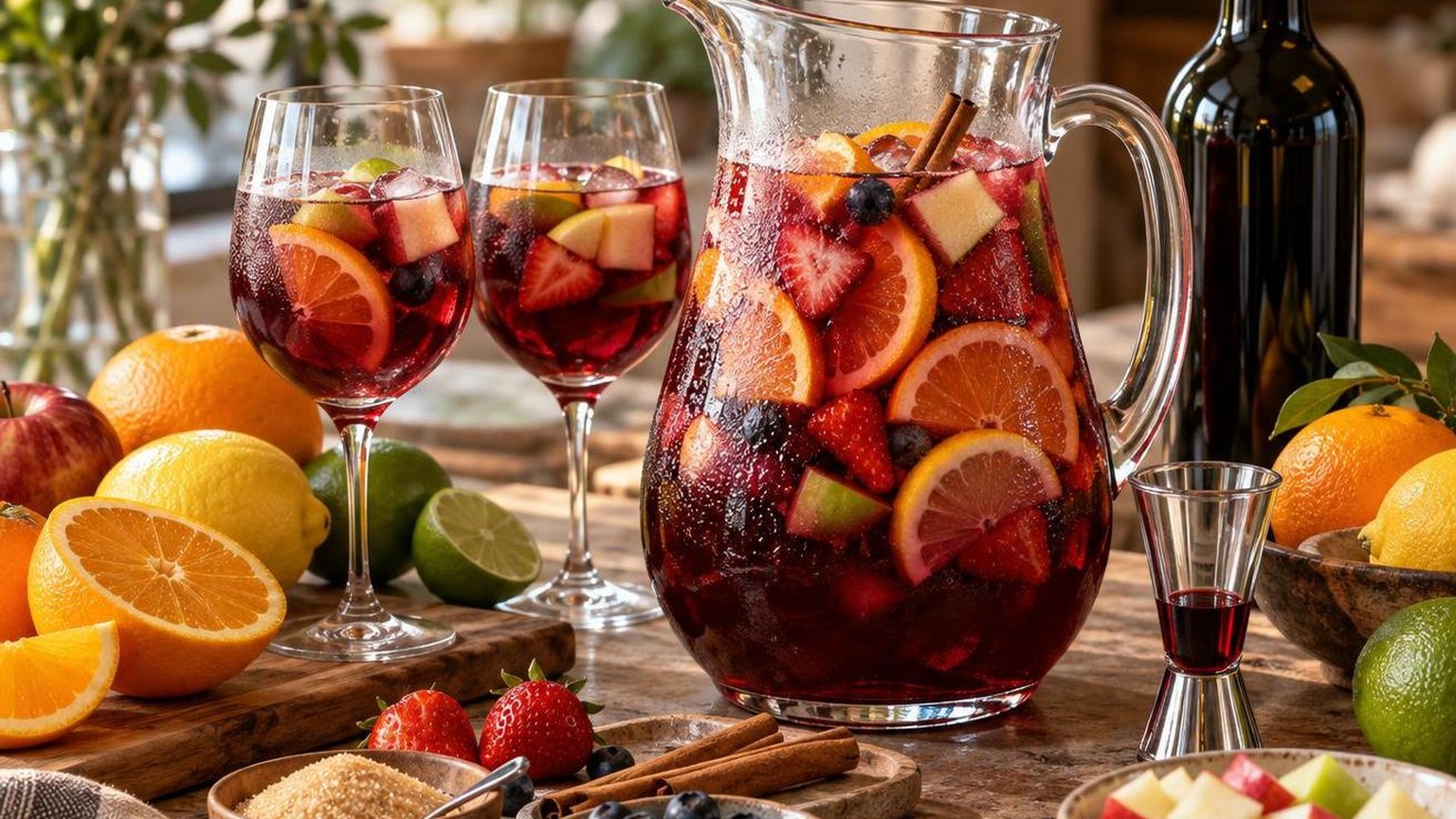
Calculating Alcohol Content in Homemade Sangria
Homemade sangria typically lands between 8% and 14% ABV depending on the base wine, added spirits, and dilution from fruit and juice.
Calculating the final ABV requires a straightforward formula that accounts for every liquid ingredient’s volume and alcohol percentage.
The Basic Formula
Multiply each ingredient’s volume (in mL) by its ABV as a decimal. Sum all alcohol volumes, divide by total liquid volume, then multiply by 100 to get the final ABV percentage.
Formula: (Sum of [Volume × ABV]) ÷ Total Volume × 100 = Final ABV%.
Sample Calculation: Classic Red Sangria
A standard recipe using 750 mL of red wine, 60 mL of brandy, 240 mL of orange juice, and 120 mL of club soda produces these values:
| Ingredient | Volume (mL) | ABV% | Alcohol (mL) |
| Red wine (Tempranillo) | 750 | 13.5% | 101.25 |
| Brandy | 60 | 40% | 24.0 |
| Orange juice | 240 | 0% | 0 |
| Club soda | 120 | 0% | 0 |
| Total | 1,170 | 125.25 |
Final ABV: 125.25 ÷ 1,170 × 100 = 10.7%. That puts this batch slightly above the average American beer (5% ABV) but below undiluted wine.
Variables That Shift the Number
- Base wine ABV: Spanish Garnacha at 15% versus a Vinho Verde at 9% creates a 6-percentage-point swing before any additions.
- Spirit quantity: Each additional 30 mL of 40% brandy raises a 1,170 mL batch by roughly 1 percentage point.
- Juice and soda ratio: Doubling the orange juice to 480 mL drops the example recipe from 10.7% to approximately 8.9% ABV.
- Ice melt: Over a 2-hour serving window, melting ice can dilute ABV by an estimated 1–2 percentage points depending on ambient temperature.
Practical Tip
A vinometer—a small glass capillary device costing $8–$15—can measure finished sangria’s alcohol content within ±1% accuracy. This tool provides a quick check when serving guests who need precise intake tracking.
Standard Drinks in a Sangria Serving
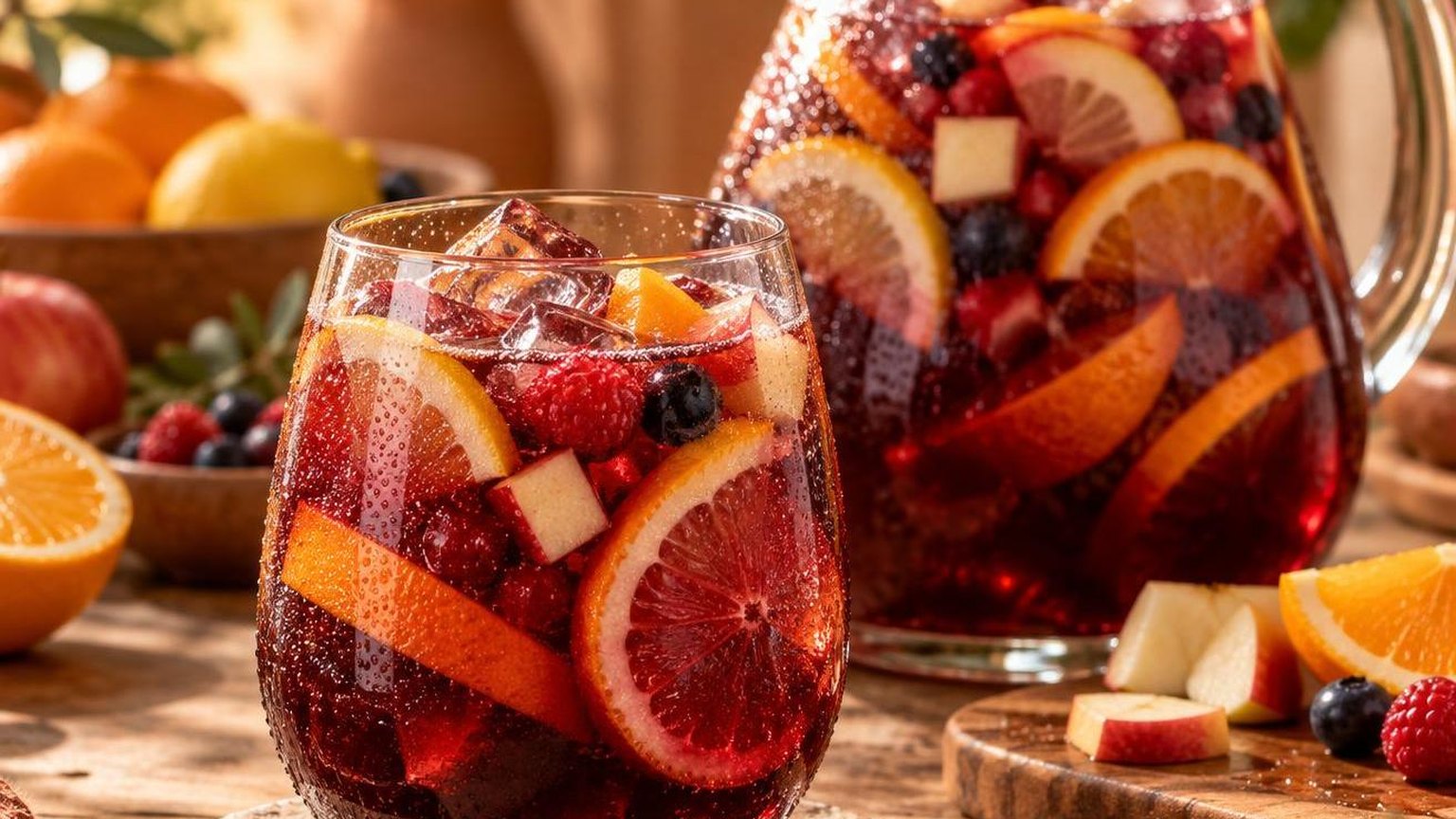
A standard drink in the United States contains 14 grams (0.6 fluid ounces) of pure alcohol.
A typical 8-ounce glass of sangria delivers roughly 0.8 to 1.2 standard drinks, depending on the recipe’s wine-to-fruit-juice ratio and whether spirits are added.
The base wine contributes most of the alcohol. Red wine at 13.5% ABV poured at 5 ounces yields exactly one standard drink. Sangria dilutes that wine with juice and fruit but often compensates with brandy or triple sec.
| Sangria Type | Typical ABV | Serving Size | Approximate Standard Drinks |
| Classic red (wine + fruit only) | 8–10% | 8 oz (237 ml) | 0.8–1.0 |
| Red with brandy (1 oz per pitcher) | 10–12% | 8 oz (237 ml) | 1.0–1.2 |
| White/rosé sangria | 7–10% | 8 oz (237 ml) | 0.7–1.0 |
| Sparkling sangria (with cava) | 8–11% | 6 oz (177 ml) | 0.6–0.8 |
| Restaurant “strong” sangria | 12–15% | 10 oz (296 ml) | 1.5–1.9 |
Restaurant pours skew higher because establishments often use full-strength wine plus 2–3 ounces of spirits per pitcher. A 64-ounce pitcher at 12% ABV contains approximately 6.4 standard drinks across roughly six servings.
Key Variables That Shift the Count
- Added spirits: Each ounce of 80-proof brandy adds 0.6 standard drinks to the entire pitcher, raising each glass by roughly 0.1 standard drinks.
- Juice and soda dilution: Orange juice and lemon-lime soda at 0% ABV can cut per-glass alcohol by 20–30% compared to an undiluted pour.
- Maceration time: Fruit absorbs some alcohol during overnight soaking—studies on alcohol absorption in fruit suggest up to 5–8% of total ethanol migrates into the fruit solids.
- Glass size: Many sangria glasses hold 10–12 ounces, not the 8-ounce reference. A 12-ounce pour of 11% ABV sangria equals approximately 1.5 standard drinks.
To track intake accurately, measure your pour volume and know the batch ABV. Divide total pure alcohol in the pitcher by the number of glasses served for a precise per-serving count.
Common Questions
What is the typical alcohol content of sangria?
Traditional sangria made with red wine ranges from 8% to 14% ABV, depending on the base wine and how much fruit juice or soda is added to dilute it.
A standard pitcher using a 13.5% ABV Tempranillo cut with orange juice and fruit typically lands around 9–11% ABV. Adding brandy or triple sec, as many recipes do, can push the final ABV back up to 12–15%.
How does sangria’s alcohol level compare to regular wine?
Most table wines sit between 12% and 15% ABV, while a diluted sangria typically falls 2–4 percentage points below the base wine’s strength.
This lower concentration often leads drinkers to consume more volume per sitting, which can offset the reduced ABV.
A 12-ounce glass of 10% ABV sangria still delivers roughly the same alcohol as a standard 5-ounce pour of 14% wine—about 0.6 standard drinks.
Does bottled or canned sangria have more or less alcohol than homemade?
Commercial pre-made sangrias sold in the US generally contain 6–10% ABV, which is lower than most homemade versions. Brands like Capriccio Bubbly Sangria are an exception at 13.9% ABV, while Beso Del Sol sits around 8%.
The TTB requires the label to state the exact ABV, so always check before assuming a bottled sangria is a lighter drink.
Does the fruit in sangria absorb alcohol?
Yes. Fruit soaked in sangria absorbs alcohol through osmosis, with porous fruits like peaches and apples absorbing more than citrus slices.
After 4–8 hours of maceration, a single piece of fruit can contain the equivalent of a half-ounce pour of wine.
Eating multiple pieces of booze-soaked fruit at the bottom of the pitcher adds meaningful alcohol intake that drinkers often underestimate.
How does adding brandy or liqueur change sangria’s ABV?
A standard sangria recipe calls for 2–4 ounces of brandy (35–40% ABV) or orange liqueur like Grand Marnier (40% ABV) per 750 mL bottle of wine.
Adding 3 ounces of 40% brandy to a pitcher made with 13% wine and 8 ounces of juice raises the overall ABV from roughly 9.5% to about 12.5%.
Each additional ounce of spirit increases the pitcher’s ABV by approximately 0.8–1 percentage point.
Does white sangria have less alcohol than red sangria?
Not necessarily—the ABV depends on the base wine, not the color.
White sangrias built on Pinot Grigio (12.5% ABV) or Vinho Verde (9–11% ABV) can be lighter, but those made with oaked Chardonnay (13.5–14.5% ABV) match or exceed typical red sangria.
The real variable is dilution: white sangria recipes often include more sparkling water or lemon-lime soda, which can lower the final ABV by 2–3 points.
How many standard drinks are in a typical pitcher of sangria?
A standard pitcher holds about 48 ounces.
Using a common recipe—one 750 mL bottle of 13% wine, 3 ounces of brandy, and 10 ounces of juice—the pitcher contains roughly 4.5 standard US drinks (one standard drink = 14 grams of pure alcohol).
Split among four people, that equals just over one standard drink per glass, though generous pours or second helpings can easily double the intake.
Further Reading
- How Many Calories In A Glass Of Moscato?
- How Long Does Wine Take to Kick In?
- What Is Sweet Wine Called?
- How Much Wine Is In A Bottle?
- Biggest Glass of Wine Meme
- How Many Fl Oz In A Bottle Of Wine?
- What Does Zinfandel Taste Like? Find Out Now
- Where Is Expiration Date on Wine Bottle?
- All Alcohol Guides
- National Institute on Alcohol Abuse and Alcoholism (2023)
- Dietary Guidelines for Americans – USDA & HHS (2020)
- TTB – Alcohol and Tobacco Tax and Trade Bureau (2023)
- CDC – Alcohol and Public Health (2023)
- USDA FoodData Central – Wine, table, red (2024)
- Cornell University – Wine Chemistry (2023)
- Journal of Studies on Alcohol and Drugs – PubMed (2014)
- Wine Institute – Wine Alcohol Content Overview (2023)
- University of California Davis – Viticulture & Enology (2023)