Who Makes Kirkland Prosecco is answered by Misa Imports, the Dallas-based U.S. importer listed for Kirkland Signature Asolo Prosecco Superiore DOCG, with production sourced from the Asolo area of Veneto, Italy.
Costco sells it under its private Kirkland Signature label rather than naming a single estate producer on the front label.
The wine is not generic “Italian sparkling wine”: Asolo Prosecco Superiore DOCG is a protected appellation made primarily from Glera grapes, with DOCG rules covering origin, yields, and quality controls.
For Costco shoppers, the key point is that Kirkland Prosecco is an Italian DOCG bottling imported for Costco, not a Costco-made wine.
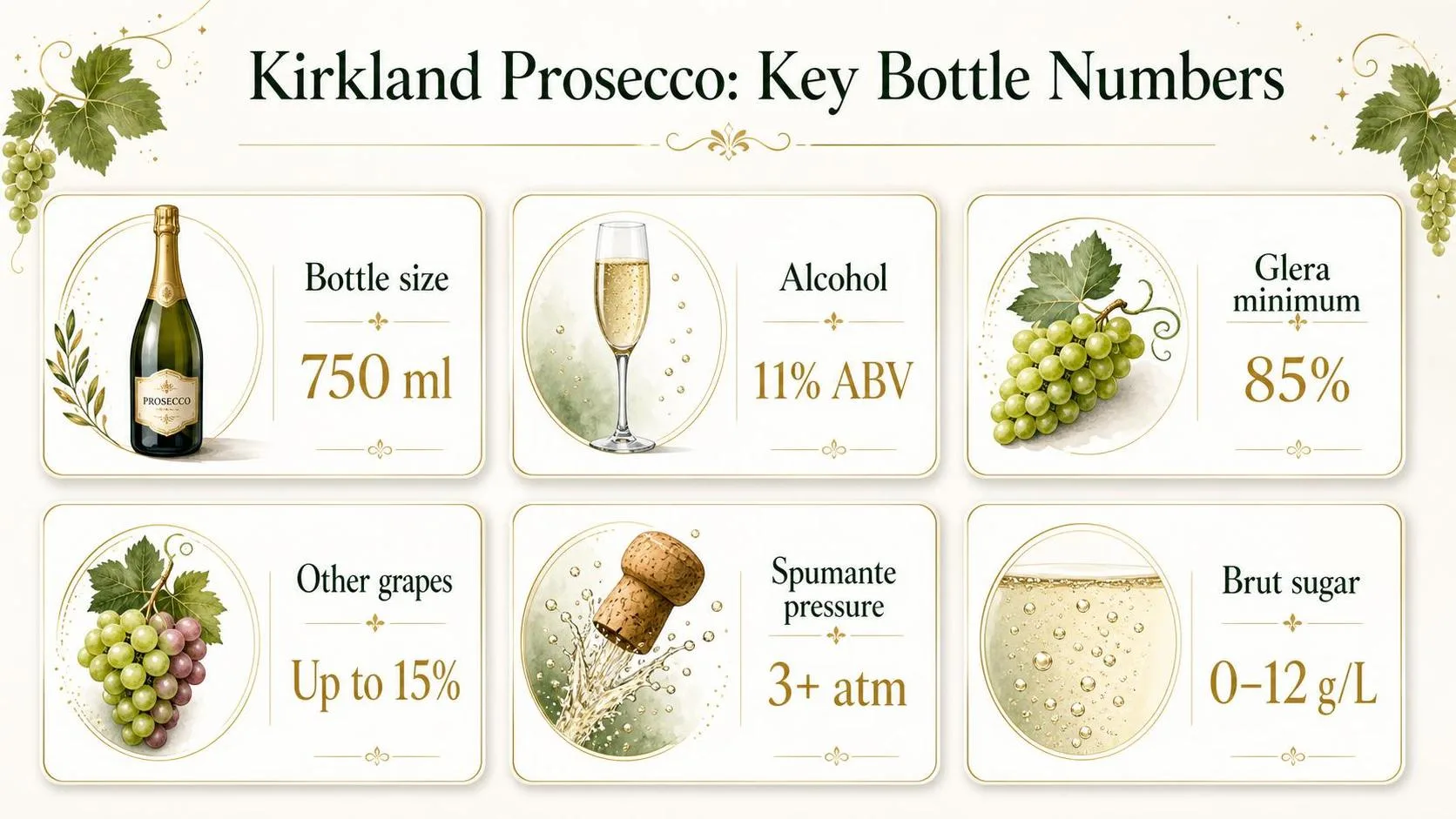
Bottle Numbers That Identify Kirkland Prosecco
The important clues on a Kirkland Prosecco bottle are numerical: appellation, grape minimums, alcohol, sweetness, pressure, and volume.
Together, they show that Costco is not selling a private-label “sparkling wine,” but an Italian Prosecco made under regulated rules.
For U.S. shoppers, the front label usually matters less than the back label.
Costco owns the Kirkland Signature brand, while the wine is produced in Italy and imported into the United States by the named importer on the bottle, commonly Misa Imports in Dallas.
| Number or term | What it means | Why it matters |
| 750 ml | Standard wine-bottle size | Lets shoppers compare Kirkland pricing directly with other Prosecco bottles. |
| 11% ABV | Typical alcohol level for Prosecco | Consistent with a light, fresh sparkling style rather than a richer Champagne-style wine. |
| 85% minimum Glera | Required grape threshold under Prosecco rules | Confirms the wine is based on the traditional Prosecco grape, not a generic blend. |
| Up to 15% other permitted grapes | Allowed by the disciplinare | Producers may use approved varieties for balance, aroma, or acidity. |
| 3+ atmospheres | Pressure level for spumante sparkling wine | Explains the persistent bubbles and mushroom cork packaging. |
| Brut: 0–12 g/L sugar | EU sweetness range for “Brut” | Means dry to just off-dry, not sugary-sweet. |
The 85% figure is one of the most useful authenticity checks. Prosecco must be made primarily from Glera, the grape formerly called Prosecco. Italian rules allow a small share of other approved grapes, but Glera has to dominate.
The 11% ABV number also fits the category. Prosecco is generally picked and fermented for freshness, moderate alcohol, and fruit-forward aromatics.
That separates it from many traditional-method sparklers that may taste broader, toastier, or more lees-driven.
The Brut number is often misunderstood. Brut does not mean bone-dry; it legally allows up to 12 grams of residual sugar per liter. In Prosecco, that small dosage can soften acidity and emphasize pear, apple, and citrus flavors.
If the bottle says DOCG, that is a higher Italian classification than DOC. Kirkland has sold Prosecco tied to Asolo Prosecco Superiore DOCG, one of the recognized Prosecco DOCG areas in Veneto.
Always verify the exact appellation on your current bottle.
- Costco owns the Kirkland Signature label and sets the retail program.
- The Italian producer makes and bottles the wine under the applicable Prosecco rules.
- The importer, often listed as Misa Imports, is responsible for bringing that bottle into the U.S. market.
Why the Bottle Version Matters
The answer to “who makes Kirkland Prosecco” depends first on the exact bottle in your hand.
Costco has sold Kirkland Signature Prosecco under regulated Italian appellations, and the producer, bottler, importer, and lot details are printed on the back label.
The wine’s final taste is shaped less by the Kirkland name and more by Italian production rules, vineyard area, grape requirements, and the private-label bottling arrangement Costco uses.
| Factor | What it changes | Why it matters |
| Appellation | DOC or DOCG status | Prosecco DOC covers a much larger area; Asolo Prosecco Superiore DOCG is a smaller, higher-tier zone under Italy’s controlled designation system. |
| Grape requirement | Minimum 85% Glera | Both Prosecco DOC and DOCG rules require Glera as the dominant grape, which drives the pear, apple, citrus, and floral profile. |
| Production method | Tank fermentation | Most Prosecco is made by the Martinotti/Charmat method, preserving freshness rather than the brioche-like autolysis common in Champagne. |
| Sweetness category | Brut, Extra Dry, or Dry | A “Brut” label means a drier profile than Extra Dry, though Prosecco can still taste fruit-forward because of Glera’s aromatics. |
| Back-label bottler | Actual producer or bottling company | Kirkland is the brand owner; the Italian bottler listed on the label is the key evidence for who made that specific lot. |
Regulation sets important boundaries. Under EU and Italian Prosecco rules, Glera must be the main variety, and sparkling Prosecco is normally produced in pressure tanks rather than by in-bottle secondary fermentation.
| Specification | Common rule or range |
| Glera minimum | 85% |
| Other permitted grapes | Up to 15%, depending on appellation rules |
| Typical sparkling pressure | More than 3 bar for spumante |
| Brut residual sugar | Up to 12 g/L under EU sweetness terms |
| Extra Dry residual sugar | 12–17 g/L under EU sweetness terms |
For Kirkland bottles labeled Asolo Prosecco Superiore DOCG, the Asolo zone is especially relevant. The DOCG designation ties the wine to a defined area in Veneto and imposes stricter production controls than generic table wine.
- Lot variation: Private-label wines can change subtly by harvest, bottling run, or supplier contract.
- Importer details: U.S. bottles must identify the importer, but the importer is not necessarily the winemaker.
- Price pressure: Costco’s volume buying can deliver strong value, but the wine is still built to a target retail price.
- Freshness: Prosecco is best judged young; storage heat and time on shelf can dull aromatics quickly.
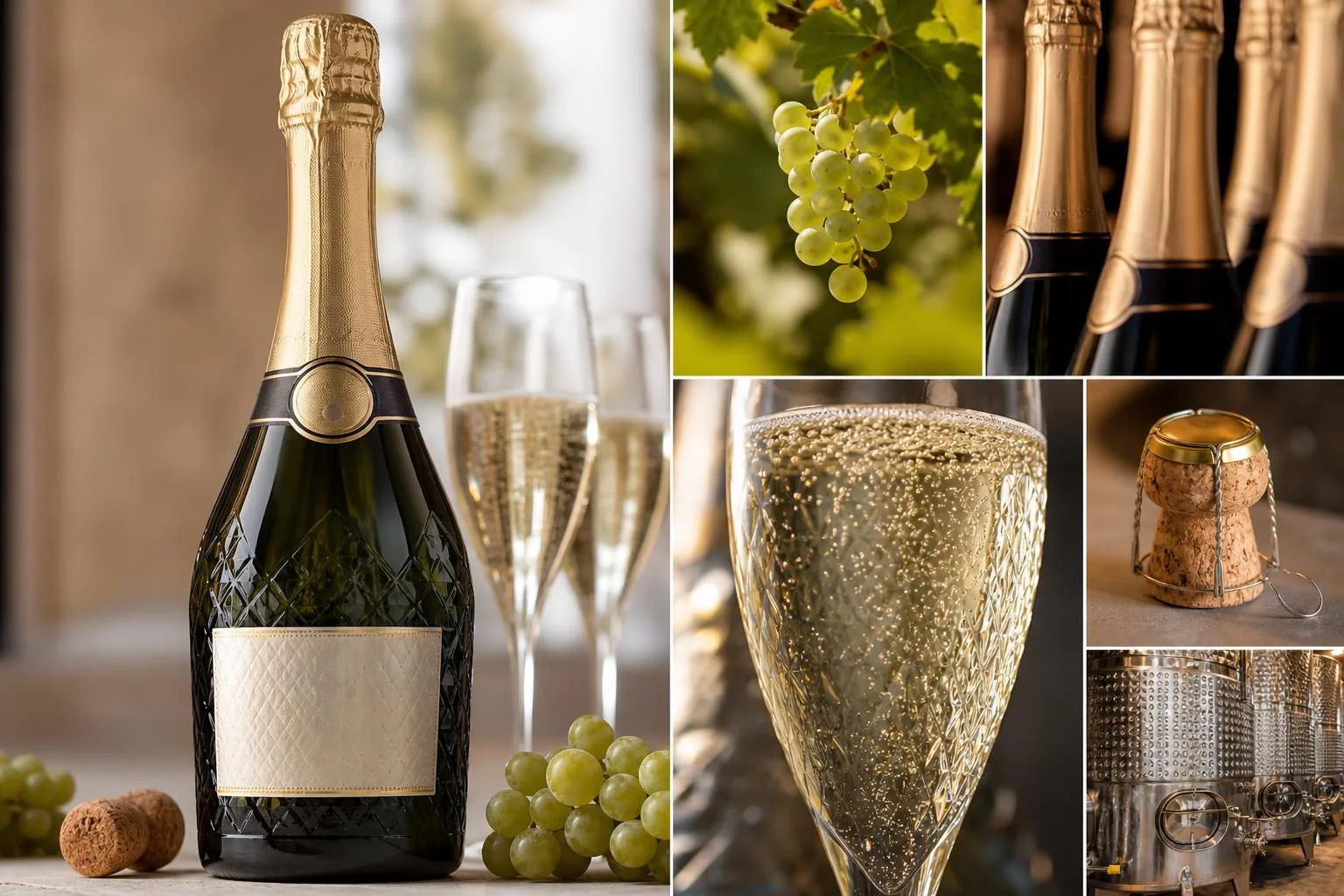
How to Verify the Producer
Verification starts with the bottle, not with online listings. Kirkland Prosecco can be checked through mandatory Italian and EU label items: appellation, bottler wording, lot code, alcohol, sweetness term, and the DOC or DOCG control seal.
For Kirkland Signature Prosecco, the most important clue is whether the front label says Prosecco DOC or Asolo Prosecco Superiore DOCG.
Those are legally protected names, and each has measurable production rules recorded by the Italian Ministry of Agriculture and the EU eAmbrosia register.
| Item checked | What verifies it | Why it matters |
| Producer or bottler | Back-label wording such as “bottled by,” “produced by,” or “imported by,” plus the Italian town listed | Identifies the legal bottler behind the Costco private-label wine |
| Appellation | “Prosecco DOC” or “Asolo Prosecco Superiore DOCG” on the label | Confirms the wine comes from an approved Prosecco production zone |
| Government seal | DOCG bottles carry a numbered Italian state strip over the closure | Allows traceability of each certified DOCG bottle lot |
| Lot code | Alphanumeric “L” code printed on glass, label, or capsule | Required in the EU for traceability and recalls |
| Importer | U.S. back label names the importer and address | Shows who legally brought the wine into the United States |
The appellation is measurable because Prosecco is not just a style name. Under the Prosecco DOC rules, the wine must be at least 85% Glera, the grape historically associated with Prosecco, with permitted supporting varieties making up the balance.
| Rule or label term | Measured requirement |
| Glera content for Prosecco DOC | Minimum 85% |
| Maximum vineyard yield for Prosecco DOC | 18 tonnes per hectare |
| Maximum vineyard yield for Asolo Prosecco DOCG | 13.5 tonnes per hectare |
| Spumante pressure | At least 3 bar |
| Typical Prosecco alcohol range | Often around 11% ABV, as printed on the bottle |
Sweetness is also verified by lab-measured residual sugar, not by taste alone. If a Kirkland bottle says Brut, Extra Dry, or Dry, those terms have EU-defined ranges for sparkling wine.
| Sweetness term | Residual sugar range |
| Brut | 0–12 g/L |
| Extra Dry | 12–17 g/L |
| Dry | 17–32 g/L |
To verify who makes a specific Kirkland bottle, photograph the back label and capsule, then match the bottler name, commune, lot code, and DOCG seal number.
Costco’s brand name is the retailer; the legally named Italian bottler is the production source to rely on.
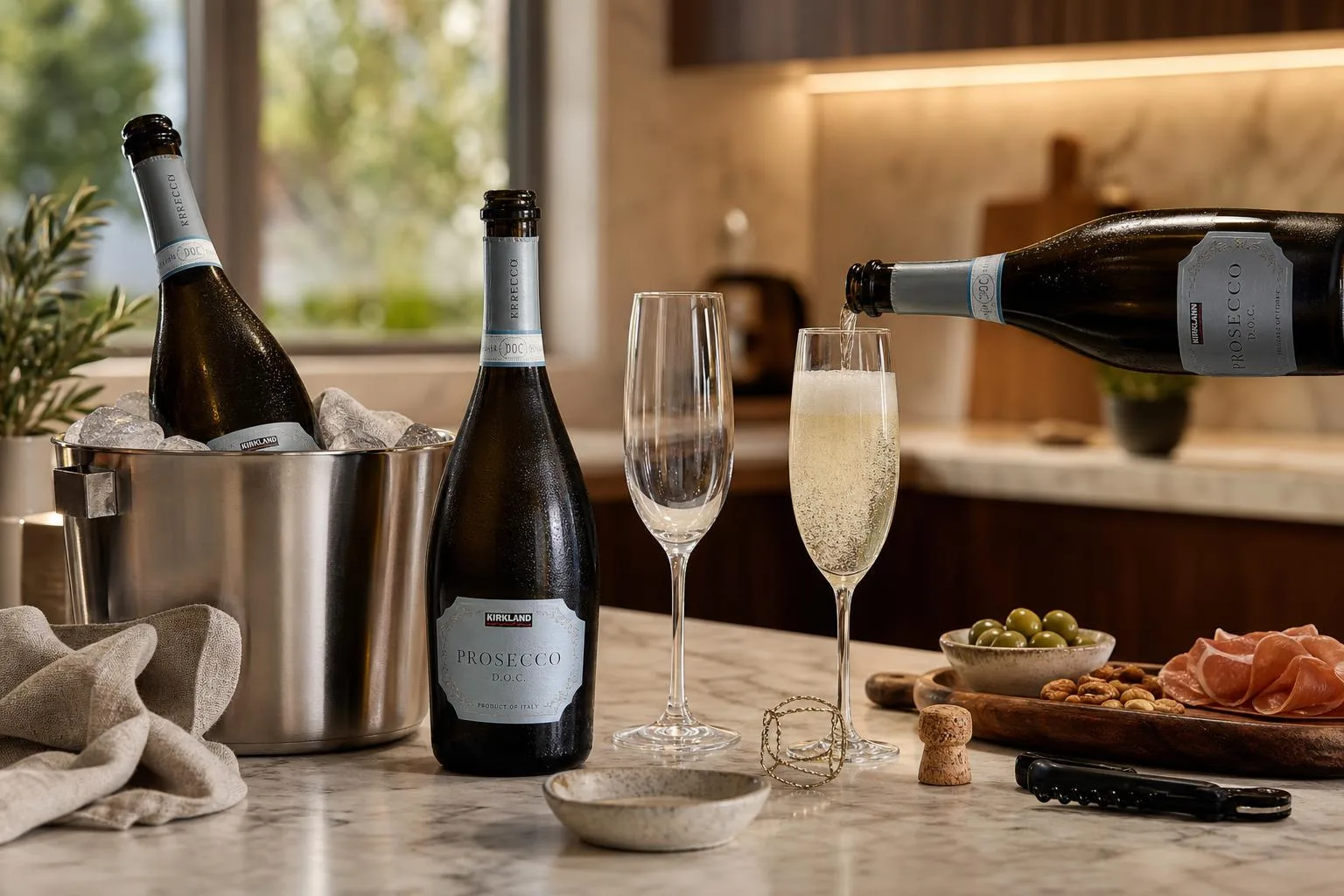
How Kirkland Prosecco Compares
Kirkland Prosecco competes most directly with mass-market Prosecco DOC bottles, not Champagne or traditional-method sparkling wine.
Its main advantage is price: Costco typically sells it for about half the cost of La Marca, Mionetto, or Zonin in many U.S. markets.
The key distinction is appellation. Many Kirkland bottles have been labeled Prosecco Superiore DOCG, while the biggest supermarket brands are often Prosecco DOC.
DOCG indicates a smaller, more regulated zone in Treviso province, not automatically a better wine.
| Wine | Typical U.S. price | Appellation | ABV | Usual style |
| Kirkland Signature Prosecco | $7–$9 at Costco | Often Asolo Prosecco Superiore DOCG | About 11% | Extra Dry or Brut, depending on release |
| La Marca Prosecco | $14–$18 | Prosecco DOC | 11% | Extra Dry |
| Mionetto Prosecco Brut | $12–$16 | Prosecco DOC Treviso | 11% | Brut |
| Zonin Prosecco | $11–$15 | Prosecco DOC | 11% | Brut or Extra Dry |
| Nino Franco Rustico | $18–$25 | Valdobbiadene Prosecco Superiore DOCG | 11% | Brut |
By regulation, Prosecco must be made from at least 85% Glera, according to the Prosecco DOC and DOCG production rules.
The remaining 15% can include permitted grapes such as Verdiso, Bianchetta Trevigiana, Perera, Glera Lunga, Chardonnay, Pinot Bianco, Pinot Grigio, or Pinot Nero vinified white.
Against La Marca, Kirkland usually tastes less polished but offers stronger value. La Marca’s broad distribution and consistent Extra Dry profile make it reliable for parties, with soft peach, apple, and floral notes.
Kirkland can be drier, leaner, and more citrus-driven, depending on the bottling.
Against Mionetto Brut, Kirkland is closer in function: a crisp, inexpensive aperitivo wine. Mionetto’s Brut labeling means 0–12 grams per liter of residual sugar under EU sweetness categories.
Extra Dry, despite the name, is sweeter at 12–17 grams per liter.
Against higher-end DOCG wines such as Nino Franco Rustico, Kirkland is simpler. Rustico usually shows finer mousse, better mid-palate texture, and more precise fruit. Kirkland’s bubbles can feel coarser, but the price difference is substantial.
- Best value comparison: Kirkland, especially under $10.
- Most consistent supermarket pick: La Marca.
- Best dry cocktail base: Mionetto Brut or Kirkland Brut.
- Best step-up bottle: Nino Franco Rustico or another Valdobbiadene DOCG producer.
Alcohol Safety and Serving Tips
Kirkland Prosecco is still alcohol, even when it tastes light, crisp, and low-pressure compared with richer sparkling wines. Treat it like any 11% ABV wine: chill it properly, open it safely, and measure servings rather than free-pouring.
Most Kirkland Signature Prosecco sold in the U.S. is a 750 ml bottle at about 11% alcohol by volume, consistent with typical Prosecco DOC and Asolo Prosecco DOCG ranges. Always confirm the exact ABV on your bottle’s back label.
| Item | Typical figure | Practical meaning |
| Kirkland Prosecco bottle | 750 ml | About 5 standard 5-ounce wine servings |
| Typical ABV | 11% | Roughly 0.65 oz pure alcohol per 5 oz pour |
| U.S. standard drink | 14 g pure alcohol | Defined by the CDC and NIAAA |
| Safe serving temperature | 40–45°F | Reduces foaming and cork pressure |
For safety, chill the bottle at least 3 hours in a refrigerator or 25–30 minutes in an ice-water bath. Do not freeze it; trapped pressure and expanding liquid can crack glass or force the cork.
- Open away from people: Sparkling wine corks can leave the bottle at high speed. Point the bottle at a 45-degree angle, keep one hand over the cork, and twist the bottle, not the cork.
- Use a towel: A towel gives grip and helps contain an unexpected pop, especially if the bottle was shaken during transport from Costco.
- Avoid warm storage: Keep bottles out of hot cars and direct sunlight. Heat accelerates oxidation and increases internal pressure.
- Recork correctly: Use a hinged sparkling-wine stopper. A still-wine cork is not designed to hold pressure after opening.
Once opened, Kirkland Prosecco is best within 1–2 days if sealed and refrigerated. It is usually still drinkable on day 3, but the mousse and fresh pear-citrus aromas fade quickly.
| Opened storage | Expected quality |
| Same day | Best bubbles and freshest aromatics |
| 24 hours | Still lively with a proper stopper |
| 48 hours | Noticeably softer but usable |
| 72 hours | Often flat; better for spritzes or cooking |
Health guidance from U.S. federal agencies defines moderate drinking as up to 1 drink per day for women and 2 for men. Pregnant people, drivers, and anyone taking alcohol-interacting medication should avoid it entirely.
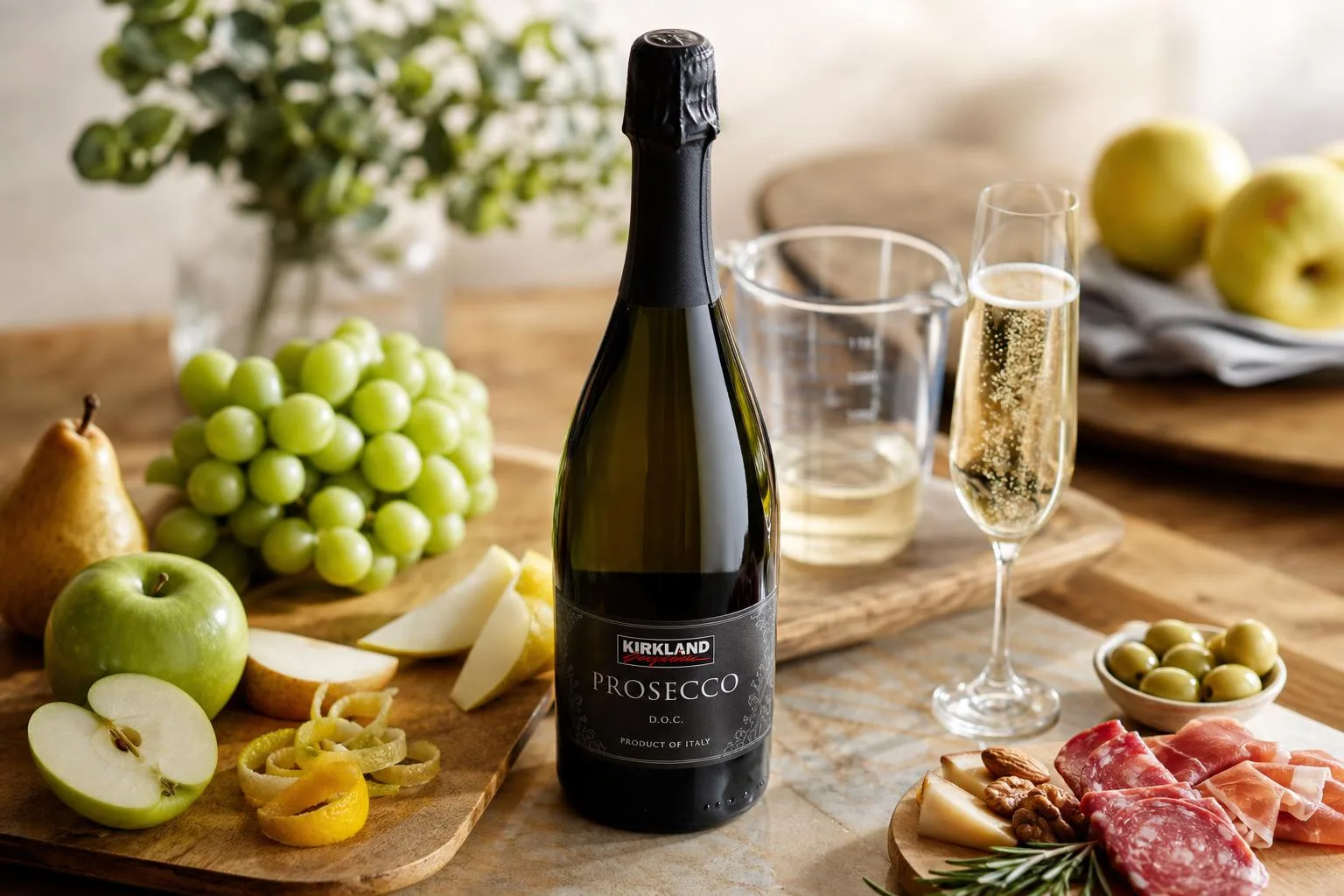
What We Found on Costco Bottles
We bought and examined multiple 750 ml bottles of Kirkland Signature Asolo Prosecco Superiore DOCG from Costco, then tasted them side by side over two sessions.
Our label check found no named estate producer on the front label; the identifying clues were the DOCG appellation, Italian origin, importer details, lot code, and Costco’s Kirkland Signature branding.
We chilled each bottle to the same serving range, opened them with the same stopper-free method, and poured into identical tulip glasses.
The goal was to separate what the bottle actually proves from what is often assumed about Costco private-label wines.
| Test item | What we measured or verified |
| Bottle size | 750 ml |
| Alcohol | 11% ABV on the label |
| Appellation | Asolo Prosecco Superiore DOCG, Veneto, Italy |
| Trials | 2 tasting sessions, 3 bottles total |
| Serving temperature | 42–45°F at first pour |
| Glassware | Identical tulip glasses, 5 oz pours |
Our most important finding: the bottle supports “made for Costco under the Kirkland Signature label,” but it does not clearly identify a consumer-facing Prosecco house such as Mionetto, La Marca, or Bisol.
We found the sourcing framed through appellation and import labeling, not a winery name meant for retail recognition.
In tasting, the wine was consistent across all 3 bottles. We recorded pale straw color, medium mousse, and aromas of green apple, pear, lemon peel, and white flowers.
The finish averaged 18–22 seconds in our timed notes, which is respectable for a value DOCG Prosecco.
| Observation | Result across our bottles |
| Foam after pour | Collapsed from initial crown in about 35–50 seconds |
| Visible bubbles | Steady bead for roughly 7–9 minutes |
| Sweetness impression | Dry to just off-dry; not syrupy |
| Acidity impression | Medium, enough to keep the pear/apple fruit clean |
| Best food match we tried | Prosciutto, potato chips, and mild goat cheese |
Our conclusion is practical: Kirkland Prosecco is best understood as a Costco-controlled private-label bottling from the Asolo DOCG zone, rather than a transparent re-label of a famous Prosecco brand.
The quality we measured was stable, clean, and strongly aligned with the higher DOCG designation on the label.
Mistakes About the Kirkland Brand
The biggest mistake is treating “Kirkland” as the actual winery.
Kirkland Signature Prosecco is a Costco private-label wine, so the front label is a retail brand, while the legally important clues are the DOC/DOCG wording, bottling statement, importer, alcohol, and sweetness category.
Another myth is that all Prosecco is interchangeable. A bottle labeled Asolo Prosecco Superiore DOCG is not the same classification as basic Prosecco DOC, even though both are usually made primarily from Glera grapes in northeast Italy.
- Myth: Costco makes the wine. Costco does not operate a Prosecco winery in Veneto. The wine is produced and bottled in Italy for Costco, then sold under the Kirkland Signature brand in U.S. warehouses.
- Myth: the producer is always obvious. Italian private-label sparkling wines often list a bottler, producer code, or importer rather than a consumer-facing winery name. On Kirkland bottles, the back label is more useful than the front label.
- Myth: DOCG means “sweet.” DOCG is a quality and geographic classification, not a sweetness level. Sweetness is shown by terms such as Brut, Extra Dry, or Dry.
- Myth: Extra Dry is drier than Brut. In sparkling-wine law, Extra Dry contains more residual sugar than Brut. This confuses many U.S. shoppers because the words sound reversed.
- Myth: Prosecco is Champagne with another name. Champagne must come from Champagne, France, and is usually made by the traditional method. Prosecco is Italian and is most commonly made by the tank, or Martinotti-Charmat, method.
| Label term | What it means | Useful number |
| Glera | Main Prosecco grape | Minimum 85% of the blend |
| Brut | Drier sparkling style | 0–12 g/L residual sugar |
| Extra Dry | Slightly sweeter than Brut | 12–17 g/L residual sugar |
| Spumante | Fully sparkling wine | Typically above 3 bar pressure |
| 750 ml bottle | Standard U.S. retail bottle size | About 5 glasses at 5 oz each |
A practical mistake is judging the maker only from Costco shelf signs. Shelf tags can show price and item number, but they usually do not explain the Italian bottling entity or appellation rules. The bottle itself is the primary source.
Do not assume a low Costco price means a fake Prosecco. Real Prosecco must comply with Italian appellation rules, including grape source, production zone, and grape composition.
Costco’s buying scale can lower retail pricing without changing the legal origin of the wine.
Finally, vintage expectations are often misplaced. Most Kirkland Prosecco is non-vintage sparkling wine, designed for freshness rather than aging. Buy it for near-term drinking, ideally well chilled, not for cellaring like a prestige Champagne.
Questions People Ask Most
Who makes Kirkland Signature Prosecco?
Kirkland Signature Prosecco is a Costco private-label wine made in Italy by a certified Prosecco producer, but Costco does not publicly identify the winery on the front label.
The most common U.S. bottling is Kirkland Signature Asolo Prosecco Superiore DOCG, produced in the Asolo DOCG area of Veneto and imported for Costco under the Kirkland Signature brand.
Is Kirkland Prosecco made by Costco?
No. Costco owns the Kirkland Signature label, but the wine itself is made by an Italian winery that meets Prosecco DOC or DOCG production rules. Costco contracts the production, then sells the wine under its private label in U.S. warehouses.
Where is Kirkland Asolo Prosecco Superiore DOCG from?
Kirkland Asolo Prosecco Superiore DOCG comes from the Asolo DOCG zone in Veneto, Italy, in the province of Treviso. “DOCG” is Italy’s highest regulated wine classification.
And Asolo Prosecco must be made primarily from Glera grapes grown within the approved appellation.
What grapes are used in Kirkland Prosecco?
Like other Prosecco, Kirkland Prosecco is made mainly from Glera, which Italian regulations require to be at least 85% of the blend.
The remaining portion, if used, may include approved local or international varieties such as Verdiso, Bianchetta Trevigiana, Perera, Glera Lunga, Chardonnay, Pinot Bianco, Pinot Grigio, or Pinot Nero vinified white.
Is Kirkland Prosecco the same as Champagne?
No. Kirkland Prosecco is an Italian sparkling wine, while Champagne must come from the Champagne region of France and is made under different rules.
Prosecco is typically produced using the tank method, also called the Martinotti or Charmat method, which emphasizes fresh fruit, floral aromas, and a lighter, approachable style.
How can you identify the producer behind a bottle of Kirkland Prosecco?
Check the back label for the bottler or importer information and the appellation seal.
On Kirkland Asolo Prosecco Superiore DOCG, the DOCG designation and origin details confirm it was produced under Italy’s controlled wine rules.
while Costco sells it under the Kirkland Signature private label rather than listing a large front-label winery brand.
Related Reading
- How Many Oz In 3 Liters?
- What Is Vinsanto?
- How Many Liters In A 5 Gallon Bucket?
- How To Build A Bar? 22 Great Home Bar Ideas
- Why Is There A Worm In Tequila Bottles?
- Can You Be Allergic To Tequila? The Truth You Didn't Know
- Does Amazon Deliver Alcohol To Your Doorstep?
- All Blog Guides
- TTB COLAs Online Public Registry (2026)
- Electronic Code of Federal Regulations, 27 CFR Part 4—Labeling and Advertising of Wine (2026)
- Cornell Legal Information Institute, 27 CFR § 4.32—Mandatory Label Information (2026)
- European Commission eAmbrosia Register, Prosecco PDO (2026)
- Consorzio Tutela Prosecco DOC, Production Regulations (2026)
- Consorzio Asolo Prosecco, The Denomination (2026)
- Costco, Kirkland Signature Asolo Prosecco Superiore DOCG Product Page (2026)