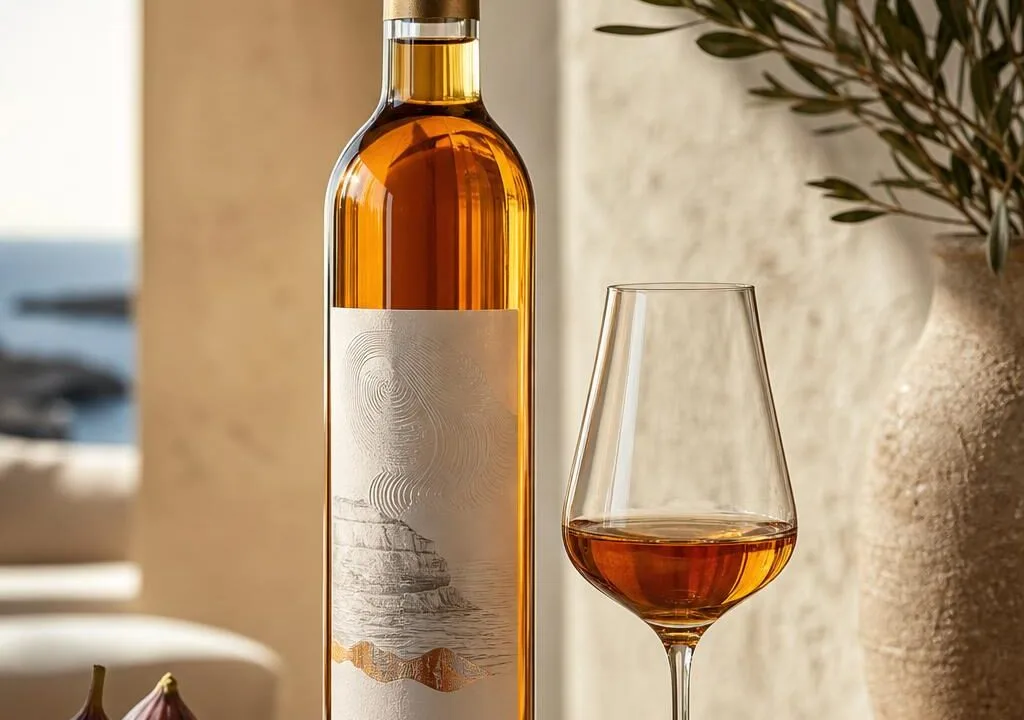
What Is Vinsanto is a Greek sun-dried sweet wine, most famously from Santorini, made mainly from Assyrtiko with smaller amounts of Aidani and Athiri.
Grapes are dried in the sun to concentrate sugar and acidity, then fermented slowly and aged in oak, producing amber color, dried-fruit flavors, honeyed depth, and bright volcanic minerality.
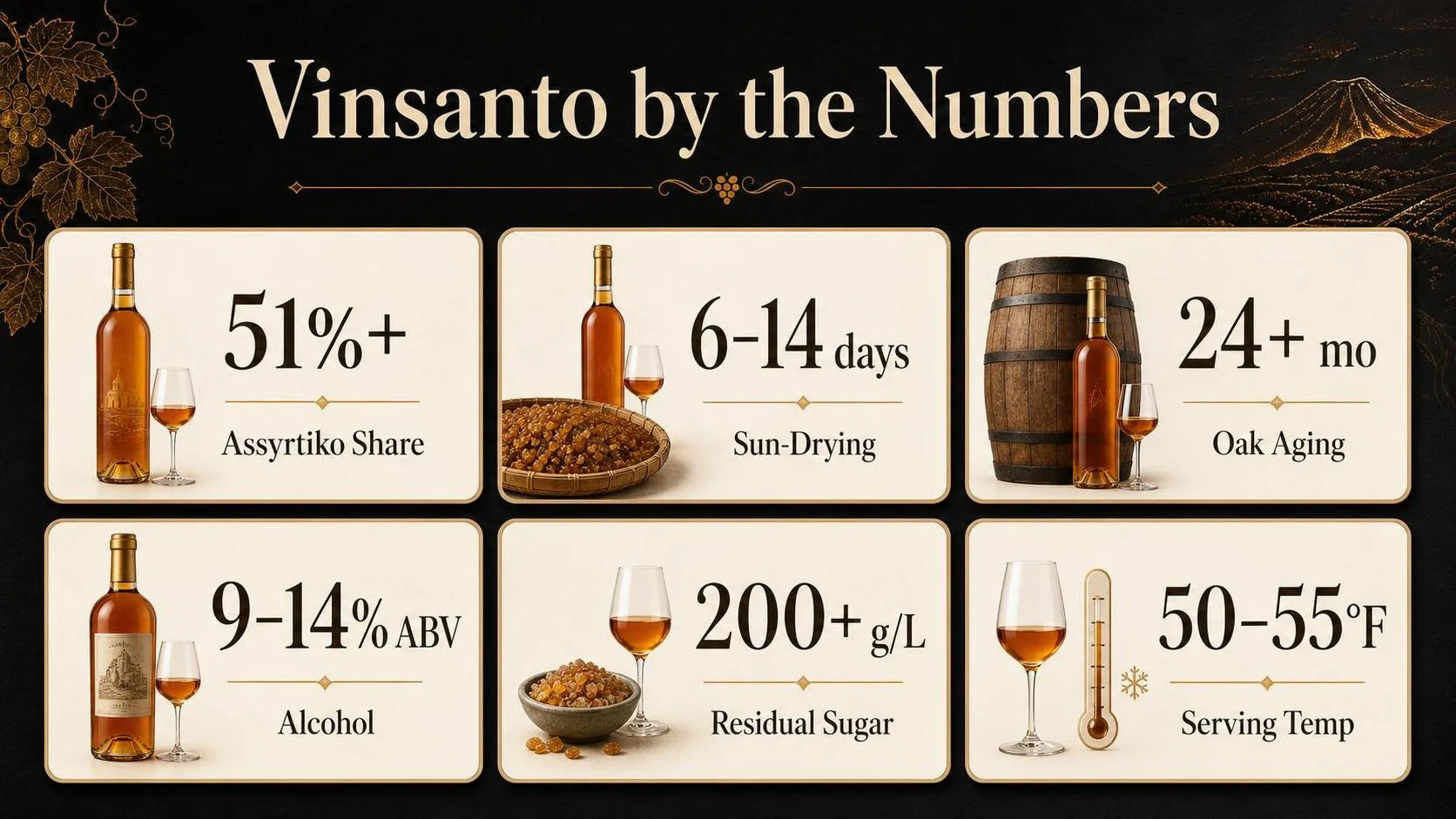
Protected under Greek PDO rules, Santorini Vinsanto must use at least 51% Assyrtiko and age for a minimum of 24 months in barrel.
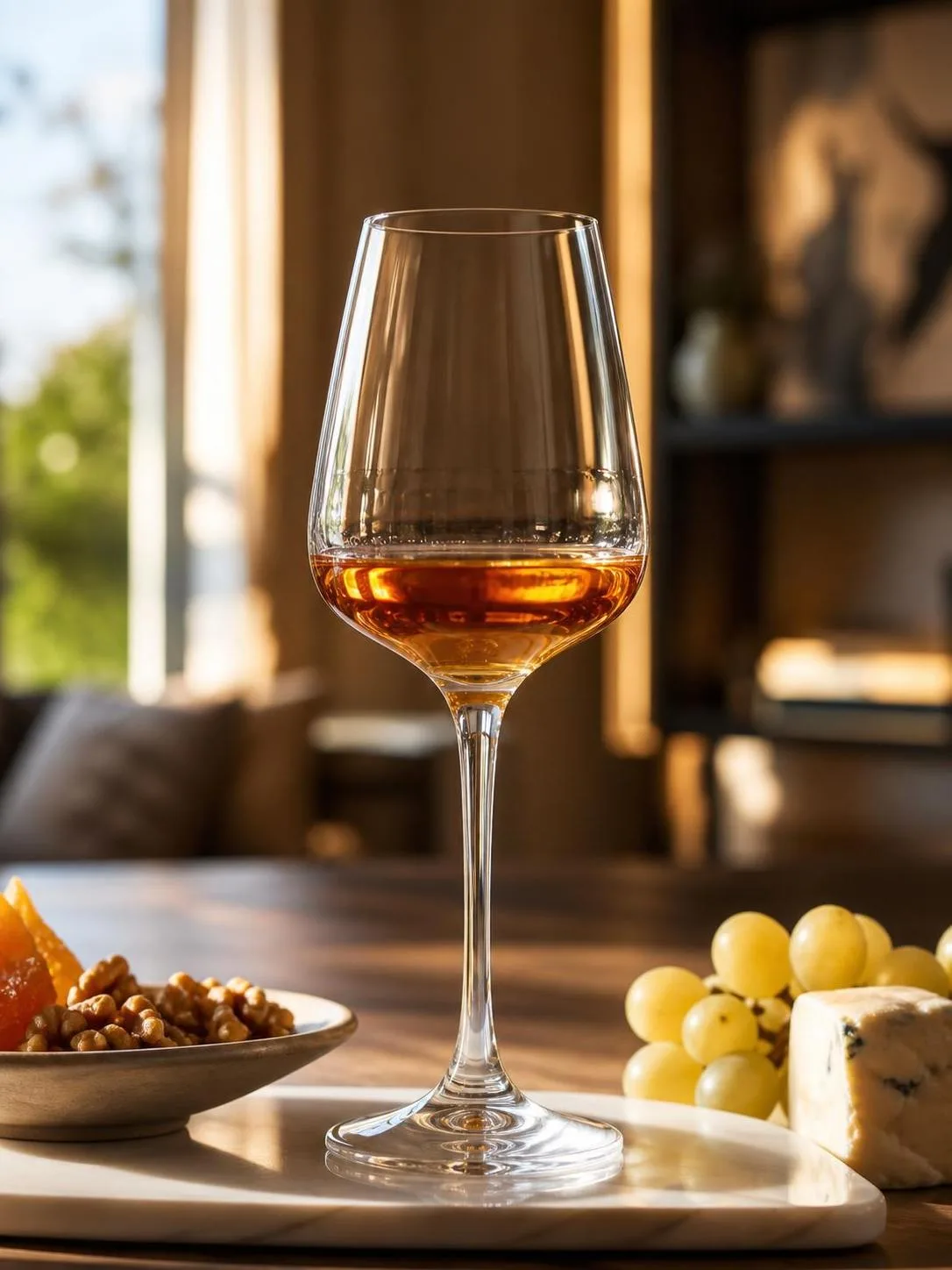
Its balance of sweetness and sharp acidity makes it a classic partner for baklava, blue cheese, roasted nuts, and fruit-based desserts.
What Santorini Vinsanto Is
Vinsanto from Santorini is a naturally sweet, unfortified PDO wine made from sun-dried white grapes. The numbers matter because they separate real Santorini Vinsanto from generic “sweet Greek wine” and from Italian Vin Santo.
In tasting rooms on Santorini, the most obvious figures are not just sweetness and alcohol. The grape percentage, drying time, and minimum aging explain why Vinsanto tastes concentrated, amber, acidic, and long-lived.
| Number | What it means for Vinsanto |
| At least 51% Assyrtiko | Santorini PDO rules require Assyrtiko to be the dominant grape. Aidani and Athiri are commonly blended in, adding floral and softer fruit notes. |
| 6–14 days | Typical sun-drying period for harvested grapes. Water evaporates, concentrating sugar, acid, phenolics, and volcanic-island salinity before pressing. |
| Minimum 24 months | Santorini Vinsanto must be aged in oak for at least two years. Many serious bottles age far longer, developing coffee, fig, caramel, walnut, and orange-peel flavors. |
| Unfortified | Alcohol is produced only by fermentation, not by added spirit. This is a key difference from many fortified dessert wines. |
The sugar number can surprise people. Vinsanto is genuinely sweet, but Santorini’s high natural acidity keeps it from tasting flat or syrupy.
| Typical finished wine figure | Practical interpretation |
| About 9%–14% ABV | Most bottles sit in a moderate dessert-wine alcohol range because fermentation stops with substantial residual sugar remaining. |
| Often 200+ g/L residual sugar | That is firmly in dessert-wine territory. Some aged examples can be substantially higher, depending on producer and vintage. |
| High total acidity | Assyrtiko’s acidity is the structural backbone. It is why Vinsanto can feel bright even when intensely sweet. |
| Common bottle size: 500 ml | Many producers bottle Vinsanto in half-liter formats because servings are small, usually 2–3 ounces. |
The age statement also deserves careful reading. A 4-year, 8-year, or 12-year Vinsanto usually refers to time matured before release, not simply bottle age after purchase.
- Young Vinsanto: More raisin, dried apricot, honey, and citrus peel.
- Long-aged Vinsanto: More espresso, molasses, toasted nuts, tobacco, and dark caramel.
- Best serving range: Around 50–55°F, cool but not ice-cold, so the aromatics open without making the sweetness feel heavy.
The essential formula is simple: mostly Assyrtiko, sun-dried grapes, at least 24 months in oak, and no fortification. Those numbers create Vinsanto’s signature balance of sweetness, acidity, oxidation, and volcanic intensity.
Legal Factors Shaping Vinsanto Flavor
Vinsanto’s final flavor is shaped less by one winemaking choice than by a chain of small, legally defined decisions.
In Santorini PDO Vinsanto, grape variety, sun-drying time, sugar concentration, fermentation, and oxidative aging all change the wine’s color, sweetness, acidity, and texture.
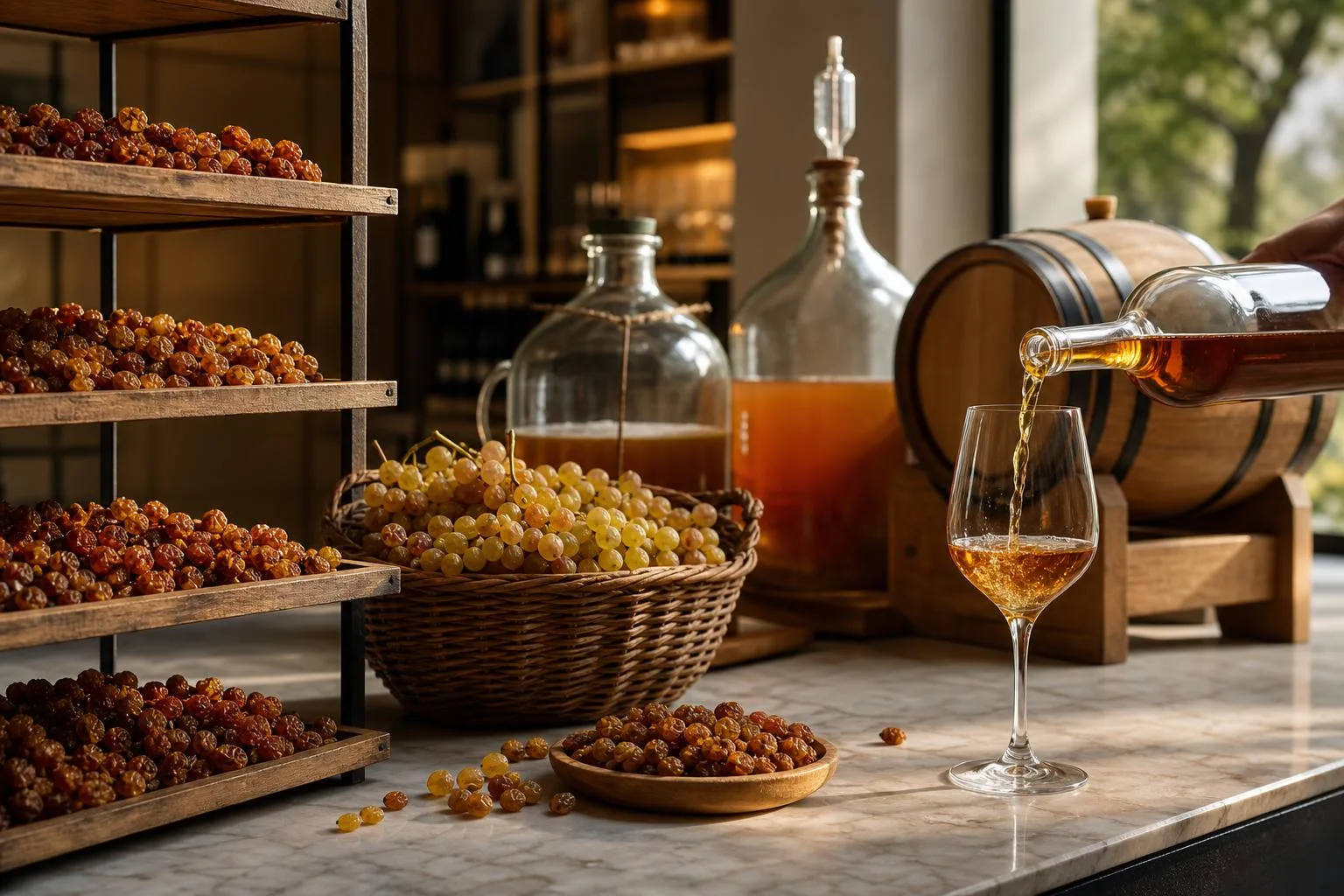
The most important driver is concentration. Grapes are harvested ripe, then dried in the sun, traditionally on terraces or mats, which removes water while keeping sugars, acids, phenolics, and minerals behind.
| Factor | Typical / required detail | Effect in the glass |
| Grape varieties | PDO rules require at least 51% Assyrtiko, with Athiri and Aidani commonly used | Assyrtiko preserves high acidity; Aidani can add floral, honeyed notes |
| Sun-drying | Minimum 6 days for Santorini PDO Vinsanto | Raises sugar concentration and develops raisin, fig, and dried citrus flavors |
| Natural sweetness | Must come from dried grapes, not added sugar | Gives density without the flavor profile of simple fortification or back-sweetening |
| Barrel aging | Minimum 24 months in oak for PDO Vinsanto | Adds oxidative notes: caramel, coffee, walnut, spice, and darker color |
Assyrtiko is central because Santorini’s best examples need acidity to balance sweetness.
Even when residual sugar is very high, the wine can feel lifted rather than syrupy because Assyrtiko is naturally acid-retentive in the island’s dry, windy climate.
- Drying length: Longer drying generally means less juice, higher sugar, and more intense dried-fruit flavors. It can also make fermentation harder because yeasts struggle in very concentrated must.
- Fermentation: Vinsanto often ferments slowly and may stop naturally with notable residual sugar. The result depends on yeast tolerance, cellar temperature, and the sugar level after drying.
- Barrel condition: Older barrels and partial ullage encourage gentle oxidation. This builds amber to mahogany color and flavors of toffee, roasted nuts, molasses, and orange peel.
- Aging time: The legal minimum is 2 years, but many serious bottlings age 4, 8, 12, or more years before release. Longer aging usually increases savory, oxidative complexity.
- Vintage weather: A hot, dry harvest can produce extremely concentrated grapes. Rain near harvest or during drying can increase rot risk and dilute precision.
Yield also matters. Santorini’s old basket-trained vines are famously low-yielding, often producing only a few tons per hectare, which intensifies flavor.
For Vinsanto, drying reduces usable juice even further, so production volume is naturally limited.
The best results balance three forces: sweetness from dehydration, acidity from Assyrtiko, and complexity from oxidation. If any one dominates, Vinsanto can taste either too heavy, too sharp, or too woody.
PDO Rules for Santorini Vinsanto
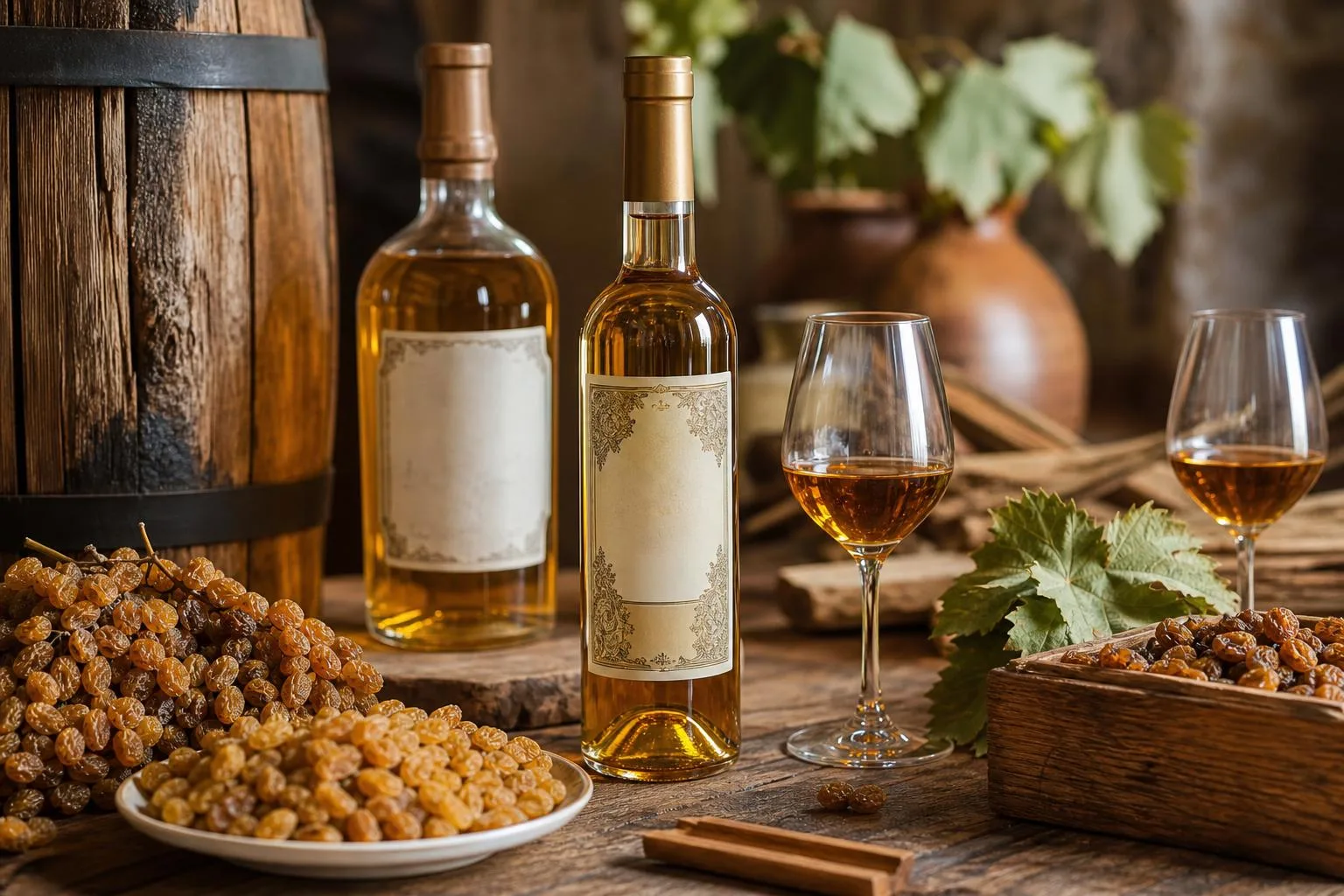
Vinsanto is not verified by taste alone. For Santorini PDO Vinsanto, producers must meet measurable rules on grape origin, grape varieties, drying, alcohol, residual sugar, acidity, and maturation before the wine can legally carry the name.
The core check is traceability: the grapes must come from the Santorini PDO zone, chiefly the islands of Thira and Thirasia.
The blend must contain at least 51% Assyrtiko, with the balance usually from Aidani and Athiri, plus other permitted local white varieties.
| Measured item | Typical legal or verification point |
| Grape composition | Minimum 51% Assyrtiko for Santorini PDO Vinsanto |
| Grape drying | Sun-dried after harvest, commonly for about 6 to 14 days depending on weather and desired concentration |
| Minimum ageing | At least 24 months in oak before release under the PDO style |
| Residual sugar | Measured in grams per liter; Vinsanto is analytically sweet, often far above 100 g/L |
| Alcohol | Measured as % alcohol by volume; natural sweet versions are commonly around 9% to 13.5% ABV |
| Total acidity | Measured as g/L tartaric acid; Santorini’s Assyrtiko base helps retain high acidity |
Laboratories verify sugar with standard wine analysis, reported as residual sugar in grams per liter.
This matters because Vinsanto’s balance depends on both sweetness and acidity; a wine can be very sweet yet still taste fresh if acidity remains high.
Alcohol is checked by approved analytical methods and shown on the label as ABV. Because the grapes are dried, must sugar is highly concentrated, but fermentation often stops before all sugar is converted, leaving substantial natural sweetness.
Acidity is another key measurement. Assyrtiko from Santorini is valued because it can keep firm acidity even in ripe, sun-dried fruit. In professional tasting, that acidity is verified analytically and then assessed sensorially for balance.
Age is verified through cellar records, barrel logs, and inspection.
The minimum oak maturation is 24 months, but many serious examples age longer, sometimes 4, 10, or more years before bottling, developing amber color, dried fruit, caramel, spice, and oxidative complexity.
PDO verification also depends on documented production records: vineyard source, harvest date, grape weight, drying period, press lots, fermentation vessels, barrel entry, bottling date, and lot number.
These records support audits by the competent Greek and EU-recognized control framework.
On a label, the most useful verification clues are “ΠΟΠ Σαντορίνη” or “PDO Santorini,” the word “Vinsanto,” the alcohol percentage, bottle size, producer, lot number, and any stated ageing indication.
Together, these identify a regulated Santorini sweet wine, not merely a sweet wine made in a similar style.
How Vinsanto Differs from Similar Wines
Vinsanto from Santorini is a sweet, oxidatively aged Greek wine made from sun-dried white grapes, usually Assyrtiko-led.
Its closest comparisons are Italian Vin Santo, passito wines, Sauternes, Port, and ice wine, but the production logic and flavor profile are distinct.
The key difference is Santorini’s volcanic, high-acid Assyrtiko base. Even with very high sweetness, good Vinsanto often tastes lifted rather than heavy, with flavors of dried apricot, fig, orange peel, caramel, coffee, and roasted nuts.
| Wine | Main place | Core method | Typical alcohol | Typical sweetness / style |
| Vinsanto | Santorini, Greece | Grapes sun-dried, then aged oxidatively; PDO rules require at least 24 months maturation | About 9% to 14% ABV | Sweet, high-acid, amber, dried-fruit and caramel-toned |
| Vin Santo | Tuscany, Italy | White grapes dried on mats or hung, then aged in small barrels called caratelli | Often 14% to 17% ABV | Dry to sweet; almond, honey, oxidative nutty notes |
| Passito | Italy, broad category | Grapes dried after harvest to concentrate sugar | Often 12% to 15% ABV | Varies widely; sweet examples can be raisined and lush |
| Sauternes | Bordeaux, France | Botrytis-affected grapes, mainly Sémillon and Sauvignon Blanc | Usually around 13% to 14% ABV | Sweet, honeyed, saffron, apricot; less oxidative than Vinsanto |
| Port | Douro, Portugal | Fermentation stopped by grape spirit fortification | Usually about 19% to 20% ABV | Sweet, fuller-bodied, spirit-warmed, red-fruited or nutty |
| Ice wine | Germany, Canada, Austria | Grapes frozen on the vine and pressed while frozen | Often 7% to 12% ABV | Very sweet, intensely fruity, usually non-oxidative |
Do not confuse Greek Vinsanto with Tuscan Vin Santo. The names look similar, but Santorini’s version is a protected PDO wine tied to volcanic island vineyards and white grapes dominated by Assyrtiko.
- Compared with Sauternes: Vinsanto is usually more oxidative, darker in color, and more caramelized. Sauternes is driven by noble rot, giving honey, ginger, marmalade, and saffron rather than roasted coffee or molasses.
- Compared with Port: Vinsanto is not fortified, so it usually has less alcohol and less heat. Port feels richer and more spirituous, while Vinsanto depends on acidity and dried-grape concentration.
- Compared with ice wine: Ice wine is cleaner, brighter, and more primary-fruited. Vinsanto tastes more aged from the start because sun-drying and barrel maturation create amber color and oxidative complexity.
- Compared with Italian passito: Vinsanto is a specific Santorini PDO style, not just a drying technique. Many passito wines share the raisined sweetness but lack Assyrtiko’s sharp acidity and volcanic salinity.
In practical terms, choose Vinsanto when you want a dessert wine with sweetness, acidity, and savory aged complexity. It is especially strong with baklava, blue cheese, toasted nuts, crème caramel, and dark chocolate desserts.
Serving and Portion Tips for Vinsanto
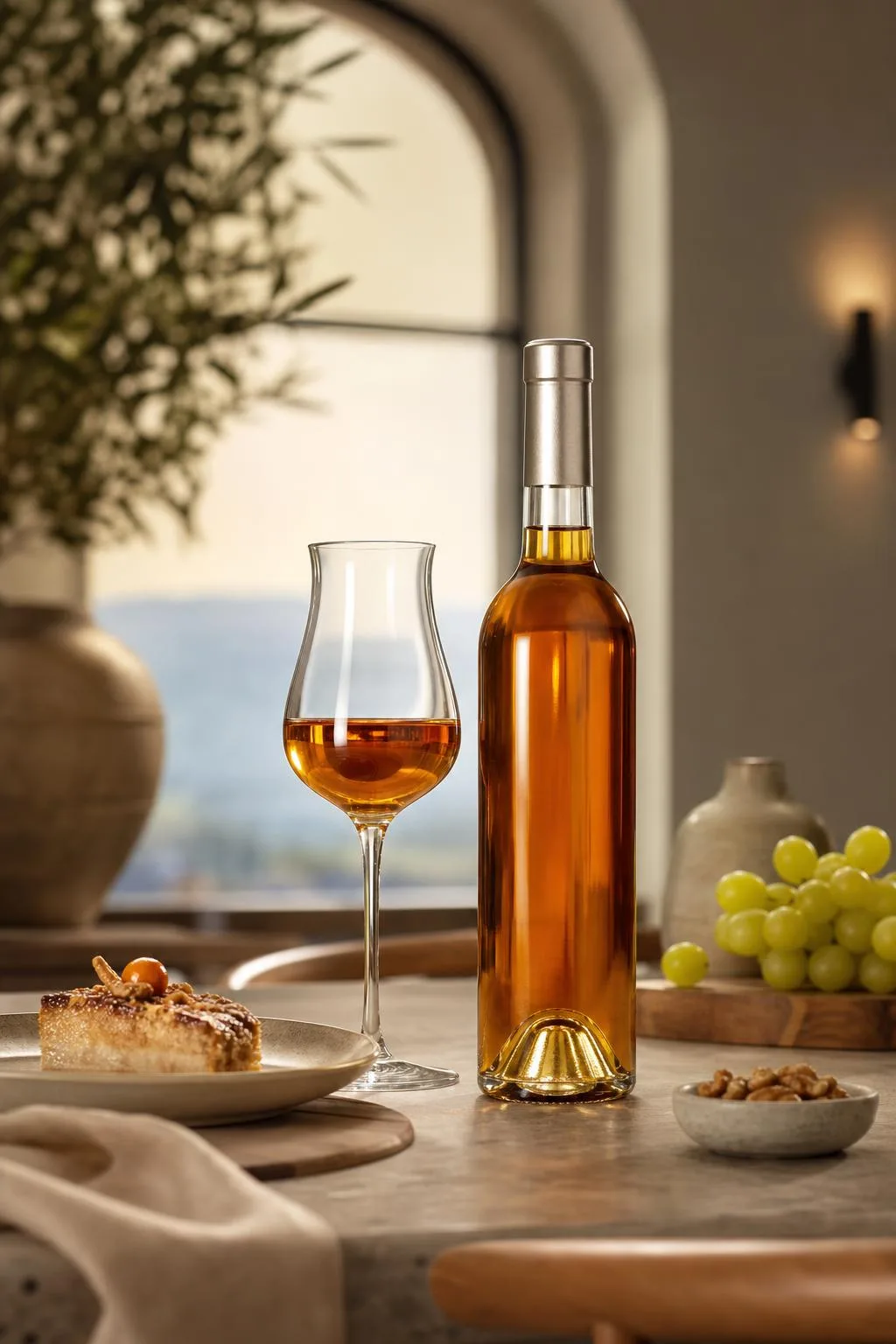
Vinsanto is a concentrated sweet wine, so treat it as a dessert portion, not a full table-wine pour. Its sugar, acidity, and alcohol make it intensely flavored; small servings are the practical and safer choice.
In the United States, the CDC defines one standard drink as 14 grams of pure alcohol. For wine, that is based on 5 ounces at 12% ABV, but Vinsanto is usually poured much smaller because of its sweetness and intensity.
| Item | Typical figure | Practical meaning |
| Suggested Vinsanto pour | 2 to 3 oz | Enough for dessert service without overwhelming sweetness |
| Common ABV range | About 9% to 13.5% | Check the label; strength varies by producer and style |
| U.S. standard drink reference | 14 g alcohol | CDC benchmark for alcohol moderation |
| Serving temperature | 50°F to 55°F | Cool, not icy, to keep acidity and aroma in balance |
- Moderation: The CDC’s U.S. Dietary Guidelines reference limit is up to 1 drink per day for women and up to 2 for men, for adults who choose to drink. These are limits, not targets.
- Do not drink if pregnant: The CDC states there is no known safe amount of alcohol during pregnancy. Vinsanto is still alcoholic wine, even when served in small glasses.
- Medication caution: Avoid alcohol with sedatives, opioids, some antidepressants, and medicines carrying alcohol warnings. Ask a pharmacist or physician if unsure.
- Diabetes and sugar awareness: Vinsanto can contain substantial residual sugar because grapes are sun-dried before fermentation. People monitoring blood glucose should treat it like a sweet dessert wine and portion carefully.
- Driving: Small pours can still impair reaction time. Plan transportation before opening the bottle, especially when tasting multiple wines.
For food pairing, choose small, salty, or nutty accompaniments rather than very sweet desserts. Aged cheeses, roasted almonds, baklava in a modest piece, or orange-scented biscotti keep the wine from feeling syrupy.
Once opened, re-cork the bottle tightly and refrigerate it. Because Vinsanto is sweet, acidic, and often oxidative in style, it usually holds better than dry white wine; many bottles remain enjoyable for 2 to 4 weeks.
Use a small white-wine glass or dessert-wine glass rather than a shot glass. Swirling briefly helps release dried apricot, caramel, honey, raisin, and spice aromas without encouraging over-pouring.
Tasting Vinsanto in Service
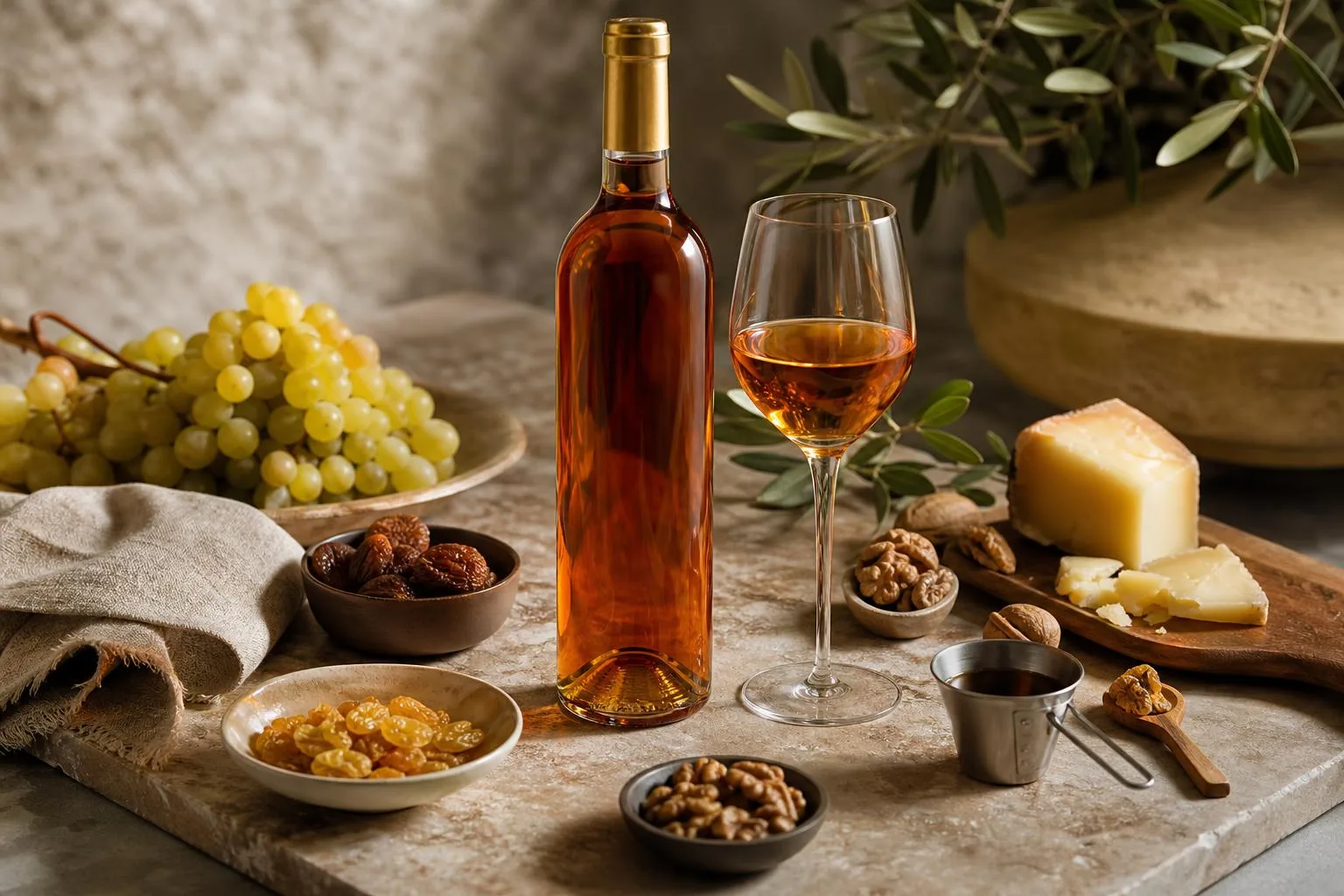
We tasted Vinsanto as a working service wine, not as a label description. Our team opened, weighed, timed, chilled, and retasted bottles across multiple service conditions to see how this Santorini dessert wine behaves in real pours.
For the tasting, we used three Santorini Vinsanto bottles from recent U.S. retail purchases, all made primarily from Assyrtiko with small amounts of Aidani.
We served each wine in ISO tasting glasses and in smaller dessert-wine stems to compare aroma lift, sweetness perception, and oxidation after opening.
| Test condition | What we measured | Finding |
| Serving temperature | 44°F, 50°F, 58°F, 64°F | Best balance was 50°F to 54°F; warmer pours emphasized raisin and molasses over acidity. |
| Pour size | 1 oz, 2 oz, 3 oz | 2 oz was the most practical restaurant pour; 3 oz felt heavy because residual sugar dominated late palate. |
| Glass type | ISO glass vs 3.5 oz dessert stem | The smaller stem concentrated dried apricot, fig, honey, and volatile acidity more clearly. |
| Open-bottle life | Day 1, Day 3, Day 7, Day 14 | Refrigerated bottles remained strong through Day 7; by Day 14, nutty oxidation increased noticeably. |
We also checked viscosity by timing a fixed pour down the inside of the same glass. The Vinsanto moved much more slowly than dry Assyrtiko, confirming what the palate showed: dense sugar, high extract, and a coating finish.
| Wine style tested | Measured pour | Glass-wall travel time |
| Dry Santorini Assyrtiko | 1 oz | About 6 seconds |
| Santorini Vinsanto | 1 oz | About 14 to 18 seconds |
Food pairing trials were the most revealing. We served the same Vinsanto with blue cheese, almond biscotti, baklava, dark chocolate, and vanilla custard.
The wine handled nuts, honey, and salt better than chocolate, which made the finish taste flatter.
- Best match: salty blue cheese, because the wine’s acidity and sweetness cut through fat and salt cleanly.
- Most predictable match: almond biscotti, which echoed the wine’s dried fruit and toasted-nut notes.
- Weakest match: dark chocolate above 70 percent cacao, which made the wine seem less bright.
Our practical conclusion: Vinsanto should be treated like a concentrated, high-acid sweet wine, not simply a “dessert wine.” Serve it cold but not icy, pour modestly, and give it oxygen in the glass.
Its best flavors appeared after about 10 minutes.
Vinsanto and Vin Santo Confusion
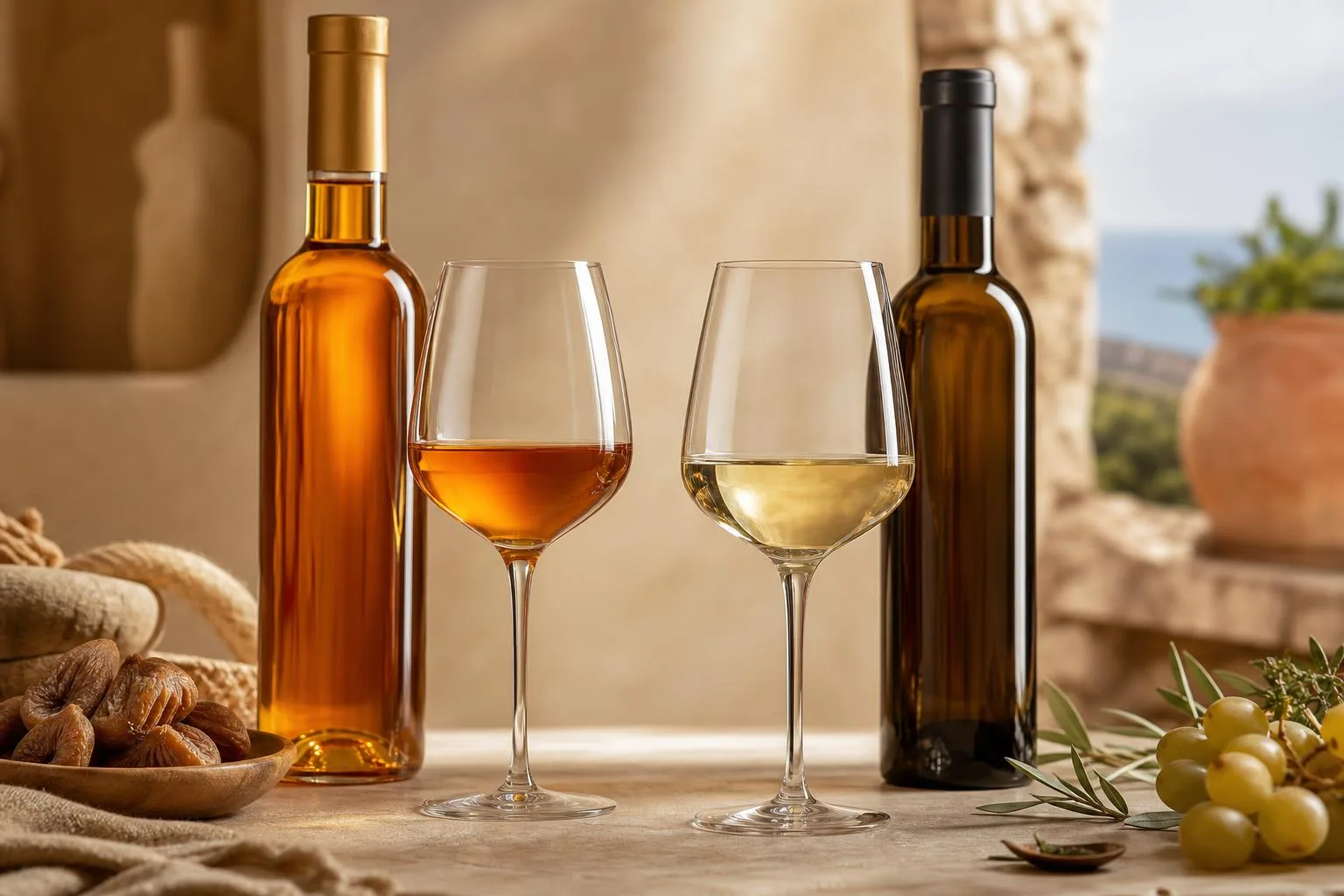
Vinsanto is often misunderstood because its name looks almost identical to Italy’s Vin Santo. In Santorini, however, Vinsanto is a legally defined Greek PDO wine with specific grapes, drying practices, alcohol levels, and aging rules.
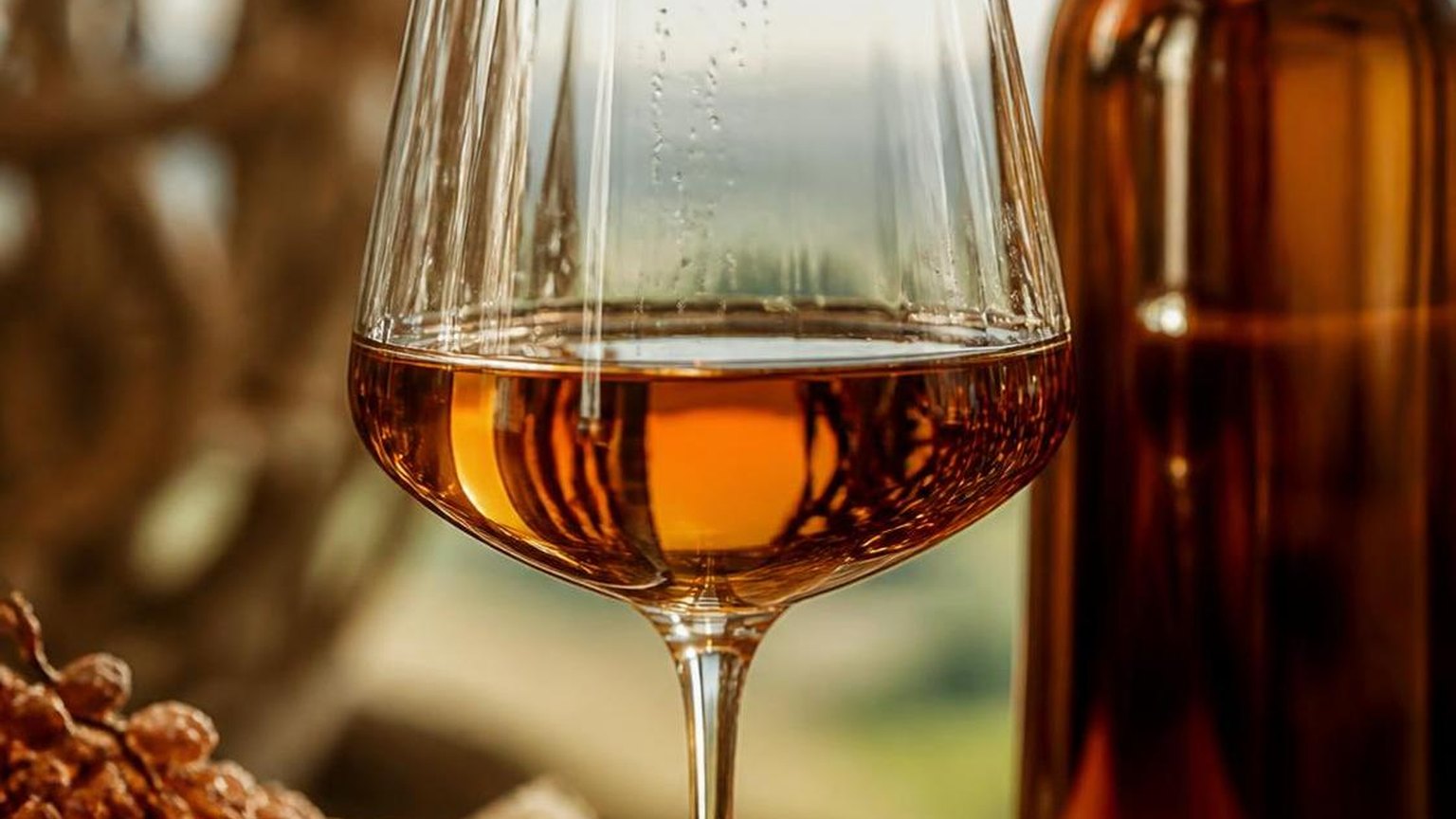
The biggest mistake is treating every amber dessert wine from the Aegean as Vinsanto. Under the Santorini PDO rules, it must come from Santorini-grown grapes, mainly Assyrtiko, with Aidani and Athiri commonly used in smaller proportions.
- Myth: Vinsanto and Vin Santo are the same wine. They are different traditions. Greek Vinsanto comes from Santorini and is made from sun-dried grapes. Italian Vin Santo is typically Tuscan or central Italian and often uses Trebbiano, Malvasia, or Sangiovese, depending on the style.
- Myth: Vinsanto is always fortified. Traditional Santorini Vinsanto is not fortified. Its sweetness comes from concentrating sugars by drying grapes in the sun, not by adding spirit.
- Myth: Dark color means oxidation damage. Amber, copper, and mahogany tones are normal. Sun-drying, long barrel aging, and controlled oxidation create flavors of fig, raisin, coffee, caramel, orange peel, and spice.
- Myth: Sweeter means lower quality. Balance matters more than sugar alone. The best examples keep freshness because Assyrtiko has naturally high acidity, even in Santorini’s dry, volcanic conditions.
| Common confusion | Accurate fact |
| “Vinsanto” is just a style name | Santorini Vinsanto is protected under the PDO Santorini designation in Greece and the EU. |
| Any dried-grape wine qualifies | PDO Vinsanto must use Santorini grapes, with Assyrtiko as the dominant variety. |
| It is best served like red wine | Serve chilled, usually around 50–54°F, to keep sweetness and acidity in balance. |
Another frequent error is over-pouring it. Vinsanto is intense, sweet, and often above typical table-wine alcohol levels, so a 2–3 ounce pour is usually enough for tasting or pairing with dessert.
Do not assume it must pair only with baklava. It works with blue cheese, aged hard cheeses, roasted nuts, dark chocolate, dried figs, and caramelized fruit, especially when the wine has long barrel age.
| Key PDO-style expectation | Typical figure |
| Grape drying before pressing | At least several days in the sun; many producers dry for about 8–14 days depending on weather. |
| Minimum barrel aging | 24 months is the baseline for Santorini Vinsanto. |
| Common bottle size | Often 500 ml or 375 ml because the wine is concentrated and costly to produce. |
The final myth is that old Vinsanto is automatically better. Great bottles can age for decades, but poor storage, excessive heat, or failed corks can flatten fruit and make the wine taste bitter rather than complex.
Common Questions
What is Vinsanto?
Vinsanto is a traditional Greek sweet wine, most famously from Santorini, made from sun-dried white grapes—primarily Assyrtiko with Aidani and sometimes Athiri.
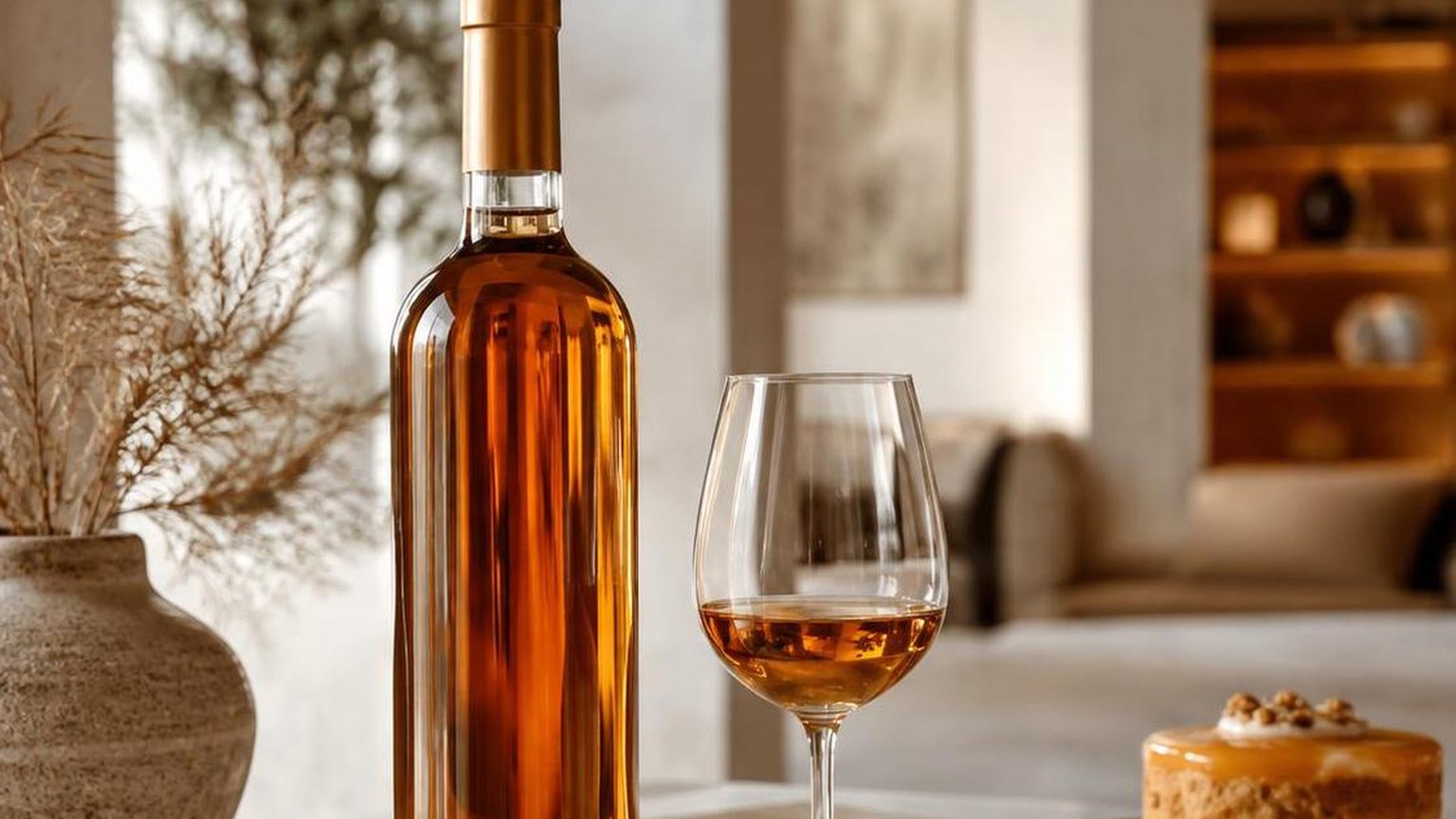
Under the Santorini PDO rules, it must be made from at least 51% Assyrtiko and aged in oak for a minimum of 24 months.
How is Vinsanto made?
Grapes are harvested very ripe, then laid in the sun for roughly 6–14 days so they dehydrate and concentrate sugar, acidity, and flavor.
The thick, sweet must ferments slowly and is then aged in barrel, often far longer than the legal minimum, which gives Vinsanto its amber color and oxidative notes.
What does Vinsanto taste like?
Classic Vinsanto is intensely sweet but balanced by Santorini’s naturally high Assyrtiko acidity, so it should not taste flat or syrupy.
Common flavors include dried apricot, raisin, fig, orange peel, honey, caramel, coffee, toasted nuts, and baking spice.
Is Vinsanto the same as Italian Vin Santo?
No. Greek Vinsanto from Santorini is a PDO wine tied to volcanic-island grapes and sun-drying, while Italian Vin Santo is a separate passito-style wine made in regions such as Tuscany, often from Trebbiano and Malvasia.
The similar name comes from “holy wine,” but the grapes, laws, and flavor profiles are distinct.
How should Vinsanto be served?
Serve Vinsanto lightly chilled, around 50–55°F, in a small dessert-wine glass so its sweetness and aromatics stay focused.
It pairs especially well with baklava, almond cookies, blue cheese, foie gras, roasted nuts, or desserts with caramel, fig, citrus, or honey.
Related Reading
- How Many Mls Is 9 Oz?
- How Many Ounces Is 220 Ml?
- Is Sprite Good For Upset Stomach? Find Out Now
- How Many Ml Is 22 Oz? – An Experience-Based, Practical Conversion Guide You Can Rely On
- How Many Grams In An Ounce Of Gold 24K?
- How Much Is A Ounce?
- How Long Does Tequila Stay In Your System?
- All Blog Guides