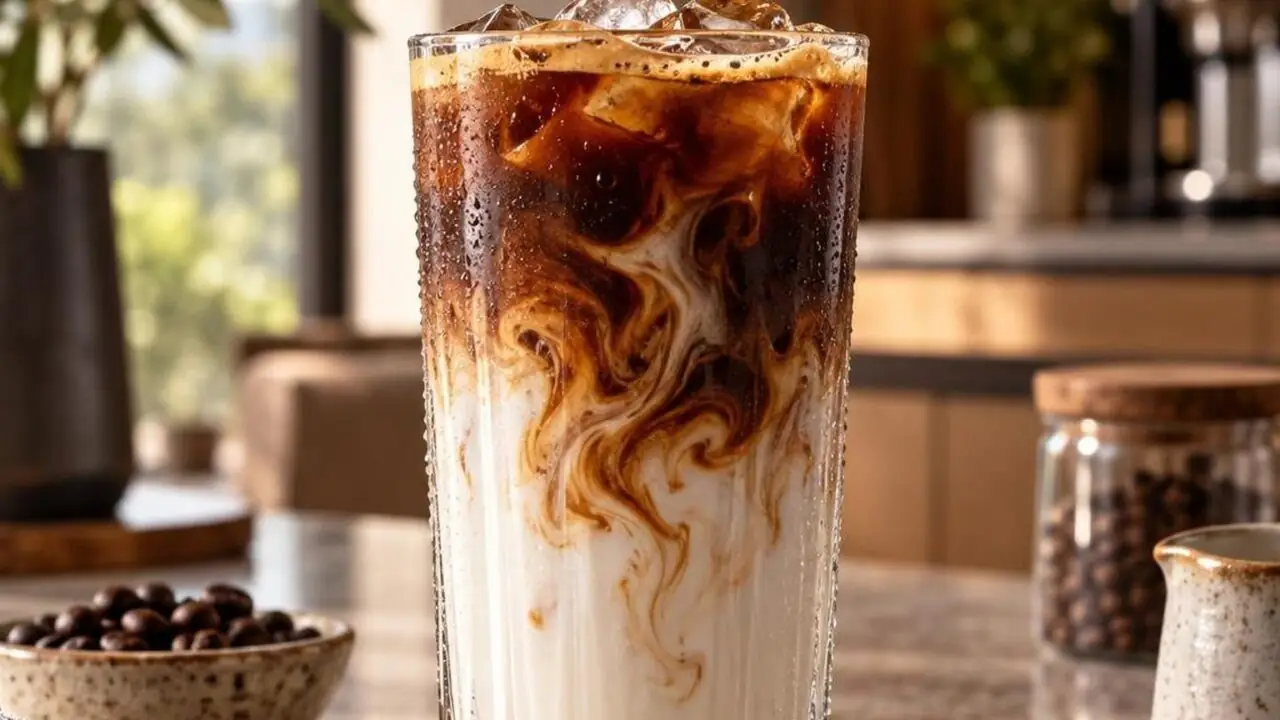
black and white drink is a layered or high-contrast beverage built around dark and pale ingredients, served for visual impact before flavor complexity.
In bars, the phrase usually points to a two-tone cocktail, mocktail, or dessert-style drink where color separation, garnish, and glassware define the presentation.
The appeal comes from contrast: opaque cream against dark syrup, clear spirits against black liqueur, or pale foam above a deep base.
A well-made version balances sweetness, acidity, texture, and aroma so the drink looks dramatic without tasting flat or sugary.
This guide explains common styles, ingredient choices, layering methods, serving tips, and ordering language, so you can recognize a black and white drink on a menu or build one cleanly at home.
What Black and White Drink Means
A black and white drink refers to any beverage combining a dark ingredient with a white one—most commonly coffee with milk, stout with cream, or chocolate with vanilla.
The term spans cocktail culture, café menus, and regional traditions across multiple continents.
The phrase carries different meanings depending on context and geography. Here are the most recognized interpretations:
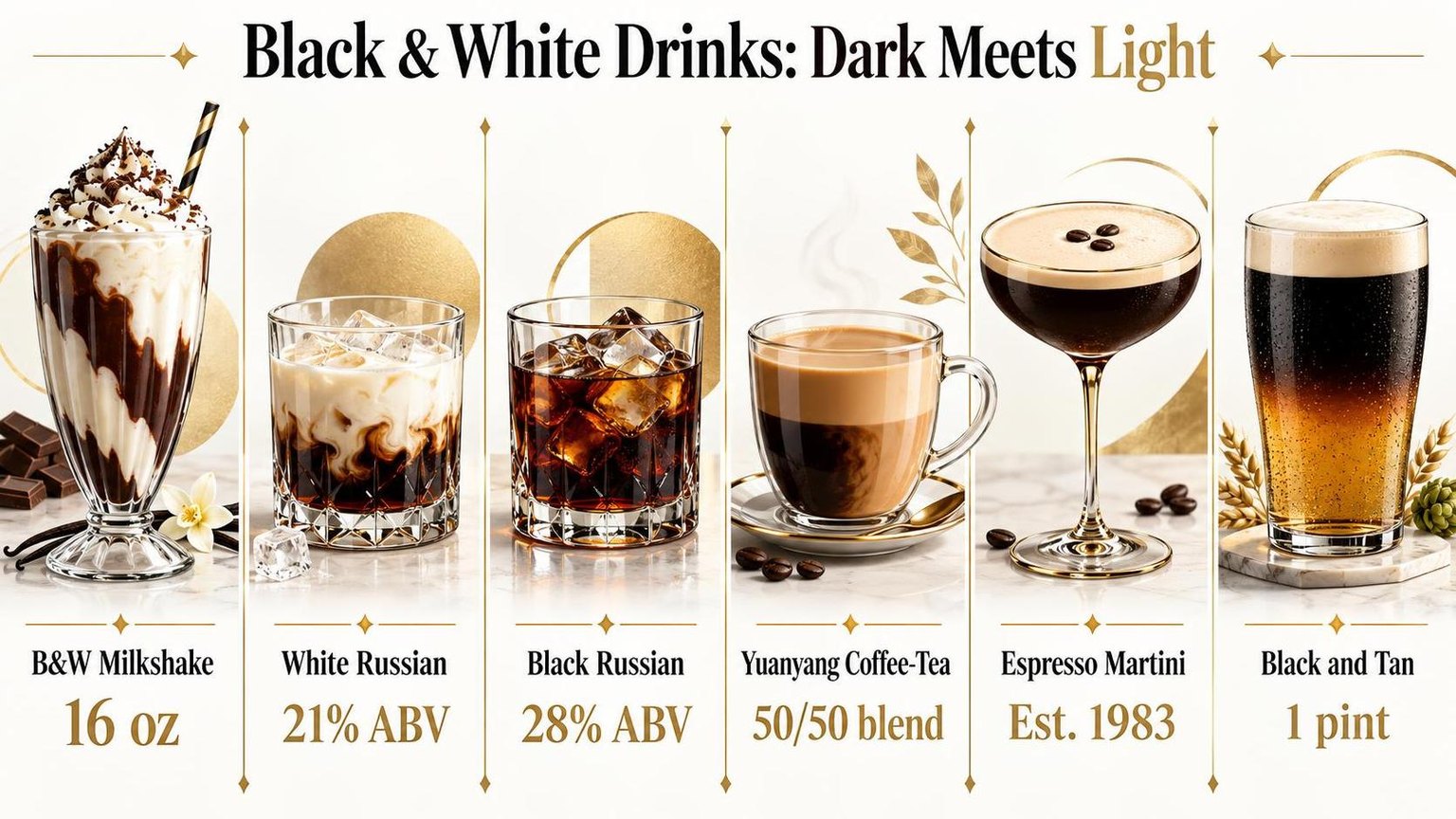
- Black and White (New York diner style): A chocolate milkshake made with vanilla ice cream, originating in mid-20th-century Manhattan soda fountains
- Black and White Russian: A layered cocktail pairing Kahlúa (black) with heavy cream or milk (white), containing roughly 20–25% ABV
- Hong Kong Yuanyang (鴛鴦): A 50/50 blend of coffee and milk tea, served daily at over 6,000 cha chaan teng restaurants across the city since the 1950s
- Black and Tan: A layered beer combining a pale ale (white/gold) with a stout like Guinness (black), poured over an inverted spoon to maintain separation
- Café au lait or flat white: Espresso paired with steamed milk, visually creating a gradient from dark to light
The visual contrast defines these drinks more than any single recipe does. Layering techniques separate the dark and light components for dramatic presentation.
| Drink | Dark Component | White Component | Typical Serving Size |
| Black & White milkshake | Chocolate syrup | Vanilla ice cream | 16 oz |
| White Russian | Kahlúa (53 ml) | Heavy cream (30 ml) | 6 oz |
| Yuanyang | Brewed coffee | Hong Kong milk tea | 8–12 oz |
| Black and Tan | Stout (half pint) | Pale ale (half pint) | 16 oz (1 pint) |
In cocktail bars, the black and white concept extends to garnish philosophy. Activated charcoal creates jet-black bases, while coconut cream or egg white foam provides the contrasting white layer.
The term has no single inventor or fixed recipe. It functions as a descriptive category—any drink achieving stark visual duality between dark and light elements qualifies.
Classic Black and White Cocktail Recipes
Black and white cocktails pair dark spirits or liqueurs with cream, milk, or white-colored ingredients to create visually striking drinks.
These recipes span from 19th-century coffee cocktails to modern layered creations served at craft bars worldwide.
Black Russian and White Russian
The Black Russian originated in 1949 at the Hotel Metropole in Brussels, created by bartender Gustave Tops for the U.S. Ambassador to Luxembourg, Perle Mesta.
| Component | Black Russian | White Russian |
| Vodka | 50 ml (2 oz) | 50 ml (2 oz) |
| Coffee liqueur | 25 ml (1 oz) | 25 ml (1 oz) |
| Heavy cream | None | 25 ml (1 oz) |
| ABV (approx.) | 28% | 21% |
| Calories (approx.) | 155 | 240 |
The White Russian gained massive cultural recognition after the 1998 film The Big Lebowski, where Jeff Bridges’ character “The Dude” drinks nine of them throughout the movie.
Black and White Martini
This cocktail layers dark crème de cacao with vanilla vodka and cream. Standard proportions use 45 ml vanilla vodka, 30 ml dark crème de cacao, and 15 ml heavy cream, shaken with ice and strained into a chilled coupe glass.
Espresso Martini
Dick Bradsell invented this drink in 1983 at Fred’s Club in London. A model reportedly asked him for something to “wake me up and then f*** me up.”.
- Vodka: 50 ml (2 oz)
- Coffee liqueur (Kahlúa): 25 ml (1 oz)
- Fresh espresso: 25 ml (1 oz), brewed and slightly cooled
- Simple syrup: 10 ml (⅓ oz), optional
Shake vigorously for 10–15 seconds to produce the signature crema on top. Three coffee beans garnish represents health, wealth, and happiness — an Italian tradition called “con la mosca.”.
Preparation Tips
Layered black and white drinks require pouring cream slowly over the back of a bar spoon. Temperature matters: chilled ingredients at 4°C (39°F) hold their separation longer than room-temperature pours.
Use freshly brewed espresso within 30 seconds of extraction for espresso-based cocktails. Stale espresso loses the oils needed to form stable foam and produces a flat, bitter result.
Layered Coffee and Cream Versions
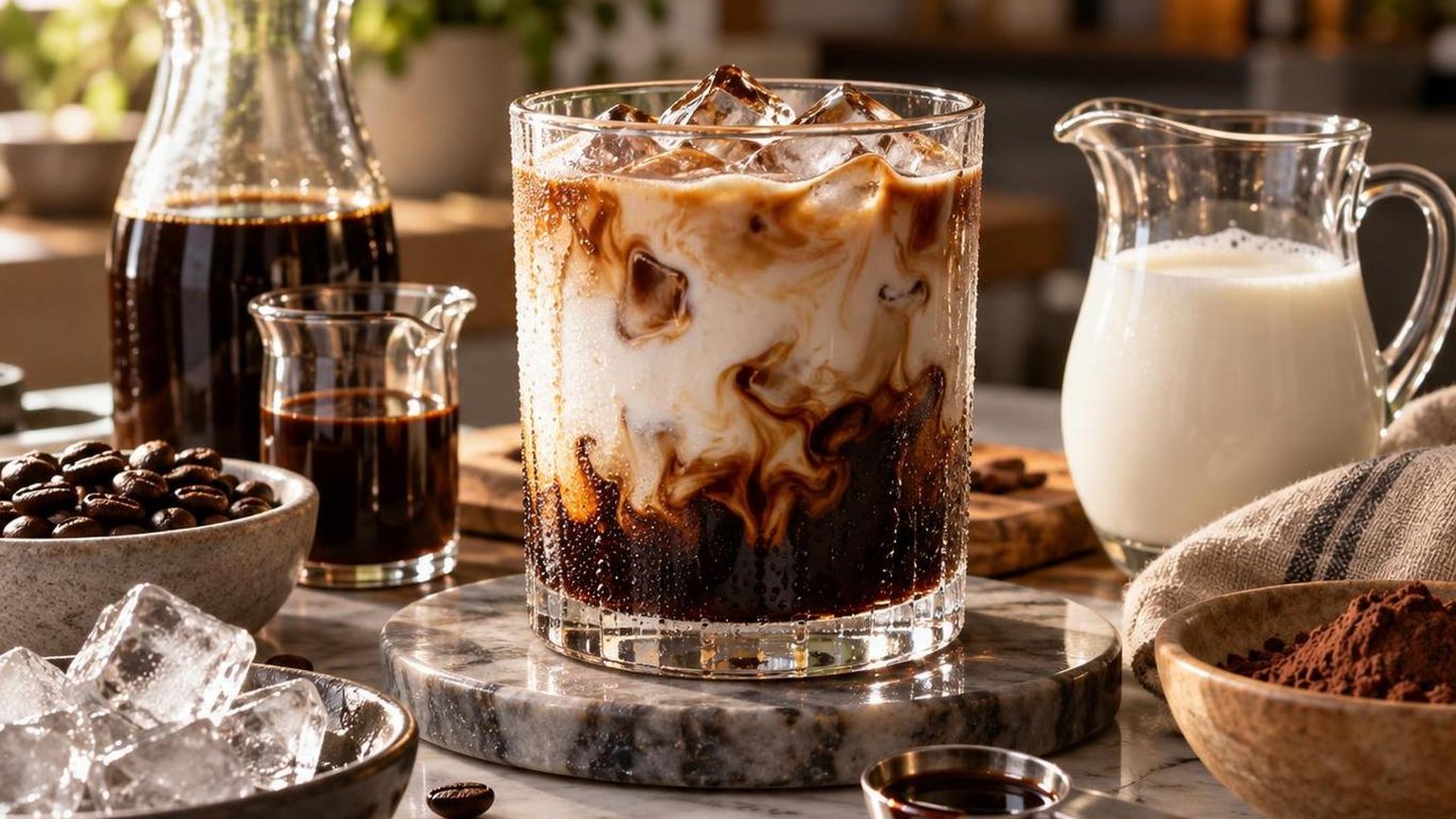
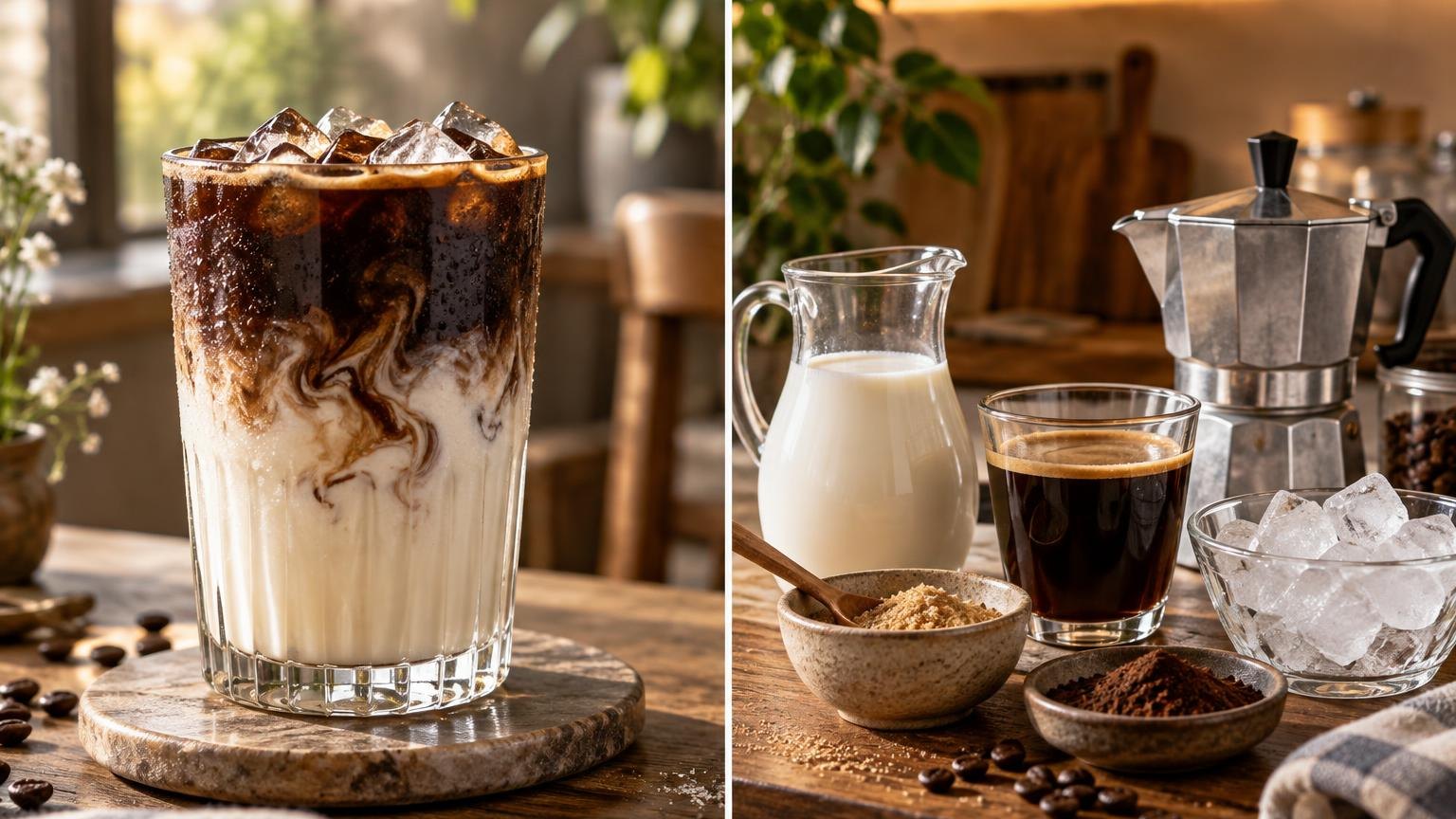
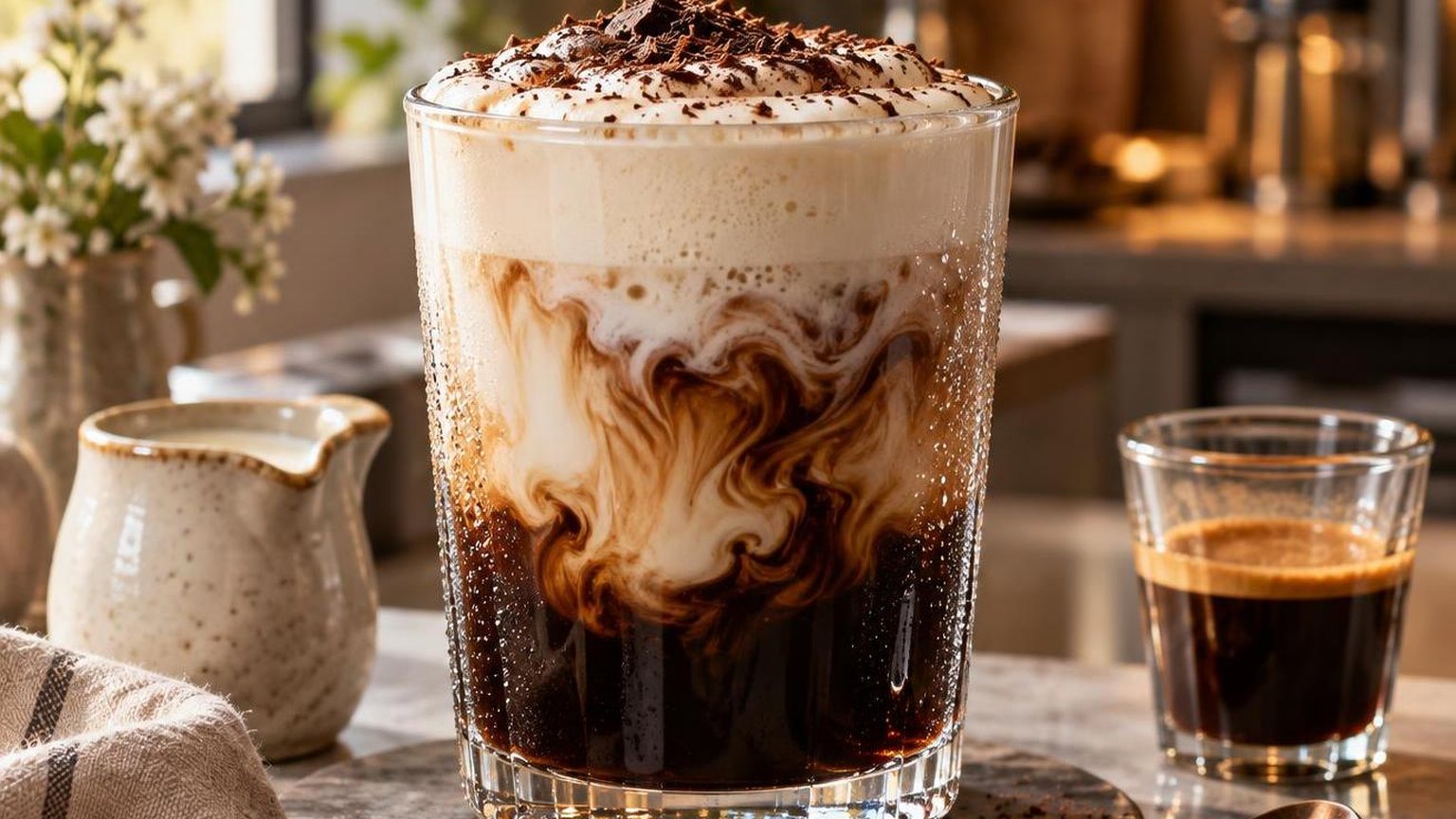
The black and white drink finds its most photogenic expression in layered coffee-and-cream preparations.
Density differences between espresso (specific gravity ~1.006) and cold milk (~1.033) create the signature stratified appearance without any special equipment.
How the Layers Form
Liquid density determines layer order. Heavier fluids sink; lighter ones float. Sugar-laden syrups and cold milk sit at the bottom while hot espresso, being less dense, rests on top.
| Layer Component | Specific Gravity | Position in Glass |
| Vanilla syrup (2:1 ratio) | ~1.300 | Bottom |
| Whole milk (chilled, 4°C) | ~1.033 | Middle |
| Espresso (hot, 90°C) | ~1.006 | Top |
| Frothed milk foam | ~0.550 | Crown |
Pouring speed matters critically. A slow pour of approximately 10 mL per second over an inverted spoon keeps layers distinct. Faster pours create turbulence that mixes the strata.
Classic Layered Black and White Recipes
- Black and White Latte: 30 mL white chocolate syrup, 180 mL cold milk, and a double espresso (60 mL) poured last to create a dark-over-light contrast.
- Tuxedo Mocha: Equal parts dark chocolate sauce (20 mL) and white chocolate sauce (20 mL) layered beneath 240 mL steamed milk and a 60 mL espresso shot.
- Irish-style Black and Tan Coffee: Cold brew concentrate floated over sweetened condensed milk at a 3:1 ratio, served in a 350 mL glass.
Temperature and Timing Factors
Temperature gaps strengthen separation. A difference of at least 50°C between espresso and refrigerated milk produces the sharpest visual divide between layers.
Layers begin diffusing within 3–5 minutes through convective mixing. Serving immediately preserves the contrast. Stirring before drinking blends flavors into a balanced 1:3 coffee-to-milk ratio.
Tall, narrow glassware (height-to-diameter ratio above 3:1) showcases layers best. A standard 360 mL latte glass with a 70 mm diameter displays three to four distinct bands clearly from the side.
Black and White Russian Variations
The White Russian and Black Russian share a common base of vodka and coffee liqueur but diverge with one ingredient: cream.
Belgian bartender Gustave Tops created the Black Russian in 1949 at Brussels’ Hotel Metropole; the White Russian emerged roughly two decades later.
The Black Russian combines two ingredients. The White Russian adds heavy cream or half-and-half as a third. This single addition shifts the drink’s character, calorie count, and flavor profile dramatically.
| Attribute | Black Russian | White Russian |
| Year of origin | 1949 | Late 1960s |
| Number of ingredients | 2 | 3 |
| Vodka (standard pour) | 50 ml (1.7 oz) | 50 ml (1.7 oz) |
| Coffee liqueur | 20 ml (0.7 oz) | 20 ml (0.7 oz) |
| Heavy cream | None | 30 ml (1 oz) |
| Approximate calories | 160–180 kcal | 275–320 kcal |
| ABV (approx.) | 28–32% | 20–24% |
| Serve style | Stirred, on rocks | Layered or stirred, on rocks |
The Black Russian’s higher ABV results from having no diluting cream. Its flavor leans bitter-sweet with pronounced coffee and spirit warmth.
The White Russian gained mainstream fame after the 1998 film The Big Lebowski. Jeff Bridges’ character, “The Dude,” drinks nine White Russians throughout the movie, turning the cocktail into a cultural icon.
Common Riffs on the Formula
- Blind Russian: Replaces cream with Baileys Irish Cream, adding 5–6 g sugar per serving.
- Colorado Bulldog: A White Russian topped with 60–90 ml of cola for effervescence.
- Anna Kournikova: Uses skim milk instead of cream, cutting roughly 80–100 calories.
- Dirty Russian: Substitutes chocolate milk for cream, adding cocoa richness.
- Mudslide: Combines vodka, coffee liqueur, and Baileys in equal 30 ml parts, often blended with ice.
Both cocktails use Kahlúa as the standard coffee liqueur, though Tia Maria (26.5% ABV versus Kahlúa’s 20%) produces a drier, less sweet result with stronger Jamaican coffee notes.
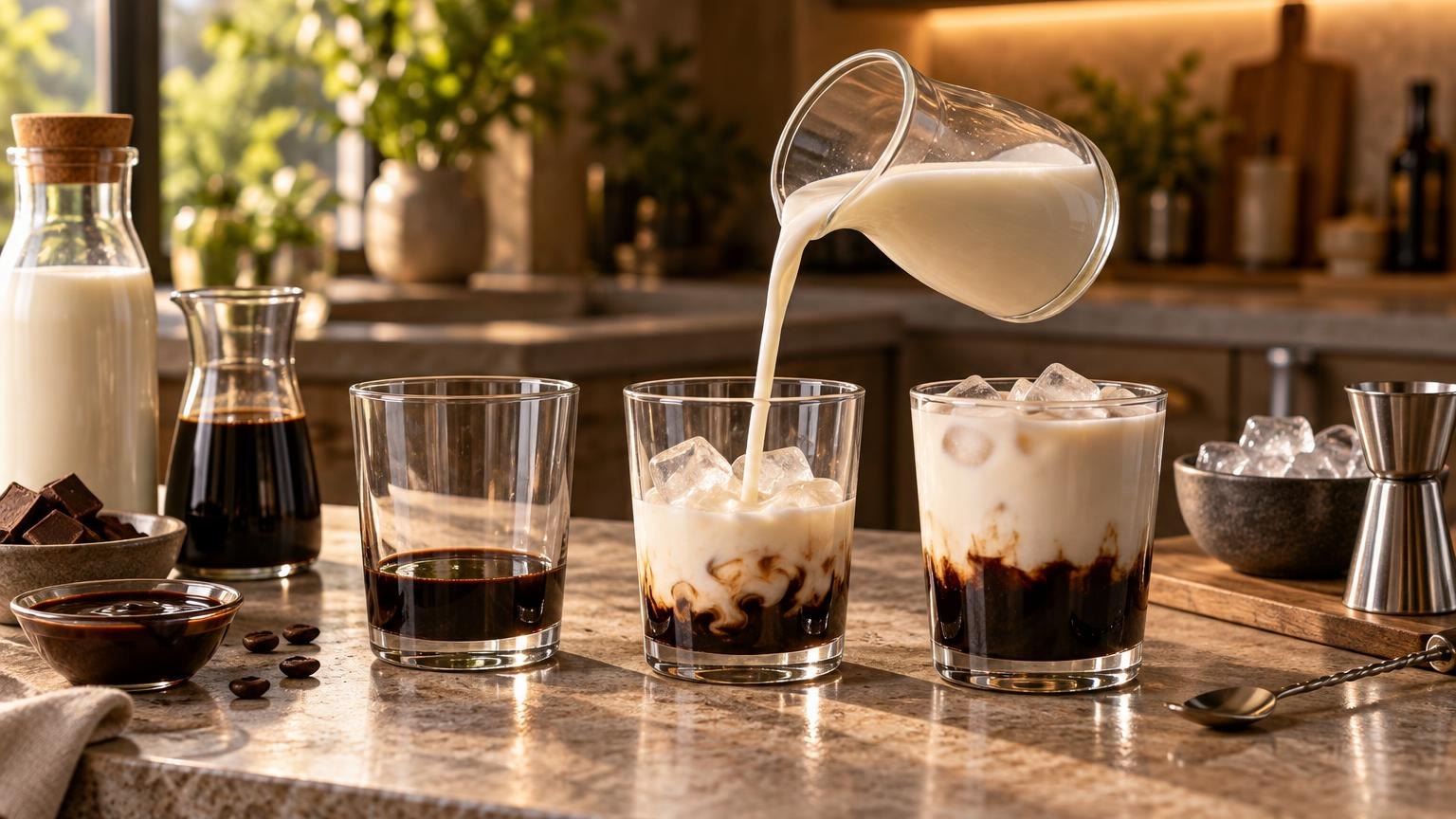
For home preparation, chill the glass and pour the vodka and coffee liqueur first. Float the cream over the back of a bar spoon for the classic layered White Russian presentation. Stir only if you prefer a uniform, latte-colored drink.
Beer Based Black and White Drinks
Beer culture produced some of the most iconic black and white drinks long before craft cocktails existed. These layered pours exploit density differences between stout and pale beer, creating striking visual contrast in a single glass.
The Black and Tan
A Black and Tan layers pale ale on the bottom with stout floated on top. The classic combination uses Bass Pale Ale (1.010 final gravity) beneath Guinness Draught (1.006 final gravity).
Guinness floats because nitrogen-infused beer is less dense than carbonated ale.
Pouring technique matters. Fill the glass halfway with pale ale, then pour stout slowly over an inverted spoon. The spoon disperses flow, preventing the layers from mixing.
Regional Variations
| Drink Name | Bottom Layer | Top Layer | Origin |
| Black and Tan | Bass Pale Ale | Guinness Draught | England |
| Half and Half | Harp Lager | Guinness Draught | Ireland |
| Black and Blue | Blueberry ale | Guinness Draught | United States |
| Black Velvet | Champagne | Guinness Draught | England, 1861 |
Note: the term “Black and Tan” carries negative historical connotations in Ireland, referencing the Royal Irish Constabulary Reserve Force of 1920–1921. Irish pubs typically call the drink a “Half and Half” instead.
Black Velvet
Created in 1861 at Brooks’s Club in London to mourn Prince Albert’s death, the Black Velvet combines equal parts Guinness and Champagne. The original recipe specifies a 1:1 ratio, poured simultaneously into a flute or tall pilsner glass.
A “Poor Man’s Black Velvet” substitutes sparkling cider for Champagne, reducing cost from roughly $15–20 per serving to under $5 while maintaining the layered black-over-gold appearance.
Serving Essentials
- Use a 16 oz (473 ml) pint glass for Black and Tans
- Chill both beers to 40–45°F (4–7°C) before pouring
- Pour the denser, carbonated beer first — always
- Allow 15–20 seconds between layers for clean separation
Nonalcoholic Black and White Options
The black and white drink concept extends well beyond cocktails. Several iconic nonalcoholic beverages pair dark and light elements, delivering striking visual contrast alongside complementary flavor profiles.
The Black and White Milkshake
New York City’s classic black and white milkshake blends chocolate syrup with vanilla ice cream. A standard 16-ounce serving contains approximately 550–700 calories depending on preparation.
The drink originated at soda fountains in the early 1900s. It remains a staple at NYC institutions like Lexington Candy Shop, operating since 1925, and Tom’s Restaurant in Brooklyn.
Black and White Coffee Drinks
Hong Kong’s yuenyeung (鸳鸯) combines black coffee with milk tea at a roughly 3:7 ratio. The drink contains approximately 100–150 mg of caffeine per 12-ounce serving from dual caffeine sources.
A standard iced black and white mocha layers dark chocolate and white chocolate sauces with espresso and steamed milk. Starbucks’ version runs around 370 calories for a 16-ounce grande.
Nutritional Comparison of Popular Black and White Drinks
| Drink | Serving Size | Calories | Caffeine (mg) | Sugar (g) |
| Black & White Milkshake | 16 oz | 550–700 | 0 | 65–80 |
| Yuenyeung (HK milk coffee tea) | 12 oz | 150–200 | 100–150 | 20–30 |
| Iced Black & White Mocha | 16 oz | 350–410 | 150 | 45–52 |
| Black Sesame Latte | 12 oz | 180–250 | 75 | 15–22 |
Trending: Black Sesame and Activated Charcoal
Black sesame lattes use ground black sesame paste swirled into steamed milk, creating a dramatic grey-to-white gradient. One tablespoon of black sesame contains 52 calories and 1.6 grams of protein.
Activated charcoal lemonades layer jet-black charcoal-infused liquid over white coconut cream. The FDA permits activated charcoal in food, though it can interfere with medication absorption within a 2-hour window.
- Best for visual impact: Activated charcoal coconut lemonade — stark two-tone separation
- Best for balanced flavor: Yuenyeung — bitter coffee tempered by sweet milk tea
- Best for dessert replacement: Black and white milkshake — rich, indulgent, zero caffeine
- Best for everyday drinking: Black sesame latte — moderate calories, earthy nutty flavor
Serving Glassware and Garnish Choices
The Black and White drink—a layered combination of dark stout and pale lager—demands specific glassware to showcase its visual contrast.
Glass selection directly affects foam retention, aroma concentration, and the stability of the layered pour.
Recommended Glassware
A 16-ounce (473 ml) pint glass remains the traditional vessel for Black and White drinks served in Irish and British pubs. The straight-sided shaker pint allows clean layering.
| Glass Type | Capacity | Best For | Layering Ease |
| Shaker Pint | 16 oz (473 ml) | Classic pub service | High |
| Nonic Pint | 20 oz (568 ml) | Imperial pint pours | High |
| Tulip Glass | 13–16 oz (384–473 ml) | Aroma enhancement | Moderate |
| Pilsner Flute | 12 oz (355 ml) | Maximum visual contrast | Low |
The Nonic pint, with its signature bulge at 3/4 height, provides a natural grip point and reduces chipping. It is the standard 20 oz imperial glass across the UK and Ireland.
Pouring Technique for Layering
Achieving a clean separation requires pouring the lighter lager first, filling approximately 60% of the glass. The stout floats on top using an inverted bar spoon held against the glass interior, poured slowly at a 45-degree angle.
Temperature matters: serve the lager at 38–42°F (3–6°C) and the stout at 44–50°F (7–10°C). The temperature difference helps maintain density separation between layers.
Garnish Options
Traditional Black and White drinks require no garnish. The visual layering itself serves as the presentation. Some modern variations add minimal accents:
- No garnish — purist approach, standard in 90% of pub service
- Shamrock stencil — drawn in the stout foam using a cardboard template and cocoa powder
- Lemon zest twist — occasionally paired with wheat-based lager versions to lift citrus aromatics
- Chocolate shavings — used in dessert-oriented variations featuring milk stout
Avoid heavy garnishes like fruit wedges or herb sprigs. They disrupt the foam layer and collapse the visual separation that defines the drink’s identity.
Common Questions
What is a Black and White drink?
A Black and White is a classic American soda fountain drink made by combining chocolate syrup with vanilla ice cream and milk, then blending or shaking until smooth.
The name refers to the visual contrast between the dark chocolate and the white vanilla components.
It originated in New York City drugstore soda fountains in the early 20th century and remains a staple at iconic establishments like Lexington Candy Shop on the Upper East Side.
How does a Black and White differ from a standard chocolate milkshake?
A standard chocolate milkshake uses chocolate ice cream as its base, producing a uniformly chocolate flavor throughout.
The Black and White specifically pairs vanilla ice cream with chocolate syrup, creating a lighter, more nuanced flavor where the vanilla dairy sweetness and the bittersweet chocolate remain distinctly perceptible rather than fully merged.
This distinction is strictly maintained in traditional New York soda fountain culture.
The Black and White drink is a chocolate-and-vanilla milkshake-style beverage, while the Black and White cookie is a soft, cake-like disc topped half with vanilla fondant and half with chocolate fondant.
Both are deeply rooted in New York City food culture, but the cookie traces its origins to Glaser’s Bake Shop (opened 1902) and Bavarian-style baking traditions.
Whereas the drink belongs to the soda fountain tradition that peaked between the 1920s and 1950s.
Can a Black and White drink be paired with wine?
The chocolate-vanilla profile pairs surprisingly well with wines that complement both elements: a Banyuls or Maury from Roussillon (fortified Grenache with cocoa notes), a Rutherglen Muscat from Australia at around 17–18% ABV.
Or a Pedro Ximénez sherry with its intense caramel-raisin sweetness.
These wines match the drink’s richness without being overwhelmed by the chocolate, making them effective dessert-course pairings at approximately 3–4 oz pours served at 14–16 °C.
How many calories are in a typical Black and White drink?
A standard 16 oz Black and White made with two scoops (approximately 200 g) of full-fat vanilla ice cream, 8 oz whole milk, and 2 tablespoons of chocolate syrup contains roughly 550–650 calories, 22–28 g of fat, and 70–80 g of sugar.
Substituting low-fat milk and reduced-sugar syrup can lower the total to approximately 400 calories, though traditionalists argue this compromises the creamy mouthfeel that defines the drink.
Further Reading
- What Alcohol Is In Mike’S Hard Lemonade?
- How Many Bottles Of Wine For 50 Guests? The Ultimate Practical Guide (With Real-World Experience)
- Who Makes Kirkland Wine At Costco?
- Does Margarita Mix Have Alcohol?
- How Many 8 Ounces In A Gallon?
- Beers with Brewers Yeast and How They Taste
- How Many Grams An Ounce?
- How To Get A Cork Out?
- What Type Of Beer Is Budweiser?
- All Blog Guides
- U.S. Food & Drug Administration – Spilling the Beans: How Much Caffeine Is Too Much? (2023)
- National Institutes of Health, National Institute on Alcohol Abuse and Alcoholism – Alcohol's Effects on the Body (2023)
- USDA FoodData Central – Coffee, brewed (2024)
- Harvard T.H. Chan School of Public Health – The Nutrition Source: Coffee (2023)
- PubMed Central – Coffee Consumption and Health: Umbrella Review of Meta-Analyses (2017)
- Centers for Disease Control and Prevention – Dietary Guidelines for Alcohol (2024)
- Cornell University, Department of Food Science – Milk Composition and Chemistry (2023)