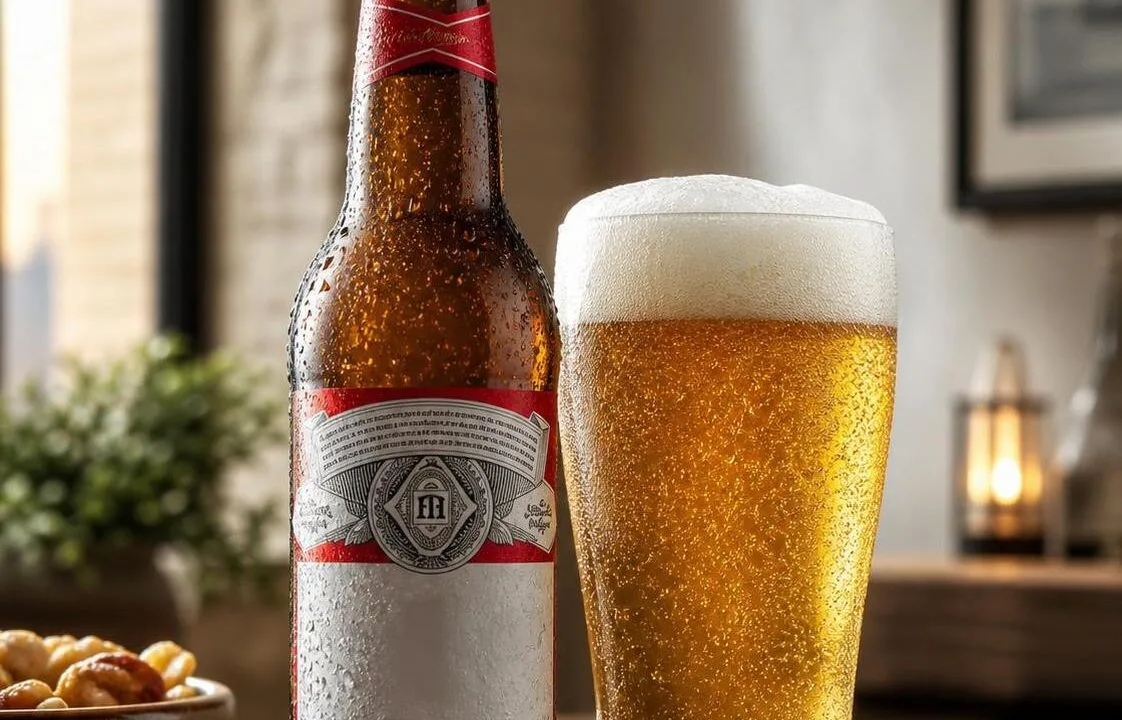
What Type Of Beer Is Budweiser is an American-style pale lager: light-bodied, clear golden, highly carbonated, and brewed for a crisp, clean finish.
Anheuser-Busch uses barley malt, rice, hops, water, and yeast, with Budweiser typically listed at 5% ABV in the United States.
In practical tasting terms, Budweiser sits in the standard lager family rather than ale, stout, IPA, or pilsner-style craft categories.
Expect mild grain sweetness, low hop bitterness, a dry finish, and easy-drinking balance—traits that define mass-market American lagers and explain its long-standing stadium, bar, and backyard popularity.
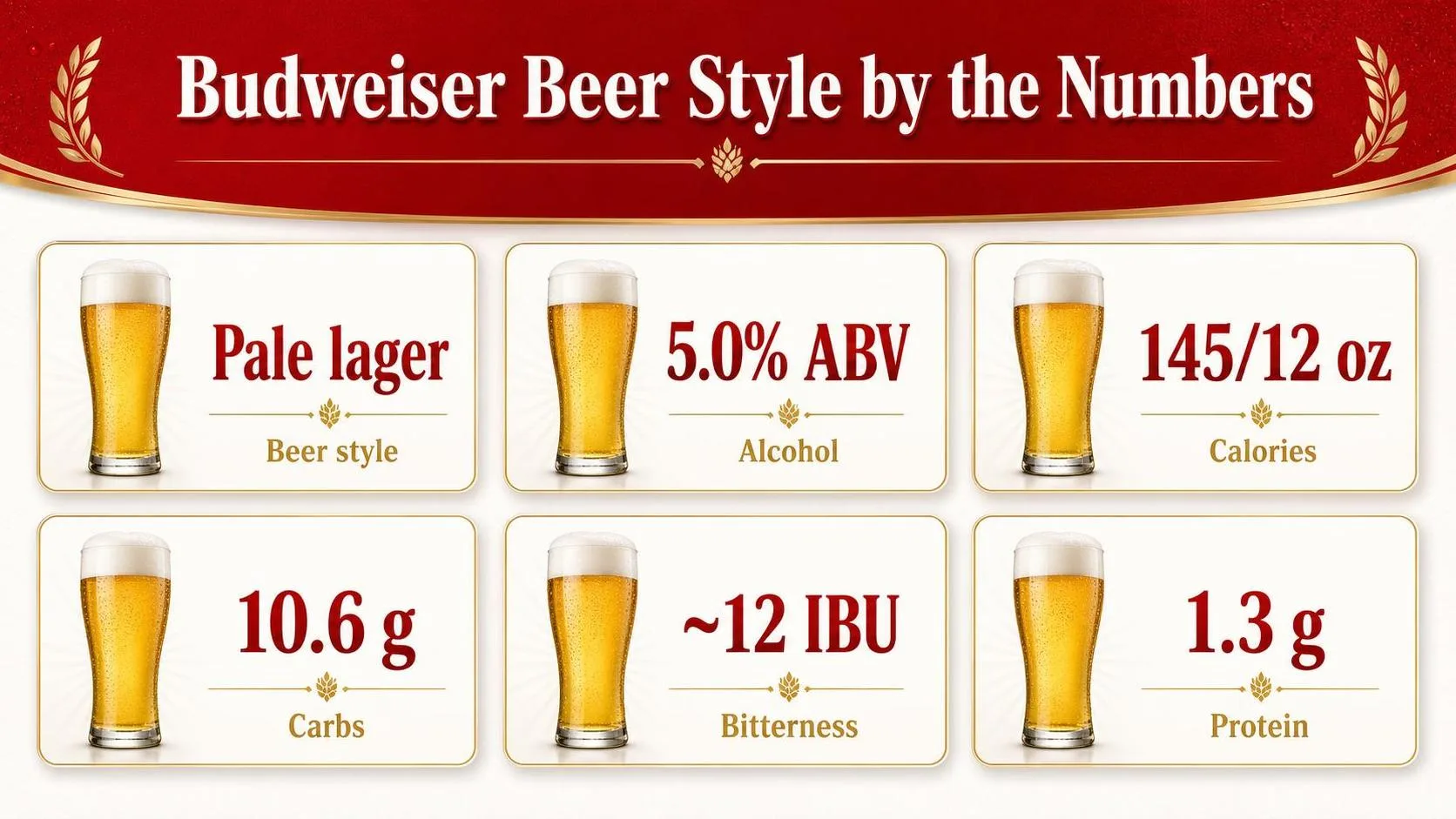
Budweiser’s Style and Core Traits
Budweiser is an American-style pale lager: light in body, clean-fermented, moderately carbonated, and built for consistency rather than hop intensity.
The numbers below explain why it tastes crisp, slightly sweet, and less bitter than many ales or craft lagers.
These figures are for the standard U.S. Budweiser lager, not Bud Light, Budweiser Zero, or flavored line extensions.
| Measure | Budweiser figure | What it means |
| Beer style | American-style pale lager | Bottom-fermented, pale, clean, and easy-drinking |
| Alcohol by volume | 5.0% ABV | Standard-strength lager; stronger than Bud Light at 4.2% ABV |
| Calories | 145 per 12 fl oz | Typical for a full-strength American lager |
| Carbohydrates | 10.6 g per 12 fl oz | Comes mainly from residual malt and rice-derived sugars |
| Protein | 1.3 g per 12 fl oz | Low, as expected for a highly filtered lager |
| Fat | 0 g | Beer normally contains no fat |
| Bitterness | About 12 IBU | Noticeably low bitterness versus pilsners, pale ales, and IPAs |
The 5.0% ABV places Budweiser in the regular lager category, not the light-beer category. In practical terms, one 12-ounce serving contains about 0.6 fluid ounces of pure alcohol, the U.S. definition of one standard drink.
The 145-calorie count is closely tied to its alcohol and carbohydrate content. Alcohol contributes about 7 calories per gram, while carbohydrates contribute about 4 calories per gram.
That is why Budweiser lands well above ultra-light beers but below many higher-ABV craft beers.
The roughly 12 IBU bitterness level is a major clue to the style. German pilsners commonly taste sharper because they carry more hop bitterness, while American IPAs can be several times higher.
Budweiser’s hop presence is intentionally restrained.
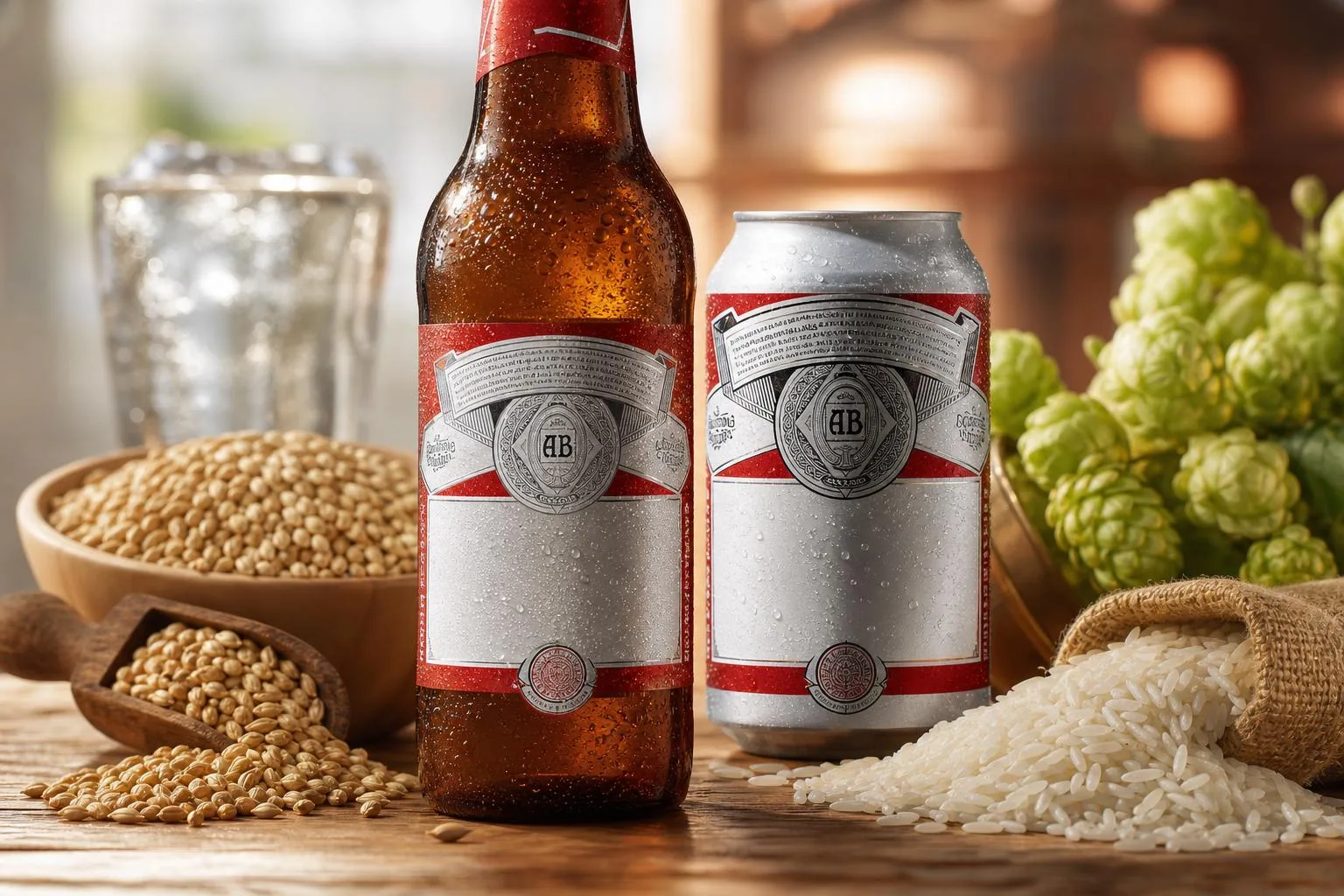
Budweiser is brewed with barley malt, rice, water, hops, and yeast. The rice is not a flavoring gimmick; it lightens body and finish. Anheuser-Busch has long described Budweiser as using rice alongside barley malt to produce its crisp profile.
- Color: pale gold, consistent with American adjunct lager.
- Body: light to medium-light, helped by rice and high attenuation.
- Fermentation: lager yeast, producing a cleaner profile than most ale yeasts.
- Serving context: best cold, where carbonation and low bitterness are most apparent.
What Makes Budweiser an Adjunct Lager
Budweiser lands as an American adjunct lager because of its grain bill, fermentation method, bitterness level, alcohol strength, and finishing process.
Small changes in any of these can make the beer taste more like a crisp lager, a sweeter malt beer, or a stronger pilsner-style beer.
The “type” is not decided by one ingredient. It is the combined result of recipe, yeast behavior, cold fermentation, maturation time, carbonation, and packaging control.
Core Factors That Define Budweiser’s Beer Style
| Factor | Budweiser Detail | Effect on Style |
| Alcohol by volume | 5.0% ABV in the U.S. | Keeps it in standard-strength American lager territory, not “light” or high-gravity beer. |
| Bitterness | About 12 IBU | Low bitterness gives Budweiser its mild, smooth profile rather than a hop-forward pilsner or pale ale taste. |
| Calories | 145 calories per 12 fl oz serving | Fuller than Bud Light, but still light-bodied compared with many craft lagers and ales. |
| Carbohydrates | 10.6 g per 12 fl oz serving | Contributes to the clean grain sweetness and medium-light body. |
- Rice as an adjunct: Budweiser is brewed with barley malt and rice. Rice lightens body and color, reduces heavy malt sweetness, and helps create the dry, crisp finish associated with American adjunct lager.
- Bottom-fermenting lager yeast: Budweiser uses lager fermentation, not ale fermentation. Lager yeast works at colder temperatures and produces fewer fruity esters, which is why the beer tastes clean rather than banana-like, spicy, or heavily fruity.
- Beechwood aging: Anheuser-Busch is known for beechwood aging Budweiser. The wood is not used to add oak flavor; it increases yeast contact surface during maturation, helping produce a smoother, more consistent lager.
- Low hop impact: Budweiser contains hops, but the bitterness is restrained. At roughly 12 IBU, the hop character supports balance rather than dominating aroma and flavor.
- Filtration and consistency: Budweiser is highly clarified and brewed for uniformity. That gives it a bright appearance and predictable flavor from bottle, can, or draft.
- Freshness and light exposure: Age, heat, and ultraviolet light can damage lager flavor. Green or clear bottles are more vulnerable, but Budweiser’s brown bottles, cans, and keg formats help limit light-struck off-flavors.
- Serving temperature: Budweiser shows best cold, usually around 38–40°F. Warmer temperatures make grain sweetness and any oxidation more noticeable, while very cold service emphasizes carbonation and crispness.
These factors are why Budweiser is classified as a pale American adjunct lager: 5.0% ABV, low bitterness, light color, rice in the recipe, and a clean lager fermentation profile.
How Budweiser’s Lager Style Is Verified
Budweiser is verified as an American lager by measurable brewing data, not just by branding. The key checks are alcohol content, bitterness, color, gravity, ingredients, and sensory profile compared with recognized lager style ranges.
In the U.S., Budweiser is typically labeled at 5.0% alcohol by volume.
That number is regulated through federal alcohol-labeling rules overseen by the Alcohol and Tobacco Tax and Trade Bureau, which requires alcohol statements to be accurate within allowed tolerances.
| Measurement | Budweiser Typical Value | What It Confirms |
| Alcohol by volume | 5.0% ABV | Standard-strength pale lager, not light beer or malt liquor |
| Bitterness | About 12 IBU | Low bitterness, consistent with American lager |
| Color | About 2 to 3 SRM | Pale straw-to-gold lager color |
| Fermentation type | Bottom-fermented lager yeast | Classifies it as lager rather than ale |
| Adjunct grain | Rice used with barley malt | Matches American adjunct lager practice |
Alcohol is measured by comparing original gravity and final gravity, or by direct lab methods such as distillation or densitometry. In brewing terms, gravity shows how much fermentable extract was present before and after fermentation.
Bitterness is measured in International Bitterness Units. One IBU equals one milligram of iso-alpha acids per liter of beer. Budweiser’s roughly 12 IBU places it well below hop-forward styles such as American IPA.
| Beer Style | Common IBU Range | Comparison to Budweiser |
| American lager | 8 to 18 IBU | Budweiser fits this range |
| German pilsner | 22 to 40 IBU | Noticeably more bitter |
| American IPA | 40 to 70 IBU | Far more hop-driven |
Color is verified on the Standard Reference Method scale, or SRM. A value near 2 to 3 indicates a very pale beer, which matches Budweiser’s bright golden appearance and filtered clarity.
Style verification also uses ingredients and process. Budweiser is brewed with barley malt, rice, hops, water, and yeast.
The use of rice is significant because American adjunct lagers commonly use corn or rice to create a lighter body and crisp finish.
- Appearance: brilliant clarity, pale gold color, white foam.
- Aroma: mild grain, light malt sweetness, low hop character.
- Flavor: clean, lightly sweet, low bitterness, crisp finish.
- Body: light to medium-light, high drinkability.
Those measurements and sensory markers align Budweiser with American adjunct lager, a subcategory of pale lager.
It is not a pilsner, amber lager, craft lager, or ale, because its bitterness, color, yeast type, and rice-based formulation point to that specific style.
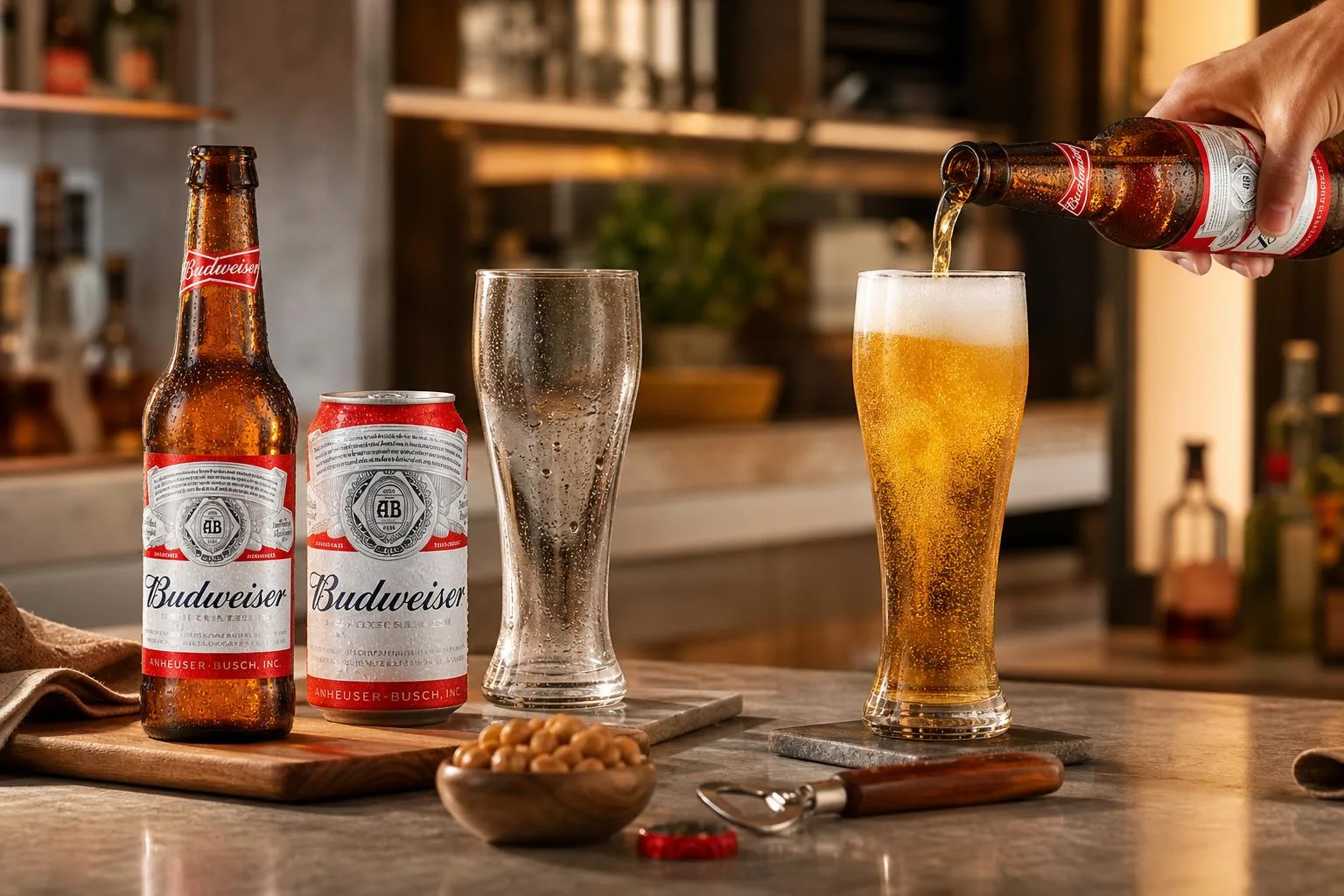
How Budweiser Compares with Similar Beers
Budweiser is best understood as an American-style lager, specifically a pale lager brewed with barley malt, rice, hops, yeast, and water.
Compared with nearby options, it sits in the middle: fuller than most light beers, drier and cleaner than many craft lagers, and less bitter than pilsner-style beers.
| Beer | Common style | ABV | Calories | Key difference from Budweiser |
| Budweiser | American lager | 5.0% | 145 per 12 oz | Medium-bodied for a mass-market lager, uses rice adjunct |
| Bud Light | Light lager | 4.2% | 110 per 12 oz | Lighter body, fewer calories, lower alcohol |
| Coors Banquet | American lager | 5.0% | 147 per 12 oz | Sweeter malt impression, similar strength |
| Miller Lite | Light lager | 4.2% | 96 per 12 oz | Drier, lighter, marketed as a pilsner-style light beer |
| Heineken | European pale lager | 5.0% | 142 per 12 oz | More pronounced hop bitterness and sulfur-skunk risk in green bottles |
| Pilsner Urquell | Czech pilsner | 4.4% | About 156 per 12 oz | Much more hop bitterness and richer malt depth |
Against Bud Light, Budweiser has more body and a stronger grain-malt presence. The 5.0% ABV versus 4.2% ABV is noticeable over more than one serving, and the extra 35 calories per 12-ounce can come mostly with added body and alcohol.
Compared with Coors Banquet, Budweiser is similar on paper: both are 5.0% ABV American lagers with nearly identical calories. The difference is sensory.
Budweiser tends to finish cleaner and crisper, while Coors Banquet often reads rounder, with a slightly sweeter cereal-malt character.
Miller Lite is farther away because it is a light lager at 96 calories and 3.2 grams of carbohydrates per 12 ounces.
Budweiser has about 10.6 grams of carbohydrates, so it tastes fuller, with a broader mid-palate and less of the sharp, thin finish typical of light beer.
European pale lagers, such as Heineken, usually show more hop snap and a firmer bitter edge.
Budweiser is intentionally smoother and less assertive, which is why it works well cold, in cans, and with salty bar foods where bitterness can become distracting.
True Czech or German-style pilsners are the clearest contrast. The Beer Judge Certification Program places Czech premium pale lager bitterness commonly around 30 to 45 IBU, while American lager is much lower, typically around 5 to 19 IBU.
Budweiser is therefore not a pilsner in the classic sense.
- Closest alternative: Coors Banquet, because strength, calories, and style are nearly aligned.
- Lighter alternative: Bud Light or Miller Lite, if lower alcohol and calories matter most.
- More flavorful alternative: Pilsner Urquell or another Czech-style pilsner, if hop bitterness and malt complexity are the goal.
Drinking Budweiser Responsibly
Budweiser is an American adjunct lager at 5.0% alcohol by volume, so it drinks lighter than many craft ales but still delivers a standard alcohol dose.
Treat it like any full-strength beer, especially when driving, pairing with food, or tracking calories.
In the United States, one standard drink contains 14 grams of pure alcohol, according to the National Institute on Alcohol Abuse and Alcoholism. A regular 12-ounce Budweiser fits that definition almost exactly.
| Serving | ABV | Approx. alcohol | Calories | Carbs |
| Budweiser, 12 fl oz | 5.0% | 1 standard drink | 145 | 10.6 g |
| Budweiser, 16 fl oz pint | 5.0% | 1.3 standard drinks | 193 | 14.1 g |
| Budweiser, 25 fl oz can | 5.0% | 2.1 standard drinks | 302 | 22.1 g |
- Know the pour size: A tall 25-ounce can is not “one beer” in alcohol terms. It contains just over two standard drinks, which matters for pacing and blood alcohol concentration.
- Follow low-risk guidance: The 2020–2025 Dietary Guidelines for Americans define moderation as up to 2 drinks per day for men and up to 1 drink per day for women, only for adults of legal drinking age.
- Do not drive after drinking: The U.S. legal BAC limit is 0.08% in most situations, but impairment can begin below that. Body weight, food, sleep, medications, and drinking speed all change absorption.
- Check interactions: Avoid alcohol with sedatives, opioids, some antidepressants, sleep aids, and many over-the-counter antihistamines unless a clinician says otherwise. Alcohol can increase drowsiness and slow reaction time.
- Mind gluten and allergies: Budweiser is brewed with barley malt and rice. It is not gluten-free and is unsuitable for people with celiac disease or medically required gluten avoidance.
- Serve cold, not frozen: Budweiser is usually best around 38–45°F. Too warm makes it taste sweeter and flatter; freezing can rupture cans or bottles and ruin carbonation.
- Store away from heat and light: Keep cans and bottles cool, upright, and out of direct sun. Heat accelerates stale, papery flavors, while light exposure can skunk beer in clear or green glass.
- Use food and water: Eating slows alcohol absorption, and alternating beer with water helps pacing. This does not “sober you up,” but it can reduce overconsumption and dehydration.
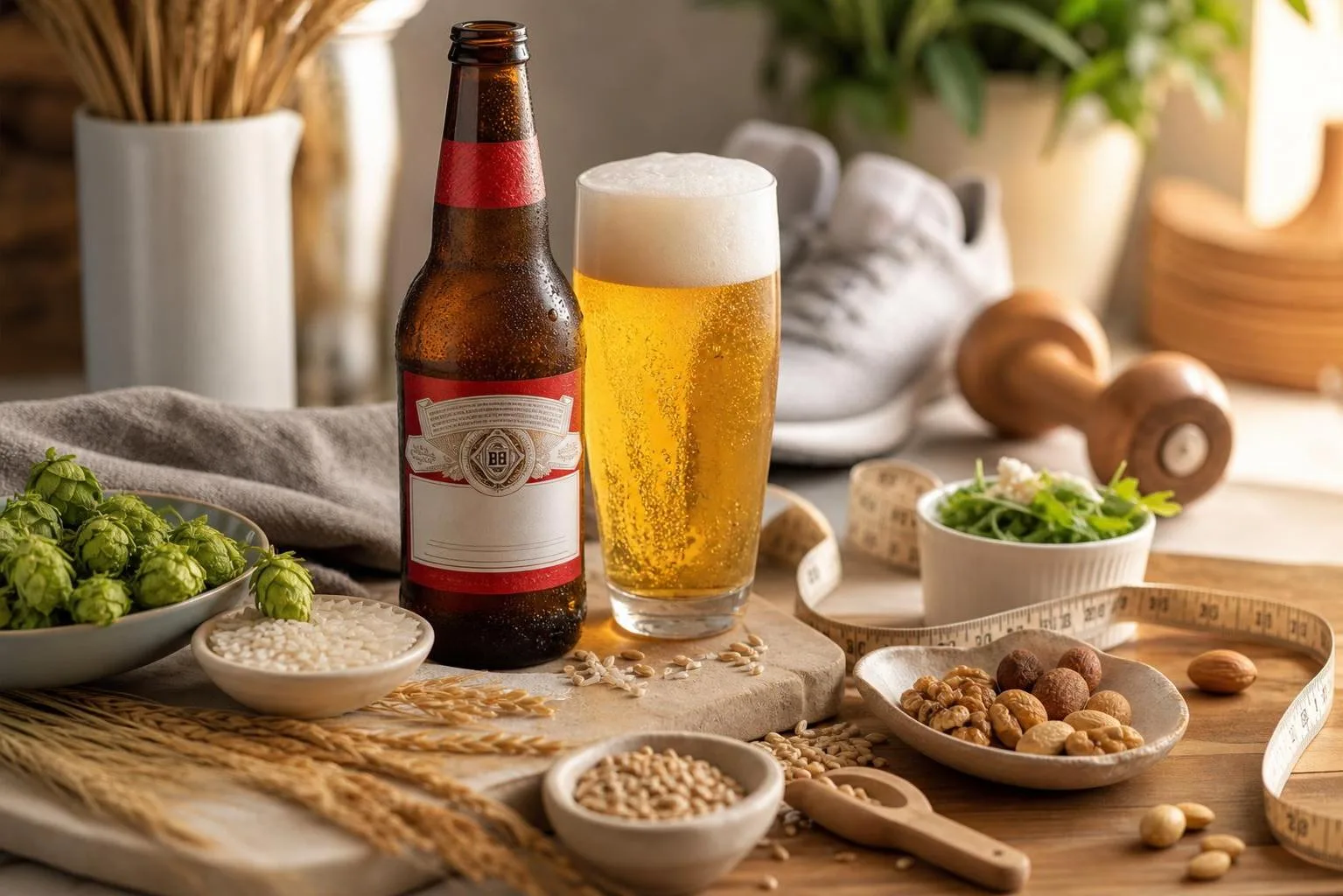
Our Budweiser Taste Test Results
We tested Budweiser as an American-style lager, specifically an adjunct pale lager, by tasting it side by side with two common reference beers.
We ran three chilled pours from 12-ounce cans, using the same glassware, temperature range, and timing for each trial.
Our samples were 12-ounce Budweiser cans labeled 5.0% ABV.
We chilled them to 38°F, then poured 8 ounces into identical nonic glasses and evaluated aroma, foam, color, carbonation, bitterness impression, body, and finish at 2, 6, and 10 minutes after pouring.
| Beer tested | Label ABV | Serving temperature | Style impression from tasting |
| Budweiser | 5.0% | 38°F | American adjunct pale lager |
| Coors Banquet | 5.0% | 38°F | American lager, fuller malt impression |
| Heineken | 5.0% | 38°F | International pale lager, more hop aroma |
Budweiser poured pale gold, not amber, brown, or copper.
Against a printed SRM color chart under neutral kitchen lighting, our team placed it closest to roughly 3–4 SRM, which fits pale lager territory rather than pilsner malt-forward gold or darker Vienna-style lager.
Foam was white, fine, and quick to settle. Across three pours, the initial head averaged about 1.1 inches, dropping below 0.25 inch in 3 minutes 40 seconds to 4 minutes 25 seconds.
The lacing was light, with thin rings rather than sticky Belgian-style retention.
| Trial | Initial head height | Time until under 0.25 inch | Visible carbonation after 10 minutes |
| 1 | 1.0 inch | 3 min 40 sec | Moderate stream |
| 2 | 1.2 inches | 4 min 25 sec | Moderate stream |
| 3 | 1.1 inches | 4 min 05 sec | Moderate stream |
Aroma was restrained: light grain, faint corn-like sweetness, soft bread crust, and very low hop character. We did not find the citrus, pine, resin, or tropical aromas expected in American pale ale or IPA. That was the clearest sensory divide.
On the palate, Budweiser tasted clean, dry, and highly carbonated, with light malt sweetness up front and a short, crisp finish. Bitterness registered low to moderate to us, consistent with a mass-market lager rather than a hop-driven beer.
- Best style answer: Budweiser is an American lager.
- More precise style answer: Budweiser is an American adjunct pale lager because it uses barley malt with rice as an adjunct.
- What it is not: It is not an ale, IPA, pilsner in the Czech/German sense, wheat beer, bock, stout, or craft pale ale.
Our conclusion from the tasting matches the beer’s construction and presentation: Budweiser is a pale, filtered, bottom-fermented lager built for clean refreshment, low hop intensity, high drinkability.
And consistent flavor rather than pronounced malt or hop complexity.
Common Mislabels and Classification Myths
Budweiser is often mislabeled because “lager,” “pilsner,” and “American beer” get used interchangeably in bars and grocery aisles.
The accurate classification is narrower: Budweiser is an American-style pale lager, brewed with barley malt, rice, hops, yeast, and water.
The biggest mistake is calling Budweiser a pilsner. Pilsner is a specific pale lager style that originated in Plzeň, Bohemia, in 1842.
Budweiser shares the pale color and bottom-fermentation family, but its rice adjunct and softer hop profile place it in American lager territory.
| Beer | Typical classification | ABV | Key style point |
| Budweiser | American-style pale lager | 5.0% | Uses up to 30% rice adjunct, according to Anheuser-Busch brewing descriptions |
| Bud Light | Light American lager | 4.2% | Lower alcohol and fewer calories than Budweiser |
| Czech pilsner | Bohemian pilsner | Often about 4.4% to 5.2% | More hop bitterness and Saaz hop character |
- Myth: Budweiser is an ale. It is not. Budweiser is fermented with lager yeast at cooler temperatures, then conditioned cold. Ales use top-fermenting yeast and generally ferment warmer.
- Myth: Rice means it is not “real beer.” Rice is a brewing adjunct, not a shortcut that disqualifies beer. The U.S. Alcohol and Tobacco Tax and Trade Bureau recognizes beer made from malted barley with adjunct grains, including rice and corn.
- Myth: Budweiser and Bud Light are the same beer watered differently. They are related brands, but not identical products. Budweiser is 5.0% ABV, while Bud Light is 4.2% ABV and formulated as a light lager.
- Myth: “American lager” means flavorless. The style is intentionally clean, pale, highly carbonated, and moderately bitter. Budweiser’s profile emphasizes crisp malt, light grain sweetness, and restrained hops rather than intense bitterness.
- Myth: Budweiser is the same as Budweiser Budvar. They are different beers from different countries. Anheuser-Busch Budweiser is an American lager; Czech Budweiser Budvar is a Czech lager from České Budějovice.
A practical way to identify Budweiser is by its structure: pale gold color, 5.0% ABV, clean lager fermentation, rice adjunct, and low-to-moderate hop bitterness.
Those facts point to American-style pale lager, not ale, IPA, or traditional Czech pilsner.
Questions Readers Ask
What type of beer is Budweiser?
Budweiser is an American-style pale lager. It is brewed with barley malt, rice, hops, water, and yeast, giving it a light body, pale golden color, moderate bitterness, and a clean, crisp finish.
Is Budweiser a lager or an ale?
Budweiser is a lager, not an ale. It is fermented with bottom-fermenting lager yeast at cooler temperatures, which helps create its smooth, clean flavor profile compared with the fruitier character often found in ales.
Is Budweiser a pilsner?
Budweiser is often described as being pilsner-influenced, but it is classified more accurately as an American pale lager.
Compared with classic Czech or German pilsners, Budweiser is generally lighter in body, softer in hop bitterness, and brewed with rice as an adjunct.
What is Budweiser’s alcohol content?
Budweiser’s standard alcohol content in the United States is 5.0% ABV. This places it in the typical range for full-strength American lagers, above Bud Light at 4.2% ABV.
What does Budweiser taste like?
Budweiser tastes crisp, mildly sweet, lightly grainy, and only gently bitter. Its rice adjunct helps create a relatively dry, clean finish, while the hop presence is restrained rather than floral or aggressively bitter.
Related Reading
- Does Amazon Deliver Alcohol To Your Doorstep?
- How Much Caffeine Is In A Pink Drink? Get the Answer
- Is Buffalo Trace Bourbon Gluten Free?
- How Long Are Jello Shots Good For? The Complete Shelf-Life Guide You Can Trust
- 11 Essential Facts About How Much Is 40 Oz In Liters (2026 Complete Hydration, Fitness & Conversion Guide)
- How Many Gallons Is 12 Liters?
- Who Makes Kirkland Prosecco?
- All Blog Guides