A standard 12-ounce bottle of regular beer contains roughly 150 calories, though how many calories are in a beer bottle ranges from about 55 in light lagers to more than 330 in heavy craft stouts.
USDA FoodData Central lists regular beer at 43 calories per 100 grams.
The total depends on alcohol by volume (ABV) and residual carbohydrates. Alcohol delivers 7 calories per gram, nearly double the 4 per gram from carbohydrate, so higher-ABV bottles carry proportionally more energy.
A 9% ABV imperial stout can top 300 calories; a 4.2% light beer stays near 100.
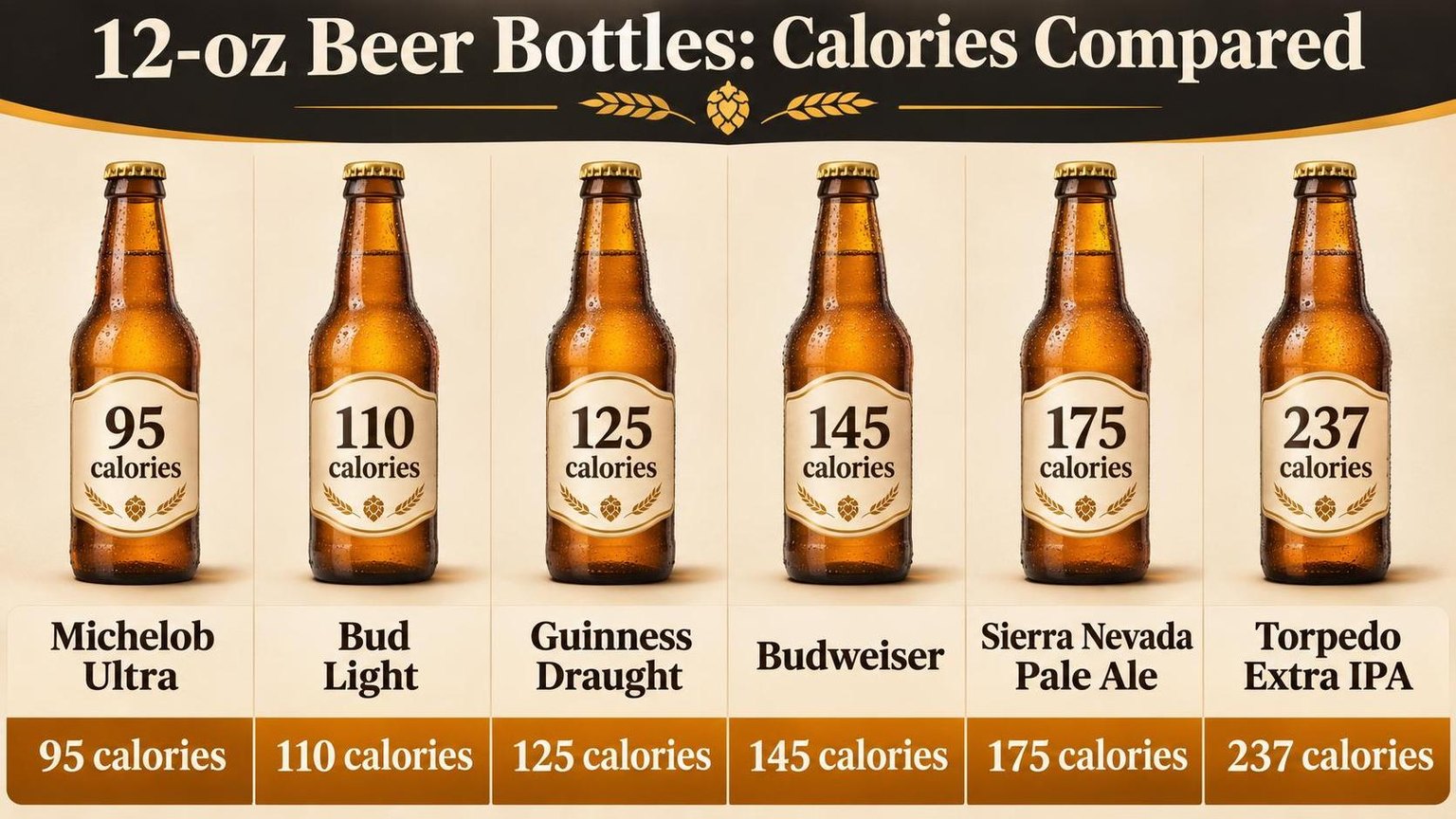
Calorie Counts by Beer Style
A beer’s calories depend mainly on its alcohol content and remaining carbohydrates, not its color. Style offers a useful starting point, but the specific recipe matters: a dry stout can contain fewer calories than a pale ale.
Calories in a Standard Bottle
These manufacturer-published figures use a 12-fluid-ounce serving, approximately 355 mL. They describe specific beers rather than fixed calorie limits for an entire style; check your bottle’s volume before applying them.
| Style | Beer | ABV | Calories |
| Low-carbohydrate light lager | Michelob Ultra | 4.2% | 95 |
| Light lager | Bud Light | 4.2% | 110 |
| American lager | Budweiser | 5.0% | 145 |
| Irish dry stout | Guinness Draught | 4.2% | 125 |
| American pale ale | Sierra Nevada Pale Ale | 5.6% | 175 |
| American IPA | Sierra Nevada Torpedo Extra IPA | 7.2% | 237 |
Why Styles Differ
- Light lagers: Brewers reduce calories through lower alcohol, fewer residual carbohydrates, or both. “Light” does not necessarily mean a dramatically lower ABV; carbohydrate differences also affect the total.
- Standard lagers: These typically retain more calories than their light counterparts. Budweiser illustrates the difference, but its figure should not stand in for every pilsner, helles, or amber lager.
- Pale ales and IPAs: Stronger recipes usually bring more calories from alcohol. Hops create bitterness and aroma, but bitterness itself is not a dependable measure of calories.
- Stouts and porters: Dark roasted malt does not automatically make beer calorie-heavy. Distinguish relatively low-strength dry stout from imperial stout, which commonly combines stronger alcohol with a richer malt profile.
Wheat beers, fruit beers, and sour beers vary substantially. Added fruit, lactose, or other sugars can affect calories, but fermentation consumes some sugars. Sweetness, haze, and thickness cannot replace a product-specific nutrition figure.
For accurate tracking: Match the exact beer name, serving size, and market.
Guinness Draught and Guinness Extra Stout are different products; substituting one product’s nutrition information for another can misstate your bottle’s calories.
Sources: Manufacturer product and nutrition information from Michelob Ultra (https://www.michelobultra.com), Bud Light (https://www.budlight.com), Budweiser (https://www.budweiser.com), Guinness (https://www.guinness.com),.
And Sierra Nevada Brewing Co. (https://sierranevada.com).
How ABV Drives Beer Calories
Alcohol by volume (ABV) is a strong clue to a beer bottle’s calorie content because ethanol supplies energy independently of carbohydrates.
At the same bottle size, higher ABV means more calories from alcohol—but it does not reveal the beer’s total calories.
Calculate the Alcohol Portion First
To estimate alcohol calories, multiply beer volume in milliliters by ABV expressed as a decimal, then by ethanol’s density and its energy value.
The calculation below uses a standard US bottle size; it excludes carbohydrates, protein, and other energy-contributing components.
| Calculation input | Value used |
| Bottle volume | 12 US fl oz, approximately 355 mL |
| Ethanol density at approximately 20°C | 0.789 g/mL |
| Alcohol energy factor | 7 calories per gram |
Formula: Alcohol calories = volume × ABV fraction × ethanol density × alcohol energy factor. On food labels, “calories” means kilocalories.
These estimates use the conventional alcohol energy factor documented in USDA nutrient-calculation guidance, rather than a laboratory measurement of an individual beer.
| Beer ABV | Alcohol-only calories per 12-fl-oz bottle |
| 4% | 78 |
| 5% | 98 |
| 6% | 118 |
| 8% | 157 |
| 10% | 196 |
Why ABV Does Not Equal Total Calories
Fermentation converts fermentable sugars into ethanol and carbon dioxide. Finished beer can still contain carbohydrates, including sugars and dextrins.
Those carbohydrates add calories beyond the alcohol-only estimates above, so the table should not be treated as a nutrition label.
Recipe and fermentation matter. A dry, highly attenuated beer can contain less residual carbohydrate than a sweeter beer at the same ABV.
Lactose, fruit additions, and other ingredients can also change the final calorie count; perceived sweetness alone cannot quantify that contribution.
- Check bottle volume. ABV describes concentration, not the total amount of alcohol in the container.
- Use published nutrition information. A brewery’s product-specific calorie figure is more useful than an ABV-only estimate.
- Check the serving basis. Confirm whether the stated calories cover the whole bottle or a smaller serving.
Sources: USDA, “National Nutrient Database for Standard Reference, Release 28: Documentation and User Guide,” energy calculations; NIAAA, “What Is a Standard Drink?” for US beer-serving context.
Table values are calculated and rounded, not measured product totals.
Calories in Popular Beer Brands
A standard U.S. beer bottle holds 12 fluid ounces, but its calories depend on the recipe and alcohol content.
The manufacturer-reported figures below cover specific beers—not every product sold under each brand—and use the same serving size for a fair comparison.
| Beer | Calories per 12 fl oz | Alcohol by volume | Manufacturer source |
| Budweiser | 145 | 5.0% | budweiser.com |
| Bud Light | 110 | 4.2% | budlight.com |
| Coors Light | 102 | 4.2% | coorslight.com |
| Miller Lite | 96 | 4.2% | millerlite.com |
| Michelob ULTRA | 95 | 4.2% | michelobultra.com |
| Busch Light | 95 | 4.1% | busch.com |
| Corona Extra | 148 | 4.6% | coronausa.com |
| Heineken Original | 142 | 5.0% | heineken.com |
Why Similar Beers Have Different Calories
Alcohol and residual carbohydrates both contribute energy. Alcohol supplies approximately 7 calories per gram; carbohydrates supply approximately 4.
Those standard energy factors, recognized by the FDA, explain why alcohol percentage alone cannot tell you a bottle’s total calories.
The light beers in the table illustrate this point: several share the same alcohol percentage but have different calorie totals.
Fermentation and recipe choices affect how much carbohydrate remains in the finished beer. “Light” does not mean carbohydrate-free or alcohol-free.
Check the Exact Product and Bottle Size
Match the full beer name before logging calories. Corona Extra is not Corona Premier, and Heineken Original is not Heineken 0.0.
A brand’s flagship lager, light lager, and nonalcoholic beer have separate nutrition profiles; their calorie figures are not interchangeable.
Also check whether the nutrition information describes the entire bottle or a reference serving. Imported bottles, large-format bottles, and different package sizes can contain a different volume from the serving used here.
Glass versus aluminum does not change the calories when beer and volume are identical.
- Read the container’s fluid-ounce amount before calculating your intake.
- Use the manufacturer’s U.S. product information rather than an entry for another market.
- Multiply calories per serving by the number of servings you actually drink.
These figures describe the beer alone. Added juice, syrups, or other mixers contribute additional calories. If the current label differs from this table, use the label for the specific product in your hand.
Light Beer Versus Regular Beer
A light beer usually contains fewer calories than a regular beer, but the difference depends on the recipe and bottle size. Compare equal volumes: a larger bottle can erase the calorie savings suggested by the word “light.”.
A Bottle-to-Bottle Comparison
These manufacturer-listed figures apply to a standard US 12-fluid-ounce serving. For a bottle holding that amount, the serving calories equal the calories in the entire bottle.
| Beer | Bottle size | Calories | Carbohydrates | Alcohol by volume |
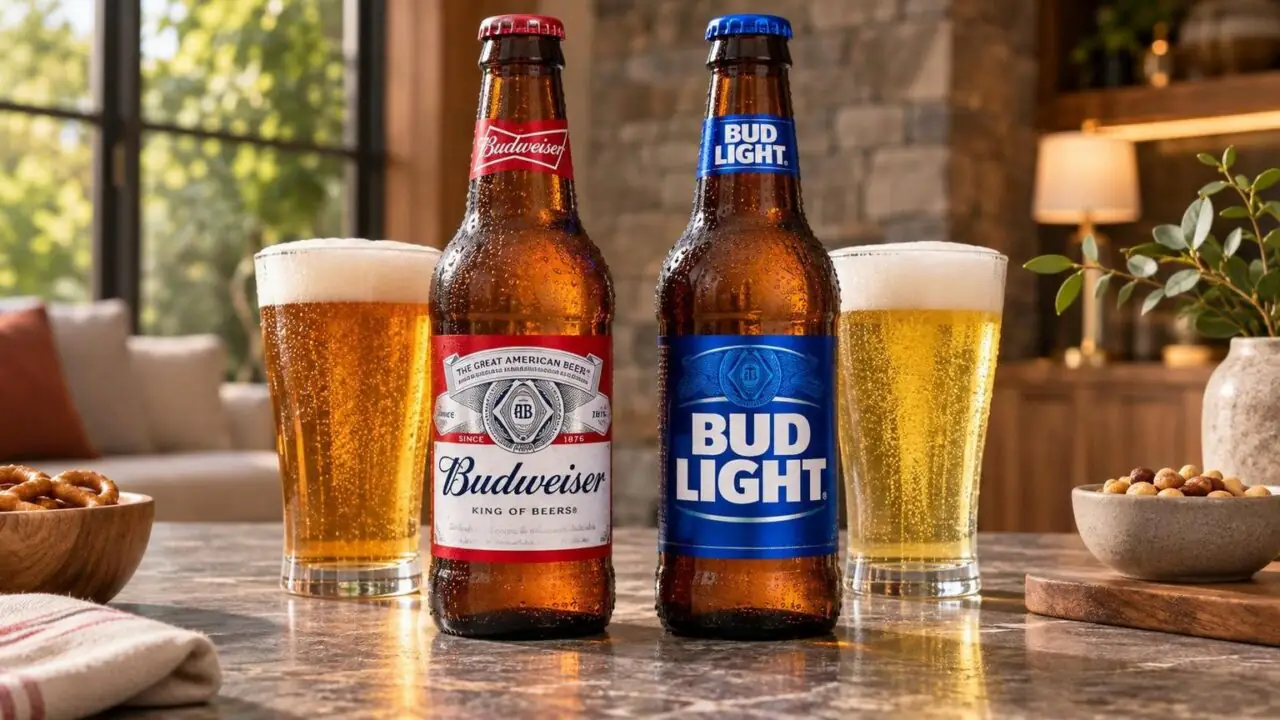
| Bud Light | 12 fl oz | 110 | 6.6 g | 4.2% |
| Budweiser | 12 fl oz | 145 | 10.6 g | 5.0% |
Sources: official US brand nutrition information from Bud Light, https://www.budlight.com/, and Budweiser, https://www.budweiser.com/. Check the package for the specific product and market; similarly named beers can have different formulations.
Why Light Beer Has Fewer Calories
Beer gets most of its calories from alcohol and carbohydrates. Brewers can reduce calories by lowering alcohol content, reducing residual carbohydrates, or doing both.
In the example above, the light beer contains less alcohol and fewer carbohydrates than its regular counterpart.
Some light-beer recipes use enzymes to break down more starch into fermentable sugars. Fermentation reduces the carbohydrates left behind, but it also produces alcohol.
Brewers must manage the overall recipe and final strength to keep total calories down.
Low carbohydrate does not automatically mean low calorie. Alcohol contributes energy independently of carbohydrates. A stronger beer can therefore contain substantial calories even when its carbohydrate content looks modest.
Color is also unreliable: a pale beer is not necessarily lower-calorie than a dark one.
What to Check Before Choosing
- Serving size: Confirm whether the nutrition information covers the whole bottle or only part of it.
- Total calories: Use the stated calorie count rather than estimating from “light,” color, or taste.
- Alcohol content: Light beer still contains alcohol; fewer calories do not make it alcohol-free or risk-free.
For calorie tracking, record the exact beer and bottle volume. Substitute its published nutrition figures rather than assigning every light beer the same calorie allowance.
How Carbs and Alcohol Add Up
Most calories in a beer bottle come from ethanol and carbohydrates left after fermentation. Bottle size sets the serving, but alcohol by volume (ABV) and residual carbohydrate determine how much energy that serving delivers.
Alcohol Supplies More Energy per Gram
Alcohol contributes calories even when a beer contains little sugar. Standard food-energy factors explain why reducing carbohydrates does not necessarily make a beer low-calorie.
| Component | Calories per gram |
| Alcohol | 7 |
| Carbohydrate | 4 |
| Protein | 4 |
Source: USDA, Energy Value of Foods: Basis and Derivation, Agriculture Handbook No. 74. These general factors support estimates; a brewer’s published nutrition information remains the better reference for a specific bottle.
Calculate the Bottle’s Main Calorie Sources
Estimate alcohol grams by multiplying beer volume in milliliters by ABV expressed as a decimal, then by ethanol’s approximate density, 0.789 grams per milliliter.
Multiply the result by its energy factor; calculate carbohydrate calories separately and add them.
The examples below use a 12-US-fluid-ounce bottle, approximately 355 milliliters. Carbohydrate amounts are illustrative assumptions, not values predicted from ABV.
Totals include only alcohol and carbohydrate, with calculations rounded to whole calories.
| ABV | Assumed carbs | Alcohol calories | Carb calories | Combined calories |
| 4% | 10 g | 78 | 40 | 118 |
| 5% | 12 g | 98 | 48 | 146 |
| 7% | 18 g | 137 | 72 | 209 |
The National Institute on Alcohol Abuse and Alcoholism defines a US standard drink as containing approximately 14 grams of pure alcohol. Its beer example is the middle-strength bottle shown above.
That is a measure of alcohol intake, not a calorie limit.
Check Total Carbohydrate, Not Sugar Alone
Fermentation converts fermentable sugars into alcohol and carbon dioxide, while some carbohydrates remain. A dry-tasting beer can therefore carry substantial alcohol calories.
A “zero sugar” claim does not establish zero carbohydrate or zero calories.
Check the brewer’s total calories and serving size before calculating your own estimate.
Small protein contributions, other energy-containing compounds, and rounding can make published calories differ from an alcohol-plus-carbohydrate calculation.
Reading Beer Labels for Calorie Info
A beer bottle’s calorie figure may describe one serving rather than the entire bottle.
Check the serving size, the bottle’s total volume, and whether the manufacturer reports calories per serving or per container before logging your drink.
Find the Nutrition Statement
Look for a “Serving Facts” panel or a “Statement of Average Analysis.” Depending on the format, these disclose calories, carbohydrate, protein, and fat.
Alcohol by volume, or ABV, describes alcohol strength; it does not tell you the beer’s total calories.
Under the federal Alcohol and Tobacco Tax and Trade Bureau’s framework, nutrition labeling remains voluntary for most TTB-regulated beer.
However, claims such as “light” or “lite” trigger additional disclosure requirements. A missing calorie number does not mean the beer contains negligible calories.
Match the Serving to the Bottle
Calories consumed = listed calories × servings consumed. If the label gives calories for a standard serving but your bottle holds more, scale the figure to the amount you actually drink. This hypothetical example shows the adjustment:
| Item | Label-sized serving | Entire larger bottle |
| Beer volume | 12 fl oz | 16 fl oz |
| Calories | 150 | 200 |
| Calculation | Listed serving value | 150 × (16 ÷ 12) |
The example assumes the same beer throughout. Do not transfer a calorie figure between different products merely because their bottle sizes match. Residual carbohydrates and alcohol content both affect the total.
When Calories Are Missing
- Check the brewery’s official product page or nutrition sheet. Match the exact beer name, variant, serving size, and country of sale.
- Use a QR code if the packaging provides one, then verify that the destination describes your specific product.
- Treat calorie estimates based only on ABV as approximations. They cannot account precisely for residual carbohydrates.
- Do not interpret “low-carb” as a complete calorie statement. Alcohol contributes energy independently of carbohydrates.
Sources: TTB Ruling 2013–2 explains voluntary Serving Facts labeling. TTB Ruling 2004–1 addresses calorie and carbohydrate representations, including disclosures accompanying “light” and “lite” claims.
Choosing Lower Calorie Beer Options
Choose beer by calories per bottle, not by color or words such as “light” and “low-carb.” Compare the same serving size, then check alcohol by volume (ABV): both alcohol and residual carbohydrates contribute calories.
Compare Calories at the Same Bottle Size
These manufacturer-listed figures apply to a 12-fl-oz serving of each U.S. beer. Budweiser provides a regular-lager reference; the other entries show how calorie counts vary among lighter options.
| Beer | Calories per 12 fl oz | ABV |
| Michelob ULTRA | 95 | 4.2% |
| Miller Lite | 96 | 4.2% |
| Bud Light | 110 | 4.2% |
| Budweiser | 145 | 5.0% |
Sources: U.S. product and nutrition information from Michelob ULTRA (https://www.michelobultra.com), Miller Lite (https://www.millerlite.com), Bud Light (https://www.budlight.com), and Budweiser (https://www.budweiser.com).
Check the current package for the specific product and market.
Check More Than the “Light” Label
- Use total calories as the deciding number. Low carbohydrate content does not guarantee the lowest calorie count because alcohol also supplies energy. A stronger low-carb beer can still carry substantial calories.
- Read the serving size. A calorie figure may describe one serving rather than the entire container. For a larger bottle, multiply the listed calories by the bottle’s volume divided by the stated serving volume.
- Consider nonalcoholic beer. Removing most alcohol can reduce calories, but residual sugars and other carbohydrates remain. Check each product’s nutrition information rather than assuming all nonalcoholic beers are equally low-calorie.
- Ignore color as a shortcut. Dark color comes largely from malt selection and roasting, not a fixed calorie level. A pale, high-alcohol beer can contain more calories than a dark, lower-strength beer.
Keep the Whole Occasion in View
Choose a lower-calorie beer you enjoy without increasing how many bottles you drink. Extra servings can erase the reduction from switching products, while changing bottle sizes makes comparisons harder.
Lower-calorie beer is not risk-free beer. Calories measure energy, not alcohol-related health risk; consider alcohol intake separately from your calorie target.
Frequently Asked Questions
How many calories are in a standard 12-ounce beer bottle?
A 12-fluid-ounce bottle of regular beer contains about 153 calories, according to USDA FoodData Central’s reference value for regular beer.
Treat this as a baseline, not a fixed count: the recipe, alcohol content, and remaining carbohydrates change the total.
How many calories are in a bottle of light beer?
A 12-ounce bottle of Bud Light contains 110 calories, while Michelob ULTRA contains 95 calories, according to their manufacturers’ nutrition information.
Compared with the USDA’s 153-calorie regular-beer reference, these options save approximately 43–58 calories per bottle.
How many calories are in a bottle of IPA?
Sierra Nevada lists 237 calories for 12 ounces of Torpedo Extra IPA, which has 7.2% alcohol by volume (ABV). That is 84 calories more than the USDA regular-beer reference; other IPAs differ because their alcohol and carbohydrate levels vary.
How does bottle size affect beer calories?
For the same beer, calories increase directly with volume: a beer containing 153 calories per 12 ounces provides approximately 204 calories in 16 ounces and 281 calories in 22 ounces.
Check both bottle volume and the nutrition serving size before counting a large bottle as one standard serving.
Why does higher-alcohol beer usually contain more calories?
Alcohol supplies approximately 7 calories per gram, compared with 4 calories per gram of carbohydrate, using FDA calorie-conversion factors.
Higher ABV therefore generally raises calories when serving size stays constant, but ABV alone cannot establish the total because residual carbohydrates also contribute.
Does nonalcoholic beer contain calories?
Yes. Heineken lists 69 calories per 11.2-ounce bottle of Heineken 0.0, despite its 0.0% ABV. Removing alcohol does not remove all calories because carbohydrates remain, so check the specific product’s nutrition information.
Further Reading
- Where Is Rainier Beer Distributed?
- How Much Is A Keg Of Coors Light? Get the Answer
- What Is the Alcohol Content of Rainier Beer?
- How Many Beers In A Heineken Mini Keg?
- What Is Root Beer Made Of? The Most Accurate Answer
- Rainier Beer: A Taste Of The Pacific Northwest
- How To Shotgun A Beer? The Ultimate No-Nonsense Guide From Real Experience
- Crowler Vs Growler – What Is The Difference Between Them?
- How Long Does It Take To Brew Beer? A Realistic, From-the-Brew-Day-to-First-Pour Timeline
- All Alcohol Guides
- MedlinePlus — Calorie Count: Alcoholic Beverages (n.d.)
- USDA — FoodData Central (n.d.)
- USDA and HHS — Dietary Guidelines for Americans, 2020–2025 (2020)
- Electronic Code of Federal Regulations — 21 CFR § 101.9: Nutrition Labeling of Food (n.d.)
- NHS — Calories in Alcohol (n.d.)
- Guinness — Guinness Draught (n.d.)
- Heineken — Heineken Original (n.d.)