Calories bottle pinot grigio are estimated at roughly 620 per standard 750 ml bottle, based on a dry style bottled at 12% ABV.
That equals about 120-125 calories in a 5 oz glass, with alcohol supplying 7 calories per gram and residual sugar adding a minor share. Retail bottles typically fall between 550 and 700.
A full bottle consumes roughly 31% of a 2,000-calorie day — more than a fast-food cheeseburger.
The spread traces to two label numbers: each 1% ABV swing across 750 ml shifts about 45 calories, while residual sugar runs under 5 g/L in dry Italian bottlings but tops 30 g/L in off-dry styles.
After pouring hundreds of these bottles behind a bar, I check ABV first; it predicts the count faster than any chart.
Calorie Count Per Standard 750ml Bottle
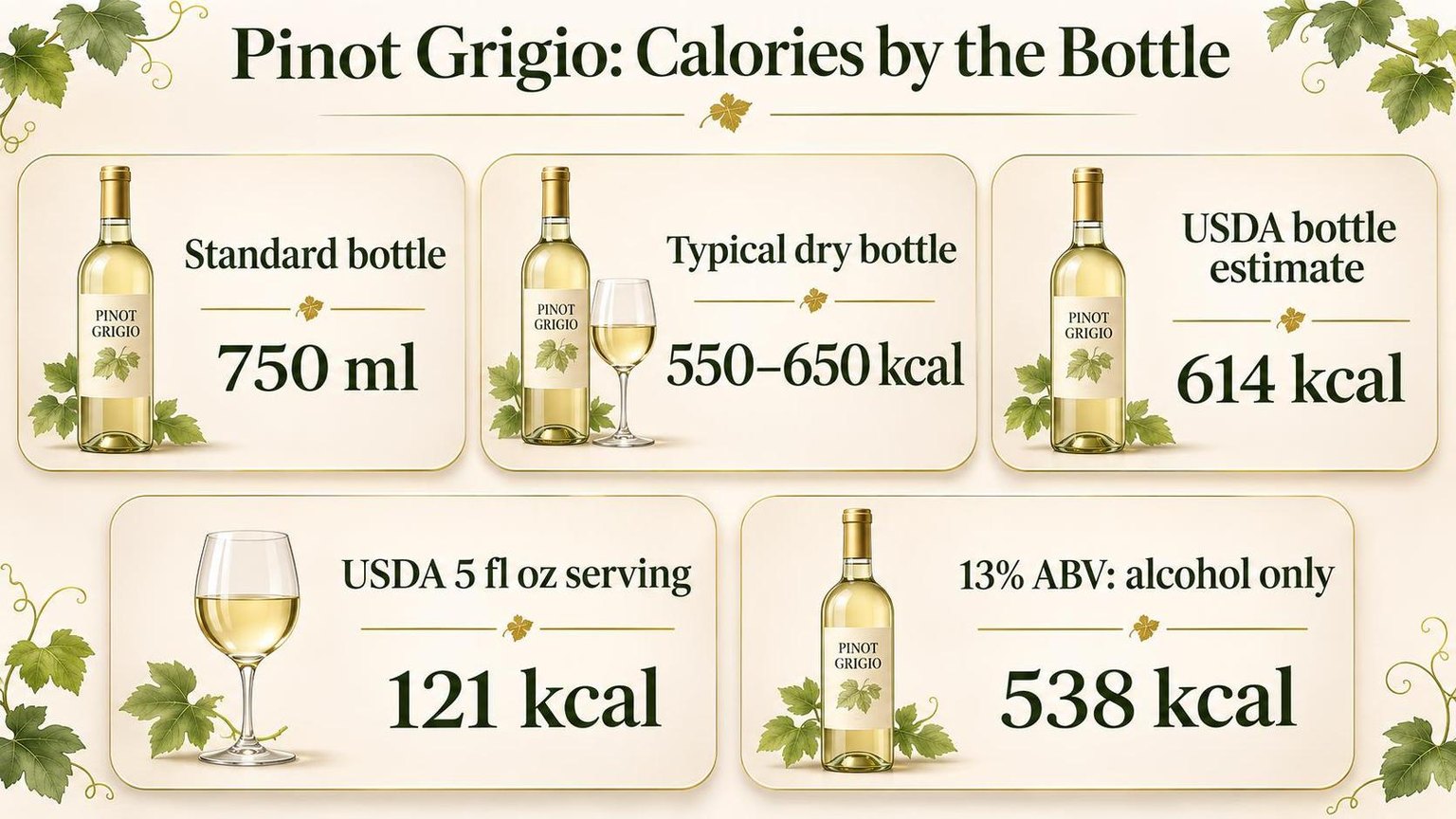
A standard 750ml bottle of dry Pinot Grigio typically contains roughly 550–650 calories. Alcohol supplies most of that energy; residual sugar contributes a smaller share, so a dry taste does not necessarily mean a low calorie count.
A Practical Bottle Estimate
USDA FoodData Central lists generic white table wine at approximately 121 calories per 5-fluid-ounce serving. Scaling that reference to a standard bottle gives the estimate below.
This is a general white-wine benchmark, not a laboratory result for every Pinot Grigio.
| Quantity | Volume | Estimated calories |
| US reference serving | 5 US fl oz, approximately 148ml | 121 |
| Standard bottle | 750ml, approximately 25.4 US fl oz | 614 |
Source: USDA FoodData Central, “Alcoholic beverage, wine, table, white,” https://fdc.nal.usda.gov/. Values are rounded.
For food logging without producer nutrition information, about 600 calories per bottle is a reasonable working estimate for an ordinary dry Pinot Grigio.
Why Alcohol Strength Changes the Total
Alcohol provides approximately 7 calories per gram. Using ethanol’s density of approximately 0.789 grams per milliliter, you can estimate the alcohol contribution directly from the bottle’s alcohol by volume, or ABV.
| Bottle ABV | Calories from alcohol alone, per 750ml |
| 12% | 497 |
| 13% | 538 |
| 14% | 580 |
These figures are not complete bottle calorie counts. They exclude residual sugar and other energy-containing components, including glycerol and organic acids.
Calculation: bottle volume × ABV expressed as a decimal × ethanol density × calories per gram of alcohol.
Check Sugar Without Overestimating Its Role
A wine containing 4 grams of residual sugar per liter contains 3 grams in a standard bottle.
At approximately 4 calories per gram of sugar, that adds just 12 calories. “Dry” describes limited sweetness; it does not mean calorie-free or necessarily sugar-free.
- Use producer nutrition information first. It reflects the specific wine more closely than a generic database entry.
- Check the vintage and ABV. Different releases under the same label can vary.
- Measure your pour. A generous glass changes your intake, even when the bottle’s calorie total stays fixed.
How ABV Changes Pinot Grigio Calories
Alcohol by volume, or ABV, drives most of the calories in dry Pinot Grigio.
For a full bottle, checking the alcohol percentage usually gives you a better starting estimate than looking for words such as “crisp,” “light,” or “refreshing.”.
Why Alcohol Percentage Matters
ABV describes the proportion of wine’s volume that is ethanol. USDA energy calculations assign alcohol approximately 7 calories per gram.
To estimate alcohol calories, convert the bottle’s ethanol volume into grams using an ethanol density of approximately 0.789 grams per milliliter.
Formula: Bottle volume in milliliters × ABV expressed as a decimal × 0.789 × 7 = estimated calories from alcohol.
The table uses a 750-milliliter bottle and holds residual sugar constant at 4 grams per liter. That sugar contributes approximately 12 calories per bottle.
These are calculated estimates, not laboratory measurements or manufacturer nutrition declarations.
| ABV | Alcohol calories | Alcohol plus sugar calories |
| 11% | 456 | 468 |
| 12% | 497 | 509 |
| 13% | 538 | 550 |
| 14% | 580 | 592 |
How to Use the Estimate
Compare bottles of the same size and similar sweetness. Under those conditions, choosing the lower-ABV Pinot Grigio generally reduces calories because it contains less ethanol.
A smaller serving reduces your intake further, regardless of the wine’s alcohol percentage.
- Read the actual ABV. Pinot Grigio is a grape variety, not a fixed alcohol level. Producer, vintage, growing conditions, and winemaking decisions affect the finished wine.
- Check sweetness separately. A lower-alcohol wine can contain enough residual sugar to offset some of its calorie advantage. Fruity aromas do not establish sugar content.
- Prioritize product-specific nutrition. Use the producer’s calorie declaration when available. Alcohol-and-sugar calculations omit contributions from other wine components, including glycerol and organic acids.
Sources: USDA FoodData Central provides the energy value for ethanol; USDA food-energy guidance uses approximately 4 calories per gram for carbohydrate. NIH PubChem’s ethanol record supplies the density reference.
Actual bottle calories depend on composition, while rounded label ABV adds uncertainty to calculations.
Calories Per Glass Versus Full Bottle
A bottle of Pinot Grigio contains the calories from every pour, regardless of glass size.
For a practical estimate, use the USDA’s generic white table wine benchmark of approximately 121 calories per 5 US fluid ounces; individual Pinot Grigio labels can differ.
Calories by Pour Size
The table applies that benchmark to each serving size. These are rounded estimates for the same wine, not laboratory measurements of a particular brand.
| Serving | Volume | Estimated calories |
| Small pour | 3 US fl oz / 89 mL | 73 |
| Moderate pour | 4 US fl oz / 118 mL | 97 |
| Standard wine serving | 5 US fl oz / 148 mL | 121 |
| Generous pour | 6 US fl oz / 177 mL | 145 |
| Large pour | 8 US fl oz / 237 mL | 194 |
| Full standard bottle | 25.36 US fl oz / 750 mL | 614 |
A standard bottle holds approximately 5.07 standard wine servings. That fractional serving matters when calculating the full bottle: multiplying the listed serving calories by five leaves a small amount uncounted.
Why Your Bottle May Differ
Alcohol supplies most of the energy in dry Pinot Grigio. Ethanol contributes approximately 7 calories per gram, so alcohol by volume, or ABV, affects the total even when the wine tastes crisp and contains little residual sugar.
Residual sugar also contributes calories. “Dry” does not mean calorie-free or necessarily sugar-free, and flavor alone cannot establish the calorie count. Fruit aromas can make a wine seem sweet without indicating substantial sugar.
- Use the producer’s calorie statement when available, and check its stated serving volume.
- Measure your usual pour with a kitchen measuring cup before estimating calories by eye.
- For tracking, multiply calories per serving by the bottle volume divided by the serving volume, using matching units.
The NIAAA defines a standard wine drink using 12% ABV. A standard serving is an alcohol-accounting measure, not a guaranteed calorie value or a recommended intake.
Sources: USDA FoodData Central, “Alcoholic beverage, wine, table, white”: https://fdc.nal.usda.gov/.
NIAAA, “What Is a Standard Drink?”: https://www.niaaa.nih.gov/alcohols-effects-health/overview-alcohol-consumption/what-standard-drink.
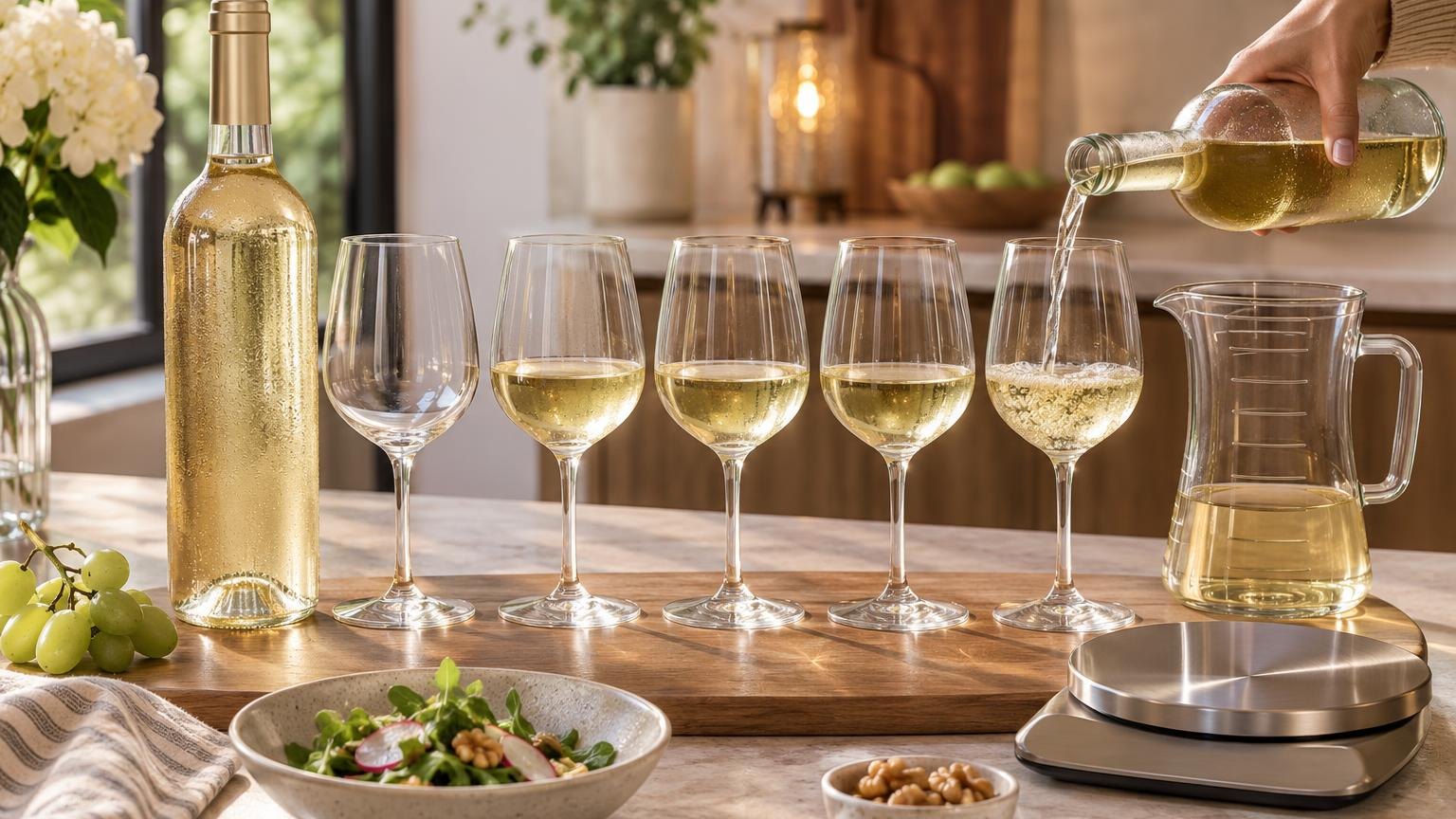
Pinot Grigio Compared to Other White Wines
Pinot Grigio sits close to other white wines in calories; it is not automatically a lower-calorie choice.
Alcohol content and residual sugar matter more than the grape name, so a bottle’s label provides better guidance than its reputation for tasting light.
Calories per Glass and Bottle
USDA FoodData Central’s generic wine entries provide useful reference points. Pinot Gris is the same grape as Pinot Grigio, although the names often signal different winemaking styles.
| White wine | Calories per 5 US fl oz | Approximate calories per 750 mL bottle |
| Pinot Grigio / Pinot Gris | 122 | 620 |
| Sauvignon Blanc | 119 | 605 |
| Chardonnay | 123 | 625 |
| Riesling | 118 | 600 |
Source: USDA FoodData Central, SR Legacy entries for “Alcoholic beverage, wine, table, white” in the listed varieties.
Glass values are rounded from USDA’s approximately 147-gram serving; bottle estimates multiply those values by 5.07 and round to the nearest five calories.
These are generic reference values, not laboratory results for every bottle. The small differences between varieties should not determine your purchase: actual alcohol levels, sweetness, and serving sizes can outweigh them.
What Changes the Calorie Count?
- Alcohol: Ethanol supplies approximately 7 calories per gram, according to FDA nutrition-labeling factors. Higher-ABV wine generally carries more calories when other components stay similar.
- Residual sugar: Sugar supplies approximately 4 calories per gram. A fruity aroma does not establish sweetness; dry wines can smell strongly of pear, peach, or citrus.
- Winemaking style: Chardonnay can be lean and unoaked or richer and higher in alcohol. Riesling ranges from dry to sweet, so its grape name alone cannot predict calories.
How to Choose a Lower-Calorie Bottle
Start with ABV, then look for residual-sugar information or a producer’s calorie declaration. A dry, lower-alcohol Pinot Grigio can offer fewer calories than a stronger Chardonnay, but a lower-alcohol Sauvignon Blanc may be equally suitable.
For accurate tracking, use the specific bottle’s nutrition information whenever available. Measure pours rather than counting glasses: glass shape and fill level do not define a standard serving.
Dry Style Sugar Levels and Residual Effects
Dry Pinot Grigio contains some residual sugar, but alcohol usually supplies most of its calories.
For a bottle-level estimate, use both the wine’s alcohol by volume (ABV) and its residual sugar rather than assuming that “dry” means sugar-free.
What “Dry” Actually Means
Residual sugar is sugar remaining after fermentation, measured in grams per liter (g/L). Yeast converts grape sugars into alcohol, so a thoroughly fermented wine can taste dry while still delivering substantial energy.
European labeling rules allow different sugar ceilings for dry wine, depending on acidity. The table shows illustrative concentrations for a standard 750 mL bottle; these are calculation examples, not measured values for every Pinot Grigio.
| Residual sugar | Sugar per bottle | Calories from sugar | EU dry classification |
| 2 g/L | 1.5 g | 6 | Within the standard limit |
| 4 g/L | 3 g | 12 | Standard upper limit |
| 9 g/L | 6.75 g | 27 | Allowed only when the acidity condition is met |
For the conditional dry classification, residual sugar cannot exceed total acidity by more than 2 g/L, with acidity expressed as tartaric acid. This explains why wines carrying the same dryness description need not contain identical amounts of sugar.
How Residual Sugar Affects Bottle Calories
Calculate sugar calories by multiplying residual sugar in g/L by 0.75 liters, then by approximately 4 calories per gram.
This estimates sugar’s contribution only; it does not calculate the bottle’s total calories or total carbohydrate content.
A 750 mL bottle at 12% ABV supplies approximately 497 calories from ethanol alone, using ethanol’s density of 0.789 g/mL and an energy factor of 7 calories per gram.
Glycerol and organic acids also contribute energy, so alcohol-plus-sugar calculations remain estimates.
- Check the producer’s technical sheet for residual sugar and ABV.
- Do not interpret pear, apple, or citrus aromas as measurements of sugar.
- Use a product-specific nutrition declaration when available; “dry” alone cannot establish bottle calories.
Sources: Commission Delegated Regulation (EU) 2019/33, Annex III, specifies dryness thresholds. USDA Agriculture Handbook No. 74, Energy Value of Foods, documents food-energy conversion factors.
Reading Wine Labels for Calorie Information
A Pinot Grigio label may tell you its alcohol content without listing calories. For a useful bottle estimate, check the bottle volume, alcohol by volume (ABV), and any calorie statement; sweetness descriptions alone cannot establish the total.
Find the Serving Size First
Most wine sold in the United States does not require a Nutrition Facts panel. Producers can voluntarily provide calorie and nutrient information under Alcohol and Tobacco Tax and Trade Bureau (TTB) guidance, including a Serving Facts statement.
If calories appear, check whether they apply to a serving or the entire container. Divide the bottle’s volume by the stated serving volume, then multiply by calories per serving.
Use matching units rather than assuming every bottle contains exactly five labeled servings.
Source: TTB Ruling 2013–2, voluntary nutrient-content statements: https://www.ttb.gov/images/pdfs/rulings/2013-2.pdf.
Use ABV When Calories Are Missing
Alcohol supplies approximately 7 calories per gram. Using an ethanol density of approximately 0.789 grams per milliliter, you can estimate alcohol-derived calories from the labeled ABV.
These calculations exclude sugar and other energy-containing components.
| Labeled ABV | Alcohol-only calories per 150 mL | Alcohol-only calories per 750 mL bottle |
| 12% | 99 | 497 |
| 13% | 108 | 538 |
These are rounded estimates, not complete calorie counts. Calculate bottle alcohol calories as bottle milliliters × ABV expressed as a decimal × 0.789 × 7.
Actual totals also reflect residual sugar and other constituents; permitted ABV labeling tolerances introduce further uncertainty.
Check What the Label Leaves Out
- “Dry” is not a calorie declaration. It describes sweetness, not a measured energy total, and does not mean zero residual sugar.
- “No added sugar” does not mean sugar-free. Some naturally occurring grape sugar can remain after fermentation.
- A QR code may provide more detail. Check the producer’s nutrition page or technical sheet and match the wine, vintage, and bottle size.
Prefer a producer’s published calorie figure over an ABV-only calculation. If no figure exists, report your result as an estimate rather than presenting alcohol calories as the bottle’s full energy content.
Choosing Lower Calorie Pinot Grigio
Choose Pinot Grigio by alcohol content and serving size, not by how light or crisp it tastes. For a dry wine, alcohol usually supplies most of the calories, so checking the label’s ABV is the most useful first step.
Use ABV to narrow your choices
The estimates below show calories from alcohol alone, not total wine calories. They use a 750 mL bottle, ethanol density of approximately 0.789 g/mL, and the USDA energy factor of 7 calories per gram of alcohol.
| Label ABV | Alcohol calories per bottle | Alcohol calories per 150 mL pour |
| 9% | 373 | 75 |
| 11% | 456 | 91 |
| 12% | 497 | 99 |
| 13.5% | 559 | 112 |
Each bottle supplies five of these measured pours. Actual totals include residual sugar and other energy-containing components, so do not treat the table as a finished wine’s nutrition label.
Its purpose is to isolate alcohol’s contribution when comparing bottles.
Check sweetness and the producer’s numbers
“Dry” does not mean calorie-free, and fruity aromas do not prove that a wine contains substantial sugar. Ask for the producer’s technical sheet or nutrition information.
Residual sugar of 4 g/L contributes approximately 12 calories across a 750 mL bottle.
- Prioritize verified totals. Use the producer’s stated calories when available, checking the serving volume before comparing products.
- Check lower-alcohol styles. Reduced-alcohol Pinot Grigio can cut alcohol-derived calories, but added sweetness can offset part of that reduction.
- Ignore unsupported shortcuts. “Organic,” “natural,” and “clean” do not establish a wine’s calorie content.
Keep the pour consistent
Measure your usual glass once with a kitchen measuring cup. A smaller glass does not guarantee a smaller serving, and topping up makes intake difficult to track.
Compare wines using the same volume rather than relying on an undefined “glass.”.
Source basis: USDA energy-conversion factors and the National Institute on Alcohol Abuse and Alcoholism’s Rethinking Drinking guidance on alcohol calories and drink sizes.
For a specific bottle, producer nutrition data takes precedence over generic estimates.
Common Questions
How many calories are in a bottle of Pinot Grigio?
A standard 750 mL bottle of Pinot Grigio typically contains about 500–650 calories, depending on alcohol content and residual sugar.
Use the producer’s nutrition information when available, since grape variety alone does not determine calories.
How many calories are in a 5-ounce glass of Pinot Grigio?
A 5-ounce pour contains approximately 100–130 calories, or about one-fifth of a standard bottle.
For comparison, USDA FoodData Central lists approximately 121 calories for a 5-ounce serving of generic white table wine, not specifically Pinot Grigio.
How much does alcohol content affect Pinot Grigio’s calories?
Alcohol supplies about 7 calories per gram, making it the main calorie source in dry Pinot Grigio.
A 750 mL bottle at 12% ABV contains approximately 497 calories from alcohol alone; at 14% ABV, that rises to approximately 580, before counting carbohydrates.
Does dry Pinot Grigio contain calories from sugar?
Yes, dry Pinot Grigio can contain residual sugar, but it usually contributes far fewer calories than alcohol. For example, a wine containing 4 grams of sugar per liter has 3 grams per 750 mL bottle, adding approximately 12 calories from sugar.
Is Pinot Grigio lower in calories than red wine?
Not necessarily; alcohol content and carbohydrates matter more than wine color.
USDA FoodData Central gives approximately 121 calories for white table wine versus 125 for red per 5-ounce serving, a small difference that does not establish the calories in individual wines.
How many calories are in different Pinot Grigio bottle sizes?
Using the same wine estimated at 500–650 calories per 750 mL, a 375 mL half-bottle contains 250–325 calories. A 1.5-liter magnum contains approximately 1,000–1,300 calories because it holds twice the standard volume.
How can I choose a lower-calorie Pinot Grigio?
Compare wines at the same serving size and prioritize lower ABV and low residual sugar. At equal sugar levels, choosing 11% rather than 13% ABV reduces alcohol-derived calories by approximately 83 per 750 mL bottle, or 16 per 5-ounce glass.
Keep Exploring
- How Many Oz Bottle of Wine?
- Drinks at Red Lobster for Cocktails, Beer, and Wine
- What Does Port Wine Taste Like? What You Need to Know
- How Many Ounces In A Bottle Of Prosecco?
- How Many Glasses of Wine in 1.5 Liters?
- How Did They Make Wine in Biblical Times?
- Good Wine with Pizza for Every Type of Slice
- All Alcohol Guides
- USDA FoodData Central (n.d.)
- National Institute on Alcohol Abuse and Alcoholism (n.d.)
- Centers for Disease Control and Prevention (n.d.)
- U.S. Food and Drug Administration (n.d.)
- Harvard T.H. Chan School of Public Health (n.d.)
- Mayo Clinic (2022)
- National Library of Medicine, PubMed (n.d.)
- U.S. Department of Agriculture (2020)