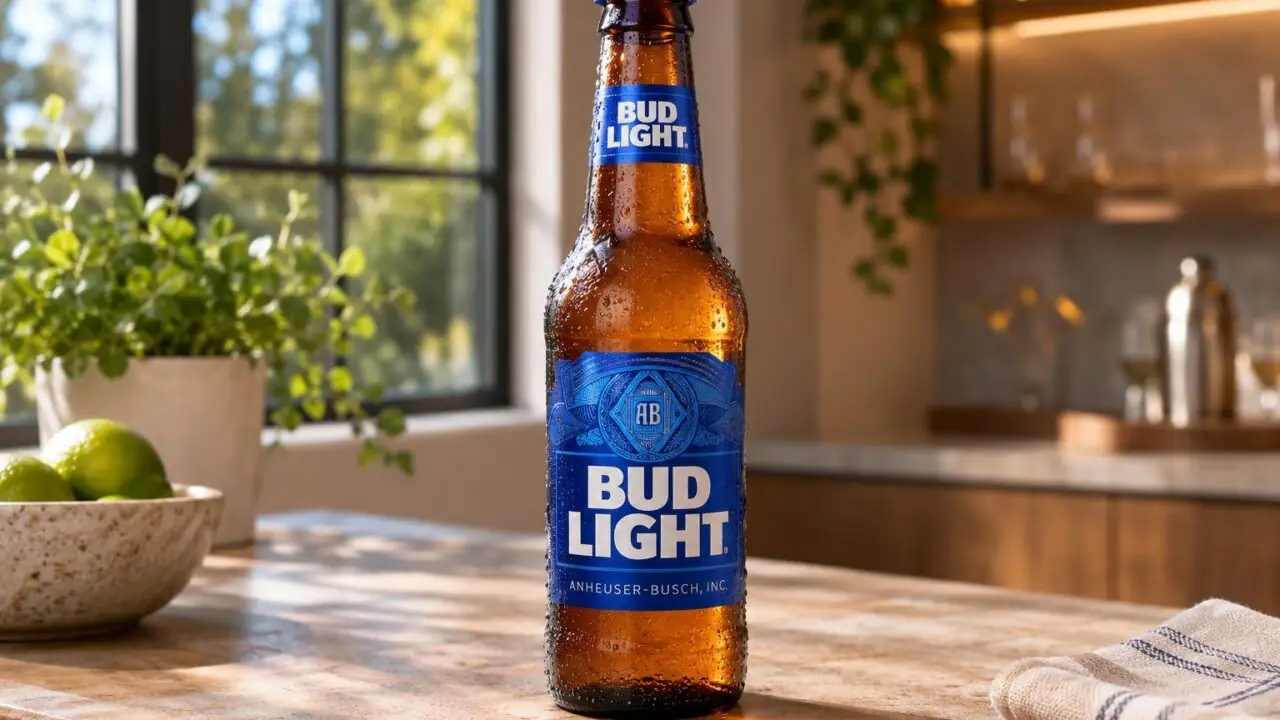
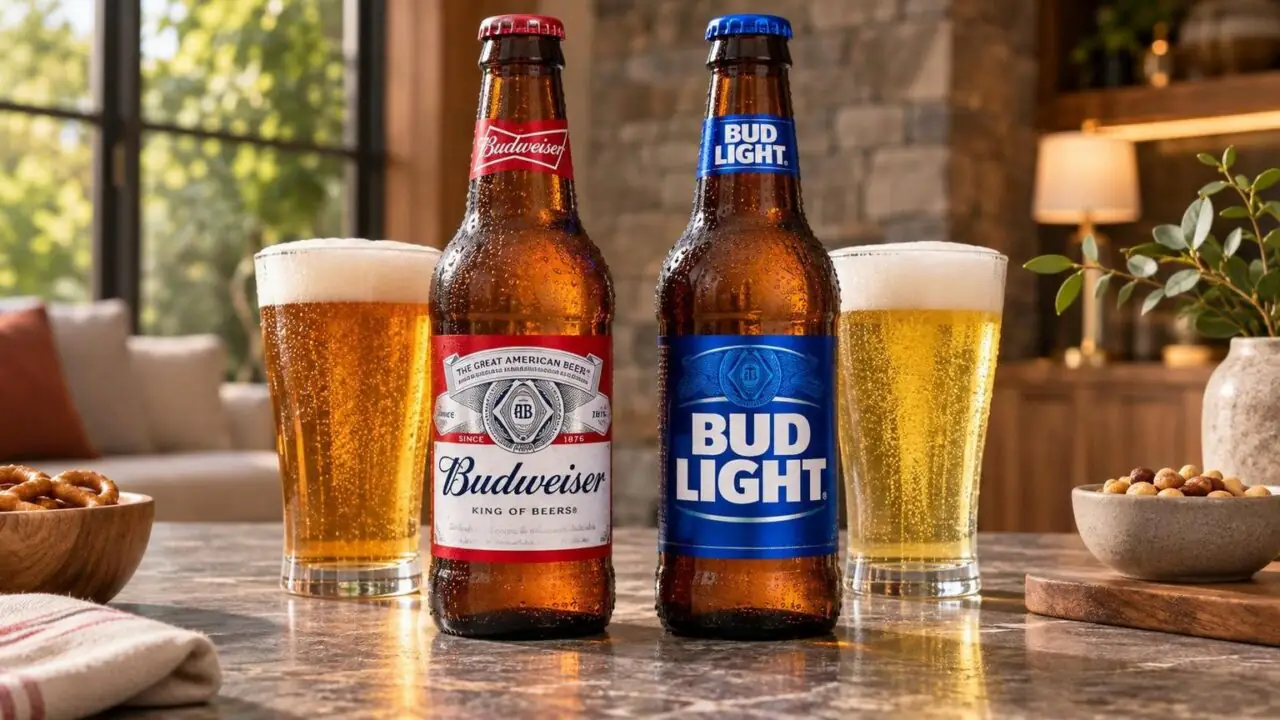
The difference between Budweiser and Bud Light comes down to calories, carbohydrates, and alcohol by volume: Budweiser delivers 145 calories, 10.6 grams of carbohydrates, and 5% ABV per 12-ounce serving, while Bud Light holds 110 calories.
6.6 grams of carbohydrates, and 4.2% ABV.
Both share Anheuser-Busch’s water-barley-rice-hops recipe, so the flavor gap is smaller than the numbers suggest.
Budweiser pours with a fuller body and a longer beechwood-aged finish, a process the brand has used since 1876. Bud Light, launched in 1982 from the same ingredients, trades that weight for a thinner, crisper mouthfeel.
Pick Budweiser with steak or pizza; pour Bud Light for sessions, tailgates, or calorie-counted drinking.
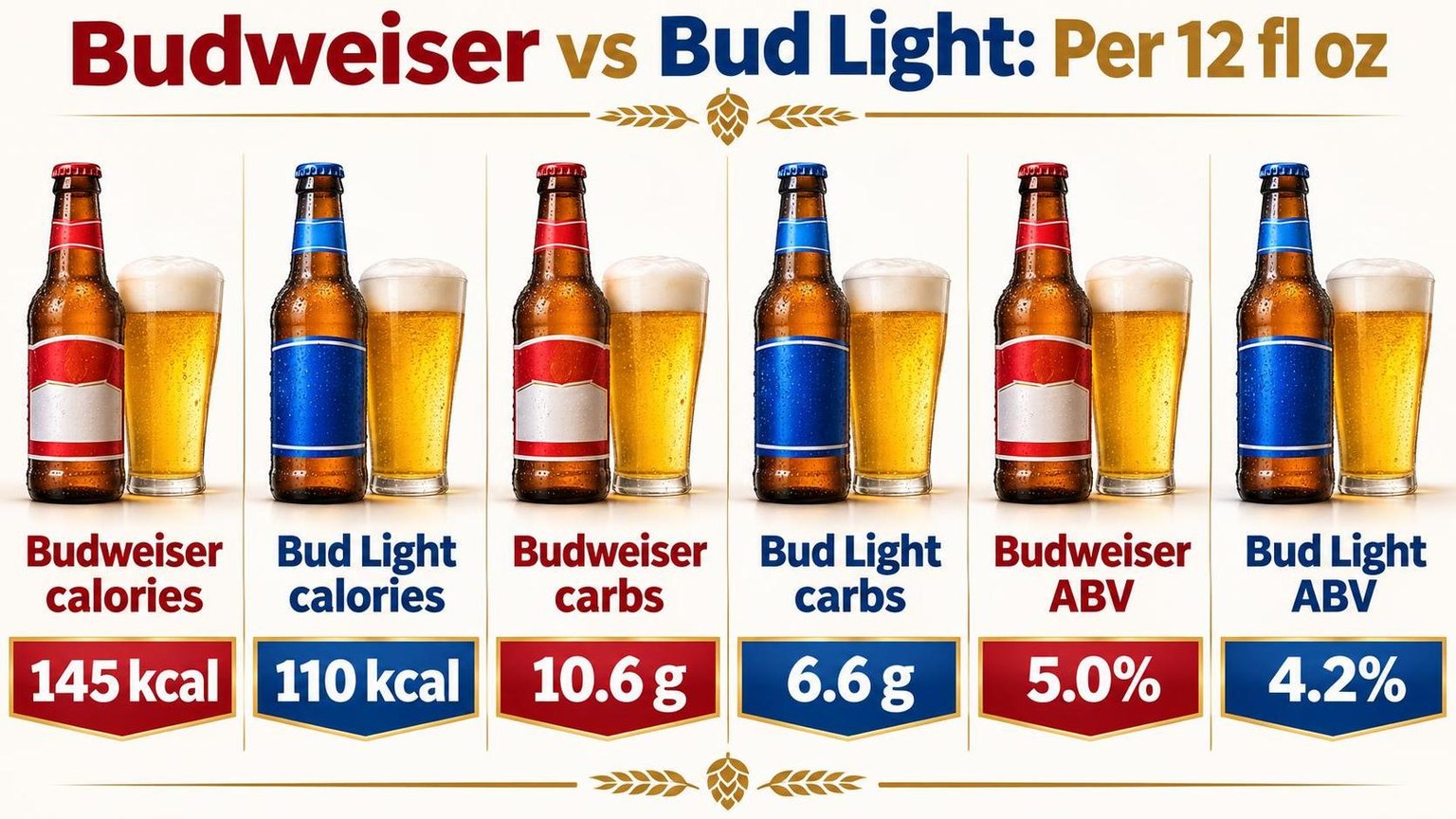
Calories and Alcohol Content Compared
Bud Light has fewer calories and less alcohol than Budweiser when you compare equal servings.
The difference matters for calorie tracking, but “light” does not mean alcohol-free or low-risk: both beers contribute alcohol and calories to your daily intake.
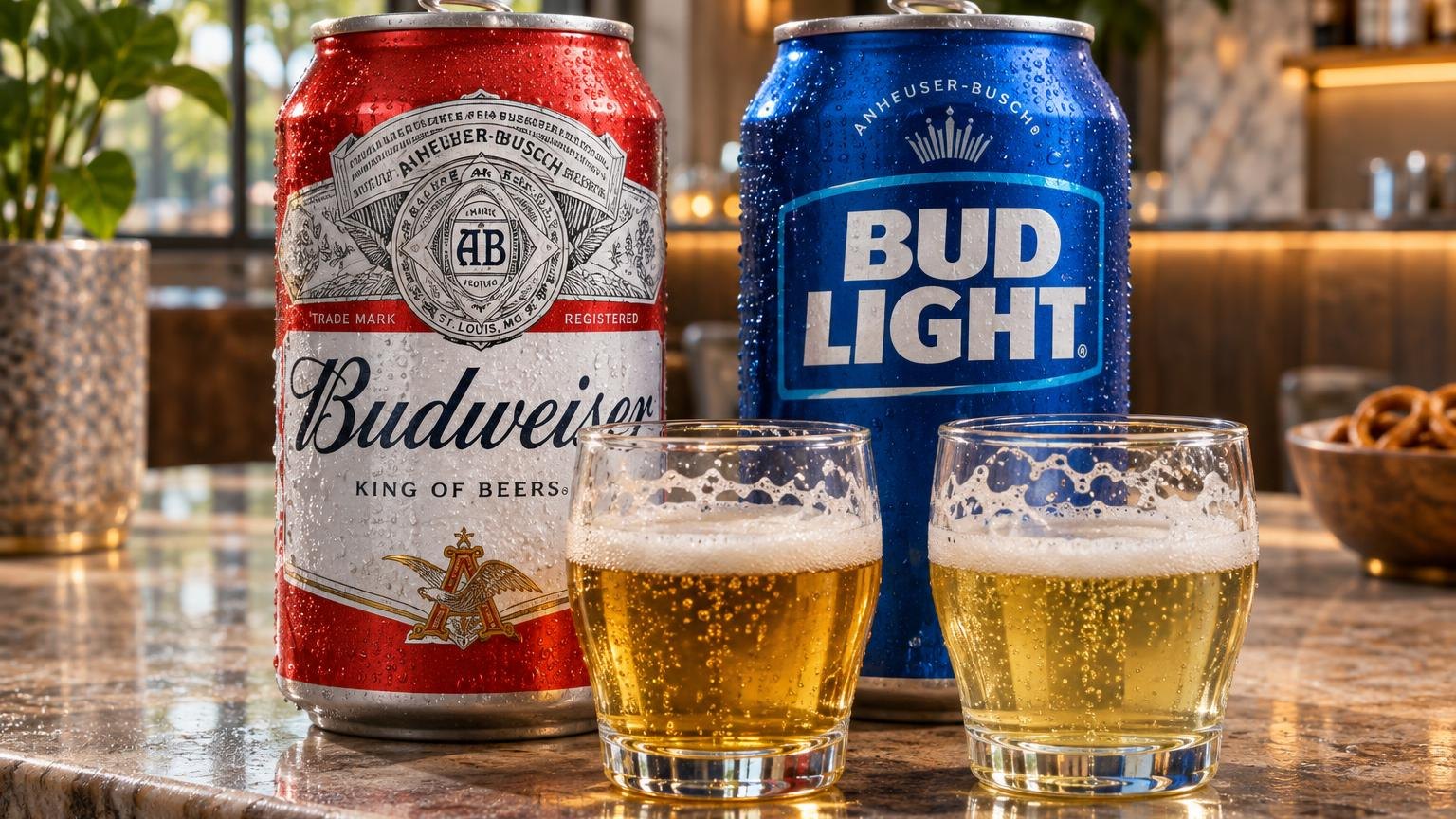
Nutrition and Strength Per Serving
The figures below apply to the standard U.S. versions, not Budweiser Zero, Bud Light Platinum, or flavored extensions.
Manufacturer nutrition information provides the calories, carbohydrates, and alcohol by volume; alcohol quantities and standard-drink equivalents are calculated from those figures.
| Measure | Budweiser | Bud Light |
| Serving size | 12 fl oz | 12 fl oz |
| Calories | 145 | 110 |
| Carbohydrates | 10.6 g | 6.6 g |
| Alcohol by volume (ABV) | 5.0% | 4.2% |
| Pure alcohol by volume | 0.60 fl oz | 0.504 fl oz |
| U.S. standard-drink equivalents | 1.00 | 0.84 |
What the Calorie Difference Means
Bud Light’s lower calorie total reflects both less alcohol and fewer carbohydrates. Alcohol itself supplies energy, so checking carbohydrate grams alone will not tell you which beer contributes fewer calories.
Neither beer becomes nutritionally beneficial because it fits a calorie target.
For food logging, use the actual container size rather than assuming every can or bottle equals the serving above. A larger package increases total calories and alcohol proportionally, even though the beer’s ABV stays unchanged.
Also distinguish “light” from “low-carb.” Bud Light contains carbohydrates; it is not carbohydrate-free.
If you track intake closely, read the current package information and log the specific product rather than selecting a generic beer entry.
How to Interpret the Alcohol Content
ABV describes alcohol concentration, not the total alcohol in whatever container you purchase. At equal volumes, Budweiser delivers more alcohol.
Drinking a larger quantity of Bud Light can erase that difference, so serving size matters alongside the percentage on the label.
The National Institute on Alcohol Abuse and Alcoholism defines a U.S. standard drink as containing 0.6 fluid ounces of pure alcohol. The table uses that definition.
A standard drink is a measurement tool, not a guarantee of safety or a prediction of impairment.
Sources: U.S. product information from Budweiser, https://www.budweiser.com/, and Bud Light, https://www.budlight.com/.
Standard-drink definition: National Institute on Alcohol Abuse and Alcoholism, https://www.niaaa.nih.gov/alcohols-effects-health/overview-alcohol-consumption/what-standard-drink.
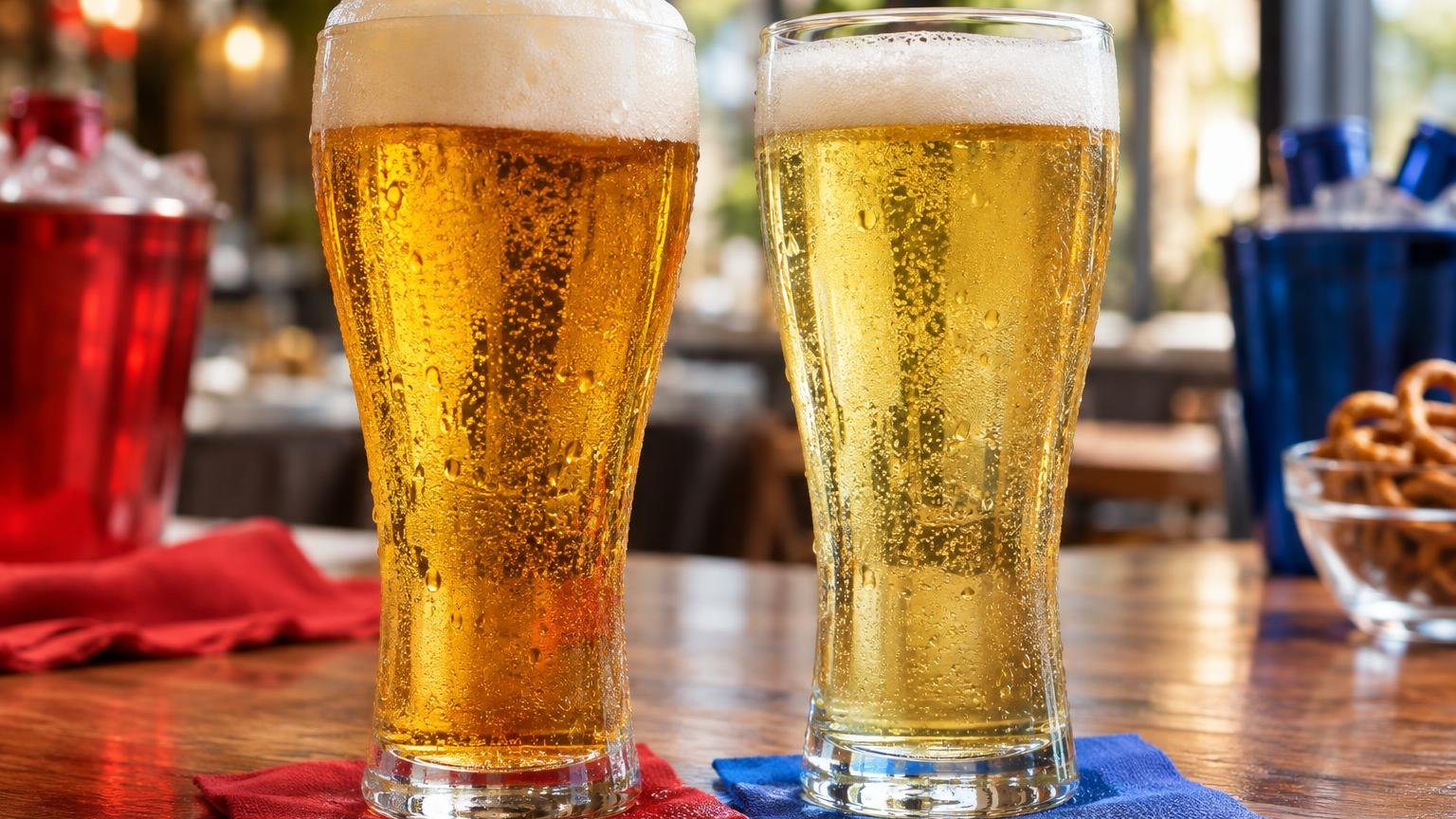
Ingredients and Brewing Process Differences
Budweiser and Bud Light share the same core brewing ingredients: water, barley malt, rice, hops, and yeast.
Their difference lies in the finished beer’s alcohol, remaining carbohydrate, and flavor intensity—not in replacing barley with rice or eliminating hops.
The Same Ingredients, Different Roles
The brands’ published ingredient information identifies barley malt, rice, hops, and water. Yeast performs fermentation, converting fermentable sugars into alcohol and carbon dioxide.
Ingredient lists alone do not reveal the recipes’ proportions or establish that the beers use identical yeast strains.
- Barley malt: Supplies starch, brewing enzymes, and malt flavor. During mashing, enzymes break starch into sugars that yeast can ferment.
- Rice: Contributes starch without the same malt character as barley. Both beers use rice; it is not an ingredient unique to Bud Light.
- Hops: Supply bitterness and aroma that balance the beer’s sweetness. Neither brand publishes enough recipe detail to support a precise comparison of hopping rates.
- Water and yeast: Provide the brewing medium and fermentation activity. Their management matters, but public ingredient statements do not disclose every production specification.
What Changes in the Finished Beer?
The brands’ U.S. nutrition information shows the measurable result of their different recipes. These figures describe equal servings; they do not disclose grain weights, mash temperatures, or fermentation schedules.
| Measure | Budweiser | Bud Light |
| Serving size | 12 fl oz | 12 fl oz |
| Alcohol by volume | 5.0% | 4.2% |
| Calories | 145 | 110 |
| Carbohydrate | 10.6 g | 6.6 g |
Bud Light contains less alcohol and carbohydrate per serving. Both contribute calories, so its lower calorie count reflects more than alcohol reduction alone.
The carbohydrate figures should not be read as measurements of sugar: beer also contains carbohydrates that brewing yeast does not readily ferment.
Fermentation, Conditioning, and Beechwood
Both are lagers, fermented with lager yeast and conditioned to develop a clean profile. Budweiser’s advertised beechwood aging is a conditioning technique, not barrel aging.
The prepared wood provides surface area for yeast during maturation rather than deliberately adding an oak-like flavor.
Bud Light also uses beechwood aging, so this process does not uniquely distinguish Budweiser. Public brand information does not establish a specific enzyme treatment or dilution step as the defining difference.
Claims that Bud Light is simply watered-down Budweiser go beyond the available recipe evidence.
Sources: Official U.S. brand ingredient, brewing, and nutrition information: https://www.budweiser.com/ and https://www.budlight.com/.
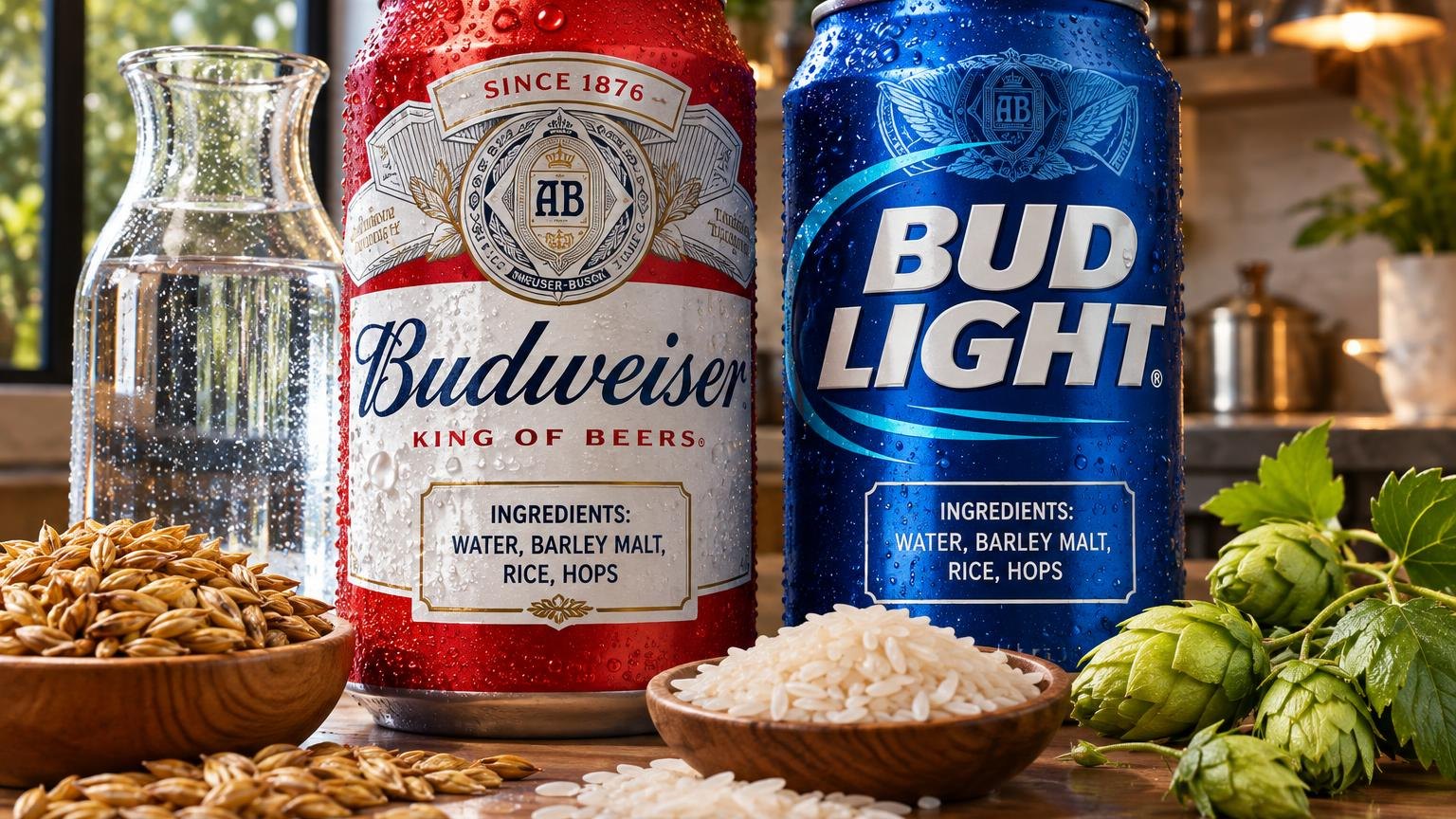
Taste Profile and Mouthfeel Breakdown
Budweiser generally tastes fuller and more grain-forward than Bud Light, with a more noticeable malt impression through the finish.
Bud Light emphasizes a lighter body and restrained flavor; neither beer aims for the pronounced bitterness or aromatic hop character of an IPA.
Flavor: Grain, Sweetness, and Bitterness
Budweiser’s malt character can suggest pale bread, cereal, and a mild sweetness. Its hop bitterness provides balance rather than a sharp bite.
The overall impression remains clean and relatively neutral, but the grain flavor typically has more presence than it does in Bud Light.
Bud Light offers a subtler grain impression, with less flavor weight across the palate.
Its sweetness and bitterness are both restrained. “Watery” is a subjective criticism, not a technical defect: drinkers seeking minimal intensity may describe the same characteristic as crisp or refreshing.
Both brands use rice alongside barley malt. Rice contributes fermentable material without the assertive malt flavors associated with darker or more heavily kilned malts.
Their difference is therefore not simply “rice versus barley”; both belong to the American adjunct-lager tradition.
Body: What the Published Numbers Show
The following figures describe the standard US beers, not stronger export variants or other products bearing either brand name.
Official brand nutrition information provides useful context for their different levels of body, although nutrition figures are not direct measurements of perceived sweetness.
| Measure | Budweiser | Bud Light |
| Serving size | 12 fl oz | 12 fl oz |
| Alcohol by volume | 5.0% | 4.2% |
| Calories | 145 | 110 |
| Total carbohydrate | 10.6 g | 6.6 g |
Budweiser’s higher alcohol and carbohydrate content is consistent with its fuller impression. Bud Light feels leaner and leaves less lingering grain character.
Total carbohydrate is not the same as sugar, however, so these figures cannot establish how sweet either beer will taste.
Carbonation and the Finish
Both present lively carbonation, which adds a prickly sensation and helps clear the palate.
Bud Light’s lighter body can make that sparkle seem more prominent, but that does not establish that it contains more dissolved carbon dioxide than Budweiser.
For a useful comparison, pour both into identical clean glasses at the same temperature. Very cold serving temperatures suppress flavor differences; slight warming makes grain character easier to assess.
Freshness, glass cleanliness, and pouring technique also influence the experience.
Sources: official US brand information at https://www.budweiser.com/ and https://www.budlight.com/; American lager style context from the Beer Judge Certification Program at https://www.bjcp.org/style/2021/1/.
Nutrition Facts Carbs and Serving Sizes
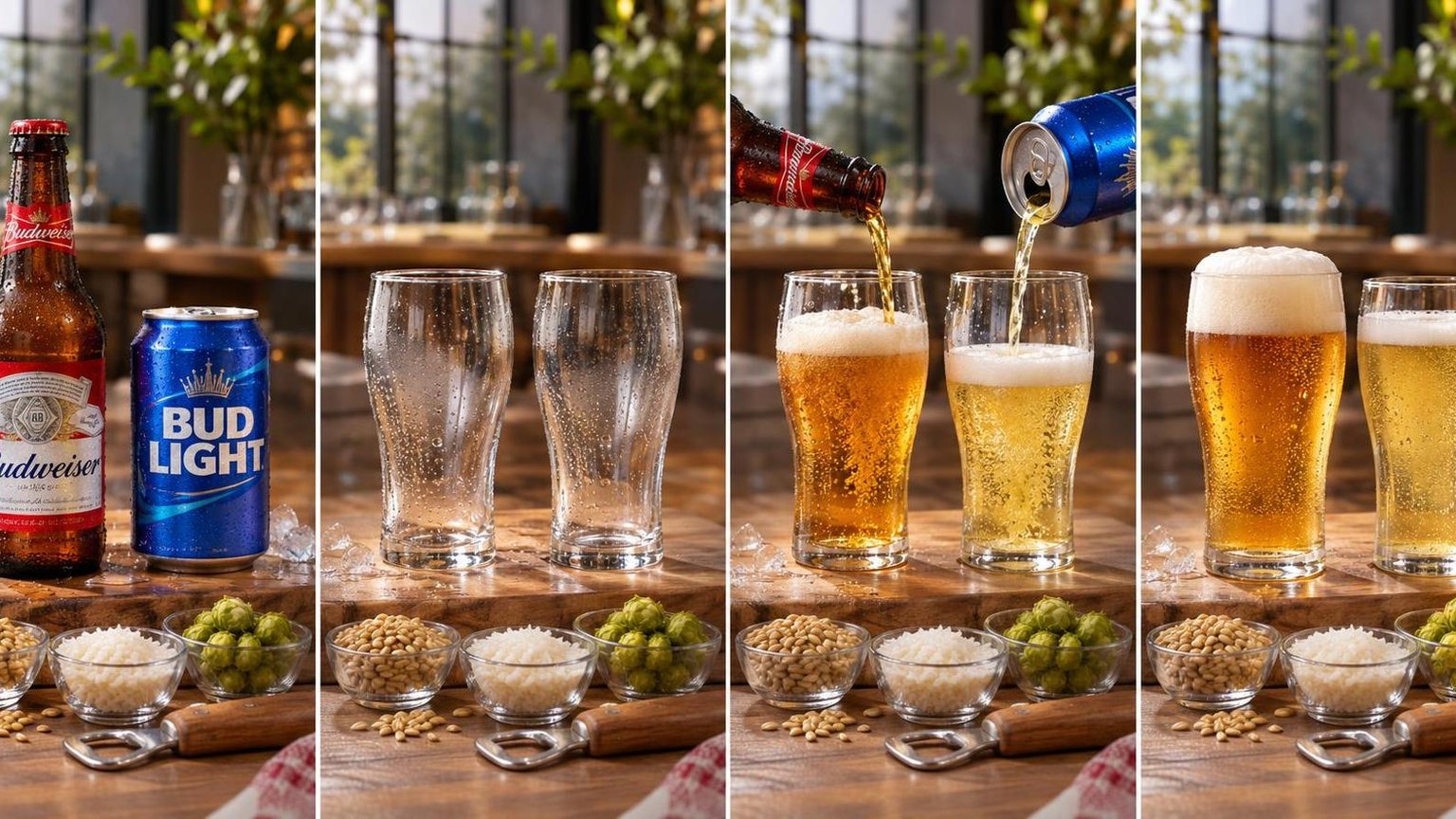
Bud Light has fewer calories and carbohydrates than Budweiser when you compare equal servings. The figures below apply to the standard U.S. beers, not Budweiser Zero, Bud Light NEXT, flavored extensions, or versions brewed for other markets.
Nutrition per 12-Fl.-Oz. Serving
The brands publish these nutrition figures for a 12-fl.-oz. serving. Check the package when buying a different format or purchasing outside the United States, where formulations and labeling can differ.
| Measure | Budweiser | Bud Light |
| Serving size | 12 fl. oz. | 12 fl. oz. |
| Calories | 145 | 110 |
| Carbohydrates | 10.6 g | 6.6 g |
| Protein | 1.3 g | 0.9 g |
| Fat | 0 g | 0 g |
| Alcohol by volume | 5.0% | 4.2% |
Sources: U.S. product information from Budweiser, https://www.budweiser.com, and Bud Light, https://www.budlight.com. These are manufacturer-reported values; the larger-serving estimates below are calculated from those published figures.
Larger Containers Change the Calculation
A can, bottle, or draft pour is not automatically one labeled serving. Multiply the published nutrition figures by the container’s fluid ounces divided by the labeled serving size. These examples assume the same beer formulation throughout.
| Beer and amount | Estimated calories | Estimated carbohydrates |
| Budweiser, 16 fl. oz. | 193 | 14.1 g |
| Bud Light, 16 fl. oz. | 147 | 8.8 g |
| Budweiser, 24 fl. oz. | 290 | 21.2 g |
| Bud Light, 24 fl. oz. | 220 | 13.2 g |
Calories are rounded to the nearest whole calorie; carbohydrates are rounded to one decimal place. Because the original label figures are already rounded, these scaled amounts are practical tracking estimates, not separate laboratory measurements.
What the Numbers Mean
- Count the actual volume. A larger Bud Light can can contain more calories and carbohydrates than a smaller Budweiser. Choosing “light” does not cancel out a larger portion.
- Do not calculate calories from carbohydrates alone. Alcohol also supplies energy. Multiplying carbohydrate grams by their calorie factor will therefore underestimate either beer’s total calories.
- Separate carbohydrates from sugar. Total carbohydrate is not a measurement of sugar alone. These carbohydrate figures do not establish either beer’s sugar content.
- Treat “light” as a product distinction, not a health guarantee. Bud Light still contains alcohol and carbohydrates. Lower calorie content does not make drinking risk-free.
For food logging, select the exact beer and enter the amount consumed rather than accepting an app’s default “one beer.” For draft service, ask the glass size and recognize that foam and fill level can affect the actual liquid volume.
History and Brand Positioning at Anheuser-Busch
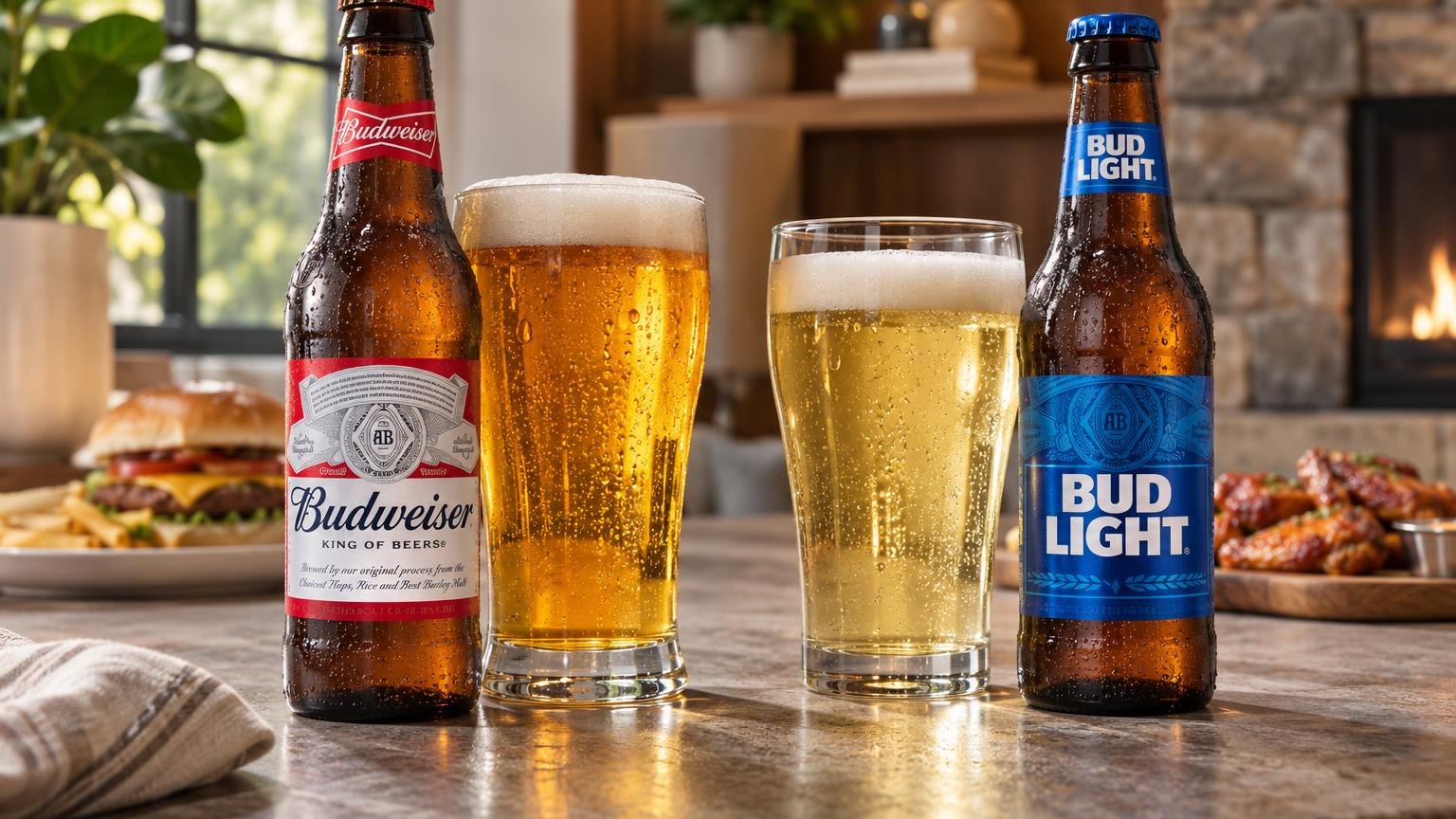
Budweiser is Anheuser-Busch’s heritage flagship; Bud Light is its lighter-bodied, lower-calorie counterpart.
Their shared brewer and family resemblance do not make them interchangeable: each brand developed around a different promise to American beer drinkers.
Budweiser Established the Flagship Identity
Adolphus Busch and his business associate Carl Conrad introduced Budweiser in 1876. Inspired by Bohemian lager traditions, the beer became a nationally distributed American lager rather than a product defined by one local market.
Anheuser-Busch used pasteurization, refrigerated rail transport, and an expanding distribution network to support that reach.
These investments helped beer travel farther while maintaining consistency, an important advantage when much American brewing still served regional customers.
Budweiser’s positioning centers on brewing tradition, consistency, and its “King of Beers” identity.
Its rice-containing recipe and beechwood aging belong to that established brewing story; beechwood supports yeast during maturation rather than giving the beer a wood-aged flavor.
Bud Light Extended the Brand Into Light Beer
Anheuser-Busch launched Bud Light in 1982, initially as Budweiser Light. It entered an already established light-beer category, offering a recognizable connection to Budweiser with less alcohol, fewer calories, and a lighter drinking profile.
| Historical distinction | Budweiser | Bud Light |
| U.S. introduction | 1876 | 1982 |
| Original launch name | Budweiser | Budweiser Light |
| Core brand position | Heritage American lager | Light American lager |
Bud Light’s advertising developed a more contemporary, social identity through sports, humor, and entertainment.
Its commercial purpose was not simply to replace Budweiser: it gave Anheuser-Busch a competing product for drinkers who preferred the growing light-lager segment.
One Brewer, Separate Consumer Promises
Both brands belong to Anheuser-Busch’s U.S. portfolio.
Anheuser-Busch became part of Anheuser-Busch InBev following InBev’s acquisition in 2008, but the brands retained separate packaging, advertising, and identities rather than becoming one product line with different labels.
- Budweiser: Emphasizes heritage, brewing credentials, and a fuller lager profile.
- Bud Light: Emphasizes refreshment, lighter body, and mainstream social occasions.
Both are mass-market beers. Budweiser’s heritage messaging does not make it a craft beer, and Bud Light’s calorie-conscious positioning does not make it alcohol-free or inherently healthy.
Brand positioning explains the intended appeal, not a guarantee of quality or personal preference.
Sources: Anheuser-Busch’s company history and Budweiser and Bud Light brand profiles; Encyclopaedia Britannica’s history of Anheuser-Busch Companies.
Which Beer Fits Your Drinking Occasion
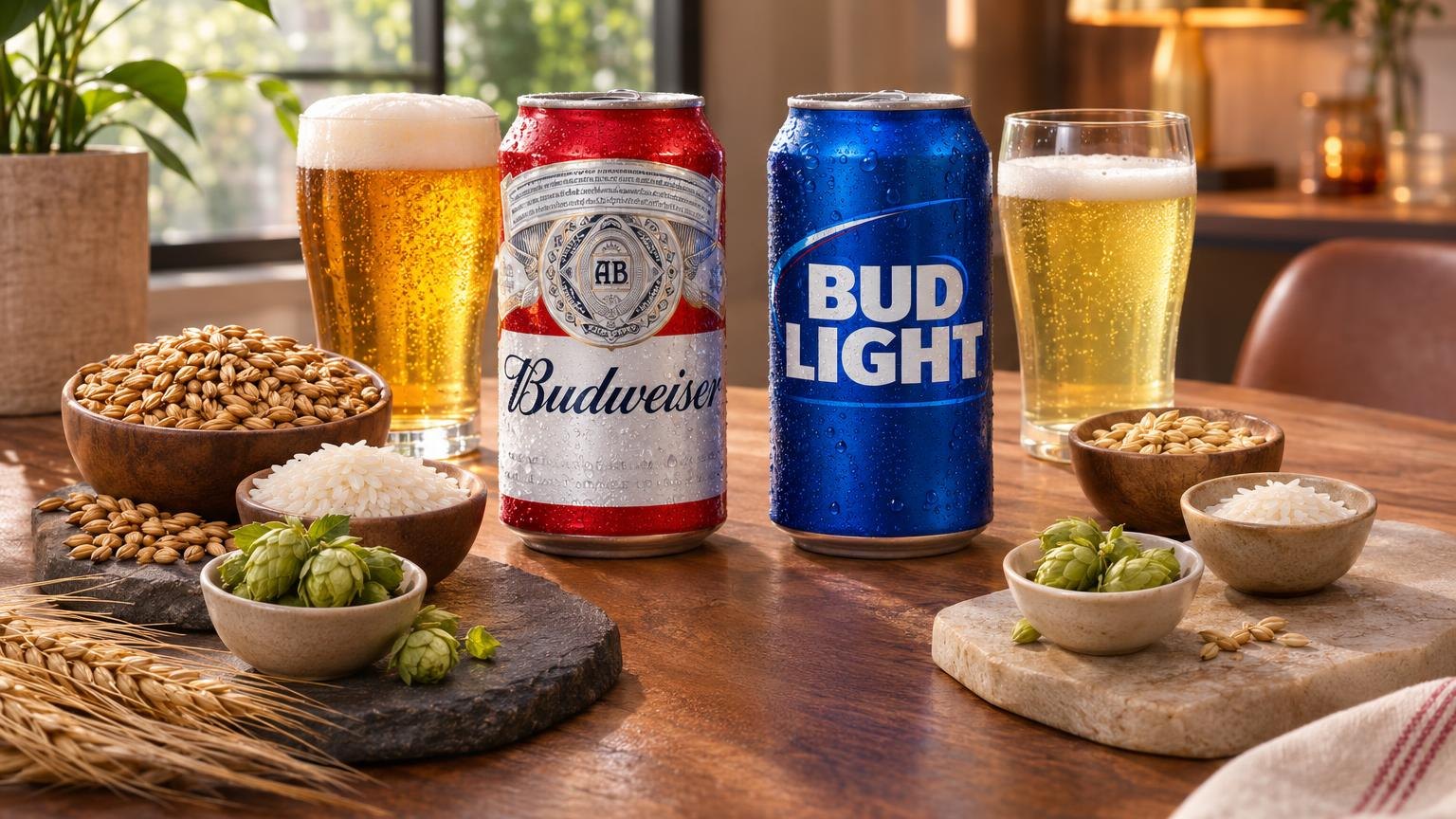
Choose Budweiser when you want more malt flavor alongside food; choose Bud Light when you prefer a lighter-bodied beer with fewer calories per equal serving.
Both are American-style lagers, but their differences in strength and body matter more than the occasion’s label.
| US product, per 12 fl oz | Budweiser | Bud Light |
| Alcohol by volume | 5.0% | 4.2% |
| Calories | 145 | 110 |
| Carbohydrates | 10.6 g | 6.6 g |
Sources: US product information from Budweiser, https://www.budweiser.com/, and Bud Light, https://www.budlight.com/. These figures apply to the original beers, not similarly named extensions.
Check the package when buying outside the United States because formulations and labeling can differ.
For Burgers, Barbecue, and a Sit-Down Meal
Budweiser is the stronger fit if you want the beer’s grainy malt character to remain noticeable beside a cheeseburger, grilled sausage, or barbecue chicken.
Its fuller body and mild sweetness complement browned meat without the pronounced bitterness associated with many IPAs.
Bud Light works when you want less flavor competition. Try it with lightly seasoned chicken, a turkey sandwich, or salty snacks.
These are pairing suggestions, not fixed rules: sauce, seasoning, and your preference for malt flavor can change the better choice.
For a Cookout or Game-Day Gathering
Bud Light suits guests who prioritize a crisp finish and lighter mouthfeel. Budweiser suits those who find light lager too thin. If you are hosting a mixed group, offering both is more useful than assuming everyone wants the same beer.
- Serve either chilled, but avoid freezing it; extreme cold suppresses aroma and flavor.
- Keep water and alcohol-free options equally accessible, especially at outdoor gatherings.
- Compare package sizes before pouring. A larger container changes total alcohol and calorie intake, even when the brand stays the same.
For Calorie Awareness or Alcohol Limits
Bud Light has the lower calorie count and alcohol concentration at equal volume, as the table shows.
That makes it the more practical choice when those specific differences guide your purchase. “Light” does not mean alcohol-free, carbohydrate-free, or safe to drink without limits.
Neither beer is appropriate before driving. For a long event, do not treat Bud Light’s lower strength as permission to drink more; quantity and pace still matter.
If you want to avoid alcohol entirely, choose a clearly labeled alcohol-free alternative rather than either standard product.
Questions People Ask Most
What is the main difference between Budweiser and Bud Light?
Budweiser is a fuller-bodied American-style lager, while Bud Light is a lighter-bodied lager with fewer calories and less alcohol. Both use barley malt, rice, hops, and water, so the difference is not that one contains rice and the other does not.
How much alcohol is in Budweiser versus Bud Light?
In the United States, Budweiser contains 5.0% alcohol by volume (ABV), compared with Bud Light’s 4.2%, according to their official product information.
At the same serving size, Budweiser contains about 19% more alcohol; percentages can differ in other markets.
How do Budweiser and Bud Light compare in calories and carbohydrates?
Official U.S. nutrition information lists 145 calories and 10.6 grams of carbohydrates per 12-fluid-ounce Budweiser, versus 110 calories and 6.6 grams for Bud Light. Choosing Bud Light saves 35 calories and 4 grams of carbohydrates per serving.
Does Bud Light taste like Budweiser?
They share a mild lager profile, but Budweiser generally has more noticeable grain sweetness and a fuller mouthfeel. Bud Light tastes lighter and less malt-forward, making it the better fit if you prefer a less pronounced beer flavor.
Is Bud Light gluten-free or safer than Budweiser for someone with celiac disease?
Neither beer is gluten-free: both contain barley malt, a gluten source identified by the FDA.
Bud Light’s lower calorie and carbohydrate counts do not make it suitable for someone with celiac disease; choose a beer specifically labeled gluten-free instead.
Related Guides
- Beer Vs Wine: Which is the Healthiest?
- How Much Is A Keg Of Bud Light? Answer From Expert
- How Much Is Heineken Alcohol Content? – In-depth Answer
- How Much Does A Keg Weigh? 11 Essential Facts, Charts & Safety Tips (2026 Update)
- What Is the Alcohol Content in Yuengling Beer?
- Ginger Beer vs Ginger Ale: Difference, Taste, Cocktails (2026 Guide)
- Beer That Doesn't Taste Like Beer for New Drinkers
- How Much Alcohol Is In Miller Lite? Alcohol in Miller Lite
- 11 Essential Facts About How Many Glasses Of Beer In A Keg (2026 Full Draft System & Event Planner Guide)
- All Alcohol Guides
- Budweiser — Official Beer Information (n.d.)
- Bud Light — Official Beer Information (n.d.)
- National Institute on Alcohol Abuse and Alcoholism — What Is a Standard Drink? (n.d.)
- USDA and HHS — Dietary Guidelines for Americans, 2020–2025 (2020)
- Electronic Code of Federal Regulations — Labeling and Advertising of Malt Beverages, 27 CFR Part 7 (n.d.)
- Harvard T.H. Chan School of Public Health — Alcohol: Balancing Risks and Benefits (n.d.)
- Brewers Association — Beer Style Guidelines (n.d.)