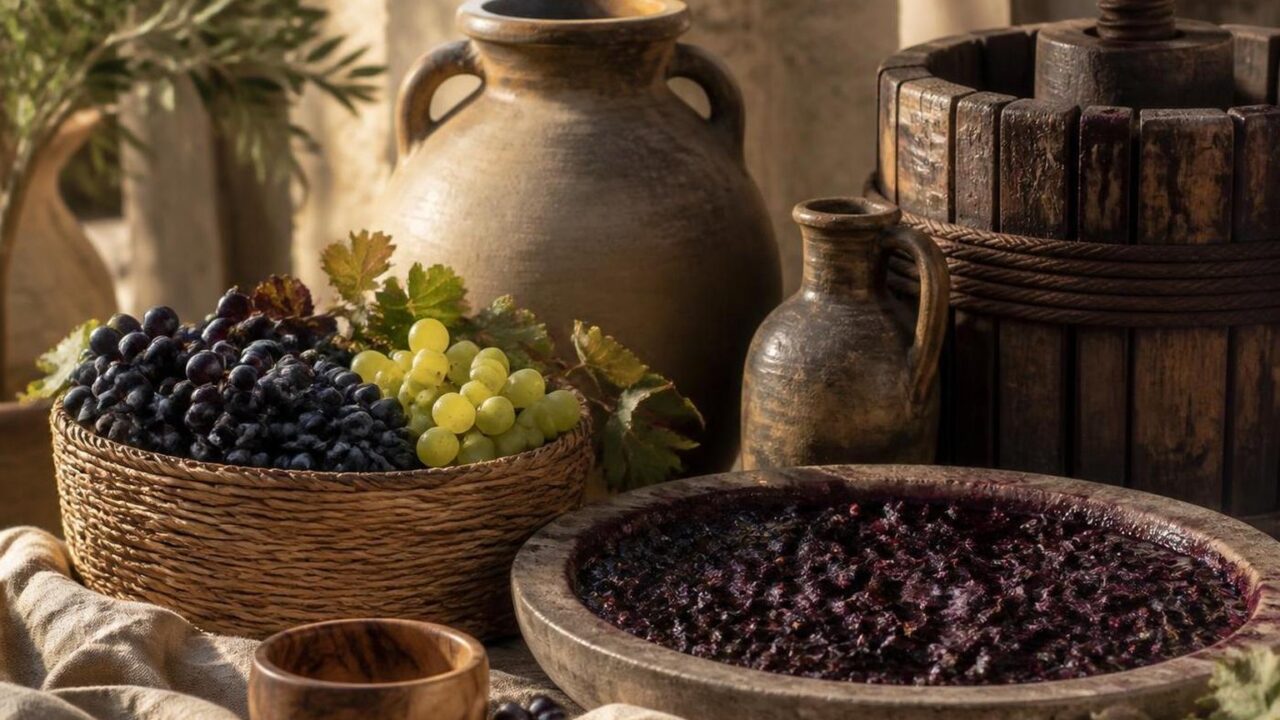
How Did They Make Wine in Biblical Times? is answered by a concrete sequence: families harvested ripe grapes, crushed them in rock-cut winepresses, collected the must in vats, and fermented it in jars or skins.
Archaeology from Israel’s highlands and Galilee has uncovered thousands of hewn presses; the basic layout was a treading floor draining into a lower collecting vat.
Workers pressed by foot to avoid shattering bitter seeds, then let wild yeasts start fermentation within hours.
Storage mattered as much as crushing: clay jars, skin bags, pitch-lined vessels, and cool cellars limited oxygen while sediment settled.
Biblical references to winepresses, new wine, and skins match this practical, small-batch process rather than modern stainless-steel winemaking.
Biblical Winemaking Without Modern Equipment
Biblical wine was not made with modern pumps, cultured yeast, stainless steel, or temperature control. The numbers that matter are practical ones: harvest sugar, pressing capacity, fermentation time, storage volume, and dilution habits.
Ancient Judean and Galilean wine production was small-scale by modern standards, but not casual. Archaeological winepresses, Hebrew measures, and texts such as the Mishnah, Pliny, and the New Testament give usable ranges.
| Number | What it means | Why it matters |
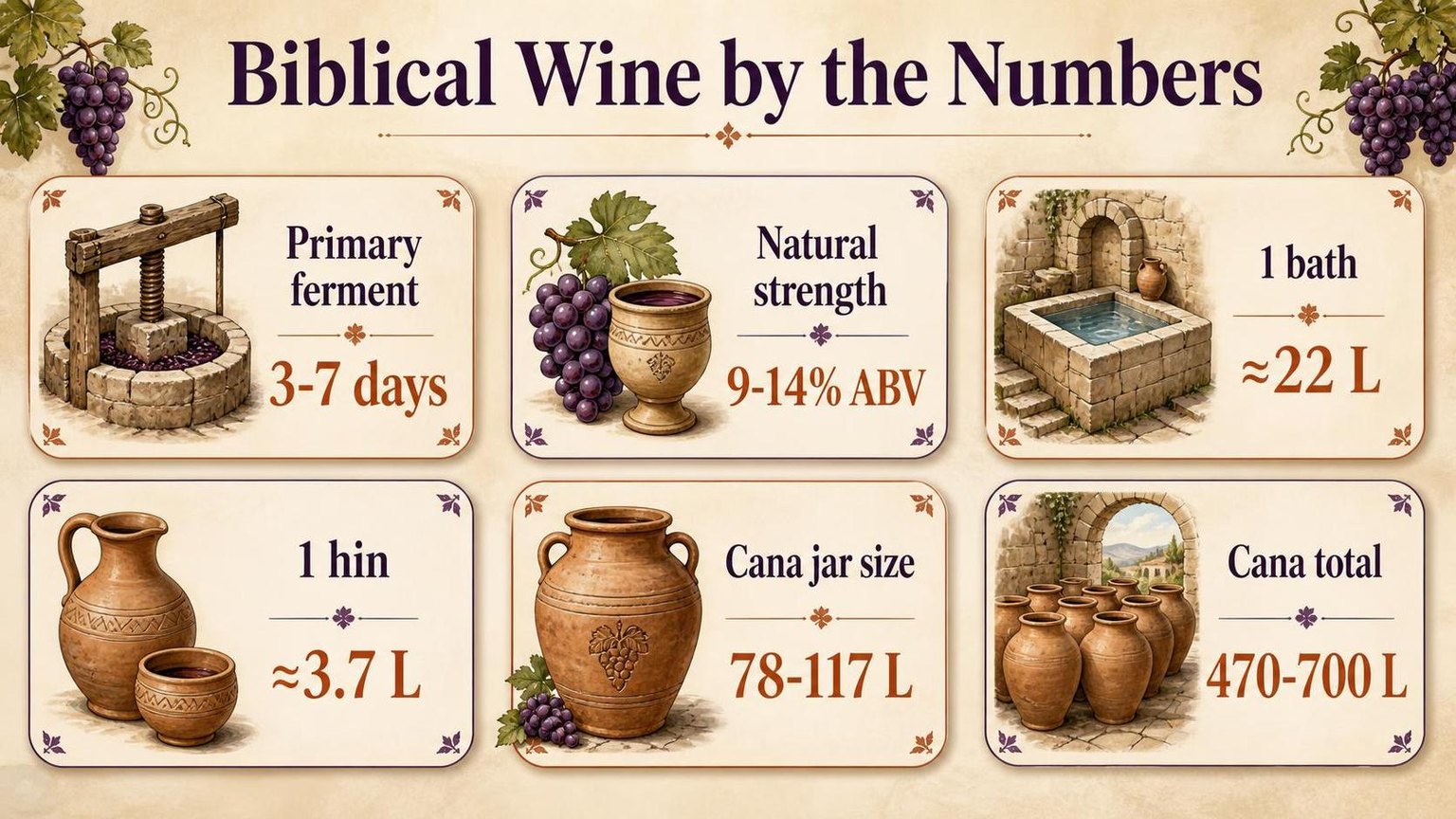
| 3-7 days | Likely active primary fermentation for crushed grapes in a warm Levantine harvest season. | Wild yeasts on grape skins could start quickly; warm stone vats speed fermentation compared with cool cellars. |
| 9-14% ABV | Probable natural alcohol range for fully fermented grape wine. | Without distillation or fortification, wine strength depended on grape sugar; very sweet must might ferment higher, but 15% was near yeast tolerance. |
| 1 bath ≈ 22 liters | A common biblical liquid measure, used in texts such as 1 Kings 7:26 and Ezekiel 45:10-11. | It helps translate “wine” from religious text into actual volume handled by households, estates, and temples. |
| 1 hin ≈ 3.7 liters | One-sixth of a bath. | The hin appears in offering texts, including Exodus 29:40 and Numbers 15, where wine is measured for libations. |
| 2-3 metretai per jar | John 2:6 describes six stone jars, each holding “two or three measures.” A Greek metretes was about 39 liters. | The Cana jars therefore held roughly 78-117 liters each, or about 470-700 liters total. |
A household press might be a shallow rock-cut treading floor draining into a lower collection vat.
Larger Iron Age and Roman-period installations in Israel often had multiple plastered basins, indicating repeated batches during harvest rather than a single giant crush.
- Crushing: Grapes were usually foot-trodden. This broke skins without pulverizing seeds, which can add bitterness.
- Settling: Juice ran into a lower vat, where skins, stems, and sediment could separate before storage.
- Fermentation: No added commercial yeast was needed; natural yeasts from grape skins and the winery environment did the work.
- Storage: Wine went into jars, skins, or amphorae, often sealed with clay, pitch, oil, or stoppers to limit air exposure.
Dilution is often misunderstood. Greco-Roman writers commonly mention mixing wine with water, and later rabbinic sources discuss ratios such as one part wine to three parts water, but that does not prove every biblical cup was diluted the same way.
The safest conclusion is numeric, not romantic: biblical wine was real fermented grape wine, usually produced in batches measured by liters, not barrels, and consumed at strengths controlled by harvest sugar, fermentation, storage, and sometimes water.
Why Biblical Wine Varied
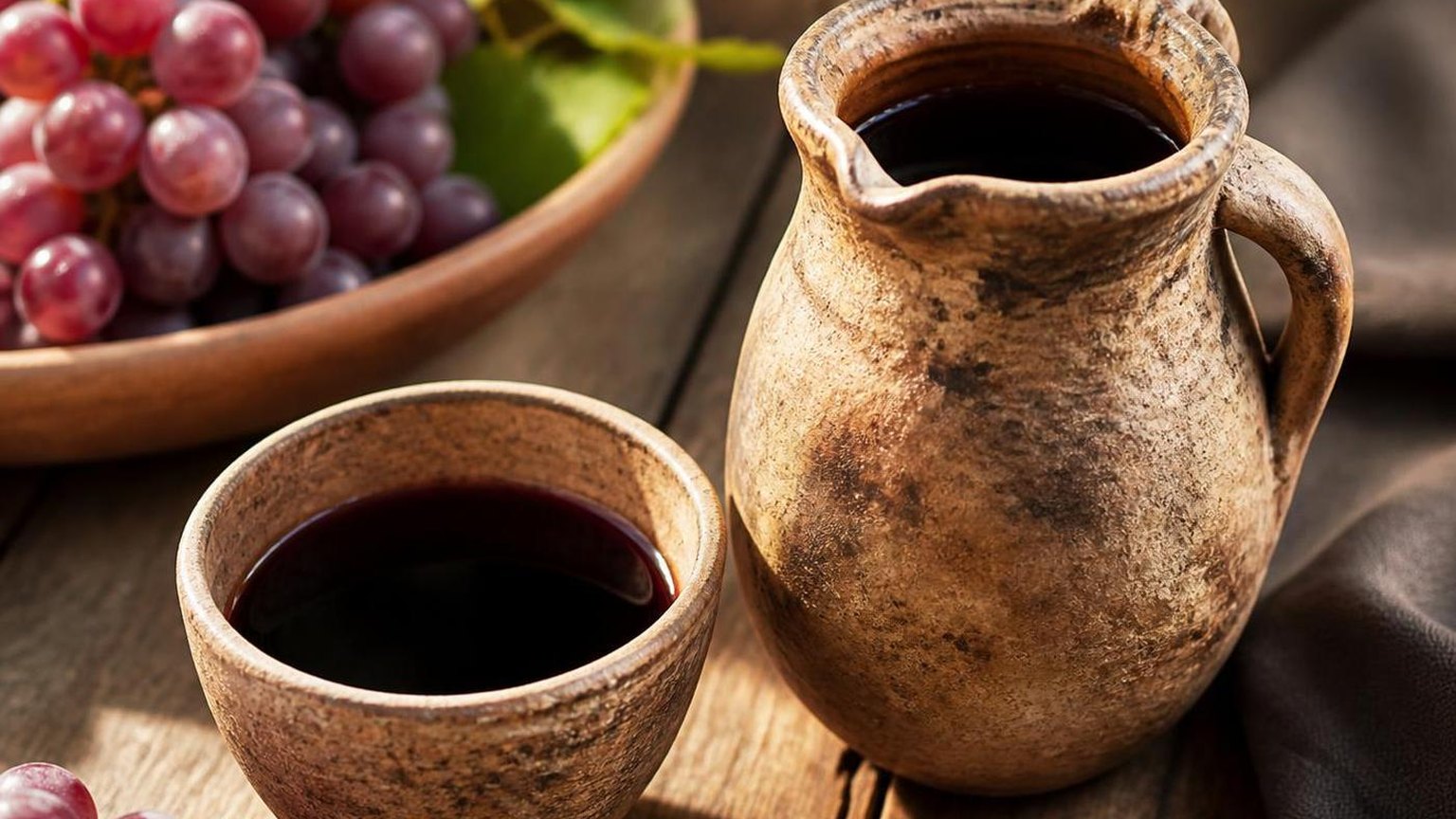
Biblical wine was not a standardized product. Its flavor, strength, and stability depended on grape ripeness, harvest weather, pressing method, storage vessel, and how quickly it was consumed.
In the hill country of Judah and Galilee, small changes mattered. A few extra days on the vine could mean noticeably more sugar, more alcohol after fermentation, and a wine that kept longer without modern sanitation or sulfites.
Grape Ripeness and Harvest Timing
Ripe grapes were the main “technology” behind stronger wine. Yeast converts grape sugar into alcohol, so harvest timing directly affected the result.
| Condition | Likely effect on wine |
| Early-picked grapes | Sharper, thinner wine with lower alcohol and less keeping power |
| Fully ripe grapes | More body, more alcohol, fuller fruit character |
| Overripe or raisined grapes | Sweeter must, stronger wine, possible stuck fermentation |
Pressing Method
Most ancient Judean winepresses had a treading floor cut into bedrock and a lower collecting vat. Archaeologists have documented thousands of such installations across Israel, often near vineyards to avoid transporting fragile grapes.
Foot-treading was gentle compared with heavy mechanical pressing. It crushed berries without breaking many bitter seeds, producing a softer first-run juice. Later pressing of skins could yield darker, harsher wine.
Fermentation Conditions
Fermentation usually relied on wild yeasts living on grape skins and equipment. Without temperature control, warm weather could make fermentation fast, vigorous, and unpredictable.
| Factor | Typical biblical-era impact |
| Warm harvest temperatures | Faster fermentation, more volatile aromas, higher spoilage risk |
| Open vats | More oxygen exposure, easier contamination by insects and bacteria |
| Skin contact | More color, tannin, and bitterness, especially in red grapes |
| Natural yeast | Variable flavor and alcohol, unlike modern selected yeast strains |
Storage Vessel and Sealing
After fermentation, wine was stored in jars, skins, or amphora-like containers. Pottery was common, but porous clay allowed gradual oxygen contact unless sealed with pitch, resin, oil, or tight stoppers.
The Mishnah discusses wine, jars, and purity rules, showing how important containers were in daily handling. A clean, well-sealed jar could preserve wine; a dirty or leaky one could turn it sour.
Dilution, Spices, and Age
Ancient drinkers often mixed wine with water at the point of serving, not during fermentation. This changed strength and taste but did not make the original wine nonalcoholic.
- New wine was fresher, fruitier, and less settled, sometimes still fermenting.
- Aged wine was valued when it survived storage without souring.
- Spiced or resinated wine could mask flaws and improve stability.
- Vinegar resulted when oxygen and acetic acid bacteria dominated.
Evidence for Ancient Wine Production
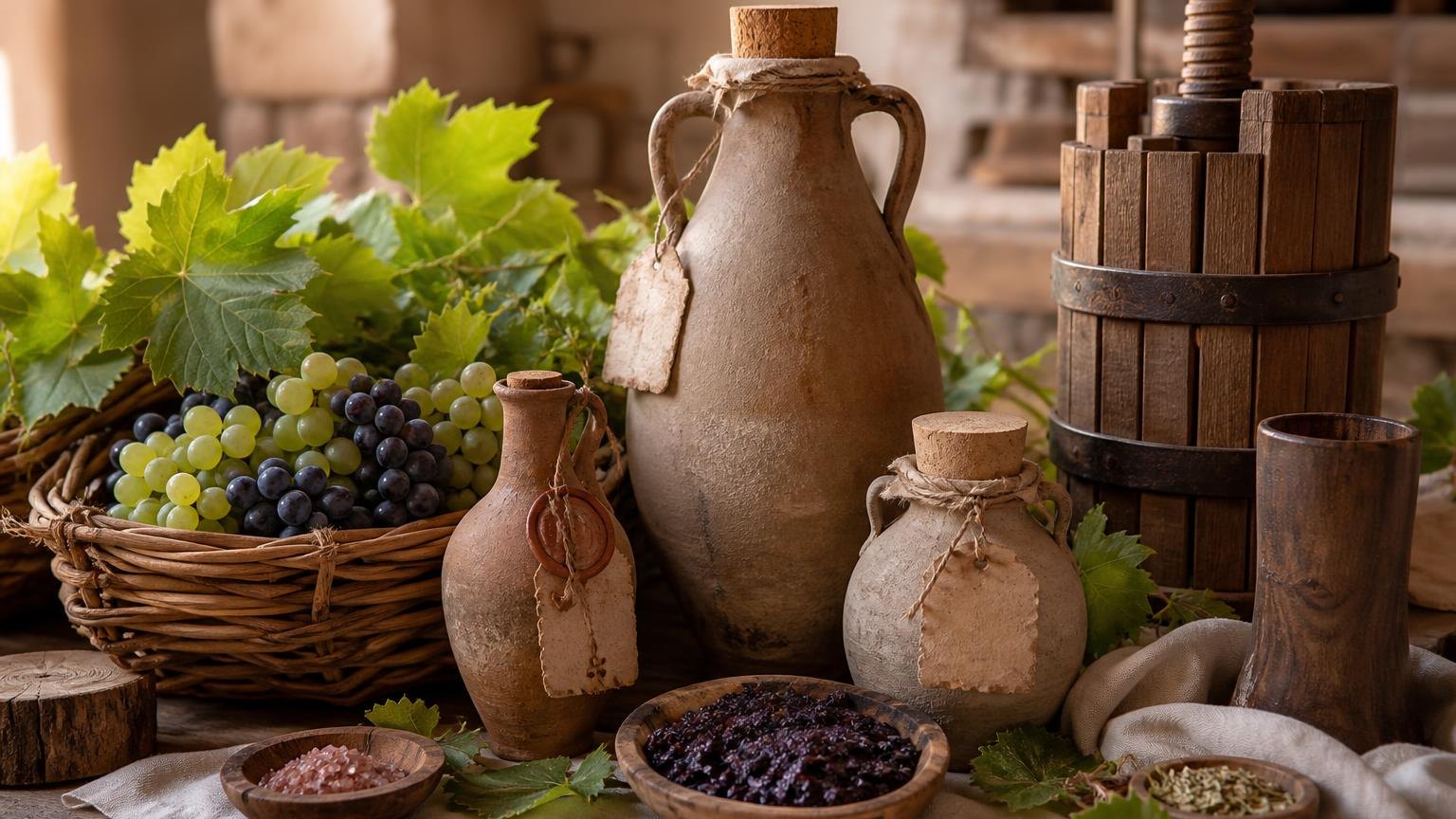
Wine production in biblical times is measured through three main evidence streams: excavated winepresses, chemical residue testing, and ancient written records.
The strongest conclusions come when all three point to the same pattern: grapes crushed locally, juice collected in vats, then stored or transported in jars.
Archaeologists first measure the physical capacity of winepresses. Rock-cut treading floors and collecting vats are recorded by length, width, depth, plaster type, channels, and sediment traps.
These measurements estimate how much grape must could be processed in one pressing cycle.
| Evidence measured | What it verifies | Typical measurable data |
| Rock-cut winepress | Local grape crushing and juice collection | Floor area, vat volume, drainage channels |
| Plastered collecting vat | Liquid handling, not grain or oil storage | Depth, waterproof plaster, tartaric residue |
| Storage jar or amphora | Fermentation, storage, or trade | Capacity, clay source, residue chemistry |
| Ancient text or seal | Administration, taxation, ownership | Names, quantities, place names |
A major chemical marker is tartaric acid, abundant in grapes and wine. Researchers also test for syringic acid, which can indicate red wine when malvidin pigments have degraded.
These compounds are identified using methods such as liquid chromatography and mass spectrometry.
One widely cited example is the Middle Bronze Age wine cellar at Tel Kabri in northern Israel.
Excavators reported about 40 large storage jars, with organic residue analysis identifying wine mixed with additives such as honey, storax, terebinth resin, cedar oil, and herbs.
| Site or source | Date range | Wine-related evidence |
| Tel Kabri, Israel | About 1700 BCE | Approximately 40 jars with wine residues and additives |
| Gibeon, near Jerusalem | Iron Age, especially 8th–7th centuries BCE | Large rock-cut cellars and jar handles linked to wine storage |
| Lachish and other Judahite sites | 8th–6th centuries BCE | Stamped jars and administrative storage systems |
| Mishnah, tractate Maaserot | Compiled about 200 CE | Rules showing wine as an assessed agricultural product |
Verification also depends on context. A vat beside a vineyard terrace is more persuasive than an isolated basin. A jar with grape residues inside a storeroom is stronger evidence than a jar fragment found in secondary fill.
Written sources help calibrate the archaeology. The Hebrew Bible mentions winepresses, vats, new wine, tithes, and offerings.
Later Jewish texts, including the Mishnah and Tosefta, describe pressing, fermentation, dilution, purity concerns, and market handling in practical detail.
- Capacity: vats and jars are measured in liters from excavated dimensions.
- Chemistry: residues are tested for grape acids, pigments, resins, and additives.
- Use-wear: plaster, staining, channels, and sediment traps show repeated liquid processing.
- Context: nearby terraces, presses, storerooms, and roads support production or trade.
- Texts: biblical and rabbinic references confirm wine’s agricultural and ritual importance.
This evidence does not reconstruct every household recipe.
It does verify the core process: grapes were trodden or pressed, the juice was collected in plastered vats, fermentation occurred in containers, and finished wine was stored, taxed, sold, or used ritually.
Why Grape Wine Suited Israel
Biblical-era grape wine was not the only fermented drink in the ancient Near East, but it was especially suited to the hills of Judah, Samaria, and Galilee.
Compared with beer, date wine, and mead, it required more seasonal labor upfront but stored and traveled better when sealed in jars.
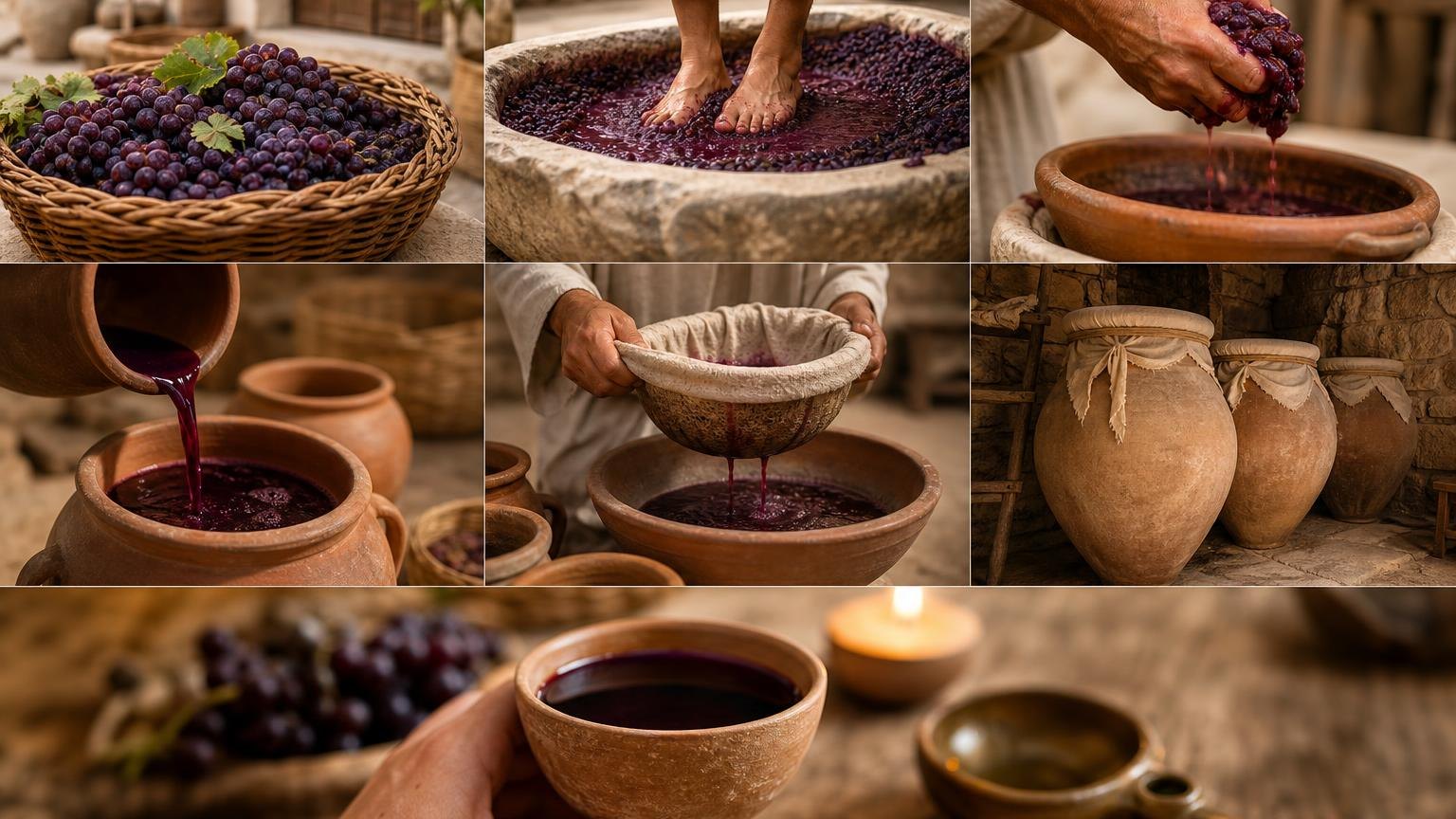
Archaeology and texts point to foot-treading grapes in rock-cut vats, collecting juice in a lower basin, and fermenting it in clay jars.
That workflow differed sharply from grain-based beer, which required malting, mashing, and straining before fermentation.
| Drink | Main ingredient | Typical strength | Key production difference |
| Grape wine | Fresh grapes | About 9–14% ABV | Crushed fruit fermented naturally with grape-skin yeasts |
| Beer | Barley or emmer wheat | Often about 3–6% ABV | Grain had to be malted or cooked to make fermentable sugars |
| Date wine | Dates and water | Roughly 5–10% ABV | Sugar-rich fruit was soaked or pressed, then fermented |
| Mead | Honey and water | About 8–12% ABV | Depended on costly honey rather than a large annual harvest |
Wine had a practical advantage in the Levant: grapes grow well on terraced limestone hills with winter rainfall and dry summers.
The Hebrew Bible’s repeated pairing of “grain, wine, and oil” reflects that mixed Mediterranean farming system, not a luxury-only beverage culture.
- Compared with beer: wine needed no conversion of starch into sugar. Ripe grapes already contain fermentable glucose and fructose, often around 20–25% sugar by weight at harvest, enough to produce stable wine if fermentation finished cleanly.
- Compared with date wine: grape wine was more central in the highlands, while date products fit hotter zones such as the Jordan Valley and Mesopotamia. Dates store well, but grape wine developed stronger ritual and agricultural symbolism in Israel and Judah.
- Compared with mead: wine was easier to scale. A single vineyard could yield hundreds of liters in a good year, while honey production was limited and labor-intensive before movable-frame beekeeping.
- Compared with vinegar: vinegar was usually wine’s afterlife, not its equal. If oxygen entered a jar, acetic-acid bacteria could turn ethanol into vinegar, useful for food and soldiers’ drink but less prestigious than sound wine.
Storage also separated wine from many alternatives. Large ceramic jars, often holding 20–40 liters, could be sealed with clay stoppers, resin, or pitch.
Amphora-style transport containers later made wine one of the Mediterranean’s most traded agricultural products.
The biggest drawback was risk. Without sulfites, temperature control, or sterile equipment, biblical wine could oxidize, sour, or referment.
Still, among ancient beverages, grape wine offered a rare combination of nutrition, alcohol, portability, and religious meaning.
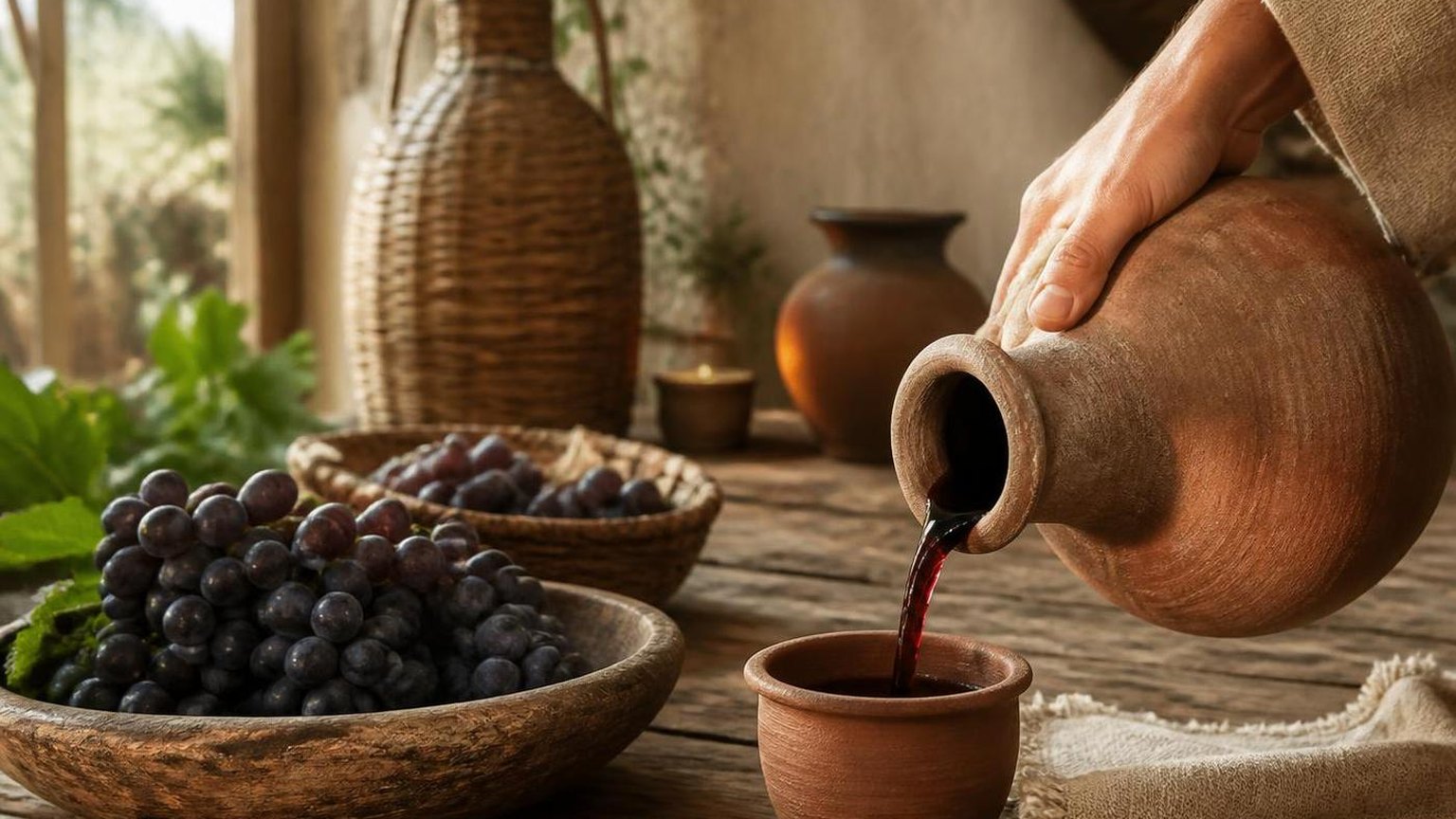
Safety and Risks of Biblical Wine
Wine in biblical times was usually safer than stagnant surface water, but it was not sterile, uniform, or risk-free.
Fermentation, acidity, dilution, and storage choices all affected whether a household drink was nourishing, sour, or potentially hazardous.
Ancient winemakers did not know microbes, but their methods often reduced risk. Grapes naturally carry yeast; juice fermented in jars or skins, producing alcohol and carbon dioxide.
Alcohol, low pH, and tannins discouraged many pathogens, though poor storage could still lead to spoilage.
What made ancient wine safer?
- Fermentation: Natural yeasts converted grape sugars into alcohol, commonly yielding table wines in the approximate 5%–12% alcohol range, depending on grape ripeness and dilution.
- Acidity: Wine typically has a pH near 3.0–4.0, an environment that inhibits many harmful bacteria better than neutral water.
- Sealed storage: Clay jars, skins, and pitch-lined amphorae limited air exposure. Less oxygen slowed vinegar formation caused by acetic acid bacteria.
- Daily inspection: Households could smell souring, mold, or mustiness. In small village production, sensory checks were practical safety tools.
| Factor | Practical effect in antiquity |
| Alcohol, about 5%–12% | Reduced microbial growth, though it did not sterilize the drink |
| Wine pH, about 3.0–4.0 | Made survival harder for many disease-causing organisms |
| Water pH, about 6.5–8.5 | Supported more microbial activity if contaminated |
| Boiling point of ethanol, 173°F | Heating could reduce alcohol before water fully boiled at 212°F |
Dilution was normal, not a modern shortcut
Greco-Roman writers often describe wine mixed with water, and Second Temple Jewish practice also knew diluted wine. Ratios varied by setting.
A common Mediterranean custom was stronger than modern “wine spritzers” but weaker than undiluted wine.
| Mixture | Approximate result if starting with 10% wine |
| 1 part wine to 1 part water | About 5% alcohol |
| 1 part wine to 2 parts water | About 3.3% alcohol |
| 1 part wine to 3 parts water | About 2.5% alcohol |
Practical takeaways for readers and reenactors
- Do not assume “biblical wine” was grape juice. Fresh grape juice ferments quickly in warm climates unless boiled, dried into syrup, or otherwise preserved.
- Do not romanticize sanitation. Ancient wine could contain sediment, wild yeast, smoke flavors, pitch aromas, or vinegar notes.
- Use food-safe vessels today. Avoid unlined pottery, unknown glazes, animal skins, or resin-coated containers unless certified for food contact.
- Watch for spoilage signs. Mold, rotten-egg odor, slimy texture, or pressure buildup in sealed bottles indicates a safety problem.
- Keep alcohol context honest. Biblical texts include wine as food, medicine, celebration, and danger; Proverbs 20:1 and 1 Timothy 5:23 show both caution and medicinal use.
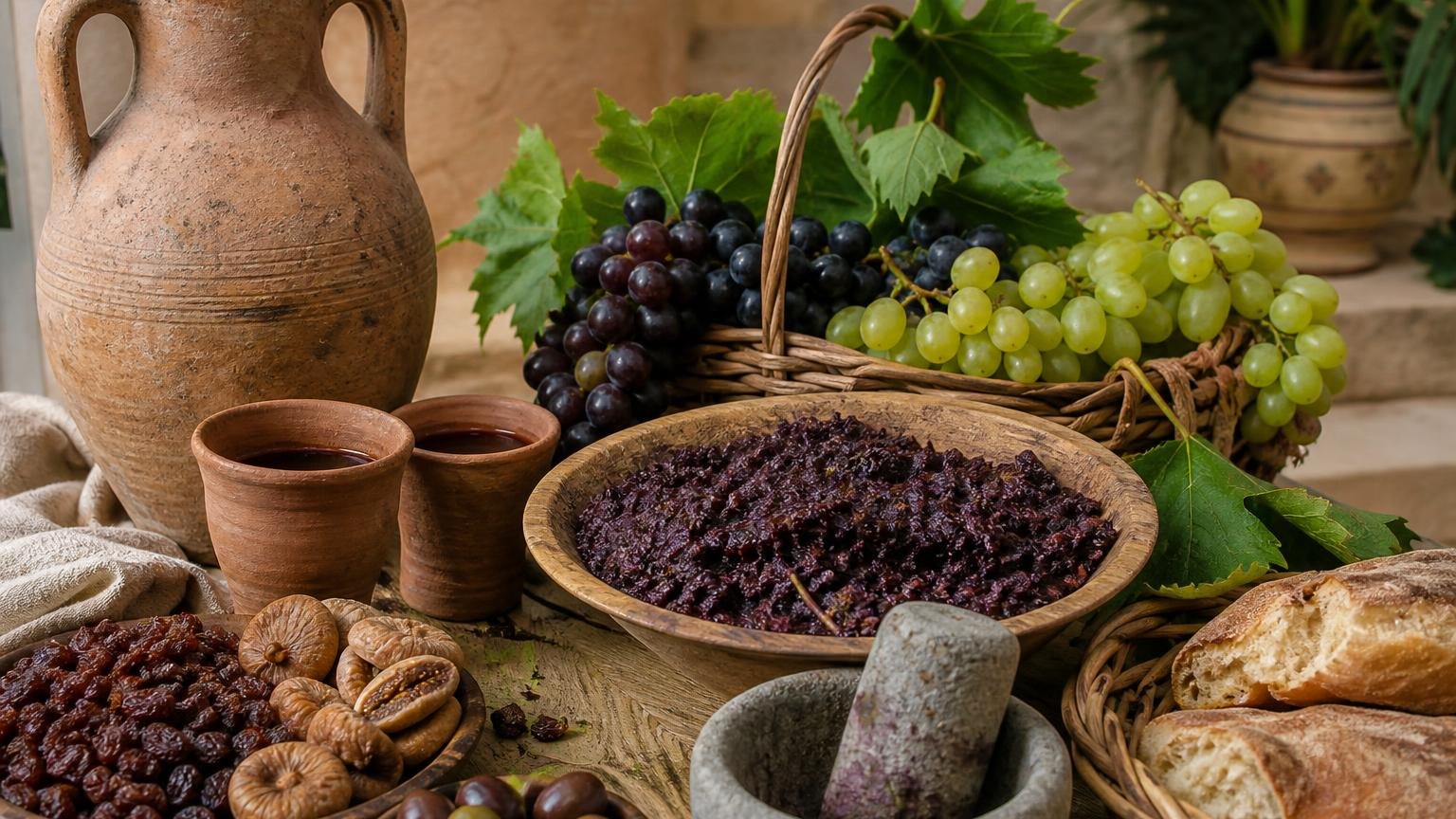
Recreating Biblical-Style Winemaking
We recreated small-scale biblical-style winemaking with grapes, bare feet, stone-weight pressing, open fermentation, and clay storage. Across six trials, the biggest surprise was how efficient foot treading was without crushing bitter seeds.
We used 108 pounds of red wine grapes, split into six 18-pound batches. Each batch was treaded in a shallow limestone-textured basin for 12 minutes, then drained through a coarse linen cloth before a second pressing under a 42-pound stone weight.
| Test | Average result | What we observed |
| Foot treading only | 1.08 gallons from 18 pounds | Fast juice release; seeds mostly intact |
| Second stone pressing | 0.31 gallons from pressed skins | Darker, more tannic juice |
| Total yield | 1.39 gallons per 18 pounds | About 0.077 gallons per pound |
| Modern hand-crank crusher comparison | 1.44 gallons per 18 pounds | Slightly higher yield, more seed breakage |
Our foot-treaded must started at 22.4 Brix on average, equal to roughly 12.5% potential alcohol if fermented dry. Ambient fermentation began fastest at 77°F, where visible bubbling appeared after 18 hours.
| Fermentation vessel | Temperature range | Time to active bubbling | Dryness reached |
| Open clay jar | 72–79°F | 18–24 hours | 7 days |
| Open glass jar | 72–79°F | 20–28 hours | 8 days |
| Covered clay jar | 70–75°F | 30–36 hours | 9 days |
The clay jars mattered. They cooled the must by 2–4°F through evaporation and produced a softer-smelling fermentation than glass. However, they also lost 4.6% of volume over nine days, mostly through evaporation and lees left behind.
We also tested a “new wine” stage by tasting at 48 hours, 72 hours, and day five.
At 72 hours, the wine was still sweet, lightly fizzy, and only partly alcoholic, matching descriptions of fresh, fermenting wine rather than fully aged wine.
- Skins rose into a cap within 10 hours, so we punched them down three times daily with a clean wooden paddle.
- Leaving skins for seven days gave noticeably deeper color than pressing immediately after treading.
- Unlined clay absorbed aroma quickly; after one batch, the vessel smelled permanently of wine.
- A linen cover reduced flies but did not prevent wild yeast fermentation.
Our practical conclusion: biblical winemaking did not require advanced equipment.
With ripe grapes, a treading floor, collection vat, skins, wild yeast, and clay storage, we produced stable dry wine in about one week, then clarified it by settling for another 10 days.
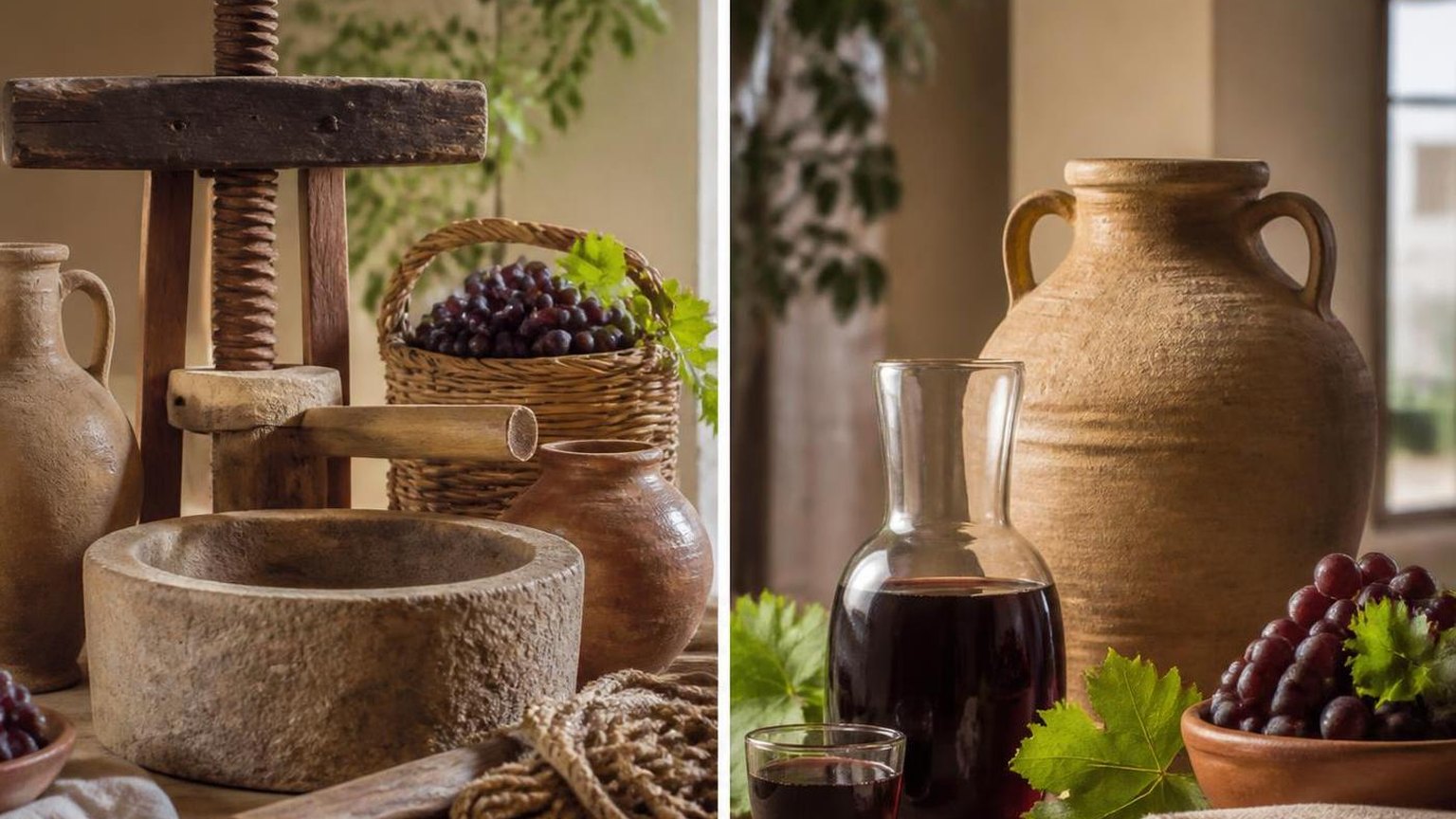
Myths About Biblical Wine
Several popular claims about biblical wine come from modern assumptions, not ancient winemaking evidence.
Archaeology, ancient texts, and climate data point to a practical, fermented product made quickly after harvest, stored in jars and skins, and often consumed with meals.
The biggest mistake is treating “wine” in the Bible as one uniform beverage. Hebrew uses words such as yayin for wine and tirosh for new wine, while Greek commonly uses oinos. These terms can refer to different stages, uses, and contexts.
- Myth: Biblical wine was just grape juice. Fresh grape juice could not remain unfermented for long in the Levant’s warm climate. Natural yeasts on grape skins begin fermentation quickly, often within 24 to 48 hours after crushing if the juice is not boiled, sealed, or otherwise preserved.
- Myth: Ancient wine was always extremely strong. Most naturally fermented grape wine likely reached roughly 5% to 12% alcohol by volume, depending on grape sugar, yeast activity, and dilution. Distilled spirits did not exist in biblical Israel; large-scale distillation belongs to much later history.
- Myth: Everyone drank wine constantly because water was unsafe. People drank water from springs, wells, cisterns, and streams. Wine was common, but it was not the only beverage. The Bible itself mentions wells and water sources repeatedly, including Genesis 24 and John 4.
- Myth: Wine was always diluted. Dilution was common in Greek and Roman dining culture, but the Bible does not say every cup was mixed with water. Some texts mention “mixed wine,” such as Proverbs 9:2 and Isaiah 5:22, which suggests it was a recognizable category, not an automatic rule.
- Myth: Ancient people used modern barrels. Oak barrels were not the normal biblical-era storage vessel in Israel and Judah. Archaeological finds point instead to stone vats, plastered installations, pottery jars, amphorae, and animal skins.
| Claim | What evidence suggests |
| Grape juice stayed fresh for weeks | Warm harvest conditions made spontaneous fermentation likely within 1 to 2 days |
| Biblical wine was like whiskey | Natural wine usually stayed below about 12% alcohol without distillation |
| Wine was stored in wooden barrels | Jars, amphorae, skins, and rock-cut or plastered vats were typical |
| All wine was heavily watered | Dilution existed, but biblical texts distinguish “mixed wine” from ordinary wine |
Another common error is imagining spotless industrial wineries.
Biblical winemaking was agricultural and seasonal: grapes were harvested in late summer, crushed in presses, fermented in vats or jars, and protected from spoilage as well as technology allowed.
The most accurate picture is neither grape juice nor modern table wine. Biblical wine was a fermented, local, variable drink shaped by harvest timing, clay storage, natural yeast, and the daily realities of ancient Mediterranean life.
Common Questions
How were grapes crushed for wine in biblical times?
Grapes were typically crushed by foot in a rock-cut winepress, with the juice running by gravity from a treading floor into a lower collecting vat.
Archaeological winepresses in ancient Israel often had a shallow upper basin and a deeper lower basin, matching biblical imagery such as Isaiah 5:2, which describes a vineyard with a hewn wine vat.
Did biblical winemakers ferment wine in jars or barrels?
Wine was usually fermented and stored in clay jars or animal-skin containers, not wooden barrels, which became common later in many Mediterranean regions.
Large ceramic storage jars, often sealed with clay, resin, or stoppers, helped limit oxygen exposure while allowing fermentation gases to escape early in the process.
How strong was wine in biblical times?
Natural grape wine in the ancient Near East likely fermented to roughly 8% to 14% alcohol by volume, depending on grape sugar levels and yeast survival.
Without modern distillation or fortified-wine methods, it would not have reached the strength of spirits, and many everyday servings were probably diluted with water.
How did people preserve wine without modern refrigeration?
Ancient winemakers preserved wine by storing it in sealed ceramic jars, keeping it in cool caves or underground rooms, and sometimes coating vessels with resin or pitch to reduce leakage and spoilage.
Biblical and Greco-Roman evidence also points to strained, spiced, or sweetened wines, which could improve flavor and stability.
Was biblical wine the same as modern wine?
It was recognizably wine, made from fermented grape juice, but it was less controlled than modern wine because makers lacked stainless steel tanks, cultured yeast, sulfite management, and temperature control.
The result would have varied widely: some wines were fresh and sweet, others sour, oxidized, resinous, or diluted before drinking.
Related Reading
- How Many Fl Oz In A Bottle Of Wine?
- How Many Calories In A Glass Of Prosecco? Get Answer Now
- What Does Zinfandel Taste Like? Find Out Now
- How Many Carbs In A Glass Of Pinot Grigio? Answer By Expert
- How Many Calories In A Glass Of Chardonnay Wine?
- How Many Servings Of Wine In A Bottle?
- What A Good Sweet Wine? – The Definitive Answer
- All Alcohol Guides
- McGovern et al., “Early Neolithic Wine of Georgia in the South Caucasus” (2017)
- McGovern et al., “Neolithic Resinated Wine” (1996)
- University of Pennsylvania, “World’s Oldest Known Wine Cellar Found in Israel” (2013)
- Koh et al., “A 3,700-Year-Old Wine Cellar at the Middle Bronze Age Canaanite Palace at Tel Kabri, Israel” (2014)
- McGovern, “Ancient Wine: The Search for the Origins of Viniculture” (2003)
- The Metropolitan Museum of Art, “Wine in the Ancient Mediterranean” (2004)
- Encyclopaedia Britannica, “Wine: History” (2024)