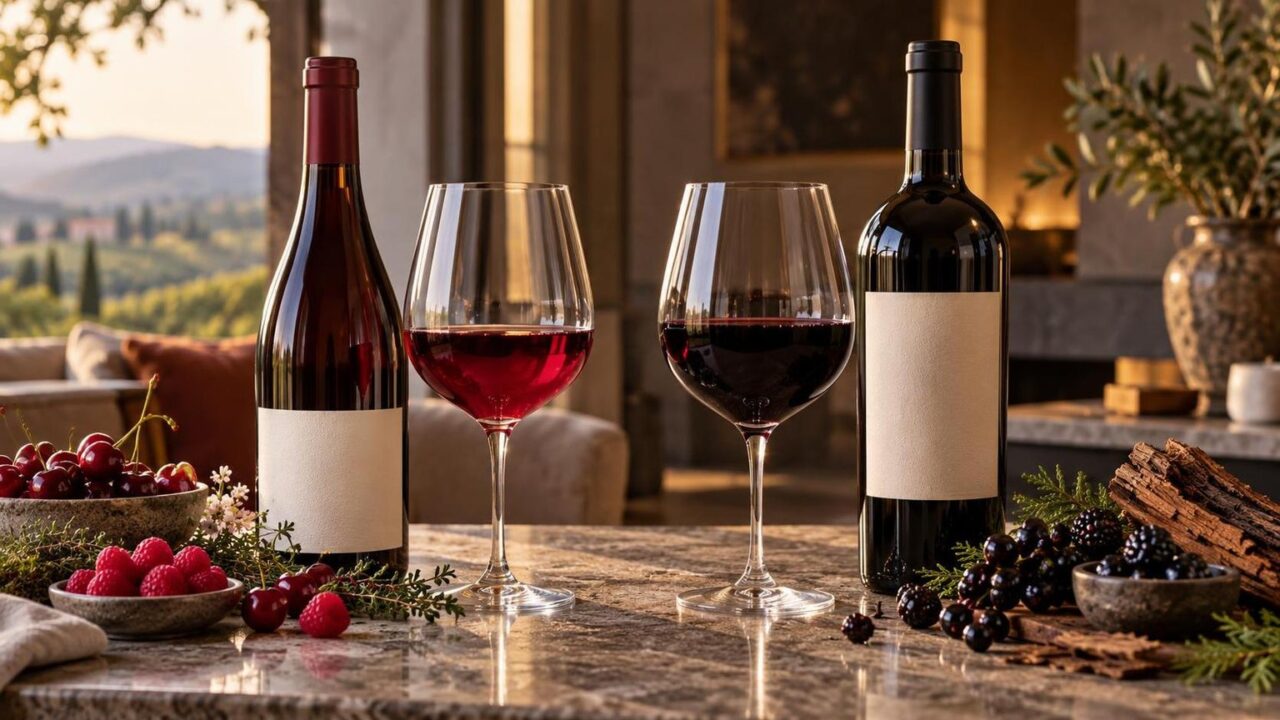
The difference between pinot noir and cabernet is that Pinot Noir typically produces lighter-bodied reds with softer tannins and red-fruit flavors, while Cabernet Sauvignon produces fuller-bodied reds with firmer tannins and black-fruit flavors.
These contrasts shape how each wine tastes and which foods it complements.
Pinot Noir often evokes cherry, raspberry, and earthy notes; Cabernet Sauvignon commonly suggests blackcurrant, blackberry, and cedar when oak-aged. Climate, ripeness, and winemaking can shift either profile.
This guide compares body, tannins, acidity, flavor, and food pairings so you can choose a bottle that suits your palate and meal.
Pinot Noir vs Cabernet Sauvignon Flavor
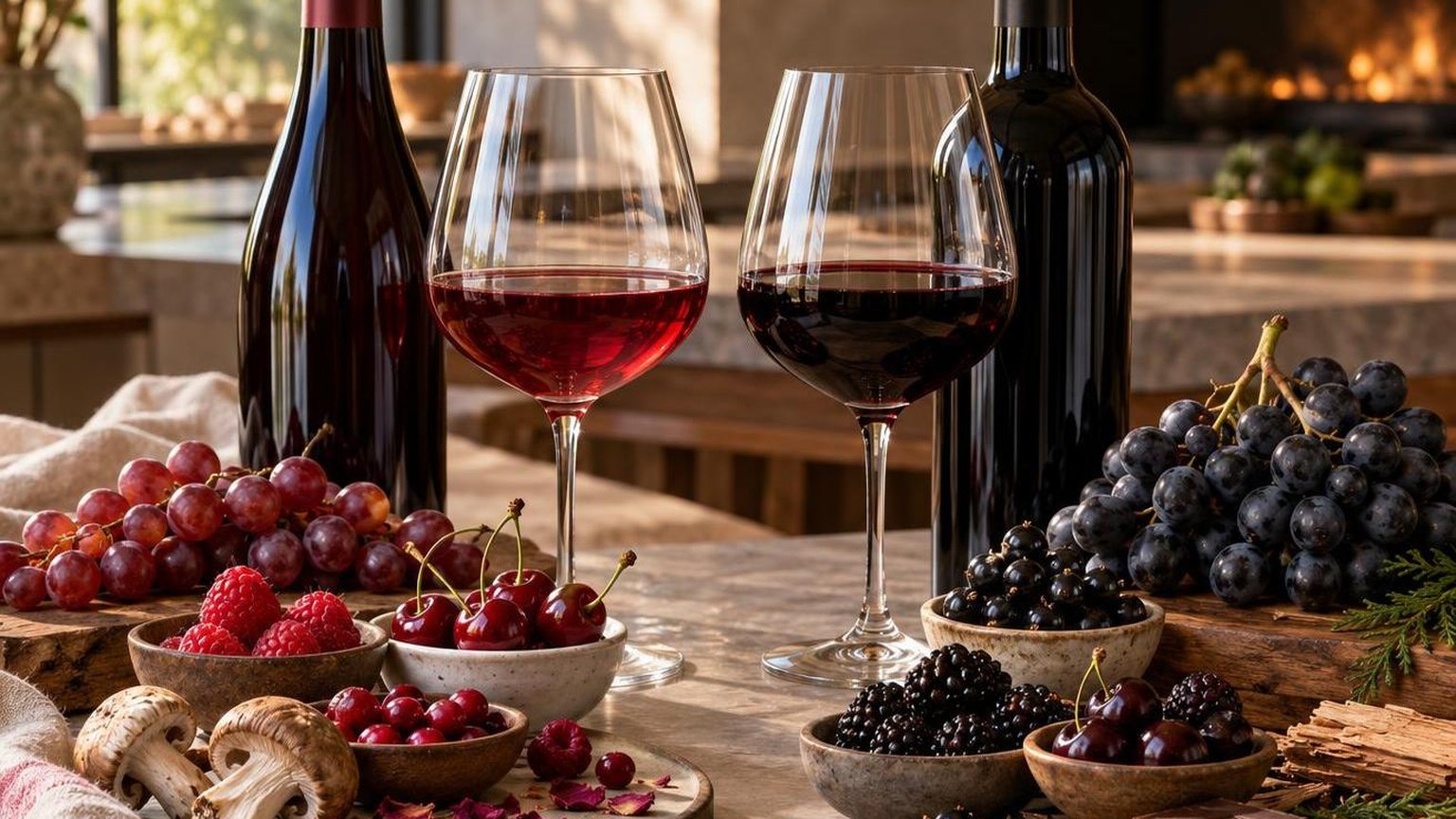
Pinot Noir and Cabernet Sauvignon occupy opposite ends of the red wine flavor spectrum. Pinot Noir delivers delicate red fruit with earthy undertones, while Cabernet Sauvignon layers dark fruit with structured tannins and oak-driven complexity.
Primary Fruit Flavors
Pinot Noir’s thin skin produces lighter pigmentation and red-fruit-dominant aromatics. Cabernet Sauvignon’s thick skin generates intense dark fruit concentration and deeper color extraction.
| Characteristic | Pinot Noir | Cabernet Sauvignon |
| Primary fruits | Red cherry, raspberry, strawberry | Blackcurrant, black cherry, blackberry |
| Secondary notes | Mushroom, forest floor, wet leaves | Cedar, tobacco, green bell pepper |
| Tertiary (aged) | Truffle, dried herbs, leather | Cigar box, graphite, dark chocolate |
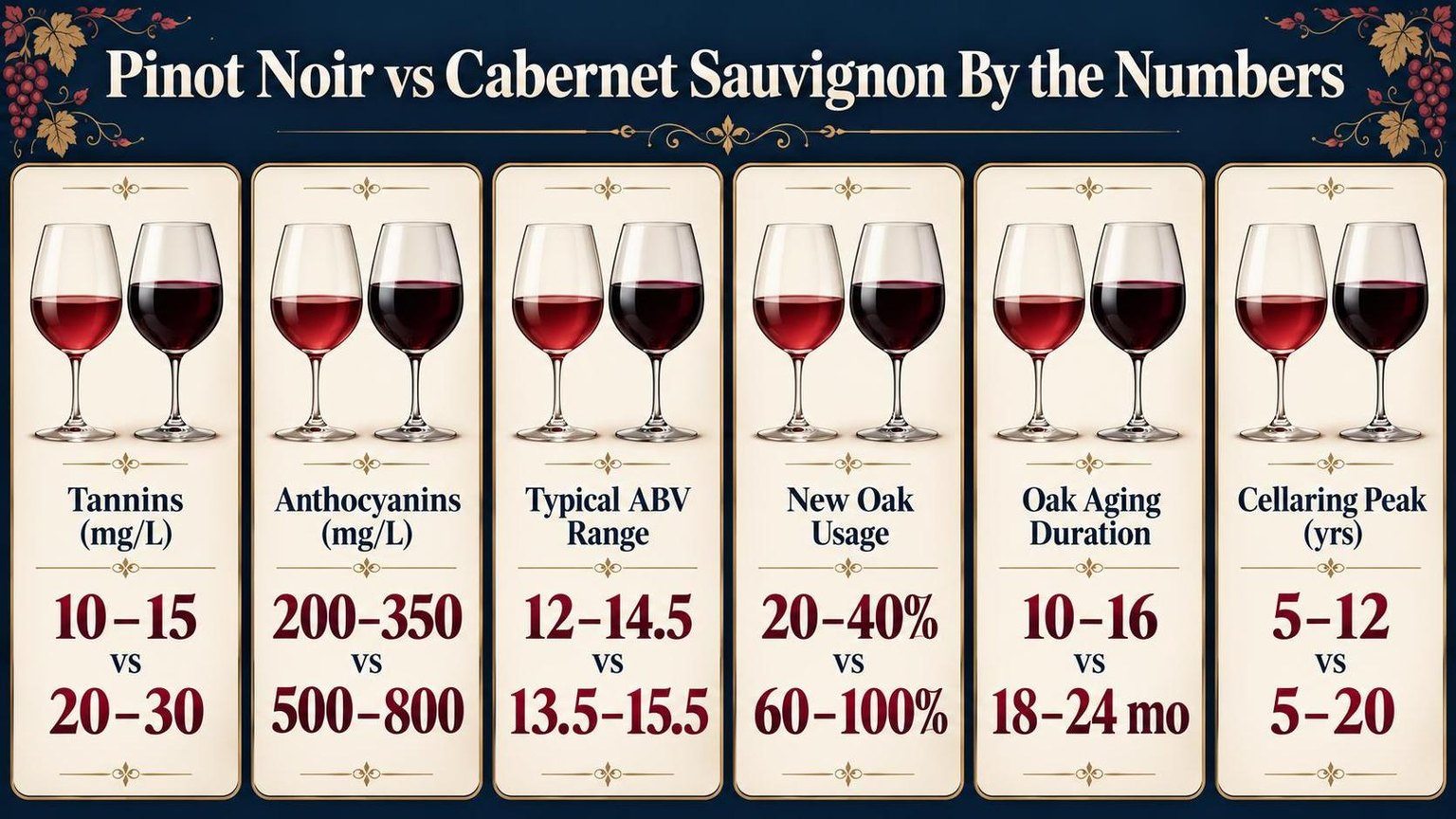
| Typical ABV range | 12–14.5% | 13.5–15.5% |
| Tannin level | Low to medium | Medium-high to high |
| Acidity | Medium-high to high | Medium |
| Body | Light to medium | Full |
Tannin and Structure
Cabernet Sauvignon contains roughly 20–30 mg/L of total phenolic tannins at release, compared to Pinot Noir’s 10–15 mg/L. This structural gap defines their mouthfeel difference fundamentally.
Those tannins give Cabernet a firm, gripping texture that benefits from 5–20 years of cellaring. Pinot Noir’s softer tannins create a silky, lighter-bodied palate that typically peaks within 5–12 years.
The Role of Terroir in Flavor
Pinot Noir is considered the most terroir-transparent grape. Burgundy’s limestone-rich soils produce mineral-driven, high-acid expressions, while Oregon’s Willamette Valley volcanic soils yield rounder cherry-and-spice profiles.
Cabernet Sauvignon is more forgiving of site variation. Napa Valley’s warm benchland soils push ripe cassis flavors above 14.5% ABV, while Bordeaux’s cooler Left Bank delivers leaner, more herbaceous structure around 13–13.5% ABV.
Oak Influence on Each Variety
Winemakers typically age Cabernet Sauvignon in 60–100% new French oak barrels for 18–24 months, adding vanilla, toast, and baking spice layers. High tannin absorbs oak impact without becoming overpowered.
Pinot Noir generally sees 20–40% new oak for 10–16 months. Excessive new oak overwhelms its delicate fruit. Top Burgundy producers like Domaine de la Romanée-Conti use around 20% new barrels to preserve purity.
Flavor Compounds Behind the Difference
- Methoxypyrazines — present in Cabernet Sauvignon at 10–30 ng/L, producing characteristic bell pepper and herbal notes; nearly absent in Pinot Noir
- Rotundone — contributes peppery spice in cool-climate Pinot Noir; detected at concentrations as low as 16 ng/L in wine
- Anthocyanins — Cabernet Sauvignon averages 500–800 mg/L versus Pinot Noir’s 200–350 mg/L, explaining the color intensity gap
- Linalool and geraniol — floral monoterpenes more prominent in Pinot Noir, contributing rose petal and violet aromatics
These measurable chemical differences confirm what the palate registers: two grapes engineered by nature for entirely distinct sensory experiences.
Why Cabernet Feels Bolder Than Pinot Noir
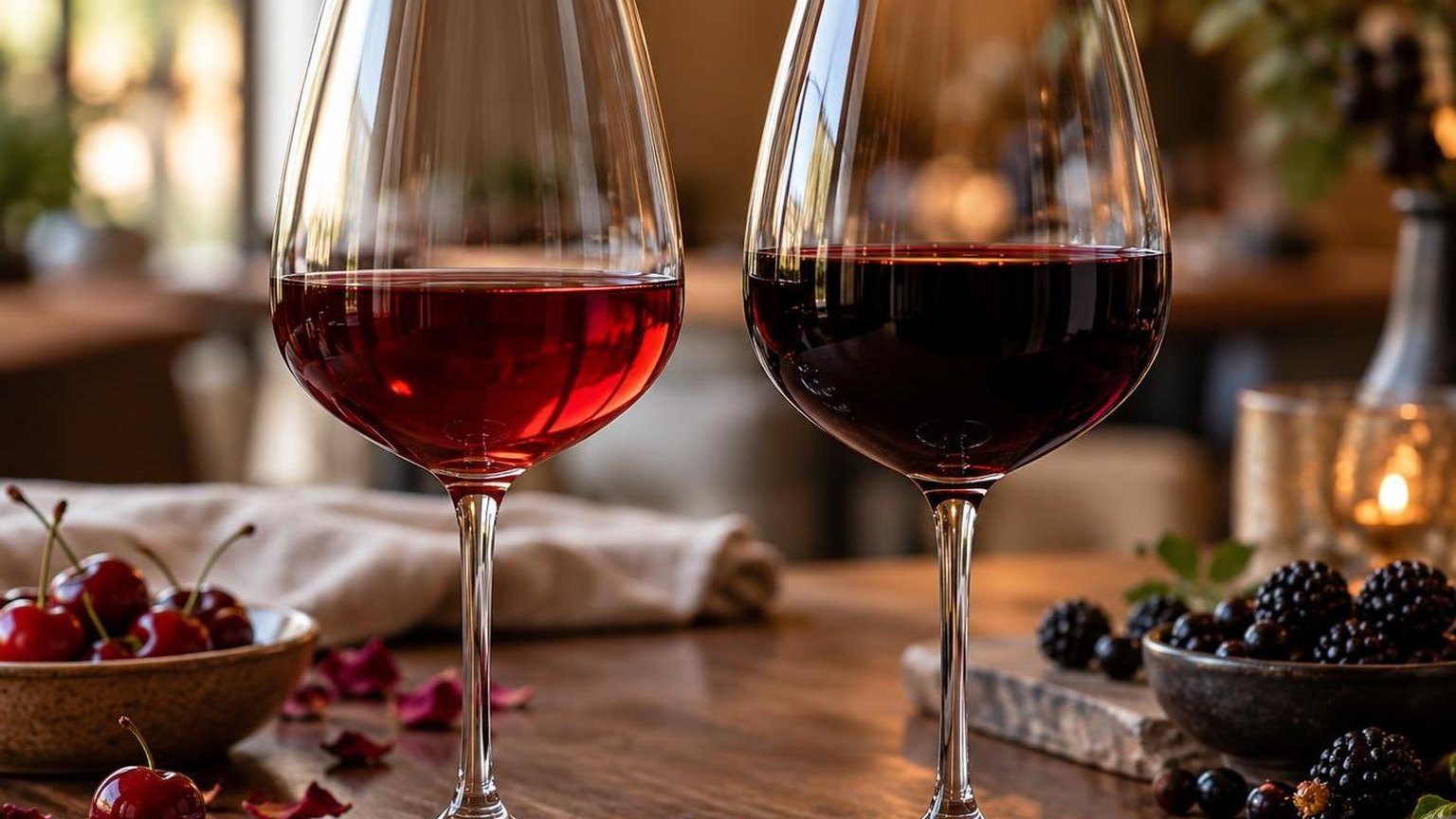
Cabernet Sauvignon feels bolder because it contains more tannin, higher alcohol, and deeper color extraction than Pinot Noir.
These differences trace directly to grape skin thickness, seed count, and phenolic compound concentration — measurable factors, not just subjective impression.
Tannin Concentration
Tannins create that drying, gripping sensation on your palate. Cabernet Sauvignon grapes have thicker skins and larger seeds than Pinot Noir, producing significantly more extractable tannin during fermentation.
| Metric | Cabernet Sauvignon | Pinot Noir |
| Total phenolic content (mg/L gallic acid equivalent) | 1,800–3,000 | 800–1,500 |
| Tannin concentration (mg/L epicatechin equivalent) | 600–1,200 | 200–500 |
| Skin-to-juice ratio | Higher (thicker skins) | Lower (thin skins) |
| Typical seed count per berry | 2–3 | 1–2 |
Seed tannins contribute harsh, astringent compounds early in a wine’s life. Cabernet’s higher seed count partly explains why young bottles can feel aggressively structured compared to Pinot Noir.
Alcohol and Body
Cabernet Sauvignon typically reaches 13.5–15.5% ABV, while Pinot Noir ranges from 12–14.5% ABV. Higher alcohol increases perceived body and viscosity on the palate.
Brix levels at harvest reflect this gap. Cabernet grapes in Napa Valley often reach 25–27° Brix. Pinot Noir from Burgundy or Oregon’s Willamette Valley is commonly picked at 22–25° Brix.
Color Depth and Anthocyanins
Cabernet Sauvignon contains roughly 500–2,000 mg/L of anthocyanins — the pigment molecules responsible for red wine color. Pinot Noir typically measures 200–500 mg/L.
Pinot Noir also lacks acylated anthocyanins, which stabilize color over time. This is why Pinot fades toward garnet and brick hues faster than Cabernet in bottle aging.
Structural Compounds Working Together
Boldness is not one variable. It emerges from the interaction of multiple compounds simultaneously:
- Tannin + alcohol: Both amplify perceived weight and drying sensation
- Anthocyanin-tannin polymers: More abundant in Cabernet, stabilizing color and adding mid-palate density
- Oak extraction: Cabernet typically sees 18–24 months in new French oak (60–100% new), adding vanillin and ellagitannins; Pinot Noir producers commonly use 20–40% new oak for 10–16 months
- Residual sugar: Both wines are usually fermented dry, so this factor is negligible
What This Means in the Glass
A 2019 Napa Cabernet Sauvignon at 14.8% ABV with 900 mg/L tannin will coat your mouth and linger for 30–60 seconds. A 2019 Willamette Valley Pinot Noir at 13.2% ABV with 300 mg/L tannin delivers a lighter, silkier texture.
Neither profile is superior. Cabernet’s boldness suits grilled ribeye and braised short ribs. Pinot Noir’s transparency showcases terroir nuances that heavier extraction would obscure.
Pinot Noir and Cabernet Sauvignon Growing Regions
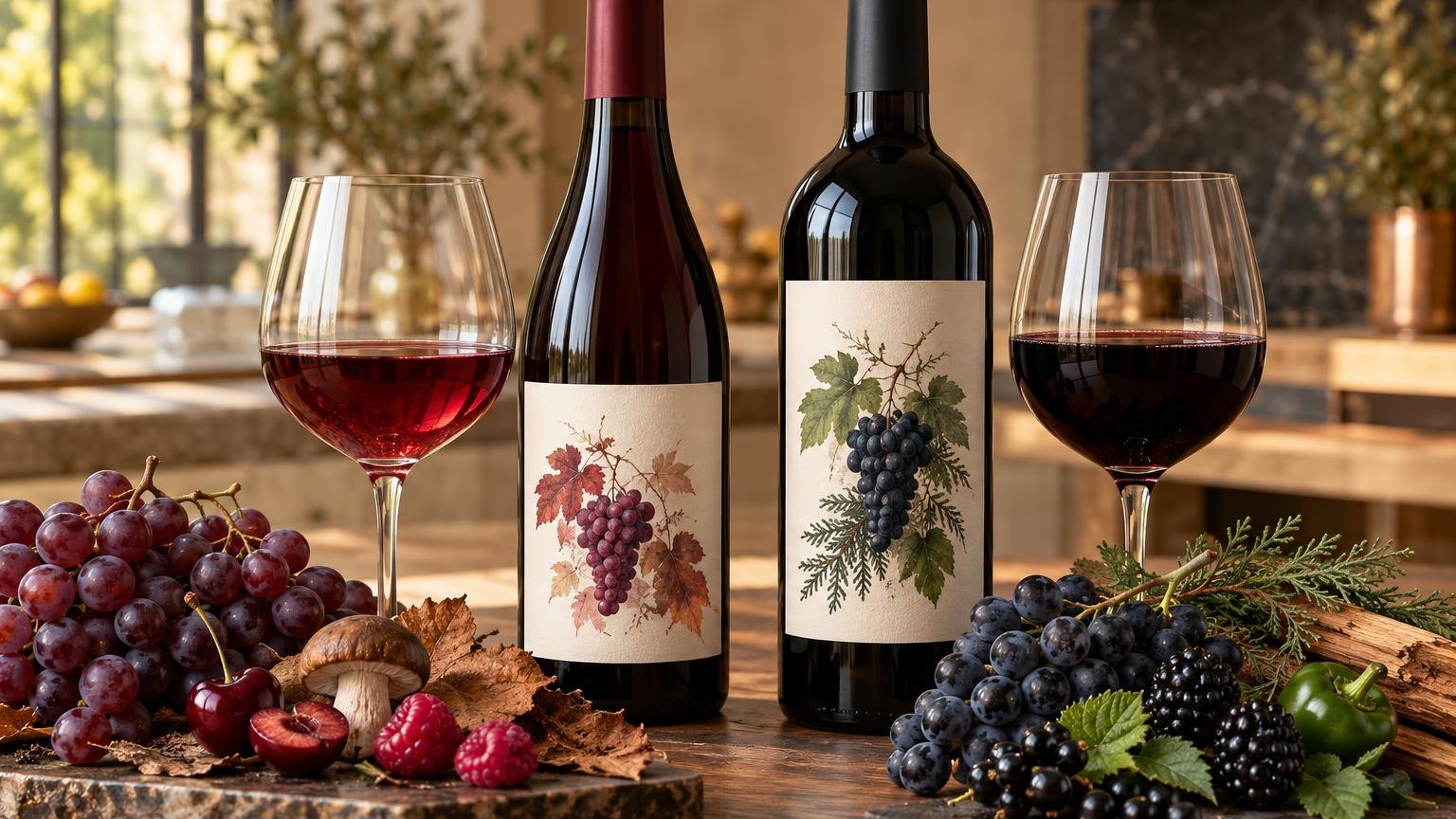
These two grapes thrive in fundamentally different climates. Pinot Noir demands cool, marginal growing conditions, while Cabernet Sauvignon ripens best in warmer, more temperate regions. Their geographic footprints reflect this core difference.
Climate Requirements
| Factor | Pinot Noir | Cabernet Sauvignon |
| Ideal growing-season temp | 14–16 °C (57–61 °F) | 17–20 °C (63–68 °F) |
| Winkler Region preference | I–II (≤1,389 degree-days) | II–III (1,111–1,667 degree-days) |
| Bud break | Early | Late |
| Harvest window | Early to mid-season | Late season |
| Skin thickness | Thin, frost-sensitive | Thick, heat-tolerant |
Key Pinot Noir Regions
Burgundy is Pinot Noir’s ancestral homeland. The Côte d’Or alone contains roughly 10,000 hectares planted to the variety, according to BIVB data.
- Burgundy, France — limestone-rich soils, continental climate, ~27,000 ha total Pinot Noir across the region
- Willamette Valley, Oregon — marine-influenced climate, ~16,000 planted acres, the largest US Pinot Noir region
- Sonoma Coast & Russian River Valley, California — fog-cooled, roughly 13,000 acres combined
- Central Otago, New Zealand — the world’s southernmost wine region at 45°S latitude, ~1,900 ha planted
- Baden and Pfalz, Germany — over 11,500 ha of Spätburgunder (Pinot Noir), making Germany the third-largest grower globally
Key Cabernet Sauvignon Regions
Cabernet Sauvignon is the world’s most widely planted wine grape at approximately 340,000 hectares globally, per OIV 2017 data. It adapts to a broader range of warm climates than Pinot Noir.
- Bordeaux Left Bank, France — Médoc and Graves appellations, ~60,000 ha region-wide, gravelly soils that retain daytime heat
- Napa Valley, California — roughly 20,000 planted acres, volcanic and alluvial benchland soils, average harvest temps around 28 °C
- Coonawarra, Australia — famous terra rossa limestone over clay, ~5,300 ha total vineyard area
- Maipo Valley, Chile — Andean rain shadow, ~10,800 ha of Cabernet, warm days and cool nights ideal for phenolic ripeness
- Ningxia, China — a rapidly expanding region at ~1,100 m elevation with over 38,000 ha under vine, increasingly Cabernet-focused
Why Region Matters for Each Grape
Pinot Noir grown in warm climates loses acidity and develops jammy, flat flavors. It requires a long, slow ripening period to build aromatic complexity.
Cabernet Sauvignon planted in cool climates struggles with underripe pyrazines, producing aggressive green bell pepper notes. It needs sustained warmth to polymerize tannins fully.
This is why top Pinot Noir rarely comes from Napa, and benchmark Cabernet almost never originates in Burgundy. Matching grape to climate is the single most consequential decision a grower makes.
Food Pairings for Pinot Noir and Cabernet
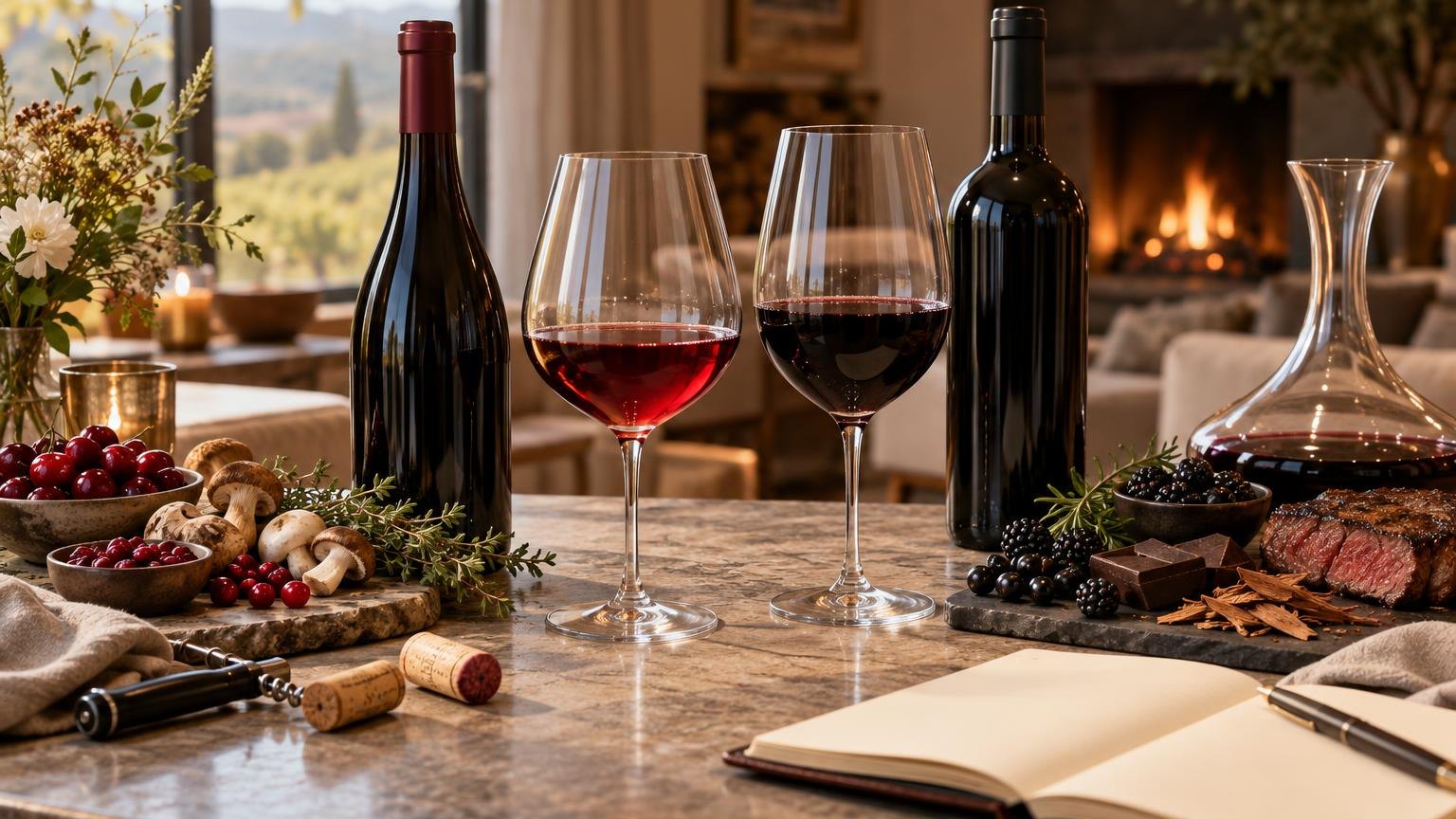
Pinot Noir and Cabernet Sauvignon pair with fundamentally different foods because their tannin levels, acidity, and body create distinct interactions with proteins, fats, and sauces.
Matching the wine’s weight to the dish’s richness remains the single most reliable pairing principle.
Why Structure Dictates the Pairing
Cabernet Sauvignon typically contains 25–30 mg/L of tannin polymers, roughly three times Pinot Noir’s 8–12 mg/L.
Tannins bind to proteins in food, which is why high-tannin wines demand fattier, more protein-rich dishes to achieve balance.
Pinot Noir’s higher acidity—pH averaging 3.4–3.6 versus Cabernet’s 3.5–3.8—makes it a stronger partner for dishes with bright, acidic components like tomato-based sauces or mushroom reductions.
Classic Pinot Noir Pairings
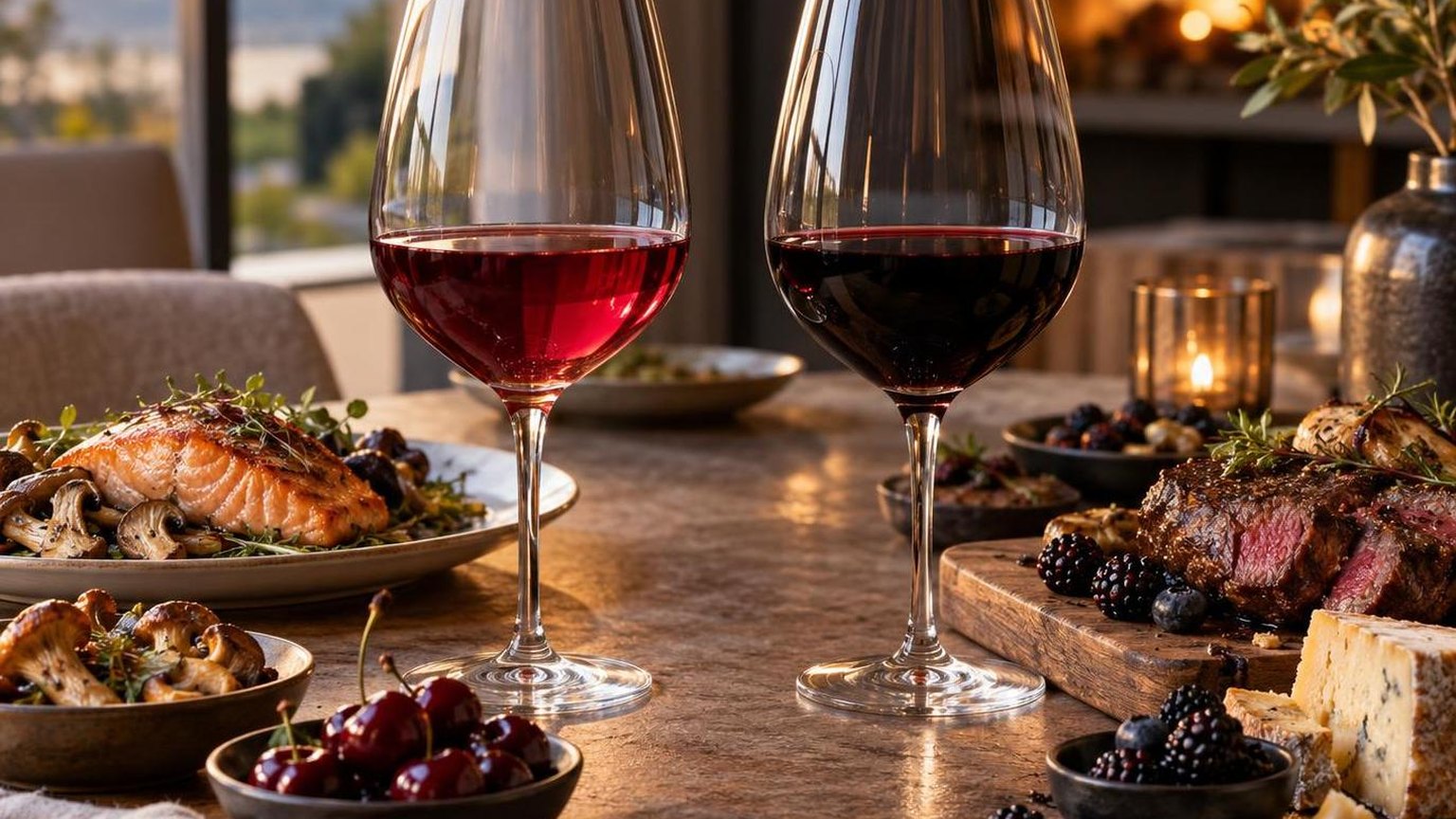
- Roast duck or duck confit: The wine’s acidity cuts through rendered duck fat while complementing gamey flavors.
- Wild salmon or grilled tuna: Pinot Noir is one of few reds with enough delicacy for oily fish; its low tannin avoids metallic off-flavors caused by tannin–fish oil interactions.
- Mushroom risotto or truffle dishes: Earthy Burgundian Pinot mirrors the umami in porcini and chanterelles.
- Gruyère and Comté cheeses: Nutty, medium-fat cheeses match the wine’s medium body without overwhelming it.
- Roast chicken or turkey: Light poultry proteins pair naturally with Pinot’s 12–13.5% ABV and silky texture.
Classic Cabernet Sauvignon Pairings
- Grilled ribeye or New York strip: Marbled beef with 15–20% fat content softens Cabernet’s firm tannins through protein binding.
- Braised lamb shank: Long-cooked collagen-rich cuts echo the wine’s full body and 13.5–15% ABV.
- Aged cheddar and Parmigiano-Reggiano: Hard, salty cheeses with concentrated fat stand up to Cabernet’s tannic grip.
- Dark chocolate (70%+ cacao): Cocoa tannins complement rather than clash with the wine’s own polyphenols.
- Portobello mushroom burgers with blue cheese: A vegetarian option with enough fat and umami density for Cabernet.
Side-by-Side Pairing Comparison
| Food Category | Pinot Noir | Cabernet Sauvignon |
| Red meat | Lean cuts (filet mignon, veal) | Fatty, marbled cuts (ribeye, short ribs) |
| Poultry | Roast chicken, duck, quail | Smoked or braised dark meat |
| Seafood | Salmon, tuna, swordfish | Generally avoid |
| Cheese | Gruyère, Brie, soft-ripened | Aged cheddar, Manchego, Gouda |
| Sauce style | Mushroom, pan jus, light cream | Bordelaise, peppercorn, demi-glace |
| Cooking method | Roasted, sautéed, poached | Grilled, braised, smoked |
A practical test: if the dish needs a steak knife, reach for Cabernet. If it yields to a fork, Pinot Noir is almost always the better match.
Aging Potential of Pinot Noir and Cabernet
Cabernet Sauvignon consistently outlasts Pinot Noir in the cellar due to higher tannin levels, deeper color concentration, and greater extract.
Top Burgundy Pinot Noirs can age magnificently, but the window is narrower and more producer-dependent than Cabernet’s.
| Factor | Pinot Noir | Cabernet Sauvignon |
| Typical aging window | 5–15 years | 10–30 years |
| Elite bottlings peak | 15–30 years | 30–50+ years |
| Tannin level (mg/L catechin equivalents) | 200–400 | 800–1,800 |
| Total phenolics (mg/L gallic acid equivalents) | 1,000–1,800 | 1,800–3,500 |
| Anthocyanin concentration (mg/L) | 200–500 | 500–1,200 |
| Ideal cellar temperature | 55 °F (13 °C) | 55 °F (13 °C) |
Why Cabernet Ages Longer
Cabernet Sauvignon’s thick skin contributes roughly 3–4 times more tannin than Pinot Noir’s thin skin. Tannins act as natural antioxidants, slowing oxidative breakdown over decades.
The grape’s higher concentration of anthocyanins stabilizes color. A 20-year-old Cabernet typically retains a deep garnet core, while Pinot Noir shifts toward pale brick-orange within 10–12 years.
Napa Valley Cabernets from producers like Caymus, Heitz Martha’s Vineyard, and Stag’s Leap regularly drink well at 25–40 years. Bordeaux First Growths from great vintages (1961, 1982, 2000, 2010) can last 50–80 years.
Pinot Noir’s Aging Curve
Most village-level Burgundy and mid-range Oregon or California Pinot Noir peaks between 5 and 10 years. After that, fruit fades faster than structure can support the wine.
Grand Cru Burgundy defies this pattern. Bottles from Romanée-Conti, La Tâche, and Chambertin regularly evolve for 25–40 years. The 1959, 1978, and 2005 vintages remain vibrant today.
- Acidity drives Pinot Noir’s longevity more than tannin — pH values of 3.3–3.5 preserve freshness over time.
- Whole-cluster fermentation adds stem tannins that extend aging potential by an estimated 3–5 years.
- New oak usage above 40% can mask Pinot Noir’s delicate fruit, accelerating perceived decline.
Practical Cellar Guidelines
Store both varieties at 55 °F with 60–70% humidity. Consistent temperature matters more than the exact number — fluctuations above 5 °F shorten a wine’s life significantly.
For Cabernet, buy from structured vintages and expect a “dumb phase” between years 5 and 10 where flavors close down before secondary complexity emerges.
For Pinot Noir, drink earlier rather than later unless you hold Grand Cru or Premier Cru Burgundy from a top producer. Roughly 90% of all Pinot Noir produced worldwide is designed for consumption within 5 years of release.
Secondary market data from Liv-ex confirms Cabernet-dominant wines (Bordeaux, Napa) appreciate 4–8% annually over 10 years, while only elite Burgundy Pinot Noirs match that trajectory.
Common Questions
Is Pinot Noir or Cabernet Sauvignon higher in tannins?
Cabernet Sauvignon contains significantly more tannins due to its thicker skin, which can be up to 50% thicker than Pinot Noir’s.
This structural difference makes Cabernet feel firmer and more astringent on the palate, while Pinot Noir delivers a silky, lighter-bodied mouthfeel with soft, barely perceptible tannins.
How do the alcohol levels compare between Pinot Noir and Cabernet Sauvignon?
Pinot Noir typically ranges from 12–14.5% ABV, while Cabernet Sauvignon runs higher at 13.5–15.5% ABV.
Cabernet’s later ripening period allows grapes to accumulate more sugar, which converts to higher alcohol during fermentation. Warm-climate examples from regions like Napa Valley or Barossa Valley can push past 15%.
Which grape is harder to grow — Pinot Noir or Cabernet Sauvignon?
Pinot Noir is notoriously difficult to cultivate because its thin skin makes it highly susceptible to rot, mildew, and frost damage, and it requires a narrow cool-climate window (average growing-season temperatures of 14–16 °C) to ripen properly.
Cabernet Sauvignon is far more resilient, thriving in diverse climates from Bordeaux to Chile, and its thick skin provides natural resistance to disease and pests.
What food pairings work best for each wine?
Pinot Noir’s lighter body and bright acidity (pH typically 3.4–3.6) make it ideal for salmon, roast duck, mushroom risotto, and soft cheeses like Gruyère.
Cabernet Sauvignon’s bold tannins and fuller structure pair with fattier proteins — grilled ribeye, braised lamb shanks, and aged cheddar — because the fat softens the tannin’s astringency.
How do Pinot Noir and Cabernet Sauvignon differ in aging potential?
Top Cabernet Sauvignons from Napa or Bordeaux can age 20–50+ years, supported by high tannin and phenolic concentration that evolve slowly in bottle.
Premium Pinot Noir from Burgundy or Oregon’s Willamette Valley peaks at 10–20 years in most vintages, relying more on acidity than tannin for longevity, and develops earthy.
Truffle-like complexity rather than the cassis-to-tobacco evolution typical of aged Cabernet.
Related Guides
- Are Wine Bottles Recyclable?
- How Many Shots Are in a Bottle of Wine?
- What Is A Sweet Wine? – 2026
- Where Is The Expiration Date On Wine Bottles? Find Out Now
- How Many Calories Are in Taylor Port Wine?
- Does Wine Taste Good?
- How Long Does Wine Take to Kick In?
- All Alcohol Guides
- UC Davis Department of Viticulture & Enology – Grape Variety Profiles (2023)
- USDA FoodData Central – Red Wine Nutrient Composition (2024)
- National Institutes of Health / PubMed – Phenolic Compounds in Red Wine Varieties (2019)
- Cornell University College of Agriculture – Grape Varieties for Cool Climates (2023)
- Oregon State University Extension – Pinot Noir Viticulture (2022)
- Wine & Spirits Education Trust (WSET) – Grape Varieties Guide (2023)
- The Oxford Companion to Wine / Jancis Robinson – Cabernet Sauvignon vs Pinot Noir (2023)