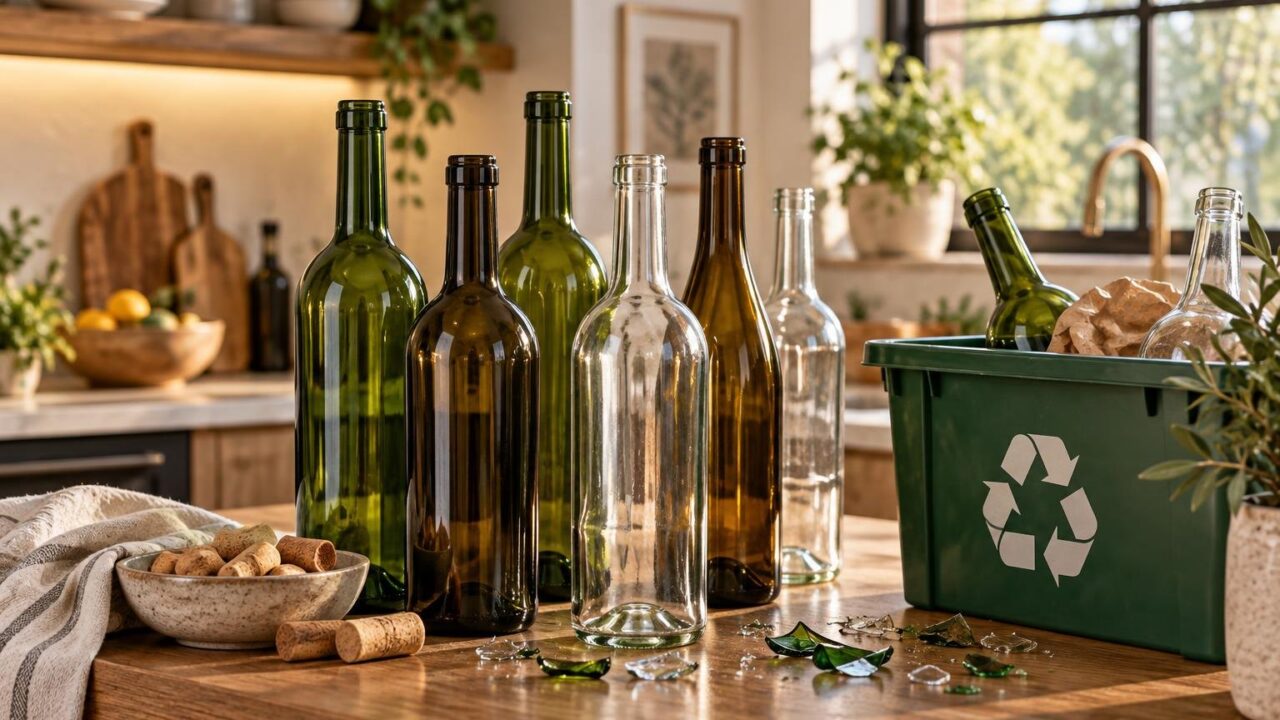
Wine bottles are recyclable in most U.S. curbside programs, with glass capable of being remelted and reformed an infinite number of times without losing quality.
The Glass Packaging Institute reports that approximately 33% of glass containers in the U.S. are actually recycled—a rate far below aluminum’s 50%.
Whether your empty bottle reaches a second life depends on color, local infrastructure, and contamination. Green, brown, and clear glass each require separate processing streams.
This guide covers what makes wine bottles recyclable, which types cause problems, and how to maximize your recycling impact.
Are Wine Bottles Actually Recyclable
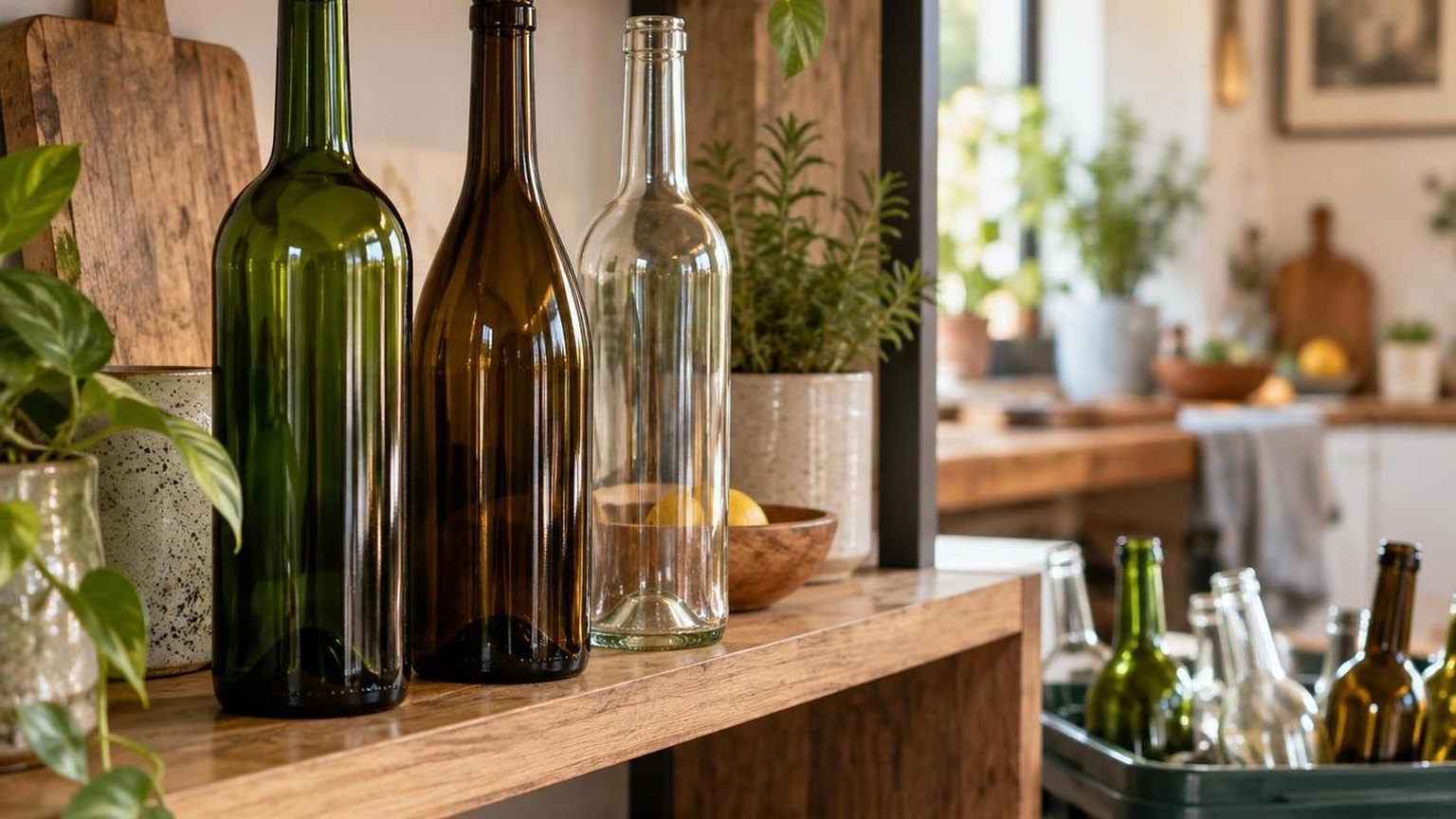
Standard glass wine bottles are 100% recyclable and can be recycled endlessly without any loss in quality or purity. The Glass Packaging Institute confirms that glass is one of the few materials achieving true closed-loop recycling.
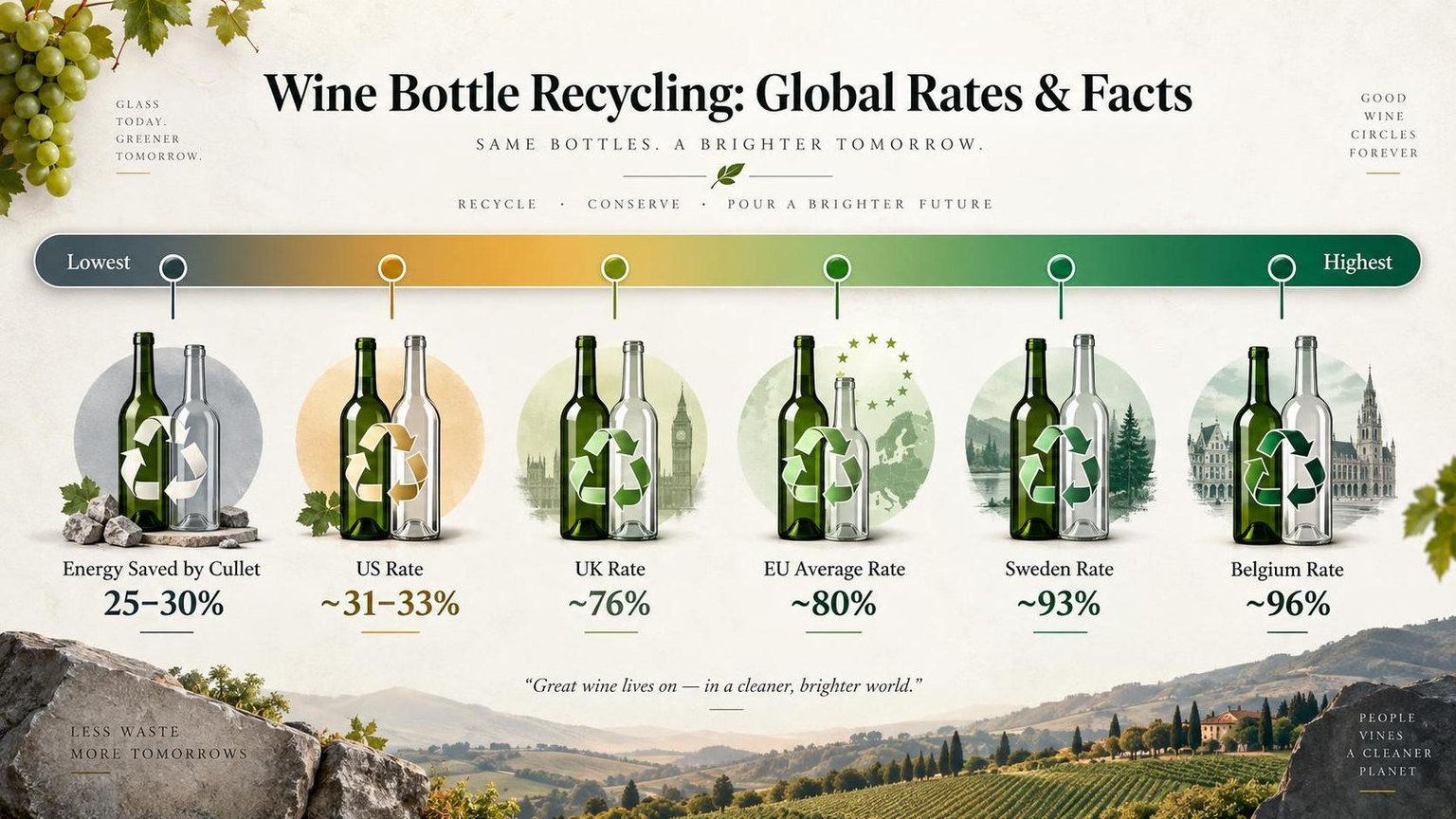
Glass recycled into new containers requires less energy than manufacturing from raw materials. Cullet—crushed recycled glass—melts at lower temperatures, reducing furnace energy demands by approximately 25–30%.
Recycling Rates by Country
Recycling performance varies dramatically by region. The EU leads due to extended producer responsibility laws, while the US lags behind with no federal bottle deposit mandate.
| Country/Region | Glass Recycling Rate |
| EU (average) | ~80% |
| Belgium | ~96% |
| Sweden | ~93% |
| United Kingdom | ~76% |
| United States | ~31–33% |
The US Environmental Protection Agency reported that in 2018, approximately 12.3 million tons of glass were generated in municipal solid waste, with only about 3.1 million tons recycled.
Why Wine Bottles Specifically Are Recyclable
Wine bottles are made from soda-lime glass—the same Type III glass used for food jars and beverage containers. This composition accepts repeated melting without structural degradation.
- Clear glass: Most widely accepted; highest market value for recyclers
- Green glass: Fully recyclable but limited domestic demand in the US; often exported or downcycled
- Brown/amber glass: Recyclable and in moderate demand for beer bottle production
Labels, foil capsules, and small amounts of adhesive residue burn off during the remelt process at temperatures exceeding 1,500°C (2,732°F). These contaminants do not prevent recycling.
What Actually Prevents Recycling
Corks, whether natural or synthetic, must be removed before recycling. Ceramic or porcelain-topped bottles contaminate glass batches because they have different melting points.
Crystal wine decanters and leaded glass cannot enter standard glass recycling streams. Lead oxide content—typically 24% or higher in full lead crystal—contaminates the cullet supply and produces unusable output.
Why Glass Color Matters
Wine-bottle glass is recyclable, but color determines what manufacturers can make from it.
Clear, amber, and green containers must usually be separated because melted glass retains its color; unlike paper, colored glass cannot be bleached back to a neutral feedstock.
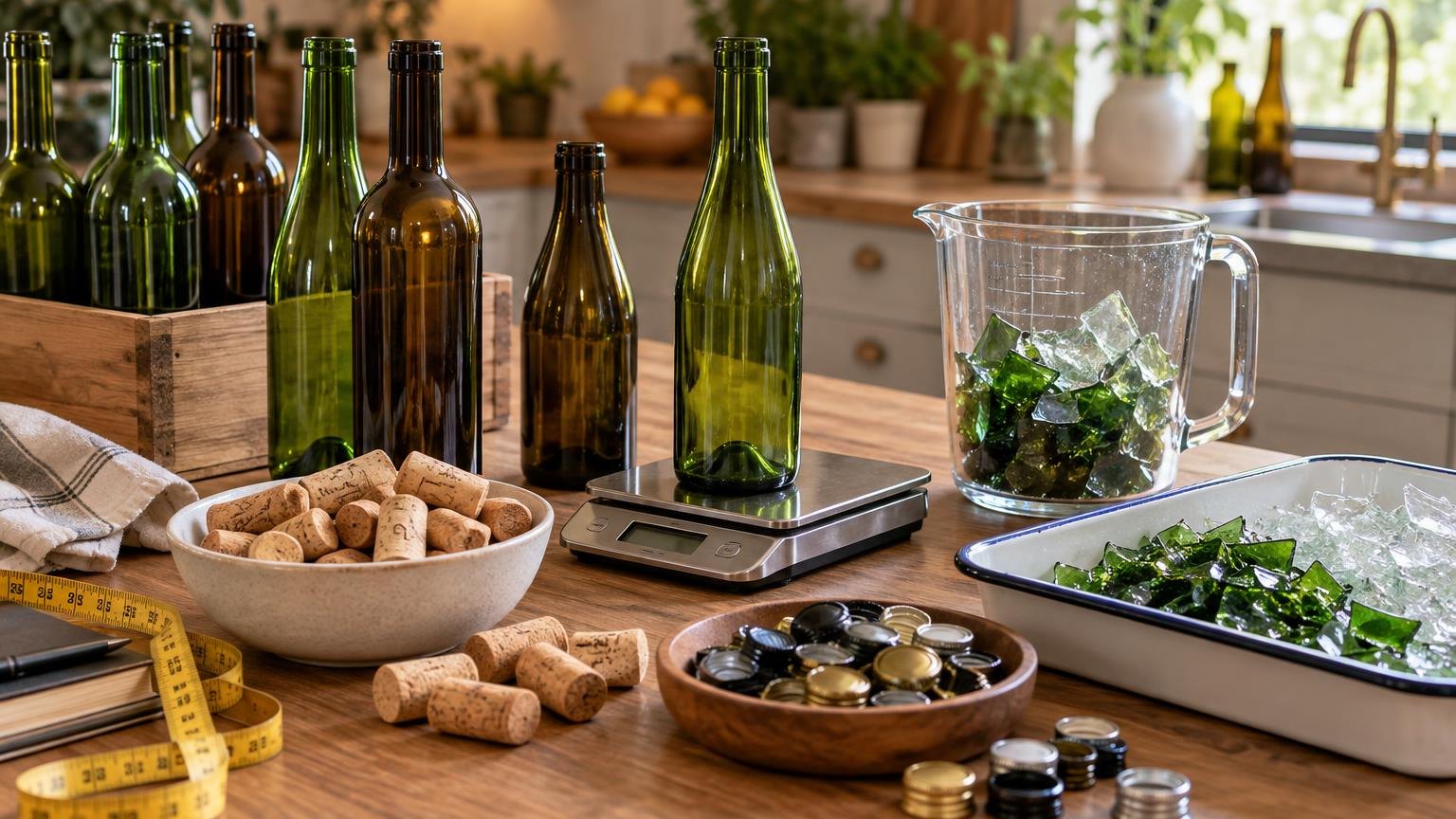
Clear glass, commonly called flint glass, has the strictest purity requirements. A small amount of green or amber cullet can visibly tint a new clear bottle, reducing its value or making it unsuitable for brands that require colorless packaging.
Amber glass contains colorants based primarily on iron, sulfur, and carbon chemistry.
It protects wine from ultraviolet and visible-light exposure more effectively than clear glass, but amber fragments can contaminate both clear and green production batches.
Green glass receives its color mainly from chromium and iron compounds. Green bottle furnaces can generally accept more mixed-color cullet than clear-glass furnaces because modest color variation is less visible in the finished container.
Acceptance limits still depend on each manufacturer’s formula and quality specifications.
| Glass stream | Typical recycling concern |
| Clear or flint | Requires highly color-pure cullet because colored fragments remain visible. |
| Amber | Must maintain consistent protective color and exclude excessive green or clear glass. |
| Green | Can often use a broader mixed-color feedstock, although composition remains controlled. |
Material recovery facilities may separate bottles with optical sorters that identify color as fragments pass on conveyors.
Facilities without suitable equipment may collect glass by color, send mixed glass to specialized processors, or reject it when transportation and cleaning costs exceed its market value.
Color separation also helps manufacturers use more cullet, the industry term for furnace-ready recycled glass. The Glass Packaging Institute reports that each increase in cullet produces measurable manufacturing benefits.
| Cullet change | Reported manufacturing effect |
| Every 10% increase | Energy use falls approximately 2% to 3%. |
| Every 10% increase | Carbon dioxide emissions fall approximately 5%. |
| One ton used | Displaces more than one ton of virgin raw materials. |
Blue, black, painted, and unusually tinted wine bottles create additional sorting problems because they may not match standard furnace recipes.
Decorative coatings, ceramic labels, stones, and heat-resistant glass are contaminants rather than usable container cullet.
Follow the local recycling program’s instructions rather than sorting by assumption. Some programs accept all bottle colors together because processing occurs downstream; others require separation or exclude glass entirely.
Empty and lightly rinse bottles, remove closures when instructed, and never place drinking glasses, mirrors, ceramics, or laboratory glass with wine bottles.

How To Prepare Empty Bottles
Proper preparation increases the likelihood that your wine bottles actually get recycled rather than rejected at the sorting facility.
Contaminated or improperly prepared glass accounts for up to 40% of recycling stream rejections, according to the Glass Packaging Institute.
Step-by-Step Preparation
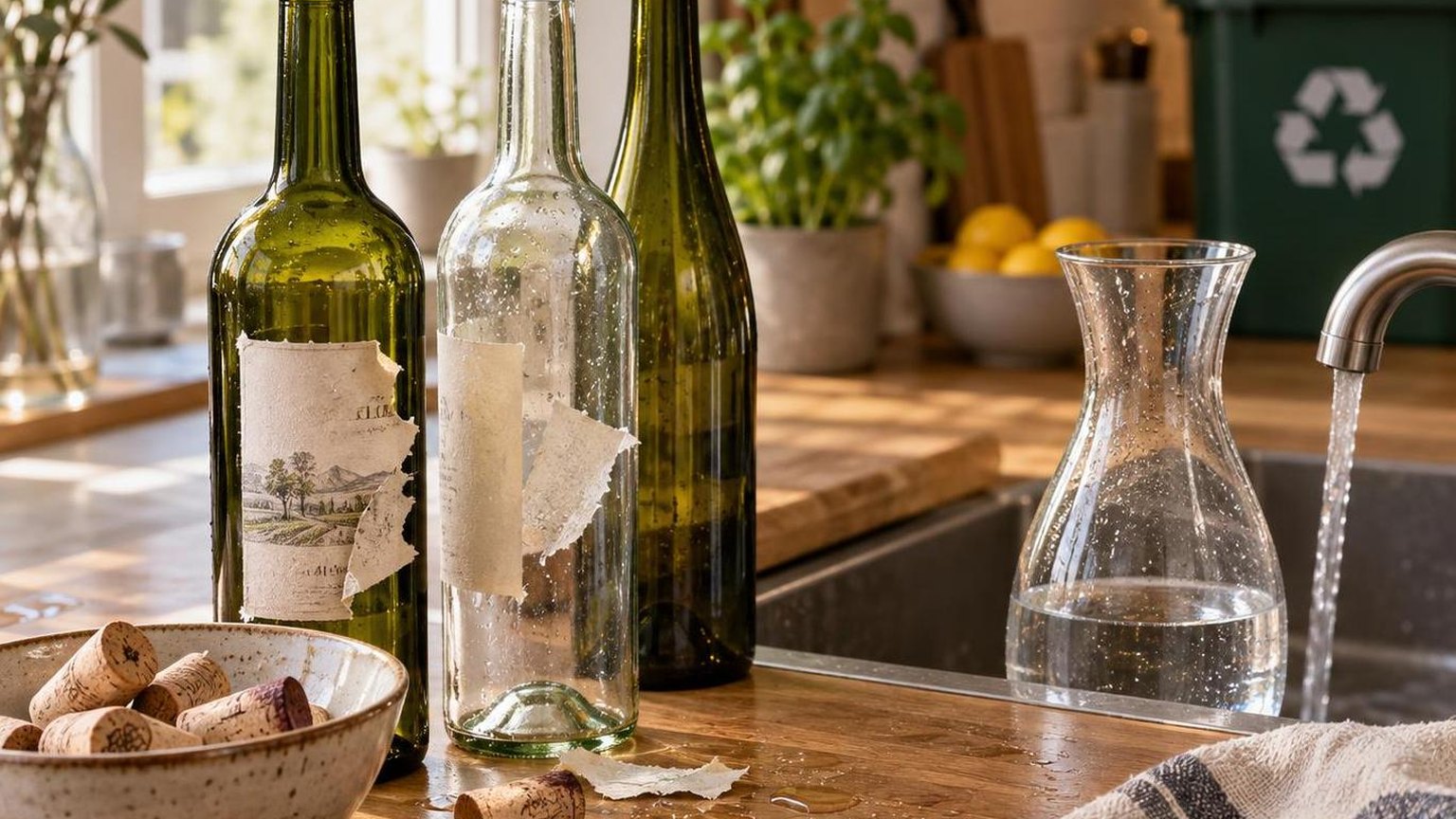
- Empty completely: Drain all remaining wine. Even 1–2 ounces of residual liquid can contaminate an entire batch of crushed glass (cullet) during processing.
- Rinse briefly: A quick rinse with tap water removes sugary residue that attracts pests and causes odor in recycling bins. No soap required.
- Remove corks and capsules: Natural cork is not recyclable with glass. Foil capsules (typically tin or aluminum) should be peeled off and recycled separately with metals.
- Leave labels on: Paper labels burn off during the remelt process at approximately 2,600–2,800°F. Most municipal recycling programs do not require label removal.
- Keep bottles whole: Do not break bottles intentionally. Broken glass creates safety hazards for workers and small shards are harder to sort by color.
What To Remove vs. What To Leave
| Item | Action | Reason |
| Natural cork | Remove | Organic material; contaminates glass cullet |
| Synthetic cork | Remove | Plastic-based; melts at different temperature |
| Screw cap | Remove | Aluminum; recycle separately with metals |
| Foil capsule | Remove | Metal; recycle with aluminum/tin |
| Paper label | Leave | Burns off at remelt temperatures |
| Wax seal | Leave | Vaporizes during furnace processing |
Color Sorting
If your municipality requires color sorting, separate bottles into three categories: clear (flint), green, and amber/brown. Color contamination above 5% degrades the quality of recycled glass.
Mixed-color cullet typically gets downcycled into fiberglass insulation or road aggregate rather than new bottles. Sorting by color preserves the highest-value recycling outcome.
When Labels And Corks Matter
Labels, foil capsules, and corks can complicate wine bottle recycling. Most municipal recycling facilities handle paper labels without issue, but other components require attention before you toss that bottle in the bin.
Paper Labels
Standard paper labels burn off during the glass remelting process at approximately 1,500°C (2,732°F). No removal needed. MRFs (Material Recovery Facilities) across the U.S. accept labeled glass bottles without restriction.
Synthetic and Metallic Labels
Plastic-coated or metallic foil labels pose a different challenge. These materials don’t combite cleanly and can introduce contaminants into recycled glass cullet.
- Plastic shrink-sleeve labels — found on roughly 15% of wine bottles — should be peeled off before recycling when possible.
- Foil capsules covering the cork area are typically aluminum or tin. Remove them and recycle separately with metals.
- Adhesive-backed metallic labels may leave residue but generally do not disqualify bottles from glass recycling streams.
Corks: Natural vs. Synthetic
Corks must be removed before recycling the bottle. Their material determines their own recycling path.
| Cork Type | Material | Recyclable? | Decomposition Time |
| Natural cork | Bark of Quercus suber | Yes — compostable or via ReCORK/Cork ReHarvest | 1–3 years in compost |
| Agglomerated cork | Cork granules + polyurethane binder | Limited — accepted by some cork recyclers | 5–10 years |
| Synthetic cork | Petroleum-based plastic (often polyethylene) | No — not accepted in standard recycling | 450+ years in landfill |
| Screw cap | Aluminum + plastic liner | Yes — recycle with aluminum/metals | 200–500 years if landfilled |
What Actually Contaminates Glass Recycling
The real threats aren’t labels or corks. Ceramic closures, lead foil capsules (used pre-1996), and broken crystal stemware containing 24% lead oxide contaminate entire batches of recycled glass.
Whole Foods, Total Wine, and many Trader Joe’s locations host cork collection bins through the ReCORK program, which has recycled over 130 million natural corks since 2008.
Why Some Bottles Get Rejected
Not every wine bottle that reaches a recycling facility gets processed.
Contamination, color mixing, and non-glass components cause Material Recovery Facilities (MRFs) to reject an estimated 20–30% of glass collected curbside, according to the Glass Recycling Coalition.
Color Contamination
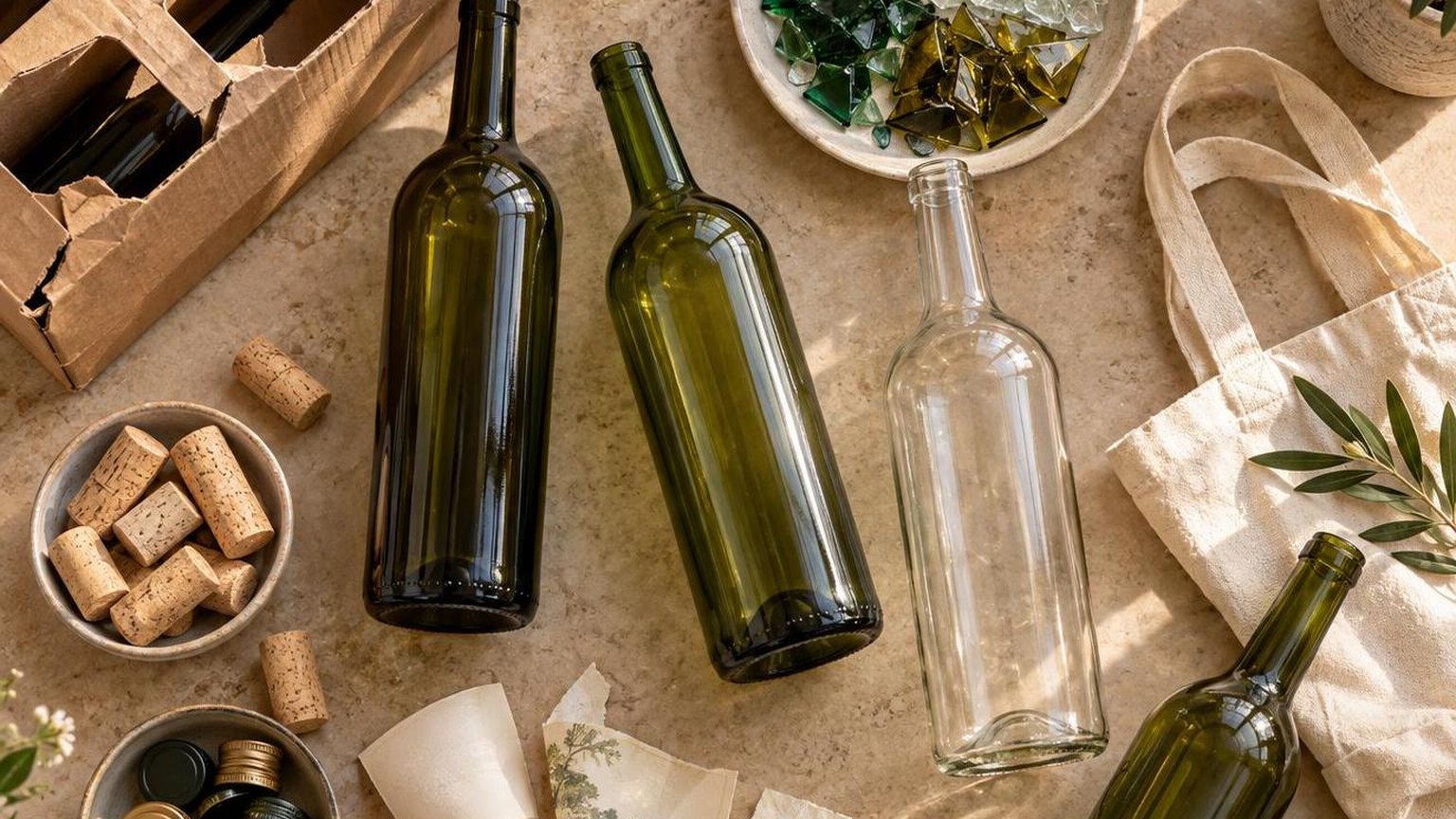
Glass must be sorted by color—clear (flint), green, and amber—before melting. Even small amounts of mixed color destroy batch integrity. Furnaces producing clear glass tolerate no more than 0.5% colored glass contamination.
| Glass Color | Max Contamination Tolerance | Common Wine Bottle Use |
| Flint (clear) | 0.5% colored glass | Rosé, white wines |
| Green | 5–10% mixed color | Bordeaux, Burgundy reds |
| Amber | 3–5% mixed color | Rare; some dessert wines |
Green glass is most forgiving. Clear glass is least forgiving. This explains why facilities in regions dominated by green wine bottles—like Northern California—report higher acceptance rates.
Non-Glass Contaminants
Ceramic closures, lead foil capsules, and metal screwcaps create problems. Ceramics have a melting point around 1,800°C versus soda-lime glass at roughly 1,050°C.
Unmelted ceramic fragments cause defects called “stones” that weaken new containers.
- Lead foil capsules: Banned in the US since 1996 by the FDA, but pre-1996 bottles still enter the recycling stream and introduce toxic contamination.
- Cork and wax seals: Organic materials combust during melting but create ash residue that discolors glass batches.
- Labels and adhesives: Modern water-soluble adhesives burn off cleanly, but older synthetic glues leave calcium carbonate deposits.
Breakage and Size
Broken glass fragments smaller than 2 inches cannot be optically sorted by automated color-detection systems.
These undersized shards, called “fines,” represent roughly 40% of glass arriving at single-stream MRFs and are typically landfilled.
Single-stream recycling—where glass mixes with paper, plastic, and metal—is the primary culprit. Dual-stream systems that separate glass reduce fines by approximately 50%, boosting actual recycling rates from around 33% to over 60%.
Reuse Versus Recycling Wine Bottles
Reusing a wine bottle consumes roughly 80% less energy than melting it down and manufacturing a new one. Both options divert glass from landfills, but they differ sharply in environmental cost, practicality, and scalability.
Energy and Resource Comparison
| Factor | Reuse (Wash & Refill) | Recycling (Crush & Remelt) |
| Energy per bottle | ~0.6 MJ | ~3.1 MJ |
| CO₂ emissions per bottle | ~50 g | ~210 g |
| Water use per bottle | ~0.5 liters (washing) | ~1.8 liters (processing) |
| Maximum reuse cycles | Up to 30–50 times | Infinite (glass never degrades) |
| Infrastructure needed | Collection, inspection, sterilization | Curbside bins, MRF sorting, furnaces |
Why Reuse Wins on Carbon
Glass furnaces operate at approximately 1,500 °C. Skipping that step by washing and refilling a bottle at around 80 °C slashes energy demand dramatically.
Oregon’s reuse pilot programs have shown that bottles collected within a 150-mile radius of the bottling facility reduce per-unit carbon footprint by up to 85% compared to single-use recycling.
Why Recycling Still Dominates
The U.S. glass recycling rate sits at roughly 33%, according to the EPA’s 2021 data. Despite its higher energy cost, recycling scales more easily than reuse programs.
- Standardized bottle shapes are required for efficient reuse — yet U.S. wineries use over 40 distinct bottle molds.
- FDA food-safety regulations impose strict sterilization requirements on refilled containers, raising compliance costs.
- Logistics costs for collecting, sorting, and returning intact bottles often exceed the price of manufacturing new glass when distances surpass 200 miles.
Practical Takeaways for Consumers
Refill programs exist in parts of Oregon, California, and New York. Participating wineries accept returned bottles and pass along small discounts, typically $0.50–$1.00 per bottle.
When reuse isn’t available, recycling remains far better than landfilling. A single recycled bottle saves enough energy to power a 60-watt light bulb for roughly 6 hours.
Check local winery websites for take-back programs before defaulting to curbside recycling. Proximity to the bottling source is the single biggest factor determining whether reuse makes environmental and economic sense.
Local Rules For Wine Bottle Recycling
Wine bottle recycling rules vary dramatically by state and municipality. What’s accepted curbside in Portland, Oregon may require a special drop-off in Houston, Texas.
Understanding your local regulations prevents contamination and keeps recyclable glass out of landfills.
State-Level Differences
Ten U.S. states plus Guam operate bottle deposit programs, commonly called “bottle bills.” These programs incentivize returns with refundable deposits.
| State | Deposit Amount | Wine Bottles Included |
| Oregon | $0.10 | No (beer/water/soda only) |
| California | $0.05 (under 24 oz) / $0.10 (24 oz+) | Yes (wine coolers; standard wine excluded) |
| Michigan | $0.10 | No |
| Maine | $0.05 / $0.15 (over 50 ml) | Yes |
| Iowa | $0.05 | Yes |
Most bottle deposit laws target carbonated beverages and exclude standard 750 ml wine bottles. Maine and Iowa are notable exceptions that include wine.
Curbside Acceptance Rates
Approximately 80% of U.S. communities with curbside recycling accept glass bottles, according to the Glass Packaging Institute. However, acceptance has declined since 2014 as single-stream recycling introduced contamination problems.
Cities like Houston and Memphis removed glass from curbside programs entirely. Residents must use designated drop-off locations instead.
What Local Programs Typically Require
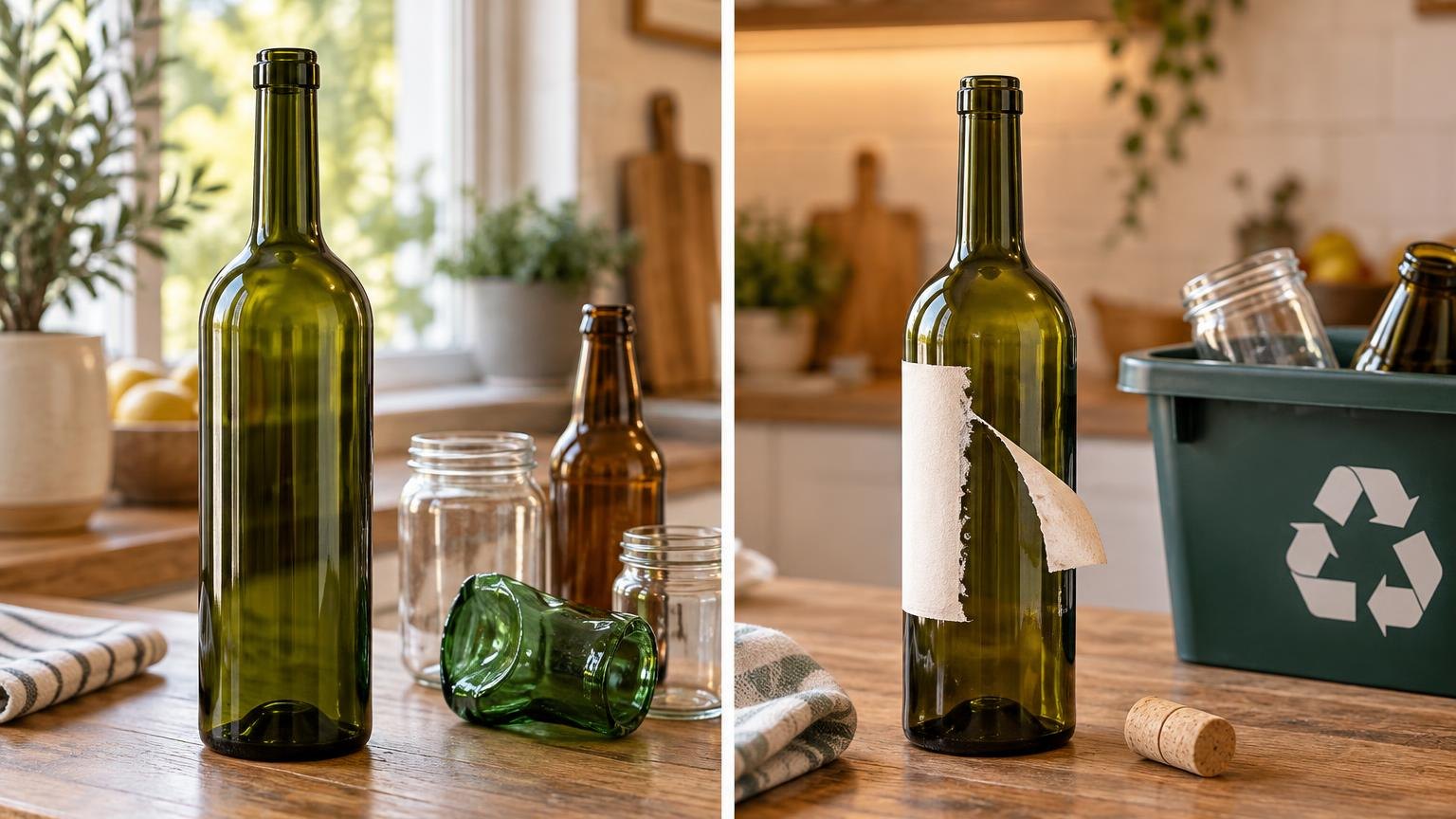
- Remove corks and metal capsules before recycling — corks are not recyclable in glass streams
- Rinse bottles to remove residual wine; heavy residue contaminates paper in single-stream bins
- Do not break bottles intentionally — broken glass creates safety hazards and sorting difficulties
- Separate by color (green, brown, clear) only if your municipality uses multi-stream collection
Finding Your Local Rules
Search your municipality’s waste management website or use Earth911’s recycling locator tool. Enter your ZIP code and material type to find the nearest accepted drop-off or confirm curbside eligibility.
Approximately 33% of glass containers in the U.S. were recycled in 2021, per EPA data. Checking local rules and following them correctly directly improves that recovery rate.
Questions People Ask Most
Are wine bottles recyclable?
Yes, standard glass wine bottles are 100% recyclable and can be recycled indefinitely without any loss in quality or purity.
The Glass Packaging Institute reports that approximately 33% of glass containers in the U.S. are recycled, far below the material’s potential.
Place empty bottles in your curbside recycling bin after removing corks, which are not accepted in glass recycling streams.
Do different wine bottle colors affect recyclability?
Green, brown (amber), and clear (flint) wine bottles are all recyclable, but they must be sorted by color at the processing facility because mixing colors contaminates the melt and produces off-color glass.
Most municipal recycling programs handle this sorting mechanically, so residents can place all colors in the same bin. Brown and green glass have slightly lower demand from manufacturers than clear glass, which can slow their reprocessing cycle.
What parts of a wine bottle cannot go in the recycling bin?
Natural cork, synthetic plastic corks, foil capsules, and wax seals must be removed before recycling the glass bottle.
Natural cork is compostable or recyclable through dedicated programs like Cork ReHarvest, which partners with Whole Foods and Total Wine drop-off locations across the U.S.
Foil capsules are typically too small and mixed-material for standard recycling sorters, so they belong in the trash unless your municipality specifies otherwise.
How much energy does recycling a wine bottle actually save?
Recycling glass uses roughly 30% less energy than manufacturing new glass from raw silica sand, soda ash, and limestone, according to the U.S. Environmental Protection Agency.
Every ton of recycled glass saves approximately 1,300 pounds of sand, 410 pounds of soda ash, and 380 pounds of limestone from extraction. A single recycled wine bottle saves enough energy to power a 100-watt light bulb for about four hours.
Can wine bottles with labels and residual wine be recycled?
Paper labels do not need to be removed — they burn off during the glass melting process, which reaches temperatures above 2,600°F (1,427°C).
A small amount of residual wine is acceptable, but bottles should be emptied and given a quick rinse to prevent contamination of other recyclables in the bin.
Bottles with heavy adhesive or painted-on decorative labels are still recyclable, though the coatings may slightly reduce the efficiency of the cullet (crushed glass) processing.
Related Guides
- What is a Wine Flight? – 2026
- Does Wine Taste Good?
- How Many Ounces In A Bottle Of Prosecco?
- How Many Carbs In A Glass Of Cabernet?
- Does Wine Have Sodium?
- What Does Port Wine Taste Like? What You Need to Know
- All Alcohol Guides
- U.S. Environmental Protection Agency (2024)
- U.S. EPA – Advancing Sustainable Materials Management (2023)
- Stanford University – Stanford Recycling (2023)
- Glass Packaging Institute (2024)
- Waste Management (2024)
- National Institutes of Health – Environmental Health Perspectives (2022)
- Container Recycling Institute (2023)
- California Department of Resources Recycling and Recovery – CalRecycle (2024)
- The Glass Recycling Company (2023)