How Many Bottles of Wine for 30 Guests? is 15 bottles for a standard two-hour gathering with moderate drinking. This assumes 750 ml bottles, five 5-ounce pours per bottle, and about two glasses per guest.
Add 3 to 6 bottles if the event runs longer, wine is the main drink, or guests are heavy wine drinkers. Split the total between red, white, and sparkling based on food, weather, and guest preference.
For most mixed groups, plan 50% red, 40% white, and 10% sparkling. Buy from a retailer with a return policy on unopened bottles, because one extra case is cheaper than running out mid-event.
Quick Answer for 30 Guests
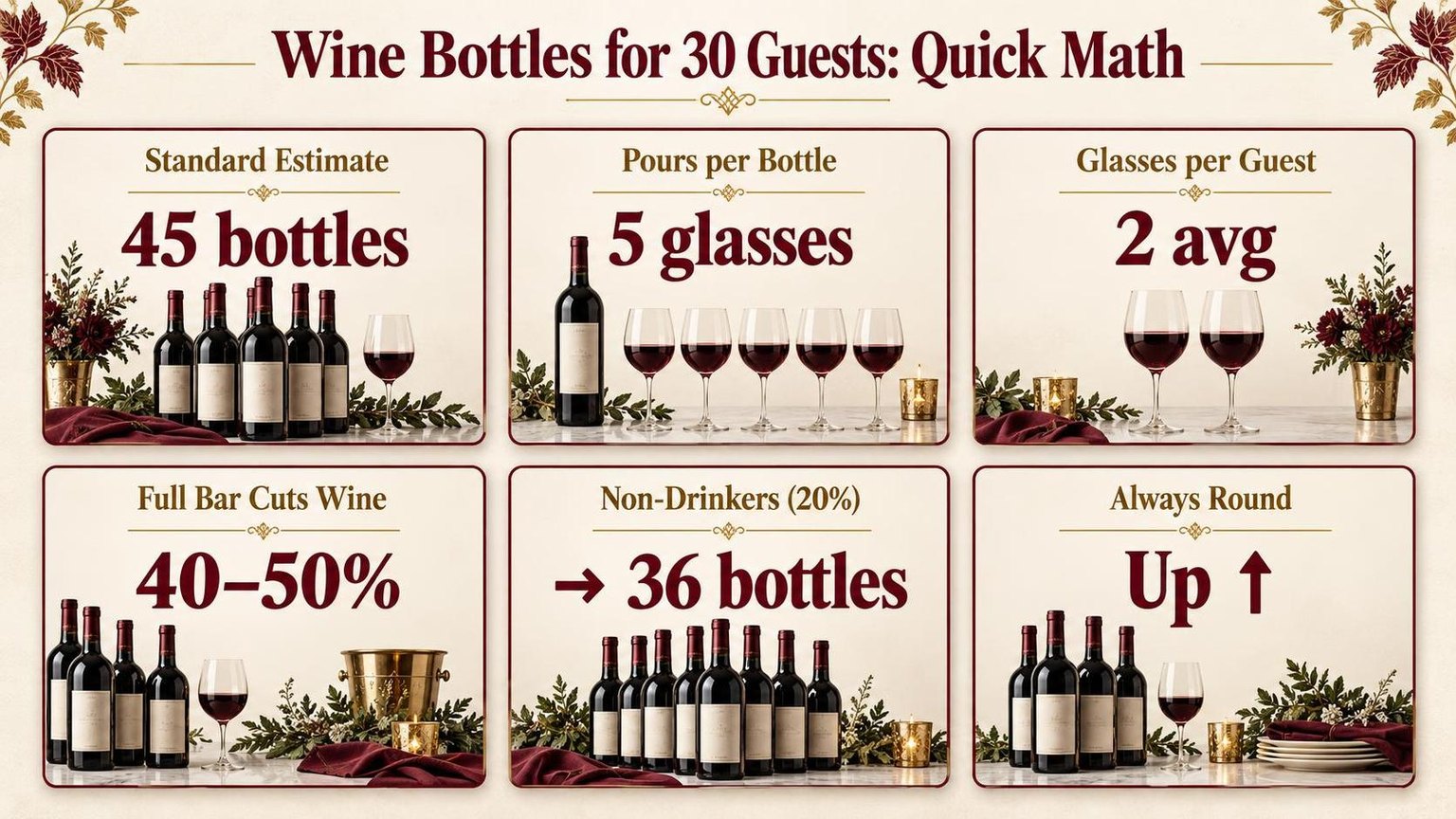
Plan for 45 bottles of wine for 30 guests at a standard 2–3 hour event. This assumes each guest drinks roughly two glasses, with each 750 ml bottle yielding five 5-ounce pours.
The calculation is straightforward: 30 guests × 2 glasses each = 60 glasses. Divide 60 by 5 pours per bottle, and you get 12 bottles per hour of drinking — or 36–48 bottles for a 3–4 hour event.
Bottle Estimates by Event Length
| Event Duration | Glasses Consumed (est.) | Bottles Needed |
| 1 hour (cocktail reception) | 30–45 | 6–9 |
| 2 hours | 60 | 12 |
| 3 hours (typical dinner party) | 90 | 18 |
| 4 hours (wedding reception) | 120 | 24 |
| 5+ hours (extended celebration) | 150+ | 30+ |
These figures assume a moderate-drinking crowd averaging one glass per hour after an initial first pour. Heavy-drinking groups can push consumption 30–50% higher.
Red vs. White Split
A common industry guideline is a 60/40 split favoring red wine for fall and winter events, and the reverse for spring and summer gatherings.
| Season | Red Bottles | White/Rosé Bottles | Total (45 bottles) |
| Spring/Summer | 18 | 27 | 45 |
| Fall/Winter | 27 | 18 | 45 |
| Mixed preference (year-round) | 23 | 22 | 45 |
Factors That Change the Count
- Non-drinkers: If 20% of guests abstain, reduce by 9 bottles (down to roughly 36).
- Beer and cocktails available: A full bar typically cuts wine consumption by 40–50%, bringing the count to 22–27 bottles.
- Food service: A seated multi-course dinner slows drinking versus a standing cocktail party.
- Time of day: Afternoon events average 1.5 glasses per person; evening events average 2.5.
Buy from retailers with a return policy on unopened bottles. Total Wine, BevMo, and many local shops accept returns within 30 days, eliminating the risk of over-purchasing.
The 45-bottle baseline keeps you covered without running short. Adjust up or down using the variables above, and always round up — running out of wine is far worse than having a few bottles left over.
Bottle Counts by Drinking Pace
For 30 wine-drinking guests, bottle requirements depend mainly on serving time and how quickly glasses are refilled. Use a standard 750-milliliter bottle as five 5-ounce servings, then round every calculation up to a whole bottle.
Estimated Bottles by Event Length
The table assumes every guest drinks wine throughout the event. “Slow” fits meals or daytime gatherings; “moderate” reflects a typical dinner party; “fast” suits wine-centered celebrations with attentive refilling.
| Drinking pace | Glasses per guest per hour | 2-hour event | 3-hour event | 4-hour event |
| Slow | 0.5 | 6 bottles | 9 bottles | 12 bottles |
| Moderate | 0.75 | 9 bottles | 14 bottles | 18 bottles |
| Fast | 1.0 | 12 bottles | 18 bottles | 24 bottles |
Calculate the base requirement by multiplying guest count, glasses per guest per hour, and event hours. Divide the result by five servings per bottle, then round upward.
This method prevents partial-bottle estimates from leaving the final guests unserved.
Adjust for the Actual Wine-Drinking Group
Do not count guests who will drink only beer, cocktails, or nonalcoholic beverages. If wine is one option among several, estimate the likely wine drinkers first and apply the appropriate pace to that smaller group.
| Wine drinkers among 30 guests | Moderate 3-hour estimate | With 10% reserve |
| 15 guests | 7 bottles | 8 bottles |
| 20 guests | 9 bottles | 10 bottles |
| 25 guests | 12 bottles | 14 bottles |
| 30 guests | 14 bottles | 16 bottles |
A reserve covers generous pours, sediment, cork problems, spills, and guests staying longer than planned.
Catered events commonly benefit from rounding upward because unopened bottles may remain usable or returnable, depending on the retailer and local alcohol rules.
Control Pace Through Pour Size
A 5-ounce pour is also the U.S. dietary standard-drink reference for wine at 12% alcohol by volume. Larger pours materially reduce bottle yield and can cause consumption to exceed the planning estimate.
| Pour size | Approximate servings per 750-milliliter bottle | Bottles for one round serving 30 guests |
| 4 ounces | 6.3 servings | 5 bottles |
| 5 ounces | 5.1 servings | 6 bottles |
| 6 ounces | 4.2 servings | 8 bottles |
For most three-hour dinners serving wine as the primary alcohol, buy 14 bottles as the mathematical estimate or 16 bottles with a practical reserve. Measure pours, keep water available, serve food, and stop service to visibly intoxicated guests.
Wine Math Using Standard Pours
A standard wine pour is 5 ounces, yielding exactly 5 glasses from each 750 mL (25.4 oz) bottle. This fixed ratio is the foundation of every wine quantity calculation for events, and it holds regardless of varietal or style.
Start with consumption rate. Industry data from the National Restaurant Association indicates the average guest drinks 2 to 3 glasses of wine over a 3- to 4-hour event. For 30 guests, that produces these totals:
| Consumption Rate | Total Glasses Needed | Bottles Required |
| 2 glasses per guest (conservative) | 60 | 12 |
| 2.5 glasses per guest (moderate) | 75 | 15 |
| 3 glasses per guest (generous) | 90 | 18 |
The moderate estimate of 15 bottles works for most mixed-crowd gatherings. A cocktail-hour-only event skews lower; a full dinner with multiple courses skews higher.
Adjusting for Non-Wine Drinkers
Not every guest drinks wine. According to the Wine Institute’s 2023 consumption data, roughly 42% of American adults choose wine as their primary alcoholic beverage.
Factor in beer drinkers, cocktail preferences, and non-drinkers with this adjusted formula.
- Estimate 70–80% of guests will drink wine at a wine-focused event.
- Estimate 50–60% at events offering a full bar alongside wine.
- Always round up to the nearest whole bottle — partial bottles cannot be purchased.
Applied to 30 guests at a wine-focused event where 75% drink wine, the math shifts:
| Scenario | Wine Drinkers | Glasses (at 2.5 each) | Bottles |
| 75% drink wine | 22–23 | 56 | 12 |
| 60% drink wine (full bar available) | 18 | 45 | 9 |
| 100% drink wine | 30 | 75 | 15 |
The Buffer Rule
Add 10–15% extra bottles beyond your calculated number. For 15 bottles, that means 2 additional bottles, bringing the total to 17. This covers heavier-than-expected drinkers, spills, and the occasional generous self-pour that exceeds 5 ounces.
Unopened bottles from retailers with return policies — such as Total Wine or Costco — cost nothing extra. Buy confidently, return what you don’t open, and never risk running short at the 30-guest mark.
Red White and Sparkling Split
Splitting your wine selection across red, white, and sparkling ensures every guest finds something to enjoy. The standard industry ratio shifts depending on season, menu, and time of day, but proven formulas keep planning straightforward.
The Classic 40/40/20 Rule
Most caterers and event planners default to a 40% red, 40% white, 20% sparkling split. For 30 guests consuming roughly 30 bottles total, that translates to a clean breakdown.
| Type | Percentage | Bottles (of 30) |
| Red | 40% | 12 |
| White | 40% | 12 |
| Sparkling | 20% | 6 |
Those 6 sparkling bottles yield approximately 30 flute pours at 5 oz each—exactly one welcome glass per guest.
Seasonal Adjustments
Season dramatically shifts preferences. Summer gatherings and outdoor daytime events skew toward chilled wines. Winter dinners and hearty menus favor reds. Adjust the ratio accordingly.
| Season/Setting | Red | White | Sparkling |
| Summer outdoor | 25% (8 bottles) | 50% (15 bottles) | 25% (7 bottles) |
| Fall/Spring mixed | 40% (12 bottles) | 40% (12 bottles) | 20% (6 bottles) |
| Winter dinner | 50% (15 bottles) | 30% (9 bottles) | 20% (6 bottles) |
Know Your Crowd
Guest demographics matter more than any formula. A 2023 Wine Intelligence report found that 54% of U.S. wine drinkers under 40 prefer white and rosé over red. Older demographics lean red by a similar margin.
- Mixed-age group: Stick with the 40/40/20 split for balanced coverage.
- Younger crowd (under 40): Shift to 30% red, 45% white/rosé, 25% sparkling.
- Steak or barbecue menu: Push red to 50–55%, drop white to 25–30%.
- Seafood or brunch: Flip it—25% red, 45% white, 30% sparkling.
Don’t Forget the Toast Factor
If you’re planning a toast, allocate sparkling separately. One 750 ml bottle fills 5 flutes, so 30 guests require exactly 6 bottles just for the toast. Buy those on top of your still-wine total to avoid running short mid-event.
When in doubt, round up by 1–2 bottles per category. Unopened wine is returnable at most retailers, making overestimation the safer and cost-free strategy.
Adjusting for Event Length
Event duration changes the bottle count more than almost any other planning variable.
A practical inventory estimate assumes each wine drinker takes two servings during the first hour and one serving during each additional hour, although actual consumption varies.
Wine-only event estimates
A standard wine bottle contains 750 milliliters, or approximately 25.4 fluid ounces. Using a 5-ounce pour, each bottle supplies about five servings. The following estimates assume all 30 guests drink wine and remain for the full event.
| Event length | Servings per guest | Total servings | Base bottles | Bottles with 10% reserve |
| 2 hours | 3 | 90 | 18 | 20 |
| 3 hours | 4 | 120 | 24 | 27 |
| 4 hours | 5 | 150 | 30 | 33 |
| 5 hours | 6 | 180 | 36 | 40 |
The reserve covers generous pours, spilled glasses, opened bottles that are not fully served, and guests who drink above the planning average. Round upward to whole bottles because partial bottles cannot be purchased.
Adjust for the actual schedule
Count drinking time rather than the venue rental period. A four-hour wedding with a one-hour ceremony and three-hour reception should normally be calculated from the reception period, unless wine is offered before the ceremony.
- Short cocktail reception: Consumption may be concentrated because guests arrive and receive drinks immediately. Maintain the first-hour allowance even when the event lasts less than a full evening.
- Seated dinner: Service often slows between courses. Controlled 5-ounce pours make the bottle estimate more dependable than self-service glasses.
- Open-house format: Guests rarely stay for the entire posted window. Estimate average attendance time from invitations, prior events, or RSVP notes rather than treating every guest as present throughout.
- Late-night party: Do not extend the one-drink-per-hour assumption indefinitely. Food, transportation plans, nonalcoholic options, and responsible-service limits can reduce later consumption.
Account for other beverages
If beer, cocktails, or substantial nonalcoholic choices are available, calculate wine only for its expected share of total drinks.
At a mixed bar, wine commonly represents roughly 40% to 50% of beverage selections, but guest preferences should override that planning range.
A 5-ounce glass of wine at 12% alcohol by volume equals one U.S. standard drink, according to federal dietary guidance. The serving-rate formula is an inventory tool, not a recommendation for personal consumption.
Provide water, food, alcohol-free choices, and safe transportation throughout the event.
Safe Buying Plan and Leftovers
Planning wine for 30 guests demands a buffer above the mathematical minimum. A safe buying plan adds 10–15% extra bottles to cover heavy pourers, unexpected arrivals, and varied drinking speeds across a multi-hour event.
Recommended Purchase Quantities
The standard estimate assumes half a bottle (two 5-oz glasses) per guest per hour. For a typical 3-hour event with 30 guests, the baseline is 45 bottles. The safe buying plan adjusts upward.
| Event Duration | Baseline Bottles | Safe Buy (+ 15%) | Expected Leftovers |
| 2 hours | 30 | 35 | 3–5 bottles |
| 3 hours | 45 | 52 | 5–7 bottles |
| 4 hours | 60 | 69 | 7–9 bottles |
| 5 hours | 75 | 86 | 8–11 bottles |
These figures assume roughly 60% of guests are active wine drinkers. Adjust downward if you’re also serving beer, cocktails, or spirits.
Managing Leftovers Strategically
Unopened wine stores indefinitely when kept at 55°F in a dark space. Prioritize buying wines with long shelf lives to maximize leftover value.
- Buy by the case: Most retailers offer 10–15% case discounts on 12-bottle purchases, effectively making your buffer bottles free.
- Choose return-friendly retailers: Total Wine, Costco, and many independent shops accept returns on unopened bottles within 30–60 days with receipt.
- Favor age-worthy reds: Cabernet Sauvignon, Barolo, and Rioja Reserva improve over 5–10 years in proper storage, making leftovers an asset.
- Avoid excess sparkling: Prosecco and non-vintage Champagne lose freshness within 1–2 years. Buy sparkling closest to your exact headcount.
The Cost of Under-Buying vs. Over-Buying
Running out mid-event creates an irreversible hospitality failure. Over-buying by 15% at $12 per bottle costs roughly $14–$20 in extra spend for 30 guests—under $0.70 per person.
Opened but unfinished bottles last 3–5 days when re-corked and refrigerated. Use a vacuum pump like Vacu Vin to extend that window to 7–10 days. Leftover wine also works for cooking sauces, vinaigrettes, and reductions.
The smartest approach: buy one full case more than your calculated need, keep receipts, and return what stays sealed. You protect your event and your budget simultaneously.
Frequently Asked Questions
How many bottles of wine do I need for 30 guests?
Plan on 15 standard 750 mL bottles if each guest drinks about two 5-ounce glasses. Buy 18 bottles to provide a 20% buffer for generous pours, breakage, or higher-than-expected demand.
How many bottles are needed if wine is the only alcoholic drink?
Allow three to four 5-ounce glasses per drinking guest, equal to 18 to 24 bottles for 30 people. Choose the higher end for an event lasting four hours or longer.
How many bottles should I buy if beer and cocktails are also served?
For a mixed bar, estimate one to two glasses of wine per guest, requiring 6 to 12 bottles for 30 guests. A practical starting point is 10 bottles when wine is one of several equally available options.
What mix of red, white, and sparkling wine works for 30 guests?
For an 18-bottle purchase, a balanced mix is eight white, seven red, and three sparkling bottles. Shift one or two bottles toward white in warm weather and toward red for a cold-weather dinner with beef or other hearty dishes.
How many glasses are in one bottle of wine?
A standard 750 mL bottle contains about five 5-ounce servings. Restaurant-style 6-ounce pours reduce the yield to roughly four glasses, so pour size materially changes the bottle count.
How much sparkling wine is needed for a toast for 30 guests?
Five 750 mL bottles cover 30 guests when each receives a 4-ounce toast pour, because one bottle yields about six such servings. Buy six bottles if servers may pour unevenly or guests are likely to request refills.
Keep Exploring
- Cheap Wine That Gets You Drunk
- What Wine Is Sweet? – Expert Guide from Flight Wine Bar
- Black Friday Wine Deals
- How Long Does Mulled Wine Last?
- How Did They Make Wine in Biblical Times?
- All Alcohol Guides
- National Institute on Alcohol Abuse and Alcoholism (2024)
- Dietary Guidelines for Americans – USDA & HHS (2020)
- Centers for Disease Control and Prevention – Alcohol Use (2024)
- Cornell University College of Agriculture – Wine Economics (2021)
- Wine & Spirits Wholesalers of America – Industry Data (2023)
- National Institutes of Health – PubMed: Alcohol serving sizes and consumption patterns (2016)
- University of California, Davis – Department of Viticulture and Enology (2023)