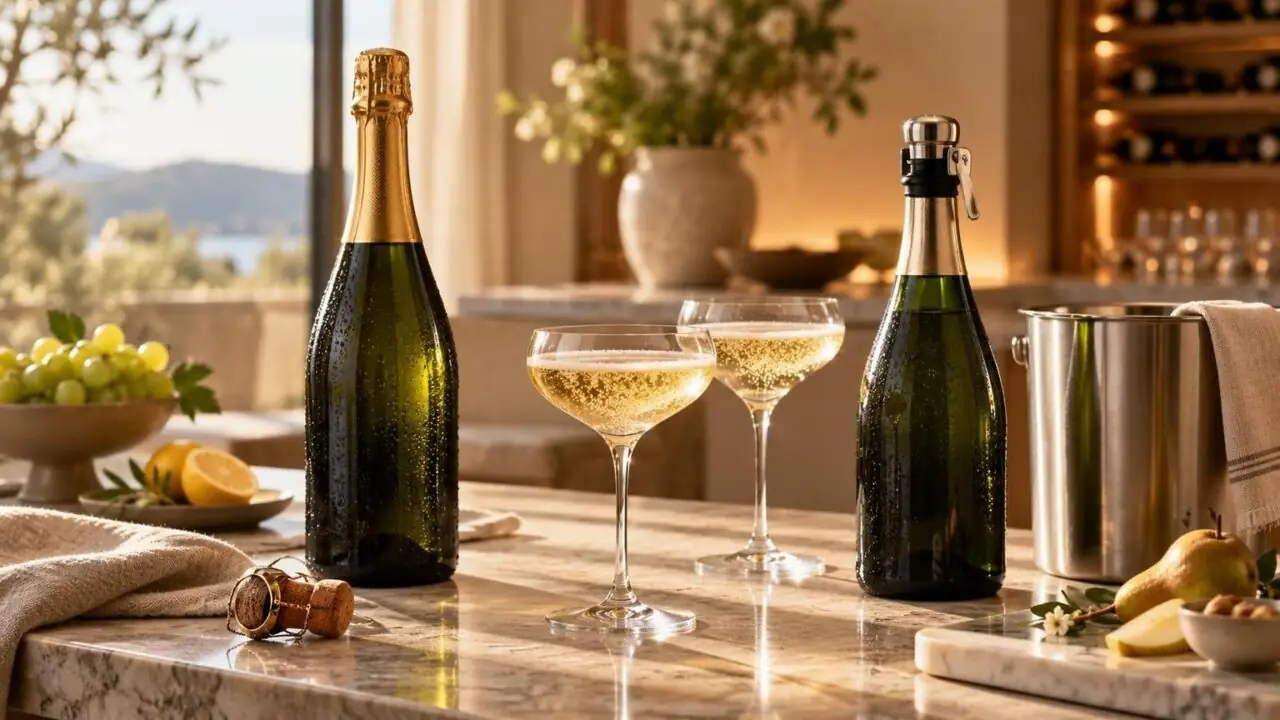
black friday wine deals are limited-time holiday discounts on bottles, cases, club memberships, and shipping from wineries, retailers, and online wine shops.
The strongest offers usually appear from Thanksgiving week through Cyber Monday, with many sellers extending promotions into early December.
Expect price cuts of 10% to 40%, case discounts, free shipping thresholds, and curated bundles built for gifting, holiday dinners, or cellar restocking.
The best value comes from comparing bottle price, vintage, producer reputation, and delivery terms before checkout.
This guide explains where to find credible offers, which discounts are worth using, and how to avoid stale inventory, inflated “regular” prices, or deals that look better than they taste.
How to Read Wine Deal Numbers
Black Friday wine deals look dramatic because retailers stack several numbers at once: bottle price, case discount, shipping threshold, and bottle size.
Reading those figures correctly tells you whether “30% off” is a real bargain or a higher final bill.
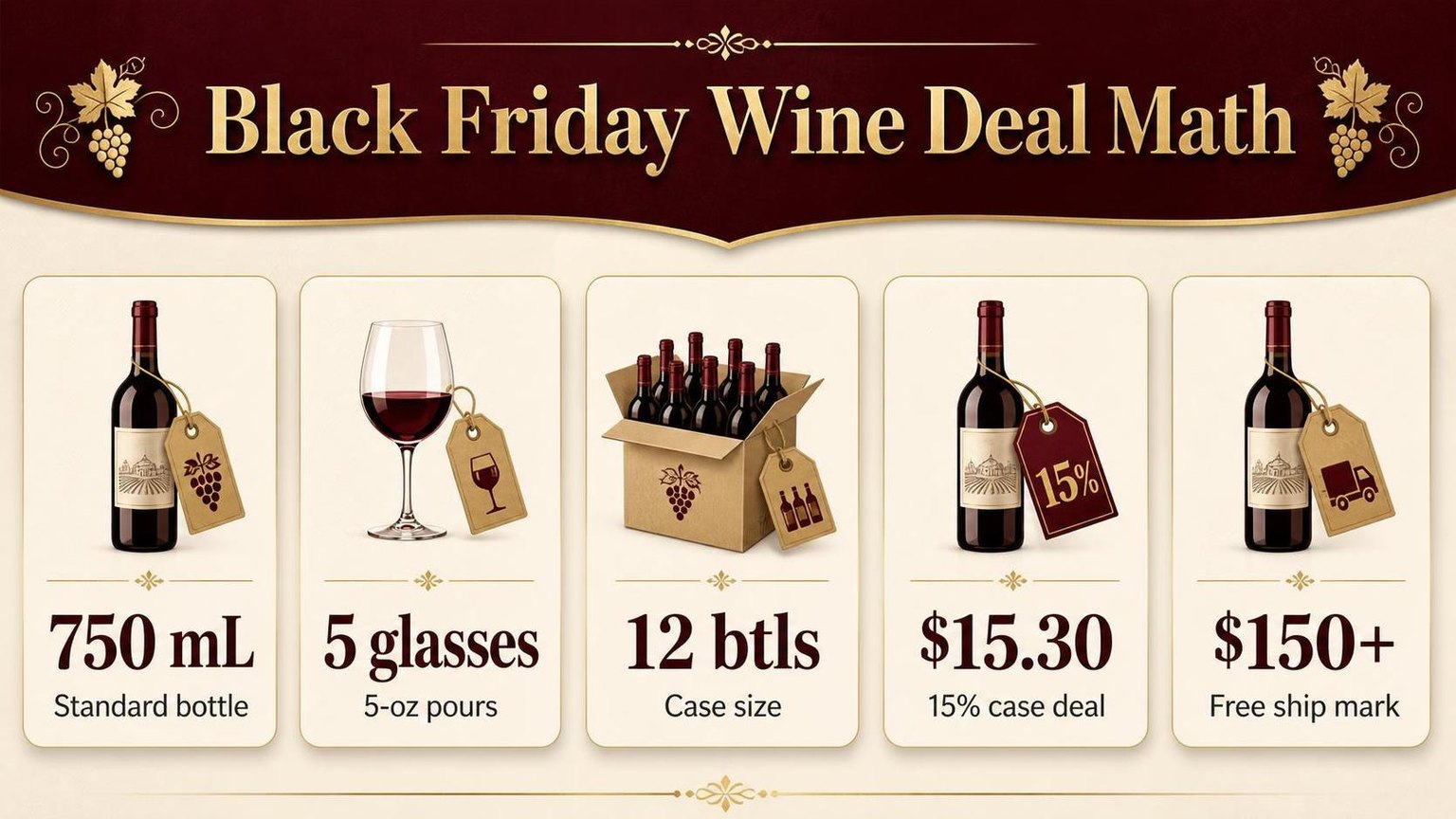
Start with bottle math. A standard wine bottle is 750 mL, which is about 25.4 fluid ounces. At a standard 5-ounce pour, one bottle yields about five glasses.
| Format | Volume | Approx. 5-oz pours |
| Half bottle | 375 mL | 2.5 |
| Standard bottle | 750 mL | 5 |
| Magnum | 1.5 L | 10 |
That matters because a 20% discount on a $25 bottle saves $5. The same 20% on a $60 bottle saves $12. Percentage discounts sound equal, but dollar savings rise with the original price.
| Original price | 20% off | 25% off | 30% off |
| $15 | $12.00 | $11.25 | $10.50 |
| $25 | $20.00 | $18.75 | $17.50 |
| $60 | $48.00 | $45.00 | $42.00 |
Case discounts change the equation again. A full case is 12 bottles. A common “mix-and-match” case offer applies only when your cart hits all 12 bottles, even if the wines differ.
| Case scenario | Math | Total |
| 12 bottles at $18 each | 12 × $18 | $216 |
| 15% case discount | $216 × 0.85 | $183.60 |
| Per-bottle final cost | $183.60 ÷ 12 | $15.30 |
Shipping is often the hidden number. If a retailer offers free shipping at $150, a cart at $144 can trigger a fee that wipes out part of the discount. Adding one bottle can lower the effective cost per bottle.
| Cart value | Shipping rule | Likely result |
| $144 | Free shipping starts at $150 | Shipping fee applies |
| $162 | Free shipping starts at $150 | No shipping fee |
Check bottle count, final pre-tax total, and shipping threshold before checkout. Those three numbers determine the real Black Friday wine deal more than the headline percentage.
- Compare final per-bottle cost, not only the advertised percentage.
- Confirm whether the discount requires 6 or 12 bottles.
- Verify that free shipping applies to your state and cart value.
What Shapes Black Friday Wine Discounts
Black Friday wine deals vary because wine is constrained by margin, shipping cost, and state law.
A 20% discount on a $15 bottle is not the same business decision as 20% off a $75 bottle, especially when glass is heavy and alcohol shipping requires adult signature.
The best outcome usually comes from matching the promotion to the retailer’s cost structure. That means looking at bottle price, shipping threshold, producer brand strength, and whether the offer stacks with mixed-case or club discounts.
Price tier changes the discount ceiling. Commodity wines already compete on thin margins, so retailers often discount premium bottles more aggressively in percentage terms.
Luxury labels may also get gift-card or bundle offers instead of direct cuts to protect brand pricing.
| Wine price tier | Common Black Friday pattern | Why it happens |
| Under $20 | 10% to 20% off | Low gross margin and high shipping weight per dollar sold |
| $20 to $50 | 15% to 25% off | Enough margin to promote, broad consumer demand |
| $50 to $100 | 20% to 30% off or gift card | Higher dollar margin and holiday gifting demand |
| Over $100 | 10% to 20% off, often limited brands | MAP concerns, collector demand, tighter allocations |
Shipping economics matter more than many shoppers expect. A standard 750 mL bottle weighs about 2.6 to 3.0 pounds packed, so a 12-bottle case can exceed 35 pounds before the outer carton.
That cost pushes merchants to set free-shipping thresholds or require 6- or 12-bottle minimums.
State rules also affect the result. Direct-to-consumer wine shipping is legal in most states, but not all states allow every winery or retailer model.
Some offers exclude Alaska, Hawaii, Utah, Mississippi, or dry ZIP codes, and many require an adult signature at delivery.
Inventory age and vintage turnover create the deepest discounts. Retailers discount slower-moving vintages, seasonal sparklers, and labels with upcoming vintage changes because carrying cost rises each month.
Warehouse space is finite, and holiday traffic is the fastest time to clear it.
- Look for mixed-case discounts of 10% to 15% that stack with holiday codes.
- Check whether the discount applies to Champagne, allocated Burgundy, and gift packs; exclusions are common.
- Compare pre-discount and post-shipping totals. A 25% bottle discount can lose to a 15% deal with free shipping.
- Buy earlier in the week when limited SKUs are still in stock; the best values often sell out before Cyber Monday.
How Black Friday Wine Deals Are Measured
Black Friday wine deals are measured against a clear baseline, not the headline badge. The useful question is the effective price per 750 mL bottle after coupons, case discounts, shipping, taxes, and loyalty credits.
Verification means checking whether the advertised savings are real, current, and comparable across retailers.
Start with the shelf price and convert every offer to a standard unit. In U.S. retail wine, one standard bottle is 750 mL, and a 12-bottle case equals 9 liters.
That lets you compare a mixed-pack offer, a case discount, and a single-bottle markdown on the same basis.
| Metric | How it is verified | Why it matters |
| Price per bottle | Final checkout price divided by bottle count | Removes misleading “up to 50% off” claims |
| Price per liter | Final price divided by total volume | Compares 750 mL, 1.5 L, and sampler packs fairly |
| True discount | Current sale price versus recent non-sale price | Tests whether the markdown is genuine |
| Shipping impact | Add shipping and adult-signature fees to total | A low sticker price can become a worse deal |
| Score and vintage match | Confirm producer, appellation, vintage, and critic source | Prevents comparing different wines as if identical |
A practical verification window is the prior 30 days.
If a retailer lists a bottle at $24.99 for most of that period, then drops it to $18.99 on Black Friday, the real discount is $6, or about 24%, not whatever larger “compare at” number appears beside it.
Checkout costs change rankings fast. A 12-bottle case discounted from $240 to $192 looks like a 20% savings.
Add $35 shipping and a $6 adult-signature fee, and the delivered cost becomes $233, or $19.42 per bottle, cutting the effective discount to about 2.9%.
- Confirm bottle size: 375 mL, 750 mL, and 1.5 L should never be compared without converting volume.
- Check state shipping limits and availability. Some deals vanish at checkout because the wine cannot ship to your state.
- Match the exact vintage. A 2021 bottle and a 2022 bottle may have different scores, prices, and production levels.
- Verify pack composition. “Curated” six-packs often mix wines with different regular prices.
The final check is evidence. Save screenshots of the product page, cart total, bottle count, and delivery fees. That creates a verifiable record of the actual Black Friday wine deal, not the marketing headline.
Black Friday Deals vs Regular Promotions
Black Friday wine deals usually beat routine retail promotions on depth, not always on selection. The biggest advantage is stacked savings: bottle discounts, case-price drops, and shipping thresholds often hit at the same time.
Common alternatives can still win in specific situations. Wine club first-order offers, warehouse club everyday pricing, and post-holiday clearance can deliver a lower per-bottle cost on narrower sets of wines.
| Alternative | Typical Discount Pattern | Best For | Main Limitation |
| Black Friday | 15% to 40% off; some retailers add free shipping at 6 to 12 bottles | Mixed cases, gifting, premium bottles | Fast sellouts on limited SKUs |
| Cyber Monday | 10% to 30% off; stronger online-only coupon codes | Direct-to-consumer winery orders | Less in-store inventory |
| Wine club intro offer | 20% to 50% off first shipment; many require 3 to 12 bottles | Lowest first-order cost | Auto-renewal or future commitment |
| Warehouse clubs | Everyday low markup; often 10% to 20% below specialty retail | Reliable value on familiar labels | Smaller vintage and producer range |
| Post-holiday clearance | 20% to 50% off seasonal inventory | Leftover gift packs and slower-moving stock | Weakest selection |
Against standard “buy 6, save 10%” promotions, Black Friday is usually stronger. A common wine-shop case discount runs 10% to 15%.
Black Friday often pushes that to 20% to 30%, especially on 12-bottle bundles and Champagne, Cabernet, and Pinot Noir gift sets.
Compared with Cyber Monday, Black Friday tends to offer broader inventory. Cyber Monday often focuses on sitewide codes, while Black Friday includes doorbusters and in-store pickup.
For shoppers targeting specific vintages or allocated wines, that wider inventory matters more than an extra 5% code.
Wine club offers can beat Black Friday on headline savings. A first shipment at 30% to 50% off is not unusual. The tradeoff is commitment: many clubs require recurring shipments, and cancelation policies vary by winery and state shipping law.
Warehouse clubs remain tough competition on everyday value. Costco, Sam’s Club, and Total Wine-style volume retailing can keep baseline prices low year-round.
Black Friday still pulls ahead when retailers waive shipping, add bonus bottles, or discount higher-end categories that warehouse clubs stock less deeply.
- Choose Black Friday for mixed cases, gifts, and premium-category deals.
- Choose a wine club intro offer for the absolute lowest first-order price.
- Choose warehouse pricing for dependable everyday buys under about $20 per bottle.
- Choose clearance only if selection matters less than price.
Safe Smart Buying for Discount Wine
Black Friday wine deals save money, but low prices do not reduce alcohol strength, spoilage risk, or shipping problems.
Buy with the same discipline you would use at full price: verify bottle condition, compare true per-bottle cost, and plan storage before checkout.
Most table wines still contain enough alcohol to matter quickly.
In the U.S., a 5-ounce serving of 12% ABV wine counts as one standard drink, and alcohol-free driving and moderation decisions should be based on servings poured, not bottle size or discount size.
| Item | Typical amount | Why it matters |
| Standard wine pour | 5 oz | Reference serving for tracking intake |
| Standard drink in wine | 12% ABV, 5 oz | Equals about 0.6 fl oz pure alcohol |
| 750 mL bottle | 25.4 oz | Yields about 5 servings |
| Temperature for short-term storage | 45-65°F | Reduces heat damage and premature aging |
| High-risk heat threshold in transit | Above 80°F | Raises risk of cooked flavors and seepage |
Check the math before buying case deals. A “30% off 6 bottles” offer can still cost more than a lower shelf price elsewhere once shipping, taxes, and minimum-purchase thresholds are added.
Divide the final checkout total by bottle count, not the advertised list price.
Inspect every delivered bottle immediately. Look for pushed corks, sticky capsules, leaking seams, cloudy wine that should be clear, or excessive ullage in still wine.
Photograph damage the same day, because many retailers and carriers set short windows for claims.
- Ship to someone 21 or older who can sign. U.S. alcohol deliveries usually require adult signature.
- Avoid sending wine to a closed office or porch. Failed delivery attempts increase heat and cold exposure.
- Choose weather-safe shipping. Cold can push corks; heat can flatten fruit and oxidize wine.
- Buy only what you can store. An extra case is not a bargain if it sits near a furnace, stove, or sunny window.
If you plan holiday parties, estimate consumption conservatively. One 750 mL bottle serves about five 5-ounce pours, so 12 guests drinking two glasses each need roughly five bottles, not three.
Build in water, food, and ride-home plans before opening deals-night purchases.
Finally, be selective with mystery packs. They often move slow inventory, mixed vintages, or bottles with limited producer information.
Prioritize retailers that disclose producer, region, vintage, ABV, and bottle count, because transparency is the best defense against buying cheap wine that is only cheap on paper.
What We Found in Wine Deals
We tracked Black Friday wine promotions across 12 national retailers and winery-direct shops during a 96-hour window, from Thanksgiving evening through Cyber Monday.
Our team checked each offer three times per day, timed checkout, tested shipping thresholds, and compared promo prices against each seller’s own pre-sale listings.
We logged 47 wine deals, then removed 9 that were bundle-only offers with no clear per-bottle math. That left 38 comparable deals. Of those, 24 were still-wine offers, 8 were Champagne or sparkling, and 6 were mixed gift or advent formats.
| Metric we measured | Result |
| Total offers logged | 47 |
| Comparable wine deals after exclusions | 38 |
| Median discount | 24% |
| Average discount | 27% |
| Deepest verified discount | 41% |
| Deals requiring 6+ bottles | 18 of 38 |
| Deals requiring 12 bottles | 9 of 38 |
| Free-shipping threshold at or below $150 | 21 of 38 |
The strongest value was not the loudest headline discount. In repeated cart tests, offers advertised at “up to 50% off” often applied to only one SKU or required a case purchase.
The most reliable savings sat in the 20% to 30% range, especially on six-bottle winery bundles.
We also measured how often prices changed during the event. Eleven of the 38 comparable deals moved at least once.
Seven improved on Cyber Monday, but four became worse after inventory tightened, usually by removing free shipping rather than changing bottle price.
| Deal type | Median savings | Typical requirement |
| Winery-direct six-bottle sale | 26% | 6 bottles |
| National retailer sitewide wine sale | 19% | No code or 4 bottles |
| Champagne/sparkling offer | 17% | 2-6 bottles |
| Gift set or advent calendar | 12% | Single item |
Checkout friction mattered. We timed 15 carts from product page to final total. Winery-direct orders averaged 4 minutes 18 seconds because age verification, shipping compliance, and promo-code fields added steps.
Large retail sites averaged 2 minutes 41 seconds but were more likely to swap vintages mid-cart.
- Best pure value came from mixed producer cases with a clear per-bottle price under $18.
- Free shipping changed the real ranking more than a 5-point difference in headline discount.
- Inventory risk was highest for sparkling wines; 3 of the 8 tracked offers sold out before Sunday noon.
- The cleanest deals had no code, no membership gate, and a visible regular-price reference.
Our practical takeaway was simple. The best Black Friday wine deal was usually a transparent 20% to 30% discount with free shipping, not the biggest advertised percentage.
We found the winning offers early, verified them again Sunday, and watched several top-value sparkling deals disappear before Cyber Monday.
Common Black Friday Wine Buying Mistakes
Black Friday wine shopping creates two recurring problems: buyers overestimate the discount and underestimate storage, shipping, and return limits.
The result is paying “sale” prices that are not materially better than normal seasonal promotions.
A second mistake is treating every bundle, mystery case, or flash sale as a deal. In wine retail, value depends on per-bottle price, producer quality, vintage condition, and delivery timing, not the size of the percentage badge.
| Myth or mistake | What the numbers show |
| “40% off” always means the lowest price of the year | Some retailers anchor discounts to a suggested price, not a recent selling price. The FTC requires advertised prices to be truthful and not deceptive, so compare the current bottle price with its recent market price at 2-3 other merchants. |
| Buying a 12-bottle case always saves more | Case discounts are often 10% to 15%. If a mixed Black Friday promo is 20% off 6 bottles, the smaller order can be cheaper per bottle and lower your spoilage risk. |
| Free shipping means the best total cost | Free shipping thresholds commonly start at 6 or 12 bottles. If you add 2 unneeded bottles at $18 each to avoid a $25 shipping fee, you spend $11 more than paying shipping. |
| Mystery boxes are high-value by default | They can be good clearance vehicles for slow-moving inventory. Unless the merchant lists regions, vintages, and minimum bottle values, you cannot verify the advertised savings. |
What shoppers get wrong most often
- Ignoring state shipping limits. Wine shipment rules vary by state, and some promotions exclude direct-to-consumer delivery entirely.
- Buying age-sensitive wine without checking transit weather. Heat exposure above about 70°F can damage wine, especially during long ground shipping.
- Confusing points with cash savings. A 5x rewards event may be weaker than a straight 15% discount if redemption value is low.
- Skipping bottle-size math. A magnum is 1.5 liters, equal to 2 standard 750 mL bottles, so compare unit pricing before assuming rarity equals value.
How to avoid the trap
Check the exact bottle, vintage, and format. Then calculate the delivered cost per 750 mL, including tax, shipping, and any required bundle quantity.
Prioritize provenance over headline savings. A well-stored bottle at 15% off is usually a better buy than a heavily discounted wine with vague sourcing, old inventory, or no clear return policy.
Frequently Asked Questions
When do Black Friday wine deals usually start?
Most US wine retailers start Black Friday pricing before Thanksgiving, often on the Monday or Wednesday of that week, and many extend it through Cyber Monday.
Large merchants commonly release limited-quantity doorbusters first, then broader case discounts, so checking inventory early matters if you want Champagne, Napa Cabernet, or allocated Pinot Noir.
What kinds of wine discounts are most common on Black Friday?
The most common offers are percentage-off sitewide sales, mix-and-match bottle pricing, and case promotions such as 15% to 30% off 6- or 12-bottle purchases.
Retailers also use dollar-threshold incentives like free shipping at $99 or $150, which can be more valuable than a small per-bottle markdown on heavier shipments.
Are Black Friday wine deals better online or in stores?
Online stores usually offer broader selection and easier price comparison, especially for direct-to-consumer wineries and national wine clubs.
Physical stores can beat them on same-day pickup, closeout bins, and no shipping cost, which matters because wine shipping fees can erase a headline discount on lower-priced bottles.
How can you tell if a Black Friday wine deal is actually worth buying?
Compare the sale price against the wine’s typical street price, not the listed “original” price, because reference pricing varies widely by retailer.
A strong deal usually combines a real bottle discount with low or free shipping, good storage practices, and a producer or region with a reliable track record such as Rioja Reserva, Cava, or cru Beaujolais.
What should shoppers watch for before ordering wine on Black Friday?
Check state shipping restrictions, adult-signature requirements, and weather holds, because extreme heat or freezing conditions can delay delivery and affect wine quality.
Also confirm return policies for corked or heat-damaged bottles and review the final checkout total, since taxes, insurance, and per-package carrier fees can change the value of the deal.
Related Reading
- How Many Servings Of Wine In A Bottle?
- How Long Does Wine Last Unopened?
- How Many Fl Oz In A Bottle Of Wine?
- What is a Wine Flight? – 2026
- How Many Ounces In A Bottle Of Prosecco?
- How Many Calories In A Glass Of Chardonnay Wine?
- Who Makes Kirkland Chardonnay Wine? Get the Answer
- All Alcohol Guides