How Many Beers Nfl Quarterbacks? is 0 beers during games, practices, meetings, and team travel, because NFL quarterbacks are working under club rules, performance standards, and league conduct expectations.
This article separates on-field reality from viral jokes, explaining when alcohol is prohibited, what players may do off duty, why quarterbacks avoid drinking near competition, and how hydration, sleep, reaction time, body weight.
And public scrutiny shape those choices across an NFL season.
NFL Quarterbacks and Beer Count Rumors
NFL quarterback beer-drinking stories have become sports folklore, blending locker-room legend with verified accounts.
These tales range from Aaron Rodgers’ shotgunning displays to Josh Allen’s viral chugging moments, each carrying varying degrees of credibility.
The most documented recent incident involves Aaron Rodgers, who shotgunned beers at Milwaukee Bucks playoff games in 2019 and 2022, captured on live television and confirmed by multiple witnesses.
Josh Allen went viral in January 2023 after chugging a beer thrown by a Bills fan during a playoff celebration, an act broadcast nationally on CBS.
Historical claims carry less verification. Here are the most frequently cited quarterback beer-count rumors:
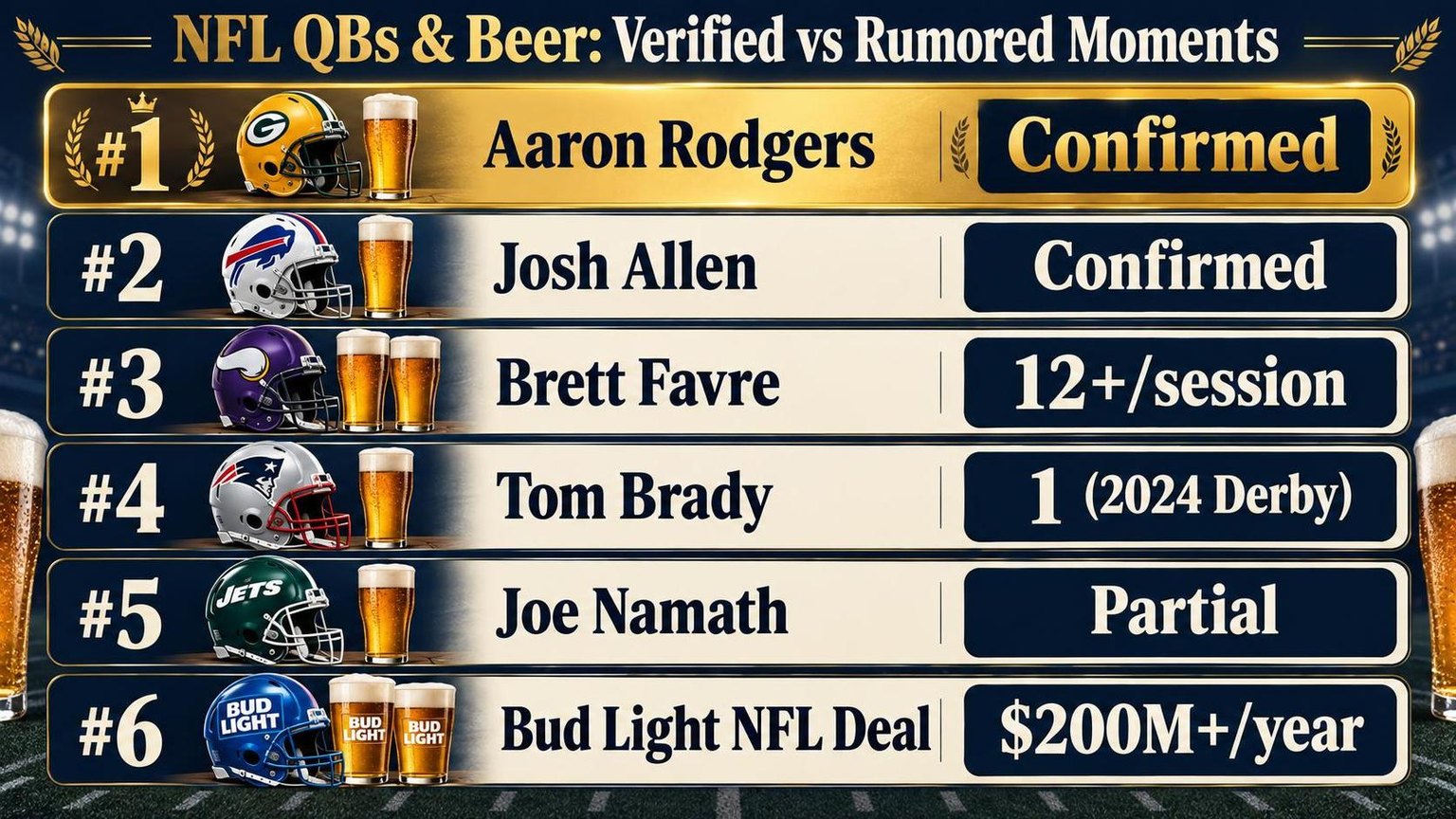
| Quarterback | Claimed Beer Count | Context | Verification Level |
| Aaron Rodgers | Multiple (on camera) | Bucks NBA playoff games | Confirmed — live TV footage |
| Josh Allen | 1 (on camera) | Bills 2023 playoff tailgate | Confirmed — broadcast video |
| Brett Favre | Reportedly 12+ per session | 1990s off-field lifestyle | Partial — Favre admitted alcohol dependency in 1996 |
| Jim McMahon | Reportedly “cases” routinely | 1985 Bears championship era | Anecdotal — teammates’ interviews |
| Kenny Stabler | Legendary but unquantified | 1970s Raiders party culture | Anecdotal — autobiographical accounts |
| Joe Namath | Unspecified heavy drinking | 1960s–70s nightlife reputation | Partial — Namath publicly acknowledged alcoholism |
Brett Favre checked into the Menninger Clinic in Topeka, Kansas, in 1996 after acknowledging Vicodin addiction and heavy alcohol use during his MVP seasons with the Packers.
Joe Namath entered an alcohol treatment program in 2003 after an infamous sideline interview on ESPN during a Jets broadcast in December 2003.
Why These Stories Persist
- Quarterbacks face intense public scrutiny, making off-field behavior newsworthy
- Beer brands actively sponsor NFL broadcasts — Bud Light held exclusive NFL rights through a deal reportedly worth over $200 million annually
- Fan culture equates drinking tolerance with toughness, reinforcing quarterback mythology
- Social media amplifies single incidents into lasting narratives within hours
Most specific “beer count” numbers attached to quarterbacks originate from secondhand teammate stories or radio show anecdotes rather than verified reporting.
The NFL’s own substance abuse policy, revised in 2020 as part of the CBA agreement, focuses on illegal substances. Alcohol consumption remains largely unregulated unless it results in legal incidents like DUI arrests.
Known Beer Stories by Quarterback
NFL quarterbacks have generated memorable beer-related moments throughout league history. These stories range from postgame celebrations to off-field endorsements, each revealing a different side of the position’s culture.
Aaron Rodgers and the Chugging Moments
Aaron Rodgers became a viral sensation by chugging beers at Milwaukee Bucks playoff games. During the 2019 NBA playoffs, Rodgers downed a full beer in seconds on camera at Fiserv Forum, drawing roaring crowd reactions.
Rodgers repeated the act multiple times across the Bucks’ championship run in 2021. Each chug was broadcast nationally, cementing his reputation as the NFL’s most enthusiastic beer-chugging QB.
Tom Brady’s Kentucky Derby Beer
Tom Brady, famous for his strict TB12 diet that largely excluded alcohol, shocked fans by chugging a beer at the 2024 Kentucky Derby. The moment went viral because Brady had spent two decades publicly avoiding alcohol for performance reasons.
Brady also chugged a beer on “The Late Show with Stephen Colbert” in 2021, finishing it faster than the host. He admitted during the Super Bowl LV boat parade that he’d been drinking considerably that day.
Joe Namath and the Party Era
Joe Namath openly embraced nightlife during his Jets career in the 1960s and 1970s. He co-owned the bar “Bachelors III” in Manhattan, which drew NFL scrutiny over its clientele.
Commissioner Pete Rozelle asked Namath to sell his stake in 1969. Namath initially announced his retirement rather than comply, though he eventually sold the bar and returned to football.
Notable Beer-Related QB Moments
| Quarterback | Event | Year |
| Aaron Rodgers | Beer chug at Bucks playoff game | 2019 |
| Tom Brady | Beer chug on Colbert’s show | 2021 |
| Tom Brady | Super Bowl LV boat parade drinking | 2021 |
| Brett Favre | Publicly discussed past alcohol abuse | 1996 |
| Jim McMahon | Known for drinking beer on team flights with the 1985 Bears | 1985 |
| Joe Namath | Owned Bachelors III bar in NYC | 1969 |
Brett Favre’s Public Recovery
Brett Favre entered rehab for alcohol dependence in 1996 after taking Vicodin and drinking heavily. He spoke publicly about his recovery, becoming one of the first star QBs to openly address alcohol issues during an active career.
- Favre won NFL MVP in the 1995 season while privately struggling with substance use
- He checked into the Menninger Clinic in Topeka, Kansas, in May 1996
- Favre went on to win three consecutive MVP awards from 1995 to 1997
Alcohol Rules for Active NFL Players
The NFL’s substance abuse policy governs alcohol use among active players with specific, enforceable rules. Violations carry escalating penalties that can end careers.
These regulations exist within the league’s Personal Conduct Policy and the jointly bargained Substances of Abuse Policy.
Core Policy Framework
The NFL does not ban alcohol consumption outright. Players can drink legally during the offseason and on non-game days during the season. The restrictions target timing, impairment, and conduct consequences.
Under the current Collective Bargaining Agreement (ratified March 2020, running through 2030), alcohol-related arrests trigger automatic entry into the league’s intervention program.
Game-Day and Facility Restrictions
- No alcohol consumption within 24 hours before kickoff — a rule coaches enforce informally but the league monitors through conduct standards.
- Alcohol is prohibited in team facilities, locker rooms, and on team transportation.
- Players cannot appear at the stadium or team functions visibly impaired.
Testing and Monitoring
Players in Stage 1 of the intervention program undergo evaluation but face no automatic discipline. Stage 2 triggers mandatory treatment and potential fines.
Stage 3 carries a minimum 4-game suspension without pay. A player earning the 2024 league minimum of $795,000 would forfeit approximately $186,765 over four games.
| Stage | Trigger | Consequence |
| Stage 1 | First alcohol-related incident or referral | Clinical evaluation, possible monitoring |
| Stage 2 | Second violation or failed compliance | Mandatory treatment, fines up to 3 game checks |
| Stage 3 | Third violation | Minimum 4-game suspension without pay |
| Banishment | Continued violations after Stage 3 | Minimum 1-year ban from the league |
DUI and Legal Consequences
A first-offense DUI typically results in a 3-game suspension under the Personal Conduct Policy. A second DUI can bring a 6-game ban.
Britt Reid, former linebackers coach (not a player but illustrative), was sentenced to 3 years in prison after a 2021 drunk-driving crash.
Between 2000 and 2023, NFL players accumulated over 150 documented DUI arrests according to the USA Today NFL arrest database. Quarterbacks represented roughly 8% of those incidents.
Recent Policy Shifts
The 2020 CBA reduced marijuana penalties significantly but maintained strict alcohol-related conduct rules.
Players are no longer suspended for positive marijuana tests, making alcohol violations comparatively more consequential in disciplinary terms.
Why Quarterback Tolerance Varies Widely
Alcohol tolerance among NFL quarterbacks depends on measurable physiological factors, not willpower or “toughness.” Body weight, composition, genetics, and drinking history create vastly different responses to the same number of beers.
Body weight is the single largest variable. A 240-pound quarterback metabolizes alcohol differently than a 210-pound starter at the same position.
| Quarterback Size Category | Example Weight | Estimated BAC After 4 Beers (1 hour) |
| Large-frame QB | 245 lbs (Josh Allen) | ~0.056% |
| Average-frame QB | 220 lbs (Patrick Mahomes) | ~0.066% |
| Lean-frame QB | 195 lbs (Kyler Murray) | ~0.078% |
These estimates use the Widmark formula, which calculates BAC based on weight, sex, alcohol consumed, and time elapsed. A 50-pound weight difference shifts BAC by roughly 0.02% per drink.
Body Composition Matters More Than Scale Weight
Muscle tissue contains approximately 75% water, while fat tissue holds only about 10%. Quarterbacks carrying higher lean mass distribute alcohol across more water volume, lowering peak BAC.
An NFL quarterback at 10% body fat absorbs alcohol more efficiently than someone at 20% body fat, even at identical scale weights. This gives heavily muscled players a measurable tolerance advantage.
Genetic Enzyme Differences
The liver enzyme alcohol dehydrogenase (ADH) breaks down ethanol at a fixed rate of roughly 0.015–0.017% BAC per hour for most adults. Genetic variants alter this rate significantly.
- ADH1B*2 variant: Metabolizes alcohol up to 100 times faster than the standard ADH1B*1 form, found in approximately 90% of East Asian populations but only 5–10% of European-descent individuals
- ALDH2*2 variant: Causes acetaldehyde buildup, producing facial flushing and nausea — effectively reducing tolerance regardless of body size
- CYP2E1 enzyme activity: Increases with chronic drinking, allowing habitual drinkers to process alcohol 50–70% faster than non-drinkers
Training and Hydration Status
NFL quarterbacks in active training maintain hydration levels well above average.
Higher total body water — roughly 60–65% in conditioned athletes versus 50–55% in sedentary adults — dilutes alcohol concentration in the bloodstream.
Conversely, post-game dehydration after losing 2–5% body weight through sweat concentrates alcohol’s effects. A quarterback drinking immediately after a game reaches higher BAC faster than when fully hydrated.
Calories and ABV in Game Day Beer
Game day beer choices range from 95-calorie light lagers to 300+ calorie craft IPAs. Understanding the calorie and alcohol content of popular stadium and tailgate beers puts quarterback drinking stories into measurable perspective.
Most NFL stadiums pour mainstream domestic brands. These beers dominate American sports consumption for good reason: they’re light, sessionable, and relatively low in calories compared to craft alternatives.
| Beer | ABV (%) | Calories (12 oz) | Carbs (g) |
| Bud Light | 4.2 | 110 | 6.6 |
| Miller Lite | 4.2 | 96 | 3.2 |
| Coors Light | 4.2 | 102 | 5.0 |
| Michelob Ultra | 4.2 | 95 | 2.6 |
| Budweiser | 5.0 | 145 | 10.6 |
| Stella Artois | 5.0 | 150 | 12.8 |
| Sierra Nevada Pale Ale | 5.6 | 175 | 14.1 |
| Lagunitas IPA | 6.2 | 180 | 15.0 |
| Voodoo Ranger IPA | 7.0 | 201 | 16.0 |
A quarterback drinking 12 Bud Lights consumes roughly 1,320 calories and 6.0 standard alcohol units. That same count in a 7% IPA delivers over 2,400 calories and nearly double the alcohol.
Why ABV Matters More Than Count
Saying a quarterback “had 10 beers” means little without knowing the ABV. Ten Michelob Ultras at 4.2% contain far less total alcohol than six Voodoo Ranger IPAs at 7.0%.
The math is straightforward. A standard U.S. drink equals 14 grams of pure alcohol—roughly one 12-oz beer at 5% ABV. Higher-ABV beers compress more alcohol into fewer cans.
- 12 beers at 4.2% ABV = approximately 10.1 standard drinks
- 12 beers at 5.0% ABV = approximately 12.0 standard drinks
- 12 beers at 7.0% ABV = approximately 16.8 standard drinks
Stadium Pour Sizes Add Complexity
NFL stadium beers are typically served in 16-oz, 20-oz, or 24-oz cups—not standard 12-oz portions. A single 24-oz stadium pour of a 5% beer equals two full standard drinks.
When former quarterbacks like Brett Favre or Jim McMahon recalled drinking large quantities, the likely beers were mainstream domestics in the 4.2–5.0% range.
That distinction matters for interpreting caloric load and intoxication level accurately.
Responsible Drinking Lessons from NFL Examples
NFL quarterback celebrations show how quickly alcohol can shift attention from achievement to impaired judgment. Viral clips are entertainment, not evidence that elite athletes tolerate alcohol safely.
Body size, fitness, and professional status do not prevent intoxication.
Public moments still carry consequences
After Tampa Bay’s Super Bowl LV boat parade, Tom Brady was filmed walking unsteadily and later joked on social media that tequila was involved.
The episode became a larger story than the celebration itself, illustrating how phones and social platforms preserve intoxicated behavior.
Patrick Mahomes and other quarterbacks have appeared in beer advertising or championship celebrations. Those appearances are commercial or ceremonial; they do not establish a safe personal intake.
A responsible viewer separates brand imagery from medical guidance and never treats an athlete’s apparent tolerance as a target.
Measure alcohol, not containers
The National Institute on Alcohol Abuse and Alcoholism defines a U.S. standard drink as approximately the same amount of pure alcohol across these servings:
| Beverage | Typical serving | Alcohol concentration |
| Regular beer | 12 fluid ounces | 5% alcohol by volume |
| Malt liquor | 8–9 fluid ounces | 7% alcohol by volume |
| Table wine | 5 fluid ounces | 12% alcohol by volume |
| Distilled spirits | 1.5 fluid ounces | 40% alcohol by volume |
A tall stadium beer or strong craft beer may contain multiple standard drinks. Count ounces and alcohol by volume rather than cups, cans, or rounds.
Drinking games, rapid shots, and celebratory chugging make intake harder to track and raise impairment risk.
Use limits as ceilings, not goals
The Dietary Guidelines for Americans state that adults of legal drinking age may choose not to drink. When alcohol is consumed, the stated daily limits are:
| Adult group | Maximum on a drinking day |
| Men | 2 drinks or fewer |
| Women | 1 drink or fewer |
These limits do not guarantee safety and are not weekly allowances to save for game day. Pregnancy, certain medications, liver disease, alcohol-use disorder recovery, and driving are reasons to avoid alcohol entirely.
Build the plan before kickoff
- Choose a sober driver or arrange a ride before drinking begins.
- Eat beforehand, alternate alcohol with water, and decline pressure to match another person’s pace.
- Do not rely on coffee, cold showers, exercise, or sleep to “sober up”; only time reduces blood alcohol concentration.
- Call emergency services if someone cannot wake, vomits repeatedly, has seizures, or breathes slowly or irregularly.
The useful NFL lesson is not how many beers a quarterback can drink. It is that visible success does not cancel alcohol’s risks, and preparation matters more than perceived tolerance.
Frequently Asked Questions
How Many Beers Can NFL Quarterbacks Drink? The Surprising Intersection of Beer and Football
NFL quarterbacks operate under strict physical demands—throwing a football 60+ yards, reading defenses in under 3 seconds, and maintaining peak conditioning across an 18-week regular season.
Yet beer culture and quarterback lore are deeply intertwined, from postgame celebrations to offseason viral moments.
The relationship between America’s most scrutinized athletes and America’s most popular alcoholic beverage reveals fascinating details about nutrition, tradition, and the realities of elite performance.
Beer, Body Composition, and Quarterback Performance
An NFL quarterback burns roughly 3,000–4,500 calories on game day depending on playing time and intensity.
A standard 12-oz beer contains approximately 150 calories and 13 grams of carbohydrates, while light beers average around 100 calories and 5–6 grams of carbs.
For a 225-pound quarterback maintaining 12–15% body fat during the season, alcohol intake directly impacts recovery, sleep architecture, and reaction time—all non-negotiable elements of the position.
Alcohol suppresses protein synthesis by up to 24% when consumed post-exercise, according to research published in PLOS ONE (2014). It also reduces REM sleep quality, which is critical for cognitive function.
Given that quarterback decision-making operates in windows of 2.5–3.0 seconds per play, even marginal cognitive impairment carries measurable consequences on the field.
Famous NFL Quarterbacks and Their Beer Stories
Several high-profile quarterbacks have become synonymous with beer culture. Aaron Rodgers was famously filmed chugging beers at Milwaukee Bucks playoff games, finishing full cups in seconds to roaring crowd approval.
During the Green Bay Packers’ 2010 Super Bowl XLV victory celebration, beer was a central feature of the locker room footage.
Jim McMahon, the Chicago Bears’ 1985 Super Bowl-winning quarterback, was openly known for his beer consumption throughout his career.
McMahon reportedly drank beer before, during, and after games and still managed to lead one of the most dominant teams in NFL history to a 15–1 record and a 46–10 Super Bowl victory.
Tom Brady, by contrast, has stated he did not drink beer or any alcohol for extended stretches during his 23-year career.
His TB12 method emphasized hydration with electrolyte-infused water and anti-inflammatory nutrition, contributing to his ability to play at an elite level until age 45—the oldest starting quarterback in NFL history.
How many beers do NFL quarterbacks typically drink during the season?
Most active NFL quarterbacks significantly limit or eliminate alcohol during the regular season.
Team nutritionists generally recommend no more than 1–2 drinks per week during the competitive period, and many quarterbacks—following the model popularized by Tom Brady—abstain entirely from September through January.
The 48-hour recovery window between intense training sessions leaves little room for alcohol’s dehydrating and sleep-disrupting effects.
Which NFL quarterback is most famous for drinking beer?
Jim McMahon of the 1985 Chicago Bears holds the most notorious reputation, openly admitting to drinking beer on game days throughout his career.
In the modern era, Aaron Rodgers gained viral attention for chugging beers at Milwaukee Bucks games, finishing full pints in roughly 3–4 seconds.
Both quarterbacks won Super Bowls, fueling the popular myth that beer consumption and elite performance aren’t mutually exclusive.
Does drinking beer hurt a quarterback’s throwing accuracy?
Alcohol impairs fine motor skills and hand-eye coordination at blood alcohol concentrations as low as 0.02%, well below the legal driving limit of 0.08%.
For an NFL quarterback who must place a ball within a 2-foot window at 20+ yards while processing defensive alignments, even minimal impairment degrades performance.
A 2018 study in the Journal of Sports Sciences confirmed that next-day athletic performance declines measurably after consuming more than 3–4 standard drinks the prior evening.
How many beers can a 225-pound NFL quarterback drink before being legally impaired?
A 225-pound male typically reaches 0.08% BAC after approximately 4–5 standard 12-oz beers consumed within two hours, based on Widmark formula calculations.
However, functional impairment for athletic tasks begins much earlier—around 2–3 beers, or roughly 0.03–0.05% BAC.
NFL teams conduct no routine alcohol testing, but the league’s personal conduct policy addresses alcohol-related incidents off the field.
Do NFL teams have rules about quarterbacks drinking beer?
The NFL’s collective bargaining agreement does not prohibit alcohol consumption, and teams rarely impose explicit drinking bans.
However, most franchises enforce informal curfew policies—typically 11 PM on nights before games and mandatory team activities. Violating these curfews carries fines that can reach $50,000 or more for repeat offenders.
Individual coaches set additional expectations; Bill Belichick’s New England Patriots were known for a culture that strongly discouraged any behavior compromising preparation.
Did any NFL quarterback ever drink beer during a game?
Jim McMahon has claimed in multiple interviews that he drank beer during games in the 1980s, and teammate accounts from the 1985 Bears corroborate these stories.
Bobby Layne, the Detroit Lions Hall of Fame quarterback from the 1950s, was legendarily reported to drink the night before—and occasionally the morning of—games.
Modern NFL sideline protocols and media scrutiny make in-game alcohol consumption virtually impossible today, with every moment captured on camera.
How does beer consumption affect an NFL quarterback’s recovery time?
Alcohol delays muscle recovery by inhibiting glycogen resynthesis and reducing human growth hormone secretion by up to 70% during sleep, according to research in the Journal of Clinical Endocrinology & Metabolism.
For quarterbacks who absorb 15–25 hits per game and rely on rapid tissue repair between Sunday contests, even moderate drinking (3+ beers) extends inflammation duration by 24–48 hours.
This is why most modern quarterback nutrition plans treat the Tuesday–Saturday window as an alcohol-free recovery period.
What beer brands sponsor NFL quarterbacks?
Active NFL players are prohibited from appearing in alcohol advertisements under the league’s personal conduct and marketing policies.
However, retired quarterbacks have endorsed beer brands—Peyton Manning became closely associated with Budweiser after shouting “I’m gonna drink a lot of Budweiser” on live television following Super Bowl 50 in February 2016.
Manning later disclosed he held a financial stake in two Anheuser-Busch distributorships in the Louisiana market, making the moment both personal and commercial.
How many calories are in the beers NFL quarterbacks reportedly prefer?
Quarterbacks who do drink tend to favor lighter options to minimize caloric impact. Michelob Ultra, a common choice among NFL athletes, contains just 95 calories and 2.6 grams of carbs per 12-oz serving.
By comparison, a craft IPA—popular in NFL cities like Denver, Seattle, and Green Bay—averages 200–300 calories per pint.
For a quarterback maintaining a strict 3,500-calorie daily intake during the season, two IPAs would represent 12–17% of the entire daily calorie budget with zero nutritional benefit for performance.
Further Reading
- What Is 180 Degree Celsius In Fahrenheit? Most Correct Answer
- How Often Should Ice Machines Be Cleaned?
- Buffalo Trace Single Barrel Select – What You Need to Know
- What To Mix With Malibu Rum?
- How Many Cups Is 16 Ounces?
- How Much Is 8 Grams Of 10K Gold Worth?
- How Many Oz Are In Liter?
- All Blog Guides
- National Institute on Alcohol Abuse and Alcoholism – Alcohol Facts and Statistics (2023)
- CDC – Dietary Guidelines for Alcohol (2022)
- USDA Dietary Guidelines for Americans 2020–2025 (2020)
- NCAA – Alcohol and Athletic Performance (2023)
- PubMed – Alcohol Intake and Athletic Performance (Barnes, 2014)
- Harvard T.H. Chan School of Public Health – Alcohol: Balancing Risks and Benefits (2023)
- NFL Player Health & Safety – Substance Abuse Policy (2023)
- ESPN – NFL Players and Alcohol Culture (2019)
- Sports Illustrated – Quarterback Training and Lifestyle Regimens (2022)
- PubMed – Effect of Alcohol on Sports Performance and Recovery (Vella & Cameron-Smith, 2010)