How Long Can Whiskey Last Opened? is 1–2 years for best flavor when the bottle is stored upright, tightly sealed, and kept away from heat and sunlight.
Whiskey does not spoil like milk because its high alcohol content resists microbial growth. Quality changes come from oxygen exposure, evaporation, and light damage.
A nearly full bottle can taste stable for years. A bottle below one-third full fades faster because more air sits above the liquid.
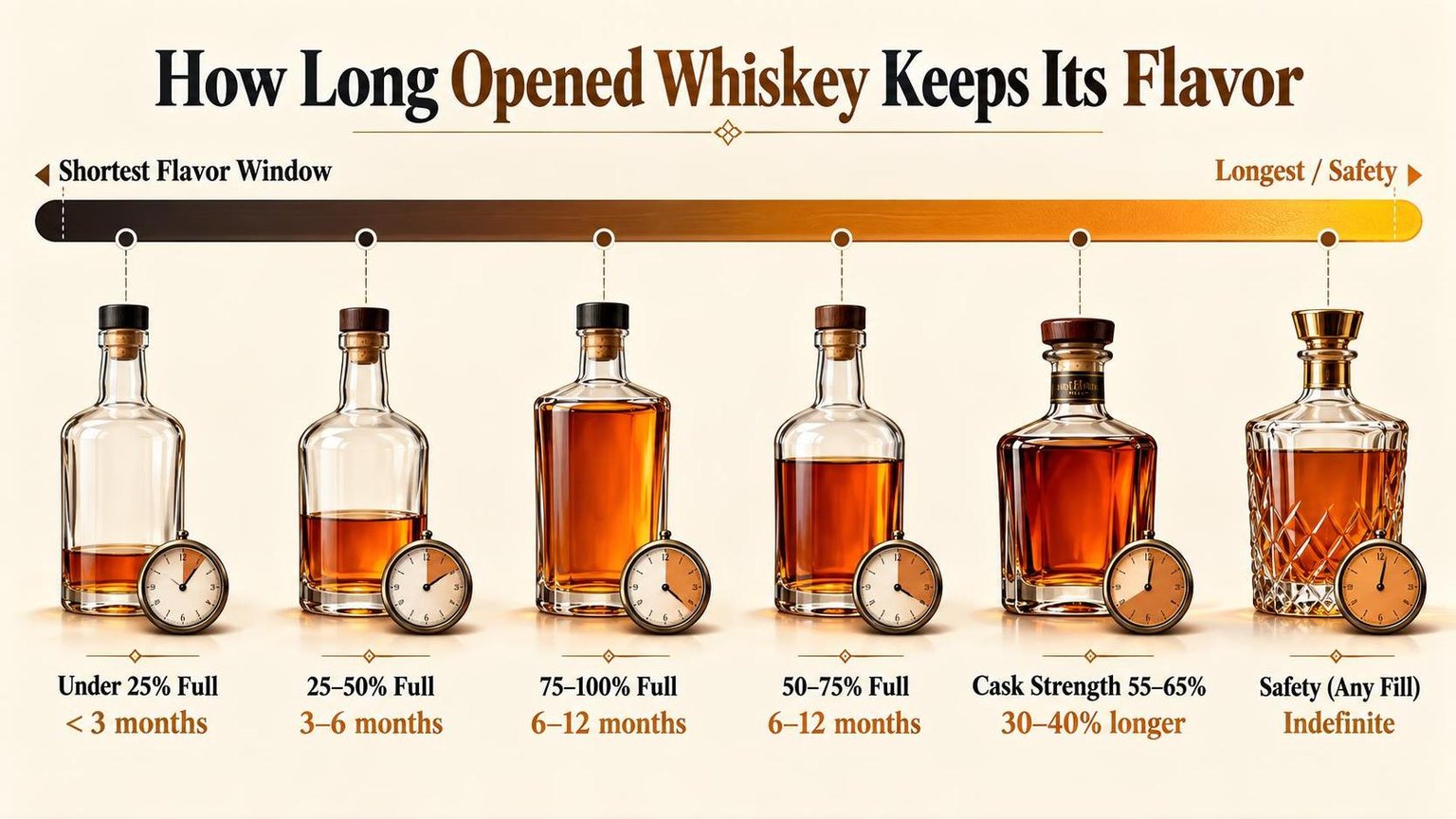
Opened Whiskey Shelf Life Timeline
Once the seal breaks, oxidation begins reshaping whiskey’s flavor profile. The rate of deterioration depends primarily on how much liquid remains in the bottle, because a larger headspace-to-liquid ratio accelerates oxidation exponentially.
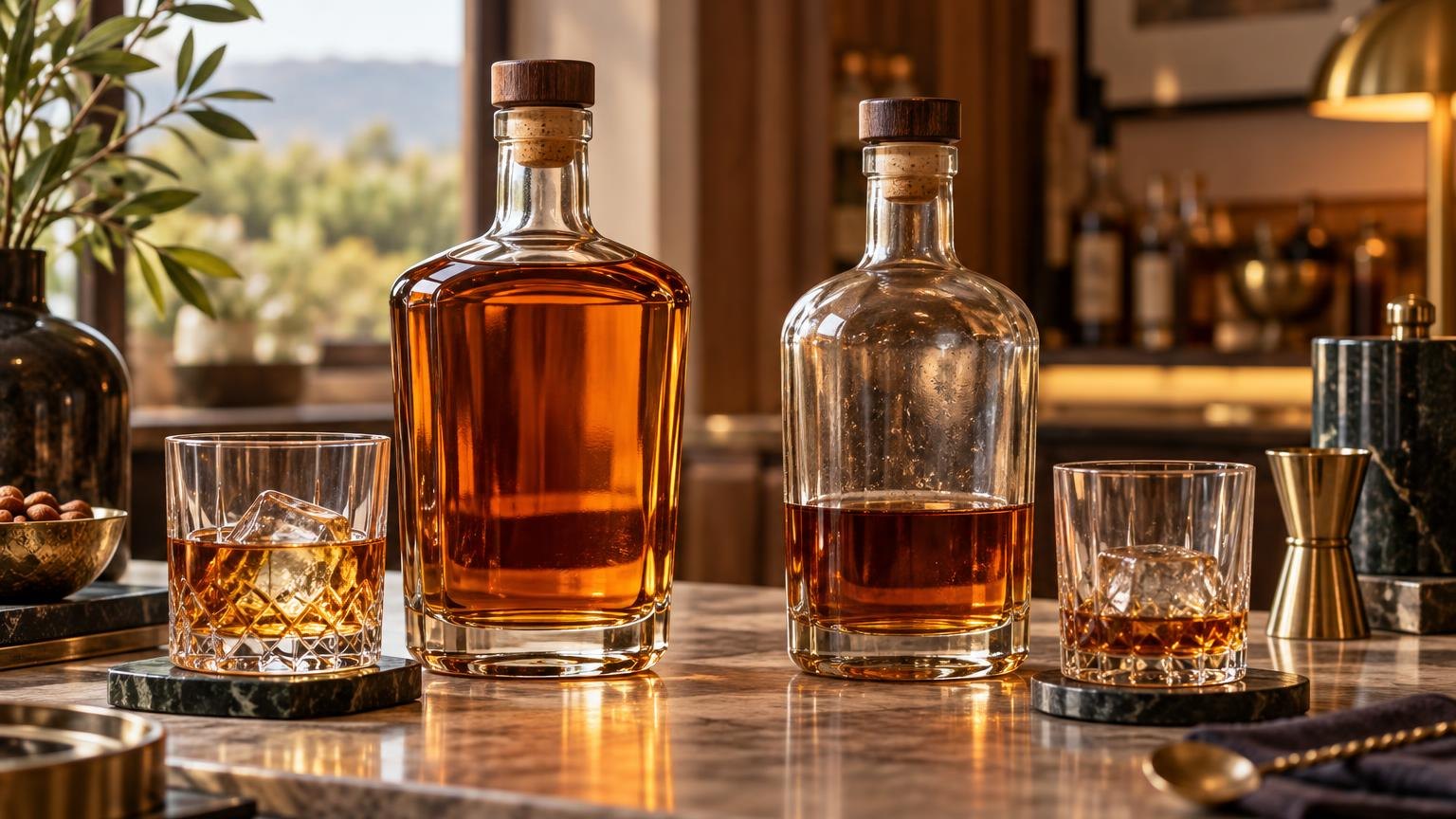
The timeline below reflects standard storage conditions: upright bottle, room temperature (15–20°C), away from direct sunlight.
| Time After Opening | Bottle Fill Level | Expected Quality |
| 0–3 months | 75–100% | Virtually identical to freshly opened; negligible oxidation detectable |
| 3–6 months | 75–100% | Subtle softening of sharp notes; most drinkers notice no decline |
| 6–12 months | 50–75% | Mild flavor flattening; high-proof whiskeys (above 46% ABV) remain stable longer |
| 12–18 months | 25–50% | Noticeable muting of top notes; oxidation-driven sweetness may emerge |
| 18–24 months | Under 25% | Significant flavor degradation; volatile aromatics largely dissipated |
| Beyond 24 months | Under 25% | Stale, flat profile; drinkable but quality markedly diminished |
The Critical Factor: Headspace Ratio
A bottle that is 25% full contains roughly 75% air. That air holds oxygen molecules that react with congeners—the flavor compounds created during distillation and barrel aging.
Whiskey chemist Dr. Bill Lumsden of Glenmorangie has noted that a quarter-full bottle deteriorates approximately 3–4 times faster than a three-quarters-full one.
ABV Matters
Higher-proof whiskeys resist oxidation more effectively. Cask-strength expressions bottled at 55–65% ABV maintain integrity roughly 30–40% longer than standard 40% ABV bottlings under identical conditions.
The alcohol itself acts as a preservative. Below 40% ABV—the legal minimum in most markets—degradation accelerates noticeably within weeks of opening.
Practical Benchmarks From Distillers
- Maker’s Mark recommends consuming opened bottles within 1–2 years for optimal flavor.
- Glenfiddich advises finishing an opened bottle within 6 months once it drops below half full.
- Buffalo Trace states that properly stored opened whiskey remains safe to drink indefinitely but acknowledges quality decline after 1 year.
Safety vs. Quality Distinction
Opened whiskey does not spoil in the way perishable food does. The 40%+ ABV environment prevents bacterial or mold growth, making it safe to consume years after opening.
The timeline above addresses flavor quality, not safety. A 5-year-old opened bottle won’t make you sick—it will simply taste flat and muted compared to its original profile.
For bottles below the one-third mark, transferring whiskey into a smaller glass container minimizes headspace and can extend quality by 3–6 additional months.
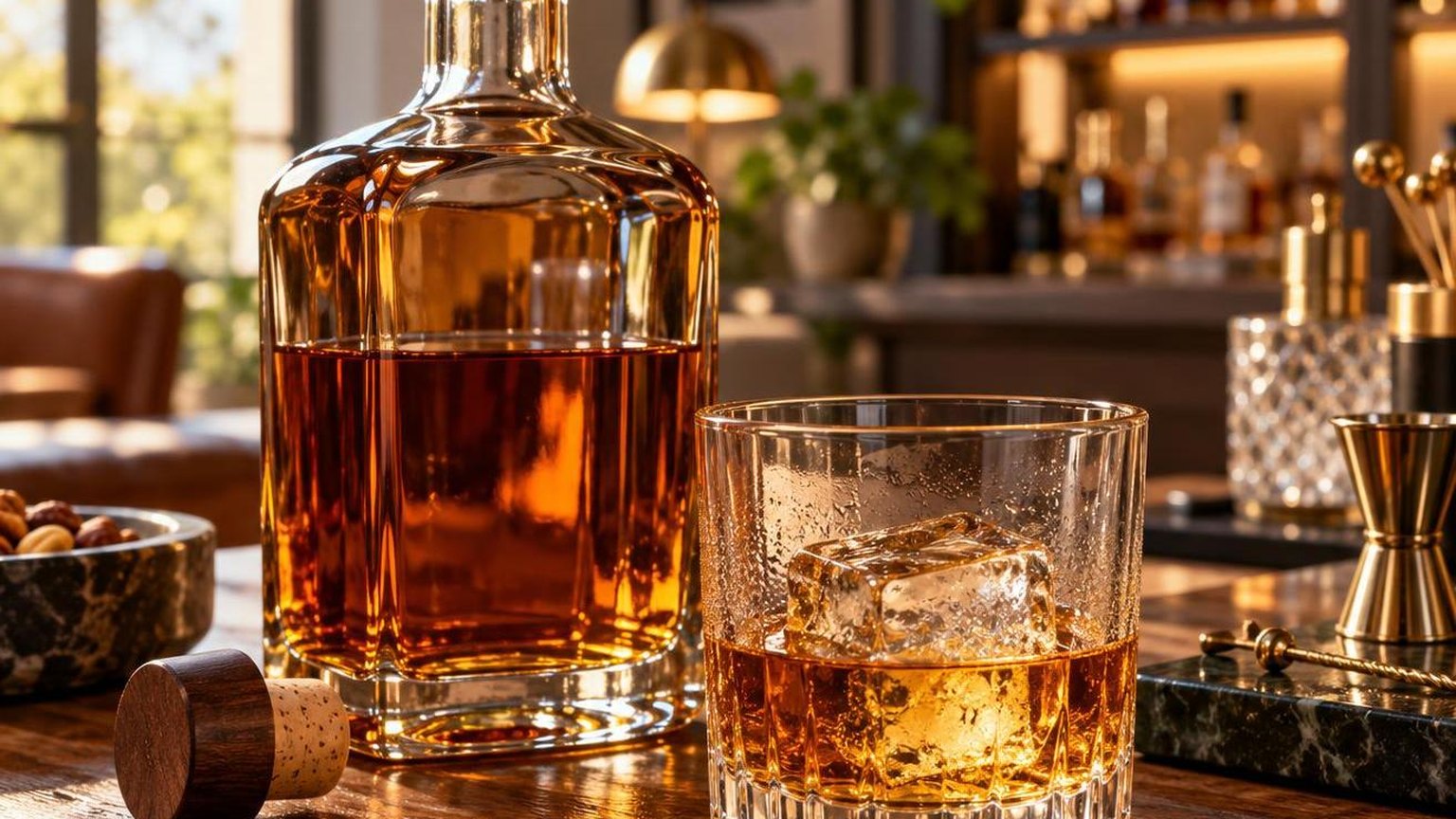
Why Whiskey Changes After Opening
Whiskey is chemically stable in a sealed bottle for decades. The moment you break that seal, oxygen begins a slow but measurable transformation of the liquid’s flavor profile, aroma compounds, and color intensity.
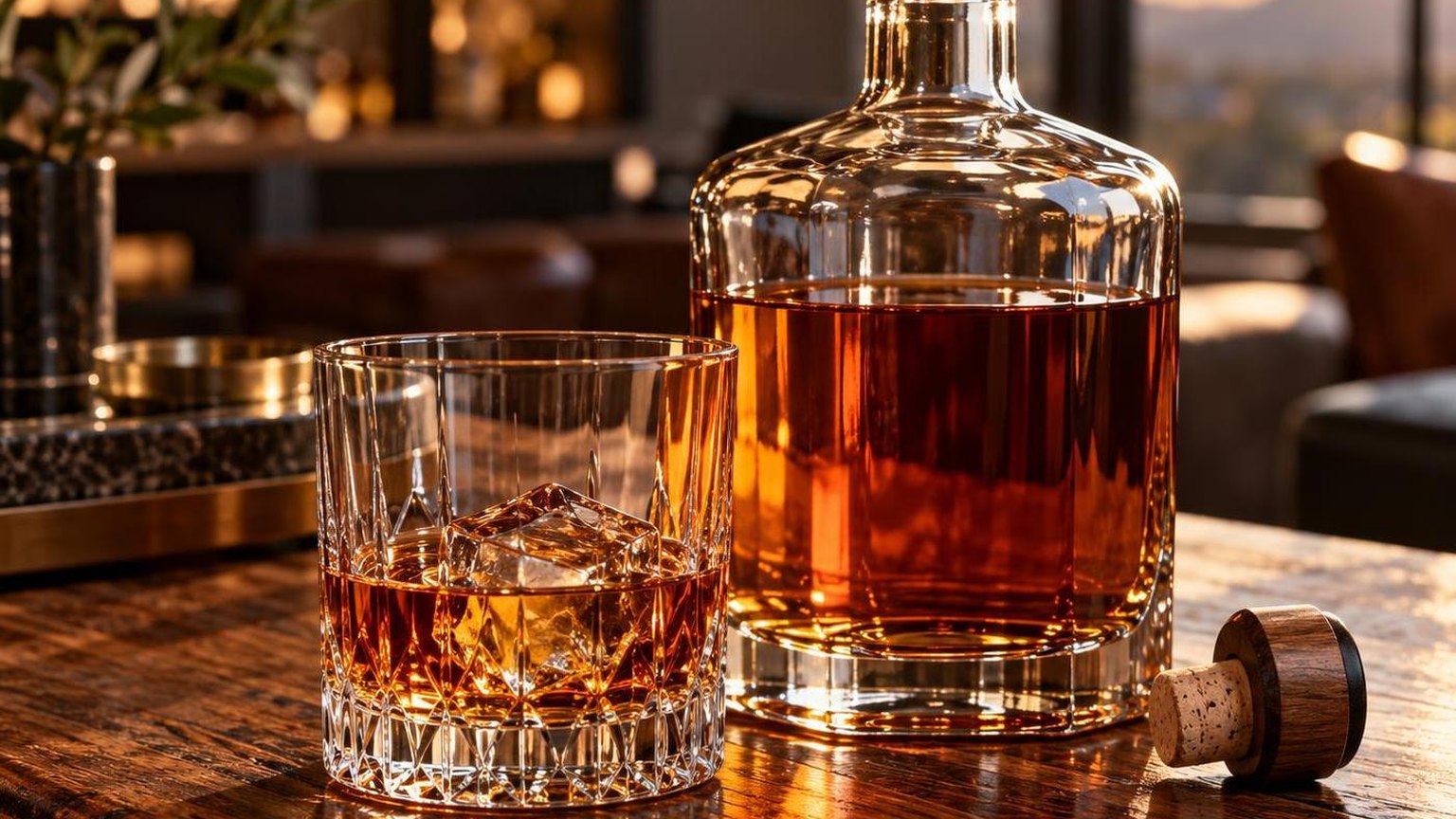
Oxidation: The Primary Driver
Oxygen reacts with congeners—flavor compounds like esters, aldehydes, and phenols produced during fermentation and maturation. These reactions alter taste at the molecular level.
Ethanol oxidizes first into acetaldehyde, then into acetic acid. At low concentrations (below 100 mg/L), acetaldehyde adds fruity notes. Above that threshold, it produces sharp, solvent-like off-flavors.
Phenolic compounds in peated Scotch are particularly vulnerable. Guaiacol and 4-methylguaiacol, responsible for smoky character, degrade measurably within 6–12 months of opening.
Volatile compounds evaporate at different rates depending on their molecular weight. Lighter aromatic esters escape faster than heavier compounds like vanillin or lactones.
| Compound | Boiling Point | Effect When Lost |
| Ethyl acetate | 77°C (171°F) | Reduced fruitiness |
| Isoamyl acetate | 142°C (288°F) | Diminished banana/pear notes |
| Vanillin | 285°C (545°F) | Less vanilla sweetness (slow loss) |
| Guaiacol | 205°C (401°F) | Weakened smokiness |
Lower-boiling-point compounds vanish first, which is why an opened bottle gradually loses its top notes while retaining deeper, woody flavors longer.
Headspace: The Critical Variable
The air-to-liquid ratio inside your bottle directly determines oxidation speed. A bottle that is three-quarters full has roughly 25% headspace. A bottle one-quarter full has approximately 75% headspace—tripling oxygen exposure.
| Fill Level | Approximate Headspace | Estimated Flavor Stability |
| 75–100% full | 0–25% | 12–24 months |
| 50–75% full | 25–50% | 6–12 months |
| 25–50% full | 50–75% | 3–6 months |
| Below 25% full | 75%+ | 1–3 months |
Other Contributing Factors
- Light exposure: UV radiation between 300–400 nm wavelength breaks down terpenes and sulfur compounds, producing stale or “skunky” off-notes in as little as a few weeks of direct sunlight.
- Temperature fluctuation: Repeated heating and cooling cycles cause the liquid to expand and contract, drawing in fresh air past the cork or cap seal and accelerating oxidation.
- ABV level: Higher-proof whiskeys (above 50% ABV) resist microbial spoilage entirely but still oxidize. Their elevated ethanol content can actually slow certain oxidation pathways compared to 40% ABV bottlings.
None of these changes make whiskey unsafe to drink. They alter flavor, not safety. Understanding the chemistry helps you control how quickly your opened bottle evolves—and when to finish it.
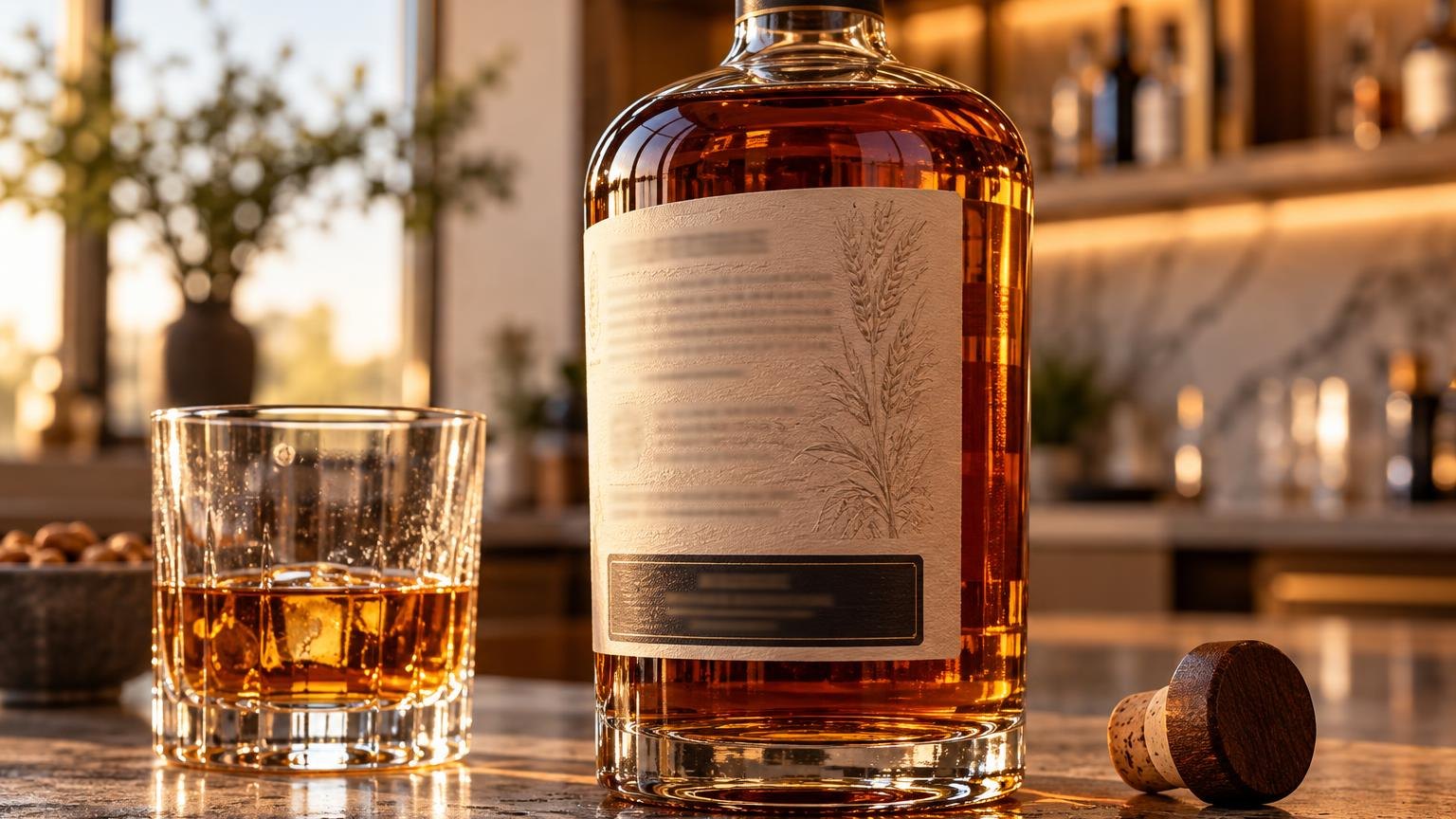
Fill Level and Oxidation Risk
The amount of air trapped inside an opened whiskey bottle directly determines how fast oxidation degrades the spirit.
As you pour and the liquid level drops, the ratio of oxygen to whiskey increases, accelerating chemical changes that flatten flavor and diminish aroma.
Oxygen interacts with congeners—esters, aldehydes, and phenolic compounds—that define a whiskey’s character. At higher fill levels, limited headspace means slower oxidation.
Below the halfway mark, degradation accelerates noticeably.
| Fill Level | Approximate Headspace | Estimated Shelf Life (Opened) | Oxidation Risk |
| Full (just opened) | ~5% | 1–2 years | Low |
| Three-quarters full | ~25% | 8–12 months | Low to moderate |
| Half full | ~50% | 4–6 months | Moderate |
| One-quarter full | ~75% | 1–3 months | High |
| Near empty (last 1–2 oz) | ~90%+ | 2–4 weeks | Very high |
These timelines assume storage at room temperature (60–70 °F / 15–21 °C) with the bottle sealed between pours. Higher temperatures and frequent opening shorten them further.
Why the Last Quarter Matters Most
Once a 750 ml bottle drops below roughly 185 ml, the oxygen-to-liquid ratio tips sharply. Each time you uncork or unscrew the cap, fresh oxygen floods the headspace, replacing the partially depleted air inside.
Peated Scotch whiskies and high-ester bourbons are especially vulnerable. Their complex volatile compounds break down faster, causing smoky notes to turn flat and fruity esters to become muted or cardboard-like.
Strategies to Minimize Oxidation
- Decant into smaller bottles. Transfer remaining whiskey into 200 ml or 375 ml glass bottles to reduce headspace to under 10%.
- Use inert gas sprays. Products like Private Preserve (a blend of nitrogen, carbon dioxide, and argon) displace oxygen in the headspace. A 2-second spray creates a protective blanket lasting days.
- Keep bottles upright. Unlike wine, whiskey’s 40%+ ABV can degrade natural cork, potentially introducing off-flavors and compromising the seal.
- Seal tightly after every pour. Parafilm wrapped around the closure adds a secondary barrier against air exchange.
- Finish low bottles promptly. When a bottle reaches the one-quarter mark, plan to drink it within 1–3 months or consolidate it.
Whiskey at 40% ABV oxidizes more readily than cask-strength expressions at 50–65% ABV. Higher alcohol content acts as a partial buffer, slowing the chemical reactions that degrade flavor compounds.
Monitoring fill level is the single most practical way to predict how much life remains in an opened bottle. No amount of premium cork or careful storage can overcome the physics of a 90% empty bottle exposed to oxygen repeatedly over months.
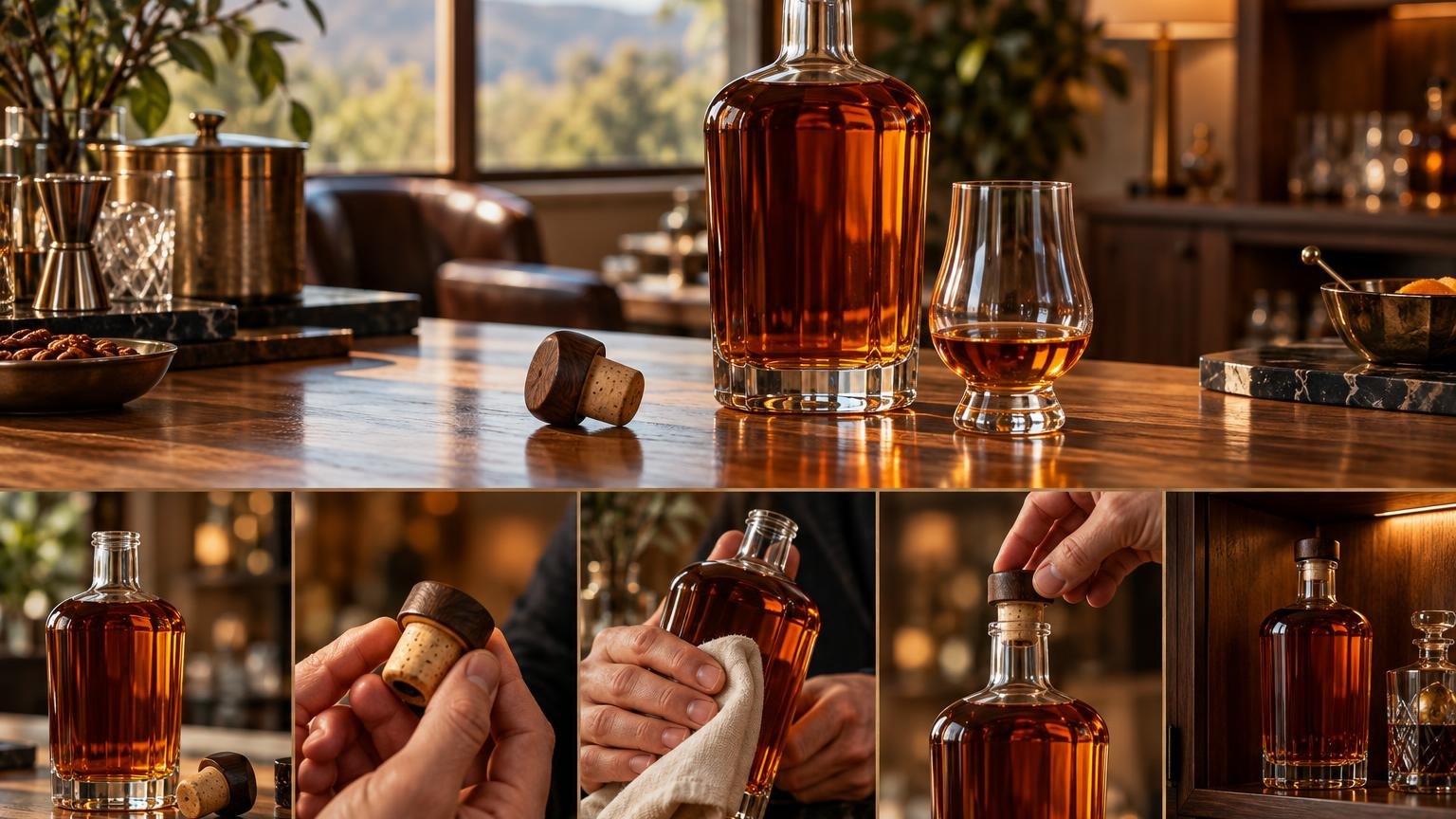
Best Storage for Opened Bottles
Proper storage directly determines whether an opened bottle of whiskey retains its character for months or deteriorates within weeks. Temperature stability, light exposure, and bottle orientation are the three controllable variables that matter most.
Temperature Control
Store opened whiskey between 15–20°C (59–68°F). Consistent temperature matters more than hitting an exact number. Fluctuations cause the liquid to expand and contract, accelerating oxidation by pulling air past the seal repeatedly.
Avoid locations near ovens, dishwashers, or windows that receive direct afternoon sun. A kitchen pantry or interior closet maintains the most stable ambient temperature in most homes.
Light Exposure
Ultraviolet light degrades whiskey’s phenolic compounds and esters, dulling flavor and fading color.
A 2017 Scotch Whisky Research Institute study confirmed measurable chemical changes in whiskey exposed to UV light within 10 days of continuous exposure.
Dark-colored glass offers partial protection, but no standard whiskey bottle blocks UV entirely. Store bottles in closed cabinets or boxes whenever possible.
Bottle Orientation
Always store whiskey upright. Unlike wine, whiskey’s 40–68% ABV will degrade natural cork over time, introducing off-flavors and compromising the seal. Prolonged horizontal storage can dissolve cork material within 2–3 months.
Seal Quality Comparison
The type of closure affects how quickly oxygen enters after opening. Performance varies significantly across seal types.
| Seal Type | Oxygen Ingress Rate | Effective Lifespan After Opening |
| Original cork (natural) | Moderate | 6–8 months |
| Original screw cap | Low | 10–12 months |
| Parafilm wrap over cork | Very low | 12–18 months |
| Wine preservation gas (argon) | Negligible | 18–24 months |
| Transferred to smaller glass bottle | Low (reduced headspace) | 12+ months |
Reducing Headspace
Oxidation rate increases as the bottle empties because more air contacts the whiskey’s surface. Once a bottle drops below one-third full, degradation accelerates noticeably—often within 1–2 months at that fill level.
Transfer remaining whiskey into a smaller glass bottle to minimize headspace. Use 200 mL or 375 mL Boston round bottles with polycone caps for the tightest seal. Avoid plastic containers; ethanol leaches compounds from most plastics.
Additional Protective Steps
- Wrap natural corks with a single layer of Parafilm M to reduce oxygen exchange by up to 90%.
- Keep bottles away from strong odors—cork closures are semi-permeable and can absorb ambient scents over weeks.
- Label transferred bottles with the whiskey name, original ABV, and date of transfer for accurate tracking.
- Never store opened whiskey in a freezer; temperatures below −10°C mute volatile aromatic compounds and can cause cloudiness from fatty acid precipitation.
These steps collectively extend an opened bottle’s prime drinking window from a few months to well over a year, preserving the distiller’s intended flavor profile.
When Opened Whiskey Goes Bad
Opened whiskey doesn’t spoil like milk or meat—it won’t harbor dangerous bacteria.
Instead, it degrades through oxidation and evaporation, gradually losing flavor complexity, aroma intensity, and character until it becomes a flat, unremarkable spirit.
The Oxidation Timeline
Once you break the seal, oxygen begins reacting with volatile flavor compounds called esters, aldehydes, and phenols. These compounds define whiskey’s distinctive taste profile.
The rate of degradation depends primarily on how much liquid remains in the bottle. More headspace means more oxygen contact, which accelerates chemical breakdown.
| Bottle Fill Level | Estimated Shelf Life After Opening | Noticeable Flavor Loss |
| 75–100% full | Up to 2 years | Minimal within 12 months |
| 50–75% full | 12–18 months | Detectable after 6 months |
| 25–50% full | 6–12 months | Significant within 3–4 months |
| Below 25% full | 3–6 months | Rapid, within weeks |
Signs Your Whiskey Has Turned
Whiskey rarely becomes unsafe, but it can become unpleasant. Watch for these specific indicators of degradation:
- Faded nose: A bourbon that once delivered rich vanilla and caramel aromas smells flat, thin, or faintly chemical.
- Shortened finish: The characteristic lingering warmth disappears, replaced by a brief, hollow sensation.
- Muted palate: Complex layers—smoke, fruit, spice—collapse into a one-dimensional sweetness or harsh alcohol burn.
- Off-colors: Noticeable lightening of color indicates that phenolic compounds have broken down.
- Stale or cardboard-like taste: Acetaldehyde buildup from prolonged oxidation produces a papery, musty quality.
Factors That Accelerate Spoilage
Temperature swings above 25°C (77°F) speed up oxidation reactions measurably. A whiskey stored at 30°C degrades roughly twice as fast as one kept at 15°C, according to spirits industry research.
Direct sunlight breaks down terpenes and phenols through UV photodegradation. Even 2–3 hours of daily sun exposure through a window can damage whiskey within a few months.
A compromised cork or loose screw cap allows both extra oxygen ingress and ethanol evaporation—the “angel’s share” effect.
Corks dry out when bottles are stored upright long-term, but whiskey’s high ABV (40%+ alcohol) can degrade cork if stored on its side.
Can Bad Whiskey Make You Sick?
No. Whiskey’s 40–68% ABV creates an inhospitable environment for pathogens. The ethanol concentration far exceeds the roughly 15% threshold needed to inhibit bacterial and fungal growth.
Degraded whiskey is a quality issue, not a safety hazard. You’ll taste the decline long before any health concern arises. If the flavor disappoints, use it in cocktails—mixers mask oxidation’s effects effectively.
Frequently Asked Questions
How long does an opened bottle of whiskey stay good at room temperature?
An opened bottle of whiskey remains at peak quality for 1–2 years when stored upright in a cool, dark place at 15–20°C (59–68°F).
After that window, oxidation gradually dulls the aroma and flavor, though the spirit remains safe to drink indefinitely due to its 40%+ ABV preventing microbial growth.
Does the amount of whiskey left in the bottle affect how fast it deteriorates?
Yes — the more airspace (ullage) in the bottle, the faster oxidation occurs.
A bottle that is one-quarter full can noticeably change in flavor within 3–6 months because the larger oxygen-to-liquid ratio accelerates chemical reactions that break down esters and congeners responsible for the whiskey’s character.
Can opened whiskey go bad enough to make you sick?
No. Spirits at 40% ABV or higher are inhospitable to pathogenic bacteria, so opened whiskey will not become unsafe to consume.
What degrades is sensory quality — flat aromas, muted flavor, and a slightly harsh or cardboard-like finish — not food safety.
Should I transfer leftover whiskey to a smaller bottle to preserve it?
Transferring whiskey to a smaller glass bottle with a tight seal is one of the most effective preservation methods.
By minimizing the headspace to roughly 1–2 cm, you reduce oxygen contact by up to 80%, which can extend peak flavor from months to well over a year. Use only glass; plastic containers can leach chemicals into high-proof spirits.
Does refrigerating or freezing opened whiskey extend its shelf life?
Refrigeration slows oxidation marginally but is unnecessary for safety, and cold temperatures mute the aromatic compounds you want to taste.
Freezing won’t damage whiskey (its freezing point is around −27°C / −17°F at 40% ABV), but it offers no meaningful preservation advantage over simply storing the bottle upright with a tight seal in a dark cabinet.
How can I tell if my opened whiskey has oxidized too much?
Pour a small amount and check for a noticeably flat or acetone-like nose, a thin mouthfeel compared to a fresh pour, or a bitter, papery finish.
Color change alone is not a reliable indicator — slight darkening can result from normal interaction with residual oxygen.
If the whiskey tastes dull or harsh in a side-by-side comparison with a freshly opened bottle of the same expression, oxidation has significantly advanced.
Keep Exploring
- Who Makes Kirkland Whisky?
- What Does Scotch Neat Mean?
- Basil Hayden Dark Rye Review – Information From Experts
- What Is Elijah Craig 18 Msrp? Answer From Expert
- How To Make Whiskey Taste Better?
- How Long Can Whiskey Stay In A Decanter?
- Crown Royal XR Red Price – How Much Does It Cost?
- What Is Whiskey and Orange Juice Called?
- All Alcohol Guides
- TTB – Alcohol and Tobacco Tax and Trade Bureau: Distilled Spirits Standards (2023)
- FDA – Food Safety and Shelf Life Guidance (2023)
- NCBI/PubMed – Oxidative Changes in Spirits During Storage (2017)
- MasterClass – How to Store Whiskey (2022)
- University of California Davis – Distilled Spirits Chemistry and Shelf Stability (2021)
- Whisky Advocate – Does Whisky Go Bad? (2022)
- USDA FoodKeeper App – Spirits Storage Guidelines (2023)