Kirkland whisky is made by different contracted distillers for Costco, with Scotch bottlings commonly sourced through Alexander Murray & Co. and several American releases linked to major U.S. producers such as Barton 1792 and Tennessee Distilling Ltd.
Costco owns the Kirkland Signature label, not the distilleries behind every bottle.
The answer changes by expression: Kirkland Signature Speyside Single Malt, Blended Scotch, Bourbon, Canadian Whisky, Irish Whiskey, and Tennessee Whiskey have not all come from one producer.
This guide separates confirmed supplier relationships, label clues, TTB records, regional rules, and credible industry reporting from rumor, so you know what can actually be proven.
What Kirkland Labels Reveal
Kirkland whisky labels give more hard facts than the rumor mill does. The most useful numbers are proof, bottle size, age statement, and the producer or bottler named on the label.
For Scotch, the recurring name to know is Alexander Murray & Co., an independent bottler that has supplied Kirkland Signature Scotch whiskies for Costco.
For American whiskey, the label’s DSP or producer line is more important than online claims.
| Kirkland whisky | Typical label number | What it means |
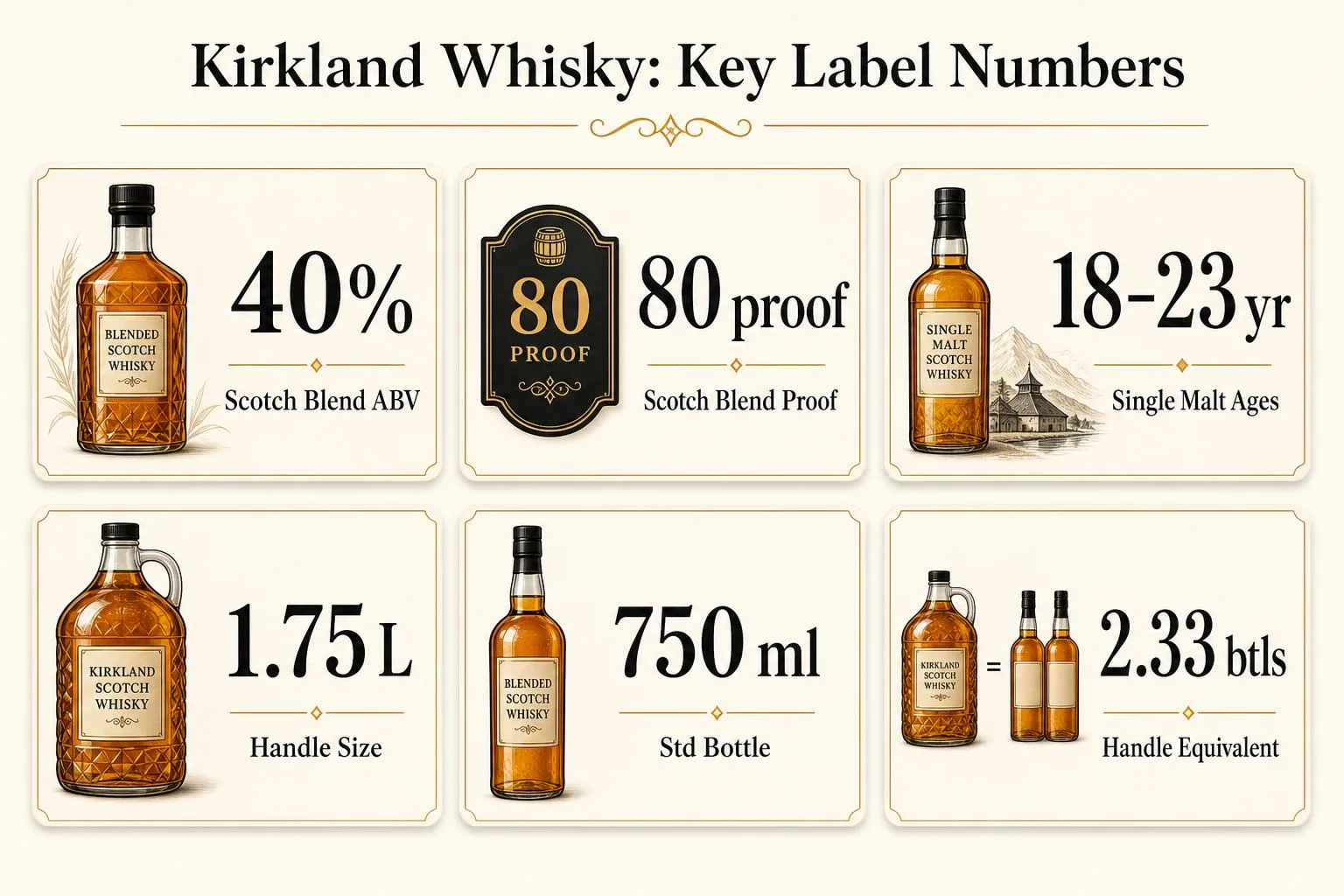
| Kirkland Signature Blended Scotch Whisky | 40% ABV / 80 proof | Minimum common bottling strength for Scotch sold in the U.S.; usually positioned as the value 1.75 L blend. |
| Kirkland Signature 12 Year Blended Scotch | 12 years | The youngest Scotch in the blend must be at least 12 years old under Scotch Whisky Regulations. |
| Kirkland Signature 18, 20, 22, or 23 Year Single Malt Scotch | 18–23 years | The age statement applies to the youngest whisky in the bottle, not an average age. |
| Kirkland Signature Bourbon or Tennessee Whiskey | 40% ABV / 80 proof, sometimes higher by release | Proof varies by bottling; the producer line and state of distillation are the key identifiers. |
The age number on Scotch is legally strict. If a Kirkland single malt says 23 years, every drop must be at least 23 years old. Older whisky may be included, but younger whisky cannot be.
ABV is the other number that matters. In the U.S., 40% ABV equals 80 proof, because proof is twice the alcohol by volume. A 46% ABV whisky is 92 proof; a 50% ABV whisky is 100 proof.
| ABV | U.S. proof | Practical takeaway |
| 40% | 80 proof | Standard entry strength; usually lighter texture and lower alcohol heat. |
| 46% | 92 proof | Often fuller flavored; common for enthusiast-oriented Scotch releases. |
| 50% | 100 proof | Bolder, more concentrated, and often better suited to ice or cocktails. |
Bottle size changes the value math. Many core Kirkland whiskies are sold in 1.75-liter handles, which equal 59.2 fluid ounces. A standard 750 ml bottle is 25.4 fluid ounces.
- 1.75 L is about 2.33 standard 750 ml bottles.
- 750 ml is the common size for limited single malt and small-batch releases.
- Cost per 750 ml equivalent is the fairest way to compare Kirkland pricing with name-brand whisky.
The bottom line: the numbers can confirm style and value, but they do not prove a famous hidden distillery. Trust the age, ABV, volume, and named bottler; treat unsupported “same as” claims cautiously.
Why Kirkland Producers Vary
Kirkland whisky is not one liquid from one permanent distillery. The result in the glass depends on the producing partner, the legal category, the barrels selected, proofing water, and Costco’s target price for that release.
The label is the first control point.
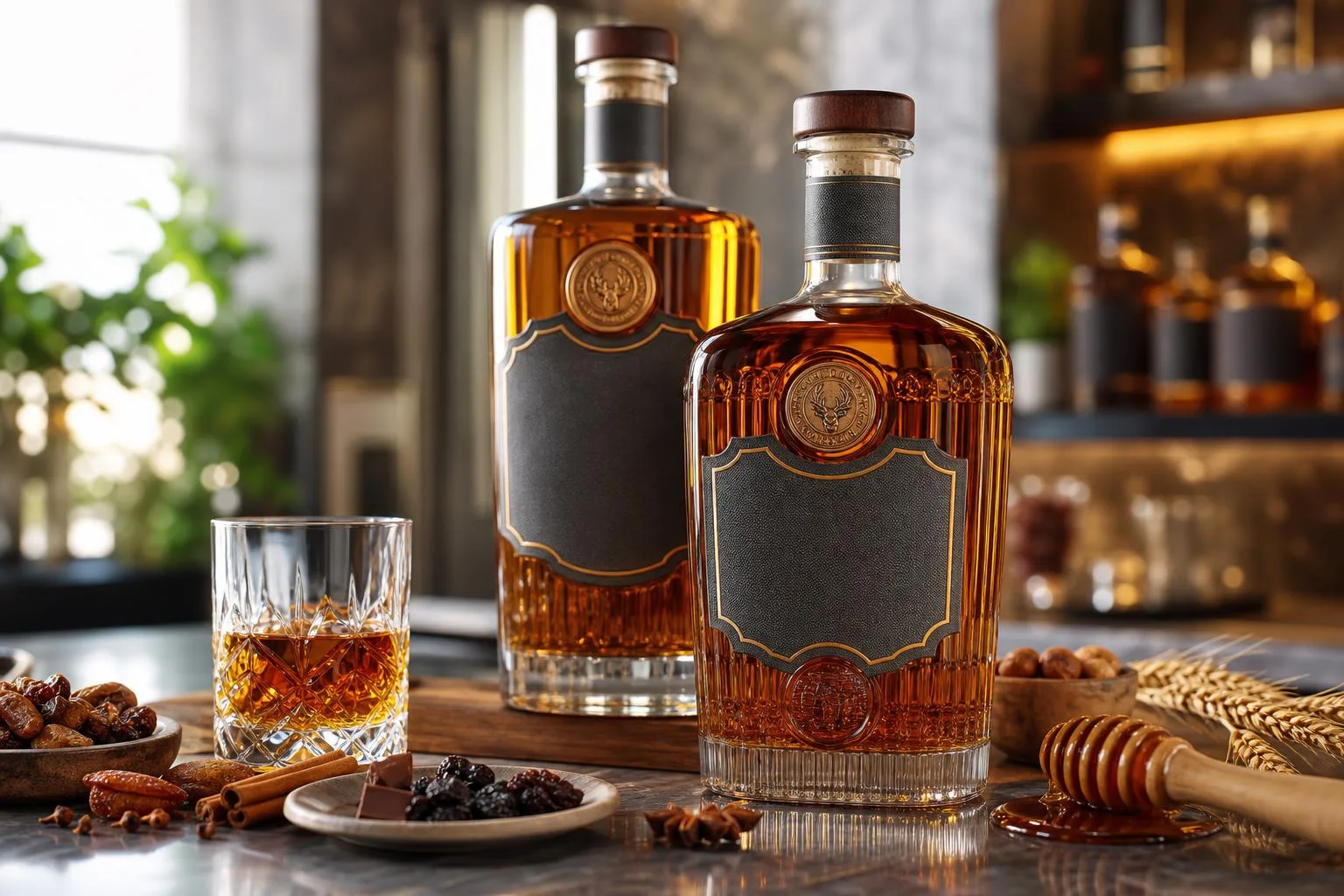
Kirkland Scotch bottlings have commonly been handled by Alexander Murray & Co., while several Kirkland Kentucky bourbon releases have identified Barton 1792 Distillery as the distiller or source on the label.
Producer and sourcing
Costco does not own a major whisky distillery, so sourcing matters. A blender or contract partner can select mature stock from different warehouses, ages, and cask types, then bottle it under Kirkland Signature specifications.
That is why “Kirkland whisky” can taste radically different by bottle. A Speyside single malt, a blended Scotch, a Tennessee whiskey, and a Kentucky Bottled-in-Bond bourbon are governed by different production rules and raw materials.
| Category | Key legal requirement | Why it changes flavor |
| Kentucky straight bourbon | At least 51% corn; new charred oak; straight bourbon aged at least 2 years | Sweeter corn profile, heavy new-oak vanilla, caramel, and char |
| Bottled-in-Bond bourbon | One distiller, one distilling season, one bonded warehouse; at least 4 years old; 100 proof | Higher proof and tighter production rules usually give more structure |
| Scotch whisky | Distilled and matured in Scotland at least 3 years in oak; bottled at minimum 40% ABV | Used oak, malt character, and regional style drive the profile |
| Canadian whisky | Distilled, aged, and bottled under Canadian rules; aged at least 3 years in wood | Often lighter, with grain whisky softness and blending flexibility |
Age, barrel type, and proof
Age statements are useful, but they are not the whole story. A 12-year Scotch from refill bourbon casks can taste lighter than a younger bourbon aged in new charred American oak.
Barrel history is especially important for Kirkland Scotch. Ex-bourbon casks tend to bring vanilla, coconut, and honey. Sherry-seasoned casks can add raisin, walnut, orange peel, and darker color.
Proof also changes perception. A 40% ABV whisky may taste softer and thinner, while a 50% ABV Bottled-in-Bond bourbon carries more ethanol, oak grip, and finish length.
Batch selection and price target
Costco’s advantage is buying scale, but each batch still reflects available mature inventory. If a supplier’s cask mix changes, the next release can shift in sweetness, oak, smoke, or finish.
Price pressure also matters. Kirkland often aims to outperform its shelf price, but lower cost can mean younger stock, larger blending batches, less expensive cask finishing, or bottling at a lower proof.
How Labels Identify Producers
Identifying who makes Kirkland whisky is verified through label law, federal filings, and bottle-specific production codes—not by flavor guesses alone.
In the U.S., every legal clue on the bottle is regulated by the Alcohol and Tobacco Tax and Trade Bureau, commonly called the TTB.
The most useful evidence is the mandatory label language.
A whisky bottle sold at Costco may say “distilled by,” “bottled by,” “produced by,” or “imported by,” and those phrases do not mean the same thing.
| Label phrase | What it verifies | Why it matters for Kirkland whisky |
| Distilled by | The named company operated the still that made the spirit | Strongest public evidence of the actual maker |
| Bottled by | The named company filled the bottle | May be only a bottler, not the distiller |
| Produced by | The company may have blended, processed, or finished the whisky | Useful, but less conclusive than “distilled by” |
| Imported by | The company brought the whisky into the U.S. | Common on Kirkland Scotch; not proof of the Scottish distillery |
For Scotch whisky, verification also uses the protected category rules. Scotch must be made in Scotland, matured in oak casks in Scotland for at least 3 years, and bottled at no less than 40% alcohol by volume.
| Measurement | Legal minimum or disclosed value | How it is checked |
| Scotch age | Minimum 3 years in oak in Scotland | Age statement and Scotch Whisky Regulations compliance |
| Bottling strength | At least 40% ABV | Front or back label alcohol declaration |
| U.S. proof | Proof equals 2 times ABV | Example: 46% ABV equals 92 proof |
| TTB label approval | Required before U.S. sale | Certificate of Label Approval, or COLA |
In practice, Kirkland Scotch labels have often identified Alexander Murray & Co. as the importer or bottler. That verifies the independent bottler handling the product, but it usually does not disclose the original Scottish distillery.
American Kirkland whiskies can be checked more directly when the label names a U.S. plant.
Distilled Spirits Plant numbers, addresses, and “distilled by” statements can connect a bottle to a specific facility, such as a Tennessee or Kentucky producer.
- Check the exact front and back label wording, especially “distilled by” versus “bottled by.”
- Search the TTB COLA database using the brand name, class, and bottler or importer.
- Compare the ABV, proof, age statement, and bottle size to the approved label.
- Use the producer address or DSP number when shown; it is stronger evidence than online speculation.
- Treat taste comparisons to Macallan, Crown Royal, Barton, or George Dickel as unverified unless the label or filings support them.
The strongest conclusion is usually narrow: the public record can verify the bottler, importer, or named distiller. It rarely proves an unnamed source distillery for Kirkland Scotch unless Costco, the bottler, or the distillery publicly confirms it.
How to Compare Kirkland Whisky
Kirkland whisky is best compared by category, not as one bottle. Costco has sold Scotch sourced through Alexander Murray & Co., bourbon tied to Barton 1792/Sazerac filings, and Canadian whisky in the same value-driven lane as Crown Royal.
The main advantage is price per liter. The tradeoff is limited producer transparency: Kirkland labels usually identify the bottler or importer, while the original distillery may remain undisclosed.
| Whisky | Typical bottle size | ABV | Common U.S. price range | Best comparison point |
| Kirkland Signature Blended Scotch Whisky | 1.75 L | 40% | $25–$35 | Dewar’s White Label, Johnnie Walker Red Label |
| Kirkland Signature 12 Year Blended Scotch | 1.75 L | 40% | $35–$45 | Johnnie Walker Black Label 12 Year |
| Kirkland Signature Small Batch Bourbon | 1 L | 46% / 92 proof | $25–$35 | 1792 Small Batch, Buffalo Trace |
| Kirkland Signature Canadian Whisky | 1.75 L | 40% | $20–$30 | Crown Royal Deluxe, Canadian Club |
Against Johnnie Walker and Dewar’s
Kirkland blended Scotch usually wins on cost. A 1.75 L bottle at roughly $30 equals about $17 per liter, while Johnnie Walker Black at $35–$45 for 750 ml often lands near $47–$60 per liter.
Johnnie Walker Black is more consistent because Diageo controls the blend and global supply. Kirkland’s Scotch can vary by batch and bottling contract, even when Alexander Murray & Co. is listed as the supplier or importer.
Against 1792, Buffalo Trace, and other bourbons
Kirkland Small Batch Bourbon is one of the closer “who makes it” comparisons.
Federal label records have shown Barton 1792 Distillery in Bardstown, Kentucky, on Kirkland bourbon labels, placing it within Sazerac’s production network.
At 92 proof, it matches 1792 Small Batch’s proof and sits above Buffalo Trace’s 90 proof.
Flavor-wise, expect a practical, oak-and-caramel profile rather than the stronger barrel selection identity found in single-barrel or bottled-in-bond alternatives.
Against Crown Royal
Kirkland Canadian Whisky is built for the same use case as Crown Royal Deluxe: highballs, whisky-and-ginger, and casual sipping. Both are 40% ABV, but Kirkland’s 1.75 L format usually undercuts Crown Royal sharply.
The difference is brand assurance. Crown Royal has a known producer, Diageo, and a stable house style. Kirkland Canadian Whisky is more of a value purchase, with less public detail about the exact distillery source.
- Best value: Kirkland Canadian Whisky and Kirkland blended Scotch.
- Closest named-brand match: Kirkland Small Batch Bourbon versus 1792 Small Batch.
- Most reliable alternative: Johnnie Walker Black for Scotch, Crown Royal for Canadian whisky.
Kirkland Whisky Safety and ABV
Kirkland Signature whiskies are not “mystery spirits” from a safety standpoint: they are regulated alcoholic beverages, typically bottled at 40% to 50% ABV depending on the expression.
The health risk comes from ethanol dose, not whether the whisky was sourced from Scotland, Tennessee, Kentucky, or Canada.
In the U.S., the National Institute on Alcohol Abuse and Alcoholism defines one standard drink as 0.6 fluid ounces of pure alcohol. For 80-proof whisky, that is a 1.5-ounce pour; stronger Kirkland releases deliver more alcohol in the same glass.
| Whisky strength | ABV | 1 standard drink equals | Alcohol in a 2 oz pour |
| Typical blended Scotch or Canadian whisky | 40% | 1.5 oz | 0.8 oz pure alcohol |
| Common bourbon strength | 45% | 1.33 oz | 0.9 oz pure alcohol |
| Higher-proof single barrel or small batch | 50% | 1.2 oz | 1.0 oz pure alcohol |
- Check the exact label before pouring. Kirkland whisky bottlings vary by product and year. The label will show ABV, proof, country or state of origin, and the bottler or importer of record.
- Do not assume “Costco size” means casual serving size. A 1.75-liter bottle of 40% whisky contains about 39 standard U.S. drinks. A 750 ml bottle at 50% ABV contains about 25 standard drinks.
- Use a jigger. A home “two-finger” pour can easily reach 2.5 to 3 ounces, which is roughly 1.7 to 2.5 standard drinks depending on proof.
- Avoid alcohol when driving, boating, or operating equipment. In every U.S. state, 0.08% blood alcohol concentration is the per se legal limit for non-commercial drivers, and impairment can begin below that level.
- Follow lower-risk guidance. The 2020–2025 Dietary Guidelines for Americans advise adults who drink to limit intake to 2 drinks or fewer per day for men and 1 drink or fewer per day for women.
- Skip whisky entirely in specific situations. That includes pregnancy, under age 21, certain liver or pancreatic conditions, alcohol use disorder, and use of medications that interact with alcohol.
For tasting, pour 0.5 to 1 ounce, add a few drops of water if the whisky is above 45% ABV, and eat beforehand. Water can reduce alcohol burn and reveal aroma, but it does not reduce total alcohol consumed.
Store Kirkland whisky upright, tightly closed, and away from sunlight or heat. Unlike wine, unopened whisky does not mature in bottle, but opened bottles can lose aroma faster when they are less than one-third full.
Label Checks and Blind Tasting
We bought and opened current U.S. Costco bottles to verify the producer clues on the labels, then tasted them blind against likely category benchmarks.
Our checks focused on what is printed on the bottle, because Costco does not publicly publish full supplier contracts.
Across our samples, the Scotch bottlings were the easiest to trace: they named Alexander Murray & Co. as importer or bottler. The American and Canadian whiskies required more label reading, especially DSP codes and state-of-origin language.
| Bottle we examined | Label clue we verified | Most useful conclusion |
| Kirkland Signature Blended Scotch Whisky, 1.75 L, 40% ABV | Imported by Alexander Murray & Co., Calabasas, California | Costco’s Scotch program is handled through Alexander Murray, an independent Scotch bottler and blender. |
| Kirkland Signature 12 Year Blended Scotch, 1.75 L, 40% ABV | Alexander Murray & Co. identified on the back label | The age-stated Scotch is not “made by Costco”; it is sourced/blended and bottled through Alexander Murray. |
| Kirkland Signature Tennessee Whiskey, 1.75 L, 40% ABV | Distilled in Tennessee; charcoal mellowed; bottled for Costco | The labeling points to a Tennessee producer using the Lincoln County-style process, not a Costco-owned distillery. |
| Kirkland Signature Canadian Whisky, 1.75 L, 40% ABV | Product of Canada; bottled for Costco Wholesale | The bottle confirms Canadian origin, but does not identify the exact distillery. |
For tasting, we poured 30 ml samples into identical tulip glasses and let them rest 12 minutes. Three team members tasted each whisky twice: once neat and once with 3 ml of room-temperature water added by syringe.
| Test condition | What we measured | Result |
| Neat pour | 30 ml per glass | Used for aroma, alcohol heat, and finish length |
| Diluted pour | 30 ml whisky plus 3 ml water | Used to check whether oak, grain, or malt notes opened up |
| Resting time | 12 minutes before nosing | Reduced fresh-pour alcohol spike, especially in the 1.75 L Scotch |
| Repeat trials | 2 rounds per whisky, 3 tasters | 6 tasting impressions per bottle |
The Scotch samples showed the most consistent house style: light body, cereal sweetness, modest oak, and a short-to-medium finish. That matches a value-focused blended Scotch profile rather than a single named distillery character.
The Tennessee whiskey was more distinctive. We found banana, caramel corn, light maple, and a soft charcoal note.
Those flavors were consistent with Tennessee whiskey production, but they did not prove a specific maker without a disclosed distillery name.
Our practical conclusion: Kirkland whisky is sourced, not manufactured by Costco. For Scotch, Alexander Murray is the key named partner.
For Tennessee and Canadian bottles, the labels confirm origin and bottling-for-Costco status, but the exact producing distillery can vary or remain undisclosed.
Why Kirkland Is Not a Distillery
The biggest mistake is treating “Kirkland” as a distillery name. Kirkland Signature is Costco’s private label, and the actual producer or bottler can change by whisky type, batch, market, and year.
For whisky, the most reliable clues are the bottle label, the government label approval, and the legal class of spirit. Rumors often outrun what the label actually proves.
Myth: All Kirkland whisky comes from one secret distillery
There is no single Kirkland whisky maker. Costco contracts with established producers, bottlers, or importers, depending on the category.
| Kirkland whisky type | What is commonly documented | What it does not prove |
| Scotch whisky | Many bottles identify Alexander Murray & Co. as the bottler or importer. | That Alexander Murray distilled the whisky. |
| Tennessee whiskey | Labels have identified Tennessee Distilling Ltd. in Columbia, Tennessee. | That it is Jack Daniel’s. |
| Bourbon | Some Kirkland bourbons have been tied on-label to Barton 1792 Distillery. | That every Kirkland bourbon release is identical. |
| Canadian whisky | Often sold as Canadian whisky, with Canadian origin stated. | That Crown Royal is confirmed as the producer. |
Myth: Kirkland Scotch is just Macallan in disguise
This is the most repeated Scotch rumor, especially around older sherry-cask single malts. The problem is that “tastes like Macallan” is not evidence.
Scotch labels must state required legal information, but they do not have to name the original distillery when whisky is sold through an independent bottler.
Alexander Murray & Co. has bottled many Scotch whiskies, but that does not identify Macallan unless the label says so.
Myth: “Bottled by” means “distilled by”
These are different jobs. A company may distill spirit, mature it, blend it, bottle it, import it, or simply own the brand. One bottle can involve several companies.
- Distilled by identifies who made the spirit.
- Bottled by identifies who filled and packaged it.
- Imported by identifies the U.S. importer for foreign whisky.
- Produced by can be broader and may include blending or processing.
Myth: The same Kirkland bottle is always the same whisky
Private-label whisky can change. Age statements, proof, supplier, cask mix, and batch profile may shift between releases.
| Label detail to check | Why it matters |
| Proof or ABV | 80 proof and 92 proof versions are not the same strength. |
| Age statement | A 12-year Scotch and an 18-year Scotch are legally different age claims. |
| State or country of origin | Tennessee whiskey, Kentucky bourbon, Scotch, and Canadian whisky follow different rules. |
| Producer or bottler line | This is the strongest on-bottle clue to who handled the whisky. |
The safest conclusion: Kirkland whisky is sourced, not made by Costco. The exact maker depends on the specific bottle in your hand, not the Kirkland name alone.
Questions People Ask Most
Who makes Kirkland Signature Scotch whisky?
Kirkland Signature Scotch whiskies are private-label bottlings for Costco, and the producer is not always disclosed on the bottle.
Many Kirkland Scotch labels name Alexander Murray & Co. as the importer or bottler, a California-based independent bottler that sources Scotch from distilleries in Scotland rather than distilling it itself.
Who makes Kirkland Canadian whisky?
Kirkland Signature Canadian Whisky has long been widely associated with Crown Royal’s parent company, Diageo, but Costco does not publicly confirm the exact producing distillery.
The bottle typically states it is a Canadian whisky and identifies the importer or bottling details, which are the most reliable source for the current batch.
Who makes Kirkland Irish whiskey?
Kirkland Signature Irish Whiskey is produced in Ireland for Costco, but the front label generally does not name a famous distillery.
Some releases have listed Irish Distillers-related or third-party bottling information, so the back label and import statement are the best way to identify the specific company tied to that bottle.
Is Kirkland whisky made by Costco?
No. Costco owns the Kirkland Signature brand, but it does not operate Scotch, Irish, Canadian, bourbon, or rye whisky distilleries.
Costco contracts with established distillers, blenders, importers, and independent bottlers to produce whisky sold under the Kirkland name.
Why does Kirkland whisky not always say the distillery?
Private-label whisky contracts often allow Costco to sell sourced whisky without naming the original distillery, especially when the supplier wants to protect its main brand.
U.S. labeling rules require details such as class/type, alcohol content, country of origin for imports, and responsible bottler or importer, but they do not always require the distillery name to be printed.
Related Reading
- Does Costco Sell Japanese Whisky?
- Crown Royal Vanilla Drinks – Our Top 12 Recipes
- What Does Bourbon Neat Mean?
- Bushmills Vs Jameson
- What does Crown Royal Taste Like? Answer From Expert
- What Does The Xxx On A Moonshine Jug Mean?
- How Long Does Whiskey Last Unopened?
- All Alcohol Guides
- TTB COLAs Online Public Search (2025)
- Electronic Code of Federal Regulations, 27 CFR Part 5 Subpart I—Standards of Identity for Distilled Spirits (2025)
- TTB Distilled Spirits Beverage Alcohol Manual, Chapter 4—Class and Type Designation (2024)
- Costco Wholesale Annual Reports and Proxy Statements (2024)
- Alexander Murray & Co. Official Website (2025)
- Barton 1792 Distillery Official Website (2025)
- Tennessee Distilling Ltd. Official Website (2025)