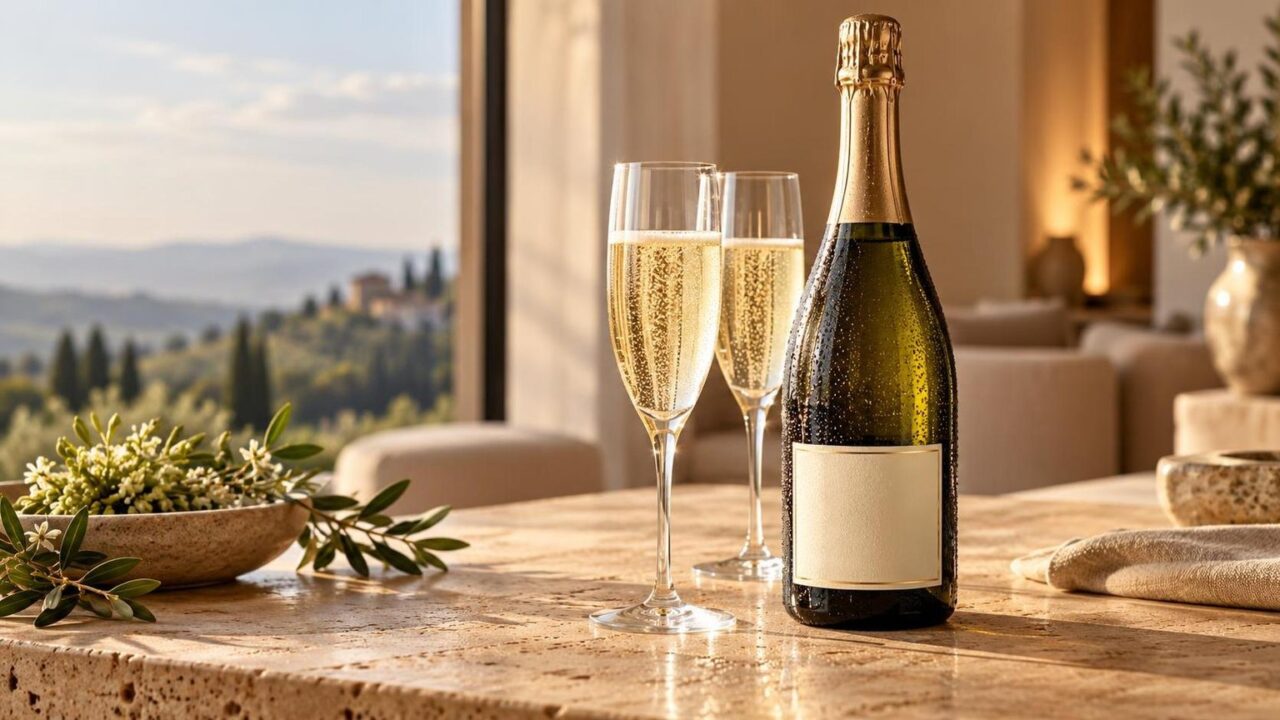
What Percentage Is Champagne? is answered by about 12% alcohol by volume for most non-vintage and vintage bottles.
Champagne commonly ranges from 11.5% to 12.5% ABV, with the exact figure set by grape ripeness, fermentation, blending, and dosage choices made before release.
That percentage matters because it shapes serving size, pacing, food pairing, and how Champagne compares with still wine.
This guide explains typical ABV, why labels vary, how sweetness does not equal strength, and what to check on the bottle before pouring.
Typical Champagne Alcohol Percentage
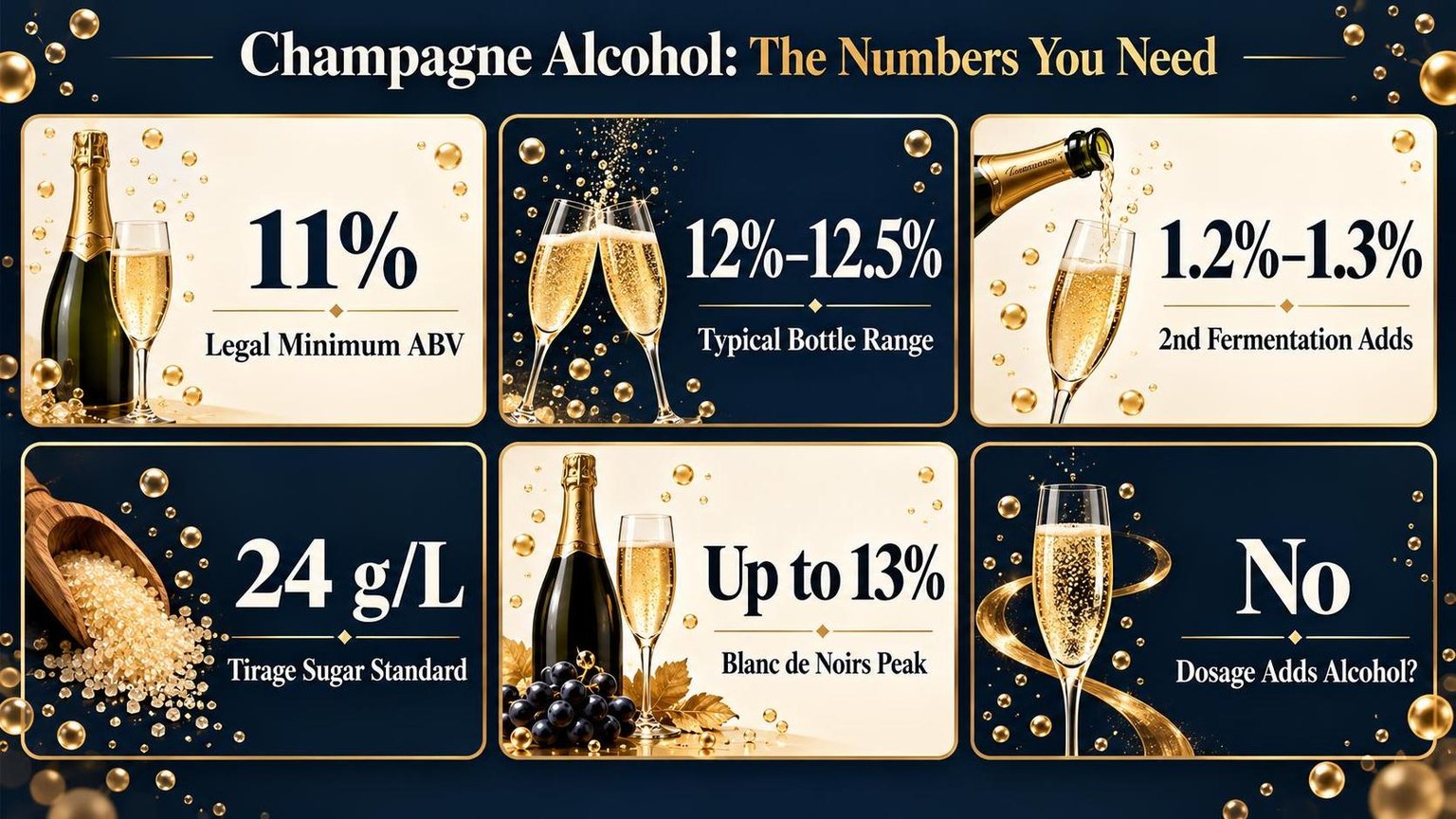
Most Champagne falls between 12% and 12.5% alcohol by volume (ABV).
This range is narrower than many wine drinkers assume, governed by strict Appellation d’Origine Contrôlée (AOC) regulations and the unique double-fermentation process that defines méthode champenoise.
French AOC law requires Champagne to reach a minimum of 11% ABV after disgorgement. In practice, most houses exceed this floor by a full percentage point or more.
ABV by Champagne Style
Different styles and dosage levels produce measurable variation in final alcohol content. The table below reflects typical ranges found on back labels of major houses.
| Champagne Style | Typical ABV Range |
| Non-Vintage Brut | 12.0% – 12.5% |
| Vintage/Prestige Cuvée | 12.0% – 12.5% |
| Blanc de Blancs | 12.0% – 12.5% |
| Blanc de Noirs | 12.0% – 13.0% |
| Rosé Champagne | 12.0% – 12.5% |
| Extra Brut / Brut Nature | 12.0% – 12.5% |
| Demi-Sec | 12.0% – 12.5% |
Why the Range Is So Narrow
Champagne’s cool climate — average annual temperature around 11 °C — limits grape sugar accumulation. Lower sugar at harvest means lower potential alcohol after primary fermentation.
The secondary fermentation inside the bottle adds roughly 1.2% to 1.3% ABV. Winemakers calibrate the liqueur de tirage (24 g/L of sugar is standard) to achieve this precise uplift.
Specific House Examples
Real-world label data confirms the narrow band:
| Champagne | Stated ABV |
| Moët & Chandon Impérial Brut | 12.0% |
| Veuve Clicquot Yellow Label | 12.0% |
| Dom Pérignon 2013 | 12.5% |
| Krug Grande Cuvée | 12.0% |
| Ruinart Blanc de Blancs | 12.5% |
| Bollinger Special Cuvée | 12.0% |
| Laurent-Perrier Rosé | 12.0% |
Key Takeaways
- The legal minimum ABV for Champagne is 11%, but commercial bottles almost always read 12% or 12.5%.
- Dosage (added sugar before corking) does not meaningfully raise ABV — it affects sweetness, not alcohol.
- Warmer vintages like 2018 and 2020 have pushed some cuvées toward 13%, though this remains uncommon.
- Champagne’s ABV sits roughly on par with still Burgundy but below most Napa Valley Chardonnays (13.5%–14.5%).
Legal Alcohol Range for Champagne
Champagne’s alcohol content is governed by strict EU and French regulations. Most bottles fall between 11% and 13% ABV, with the legal framework setting precise minimums that producers must meet before any wine earns the Champagne appellation.
Minimum Alcohol Requirements
EU Regulation 1308/2013 mandates a minimum natural alcohol of 9% ABV for sparkling wines produced in wine-growing zone C I, which includes the Champagne region.
After the secondary fermentation in bottle, the finished product must reach at least 11% ABV total.
The Comité Champagne (CIVC) enforces additional internal standards. Base wines typically arrive at 10.5%–11% ABV before tirage.
The second fermentation adds approximately 1.2%–1.3% ABV from the conversion of the liqueur de tirage’s 24 g/L of sugar.
Alcohol Levels by Champagne Style
| Champagne Style | Typical ABV Range | Key Factor |
| Non-Vintage Brut | 12.0%–12.5% | Blended for consistency across vintages |
| Vintage Brut | 12.0%–12.5% | Single-harvest fruit, riper selection |
| Blanc de Blancs | 12.0%–12.5% | 100% Chardonnay, moderate alcohol |
| Blanc de Noirs | 12.0%–13.0% | Pinot Noir/Meunier, slightly fuller |
| Rosé | 12.0%–12.5% | Blending or saignée method |
| Prestige Cuvée | 12.0%–12.5% | Extended lees aging, top parcels |
| Demi-Sec / Doux | 12.0%–13.0% | Higher dosage adds residual sugar, not ABV |
Dosage—the sugar added post-disgorgement—does not raise alcohol percentage. It contributes sweetness only. A Brut Nature at 0 g/L dosage and a Demi-Sec at 32–50 g/L dosage from the same base can share identical ABV.
Climate Impact on Legal Limits
Warmer vintages like 2018, 2019, and 2020 pushed base wine alcohol toward 11.5% ABV or higher. After second fermentation, some cuvées approached 13% ABV. Cooler years like 2014 produced leaner base wines closer to 10% ABV.
The CIVC may authorize chaptalization—adding sugar to must before primary fermentation—in difficult vintages. This practice is regulated and limited to raising potential alcohol by no more than 1.5% ABV in zone C I.
It ensures base wines meet minimum thresholds even in underripe years.
French fraud control agency DGCCRF conducts random ABV testing on commercial Champagne. Labels must state actual alcohol content within a tolerance of ±0.5% ABV per EU labeling regulation 1169/2011. Mislabeling carries significant penalties.
Champagne Versus Wine Alcohol Levels
Champagne typically contains 12–12.5% ABV, placing it slightly below many still wines. Understanding how Champagne compares to red, white, and rosé wines helps drinkers make informed choices about consumption and food pairing.
The alcohol content of wine varies significantly by style, grape variety, and region of production. Climate plays a decisive role—warmer regions produce riper grapes with higher sugar levels, which ferment into higher-alcohol wines.
| Wine Type | Typical ABV Range | Common Example |
| Champagne (Non-Vintage) | 12–12.5% | Moët & Chandon Impérial (12%) |
| Prosecco | 11–12% | La Marca Prosecco (11%) |
| Pinot Grigio | 12–13% | Santa Margherita (12.5%) |
| Sauvignon Blanc | 12.5–13.5% | Cloudy Bay (13.5%) |
| Chardonnay (Oaked) | 13–14.5% | Rombauer Carneros (14.5%) |
| Pinot Noir | 12.5–14% | Meiomi Pinot Noir (13.7%) |
| Cabernet Sauvignon | 13.5–15% | Caymus Napa Valley (14.6%) |
| Zinfandel | 14–16% | Turley Old Vines (15.5%) |
| Amarone della Valpolicella | 15–16% | Bertani Amarone (15%) |
Champagne’s moderate alcohol level stems from the cool climate of the Champagne region. Average growing-season temperatures hover around 16°C (61°F), limiting grape sugar accumulation compared to warmer zones like Napa Valley or Barossa Valley.
Why Champagne Feels Stronger Than It Is
Despite lower ABV, Champagne’s carbonation accelerates alcohol absorption into the bloodstream.
A 2007 study published in the journal Alcohol and Alcoholism found that sparkling wine raised blood alcohol levels faster than flat wine of identical strength in the first 20 minutes of consumption.
Several factors contribute to Champagne’s perceived potency:
- CO₂ pressure: Champagne bottles hold approximately 6 atmospheres of pressure, forcing dissolved carbon dioxide into rapid release upon pouring
- Serving temperature: Champagne served at the recommended 8–10°C (46–50°F) can mask alcohol perception on the palate
- Glass shape: Flute glasses concentrate bubbles and aromatics, intensifying sensory impact per sip
- Drinking pace: Champagne is often consumed quickly during toasts and celebrations, compressing alcohol intake into shorter windows
For calorie-conscious drinkers, Champagne’s lower ABV translates to roughly 90–100 calories per 5-ounce pour.
A comparable glass of 14.5% Cabernet Sauvignon delivers approximately 120–130 calories, making Champagne the lighter option by a meaningful margin.
Why Champagne Feels Stronger
Champagne’s 12–12.5% ABV matches most still white wines, yet drinkers consistently report feeling its effects faster. The culprit is carbon dioxide, which accelerates alcohol absorption in a measurable, well-documented way.
The Carbon Dioxide Effect
A landmark 2003 study published in the British Medical Journal by researchers at the University of Surrey tested this directly. Participants drank either flat or carbonated Champagne with identical alcohol content.
Those who drank the bubbly version reached a mean blood alcohol concentration of 0.054 g/dL within 5 minutes. The flat-Champagne group hit only 0.039 g/dL in the same timeframe — a 38% difference.
| Condition | BAC at 5 Minutes | Peak BAC |
| Carbonated Champagne | 0.054 g/dL | 0.058 g/dL |
| Flat Champagne (same ABV) | 0.039 g/dL | 0.052 g/dL |
CO₂ opens the pyloric sphincter — the valve between the stomach and small intestine — allowing alcohol to pass into the small intestine faster, where absorption is most efficient.
Pressure and Bubble Count
A standard bottle of Champagne contains approximately 49 million bubbles, according to research from the University of Reims.
Internal pressure reaches roughly 5–6 atmospheres (about 75–90 psi) — three times the pressure in an average car tire.
This pressure forces CO₂ into solution at high concentrations, around 12 grams per liter. Each sip delivers a substantial dose of dissolved gas directly to the stomach lining.
Other Contributing Factors
- Drinking pace: Champagne is often consumed quickly during toasts and celebrations, compressing alcohol intake into a shorter window.
- Serving temperature: Champagne is served at 8–10°C (46–50°F), which encourages faster sipping compared to room-temperature red wines.
- Empty-stomach occasions: Champagne frequently precedes meals as an apéritif, meaning less food in the stomach to slow absorption.
- Smaller pours: A standard Champagne flute holds 125 mL versus a typical 150 mL wine pour, prompting more frequent refills and less accurate tracking of intake.
The combination of carbonation-driven absorption and social drinking patterns makes Champagne’s moderate 12% ABV hit noticeably harder than an equivalent glass of Chablis or Pinot Grigio.
Serving Size and Alcohol Intake
A standard serving of Champagne is 5 ounces (150 ml), containing roughly 0.6 ounces of pure alcohol at 12% ABV.
Understanding how serving size translates to actual alcohol intake helps drinkers make informed decisions and stay within recommended guidelines.
Standard Drink Equivalents
In the United States, one “standard drink” contains 14 grams (0.6 fl oz) of pure ethanol. A 5-ounce glass of 12% ABV Champagne equals exactly one standard drink.
| Serving Size | ABV | Pure Alcohol (g) | Standard Drinks |
| 4 oz (120 ml) flute | 12% | 11.4 | 0.8 |
| 5 oz (150 ml) standard | 12% | 14.0 | 1.0 |
| 6 oz (180 ml) generous | 12% | 17.0 | 1.2 |
| 8 oz (240 ml) coupe, filled | 12% | 22.7 | 1.6 |
Many coupe glasses hold 8–10 ounces when filled near the rim. A single generous pour can equal nearly two standard drinks without the drinker realizing it.
Champagne vs. Other Beverages per Serving
| Beverage | Typical Serving | ABV | Pure Alcohol (g) |
| Champagne | 5 oz | 12% | 14.0 |
| Red wine (Cabernet) | 5 oz | 14% | 16.6 |
| Light beer | 12 oz | 4.2% | 14.0 |
| IPA craft beer | 12 oz | 6.5% | 22.8 |
| Distilled spirit (80 proof) | 1.5 oz | 40% | 14.0 |
Champagne delivers alcohol comparable to a light beer or a shot of spirits when poured at standard sizes. It contains less alcohol per serving than most full-bodied red wines.
Why Champagne Feels Stronger
Research published in the British Medical Journal found that carbonated alcoholic drinks raise blood alcohol concentration faster than flat equivalents.
Carbon dioxide accelerates gastric emptying, pushing alcohol into the small intestine more quickly.
Participants drinking carbonated Champagne reached a BAC of 0.054% within 20 minutes, compared to 0.039% for the same Champagne served flat. That 38% difference explains why Champagne’s effects feel disproportionate to its moderate ABV.
Staying Within Guidelines
- The USDA Dietary Guidelines recommend no more than 2 standard drinks per day for men and 1 for women.
- Two 5-ounce glasses of Champagne equal exactly 2 standard drinks — the male daily limit.
- Use a marked flute or measuring cup once to calibrate your typical pour at home.
- At events with free-flowing refills, track glasses manually; topped-off flutes make counting unreliable.
Knowing that a single properly poured flute equals one standard drink simplifies responsible consumption. The real risk lies in oversized pours and carbonation-driven faster absorption, not in Champagne’s ABV itself.
Lower Alcohol Champagne Alternatives
Not every celebration demands 12% ABV sparkling wine. Several categories offer genuine effervescence at significantly lower alcohol levels, ranging from 0% to 8% ABV.
Understanding these options helps guests who prefer moderation without sacrificing the ritual of popping a bottle.
Sparkling Wine Alternatives by Alcohol Content
| Category | Typical ABV | Origin/Style |
| Non-Alcoholic Sparkling Wine | 0.0–0.5% | Dealcoholized via vacuum distillation or reverse osmosis |
| Moscato d’Asti DOCG | 5.0–6.5% | Piedmont, Italy; single fermentation, naturally sweet |
| Brachetto d’Acqui DOCG | 5.5–6.5% | Piedmont, Italy; aromatic red sparkling |
| Bugey-Cerdon AOP | 7.0–8.0% | Savoie, France; méthode ancestrale rosé |
| German Sekt (Kabinett-level) | 7.0–8.5% | Germany; often Riesling-based, lighter styles |
| Clairette de Die Tradition AOP | 7.0–9.0% | Rhône Valley, France; Muscat-dominant méthode ancestrale |
Non-Alcoholic Sparkling Wines
The non-alcoholic sparkling category grew by over 30% in US retail sales between 2021 and 2023. Producers like French Bloom, Oddbird, and Thomson & Scott Noughty use dealcoholization technology to remove ethanol after full fermentation.
Quality varies significantly. Vacuum distillation at low temperatures (25–30°C) preserves more aromatic compounds than simple boiling. Expect 15–30 calories per 5 oz serving versus roughly 120 calories in standard Champagne.
Moscato d’Asti: The Gold Standard for Low-ABV Sparkling
Moscato d’Asti caps at around 5.5% ABV by DOCG regulation, with residual sugar typically between 100–140 g/L. Fermentation is halted early by chilling and filtering, preserving natural grape sweetness and keeping alcohol low.
Top producers include Paolo Saracco, Vietti, and G.D. Vajra. Bottles typically cost $12–$20, making them affordable alternatives.
Pressure sits around 1–2 atmospheres versus Champagne’s 5–6, producing a gentle frizzante rather than full mousse.
Méthode Ancestrale Options
Bugey-Cerdon and Clairette de Die Tradition use méthode ancestrale, bottling partially fermented juice so residual sugar remains and alcohol stays below 9%. These wines deliver authentic winemaking tradition without dealcoholization processing.
- Bugey-Cerdon typically blends Gamay and Poulsard grapes at 7–8% ABV
- Clairette de Die Tradition must contain at least 75% Muscat Blanc à Petits Grains
- Both styles pair well with fruit desserts, brunch dishes, and charcuterie
- Serve chilled to 6–8°C for optimal freshness and controlled effervescence
Questions Readers Ask
What is the typical alcohol percentage of Champagne?
Most Champagne falls between 12% and 12.5% ABV (alcohol by volume).
French appellation rules require a minimum of 11% ABV for non-vintage and 11% for vintage Champagne, but the second fermentation in bottle adds roughly 1.2–1.3% ABV on top of the base wine’s alcohol.
Pushing finished bottles consistently into the 12–12.5% range.
Why does Champagne have a lower alcohol percentage than most still wines?
Champagne grapes are harvested earlier than those destined for still wine, typically at 10–11% potential alcohol in the base wine, to preserve high acidity essential for sparkling wine structure.
The cool climate of the Champagne region (average growing-season temperature around 16°C) naturally limits sugar accumulation in the fruit.
This combination keeps final ABV below the 13.5–15% range common in Californian or Australian still wines.
Does the alcohol percentage differ between Brut, Extra Brut, and Doux Champagne?
Sweetness level (dosage) has minimal impact on ABV because the added sugar in dosage is not fermented.
A Brut Champagne (0–12 g/L residual sugar) and a Doux Champagne (50+ g/L residual sugar) from the same house typically share the same 12–12.5% ABV. The dosage changes perceived sweetness but not the ethanol content.
How does Champagne’s alcohol content compare to Prosecco and Cava?
Champagne (12–12.5% ABV) sits slightly above Prosecco, which ranges from 11–11.5% ABV, and is comparable to most Cava at 11.5–12% ABV.
The difference stems largely from production method: Champagne’s traditional method with in-bottle secondary fermentation adds more alcohol than Prosecco’s Charmat tank method.
Which is designed to preserve fruitiness at lower pressure and alcohol.
Can vintage or prestige cuvée Champagnes have higher alcohol percentages?
Yes. Prestige cuvées like Dom Pérignon, Krug Grande Cuvée, and Louis Roederer Cristal sometimes reach 12.5–13% ABV because producers select riper fruit from grand cru vineyards in warmer vintages.
The 2002 and 2012 vintages, both notably warm in Champagne, produced base wines with higher natural sugar levels that translated into slightly elevated final alcohol.
Does Champagne’s alcohol percentage affect how quickly it intoxicates you?
Research published in the British Medical Journal found that carbonation accelerates alcohol absorption, meaning Champagne at 12% ABV can raise blood alcohol concentration faster than a still wine at the same percentage.
The CO₂ increases gastric emptying rate, moving alcohol into the small intestine more quickly. A standard 150 mL glass of Champagne contains roughly 1.4–1.5 UK units of alcohol, comparable to a glass of medium-bodied red wine.
Keep Exploring
- Dom Perignon Vs Cristal: The Easiest Way to Distinguish
- Does Champagne Have Sulfites?
- Difference Between Brut and Extra Dry Champagne
- What Champagne Is Sweet? – Find Out Now
- Moet Vs Veuve: The Easiest Way to Distinguish Between Them
- How Many Calories in a Bottle of Champagne? The Eye-Opening Truth You Must Know Before Your Next Celebration
- How Many Servings in a Bottle of Champagne?
- How To Box Chocolate Covered Strawberries And Champagne? The Ultimate Elegant Gift Guide (Step-by-Step Tutorial)
- How Many Oz In A Bottle Of Champagne? The Complete, Real-World Guide (With Sizes, Uses & Serving Math)
- All Alcohol Guides
- Alcohol and Tobacco Tax and Trade Bureau – TTB (2024)
- National Institute on Alcohol Abuse and Alcoholism – NIAAA (2024)
- USDA FoodData Central (2024)
- U.S. Dietary Guidelines for Americans – USDA & HHS (2020)
- CDC – Alcohol and Public Health FAQ (2024)
- University of California Davis – Department of Viticulture and Enology (2023)
- Comité Champagne – CIVC Official Technical Documentation (2024)
- Wine Spectator – Understanding Alcohol Levels in Wine (2023)
- Decanter – Champagne Alcohol Content Guide (2023)