Does Champagne Have Sulfites? Yes—Champagne is a fermented grape wine that naturally contains sulfites, and most producers also add sulfur dioxide to protect freshness, color, and flavor.
In the U.S., any wine with 10 parts per million or more must state “contains sulfites” on the label.
Sulfite levels in Champagne are typically far below the legal U.S. wine limit of 350 parts per million, but they still matter for sensitive drinkers.
This guide explains where sulfites come from, how Champagne compares with other wines, and what label terms, production choices, and serving habits actually mean for your glass.
Does Champagne Naturally Contain Sulfites
Every bottle of Champagne contains sulfites, regardless of whether any were added during production.
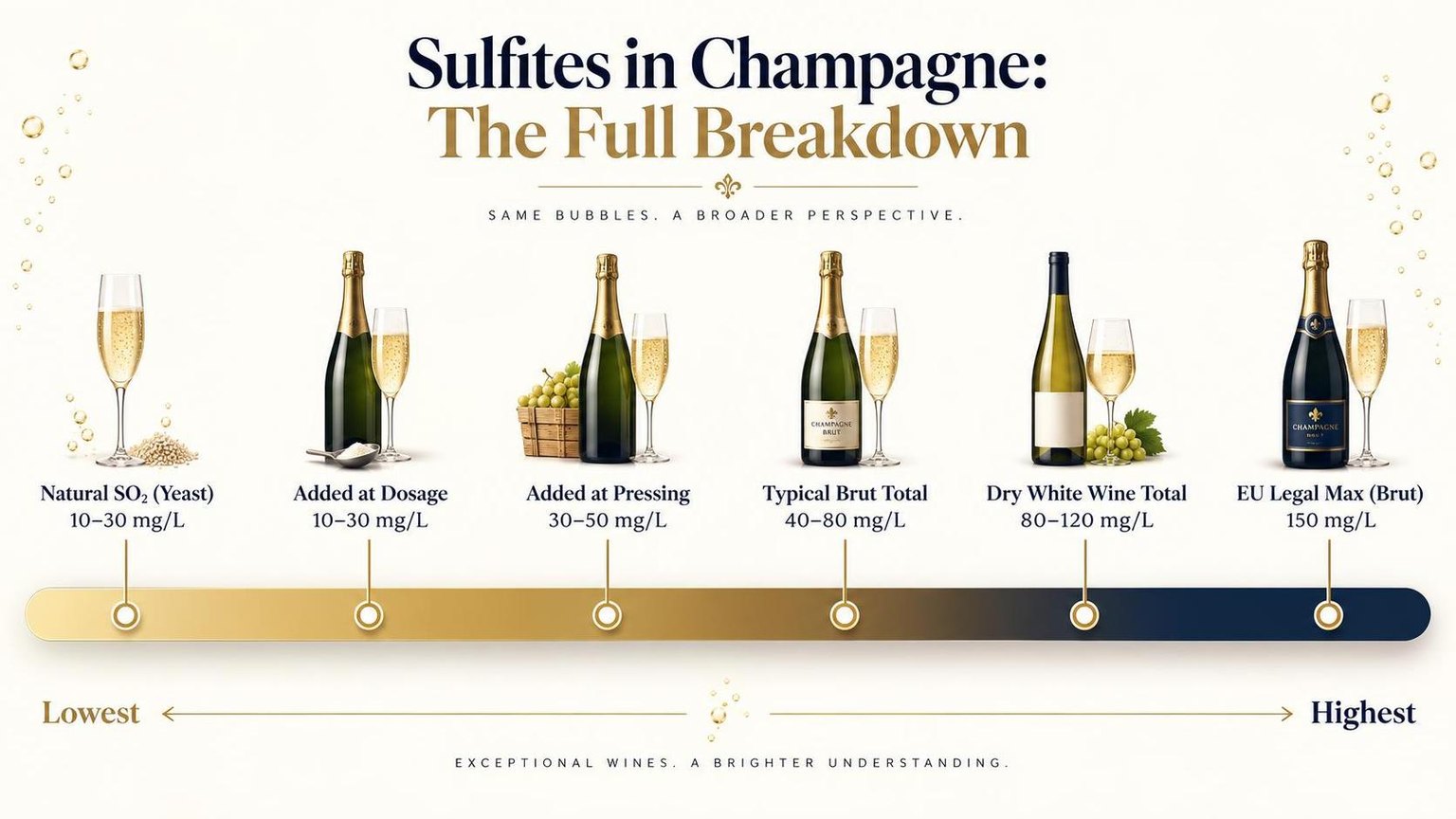
Yeast metabolism during alcoholic fermentation generates sulfur dioxide (SO₂) as a natural byproduct, typically producing between 10 and 30 mg/L without any winemaker intervention.
Sulfites form when yeast reduces elemental sulfur and sulfate compounds present in grape must. The amino acids cysteine and methionine participate in this biochemical pathway during fermentation.
Natural vs. Added Sulfites in Champagne
Most Champagne producers supplement naturally occurring SO₂ with additional sulfites at multiple stages. The distinction matters for consumers tracking total intake.
| Source | SO₂ Contribution (mg/L) | When It Occurs |
| Natural fermentation byproduct | 10–30 | Primary and secondary fermentation |
| Added at pressing/must stage | 30–50 | Before primary fermentation |
| Added at dosage/disgorgement | 10–30 | Final production stage |
| Typical total in finished Champagne | 40–80 | At release |
EU regulations cap total SO₂ in Champagne at 185 mg/L for brut styles and 235 mg/L for demi-sec. Most producers stay well below these ceilings.
Why Zero-Sulfite Champagne Does Not Exist
No fermented wine — including Champagne — can be entirely sulfite-free. The metabolic activity of Saccharomyces cerevisiae yeast guarantees a baseline sulfite presence in every bottle.
- Champagne undergoes two fermentations (primary in tank, secondary in bottle), each generating natural SO₂
- Labels stating “no sulfites added” still contain naturally occurring levels of 10–30 mg/L
- The U.S. TTB requires a “Contains Sulfites” label on any wine exceeding 10 mg/L — virtually all Champagne exceeds this threshold
- Australia mandates sulfite declaration above 10 mg/L; the EU threshold is also 10 mg/L
Champagne’s second in-bottle fermentation — the méthode traditionnelle — adds a further incremental sulfite contribution that still wines do not have.
This makes Champagne inherently a sulfite-containing product at every production scale.
Producers marketing “sans soufre” (without sulfur) Champagne, such as Drappier’s Brut Nature Zéro Dosage, omit added sulfites but still contain naturally generated SO₂, typically measuring around 15–20 mg/L at release.

How Much Sulfite Champagne Contains
Champagne typically contains between 40 and 80 mg/L of total sulfur dioxide at the point of disgorgement. EU law caps sulfites in Champagne at 150 mg/L, while the US TTB sets no separate limit beyond mandatory label disclosure above 10 ppm.

These levels vary by style. Sweeter Champagnes require more sulfite to protect residual sugar from refermentation. Brut Nature and zero-dosage bottlings tend to carry the lowest concentrations.
| Champagne Style | Typical Total SO₂ (mg/L) | EU Legal Max (mg/L) |
| Brut Nature / Zero Dosage | 20–40 | 150 |
| Extra Brut | 30–50 | 150 |
| Brut | 40–80 | 150 |
| Extra Dry / Sec | 50–90 | 185 |
| Demi-Sec / Doux | 60–120 | 185 / 235 |
Note the EU raises the ceiling to 185 mg/L for sparkling wines with residual sugar above 5 g/L, and to 235 mg/L for the sweetest categories.
How Champagne Compares to Other Wines
Champagne’s sulfite levels generally run lower than most still white wines. The secondary fermentation in bottle consumes a portion of the free SO₂, reducing the final total.
| Wine Type | Typical Total SO₂ (mg/L) | EU Legal Max (mg/L) |
| Champagne (Brut) | 40–80 | 150 |
| Dry White Wine | 80–120 | 200 |
| Dry Red Wine | 50–100 | 150 |
| Sweet White (Sauternes) | 150–250 | 300 / 400 |
Red wines contain tannins that act as natural antioxidants, partially reducing the need for added sulfites. Champagne lacks significant tannin but benefits from CO₂ pressure and low pH (typically 3.0–3.1), both of which inhibit oxidation.
Why the Numbers Matter
- FDA threshold: Labels must declare “Contains Sulfites” when total SO₂ exceeds 10 ppm (10 mg/L). Virtually all Champagne exceeds this.
- Sensitivity range: The roughly 1% of the population with sulfite sensitivity may react at levels above 20–30 mg/L, per Cleveland Clinic data.
- Organic standards: USDA-certified organic wine must stay below 10 mg/L of added sulfites; EU organic wine allows up to 100 mg/L for sparkling.
Grower Champagnes from producers like Laherte Frères and Jérôme Prévost often target 30–50 mg/L total SO₂, prioritizing minimal intervention while maintaining stability through careful cellar hygiene.
Why Champagne Producers Add Sulfites
Sulfur dioxide (SO₂) serves as both an antioxidant and antimicrobial agent in Champagne production.
Without it, the wine would oxidize rapidly and become vulnerable to spoilage bacteria like Acetobacter, which converts alcohol into acetic acid (vinegar).
Key Functions of SO₂ in Champagne
- Antioxidant protection: SO₂ binds with dissolved oxygen and hydrogen peroxide, preventing browning and preserving fresh fruit aromas through years of aging on lees.
- Antimicrobial control: Molecular SO₂ at concentrations above 0.5–0.8 mg/L inhibits wild yeast strains like Brettanomyces and lactic acid bacteria that cause off-flavors.
- Enzymatic inhibition: SO₂ deactivates polyphenol oxidase (PPO) and laccase enzymes released during pressing, which would otherwise cause premature oxidation of the must.
- Acetaldehyde binding: SO₂ binds free acetaldehyde — a compound that produces stale, bruised-apple aromas — rendering it sensorially neutral.
When Sulfites Are Added
Champagne producers typically add SO₂ at three critical stages during production. Each addition targets a specific vulnerability in the winemaking process.
| Stage | Typical SO₂ Dose | Purpose |
| At pressing (must) | 50–80 mg/L | Protect juice from oxidation, suppress wild microbes |
| Post-primary fermentation | 20–40 mg/L | Stabilize base wine before assemblage |
| At dosage (liqueur d’expédition) | 10–20 mg/L | Preserve wine after disgorgement |
Total SO₂ in finished Champagne generally ranges from 100–150 mg/L. EU regulations cap total SO₂ at 185 mg/L for sparkling wines with residual sugar above 5 g/L.
Why Zero-Sulfite Champagne Is Rare
Champagne’s extended aging — a minimum of 15 months on lees for non-vintage, 36 months for vintage — demands sustained antioxidant protection. Removing SO₂ entirely shortens shelf life dramatically.
Some producers like Drappier offer ultra-low-sulfite cuvées (the “Brut Nature Sans Soufre” contains under 30 mg/L total SO₂).
These wines rely on meticulous hygiene and cold-chain logistics to remain stable, adding significant production cost.

Champagne Sulfites Versus Other Wines
Champagne typically contains 40–80 mg/L of total sulfites, placing it in the lower-to-middle range among wines. Dry red wines generally carry less, while sweet whites and dessert wines carry significantly more.
The differences come down to sugar content, pH, and winemaking method.
Below is a comparison of average total sulfite levels across major wine categories.
| Wine Type | Typical Total Sulfites (mg/L) |
| Dry red wine | 20–60 |
| Dry white wine | 50–100 |
| Non-vintage Brut Champagne | 40–80 |
| Vintage/prestige Champagne | 30–60 |
| Prosecco | 50–90 |
| Rosé wine | 40–80 |
| Off-dry/semi-sweet white | 100–150 |
| Sauternes/dessert wine | 150–300 |
The EU caps total sulfites in sparkling wines at 185 mg/L and in dry reds at 150 mg/L. The U.S. FDA sets an upper ceiling of 350 mg/L for all wines.
Why Champagne Sits Lower Than Many Whites
Several factors keep Champagne’s sulfite load moderate compared to still white wines and dessert wines.
- Secondary fermentation: The méthode traditionnelle creates CO₂, which acts as a natural preservative, reducing the need for added SO₂.
- Low residual sugar: Brut Champagne contains under 12 g/L of sugar. Less sugar means less microbial risk and less sulfite required for stability.
- Extended lees aging: Non-vintage Champagne ages a minimum of 15 months on lees (vintage cuvées at least 36 months), which builds natural antioxidant compounds that partially replace sulfites’ protective role.
- Lower pH: Champagne’s pH typically ranges from 3.0 to 3.1, more acidic than most still wines. At lower pH, molecular SO₂ is more effective, so less total sulfite achieves the same preservation.
Red Wine: The Lowest Sulfite Category
Dry reds average 20–60 mg/L because tannins and anthocyanins provide natural antioxidant protection. These polyphenolic compounds are largely absent in Champagne’s base wines, which are pressed quickly off the skins.
Consumers sensitive to sulfites should note that even low-sulfite wines labeled “contains sulfites” in the U.S. exceed 10 mg/L. Truly sulfite-free wine does not exist — fermentation alone generates 6–40 mg/L naturally.

Organic Champagne and Sulfite Rules
Organic Champagne follows stricter sulfite limits than conventional Champagne, but “organic” means different things depending on the certifying body. EU and USDA regulations diverge sharply on permitted sulfite levels.
The EU sets organic wine sulfite limits below conventional thresholds. For sparkling wines, the difference is meaningful.
| Category | EU Conventional Limit | EU Organic Limit |
| Dry sparkling (sugar < 35 g/L) | 185 mg/L total SO₂ | 155 mg/L total SO₂ |
| Semi-dry sparkling (sugar 33–50 g/L) | 235 mg/L total SO₂ | 205 mg/L total SO₂ |
EU organic rules, established under Regulation 203/2012, reduce permitted sulfites by exactly 30 mg/L compared to conventional equivalents across all wine categories.
USDA rules take a harder line. The distinction matters for Champagne exported to the United States.
- “100% Organic” (USDA) — no added sulfites permitted; only naturally occurring SO₂ allowed, typically under 10 mg/L
- “Organic” (USDA) — same rule; no added sulfites
- “Made with organic grapes” (USDA) — sulfites allowed up to 100 mg/L total SO₂
This means a Champagne labeled EU organic can still contain 155 mg/L of sulfites — far exceeding what USDA organic permits.
French certification body Ecocert and Demeter (biodynamic) each add their own layer. Demeter limits total SO₂ in sparkling wine to 120 mg/L for brut styles.
Producers like Fleury, a pioneer in biodynamic Champagne since 1989, and Françoise Bedel typically keep total SO₂ between 30–60 mg/L — well below any regulatory ceiling.
Natural Champagne producers sometimes bottle with zero added sulfites. These cuvées rely on low pH (around 3.0–3.1) and high acidity to remain microbiologically stable without SO₂ protection.
Check the back label for “contains sulfites,” which is mandatory in the US above 10 mg/L and in the EU above 10 mg/L per Regulation 1169/2011.
An organic certification alone does not guarantee low sulfites — the specific standard behind it determines the actual limit.

Can Sulfites Cause Champagne Headaches
Sulfites are widely blamed for wine headaches, but scientific evidence points to other compounds as the primary culprits. Only about 1% of the general population has true sulfite sensitivity, according to the FDA.
The “red wine headache” phenomenon has been studied for decades. Researchers at UC Davis identified several compounds more likely to trigger headaches than sulfites.
Compounds More Likely to Cause Headaches
| Compound | Found in Champagne | Headache Mechanism |
| Histamine | 0.5–4 mg/L | Dilates blood vessels, triggers inflammatory response |
| Tyramine | 1–25 mg/L | Constricts then dilates blood vessels |
| Acetaldehyde | 10–80 mg/L | Toxic metabolite that causes flushing and headaches |
| Ethanol (alcohol) | ~12% ABV | Dehydration and vasodilation |
| Sulfites | 20–150 mg/L | Primarily respiratory symptoms, not headaches |
A 2023 study from UC Davis identified quercetin-3-glucuronide, a flavonol metabolite, as a potent inhibitor of alcohol metabolism — causing acetaldehyde buildup and headaches.
Dried apricots contain roughly 500–2,000 mg/kg of sulfites. That concentration dwarfs anything found in Champagne, yet dried fruit rarely gets blamed for headaches.
Why Champagne Specifically Triggers Headaches
- Carbon dioxide accelerates alcohol absorption into the bloodstream — a 2001 study in the British Medical Journal showed carbonated alcoholic drinks raised blood alcohol levels faster than flat equivalents
- Faster consumption — celebratory settings encourage rapid drinking
- Dehydration — alcohol suppresses antidiuretic hormone (vasopressin), and many drinkers skip water between glasses
- Sugar in dosage — Brut Champagne contains up to 12 g/L of residual sugar, which may contribute to blood sugar fluctuations
True sulfite sensitivity manifests as respiratory symptoms: wheezing, chest tightness, and in severe cases, anaphylaxis. It disproportionately affects asthmatics — roughly 5–10% of asthma sufferers show sulfite sensitivity.
Headaches after Champagne are far more likely caused by alcohol, histamine, carbonation speed, or dehydration than by sulfite content. Drinking water between glasses remains the most effective preventive measure.

Reading Sulfite Labels on Champagne
Champagne labels rarely state exact sulfite concentrations. Regulations in the US, EU, and Australia mandate “contains sulfites” warnings above specific thresholds, but the phrasing and limits differ by market.
Labeling Thresholds by Region
| Region | Warning Required Above | Label Phrase |
| United States | 10 mg/L (ppm) | “Contains Sulfites” |
| European Union | 10 mg/L (ppm) | “Contains Sulphites” or pictogram (since 2012) |
| Australia / New Zealand | 10 mg/L (ppm) | “Contains Sulphites” (allergen declaration) |
| Canada | 10 mg/L (ppm) | “Contains Sulphites / Contient des sulfites” |
The 10 mg/L threshold is universal across major wine markets. Because fermentation alone generates 6–40 mg/L of natural sulfites, virtually every Champagne exceeds this level.
What the Label Does Not Tell You
US TTB regulations (27 CFR §4.32) require the “Contains Sulfites” statement but do not mandate listing the exact concentration. The same applies under EU Regulation 1169/2011.
A bottle labeled “Contains Sulfites” could hold anywhere from 11 mg/L to the legal maximum of 150 mg/L (EU limit for dry sparkling wine) or 350 mg/L under US law.
Terms That Signal Lower Sulfite Levels
- “Sans sulfites ajoutés” / “No added sulfites” — No exogenous SO₂ added; natural sulfites from fermentation still present, typically 10–30 mg/L.
- “Organic” (USDA NOP) — Total SO₂ must stay below 10 mg/L at bottling; no sulfite warning required.
- “Made with organic grapes” (US) — Added sulfites allowed up to 100 mg/L; label must still say “Contains Sulfites.”
- “Biodynamic” (Demeter-certified) — Total SO₂ capped at 90 mg/L for sparkling wine.
Practical Reading Tips
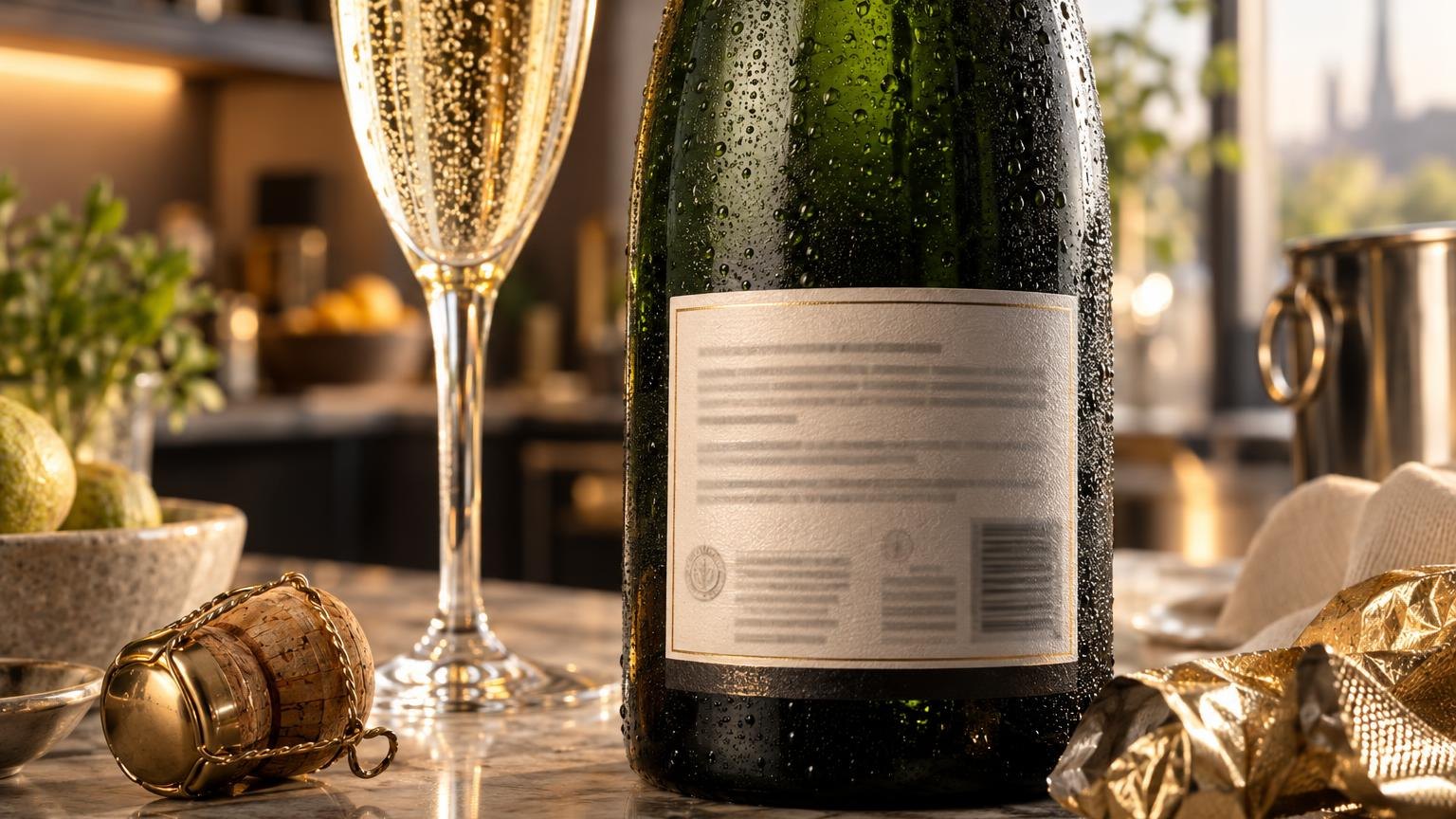
Check the back label near the government warning. On US-market Champagne, “Contains Sulfites” appears within or directly below the TTB-mandated health warning statement.
For precise SO₂ data, consult the producer’s technical sheet. Houses like Louis Roederer and Bollinger publish total SO₂ figures — typically 25–45 mg/L for their prestige cuvées — on importer or estate websites.

Questions Readers Ask
Does Champagne contain sulfites?
Every bottle of Champagne contains sulfites. Yeast naturally produces 10–20 mg/L of sulfur dioxide during fermentation, so even a “zero added sulfite” Champagne is never truly sulfite-free.
Most conventional Champagnes contain 120–150 mg/L of total SO₂, well below the EU legal maximum of 185 mg/L for sparkling wines.
Why are sulfites added to Champagne during production?
Winemakers add sulfur dioxide at multiple stages—after pressing, before bottling, and at dosage—to prevent oxidation and inhibit spoilage bacteria such as Brettanomyces and acetic acid bacteria.
Without added SO₂, Champagne’s delicate aromas of brioche and citrus would deteriorate rapidly. The second fermentation in bottle also demands microbiological stability that sulfites help guarantee.
How do sulfite levels in Champagne compare to still wines?
Champagne typically contains 120–150 mg/L of total SO₂, which is lower than most sweet white wines (up to 300–400 mg/L) and comparable to dry white wines (100–150 mg/L).
Dry red wines generally carry less, averaging 50–100 mg/L, because tannins provide additional antioxidant protection that sparkling whites lack.
Can you buy sulfite-free Champagne?
Truly sulfite-free Champagne does not exist because fermentation itself generates sulfites.
However, a small number of grower-producers such as Champagne Drappier (Brut Nature Zéro Dosage) and Leclerc Briant market cuvées with no sulfites added beyond what yeast creates, resulting in total SO₂ levels around 20–30 mg/L.
These bottles require careful storage at 10–12 °C and shorter cellaring windows.
Do sulfites in Champagne cause headaches?
Clinical evidence does not support sulfites as a primary headache trigger for most people.
A 2008 study in the Journal of Headache and Pain pointed to biogenic amines like histamine and tyramine, plus alcohol-induced vasodilation, as more likely causes.
Sulfite sensitivity affects roughly 1% of the general population and up to 5% of asthmatics, manifesting mainly as respiratory symptoms rather than headaches.
What does “Contains Sulfites” mean on a Champagne label?
In the United States, the TTB (Alcohol and Tobacco Tax and Trade Bureau) requires the statement “Contains Sulfites” on any wine with total SO₂ at or above 10 mg/L—a threshold every Champagne exceeds.
The EU mandates a similar allergen declaration for wines above 10 mg/L. The label does not distinguish between naturally occurring and added sulfites, nor does it disclose the exact concentration.
Do organic or biodynamic Champagnes have fewer sulfites?
EU-certified organic sparkling wines are capped at 155 mg/L of total SO₂, roughly 30 mg/L below the conventional limit of 185 mg/L. Biodynamic certifiers like Demeter impose even stricter limits—typically 90 mg/L for dry sparkling wine.
Producers such as Fleury and Françoise Bedel, both Demeter-certified, regularly bottle Champagnes in the 40–70 mg/L range, offering a measurably lower-sulfite option without sacrificing aging potential.
Keep Exploring
- Alcohol Content in Champagne Explained
- How Long Does Moet Champagne Last Unopened? – A Real-World, Experience-Based Guide to Shelf Life, Storage, and Quality (2026 Update)
- Dom Perignon Vs Cristal: The Easiest Way to Distinguish
- How To Break A Champagne Bottle? – A Complete Safety-First Guide Based on Real Experience
- How To Bottle Champagne Cork? – A Practical, Step-by-Step Guide From Real Experience
- All Alcohol Guides
- U.S. Food & Drug Administration — Sulfites in Wine (2024)
- National Institutes of Health / PubMed — Sulfite Sensitivity and Wine (2017)
- USDA FoodData Central — Champagne Nutrient & Additive Data (2024)
- University of California Davis — Sulfur Dioxide Management in Winemaking (2022)
- TTB / Alcohol and Tobacco Tax and Trade Bureau — Wine Labeling: Sulfite Declaration (2023)
- Comité Champagne / CIVC — Champagne Winemaking Process (2024)
- World Health Organization / JECFA — Safety Evaluation of Sulfites (2023)
- Cleveland Clinic — Sulfite Sensitivity: Symptoms and Foods to Avoid (2023)
- Wine Spectator — Understanding Sulfites in Wine (2023)