How Many Shots of Whiskey to Get Drunk? is commonly answered as 3 to 5 standard 1.5-ounce shots for many adults, but the real threshold varies by body weight, sex, food intake, drinking speed, tolerance, and whiskey proof.
A U.S. standard shot of 80-proof whiskey contains about 0.6 fluid ounces of pure alcohol. This guide explains what changes blood alcohol concentration, why “drunk” is not the same as legally impaired, and when to stop drinking for safety.
What Counts as One Whiskey Shot
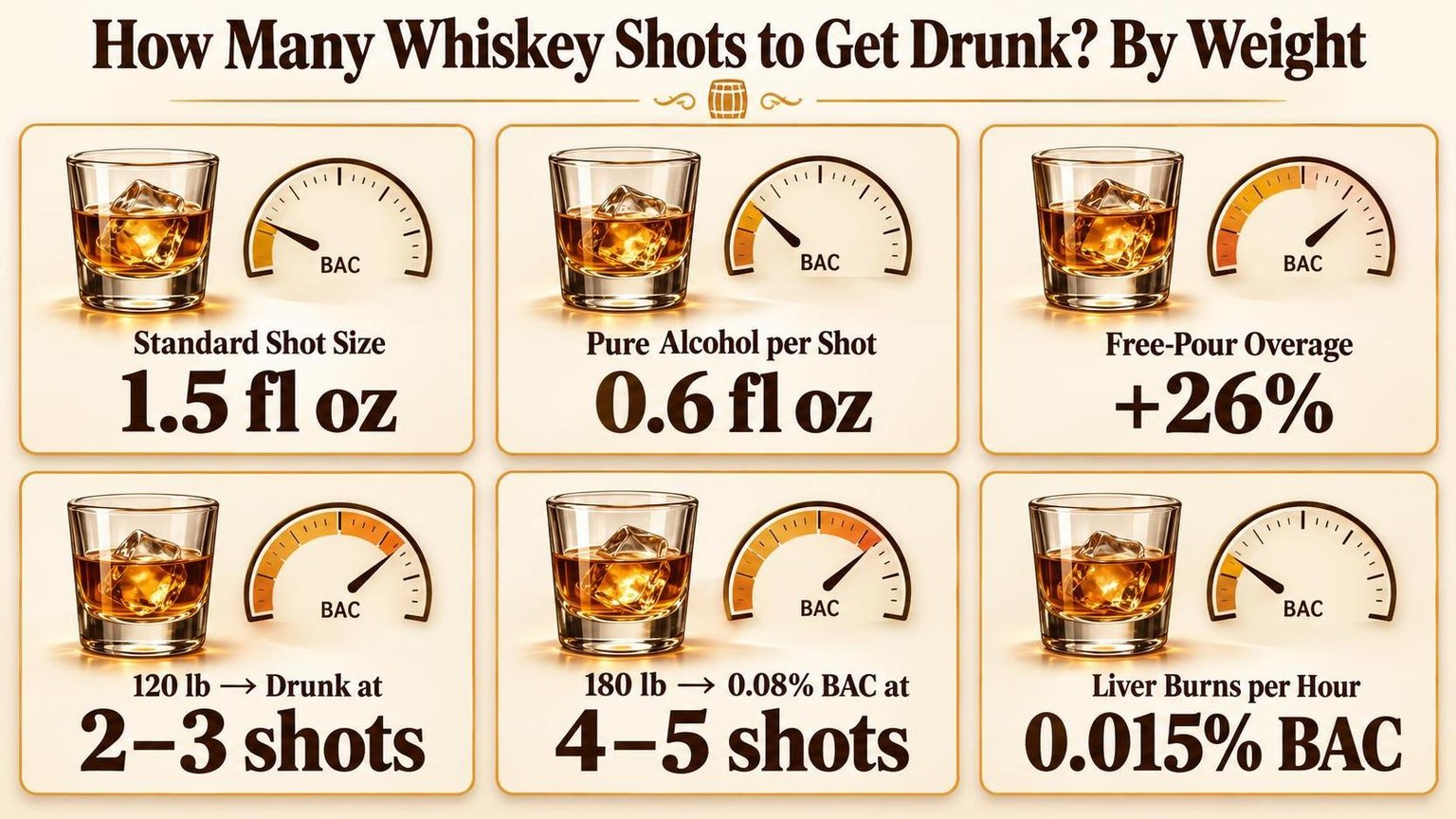
A standard whiskey shot in the United States contains 1.5 fluid ounces (44 ml) of liquid at 40% alcohol by volume. This delivers exactly 0.6 fluid ounces of pure ethanol—the same amount found in a 12-oz beer or 5-oz glass of wine.
Shot sizes vary significantly by country, which directly affects intoxication rates for travelers and home pourers.
| Country | Standard Shot Size | Metric Equivalent |
| United States | 1.5 fl oz | 44 ml |
| United Kingdom | 0.84 fl oz (single) | 25 ml |
| Australia | 1.01 fl oz | 30 ml |
| Germany | 0.68 fl oz | 20 ml |
| Japan | 2.03 fl oz | 60 ml |
A Japanese single pour contains nearly 2.5 times the alcohol of a UK single measure. This distinction matters when estimating intoxication.
ABV Changes the Equation
Not all whiskeys carry the standard 40% ABV. Proof levels shift the actual alcohol content per shot dramatically.
| Whiskey Type | Typical ABV | Pure Alcohol per 1.5-oz Shot |
| Standard bourbon (e.g., Jim Beam) | 40% | 0.6 fl oz |
| Bottled-in-bond (e.g., Evan Williams BiB) | 50% | 0.75 fl oz |
| Cask strength (e.g., Booker’s) | 62–63% | 0.93–0.95 fl oz |
| Barrel proof rye (e.g., Stagg Jr.) | 65% | 0.98 fl oz |
One shot of cask-strength bourbon at 63% ABV delivers roughly 58% more pure alcohol than a standard 40% ABV shot.
Free-Poured vs. Measured Shots
Research published in Alcoholism: Clinical and Experimental Research found that free-poured drinks average 26% larger than a standard serving. Bartenders without jiggers routinely overpour.
- Jigger-measured shot: 1.5 fl oz (accurate within 1–2 ml)
- Free-poured shot: typically 1.7–2.0 fl oz
- Generous home pour: often 2.0–2.5 fl oz, effectively 1.3–1.7 standard drinks
Counting “shots” means nothing without knowing the pour size and proof. A generous home pour of barrel-proof whiskey can equal nearly three standard drinks in a single glass.
Typical Shot Counts by Body Weight
Body weight is the single most influential variable in how quickly alcohol raises your blood alcohol concentration (BAC).
A 120-pound person reaches legal intoxication roughly twice as fast as a 240-pound person consuming the same number of standard shots.
The table below estimates BAC after consuming standard 1.5-oz shots of 80-proof (40% ABV) whiskey within one hour, based on the Widmark formula.
| Body Weight | 2 Shots | 3 Shots | 4 Shots | 5 Shots |
| 120 lbs (54 kg) | 0.06% | 0.09% | 0.12% | 0.15% |
| 140 lbs (64 kg) | 0.05% | 0.08% | 0.11% | 0.13% |
| 160 lbs (73 kg) | 0.05% | 0.07% | 0.09% | 0.12% |
| 180 lbs (82 kg) | 0.04% | 0.06% | 0.08% | 0.10% |
| 200 lbs (91 kg) | 0.04% | 0.05% | 0.07% | 0.09% |
| 220 lbs (100 kg) | 0.03% | 0.05% | 0.06% | 0.08% |
| 240 lbs (109 kg) | 0.03% | 0.04% | 0.06% | 0.07% |
The legal driving limit in all 50 U.S. states is 0.08% BAC. Values at or above that threshold are bolded considerations for impairment.
Key Takeaways from the Data
- A 120-lb person typically feels noticeably drunk after just 2–3 shots, reaching around 0.06–0.09% BAC within 60 minutes.
- A 180-lb person generally needs 4–5 shots in an hour to hit 0.08–0.10% BAC.
- A 240-lb person may consume 5 shots and still remain at approximately 0.07% BAC—just under the legal limit—but cognitive impairment begins as low as 0.03%.
These estimates use the Widmark factor of 0.68 for men and 0.55 for women. Women reach higher BAC levels at the same weight due to differences in body water percentage and alcohol dehydrogenase activity.
The liver metabolizes alcohol at a fixed rate of roughly 0.015–0.017% BAC per hour, regardless of body size. Drinking faster than this rate guarantees accumulation.
Food intake, hydration, and individual tolerance shift these numbers. An empty stomach accelerates alcohol absorption by up to 30%, according to research published in the Journal of Forensic Sciences.
How ABV Changes Drunkenness Speed
Alcohol by volume (ABV) directly determines how much ethanol enters your bloodstream per shot. A single 1.5-oz pour of 80-proof whiskey delivers 0.6 oz of pure alcohol, while a barrel-proof pour packs nearly double that amount.
Standard whiskey categories span a wide ABV range, and each level changes intoxication speed measurably.
| Whiskey Type | Typical ABV | Pure Alcohol per 1.5-oz Shot | Estimated BAC Rise (160-lb Person) |
| Standard Bourbon (e.g., Jim Beam) | 40% | 0.60 oz | ~0.02% |
| Bottled-in-Bond (e.g., Evan Williams BiB) | 50% | 0.75 oz | ~0.025% |
| Cask Strength (e.g., Booker’s) | 62–65% | 0.93–0.98 oz | ~0.033% |
| Barrel Proof (e.g., Stagg Jr.) | 65–68% | 0.98–1.02 oz | ~0.035% |
At 40% ABV, three shots bring a 160-lb person to roughly 0.06% BAC—below the U.S. legal limit of 0.08%. The same three shots of a 65% cask-strength whiskey push BAC to approximately 0.10%, already over the legal threshold.
Why Higher ABV Hits Faster
Concentrated ethanol crosses the stomach lining and enters the bloodstream more rapidly. Research published in the Journal of Forensic Sciences confirms that beverages above 20% ABV accelerate gastric emptying, increasing absorption speed.
- 40% ABV: Peak BAC typically reached 30–45 minutes after a shot on an empty stomach.
- 50% ABV: Peak BAC arrives roughly 20–35 minutes after consumption.
- 60%+ ABV: Peak BAC can hit within 15–25 minutes, leaving less reaction time to gauge intoxication.
Practical Takeaway
Always check the label. A 130-proof whiskey delivers 63% more ethanol per shot than an 80-proof bottle. Two cask-strength pours equal roughly three standard shots in total alcohol content.
The liver metabolizes about 0.015% BAC per hour regardless of what you drank. Higher-ABV whiskey simply front-loads more ethanol than your body can clear, accelerating drunkenness proportionally.
Why Tolerance Changes Shot Limits
Alcohol tolerance fundamentally alters how many whiskey shots produce intoxication. A 180-lb occasional drinker may feel drunk after 4 shots, while a habitual drinker of the same weight might need 7–8 shots to reach a similar perceived effect.
How Tolerance Develops
Repeated alcohol exposure triggers neuroadaptive changes. The brain upregulates GABA-A receptor subtypes and increases glutamate activity, requiring more alcohol to achieve the same sedative effect.
Functional tolerance can develop in as few as 7–10 days of consistent drinking, according to research published in Alcohol Research & Health (NIAAA). Three distinct tolerance types affect shot limits differently.
| Tolerance Type | Mechanism | Impact on Shot Limit |
| Metabolic (pharmacokinetic) | Liver produces more alcohol dehydrogenase enzymes | BAC rises 10–30% slower per shot |
| Functional (pharmacodynamic) | Brain neurons become less sensitive to alcohol | Perceived impairment drops at same BAC |
| Learned (behavioral) | Practiced compensation in familiar settings | Motor tasks appear less affected; BAC unchanged |
Metabolic tolerance increases the rate the liver clears ethanol from roughly 0.015 g/dL per hour in non-tolerant individuals to approximately 0.020 g/dL per hour in chronic drinkers.
The Danger of Functional Tolerance
Functional tolerance masks impairment without reducing organ damage. A tolerant person drinking 8 shots still reaches a BAC near 0.16–0.20%, double the US legal limit of 0.08%.
The liver processes roughly one standard drink per hour regardless of tolerance level. Whiskey shots consumed faster than this rate accumulate ethanol in the bloodstream at nearly the same pace for everyone.
- Tolerance does not reduce liver toxicity—cirrhosis risk rises with cumulative intake, not perceived drunkenness.
- Tolerance can reverse within 2–3 weeks of abstinence, sharply lowering the shot threshold for intoxication.
- Genetic variants in ADH1B and ALDH2 enzymes cause up to a 40% difference in baseline alcohol metabolism between individuals.
- Women develop functional tolerance more slowly than men due to lower body water percentage (52% vs. 61%).
Higher tolerance never equals safety. It simply delays subjective drunkenness while the same toxic load damages the liver, heart, and brain with every additional shot consumed.
BAC Estimates After Whiskey Shots
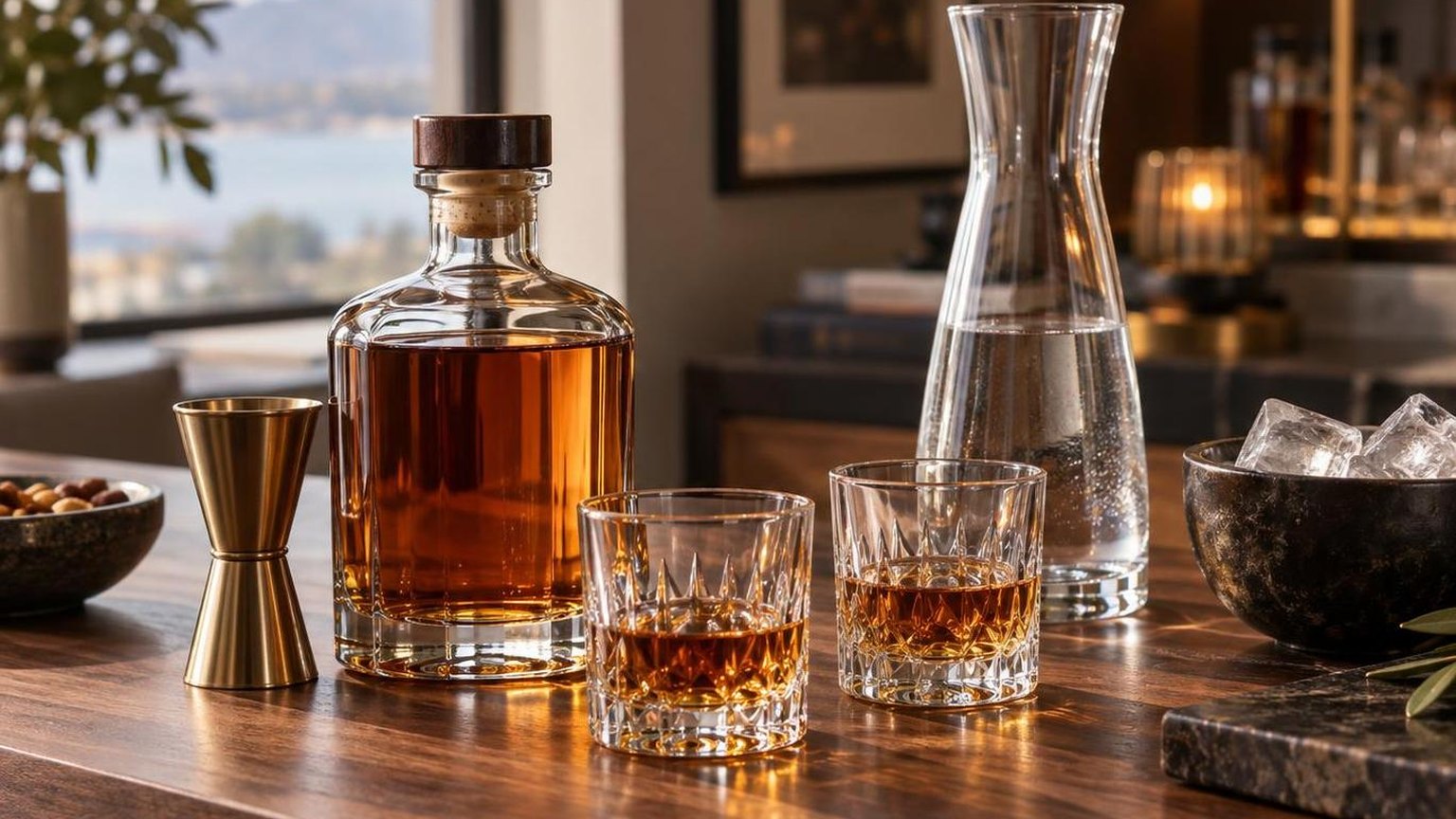
Blood Alcohol Concentration (BAC) rises predictably based on body weight, biological sex, and number of standard drinks consumed.
A standard whiskey shot (1.5 oz at 40% ABV) contains roughly 0.6 oz of pure alcohol — identical to one standard drink defined by the NIAAA.
The Widmark formula estimates BAC using body weight and a gender-based metabolic constant (0.73 for men, 0.66 for women). The following table shows approximate BAC levels one hour after drinking, assuming no food in the stomach.
| Shots | Man (160 lb) | Man (200 lb) | Woman (130 lb) | Woman (160 lb) |
| 1 | 0.03% | 0.02% | 0.04% | 0.03% |
| 2 | 0.05% | 0.04% | 0.08% | 0.07% |
| 3 | 0.08% | 0.06% | 0.12% | 0.10% |
| 4 | 0.10% | 0.08% | 0.16% | 0.13% |
| 5 | 0.13% | 0.10% | 0.21% | 0.17% |
These figures account for roughly 0.015% BAC metabolized per hour — the average hepatic clearance rate confirmed by forensic pharmacology research.
What BAC Levels Actually Feel Like
- 0.02–0.03%: Mild relaxation, slight warmth. Most people do not feel “drunk.”
- 0.05–0.06%: Lowered inhibitions, impaired judgment. Legally impaired in Utah (0.05% limit).
- 0.08%: The legal intoxication threshold in 49 U.S. states. Coordination, reaction time, and speech are measurably affected.
- 0.10–0.12%: Clear motor impairment, slurred speech, poor balance.
- 0.15%+: High risk of vomiting, blackouts, and dangerously impaired motor control.
A 160-lb man typically reaches the 0.08% legal limit after 3 shots in one hour. A 130-lb woman can reach 0.08% after just 2 shots in the same timeframe.
Cask-strength whiskeys (50–65% ABV) deliver 25–63% more alcohol per shot than standard 80-proof bottles. Drinking these raises BAC proportionally faster — two shots of barrel-proof bourbon can equal three shots of standard whiskey.
Food, hydration, and individual enzyme activity (particularly ADH and ALDH2 levels) shift these numbers. Estimates above reflect averages; personal variation of ±20% is common according to data published in the Journal of Forensic Sciences.
Signs You Should Stop Drinking
Your body sends measurable warning signals before alcohol becomes dangerous. A blood alcohol concentration (BAC) of 0.08% is the legal limit in all 50 US states, but impairment starts as low as 0.02%. Recognizing these signs prevents overconsumption.
BAC Levels and Warning Signs
| BAC Level | Typical Signs | Risk Level |
| 0.02–0.03% | Slight warmth, mild mood elevation, relaxed inhibitions | Low |
| 0.05–0.06% | Lowered alertness, impaired judgment, exaggerated emotions | Moderate |
| 0.08–0.10% | Slurred speech, poor coordination, slowed reaction time | High — legally impaired |
| 0.15–0.19% | Severe motor impairment, blurred vision, nausea | Dangerous |
| 0.25%+ | Confusion, vomiting, risk of unconsciousness | Life-threatening |
At 0.30% BAC or above, alcohol poisoning becomes likely. At 0.40%, the risk of coma or death is significant. These thresholds apply to all body types.
Physical Signs to Stop Immediately
- Slurred or slow speech — indicates your central nervous system is significantly depressed
- Difficulty standing or walking straight — motor cortex impairment, typically at 0.08% BAC or higher
- Nausea or stomach discomfort — your body’s direct signal that it cannot process more ethanol
- Blurred or double vision — occurs around 0.10–0.15% BAC as eye muscles lose coordination
- Numbness in face, hands, or feet — peripheral nerve suppression, a late-stage warning
- Memory gaps during the session — fragmentary blackouts begin around 0.16% BAC according to NIAAA research
Behavioral Red Flags
Repeating yourself, making impulsive decisions, or feeling emotionally volatile are cognitive impairment markers. These appear before the more obvious physical symptoms.
The CDC defines binge drinking as 5 or more drinks for men, or 4 or more for women, within approximately 2 hours. Exceeding these thresholds raises BAC to 0.08% or above in most adults.
Stop drinking when you notice any single sign listed above. Switch to water, eat food, and wait at least one hour per standard drink before considering driving.
Your liver metabolizes roughly one standard drink — 1.5 oz of 80-proof whiskey — per hour.
Safer Whiskey Drinking Guidelines
The U.S. Dietary Guidelines for Americans (2020–2025) define moderate drinking as up to 2 standard drinks per day for men and 1 for women. A standard whiskey drink equals 1.5 oz (44 ml) at 40% ABV, containing 0.6 oz of pure alcohol.
Standard Drink Limits by Authority
| Organization | Men (per day) | Women (per day) | Standard Drink Size |
| USDA / HHS (US) | 2 drinks | 1 drink | 1.5 oz / 44 ml |
| NHMRC (Australia) | 10 per week max | 10 per week max | 30 ml spirit |
| NHS (UK) | 14 units/week | 14 units/week | 25 ml single measure |
| WHO | No safe level stated | No safe level stated | — |
The NIAAA defines binge drinking as reaching a BAC of 0.08% or higher—typically 5+ drinks for men or 4+ drinks for women within about 2 hours.
Practical Harm-Reduction Strategies
- Measure every pour. Free-poured whiskey averages 2–2.5 oz per glass, exceeding the 1.5 oz standard by 33–67%. Use a jigger.
- Pace at one drink per hour. The liver metabolizes roughly 0.015 g/dL of BAC per hour, equivalent to about one standard drink for a 160 lb person.
- Alternate with water. Drink at least 8 oz of water between each whiskey to slow consumption and reduce dehydration.
- Eat before and during. Food slows gastric emptying by up to 50%, reducing peak BAC significantly compared to drinking on an empty stomach.
- Avoid mixing with energy drinks. The CDC reports that combining alcohol with caffeine masks intoxication cues, increasing the likelihood of binge drinking by approximately 3 times.
- Set a hard stop. Decide your drink count before you start. Two 1.5 oz pours of 80-proof whiskey total 1.2 oz of pure ethanol—enough for most adults to feel relaxed without impairment.
Cask-strength whiskeys (50–68% ABV) deliver 25–70% more alcohol per ounce than standard 80-proof bottles. Adjust your pour size downward proportionally.
Certain populations should avoid whiskey entirely: pregnant women, individuals on medications like metformin or benzodiazepines, anyone with liver disease, and people under the legal drinking age of 21 in the United States.
Common Questions
How many shots of whiskey does it take for an average person to feel drunk?
For a 160-lb (73-kg) person with average alcohol tolerance, 3–4 shots of 80-proof (40% ABV) whiskey consumed within one hour typically pushes blood alcohol concentration (BAC) to 0.08%—the legal intoxication threshold in all 50 US states.
Body weight, sex, food intake, and individual enzyme activity shift that number by 1–2 shots in either direction.
How does body weight change the number of shots needed to get drunk?
A 120-lb person reaches 0.08% BAC after roughly 2–3 shots in an hour, while a 220-lb person may need 5–6 shots in the same timeframe.
This occurs because a larger body distributes alcohol across more water volume, diluting its concentration in the bloodstream.
Why do women generally get drunk faster on whiskey than men?
Women carry about 52% body water compared to 61% in men, concentrating alcohol in a smaller fluid volume and producing a higher BAC per shot.
Women also produce less gastric alcohol dehydrogenase, the stomach enzyme that breaks down ethanol before it enters the bloodstream, so more alcohol is absorbed per serving.
Does eating before drinking whiskey really slow down intoxication?
A meal containing fat, protein, and carbohydrates can reduce peak BAC by up to 20–30% compared to drinking on an empty stomach, according to research published in the Journal of Forensic Sciences.
Food slows gastric emptying, which delays alcohol’s transit to the small intestine where roughly 80% of absorption occurs.
How long does it take the body to metabolize one shot of whiskey?
The liver processes alcohol at a near-constant rate of about 0.015–0.017 g/dL per hour, which translates to roughly one standard 1.5-oz shot of 80-proof whiskey every 60–75 minutes.
Drinking faster than this rate causes BAC to accumulate, which is why rapid consecutive shots accelerate intoxication dramatically.
Does higher-proof whiskey get you drunk in fewer shots?
A standard 1.5-oz shot of cask-strength bourbon at 130 proof (65% ABV) delivers 62.5% more pure ethanol than an 80-proof (40% ABV) shot of the same volume.
Two shots of cask-strength whiskey can produce roughly the same BAC as 3–4 shots of standard 80-proof whiskey, so proof matters significantly when estimating intoxication.
Can you build a tolerance that increases how many shots it takes to feel drunk?
Regular heavy drinkers develop functional tolerance, meaning the brain adapts to alcohol’s sedative effects and subjective “drunkenness” feels blunted—but BAC still rises at the same metabolic rate.
A tolerant individual may feel sober after 5–6 shots yet register a BAC of 0.10% or higher, making them both legally impaired and at elevated risk for liver damage.
How many shots of whiskey are considered dangerous or potentially lethal?
A BAC of 0.30–0.40% is life-threatening for most adults; for a 160-lb person, that range corresponds to roughly 10–15 shots consumed within 2–3 hours.
The CDC reports that approximately 2,200 Americans die annually from alcohol poisoning, with binge drinking—defined as 5+ drinks in about 2 hours for men—being the primary cause.
Related Reading
- What To Mix With Disaronno?
- What Does Barrel Proof Mean? What You Need to Know
- What Is The Best Irish Whiskey To Drink Straight?
- Basil Hayden Dark Rye Review – Information From Experts
- What Is A Jameson And Coke Called? Get the Answer
- All Alcohol Guides
- National Institute on Alcohol Abuse and Alcoholism – "What Is A Standard Drink?" (2024)
- Centers for Disease Control and Prevention – "Dietary Guidelines for Alcohol" (2024)
- National Institute on Alcohol Abuse and Alcoholism – "Understanding Blood Alcohol Content (BAC)" (2024)
- PubMed – "Alcohol Pharmacokinetics: Absorption, Distribution, and Elimination" (2012)
- Stanford University Office of Alcohol Policy and Education – "Blood Alcohol Concentration (BAC) Calculator" (2024)
- National Highway Traffic Safety Administration – "Impaired Driving" (2024)
- Bowling Green State University – "Alcohol Metabolism" (2024)