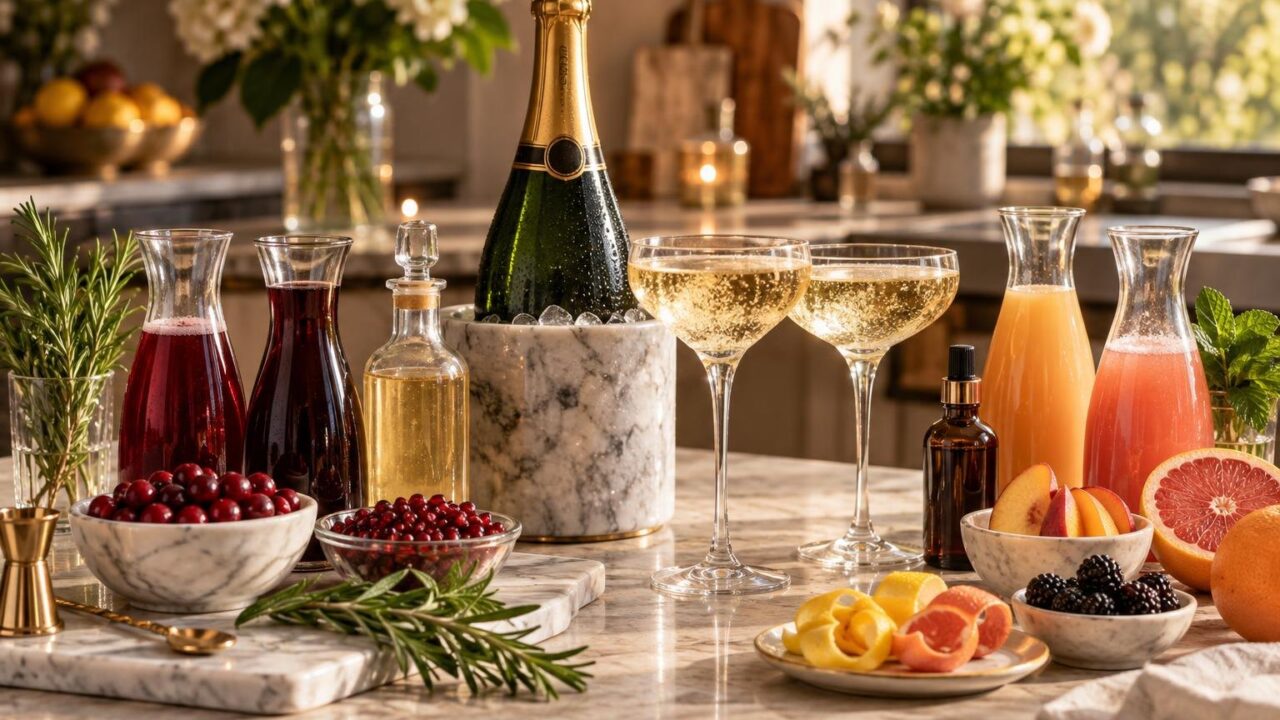
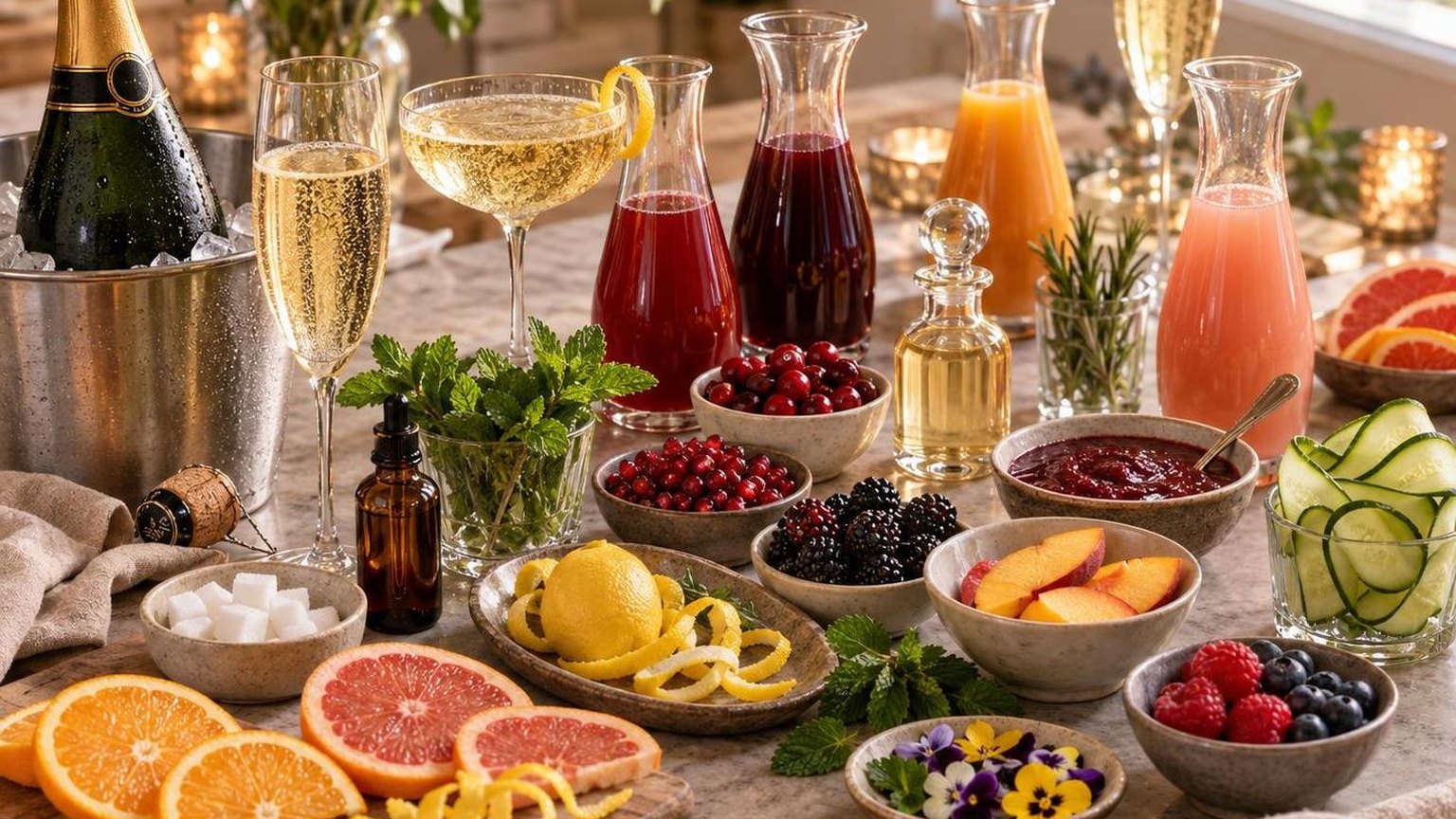
What to Mix with Champagne Besides Orange Juice is a practical list of dry, tart, floral, and bitter mixers: cranberry juice, grapefruit, peach nectar, elderflower liqueur, crème de cassis, bitters, and fresh herbs all work without burying the bubbles.
Champagne’s high acidity, fine carbonation, and low-to-moderate sugar make it flexible. The best mixers add contrast, not weight. Use chilled ingredients, small pours, and avoid thick syrups unless the wine is very dry.
This guide focuses on balanced combinations for brunch, aperitifs, parties, and low-effort cocktails using ingredients that are easy to measure, pour, and adjust by sweetness level.
Fresh Citrus Beyond Orange Juice
Orange juice dominates Champagne cocktails through sheer familiarity, not superiority.
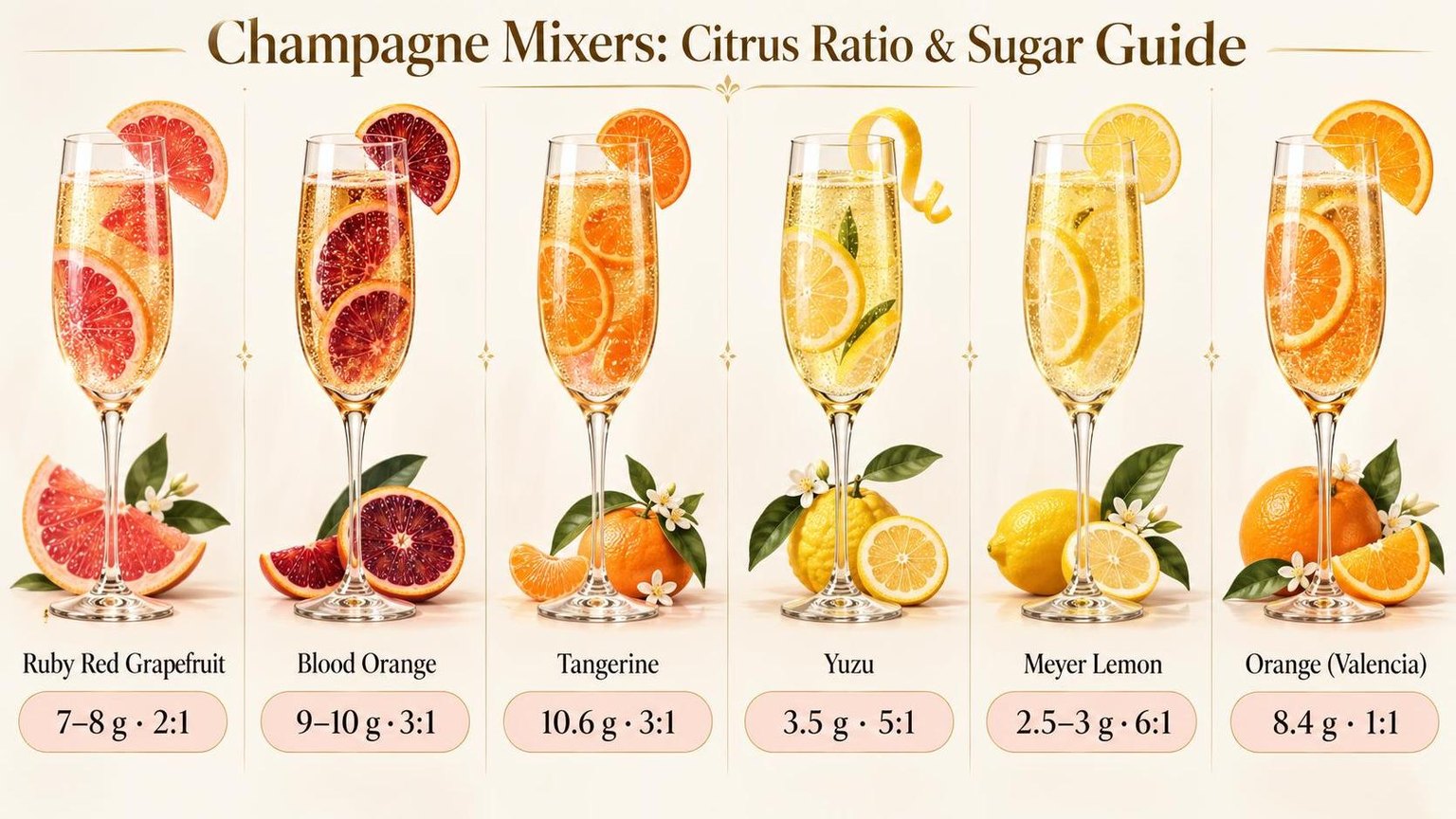
Grapefruit, blood orange, tangerine, yuzu, and Meyer lemon each bring distinct acidity profiles that complement Champagne’s 12–12.5% ABV and natural tartaric acid backbone with greater complexity.
Grapefruit Juice: The Classic Alternative
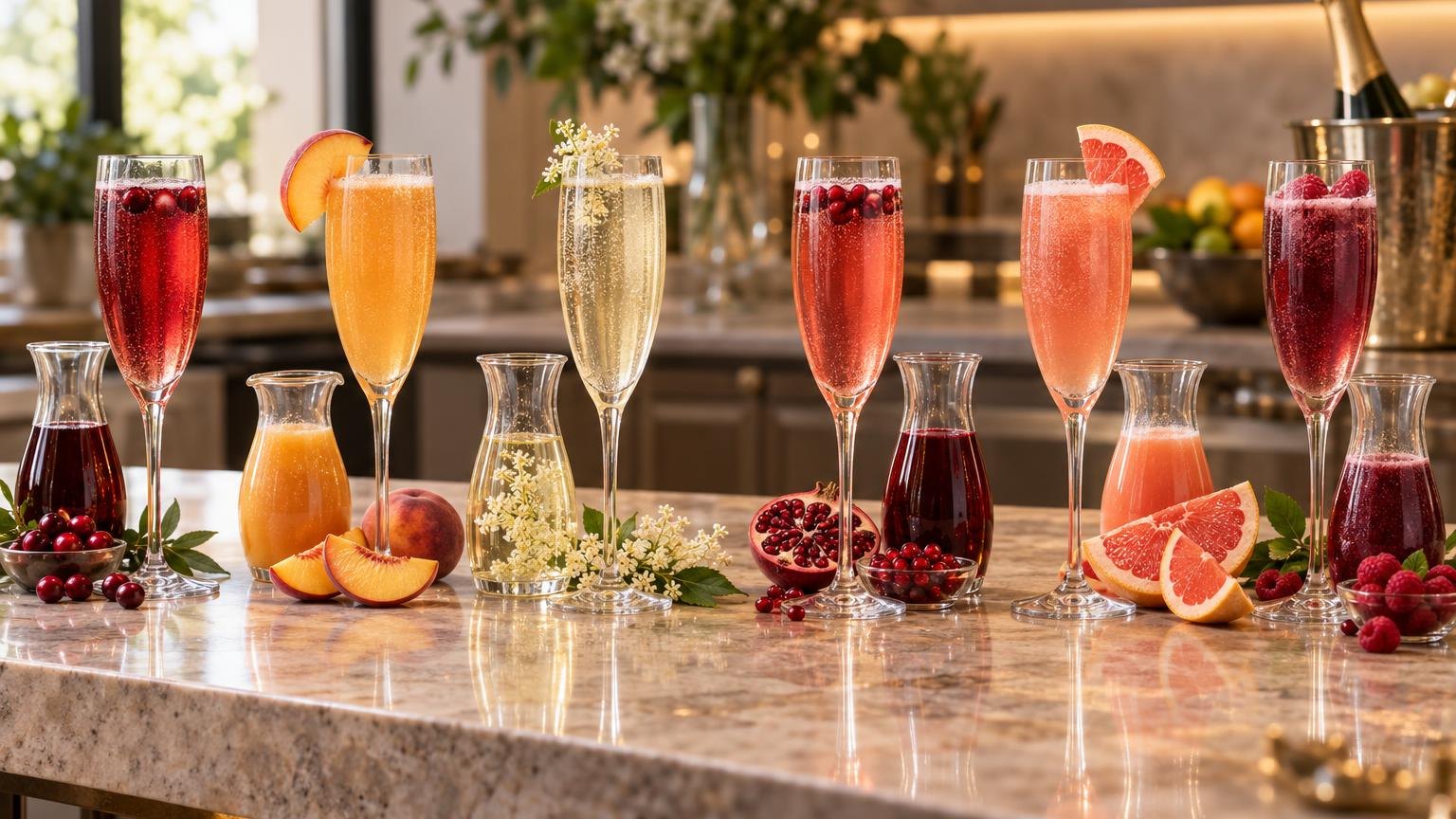
A 2:1 ratio of Champagne to fresh Ruby Red grapefruit juice creates a cocktail the French call a “Bière de Champagne.” Pink and Ruby Red varieties contain roughly 7–8 g of sugar per 100 mL compared to orange juice’s 8.4 g.
Producing a drier, more tart result.
White grapefruit works even better with Brut Champagne (under 12 g/L residual sugar). Its lower sugar content—approximately 6.2 g per 100 mL—lets Champagne’s yeasty, biscuity notes remain prominent.
Citrus Juice Profiles Compared
| Citrus Juice | Sugar (g/100 mL) | pH Level | Recommended Ratio (Champagne:Juice) |
| Orange (Valencia) | 8.4 | 3.3–4.2 | 1:1 |
| Ruby Red Grapefruit | 7.0–8.0 | 3.0–3.5 | 2:1 |
| Blood Orange | 9.0–10.0 | 3.4–3.8 | 3:1 |
| Tangerine | 10.6 | 3.3–4.5 | 3:1 |
| Meyer Lemon | 2.5–3.0 | 2.0–2.4 | 6:1 |
| Yuzu | 3.5 | 2.1–2.6 | 5:1 |
Blood Orange and Tangerine
Blood oranges contain anthocyanins—the same pigment compounds found in red wine—giving them a deeper flavor and striking crimson color. Their higher sugar content (9–10 g/100 mL) pairs best with Brut Nature or Zero Dosage Champagne.
Tangerine juice, at 10.6 g of sugar per 100 mL, is the sweetest option listed. Use it sparingly at a 3:1 Champagne-to-juice ratio to avoid cloying sweetness overwhelming the wine’s effervescence.
Yuzu and Meyer Lemon
Yuzu, a Japanese citrus prized by bartenders worldwide, offers floral aromatics alongside sharp acidity (pH 2.1–2.6).
A 5:1 ratio preserves Champagne’s mousse while adding a perfumed, slightly bitter edge absent from conventional citrus options.
Meyer lemons—a cross between a mandarin and a citron—deliver less acidity than standard Eureka lemons. Their pH of 2.0–2.4 still demands heavy dilution, but their gentle sweetness eliminates the need for added simple syrup.
Preparation Tips
- Always juice citrus fresh; pasteurized bottled juices contain heat-degraded flavor compounds that taste flat against live carbonation.
- Strain through a fine-mesh sieve to remove pulp, which accelerates CO₂ loss in the glass.
- Chill juice to 4–7°C (39–45°F) before combining—warm juice collapses Champagne’s bead within seconds.
- Pour juice first, then add Champagne slowly along the glass wall to preserve up to 70% more carbonation than reverse pouring.
Bitters Liqueurs and Champagne Cocktails
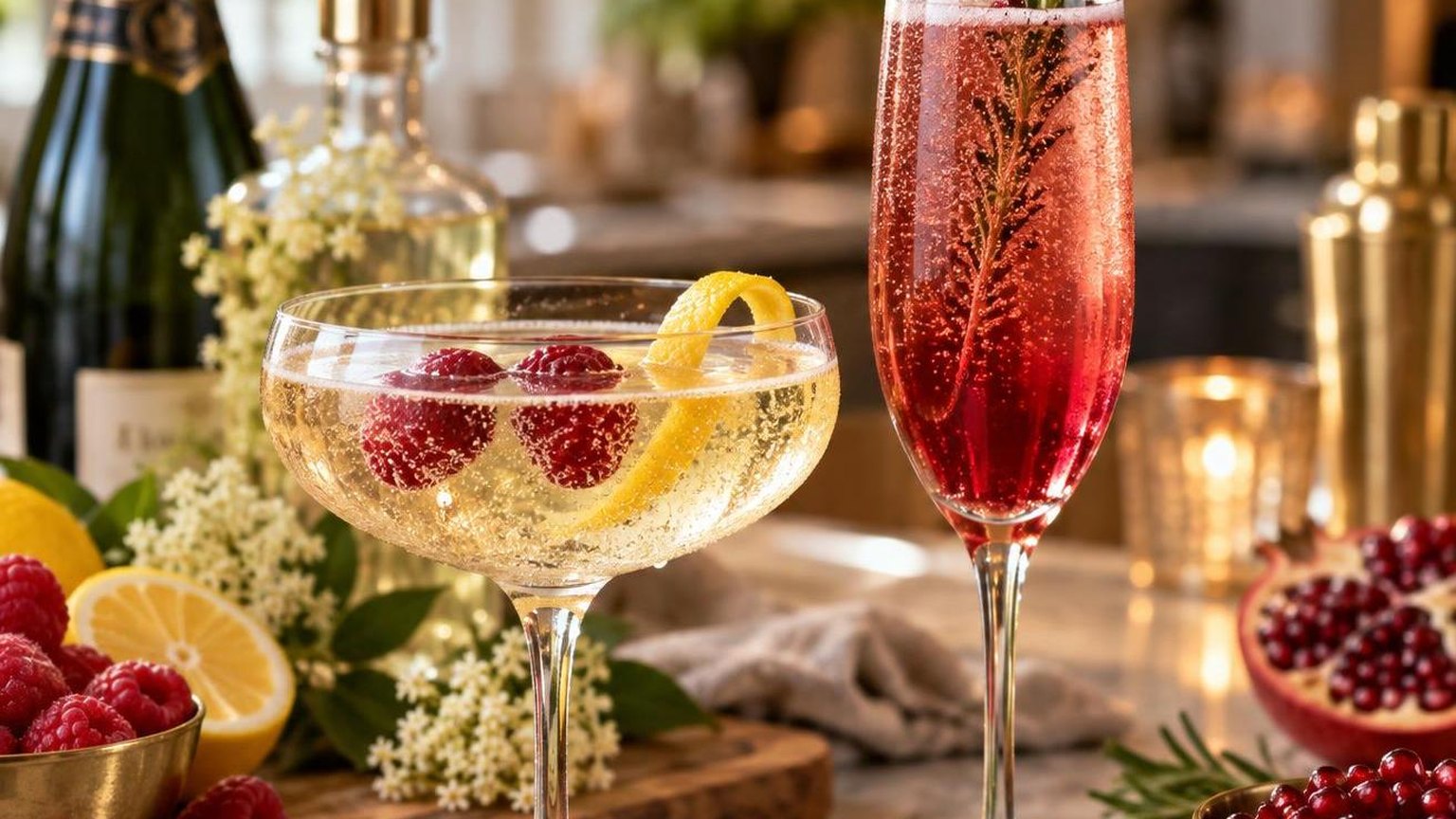
Bitters and liqueurs transform Champagne from a simple pour into a structured cocktail with layered aromatics.
The classic Champagne Cocktail, documented since Jerry Thomas’s 1862 Bar-Tender’s Guide, remains the blueprint for this entire category.
The Classic Champagne Cocktail
Soak one white sugar cube with 2–3 dashes of Angostura bitters. Drop it into a flute, add 15 ml (½ oz) cognac, then top with 120 ml of brut Champagne.
The sugar cube dissolves slowly, releasing a steady stream of fine bubbles while the bitters contribute gentian root and cassia bark aromatics.
Bitters That Work with Champagne
Not all bitters pair equally well with sparkling wine’s acidity (pH 3.0–3.3). Aromatic and citrus-forward styles integrate best.
| Bitters Style | Example Brand | Dose per Flute | Flavor Profile |
| Aromatic | Angostura | 2–3 dashes | Clove, cinnamon, gentian |
| Orange | Regans’ No. 6 | 2 dashes | Dried orange peel, cardamom |
| Peach | Fee Brothers Peach | 2 dashes | Stone fruit, light spice |
| Lavender | Scrappy’s Lavender | 1–2 dashes | Floral, herbaceous |
| Celery | The Bitter Truth Celery | 1 dash | Vegetal, savory |
Liqueurs That Elevate Champagne
Liqueurs add body and sweetness, balancing Champagne’s tartaric acid. Keep volumes to 15–22 ml per 120 ml of Champagne to avoid masking carbonation.
- Chambord (20% ABV): 15 ml turns a flute into a Kir Royale variant with black raspberry depth. Chambord’s cognac base harmonizes with Champagne’s yeast-derived brioche notes.
- St-Germain (20% ABV): 15 ml of this elderflower liqueur adds lychee and pear aromatics. Created in 2007, it became the most awarded new liqueur of the 2000s decade.
- Crème de Violette (20% ABV): 10–15 ml delivers a purple hue and floral perfume. Combined with 2 dashes of Peychaud’s bitters, it creates a striking aromatic aperitif.
- Maraschino (32% ABV): 10 ml of Luxardo Maraschino contributes dry cherry and almond character. Higher proof means a smaller pour is sufficient.
- Grand Marnier (40% ABV): 15 ml of this cognac-orange blend adds warmth and bitter orange oil complexity without excessive sweetness.
Technique Tips
Always add bitters and liqueurs to the glass before pouring Champagne. Pouring over these ingredients integrates flavors through natural carbonation turbulence, eliminating the need to stir and preserving dissolved CO₂.
Chill liqueurs to 6–8 °C before mixing. Room-temperature additions warm the Champagne and accelerate CO₂ loss.
A 10 °C temperature difference can reduce effervescence duration by roughly 30%, according to research by Gérard Liger-Belair at the University of Reims.
Fruit Purées for Bellinis and Rossinis
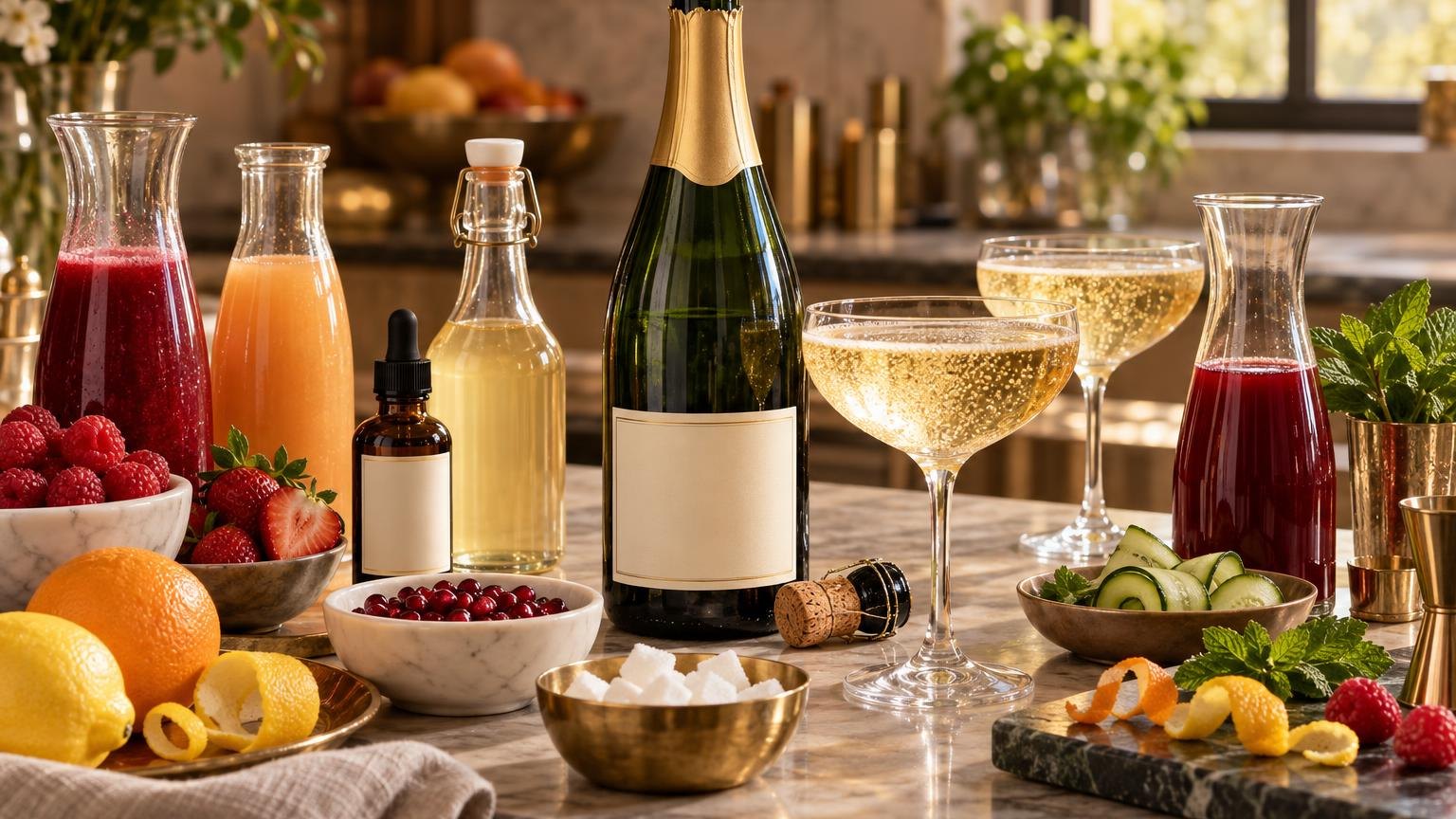
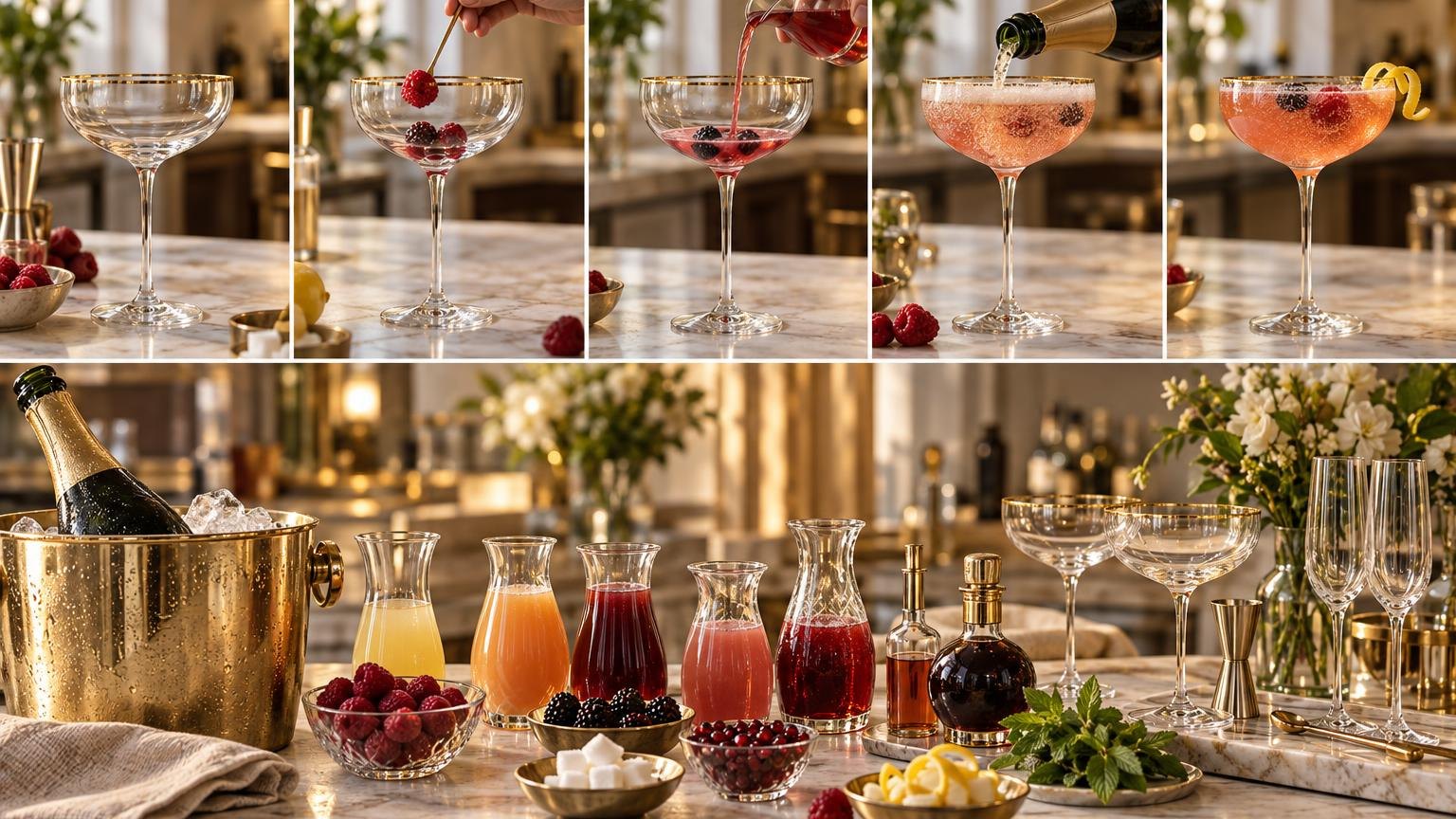
The Bellini was invented in 1948 by Giuseppe Cipriani at Harry’s Bar in Venice, using white peach purée and Prosecco. The Rossini substitutes strawberry purée.
Both templates work beautifully with Champagne, producing richer, more complex results than their Prosecco-based originals.
Classic Bellini Ratio and Technique
Cipriani’s original recipe calls for 2 parts white peach purée to 3 parts sparkling wine.
With Champagne’s higher pressure (5–6 atmospheres versus Prosecco’s 3–3.5), pour the purée first and add Champagne slowly to preserve effervescence.
White peaches contain less acidity than yellow varieties, typically measuring 3.3–3.7 pH compared to 3.0–3.4 for yellow peaches. This lower acidity pairs better with Champagne’s already-sharp malic and tartaric acid profile.
Purée-to-Champagne Ratios by Fruit
| Fruit Purée | Ratio (Purée : Champagne) | Added Sugar Needed | Cocktail Name |
| White peach | 2 : 3 | None | Bellini |
| Strawberry | 1 : 3 | ½ tsp per serving | Rossini |
| Raspberry | 1 : 4 | ½ tsp per serving | Tintoretto (variation) |
| Mango | 1 : 3 | None | No standard name |
| Passion fruit | 1 : 4 | 1 tsp per serving | No standard name |
| Pomegranate | 1 : 4 | 1 tsp per serving | No standard name |
Tart fruits like raspberry and passion fruit require less purée and more sugar. Sweeter fruits like mango (14–16° Brix) and white peach (11–14° Brix) need little or no sweetening adjustment.
Making Purées at Home
- Use fully ripe fruit — underripe fruit lacks the sugar content and aromatic compounds needed to stand up to Champagne’s yeast-driven flavors.
- Blend fruit until completely smooth, then pass through a fine-mesh sieve to remove seeds and fibrous material.
- Add 1 teaspoon of fresh lemon juice per 250 g of purée to prevent oxidation and brighten flavor.
- Chill purée to 4°C (39°F) before mixing — warm purée accelerates CO₂ loss in Champagne.
- Freeze purée in ice cube trays for up to 3 months; thaw in the refrigerator for 8–12 hours before use.
Choosing the Right Champagne Style
Brut Champagne (0–12 g/L residual sugar) works best with naturally sweet purées like mango and peach. Extra Brut (0–6 g/L) suits purées where you’ve added sugar separately, giving you more control over final sweetness.
Avoid vintage or prestige cuvées for purée cocktails. A reliable non-vintage Brut in the $30–$45 range delivers the acidity and mousse needed without wasting complex aging nuances behind fruit flavors.
The Rossini Distinction
The Rossini uses 40–50 g of fresh strawberry purée per 120 mL flute. Named after composer Gioachino Rossini, it originated at Harry’s Bar alongside the Bellini.
Strain the purée thoroughly — strawberry seeds sink and create an unappealing sediment layer within minutes.
Savory Mixers for Brunch Champagne
Savory Champagne cocktails deliver complexity that fruit-based options cannot match.
Tomato juice, vegetable broths, and herb-infused syrups transform brut Champagne into sophisticated brunch drinks that pair naturally with eggs, charcuterie, and smoked fish.
Tomato Juice: The Champagne Cocktail Staple
A Champagne Bloody Mary—sometimes called a Bloody Fizz or Poinsettia Rouge—combines 2 ounces of tomato juice with 4 ounces of brut Champagne.
The acidity of tomato juice (pH around 4.1–4.3) complements Champagne’s tartaric acid profile without clashing.
Use high-quality, thick-pressed tomato juice rather than thin cocktail blends. Season the tomato juice separately with celery salt, horseradish, and cracked black pepper before adding the Champagne.
Pour the sparkling wine last to preserve carbonation.
Clamato and Champagne
Substituting Clamato for plain tomato juice creates a briny, umami-rich variation. The clam broth component adds approximately 250 mg of sodium per 8-ounce serving, so reduce any added salt accordingly. This pairs exceptionally well with raw oysters.
Herb-Infused Simple Syrups
Rosemary, thyme, and basil syrups add savory depth at low volume. Use a 1:1 sugar-to-water ratio infused with fresh herbs for 15–20 minutes. Add just ½ ounce per flute to avoid overpowering the wine.
| Herb Syrup | Amount per Flute | Best Champagne Style | Flavor Profile |
| Rosemary | ½ oz | Brut | Piney, aromatic |
| Thyme | ½ oz | Extra Brut | Earthy, floral |
| Basil | ½ oz | Brut Nature | Peppery, fresh |
| Sage | ¼ oz | Brut | Musky, warm |
Vegetable Juices Beyond Tomato
Carrot juice blended with Champagne in a 1:2 ratio produces a naturally sweet, earthy cocktail. Fresh beet juice at just 1 ounce per glass delivers striking color and mineral undertones that echo Champagne’s chalky terroir character.
- Cucumber juice: 1.5 oz per flute, adds cooling freshness with only 8 calories per ounce
- Celery juice: 1 oz per flute, brings vegetal salinity and approximately 40 mg sodium per ounce
- Fennel juice: 1 oz per flute, contributes anise notes that complement blanc de blancs Champagne
Hot Sauce and Shrub Additions
Two to three dashes of Tabasco (roughly 0.5 ml) stirred into a Champagne flute add heat without altering carbonation significantly. For a more complex approach, 1 ounce of apple cider vinegar shrub introduces tangy, fermented depth.
Shrubs with a vinegar-sugar-vegetable base (such as red pepper or celery shrub) date back to 17th-century colonial drinking traditions.
Their acidity level, typically pH 2.8–3.2, integrates seamlessly with Champagne’s own acidity range of pH 3.0–3.3.
Low Alcohol Mixers That Preserve Bubbles
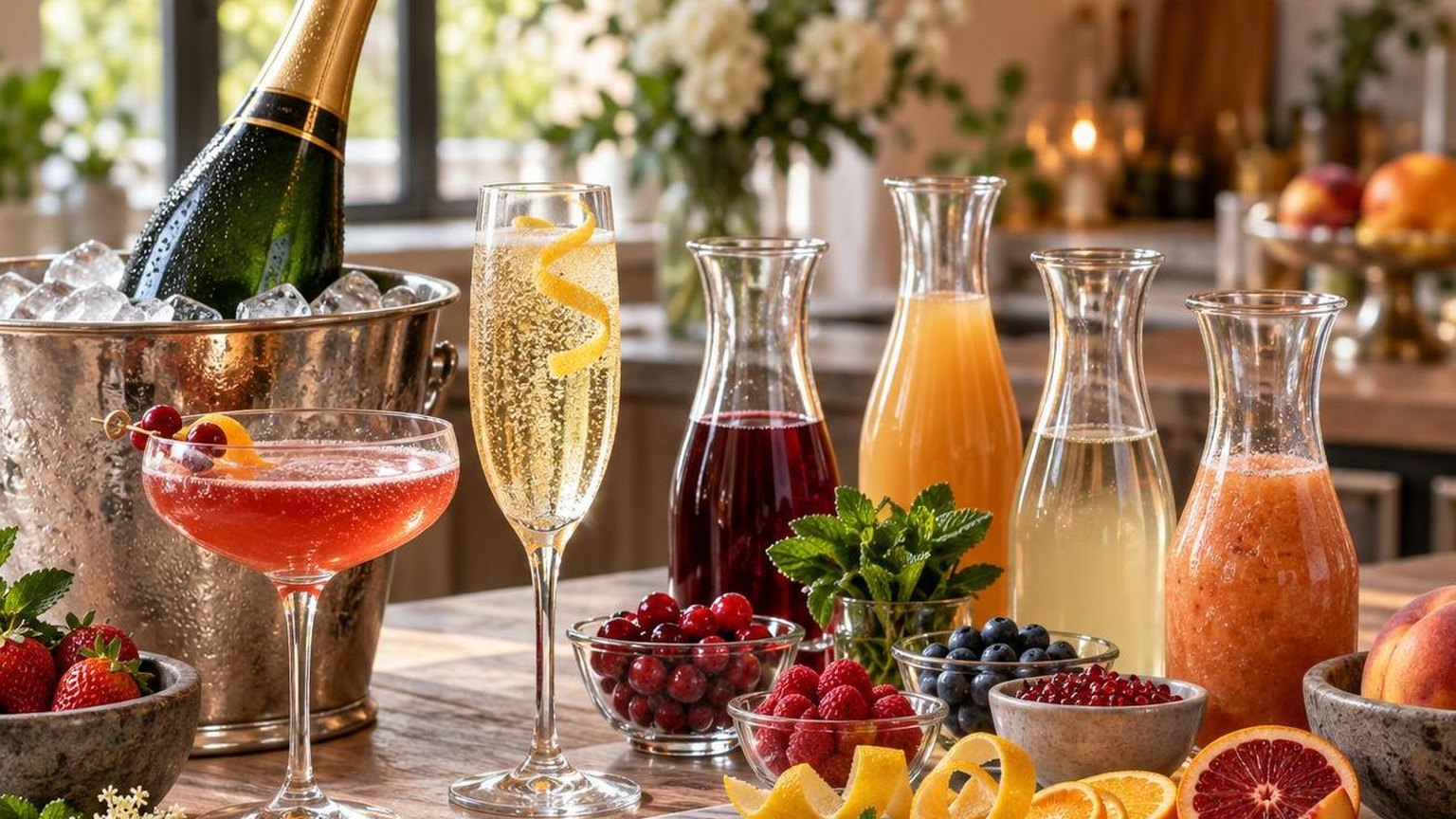
Carbonation loss accelerates when high-proof spirits hit champagne, disrupting the dissolved CO₂ equilibrium. Low-alcohol mixers—under 15% ABV—introduce less ethanol disruption, helping retain effervescence longer.
These options keep your flute lively while adding genuine complexity.
Why ABV Matters for Bubbles
Research published in the Journal of Agricultural and Food Chemistry confirms that CO₂ solubility decreases as alcohol concentration rises.
Keeping the final drink below 14–15% ABV preserves noticeably more carbonation than a champagne-plus-spirit cocktail that pushes toward 18–20%.
| Mixer | Typical ABV | Estimated Final Drink ABV | Bubble Retention vs. Neat Champagne |
| St-Germain Elderflower Liqueur | 20% | 13–14% | ~85% |
| Lillet Blanc | 17% | 12–13% | ~88% |
| Chambord | 16.5% | 12–13% | ~88% |
| Aperol | 11% | 11–12% | ~92% |
| Crème de Pêche | 15% | 12–13% | ~89% |
Estimated final ABV assumes a standard ratio of 1 oz (30 ml) mixer to 4 oz (120 ml) champagne. Bubble retention percentages are approximate, based on comparative CO₂ loss observations.
St-Germain Elderflower Liqueur
At 20% ABV, St-Germain sits at the upper boundary. Pour ¾ oz into a flute, then top with 4 oz brut champagne. The liqueur’s natural elderflower sweetness carries 12 g of sugar per ounce, balancing high-acid cuvées without masking minerality.
Lillet Blanc
This Bordeaux-based aromatized wine (17% ABV) contains quinine and citrus botanicals. Use a 1:4 ratio with champagne for a drink reminiscent of a French aperitif. Lillet’s gentle bitterness complements blanc de blancs especially well.
Aperol
The Aperol Spritz formula—3 parts prosecco, 2 parts Aperol, 1 splash soda—adapts beautifully to champagne. Aperol’s 11% ABV barely shifts the alcohol level.
Its bitter orange and rhubarb profile pairs with rosé champagne for a striking coral-colored drink.
Chambord
Black raspberry liqueur at 16.5% ABV produces the classic Kir Royale variation. Use just ½ oz per flute to avoid oversweetening.
Chambord contains cognac, Madagascar vanilla, and Moroccan citrus peel—layers that unfold as bubbles carry aromatics upward.
Best Practices for Maximum Fizz
- Chill both mixer and champagne to 42–46°F (6–8°C); cold liquid holds CO₂ more effectively.
- Pour the mixer into the glass first, then add champagne slowly along the glass wall at a 45° angle.
- Never stir—the pouring action provides sufficient integration.
- Use a flute or tulip glass; wide coupes lose carbonation up to 3× faster due to larger surface area.
- Consume within 10–15 minutes of mixing for optimal effervescence.
These low-alcohol mixers deliver flavor complexity without flattening your champagne. The key principle is simple: less added ethanol means more persistent, finer bubbles in every sip.
Common Questions
What fruit juices mix well with Champagne besides orange juice?
Peach purée creates a Bellini (invented at Harry’s Bar in Venice, 1948), while crème de cassis (blackcurrant liqueur) plus Champagne makes a Kir Royale.
Pomegranate juice, pear nectar, and passion fruit juice also pair naturally because their acidity (pH 3.0–3.5) closely matches Champagne’s own pH range of 3.0–3.2, preventing flavor clash.
Can you mix Champagne with liqueurs?
St-Germain elderflower liqueur (20% ABV) is one of the most popular choices—typically 15 ml per flute—adding floral sweetness without overpowering the wine’s effervescence.
Chambord (black raspberry, 16.5% ABV), crème de violette, and Grand Marnier all work in small pours of 10–20 ml per 120 ml of Champagne.
Does mixing Champagne with other spirits ruin the bubbles?
Adding a small amount of spirit—typically a bar spoon (5 ml) to half an ounce (15 ml)—has minimal impact on carbonation because CO₂ loss is driven by surface agitation, not alcohol content.
Pour the spirit first, then add Champagne slowly down the side of the glass to preserve the mousse. Cocktails like the French 75 (gin, lemon, sugar, Champagne) prove that spirits and bubbles coexist effectively.
What is the correct ratio when mixing Champagne cocktails?
Most classic Champagne cocktails use a 3:1 or 4:1 ratio of Champagne to the secondary ingredient.
A Bellini calls for roughly two-thirds Champagne to one-third peach purée, while a Kir Royale uses just 10–15 ml of crème de cassis topped with 120–150 ml of Champagne.
Exceeding 1:1 dilutes the wine’s character and flattens carbonation.
Can you mix Champagne with bitters?
The classic Champagne Cocktail—dating to at least the 1862 edition of Jerry Thomas’s bartender guide—soaks a sugar cube with 2–3 dashes of Angostura bitters, then tops it with Champagne and a lemon twist.
The bitters add warm spice notes (clove, gentian, cinnamon) that complement Brut Champagne’s toasty, brioche-like flavors.
Is it better to use Brut or Demi-Sec Champagne for mixing?
Brut (less than 12 g/L residual sugar) works best with sweet mixers like fruit purées and liqueurs because it prevents the drink from becoming cloying.
Demi-Sec (32–50 g/L residual sugar) pairs better with tart additions such as fresh lemon juice or grapefruit juice, where its sweetness provides balance.
Using Extra Brut or Brut Nature with already-dry ingredients can make the cocktail taste harsh.
What non-alcoholic mixers pair with Champagne?
Hibiscus tea (cooled and unsweetened) tints the wine pink and adds tart, cranberry-like flavor.
Fresh muddled herbs like mint or basil, a splash of rosewater (no more than 2–3 drops per flute), and shrubs (fruit-vinegar syrups) all add complexity without additional alcohol.
Even a few drops of high-quality honey dissolved in warm water create an approachable, lightly sweet sparkler.
Will cheap sparkling wine work as well as real Champagne in these mixes?
For cocktails, a quality Crémant (Loire, Alsace, or Burgundy, typically $12–$18) or Spanish Cava ($8–$14) delivers comparable acidity and fine bubbles at a fraction of the cost of Champagne ($40+ average).
Prosecco works in fruit-forward drinks like Bellinis but its larger, frothier bubbles and lower acidity (around pH 3.3–3.5) make it less suited to spirit-heavy cocktails like the French 75.
Reserve true Champagne for sipping or minimal-ingredient cocktails where its yeasty complexity can shine.
Further Reading
- How Many Calories In A Bottle Of Champagne 750Ml? The Surprising Truth You Need to Know (Complete Guide)
- What Percentage Alcohol Is Champagne?
- 9 Must-Know Facts About How Many Glasses Of Champagne To A Bottle (2026 Expert Serving Guide)
- How To Box Chocolate Covered Strawberries And Champagne? The Ultimate Elegant Gift Guide (Step-by-Step Tutorial)
- Alcohol Content in Champagne Explained
- How Many Mimosas in a Bottle of Champagne?
- Brut Vs Extra Dry Champagne: The Easiest Way to Distinguish
- Dom Perignon Vs Cristal: The Easiest Way to Distinguish
- Does Sparkling Wine Have Alcohol?
- All Alcohol Guides
- USDA FoodData Central – Nutrient profiles for fruits, juices, and mixers used in Champagne cocktails (2024)
- National Institute on Alcohol Abuse and Alcoholism – Alcohol content and standard drink definitions relevant to mixed Champagne drinks (2024)
- PubMed Central – "Carbon dioxide in carbonated beverages induces ghrelin release and increased food consumption" (2017)
- Cornell University College of Agriculture – Research on flavor compound interactions in sparkling wine (2023)
- CDC – Dietary Guidelines for alcohol moderation when consuming mixed drinks (2020)
- University of California Davis – Department of Viticulture and Enology, sparkling wine composition studies (2024)
- Difford's Guide – Professional bartender cocktail database with Champagne cocktail recipes and ratios (2024)
- Wine Folly – Visual guide to sparkling wine styles and food/mixer pairing principles (2024)
- Imbibe Magazine – Editorial coverage of modern Champagne cocktail trends and mixology techniques (2024)
- The Oxford Companion to Spirits and Cocktails, Oxford University Press – Authoritative reference on Champagne cocktail history and formulation (2021)