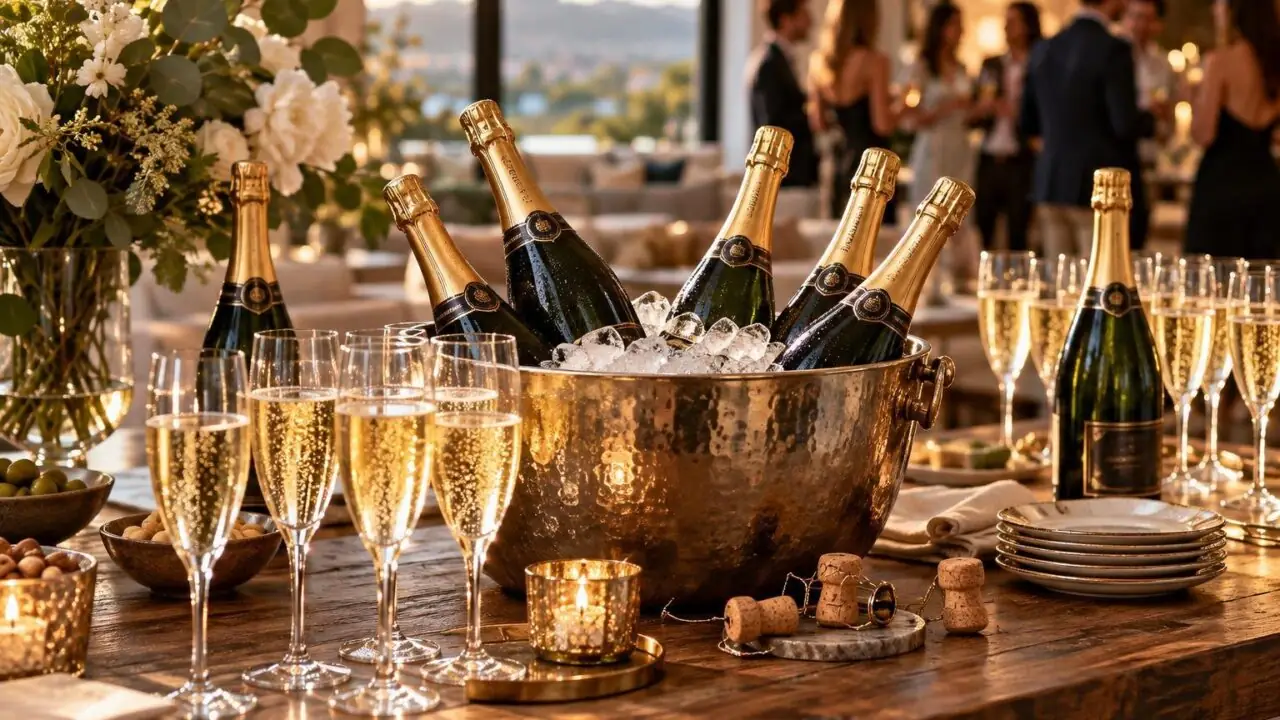
Champagne typically contains 12–12.5% alcohol by volume (ABV), placing it squarely alongside most still wines.
That narrow range results from strict Appellation d’Origine Contrôlée regulations governing grape ripeness, dosage, and fermentation in the Champagne region of northeastern France.
Several factors shift the final ABV slightly: vintage conditions, residual sugar level (brut vs. demi-sec), and whether the house adds a higher-sugar liqueur d’expédition.
Prestige cuvées from warmer years occasionally reach 13% ABV, while blanc de blancs from cooler vintages may sit closer to 11.5%. Understanding these variables helps you choose bottles that match your palate and occasion.
Typical ABV Range in Champagne
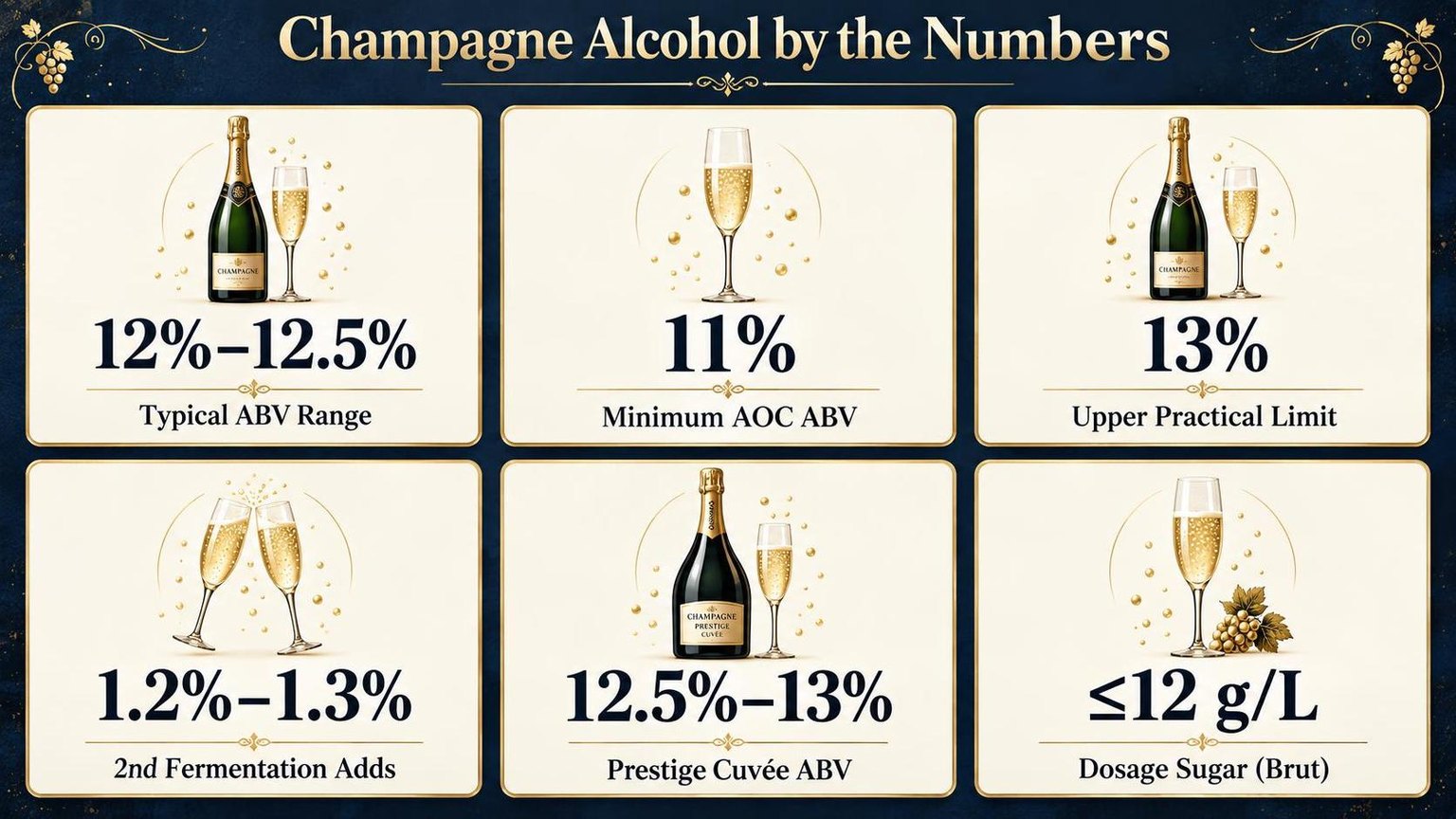
Most Champagne falls between 12% and 12.5% ABV, though the full spectrum runs from about 11% to 13%.
This range results from strict Appellation d’Origine Contrôlée (AOC) regulations, grape ripeness levels in the cool Champagne climate, and the secondary fermentation that adds roughly 1.2–1.3% alcohol in bottle.
The Comité Champagne requires a minimum potential alcohol of 9% from base wine grapes at harvest. Secondary fermentation in bottle raises the final ABV by adding approximately 24 grams of sugar per liter during liqueur de tirage.
ABV by Champagne Style
Different styles and cuvées land at distinct points within the overall range. Prestige cuvées often sit slightly higher due to stricter fruit selection and riper grapes.
| Champagne Style | Typical ABV |
| Non-Vintage Brut | 12.0%–12.5% |
| Vintage/Millésimé | 12.0%–12.5% |
| Prestige Cuvée (e.g., Dom Pérignon, Krug Grande Cuvée) | 12.5%–13.0% |
| Blanc de Blancs | 12.0%–12.5% |
| Blanc de Noirs | 12.0%–12.5% |
| Rosé Champagne | 12.0%–12.5% |
| Extra Brut / Brut Nature | 12.0%–12.5% |
| Demi-Sec | 11.0%–12.0% |
Why the Range Is Narrow
Champagne’s northerly latitude — around 49°N — limits grape sugar accumulation. Cooler growing seasons historically produced base wines at 9%–10.5% ABV before secondary fermentation pushed the total upward.
Climate change has shifted this baseline. Average harvest sugar levels rose measurably between the 1980s and 2020s, with base wines now routinely reaching 10.5%–11% ABV. The result is final bottles occasionally touching 13%.
Specific Producer Examples
Label-declared ABV values from well-known houses illustrate the tight clustering within the range.
| Producer & Cuvée | Declared ABV |
| Moët & Chandon Impérial Brut NV | 12.0% |
| Veuve Clicquot Yellow Label Brut NV | 12.0% |
| Dom Pérignon 2013 Vintage | 12.5% |
| Krug Grande Cuvée 171ème Édition | 12.5% |
| Ruinart Blanc de Blancs NV | 12.5% |
| Laurent-Perrier Demi-Sec | 12.0% |
| Bollinger Special Cuvée NV | 12.0% |
How Dosage Affects Perceived Strength
Dosage sugar does not change ABV — it is added after disgorgement in tiny quantities. A Brut Nature at 0–3 g/L sugar and a Demi-Sec at 32–50 g/L can share identical ABV.
However, higher dosage can mask the perception of alcohol on the palate. Demi-Sec Champagnes taste softer and less “hot,” even when their ABV matches a Brut at 12%.
- Minimum legal ABV for Champagne AOC: 11%
- Most common declared ABV on labels: 12.0% or 12.5%
- Upper practical limit: 13%, rarely exceeded
- Secondary fermentation contribution: approximately 1.2%–1.3% additional alcohol
Why Champagne ABV Varies by Style
Champagne typically ranges from 11.5% to 13.5% ABV, but the specific style determines where a bottle falls within that spectrum.
Base wine composition, dosage levels, and winemaking decisions during méthode champenoise all directly influence final alcohol content.
Style-by-Style ABV Breakdown
Different Champagne styles produce measurably different alcohol levels. The table below reflects typical ranges found across major houses and grower-producers.
| Champagne Style | Typical ABV Range | Key Factor |
| Brut Nature / Zero Dosage | 12.0%–12.5% | No added sugar post-disgorgement |
| Extra Brut | 12.0%–12.5% | 0–6 g/L dosage |
| Brut (most common) | 12.0%–12.5% | Up to 12 g/L dosage |
| Extra Dry / Extra Sec | 12.0%–12.5% | 12–17 g/L dosage |
| Sec (Dry) | 12.0%–12.5% | 17–32 g/L dosage |
| Demi-Sec | 12.0%–13.0% | 32–50 g/L dosage |
| Doux | 12.0%–13.5% | 50+ g/L dosage |
| Blanc de Blancs | 12.0%–12.5% | 100% Chardonnay, lighter body |
| Blanc de Noirs | 12.0%–13.0% | Pinot Noir/Meunier, riper fruit |
| Prestige Cuvée (Vintage) | 12.0%–12.5% | Selected parcels, precise vinification |
Grape Variety Influence
Chardonnay grapes from the Côte des Blancs typically reach 10%–10.5% potential alcohol at harvest. Pinot Noir from Ambonnay or Bouzy often achieves 10.5%–11%. These differences carry through to the finished wine.
The secondary fermentation inside the bottle adds approximately 1.2%–1.3% ABV. This occurs when 24 grams per liter of sugar converts to roughly 1.25% additional alcohol plus CO₂ pressure of 5–6 atmospheres.
Dosage and Its Subtle Effect
Dosage—the liqueur d’expédition added after disgorgement—contains sugar dissolved in reserve wine.
While dosage primarily affects sweetness perception, the sugar itself does not re-ferment because yeast is removed during disgorgement.
The liquid added during dosage slightly dilutes alcohol content. A standard 8 g/L Brut dosage reduces ABV by roughly 0.1%–0.2%. Higher dosage in Demi-Sec styles can dilute ABV marginally more.
Vintage Conditions Matter
Warmer harvest years produce riper grapes with higher sugar levels. The 2018 and 2020 vintages in Champagne yielded base wines reaching 11% potential alcohol—higher than the 10%–10.5% seen in cooler years like 2014.
Climate trends are gradually pushing Champagne ABV upward. Average harvest potential alcohol has increased by approximately 0.5%–1.0% over the past three decades, according to data from the Comité Champagne (CIVC).
- Cool vintages (e.g., 2014): final ABV closer to 12.0%
- Warm vintages (e.g., 2018, 2020): final ABV can reach 12.5%–13.0%
- Chaptalization: permitted under AOC rules to raise must sugar by up to 1.5% potential alcohol in underripe years
Style, grape selection, vintage conditions, and dosage collectively explain why two Champagnes on the same shelf can differ by a full percentage point in alcohol—a meaningful gap in a wine region where precision defines quality.
Comparing Champagne to Other Sparkling Wines
Champagne typically falls between 12% and 12.5% ABV, placing it in the middle range among sparkling wines worldwide. Understanding how it compares to Prosecco, Cava, and other styles helps wine drinkers make informed choices based on alcohol content.
Alcohol Content by Sparkling Wine Type
| Sparkling Wine | Region | Typical ABV Range |
| Champagne | Champagne, France | 12%–12.5% |
| Prosecco | Veneto, Italy | 11%–12% |
| Cava | Catalonia, Spain | 11.5%–12% |
| Crémant d’Alsace | Alsace, France | 11.5%–12.5% |
| Franciacorta | Lombardy, Italy | 12%–13% |
| Moscato d’Asti | Piedmont, Italy | 5%–6.5% |
| English Sparkling Wine | England | 12%–12.5% |
| Sekt (German Sparkling) | Germany | 10%–12.5% |
| Cap Classique | South Africa | 11.5%–12.5% |
Why Prosecco Tends Lower
Prosecco uses the Charmat (tank) method, completing secondary fermentation in pressurized steel tanks rather than individual bottles. The Glera grape also naturally produces wines with lower potential alcohol.
Most Prosecco DOC lands around 11%–11.5% ABV. Prosecco Superiore DOCG from Conegliano Valdobbiadene occasionally reaches 12%, though this remains uncommon.
Franciacorta: Italy’s Higher-Alcohol Alternative
Franciacorta undergoes traditional method fermentation identical to Champagne. Made from Chardonnay, Pinot Nero, and Pinot Bianco, it regularly reaches 12.5%–13% ABV, often surpassing Champagne.
Franciacorta Satèn, a blanc de blancs style, uses lower bottle pressure (under 5 atmospheres versus Champagne’s 6) but maintains similar alcohol levels around 12.5%.
Moscato d’Asti: The Low-Alcohol Outlier
At just 5%–6.5% ABV, Moscato d’Asti contains roughly half the alcohol of Champagne. Winemakers deliberately halt fermentation early, preserving the Muscat grape’s natural sweetness and aromatics.
Key Factors Driving These Differences
- Climate: Champagne’s cool 10.5°C average growing temperature limits grape sugar accumulation, capping natural alcohol potential
- Production method: Traditional method wines (Champagne, Franciacorta, Cava) gain approximately 1.2%–1.5% ABV during secondary fermentation in bottle
- Grape varieties: Chardonnay and Pinot Noir achieve higher sugar levels than Glera or Muscat in their respective climates
- Regulatory minimums: EU law requires Champagne to reach at least 11% ABV; Prosecco DOC requires only 9%
Practical Takeaway
Choosing Prosecco or Moscato d’Asti over Champagne meaningfully reduces alcohol intake per glass. A standard 150ml pour of Champagne at 12.5% delivers 1.5 units of alcohol, versus 1.3 units for Prosecco at 11%.
Franciacorta and prestige English sparkling wines match or exceed Champagne’s strength.
Drinkers seeking lower-alcohol sparkling options should look to Moscato d’Asti or German Sekt labeled “trocken” at the lighter end of the spectrum.
How Dosage Influences Alcohol Content
Dosage—the final addition of sugar-wine mixture before corking—directly affects a Champagne’s perceived sweetness but also has a measurable, often overlooked impact on alcohol content.
This liqueur d’expédition typically dilutes base wine alcohol by 0.1–0.5% ABV depending on volume and composition.
What Dosage Actually Contains
The liqueur d’expédition is a blend of reserve wine and cane or beet sugar. Concentrations range from 500 to 750 grams of sugar per liter of liqueur, though each house guards its exact recipe.
During disgorgement, roughly 10–15 mL of wine is lost from each 750 mL bottle. The dosage replaces this lost volume and adds the desired sugar level, measured in grams per liter of the finished wine.
Dosage Categories and Their Alcohol Impact
The EU regulation (EC No 607/2009) defines Champagne sweetness levels by residual sugar. Each category correlates with a slightly different final ABV after dosage addition.
| Dosage Category | Sugar (g/L) | Typical ABV Impact | Common Final ABV |
| Brut Nature (Zero Dosage) | 0–3 | No dilution effect | 12.0–12.5% |
| Extra Brut | 0–6 | −0.05 to −0.1% | 12.0–12.5% |
| Brut | 0–12 | −0.1 to −0.2% | 12.0–12.5% |
| Extra Dry (Extra Sec) | 12–17 | −0.2 to −0.3% | 11.8–12.3% |
| Sec (Dry) | 17–32 | −0.3 to −0.4% | 11.5–12.0% |
| Demi-Sec | 32–50 | −0.3 to −0.5% | 11.5–12.0% |
| Doux | 50+ | −0.4 to −0.6% | 11.0–12.0% |
Why Zero-Dosage Wines Often Show Higher ABV
Brut Nature Champagnes skip dosage entirely. No dilution occurs, so the full fermentation-derived alcohol remains intact. Labels from producers like Drappier or Ayala frequently show 12.5% ABV for their zero-dosage cuvées.
In contrast, a Demi-Sec bottling from the same base wine may read 12.0% ABV after receiving 8–10 mL of concentrated sugar solution that replaces wine volume with a lower-alcohol liquid.
The Sugar Does Not Re-Ferment
A common misconception: dosage sugar does not restart fermentation. The wine already contains 5–6 atmospheres of CO₂ pressure, and sulfur dioxide added during disgorgement inhibits residual yeast activity.
The sugar therefore stays as residual sweetness rather than converting to additional alcohol. This is the critical distinction from the second fermentation, where sugar addition deliberately generates roughly 1.2–1.3% more ABV.
Practical Takeaway for Consumers
- Brut Nature and Extra Brut typically deliver the highest ABV per glass because no dilution occurs.
- Demi-Sec and Doux styles trade a fraction of alcohol for perceptible sweetness.
- The difference between zero dosage and high dosage rarely exceeds 0.5% ABV—noticeable analytically but subtle on the palate.
- Always check the label: EU law requires ABV disclosure within ±0.5% tolerance on all Champagne bottles.
Low-Alcohol and Zero-Dosage Champagne Options
Not all Champagne sits at the standard 12–12.5% ABV.
A growing segment of producers now offers Brut Nature and zero-dosage bottlings that finish fermentation with no added sugar, typically landing between 12% and 12.5% ABV with noticeably drier profiles.
Understanding Dosage and Its Impact on Perception
Dosage refers to the sugar-wine mixture (liqueur d’expédition) added after disgorgement. While dosage itself adds minimal alcohol, it directly shapes how alcoholic a Champagne tastes.
Less sugar means the alcohol comes through more prominently on the palate.
| Champagne Style | Dosage (g/L sugar) | Typical ABV |
| Brut Nature / Zero Dosage | 0–3 g/L | 12.0–12.5% |
| Extra Brut | 0–6 g/L | 12.0–12.5% |
| Brut | 0–12 g/L | 12.0–12.5% |
| Extra Dry / Extra Sec | 12–17 g/L | 12.0–12.5% |
| Demi-Sec | 32–50 g/L | 12.0–13.0% |
Notable Zero-Dosage Champagnes
Several prestigious houses and grower-producers champion the zero-dosage category. These wines rely entirely on grape ripeness and terroir expression without sugar masking any flaws.
- Drappier Brut Nature Zero Dosage – Pinot Noir-dominant, 12% ABV, with no added sulfur in some cuvées
- Laurent-Perrier Ultra Brut – one of the earliest modern zero-dosage Champagnes, launched in 1981, at 12% ABV
- Louis Roederer Brut Nature – produced with organic and biodynamic fruit from Philippe Starck collaboration, 12% ABV
- Ayala Brut Nature – Chardonnay-led at 12% ABV, aged a minimum of 3 years on lees
Truly Low-Alcohol Alternatives
Authentic Champagne below 11% ABV is essentially nonexistent. The AOC regulations and secondary fermentation process add approximately 1.2–1.3% ABV, making sub-11% bottles structurally impractical within appellation rules.
For consumers seeking significantly lower alcohol, options exist outside the Champagne AOC. Several French and international producers now make dealcoholized sparkling wines at 0.0–0.5% ABV using vacuum distillation or reverse osmosis.
| Product | Origin | ABV | Method |
| French Bloom Organic | France | 0.0% | Dealcoholized sparkling |
| Oddbird Blanc de Blancs | France | 0.0% | Dealcoholized Chardonnay |
| Thomson & Scott Noughty | Spain | 0.0% | Vacuum-distilled organic |
These products cannot legally be labeled “Champagne.” They do, however, replicate the fine-bubble mousse and toast-and-citrus aromatics that Champagne drinkers expect.
Choosing Based on Your Preferences
If you want genuine Champagne with the leanest possible profile, select Brut Nature from a reputable grower. Expect 12% ABV but a bone-dry finish that showcases acidity and minerality without residual sugar softening the edges.
For strict alcohol avoidance, dealcoholized sparkling wines are the only viable path. No true Champagne exists at meaningfully reduced alcohol levels within current AOC production standards.
Questions People Ask Most
What is the typical alcohol percentage in Champagne?
Most Champagne falls between 12% and 12.5% ABV, with 12.2% being the most common level across major houses like Moët & Chandon, Veuve Clicquot, and Laurent-Perrier.
EU regulations require Champagne to reach a minimum of 11% ABV to carry the appellation designation.
Why does Champagne have a higher alcohol content than some other sparkling wines?
Champagne undergoes two separate fermentations — the second fermentation in the bottle (méthode champenoise) adds approximately 1.2% to 1.5% additional alcohol beyond the base wine’s original level.
By contrast, Prosecco’s Charmat method and shorter secondary fermentation typically yields wines at 11% to 11.5% ABV, roughly a full percentage point lower than Champagne.
Does the sweetness level of Champagne affect its alcohol percentage?
Brut Nature and Extra Brut Champagnes with zero or minimal dosage often register at 12.5% ABV or slightly above because no sugar dilutes the final blend.
Demi-Sec and Doux styles, which contain 32–50+ g/L of residual sugar in the dosage liqueur, may show marginally lower effective alcohol, typically around 12% ABV, though the label ABV remains similar.
Is vintage Champagne higher in alcohol than non-vintage?
Vintage Champagnes tend to sit at 12.5% ABV or slightly higher because producers select riper, more concentrated grapes from exceptional harvest years. Non-vintage cuvées, blended across multiple years for consistency, average closer to 12% ABV.
The difference is modest — usually 0.3% to 0.5% — but reflects the warmer, riper fruit profile of declared vintages.
Has climate change increased the alcohol level of Champagne?
Measurably, yes. Average potential alcohol in Champagne grapes has risen from roughly 9.5% in the 1980s to over 10.5% in the 2010s, according to data tracked by the Comité Champagne (CIVC).
Warmer growing seasons produce higher sugar levels at harvest, pushing finished Champagne from a historical norm of 11.5%–12% ABV toward 12.5%–13% in recent vintages like 2018 and 2020.
How does Champagne’s alcohol content compare to still Pinot Noir and Chardonnay wines?
A Burgundy Pinot Noir typically ranges from 12.5% to 13.5% ABV, and a Californian Chardonnay often reaches 13.5% to 14.5% ABV — both notably higher than Champagne’s 12%–12.5% range.
The difference exists because Champagne grapes are deliberately harvested earlier at lower sugar levels (around 10–11° potential alcohol) to preserve the high acidity essential for sparkling wine production.
Keep Exploring
- How To Bottle Elderflower Champagne? — A Complete Professional Guide to Safe Bottling, Fermentation Control, and Long-Term Storage
- How To Break A Champagne Bottle? – A Complete Safety-First Guide Based on Real Experience
- Difference Between Brut and Extra Dry Champagne
- What Champagne Is Sweet? – Find Out Now
- 11 Essential Facts About How Much Alcohol Is In Champagne (2026 ABV Guide, Serving Strength, Effects & Real Tasting Experience)
- How Long Does Moet Champagne Last Unopened? – A Real-World, Experience-Based Guide to Shelf Life, Storage, and Quality (2026 Update)
- All Alcohol Guides
- Comité Champagne / CIVC (2024)
- U.S. Alcohol and Tobacco Tax and Trade Bureau – TTB.gov (2023)
- National Institute on Alcohol Abuse and Alcoholism – NIH.gov (2024)
- USDA FoodData Central (2024)
- PubMed / Journal of Agricultural and Food Chemistry (2013)
- University of California Davis – Department of Viticulture & Enology (2023)
- Wine Folly (2023)
- Decanter Magazine (2024)
- MasterClass (2023)
- GuildSomm (2023)