

Does Vodka Have Sulfites? Plain vodka generally contains no meaningful sulfites because distillation leaves most nonvolatile compounds behind.
Sulfites are not typically added to unflavored vodka, though the exact ingredients can vary by brand and product.
Flavored vodka may contain sulfites if ingredients or processing introduce them, so check the label or contact the producer if you are sensitive.
In the United States, packaged foods and beverages containing 10 parts per million or more of sulfites must declare them.
Distilled spirits are subject to different labeling rules, so the absence of a sulfite statement is not a guarantee that a product contains none. For a serious allergy, choose plain vodka and verify directly with the manufacturer.
Does Vodka Naturally Contain Sulfites
Vodka can contain trace sulfites, but sulfites are not an inherent ingredient of vodka. Yeast may produce sulfur dioxide during fermentation, including when the starting material is grain, potatoes, or another source of fermentable sugar.

Sulfur dioxide and related compounds can enter the fermented liquid before distillation. Distillation separates alcohol and other volatile compounds from much of that liquid; it does not establish that every sulfur compound has been removed.
Consequently, “distilled” is not the same as “guaranteed sulfite-free.”.
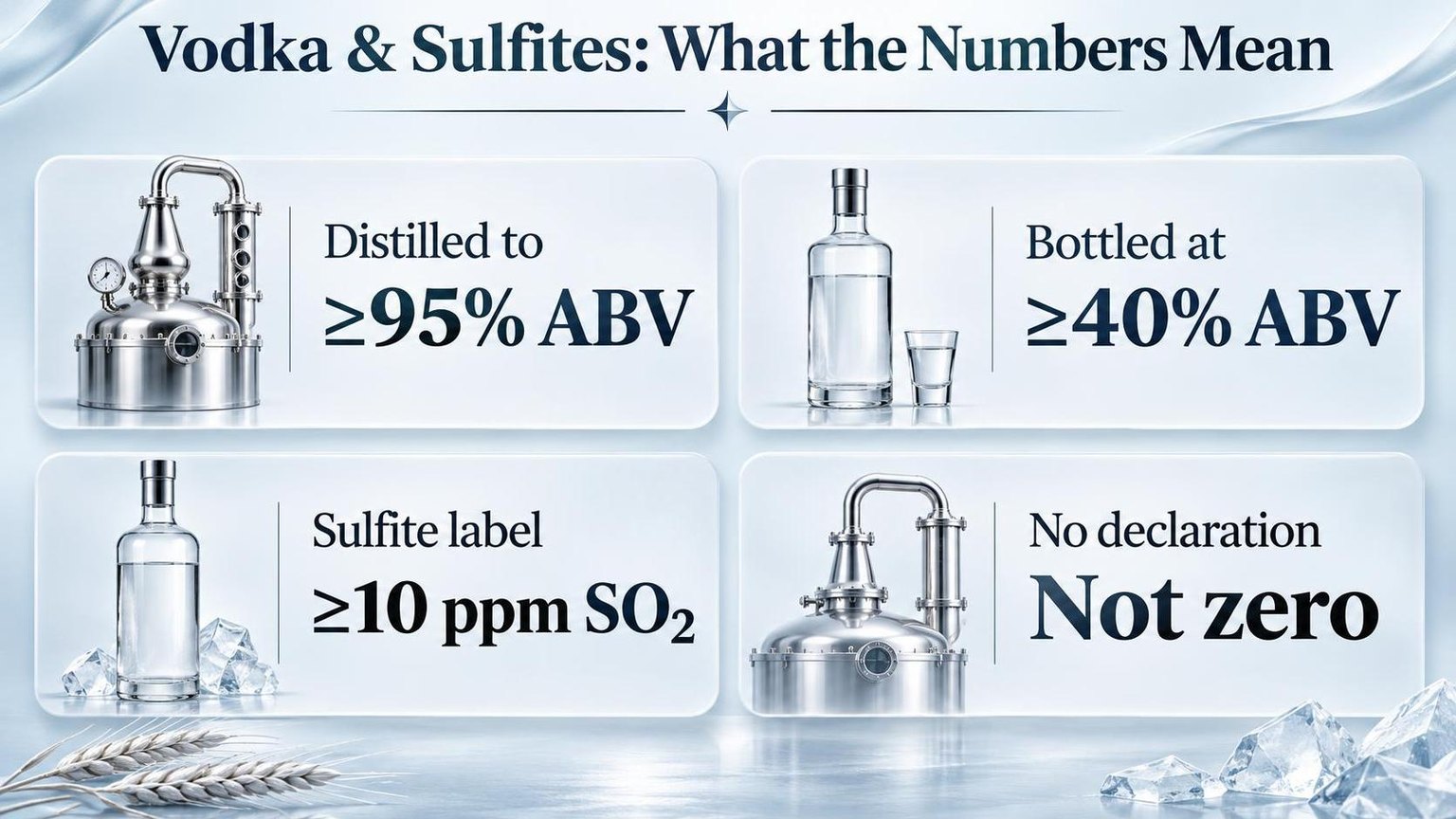
U.S. vodka is a type of neutral spirit. Federal standards define neutral spirits as distilled at or above 95% alcohol by volume and, when bottled, at no less than 40% alcohol by volume (27 CFR § 5.142).
Those standards describe how vodka is made and sold; they do not specify its sulfite concentration.
There is also no single sulfite concentration that applies to every vodka. The fermentation conditions, distillation cuts, water used for proofing, and any permitted post-distillation ingredients can differ by producer.
An unflavored vodka’s ingredient list or marketing description therefore cannot, by itself, establish a measured sulfite result.
The relevant U.S. labeling threshold is 10 parts per million (ppm), expressed as sulfur dioxide: TTB requires a sulfite declaration on distilled-spirits labels when sulfites are present at or above that level (27 CFR § 5.63).
A bottle without that declaration is not proof of zero sulfites; it may contain sulfites below the declaration threshold.
Be especially careful about extending a statement about plain vodka to flavored vodka. Added fruit preparations, mixers, or other ingredients may introduce sulfites.
A cocktail’s ingredients matter too: sulfites detected in a finished drink cannot automatically be attributed to its vodka.
If you need to avoid sulfites, ask the producer whether it has tested the specific product for sulfur dioxide and what the test found.
If your concern stems from a prior reaction, bring the product details to a clinician rather than relying on taste, clarity, or the absence of a sulfite statement on the label.

How Distillation Affects Sulfites in Vodka
Distillation generally lowers the sulfite content of vodka, but it does not prove that the finished bottle is sulfite-free. The important distinction is between sulfite compounds left in the still and sulfur dioxide, which can travel with vapor.
Vodka begins with a fermented liquid made from grain, potatoes, or another fermentable material. Fermentation can produce sulfur compounds, and some producers may use sulfites during ingredient handling.
Distillation then separates alcohol and other volatile compounds from much of the water and dissolved material in that liquid.
Most dissolved sulfite salts do not evaporate like ethanol. They therefore tend to remain in the stillage rather than pass into the collected spirit.
That is why sulfites present in a fermented base cannot simply be assumed to appear at the same concentration in vodka.
“Distilled out” is not the same as “impossible to detect,” however. Sulfites in acidic liquid can exist partly as molecular sulfur dioxide, a volatile gas. Heating may release it, allowing some to accompany the vapor.
The amount carried over depends on the starting liquid and how the distillation is run.
| Relevant point | U.S. specification or threshold |
| Neutral spirits used for vodka | Distilled at or above 95% alcohol by volume (190 proof) |
| Bottled vodka | At least 40% alcohol by volume (80 proof) |
| Sulfite label disclosure | Required at 10 ppm or more in the finished product, measured as sulfur dioxide |
The production specifications come from 27 CFR § 5.142; the disclosure threshold comes from U.S. Alcohol and Tobacco Tax and Trade Bureau sulfite-labeling rules.
Distilling to a high alcohol concentration removes much of the original liquid, but the proof requirement is not a sulfite test.
What happens after distillation matters, too. Vodka is diluted before bottling, and flavored versions may contain added extracts or other ingredients. Those additions can change the finished product’s sulfite content.
Likewise, sulfur aromas in a spirit do not establish that it contains sulfites; other sulfur compounds can cause them.
For a specific bottle, check the label for a “Contains Sulfites” statement. Its absence does not mean the concentration is zero: the U.S. disclosure rule applies at the stated threshold.
A producer’s finished-product analysis is the way to establish a measured level.

Why Vodka Labels Rarely Mention Sulfites
Plain vodka rarely carries a sulfite statement because distillation separates the alcohol from most nonvolatile compounds in its fermented starting material.
A missing statement is not, however, a guarantee that a bottle contains absolutely no sulfites.
Under U.S. Alcohol and Tobacco Tax and Trade Bureau (TTB) labeling rules, distilled spirits must declare sulfites when they contain sulfur dioxide at or above the federal threshold.
That requirement concerns the finished drink, not simply whether sulfites were present in grain, fruit, or another ingredient before distillation.
| Sulfur dioxide in finished vodka | Federal sulfite statement |
| Below 10 parts per million (ppm) | Not required on the basis of sulfite concentration |
| 10 ppm or more | Required |
This threshold explains why a label can be silent even if testing finds a trace. It also means that “no sulfite statement” and “sulfite-free” are different claims.
The TTB’s distilled-spirits labeling guidance applies the threshold to sulfur dioxide in the product offered for sale.
Vodka begins with a fermented material, but it is bottled after distillation. Alcohol and water pass into the collected distillate; most dissolved salts and other nonvolatile substances remain behind.
Sulfites in a fermenting mash therefore do not automatically carry through into the finished spirit.
What happens after distillation matters, too. A producer may add flavorings or other permitted ingredients, depending on the product. Those additions create a separate opportunity for sulfites to enter the bottle.
Plain, unflavored vodka and a flavored vodka should not be treated as interchangeable when checking for a sensitivity trigger.
Most U.S. distilled-spirits labels are not required to provide a full ingredient list. The absence of listed ingredients therefore tells you little about every processing step or flavor component.
The sulfite declaration is a threshold-based labeling requirement, not a complete account of how the vodka was made.
If you need to avoid sulfites below the labeling threshold, ask the producer about the specific bottling and whether it has finished-product test results.
Check the actual bottle as well: a brand’s unflavored vodka and its flavored versions may have different ingredients and labels.

Flavored Vodka and Added Sulfites
Plain vodka is distilled, but flavoring is commonly added afterward.
That distinction matters: a flavored vodka can contain sulfites introduced with fruit preparations, wine-based ingredients, or other flavoring materials, even when the distilled vodka itself did not contain detectable sulfites.
Sulfites are preservatives that include sulfur dioxide, potassium metabisulfite, and sodium bisulfite. They can help limit oxidation or microbial spoilage in an ingredient before it reaches the vodka.
A fruit flavor does not automatically mean sulfites were used; the supplier’s formulation and the finished drink determine what is present.
In the United States, the Alcohol and Tobacco Tax and Trade Bureau (TTB) requires a sulfite declaration on a distilled-spirits label when the finished product contains sulfur dioxide at a concentration of 10 parts per million or more.
Look for “Contains sulfites” on the bottle, including the back label. The rule concerns the finished spirit, not merely whether an ingredient contained a sulfiting agent before dilution or processing.
Conversely, a bottle without that declaration is not a promise of absolute zero. Its sulfite concentration may be below the labeling threshold.
A flavor name, color, or “natural flavors” claim cannot establish a sulfite concentration either; the finished product must be assessed.
How to Check a Flavored Bottle
- Read the entire bottle label for a sulfite declaration rather than relying on the flavor name or a retailer’s description.
- If the label does not answer your question, ask the producer whether its finished vodka has been tested for sulfites and whether its flavoring ingredients contain sulfiting agents.
- At a bar, check the whole drink. Wine, juice, cocktail cherries, or a prepared mixer can introduce sulfites even when the vodka bottle does not carry a sulfite declaration.
These distinctions are particularly useful if you have a known sulfite sensitivity. They also help avoid blaming sulfites for every reaction to a flavored drink: alcohol and other ingredients can cause symptoms through different mechanisms.
For a medically diagnosed sensitivity, use your clinician’s advice when choosing spirits and mixers.
Sources: TTB, “Sulfite Labeling Requirements”; U.S. Food and Drug Administration, 21 CFR § 101.100(a)(4), on sulfiting agents in foods.
Vodka Versus Wine Sulfite Levels
Plain, unflavored vodka generally contains far less sulfite than wine because distillation leaves most nonvolatile sulfites behind. Wine is not distilled, and winemakers may add sulfur dioxide to protect it from oxidation and microbial spoilage.
Neither difference guarantees that a particular bottle is sulfite-free.
The comparison below uses equal-standard-drink servings: 1.5 fluid ounces of 40% ABV vodka and 5 fluid ounces of 12% ABV wine, as defined by the National Institute on Alcohol Abuse and Alcoholism.
The wine figures are illustrations, not measurements of every red or white wine.
| Beverage and serving | Illustrative sulfite concentration | Approximate sulfites per serving |
| Plain vodka, 1.5 fl oz | None detected | Below the test’s detection limit; not necessarily zero |
| Wine, 5 fl oz | 100 mg/L | 15 mg |
| Wine, 5 fl oz | 200 mg/L | 30 mg |
The wine calculations use a 5-ounce pour of approximately 148 milliliters. Actual concentrations vary by bottle; color alone cannot establish a wine’s sulfite level.
Under U.S. federal wine-production rules, finished wine may contain no more than 350 parts per million of total sulfur dioxide (27 CFR § 24.246).
Labels provide a useful threshold, not an exact measurement.
The Alcohol and Tobacco Tax and Trade Bureau requires a sulfite declaration on wine and distilled spirits when the finished product contains at least 10 parts per million of sulfur dioxide. “Contains sulfites” does not tell you.
Whether a drink is just above that threshold or much higher.
Conversely, no sulfite declaration does not mean zero sulfites: a product can fall below the labeling threshold.
This distinction matters when comparing vodka with wine, because a trace amount in vodka is not equivalent to the larger amount that a 5-ounce wine serving can deliver.
Check flavored vodkas separately. Distillation explains why plain vodka is typically low in sulfites, but ingredients added afterward do not pass through that distillation step.
If you need to avoid sulfites because of a documented sensitivity, ask the producer about the specific bottle rather than assuming all vodka has the same composition.

Sulfite Sensitivity and Vodka Reactions
A reaction after vodka does not, by itself, indicate sulfite sensitivity. Plain vodka is distilled, but sulfites may enter a finished drink through flavorings, mixers, or other ingredients added after distillation.
The exact product and recipe matter more than the word “vodka” on the menu.
Where sulfites could enter the drink
Distillation separates alcohol from much of the original fermented material; it does not establish that every bottled vodka or vodka cocktail is sulfite-free.
A flavored vodka may contain ingredients added after distillation, while a cocktail may include wine, juice, or a prepared mixer. Ask about the complete drink, not just its base spirit.
In the United States, the Alcohol and Tobacco Tax and Trade Bureau requires a sulfite declaration on an alcoholic-beverage label when the finished product contains sulfites at a concentration of 10 parts per million or more, measured as sulfur dioxide.
No declaration is not proof of zero sulfites; it means the labeling threshold was not met.
What the symptoms can—and cannot—tell you
Sulfite sensitivity is particularly relevant for people with asthma. The American Academy of Allergy, Asthma & Immunology notes that sulfites can provoke wheezing or other asthma symptoms in susceptible people.
Hives and more severe reactions have also been reported, but symptoms alone cannot identify the substance responsible.
Alcohol itself can cause flushing, nasal congestion, or worsening asthma symptoms in some people. A reaction to a vodka cocktail might instead involve a mixer, citrus, another ingredient, or alcohol.
Repeatedly reacting to one drink but tolerating plain vodka is useful information to bring to a clinician, not a diagnosis.
What to do after a suspected reaction
- Stop drinking the suspected beverage. Save its label, or write down the brand, flavor, mixer, and other ingredients while you can still identify them.
- If you have asthma, follow your prescribed action plan. Discuss recurrent reactions with an allergist rather than testing the suspected drink on yourself.
- For trouble breathing, throat swelling, faintness, or rapidly worsening symptoms, seek emergency care. Use prescribed epinephrine if your emergency plan directs you to do so.

How to Check a Vodka Bottle
Start with the bottle you intend to drink, not a general claim about vodka.
In the United States, distilled spirits containing sulfites at the regulatory disclosure level must say so on the label, but a label without that statement is not proof of zero sulfites.
Read the entire label
Check the front, back, and any neck label for “Contains sulfites” or a similar declaration. Under the U.S.
Alcohol and Tobacco Tax and Trade Bureau’s distilled-spirits labeling rules, disclosure is required when a product contains sulfites at 10 parts per million or more, measured as total sulfur dioxide.
That threshold matters: a vodka can contain sulfites below 10 parts per million without a sulfite statement. Also check the exact product name.
A plain vodka and a flavored vodka sold under the same brand may use different ingredients and have different labels.
Look for relevant ingredients, not just the word “sulfites”
- Potential clues: Sulfur dioxide, sodium metabisulfite, potassium metabisulfite, sodium bisulfite, and potassium bisulfite are names associated with sulfiting agents. An ingredient mention is worth investigating even if you do not see a separate sulfite statement.
- Flavored products: Check for added fruit, juice, wine, botanical extracts, or mixers. Do not assume an ingredient containing sulfites makes the finished vodka exceed the disclosure threshold; the concentration in the finished bottle is what matters.
- Misleading look-alikes: “Sulfate” is not another name for sulfite. Likewise, “gluten-free” and “organic” do not, by themselves, establish that a vodka contains no sulfites.
Confirm when the label does not answer your question
If you need a firmer answer, contact the producer with the brand, exact flavor, bottle size, and lot code.
Ask whether the finished product has been tested for total sulfur dioxide, what the result was, and whether any sulfiting agents are used in flavorings or other additions.
A producer’s answer about a different flavor or an older formulation may not apply to your bottle.
The TTB’s public label-approval database can help you inspect an approved U.S. label, but it is not a laboratory result or a complete ingredient list.
If sulfites cause you reactions, do not treat an absent label statement as a medical safety guarantee.

Common Questions
Does plain vodka contain sulfites?
Plain, unflavored vodka typically has little to no measurable sulfites. Its alcohol is distilled, and sulfites present in the fermented starting material generally remain behind rather than vaporizing with the alcohol.
Can distillation remove sulfites from vodka?
Distillation substantially reduces sulfites because sulfur dioxide and sulfite salts do not travel through the still in the same way ethanol does.
It does not guarantee that every finished vodka is sulfite-free: ingredients or additives introduced after distillation can change what is in the bottle.
Can flavored vodka have sulfites?
Yes. A flavored vodka may contain sulfites if a fruit preparation, flavoring, or other ingredient added after distillation contains them; the plain vodka base does not determine the finished product’s sulfite content.
Check the specific bottle or ask its producer, particularly when ingredients change between flavors.
When must a vodka label disclose sulfites?
Under U.S. Alcohol and Tobacco Tax and Trade Bureau labeling rules, a distilled spirit containing 10 parts per million (ppm) or more of sulfur dioxide must disclose sulfites on its label.
That threshold refers to the finished drink, not merely an ingredient used to make it.
Does a vodka without a sulfite warning have zero sulfites?
No. The absence of a U.S. sulfite warning does not establish zero sulfites; it indicates the product does not meet the 10 ppm disclosure threshold. If you need a measured value, request a product-specific analysis from the producer.
Does vodka usually have fewer sulfites than wine?
Generally, yes: plain vodka is distilled, while wine is fermented and commonly contains naturally occurring or added sulfites. Both products are subject to the U.S.
10 ppm sulfite-disclosure threshold, so a particular bottle’s label is more useful than the beverage category alone.
Could a reaction to vodka be caused by sulfites?
It is possible, especially with a flavored vodka or a mixed drink containing another sulfite source, but a reaction does not identify sulfites as the cause.
Sulfite sensitivity can trigger breathing symptoms in some people with asthma, according to the American Academy of Allergy, Asthma & Immunology; seek medical advice rather than testing a suspected reaction by drinking again.
Further Reading
- What To Mix With Peach Ciroc?
- What Does Vodka Taste Like?
- What Is Vodka Proof?
- Alcohol Percentage in Ciroc
- Tito'S Vodka Vs Grey Goose
- Is Vodka & Dr Pepper Good?
- All Alcohol Guides
- Electronic Code of Federal Regulations, Distilled Spirits Labeling (2024)
- Electronic Code of Federal Regulations, Wine Labeling (2024)
- Electronic Code of Federal Regulations, Food Labeling Exemptions for Sulfiting Agents (2024)
- Electronic Code of Federal Regulations, Substances Generally Recognized as Safe (2024)
- Electronic Code of Federal Regulations, Flavoring and Incidental Additive Labeling (2024)
- European Union, Food Information to Consumers Regulation (2011)
- European Union, Spirit Drinks Regulation (2019)
- Vally and Misso, Considerations for the Diagnosis and Management of Sulphite Sensitivity (2012)
- USDA, FoodData Central (2024)
- Alcohol and Tobacco Tax and Trade Bureau, Spirits Labeling (2024)