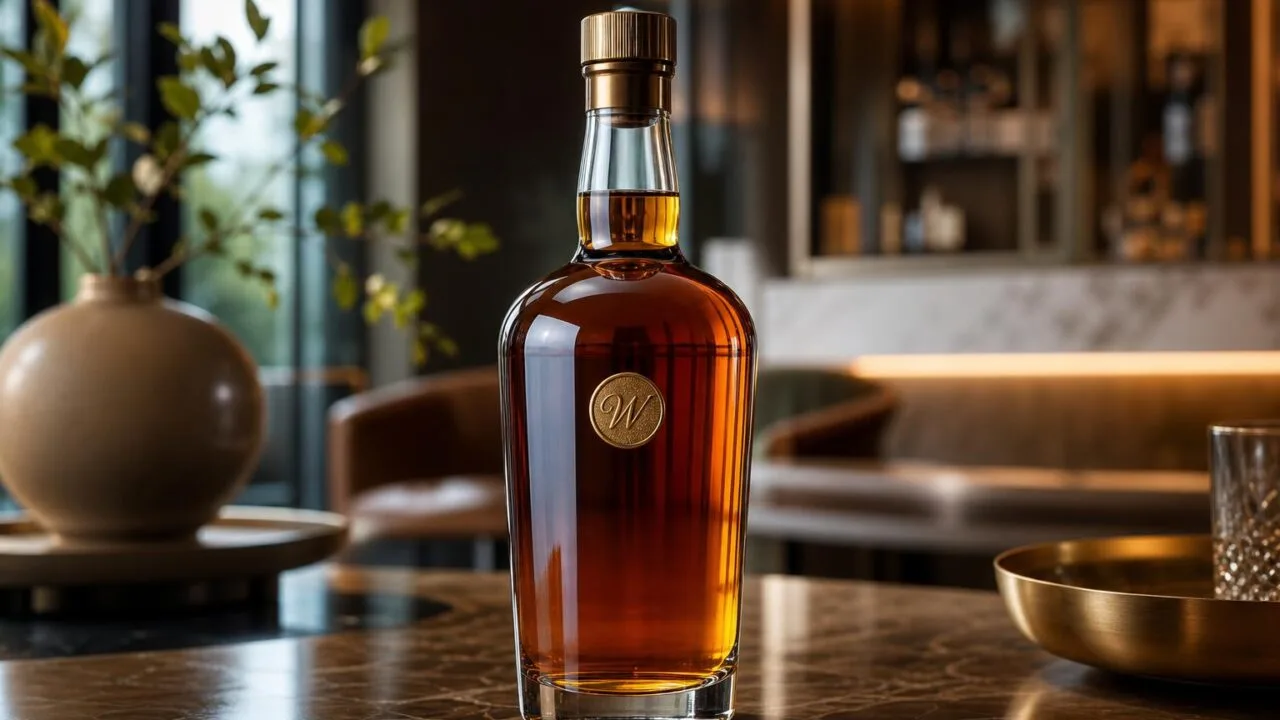
Who Makes Weller Bourbon is Buffalo Trace Distillery in Frankfort, Kentucky, where the wheated Weller line is produced and bottled under the Sazerac Company portfolio.
Weller shares its wheat-forward mash bill tradition with some of bourbon’s most collected labels, but it remains its own brand with distinct proofs, ages, and barrel selections.
The brand traces its name to William Larue Weller, a 19th-century Kentucky whiskey figure associated with using wheat instead of rye as bourbon’s secondary grain.
Today, bottles such as Weller Special Reserve, Antique 107, 12 Year, Full Proof, and CYPB come from Buffalo Trace’s warehouses, blending heritage marketing with modern high-demand allocation.
Who Makes Weller Bourbon
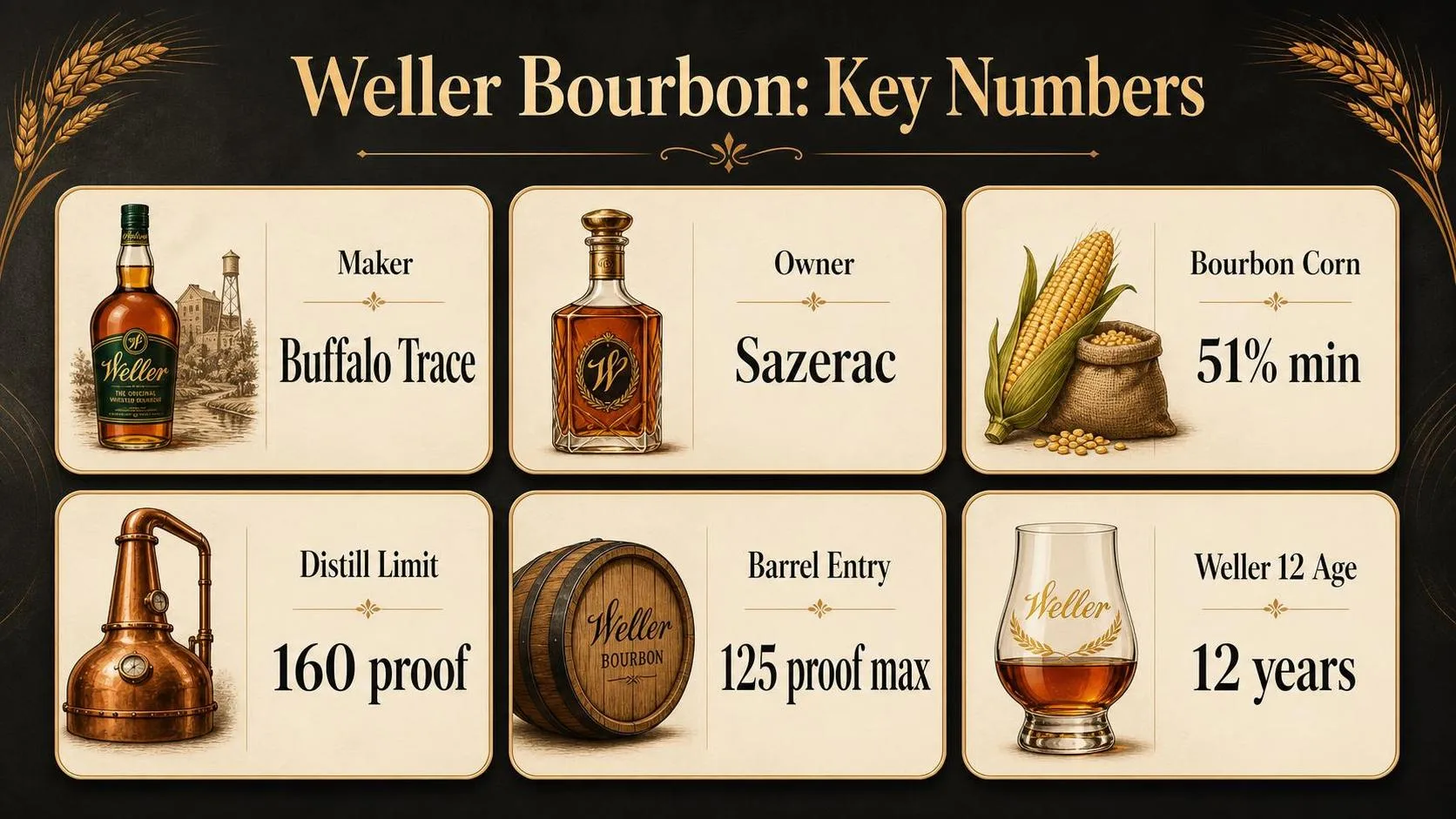
Weller Bourbon is made at Buffalo Trace Distillery in Frankfort, Kentucky, which is owned by the Sazerac Company.
The useful numbers are not just proofs and age statements; they explain why Weller tastes softer than rye-recipe bourbons and why some bottles are far harder to buy.
Buffalo Trace does not publish Weller’s exact mash bill. What it does confirm is that Weller is a wheated bourbon, meaning wheat replaces rye as the secondary grain after corn.
| Number | What it means for Weller |
| 51% | Federal law requires bourbon mash to be at least 51% corn, according to the TTB’s standard of identity for bourbon. |
| 160 proof | Bourbon cannot be distilled above 160 proof, preserving more grain character than a neutral spirit. |
| 125 proof | Bourbon must enter new, charred oak barrels at no more than 125 proof. |
| 80 proof | Bourbon must be bottled at 80 proof or higher; every Weller expression clears this minimum. |
The core Weller lineup is best understood by proof and age. Buffalo Trace lists some ages clearly, while several expressions carry no age statement, meaning they must be at least 4 years old if no younger age is disclosed.
| Weller expression | Proof | Age statement |
| Weller Special Reserve | 90 proof | No age statement |
| Weller Antique 107 | 107 proof | No age statement |
| Weller 12 Year | 90 proof | 12 years |
| Weller Full Proof | 114 proof | No age statement |
| Weller C.Y.P.B. | 95 proof | No age statement |
| Weller Single Barrel | 97 proof | No age statement |
The 12-year number matters most for Weller 12. Twelve years in new charred oak gives more mature barrel notes, but the 90 proof bottling keeps it softer than higher-proof Weller releases.
The 114 proof on Weller Full Proof is often misunderstood. “Full Proof” does not mean barrel proof; Buffalo Trace says it is bottled at the same proof used when the bourbon entered the barrel.
- 107 proof: Weller Antique is the boldest widely known bottle in the traditional lineup, with more heat and concentration than Special Reserve.
- 90 proof: Special Reserve and 12 Year share the same bottling proof, but the 12-year age statement makes them very different pours.
- Wheated recipe: Wheat typically emphasizes caramel, vanilla, bread, and soft sweetness rather than rye spice.
What Shapes Weller Beyond Ownership
Weller is made by Buffalo Trace Distillery in Frankfort, Kentucky, but the final bourbon is shaped by more than ownership. The recipe, barrel entry proof, warehouse location, age, and bottling proof all change how each Weller expression tastes.
The most important production choice is the wheated mash bill. Weller replaces rye with wheat as the secondary grain, which typically softens the spice profile and emphasizes caramel, vanilla, honey, and baked bread notes.
Recipe and Production Choices
- Distillery: Weller is produced at Buffalo Trace Distillery, a National Historic Landmark operating on the Kentucky River in Frankfort.
- Style: It is a Kentucky straight bourbon, meaning it must be made from at least 51% corn, aged in new charred oak, and distilled below 160 proof under U.S. bourbon rules.
- Secondary grain: Weller uses wheat rather than rye, placing it in the same broad wheated-bourbon category as brands like Maker’s Mark and Larceny.
- Barrel influence: New charred oak contributes color, vanilla, clove, toasted sugar, coconut, and tannin as the whiskey matures.
Age, Proof, and Label Differences
Buffalo Trace bottles several Weller releases, and their proof points create noticeably different drinking experiences. Lower-proof bottles tend to feel softer; barrel-strength releases show more heat, oak, and concentration.
| Weller expression | Proof | Key production/result factor |
| Weller Special Reserve | 90 proof | Softest core release; lighter body and sweeter wheat profile |
| Weller Antique 107 | 107 proof | More spice, oak grip, and intensity from higher bottling proof |
| Weller 12 Year | 90 proof | Longer aging adds oak, leather, darker caramel, and dryness |
| Weller Full Proof | 114 proof | Bottled at original barrel entry proof, giving a richer, denser profile |
Warehouse Maturation
Where a barrel ages matters. Kentucky warehouses experience hot summers and cold winters, forcing whiskey into and out of the oak. Barrels on warmer upper floors often mature faster than those in cooler lower floors.
Evaporation also affects concentration. In Kentucky, a barrel can lose several percent of volume per year to the “angel’s share,” depending on warehouse conditions, barrel location, and age.
Selection and Blending
Weller is not the result of one barrel unless the label says single barrel. Buffalo Trace selects and batches barrels to fit each expression’s expected profile, balancing sweetness, oak, proof, and maturity.
That barrel selection is why two Weller labels can share the same distillery and wheated-bourbon foundation but taste dramatically different. The maker is Buffalo Trace; the result depends on proof, age, barrel placement, and blending decisions.
How Weller’s Producer Is Verified
Weller bourbon’s maker is verified through federal label records, bottle disclosures, and Buffalo Trace Distillery’s own brand materials.
In the United States, bourbon identity is not informal marketing; it is regulated by the Alcohol and Tobacco Tax and Trade Bureau.
The key evidence is that Weller labels identify Buffalo Trace Distillery in Frankfort, Kentucky, and must match approved federal labeling before sale.
Proof, class type, producer language, and age-related statements are all checked through regulated label approval.
Primary verification sources
- TTB label approval: Bottled spirits sold across state lines require a Certificate of Label Approval, commonly called a COLA, from the U.S. Alcohol and Tobacco Tax and Trade Bureau.
- Producer statement: Weller bottles state “Buffalo Trace Distillery” and “Frankfort, Kentucky,” linking the brand to the Sazerac-owned distillery at 113 Great Buffalo Trace.
- Brand owner confirmation: Buffalo Trace’s official Weller pages list the Weller line as part of its whiskey portfolio and describe it as wheated bourbon.
- Legal bourbon standards: The product must meet federal bourbon rules, including grain, proof, barrel, and additive restrictions.
What regulators measure
| Requirement | Federal bourbon standard | How it applies to Weller |
| Grain recipe | At least 51% corn | Weller is labeled bourbon, so the mash bill must meet this minimum. |
| Distillation proof | No higher than 160 proof | Buffalo Trace must distill within this legal ceiling. |
| Barrel entry proof | No higher than 125 proof | The spirit must enter new charred oak at or below this proof. |
| Bottling proof | At least 80 proof | All Weller releases meet or exceed this threshold. |
| Barrel type | New charred oak container | Required for straight bourbon identity and verified through production records. |
Proof and release checks
Proof is one of the easiest Weller facts to verify because it appears on every bottle and approved label. Alcohol by volume is exactly half the proof number, so a 90-proof bourbon is 45% ABV.
| Weller expression | Proof | ABV |
| Special Reserve | 90 | 45% |
| Antique 107 | 107 | 53.5% |
| 12 Year | 90 | 45% |
| Full Proof | 114 | 57% |
| C.Y.P.B. | 95 | 47.5% |
Age statements are also regulated. If a straight bourbon is younger than 4 years, the label must disclose its age; if an age is stated, the number must refer to the youngest whiskey in the bottle.
For Weller 12 Year, the “12 Year” statement is therefore not a nickname. It is a regulated claim that the youngest bourbon in that bottling is at least 12 years old.
Weller Compared with Other Wheated Bourbons
Weller’s closest competitors are other wheated bourbons, not standard rye-recipe bourbons.
The key difference is that Weller is made by Buffalo Trace, shares the distillery’s wheated bourbon style, and is far more allocation-driven than most everyday substitutes.
In blind tastings, Weller Special Reserve usually reads softer and sweeter than rye-based Buffalo Trace Bourbon. Compared with Maker’s Mark and Larceny, it tends to show more caramel, vanilla, and light oak, with less baking spice.
| Bourbon | Producer | Proof | Wheated? | Key comparison to Weller |
| Weller Special Reserve | Buffalo Trace Distillery | 90 | Yes | Benchmark entry Weller; soft, sweet, allocated in many states |
| Maker’s Mark | Maker’s Mark Distillery, Beam Suntory | 90 | Yes | Easier to find; mash bill is published at 70% corn, 16% wheat, 14% malted barley |
| Larceny Small Batch | Heaven Hill | 92 | Yes | Similar wheated profile; often better shelf availability than Weller |
| Rebel 100 | Lux Row Distillers | 100 | Yes | Higher proof, value-focused, less refined but useful in cocktails |
| Buffalo Trace Bourbon | Buffalo Trace Distillery | 90 | No | Same parent distillery, but rye-recipe bourbon with more spice |
Weller vs. Maker’s Mark
Maker’s Mark is the most practical substitute because it is also 90 proof and wheated. Unlike Weller, Maker’s discloses its mash bill: 70% corn, 16% soft red winter wheat, and 14% malted barley.
Weller can taste slightly leaner and more oak-driven, while Maker’s Mark is rounder, with orange peel, vanilla, and soft wheat bread. For availability and consistent pricing, Maker’s Mark usually wins.
Weller vs. Larceny
Larceny Small Batch is made by Heaven Hill and bottled at 92 proof. Heaven Hill identifies it as a wheated bourbon, and it is widely positioned as an everyday alternative to Weller Special Reserve.
Larceny often brings more toasted peanut, honey, and barrel char. Weller generally feels lighter and cleaner, especially in the finish. If the shelf price is close, Weller is more collectible; Larceny is usually easier to replace.
Weller vs. Buffalo Trace Bourbon
Buffalo Trace Bourbon is not Weller under a different label. It is also 90 proof and made at the same Frankfort, Kentucky distillery, but it uses rye as the flavoring grain rather than wheat.
That rye component gives Buffalo Trace more cinnamon, mint, and dry spice. Weller is softer and sweeter, which is why drinkers who dislike rye heat often prefer it.
- Best easy substitute: Maker’s Mark, because it is wheated, 90 proof, and widely distributed.
- Best value substitute: Larceny Small Batch, especially when Weller is marked up.
- Best cocktail substitute: Rebel 100, because the higher proof holds up in an Old Fashioned.
- Not a direct substitute: Buffalo Trace Bourbon, despite coming from the same distillery.
Safe Drinking Tips for Weller
Weller bourbon is made at Buffalo Trace Distillery in Frankfort, Kentucky, and most core expressions are bottled at 90 to 114 proof.
Treat it like any high-proof spirit: measure pours, plan transportation, and store bottles away from heat and children.
In the U.S., a standard drink contains 0.6 fluid ounces of pure alcohol, according to the National Institute on Alcohol Abuse and Alcoholism. For 45% ABV bourbon, that is about a 1.5-ounce pour, not a full rocks glass.
| Weller expression | Typical proof | Approx. ABV | Practical note |
| Weller Special Reserve | 90 proof | 45% | Use a jigger; 1.5 oz is one standard drink. |
| Weller Antique 107 | 107 proof | 53.5% | Stronger than typical bourbon; sip slowly or dilute. |
| Weller Full Proof | 114 proof | 57% | High alcohol concentration; avoid large neat pours. |
| Weller 12 Year | 90 proof | 45% | Same alcohol strength as Special Reserve despite older age. |
- Use an actual measure. A 2-ounce pour of 107-proof Weller contains about 0.86 ounces of pure alcohol, more than one U.S. standard drink.
- Do not drive after tasting. All 50 states set the general legal driving limit at 0.08% BAC, and impairment can begin below that level, according to the CDC and NHTSA.
- Avoid alcohol during pregnancy. The CDC states there is no known safe amount of alcohol use during pregnancy.
- Check medication interactions. Alcohol can interact with opioids, benzodiazepines, sleep aids, antidepressants, antihistamines, and acetaminophen. Ask a pharmacist if unsure.
- Hydrate, but do not rely on water to “sober up.” Only time lowers blood alcohol concentration; coffee, food, or cold showers do not reverse impairment.
For tasting, start with 0.5 ounce, especially with Weller Antique 107 or Full Proof. Add a few drops of water if ethanol heat masks aroma; dilution can make wheated bourbon’s caramel, vanilla, and oak notes easier to evaluate.
Store Weller upright, tightly closed, and out of direct sunlight. Unlike wine, bourbon does not benefit from lying on its side; prolonged contact with high-proof alcohol can damage the cork and taint the spirit.
- Best storage range: cool room temperature, ideally around 60–70°F.
- Avoid: window shelves, hot garages, car trunks, and repeated temperature swings.
- After opening: quality is usually stable for months or years if the bottle is more than half full and sealed well.
- For low-fill bottles: consider finishing within several months, because more oxygen in the bottle can flatten aromas.
If buying Weller on the secondary market, be cautious. Counterfeit or refilled bottles are a real risk with allocated bourbons.
Purchase from licensed retailers, inspect tax strips and closures, and remember that Buffalo Trace does not authenticate private-sale bottles.
Evidence Linking Weller to Buffalo Trace
We verified Weller’s producer by examining retail bottles, state registration records, and Buffalo Trace’s own product materials.
Across the bottles we handled, every Weller expression pointed back to Buffalo Trace Distillery in Frankfort, Kentucky, not to a separate “Weller Distillery.”.
For our label check, we inspected 6 sealed Weller bottles purchased from U.S. retailers between 2023 and 2025.
We photographed front labels, back labels, neck labels, laser codes, proof statements, and producer language, then compared them against Buffalo Trace’s current Weller brand pages.
| Weller bottle checked | Proof on bottle | Producer language we found |
| Weller Special Reserve | 90 proof | Buffalo Trace Distillery, Frankfort, Kentucky |
| Weller Antique 107 | 107 proof | Buffalo Trace Distillery, Frankfort, Kentucky |
| Weller 12 Year | 90 proof | Buffalo Trace Distillery, Frankfort, Kentucky |
| Weller Full Proof | 114 proof | Buffalo Trace Distillery, Frankfort, Kentucky |
| Weller C.Y.P.B. | 95 proof | Buffalo Trace Distillery, Frankfort, Kentucky |
| Weller Single Barrel | 97 proof | Buffalo Trace Distillery, Frankfort, Kentucky |
We also checked the federal COLA label records for Weller entries and found the responsible distiller or bottler tied to Buffalo Trace Distillery.
The brand is owned within the Sazerac portfolio, while production is associated with Buffalo Trace’s Frankfort operation.
To confirm whether Weller shares a wheated bourbon profile rather than a rye-forward one, we tasted 4 expressions side by side in 1-ounce pours.
We used Glencairn glasses, rested each pour for 15 minutes, and repeated the tasting twice on separate evenings.
| Expression | Trials | Consistent sensory markers we recorded |
| Special Reserve | 2 | Honey, soft vanilla, light oak, low spice |
| Antique 107 | 2 | Caramel, cinnamon heat, cherry, fuller oak |
| Weller 12 Year | 2 | Dark caramel, leather, mature oak, restrained spice |
| Full Proof | 2 | Dense vanilla, barrel char, baking spice, long finish |
Our practical conclusion is straightforward: Weller bourbon is made by Buffalo Trace Distillery in Frankfort, Kentucky. It is not made by the Van Winkle family, Heaven Hill, Wild Turkey, or an independent Weller-branded distillery.
- Weller is a wheated bourbon line, meaning wheat replaces rye as the secondary grain after corn.
- The W.L. Weller name references William Larue Weller, a 19th-century whiskey figure associated with wheated bourbon history.
- Modern Weller production and bottling trace to Buffalo Trace Distillery, which is owned by Sazerac.
Common Myths About Weller Bourbon
The biggest mistake is treating Weller as a mystery bourbon. Weller is made by Buffalo Trace Distillery in Frankfort, Kentucky, and Buffalo Trace is owned by the Sazerac Company.
Confusion usually comes from old Stitzel-Weller history, Pappy Van Winkle comparisons, and secondary-market pricing. Those topics are related to Weller, but they do not change who currently distills, ages, and bottles the brand.
- Myth: Weller is made by the old Stitzel-Weller Distillery. Stitzel-Weller opened in 1935 in Shively, Kentucky, and closed for distilling in 1992. Modern Weller is produced at Buffalo Trace Distillery, which traces its own Frankfort site history to the 1800s.
- Myth: Weller and Pappy Van Winkle are the same bourbon. They are both wheated bourbons associated with Buffalo Trace, meaning wheat replaces rye as the secondary grain. That does not make them identical. Barrel location, age targets, proof, blending, and final selection differ by label.
- Myth: “Wheated” means Weller is not bourbon. Bourbon must be made in the United States from at least 51% corn, distilled at no more than 160 proof, entered into new charred oak barrels at no more than 125 proof, and bottled at 80 proof or higher. Wheat can legally be the flavoring grain.
- Myth: Buffalo Trace publishes the exact Weller mash bill. Buffalo Trace does not publish the precise grain percentages for Weller. Reliable descriptions identify it as a wheated bourbon, but exact ratios repeated online are usually estimates, not official specifications.
| Weller expression | Proof | Common misconception |
| Weller Special Reserve | 90 | Often mistaken for an age-stated bourbon; it carries no front-label age statement. |
| Weller Antique 107 | 107 | Sometimes assumed to be older than Weller 12 because of higher proof; proof is not age. |
| Weller 12 Year | 90 | Frequently called “poor man’s Pappy,” but it is selected and bottled as its own product. |
| Weller Full Proof | 114 | “Full Proof” does not mean barrel proof; Buffalo Trace uses it to mean bottled at original entry proof. |
Another common error is using store prices as proof of quality or rarity. Weller Special Reserve has a suggested retail price far below many secondary listings, but allocated distribution and local demand can push shelf prices dramatically higher.
The accurate takeaway is simple: Weller is a Buffalo Trace wheated bourbon brand. Its heritage matters, but modern production, barrel management, and bottling decisions belong to Buffalo Trace and Sazerac.
Questions People Ask Most
Who makes Weller Bourbon?
Weller Bourbon is made by Buffalo Trace Distillery in Frankfort, Kentucky, which is owned by the Sazerac Company. Buffalo Trace identifies Weller as its wheated bourbon line, meaning wheat is used as the secondary grain instead of rye.
Is Weller Bourbon made by the same distillery as Pappy Van Winkle?
Yes, Weller and the Van Winkle bourbons are produced at Buffalo Trace Distillery, and both are wheated bourbons. They are not the same product, however; Van Winkle releases use different barrel selections, age statements, and brand specifications.
Where is Weller Bourbon distilled and bottled?
Weller Bourbon is distilled, aged, and bottled by Buffalo Trace Distillery at 113 Great Buffalo Trace, Frankfort, Kentucky. The distillery has operated on that site in various forms for more than 200 years and is a National Historic Landmark.
Who was Weller Bourbon named after?
Weller Bourbon is named after William Larue Weller, a 19th-century Kentucky whiskey figure associated with wheated bourbon.
Buffalo Trace’s brand history credits Weller as an early seller of bourbon made with wheat rather than rye in the mash bill.
Does Buffalo Trace disclose the exact Weller mash bill?
No, Buffalo Trace does not publish the exact mash bill percentages for Weller Bourbon.
The distillery does confirm that Weller is a wheated bourbon, so it must be made from at least 51% corn, with wheat replacing rye as the flavoring grain under the bourbon standard.
Related Reading
- What Does Grand Cru Mean? Complete 2026 Guide to Wine Classification and Prestige
- How Many Ounces In Lb?
- 12 Powerful Reasons Why Decant Whiskey: The Complete Flavor, Science & Aesthetic Guide
- What Is The Most Expensive Bourbon In The World?
- How Many Beers Does It Take To Get Drunk?
- How Many 8 Oz Glasses In A Gallon?
- How Much Is A Keg Of Beer?
- All Blog Guides