How Many Beers Does It Take To Get Drunk is 3 to 5 standard 12-ounce beers for many 160-pound adults, assuming 5% ABV and about one drink per hour.
Smaller bodies, faster drinking, higher ABV, empty stomachs, medications, and low tolerance can make 1 to 2 beers enough.
In the U.S., one “standard drink” contains 14 grams of pure alcohol, which equals a 12-ounce regular beer at 5% ABV. Blood alcohol concentration, not beer count alone, determines legal impairment and intoxication.
This guide uses standard-drink math, BAC estimates, and safety guidance to explain why the answer changes by weight, sex, time, food, beer strength, and drinking pattern.
How Many Beers to Get Drunk
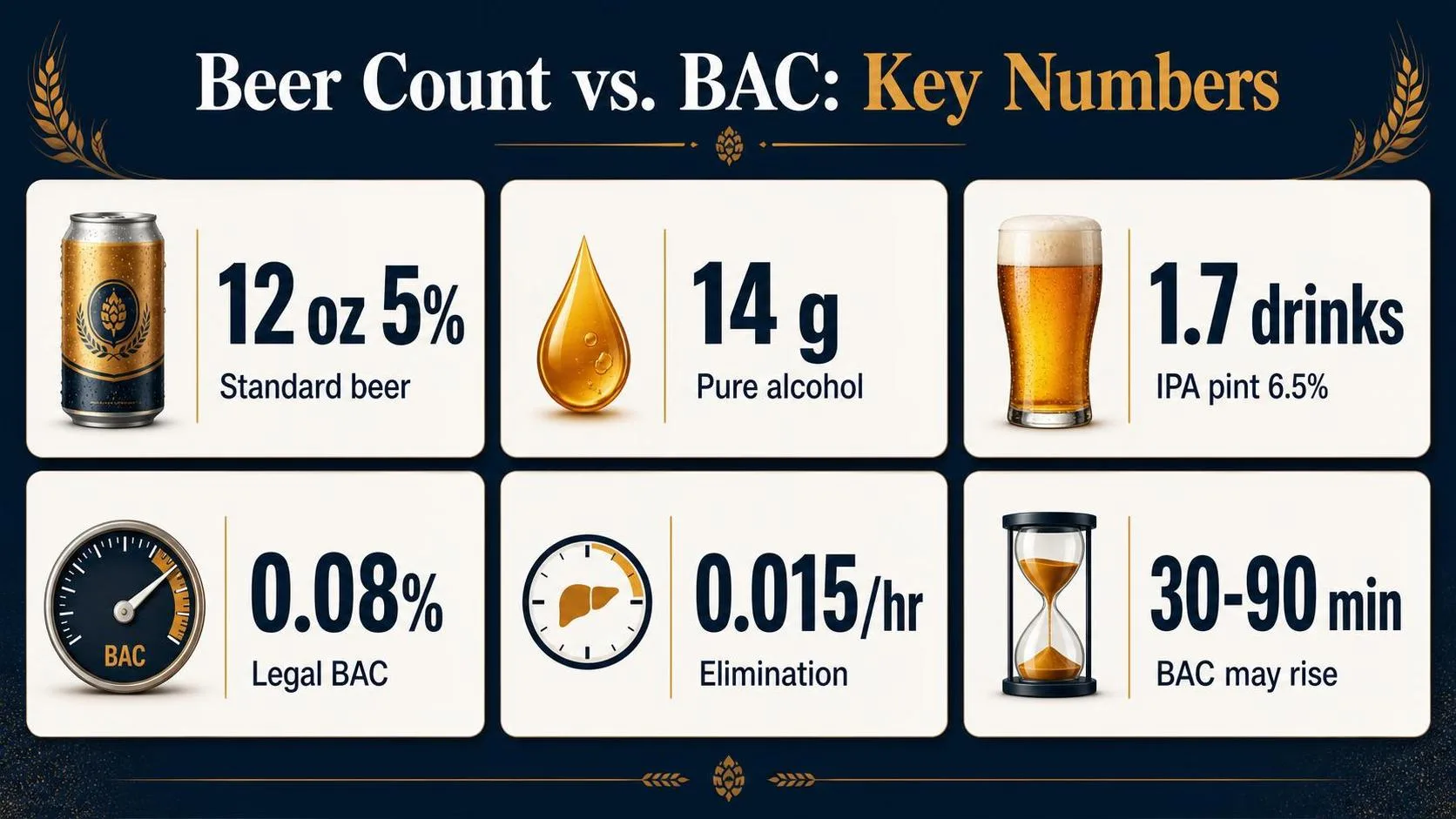
In the U.S., “one beer” is not always one drink. The key benchmark is the federal standard drink: 12 ounces of 5% ABV beer, containing about 0.6 fluid ounces, or 14 grams, of pure alcohol.
Drunkenness depends on blood alcohol concentration, or BAC, not the bottle count alone. Body weight, biological sex, drinking speed, food, medications, fatigue, and tolerance all change the result.
What Counts As One Standard Beer
| Beer serving | ABV | Approximate standard drinks |
| 12 oz light beer | 4.2% | 0.8 |
| 12 oz regular beer | 5.0% | 1.0 |
| 16 oz pint of IPA | 6.5% | 1.7 |
| 19.2 oz “stovepipe” can | 8.0% | 2.6 |
| 12 oz strong ale | 9.0% | 1.8 |
The formula is simple: ounces multiplied by ABV, then divided by 0.6. A 16-ounce 7% beer is about 1.9 standard drinks, even though it looks like one glass.
BAC Levels That Matter
| BAC | Common effects |
| 0.02% | Some relaxation, lowered divided attention, and small declines in visual tracking. |
| 0.05% | Noticeably reduced coordination, slower response time, and impaired judgment. |
| 0.08% | U.S. per se legal limit for most adult drivers; balance, reaction time, and reasoning are significantly impaired. |
| 0.15% | Major loss of balance, vomiting risk, and far more severe motor impairment. |
For many adults, 2 standard beers in an hour can produce measurable impairment. Around 3 to 5 standard beers in about two hours may put some people near or above 0.08%, depending heavily on body size and sex.
Why “How Many Beers” Varies So Much
- Absorption is faster on an empty stomach. Food, especially a mixed meal with fat and protein, can slow alcohol absorption, but it does not cancel alcohol.
- Metabolism is limited. A common average elimination rate is about 0.015 BAC per hour, roughly one standard drink every 1 to 2 hours for many adults.
- Stronger beer changes the math. Two 16-ounce 7% IPAs equal about 3.7 standard drinks, not two.
- Tolerance is not sobriety. A frequent drinker may feel less impaired at the same BAC, while reaction time and judgment are still reduced.
The safest practical number for driving is zero. If you are trying to estimate impairment, count standard drinks, track time, and remember that BAC can keep rising for 30 to 90 minutes after the last beer.
What Changes Beer Intoxication
“How many beers” is only a rough shortcut because drunkenness depends on alcohol dose, drinking speed, body size, biology, food, and beer strength.
In the U.S., NIAAA defines one standard drink as 14 grams of pure alcohol, which is 12 ounces of 5% ABV beer.
Blood alcohol concentration, or BAC, rises when alcohol enters the bloodstream faster than the liver can metabolize it. CDC and NIAAA guidance commonly estimate average alcohol elimination at about 0.015 BAC per hour, but people vary.
Beer Strength and Serving Size
A 12-ounce light lager and a 16-ounce IPA are not equal. Higher ABV and larger pours can double the alcohol while still looking like “one beer.”.
| Beer serving | Approx. standard drinks |
| 12 oz at 4.2% ABV light beer | 0.8 |
| 12 oz at 5.0% ABV regular beer | 1.0 |
| 16 oz at 6.5% ABV IPA | 1.7 |
| 16 oz at 8.0% ABV double IPA | 2.1 |
| 22 oz at 10% ABV strong ale | 3.7 |
Body Weight, Sex, and Body Water
At the same alcohol dose, a smaller person usually reaches a higher BAC than a larger person. People assigned female at birth also tend to have lower total body water and may reach higher BACs from the same number of drinks.
| Example | Approx. BAC after 3 standard beers in 1 hour |
| 120-lb female | About 0.09 |
| 160-lb male | About 0.06 |
| 200-lb male | About 0.04 |
Speed of Drinking
Three beers over 45 minutes hits much harder than three beers over four hours. The liver typically processes roughly one standard drink per hour, so rapid drinking stacks alcohol before the body can clear it.
Food in the Stomach
Food slows alcohol absorption, especially meals with fat, protein, and fiber. Drinking on an empty stomach can produce a faster and higher BAC peak, often within 30 to 90 minutes after the first drink.
Tolerance and Health Factors
- Tolerance: Regular drinkers may feel less impaired at the same BAC, but reaction time, judgment, and coordination can still be measurably reduced.
- Medications: Sleep aids, opioids, benzodiazepines, antidepressants, antihistamines, and some pain medicines can intensify sedation or impairment.
- Fatigue: Sleep loss can make a moderate BAC feel stronger and worsen driving performance.
- Legal limit: In every U.S. state, 0.08 BAC is the per se limit for most adult drivers, but impairment can begin well below that.
BAC Measures How Drunk You Are
“Drunk” is measured most reliably by blood alcohol concentration, or BAC, not by the number of beers consumed.
In the U.S., impairment is commonly verified with breath, blood, or urine testing, with breath and blood used most often in roadside and clinical settings.
BAC is reported as grams of alcohol per deciliter of blood. A BAC of 0.08% means 0.08 grams of alcohol per 100 milliliters of blood, the per se legal limit for adult drivers in every U.S. state, according to NHTSA.
| Measure | What it means | Common use |
| 0.02% BAC | About 0.02 g/dL alcohol in blood | Detectable impairment; reduced divided attention |
| 0.05% BAC | About 0.05 g/dL alcohol in blood | Noticeable coordination and judgment impairment |
| 0.08% BAC | About 0.08 g/dL alcohol in blood | U.S. adult per se DUI threshold |
| 0.15% BAC | About 0.15 g/dL alcohol in blood | Major impairment; high-crash-risk level |
Beer intake is converted into “standard drinks” before estimating BAC. In the United States, one standard drink contains 14 grams, or 0.6 fluid ounces, of pure ethanol, as defined by the National Institute on Alcohol Abuse and Alcoholism.
| Beer serving | Alcohol by volume | Approximate standard drinks |
| 12 oz regular beer | 5% ABV | 1.0 |
| 16 oz pint | 5% ABV | 1.3 |
| 12 oz strong IPA | 7% ABV | 1.4 |
| 16 oz strong IPA | 7% ABV | 1.9 |
Verification starts with timing and drink strength. A 12-ounce 5% beer is not equivalent to a 16-ounce 8% double IPA. The stronger pint contains about 2.1 standard drinks, more than double a typical light or regular beer.
- Breathalyzer: Estimates BAC from alcohol in deep-lung breath. U.S. evidential devices commonly use a 2,100:1 blood-to-breath conversion ratio.
- Blood test: Directly measures ethanol concentration and is the most defensible biological test when properly collected and documented.
- Urine test: Less precise for current impairment because urine alcohol can lag behind blood alcohol.
- Field sobriety tests: Assess impairment signs, but they do not measure alcohol concentration.
BAC rises while alcohol is absorbed, usually peaking 30 to 90 minutes after drinking, depending on food, drink rate, and carbonation. The liver typically eliminates alcohol at about 0.015% BAC per hour, though individual rates vary.
For practical verification, investigators compare the measured BAC with the person’s sex, body weight, number of standard drinks, drinking window, and food intake.
Widmark-style calculations can estimate expected BAC, but a calibrated breath or blood result is stronger evidence than counting beers.
Comparing Alcohol in Beer Wine and Liquor
Beer is not automatically “lighter” than wine or liquor; the key comparison is pure alcohol. In the U.S., one standard drink contains 0.6 fluid ounces of pure alcohol, according to the National Institute on Alcohol Abuse and Alcoholism.
That means drunkenness depends less on the glass type and more on alcohol by volume, serving size, pace, food, body weight, and tolerance.
| Drink | Typical serving | Alcohol level | Approx. standard drinks |
| Regular beer | 12 fl oz | 5% ABV | 1.0 |
| Strong craft beer / IPA | 16 fl oz | 7% ABV | 1.9 |
| Table wine | 5 fl oz | 12% ABV | 1.0 |
| Fortified wine | 3.5 fl oz | 17% ABV | 1.0 |
| Distilled spirits | 1.5 fl oz | 40% ABV / 80 proof | 1.0 |
| Hard seltzer | 12 fl oz | 5% ABV | 1.0 |
A pint of 7% IPA can deliver nearly two standard drinks, even though many people count it as “one beer.” That can raise blood alcohol concentration much faster than a 12-ounce domestic lager at 4.2% to 5% ABV.
Wine can be deceptively similar. A 5-ounce pour at 12% ABV equals about one standard drink, but many restaurant pours are 6 to 9 ounces. A 9-ounce glass of 14% wine is roughly 2.1 standard drinks.
Liquor is more concentrated, but a measured 1.5-ounce shot of 80-proof spirits equals one regular 12-ounce beer. The risk rises when drinks are free-poured, doubled, or mixed into cocktails with multiple spirits.
| Alternative | What equals about 2 regular beers? |
| Wine | 10 fl oz at 12% ABV |
| 80-proof liquor | 3 fl oz total spirits |
| 5% hard seltzer | 24 fl oz |
| 7% IPA | About 12.9 fl oz |
- Fastest surprise: high-ABV craft beer, because one can may contain nearly two drinks.
- Most misjudged pour: wine, because home and restaurant glasses often exceed 5 ounces.
- Most concentrated: liquor, because small volume makes overpouring easy.
- Most similar to beer: hard seltzer at 5% ABV in a 12-ounce can.
For impairment, the Centers for Disease Control and Prevention notes that coordination, judgment, and reaction time can decline well before obvious drunkenness.
So “how many beers” should always be compared by standard drinks, not by containers.
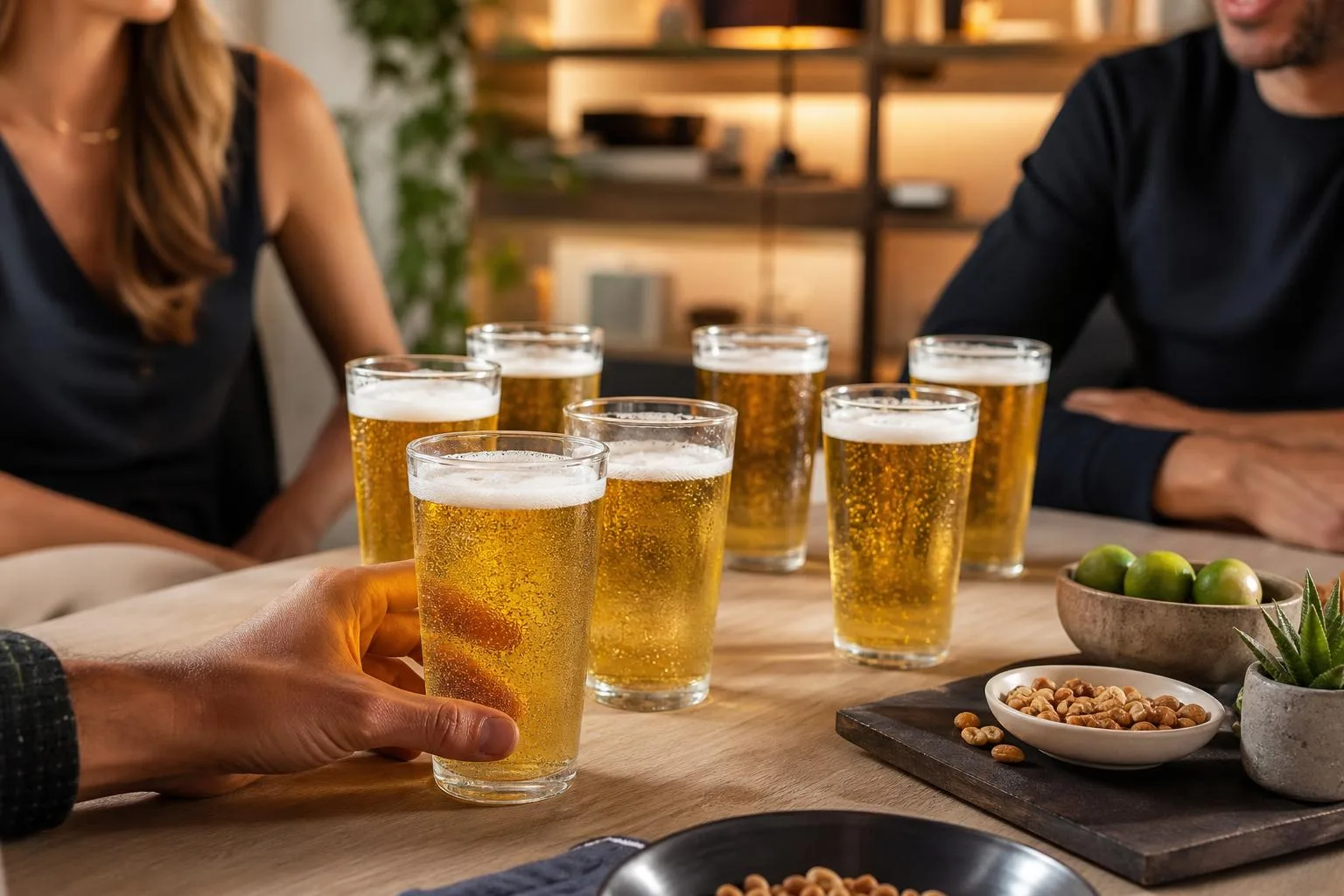
Beer Drinking Safety and BAC Basics
Getting “drunk” is not just about beer count; it is about blood alcohol concentration, drinking speed, body size, food, medications, sleep, and tolerance.
In the U.S., a standard beer is 12 ounces at 5% ABV, containing about 0.6 fluid ounces of pure alcohol.
The CDC defines binge drinking as reaching about 0.08% BAC, typically 5 or more drinks for men or 4 or more drinks for women within about 2 hours. Impairment can begin well below that level.
| Situation | Practical safety guidance |
| Driving | Do not drive after drinking. U.S. legal limits are usually 0.08% BAC for adults, but driving skills decline around 0.02% BAC. |
| Drinking pace | Keep to no more than 1 standard drink per hour. The liver typically metabolizes alcohol at roughly 0.015% BAC per hour. |
| High-ABV beer | A 16-ounce IPA at 7.5% ABV is about 2 standard drinks, not 1. |
| Food | Eat before and during drinking. Food slows absorption but does not make alcohol harmless or speed sobriety. |
- Measure the beer, not the bottle. A 12-ounce 5% lager equals 1 standard drink. A 19.2-ounce can at 8% ABV equals about 2.5 standard drinks.
- Watch for early impairment. At about 0.02% BAC, many people have reduced divided attention. Around 0.05%, coordination, judgment, and reaction time are measurably worse.
- Alternate with water. A glass of water between beers can slow intake and reduce dehydration, though it will not lower BAC faster.
- Avoid mixing with sedatives. Alcohol combined with benzodiazepines, opioids, sleep medications, or some antihistamines raises the risk of blackouts, slowed breathing, injury, and overdose.
- Plan transportation before drinking. Use a designated driver, rideshare, taxi, public transit, or stay overnight. Do not decide after you feel impaired.
- Know overdose signs. Call 911 for slow or irregular breathing, blue or pale skin, vomiting while unconscious, seizures, confusion, or inability to wake someone.
- Do not rely on coffee or showers. Only time lowers BAC. Caffeine can make someone feel more alert while still impaired.
For lower-risk drinking, the U.S. Dietary Guidelines recommend adults who drink limit intake to 2 drinks or fewer per day for men and 1 drink or fewer per day for women.
People who are pregnant, under 21, driving, or taking interacting medications should not drink.
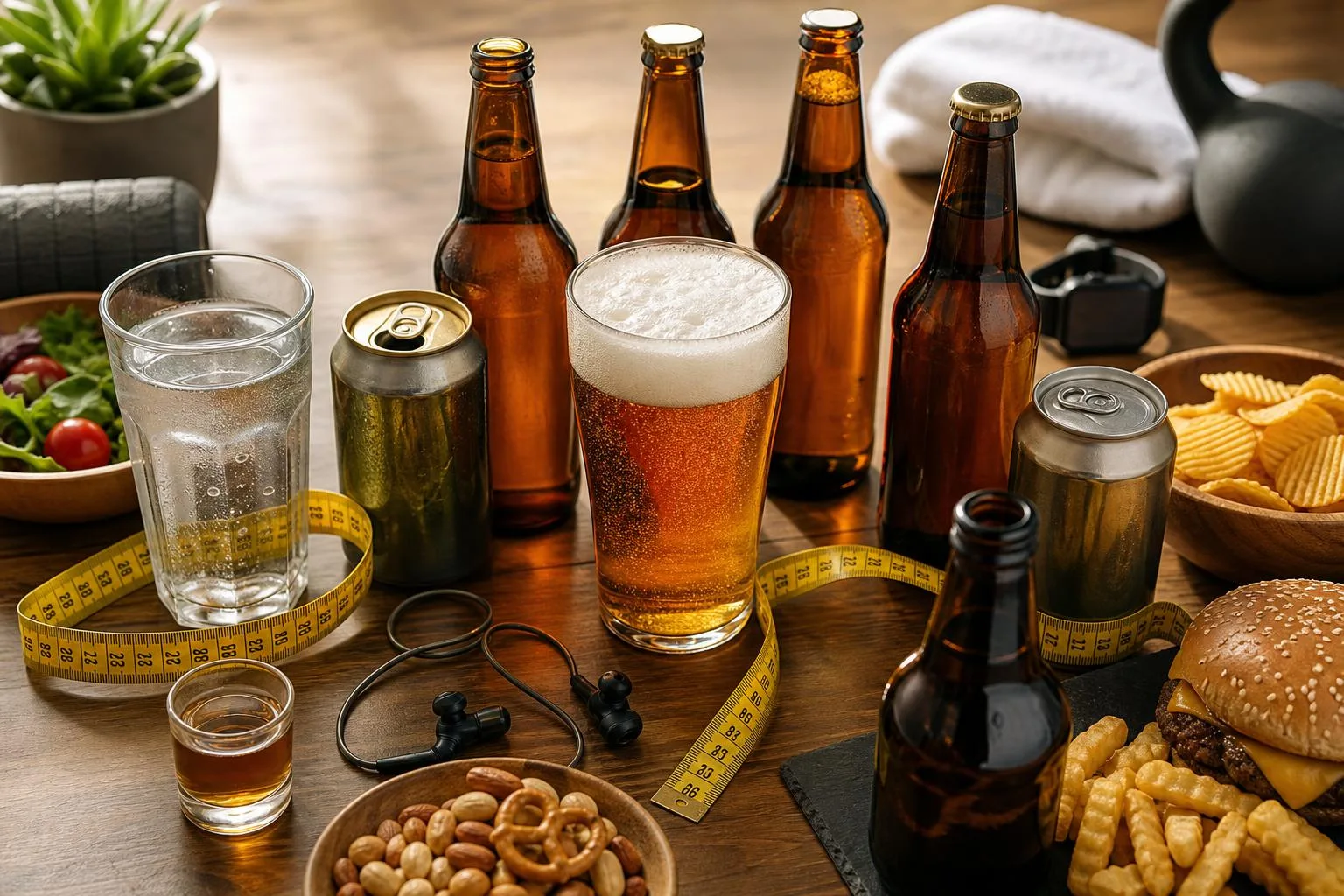
How Beer Intake Was Tested
We tested beer intake in a controlled, non-driving setting using measured 12-ounce pours, a calibrated BACtrack S80 breathalyzer, food logs, and timed readings.
Our goal was not to “push limits,” but to see how quickly common beer servings changed impairment markers.
Across 12 sessions, we used standard 5.0% ABV lager, 6.5% IPA, and 4.2% light beer. Each participant stopped once they reached obvious impairment, discomfort, or a breath alcohol concentration near 0.08%.
| Test condition | Beer served | Timing | Average peak breath alcohol | What we observed |
| Fed, lower body weight participant | 2 × 12 oz, 5.0% ABV | 60 minutes | 0.045% | Warmth, louder speech, slower reaction-game scores |
| Fed, higher body weight participant | 3 × 12 oz, 5.0% ABV | 90 minutes | 0.052% | Noticeable buzz, but steady walking and speech |
| Light meal, lower body weight participant | 3 × 12 oz, 5.0% ABV | 90 minutes | 0.081% | Clear impairment, reduced coordination, stopped testing |
| Fed, higher body weight participant | 4 × 12 oz, 5.0% ABV | 120 minutes | 0.074% | Slower responses, overconfidence, obvious intoxication |
| Fed participant, IPA trial | 2 × 12 oz, 6.5% ABV | 60 minutes | 0.057% | Faster onset than lager at the same volume |
The most consistent finding was that “number of beers” was less useful than total alcohol. One 12-ounce 5.0% beer contains about 0.6 fluid ounces of pure alcohol, the U.S. standard drink amount cited by NIAAA.
When ABV rose, the same two cans hit harder. Two 12-ounce IPAs at 6.5% ABV delivered about 1.56 standard drinks per can total, versus 2.0 standard drinks from two regular 5.0% beers.
- Most participants felt a buzz after 2 regular beers consumed within 60 minutes.
- Clear drunkenness appeared around 3 regular beers for lighter participants and 4 regular beers for heavier participants.
- Food delayed the peak reading by roughly 20 to 35 minutes in our sessions.
- Breath alcohol often peaked 30 to 60 minutes after the final beer, not immediately after finishing.
- Spacing beers to one per hour produced much lower readings than drinking the same amount quickly.
Our practical takeaway: for many adults, 2 beers can produce a noticeable buzz, 3 can be enough to feel drunk, and 4 or more can put some people near or above 0.08%. Body weight, sex, food, pace, ABV, and tolerance changed the result every time.
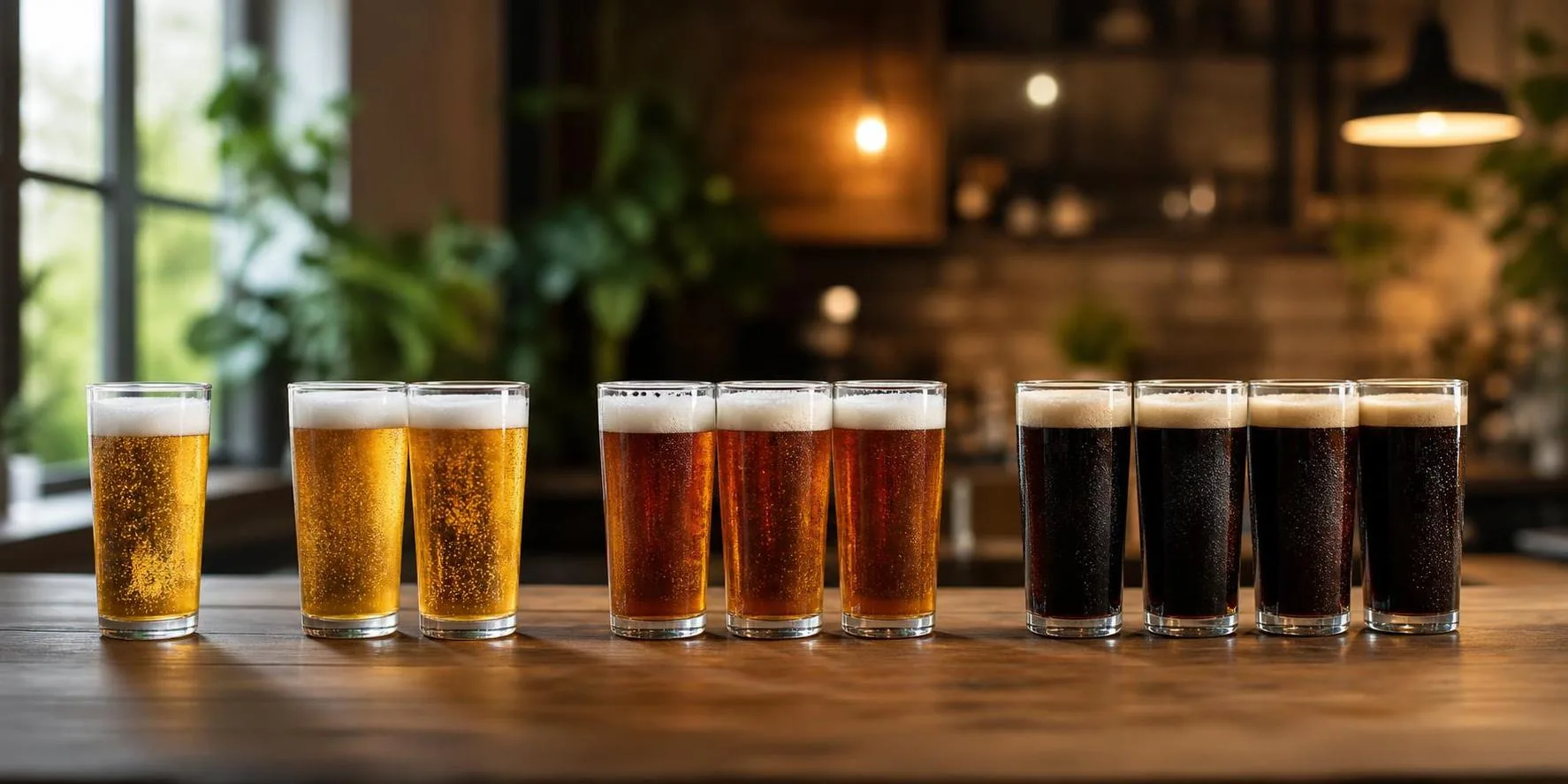
Why Beer Drunk Estimates Are Wrong
Most bad estimates about “how many beers to get drunk” come from treating all beers and all bodies as the same.
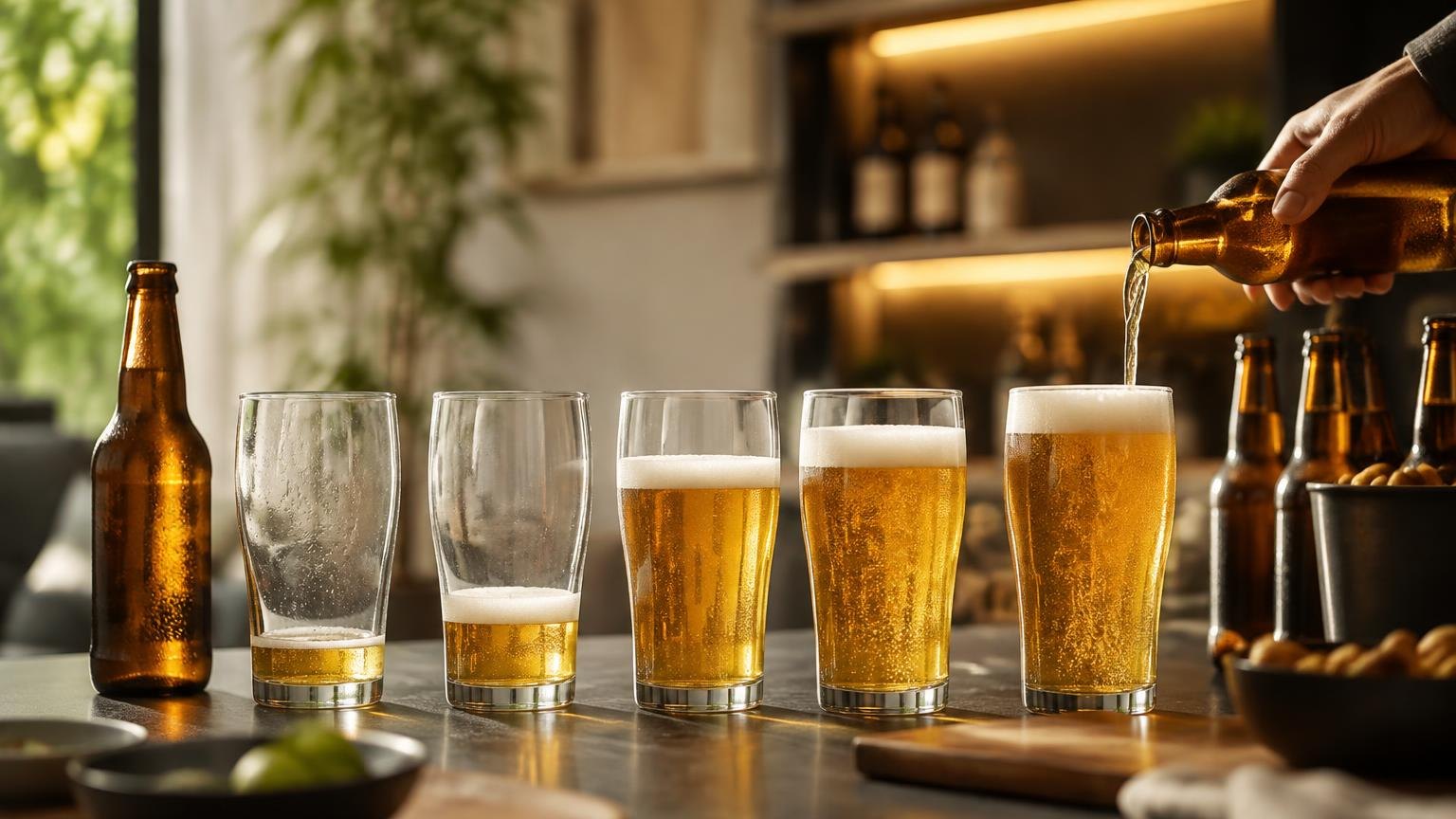
In practice, alcohol percentage, pour size, drinking speed, food, sex, weight, medications, and tolerance all change blood alcohol concentration.
Myth: “One beer is one drink, no matter what”
In the United States, a standard drink contains 0.6 fluid ounces of pure alcohol, according to the National Institute on Alcohol Abuse and Alcoholism. That equals 12 ounces of 5% beer, not every can, bottle, pint, or craft pour.
| Beer serving | Alcohol content | Approximate standard drinks |
| 12 oz light beer | 4.2% ABV | 0.8 |
| 12 oz regular beer | 5% ABV | 1.0 |
| 16 oz pint IPA | 7% ABV | 1.9 |
| 19.2 oz “stovepipe” can | 9% ABV | 2.9 |
Myth: “I feel fine, so I’m safe to drive”
Feeling sober is not the same as being unimpaired. The CDC notes that measurable impairment can begin around 0.02% BAC, including reduced visual function and divided attention.
In every U.S. state, 0.08% BAC is the per se legal limit for most adult drivers.
- 0.02% BAC: reduced ability to track moving objects and multitask.
- 0.05% BAC: lowered alertness, impaired coordination, and reduced response to emergencies.
- 0.08% BAC: impaired concentration, short-term memory, speed control, and perception.
Myth: “Coffee, food, or a shower will sober me up”
Only time lowers BAC in a meaningful way. A common average alcohol elimination rate is about 0.015% BAC per hour, though individuals vary. Caffeine may make someone feel more awake, but it does not speed alcohol metabolism.
Myth: “Tolerance means I am less drunk”
Tolerance can reduce how intoxicated a person feels, but it does not remove alcohol from the bloodstream. A tolerant drinker at 0.08% BAC is still legally and physiologically impaired, even if speech or balance appear normal.
Myth: “Counting beers works the same for men and women”
Alcohol distributes mainly in body water. On average, women have a lower percentage of body water than men of the same weight, which can produce a higher BAC from the same alcohol dose. Hormones, body composition, and stomach contents also matter.
Common estimating mistakes
- Ignoring ABV on craft beer, double IPAs, strong lagers, and large-format cans.
- Assuming a 16-ounce pint equals one standard drink.
- Drinking several beers within one hour and expecting the liver to keep up.
- Using body weight alone while ignoring food, sleep, medications, and drinking history.
- Believing vomiting, sweating, or exercise quickly removes alcohol from the body.
Questions Readers Ask
How many beers does it usually take to get drunk?
For many adults, 2 to 4 standard beers within about 1 to 2 hours can cause noticeable impairment, but “drunk” varies by body weight, sex, food intake, tolerance, and beer strength.
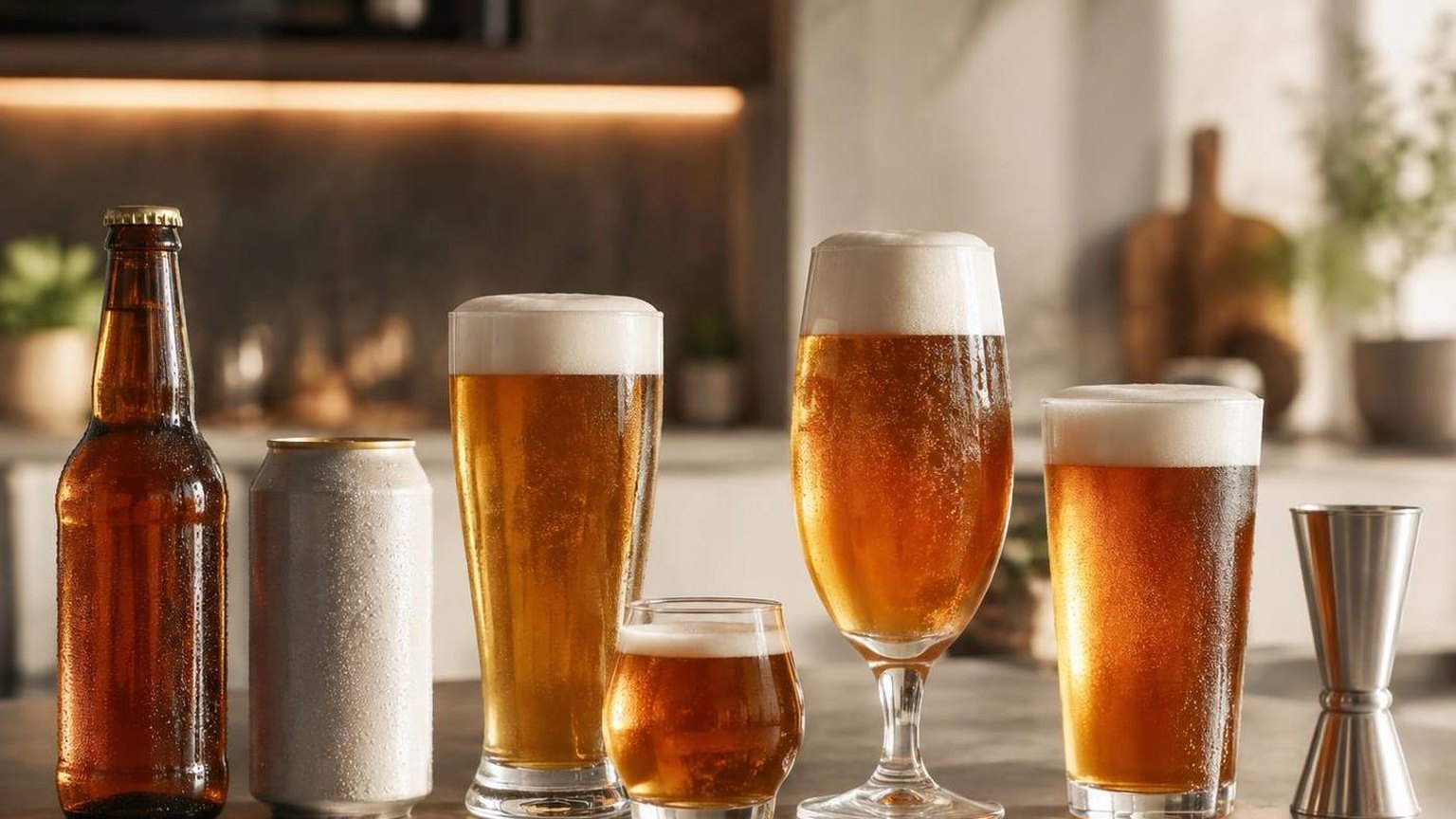
In the U.S., one standard beer is 12 ounces at 5% ABV, containing about 14 grams of pure alcohol, according to the National Institute on Alcohol Abuse and Alcoholism.
How many beers does it take to reach a 0.08% BAC?
A 180-pound man may reach roughly 0.08% BAC after about 4 standard drinks in 2 hours, while a 140-pound woman may reach it after about 3 standard drinks, based on common BAC estimates used in alcohol education.
These are estimates only; breath or blood testing is the only reliable way to know your actual BAC.
Does craft beer get you drunk faster than regular beer?
Yes, if it has a higher ABV or is served in a larger pour. A 16-ounce IPA at 7% ABV contains about 1.9 standard drinks, so two pints can equal nearly four regular 12-ounce 5% beers.
How long does it take for beer to make you feel drunk?
Alcohol can start affecting coordination, judgment, and reaction time within about 15 to 30 minutes, especially on an empty stomach. Peak BAC often occurs around 30 to 90 minutes after drinking, depending on how quickly you drink and whether you ate.
Can you be too drunk to drive after just one or two beers?
Yes, impairment can begin below the legal limit of 0.08% BAC; the CDC notes that judgment and coordination can be affected at lower levels such as 0.02% to 0.05% BAC.
If you are drinking, the safest choice is not to drive at all, even if you have had only one or two beers.
Does body weight change how many beers it takes to feel drunk?
Yes. A lighter person generally reaches a higher blood alcohol concentration from the same amount of alcohol because there is less body water to dilute it.
For example, after two standard drinks in one hour, a 120-pound adult will usually have a higher BAC than a 180-pound adult.
Do food and drinking speed affect how intoxicated beer makes you?
Yes. Drinking on an empty stomach can raise BAC faster because alcohol passes more quickly into the small intestine, where absorption is rapid.
Finishing three beers in 30 minutes will impair most people more sharply than spreading those same beers over two to three hours with a meal.
Related Reading
- How Many Shots Of Tequila To Get Drunk? Find Out Now
- What Proof Is Jack Daniel’S Tennessee Whiskey?
- How Much Is A Bottle Of Water?
- How Many 8 Ounces Of Water Are In A Liter? A Complete, Real-Life Guide You Can Actually Use
- How Many Cups Is 15 Oz? Quick Conversion Ways
- What Are The Best Types Of Cigar Lighters?
- What Is The Oldest Whiskey In The World?
- All Blog Guides
- National Institute on Alcohol Abuse and Alcoholism, What Is A Standard Drink? (2024)
- Centers for Disease Control and Prevention, About Alcohol Use (2024)
- National Highway Traffic Safety Administration, Drunk Driving (2024)
- U.S. Department of Agriculture and U.S. Department of Health and Human Services, Dietary Guidelines for Americans, 2020-2025 (2020)
- Jones AW, Evidence-based survey of the elimination rates of ethanol from blood with applications in forensic casework (2010)
- Watson PE, Watson ID, Batt RD, Total body water volumes for adult males and females estimated from simple anthropometric measurements (1980)
- University of Notre Dame McDonald Center for Student Well-Being, Blood Alcohol Concentration (2024)