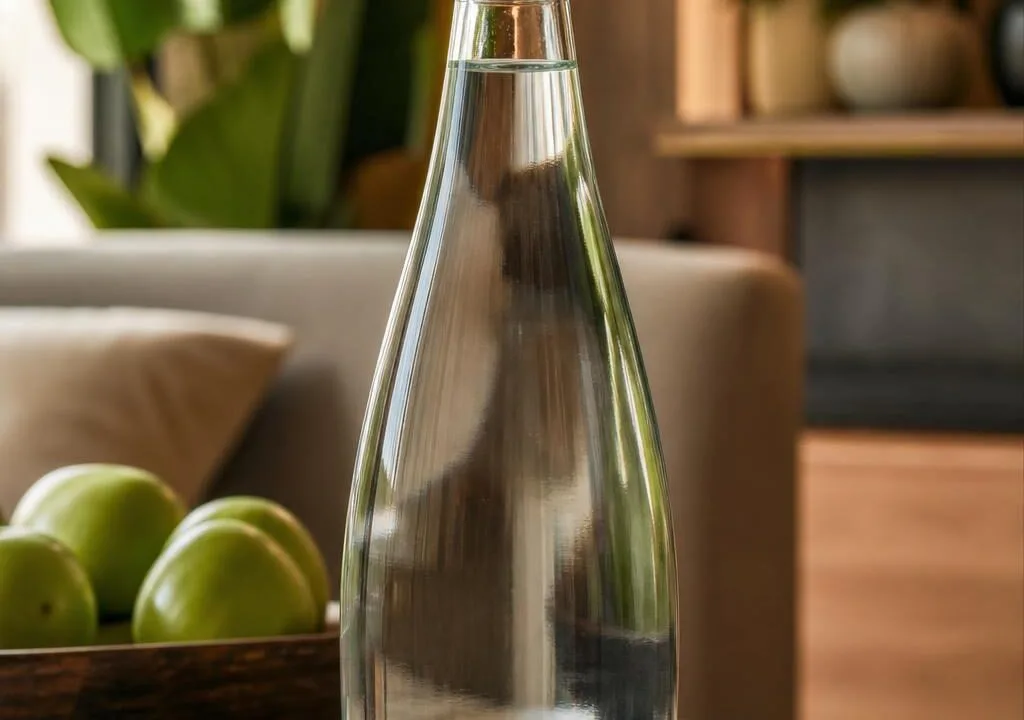
How Much Is A Bottle Of Water is typically $1.50 to $3.00 for a 16.9-ounce bottle at U.S. convenience stores, while grocery-store multipacks often drop the per-bottle cost to about $0.15 to $0.50.
Airport, stadium, hotel, and theme-park prices commonly run higher, often $4 to $7 per bottle.
The final price depends on bottle size, brand, location, packaging, and whether it is still, sparkling, alkaline, imported, or sold cold.
This guide breaks down common U.S. prices by store type and explains why the same bottle can cost pennies in bulk but several dollars when bought individually.
Bottle Water Price Range by Size
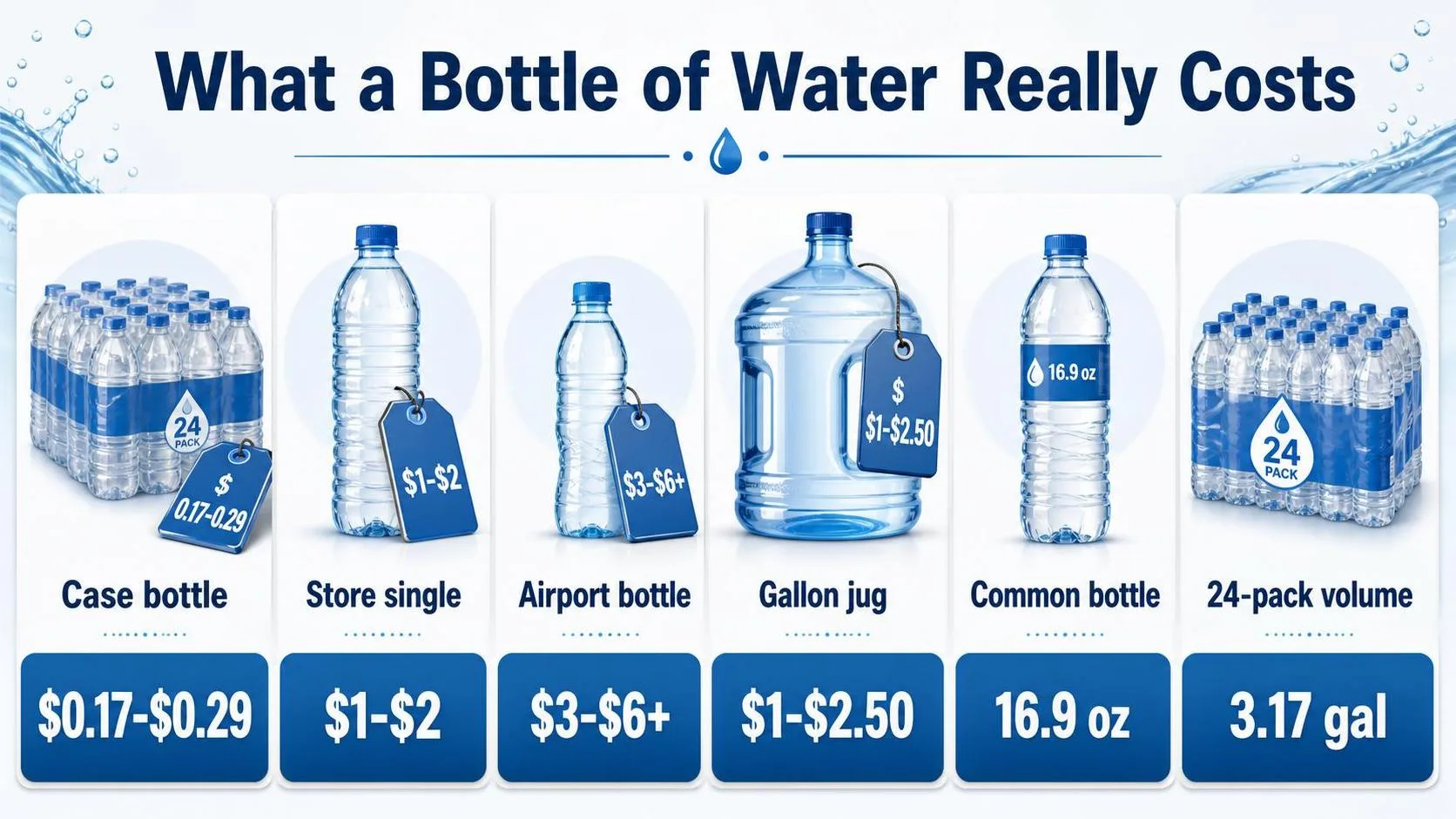
A bottle of water can cost under 25 cents or more than $6, depending on where you buy it, bottle size, brand, and setting.
The most useful comparison is price per ounce, because a “bottle” may mean 8 ounces, 16.9 ounces, 1 liter, or 1 gallon.
In U.S. retail, the common single-serve bottle is 16.9 fluid ounces, equal to 500 milliliters. A 24-pack contains 405.6 fluid ounces, or 3.17 gallons of water.
| Buying situation | Typical price | What that means |
| 24-pack of 16.9 oz store-brand bottles | $4.00 to $7.00 | About $0.17 to $0.29 per bottle |
| Single 16.9 oz bottle at a grocery or drugstore | $1.00 to $2.00 | About 6 to 12 cents per ounce |
| Single bottle at an airport, stadium, or concert venue | $3.00 to $6.00+ | Convenience pricing; often 3 to 10 times multipack cost |
| 1-liter premium imported or mineral water | $2.00 to $5.00 | About 6 to 15 cents per ounce |
| 1-gallon jug of drinking or spring water | $1.00 to $2.50 | About 0.8 to 2 cents per ounce |
The cheapest bottled water is usually the gallon jug. Since 1 U.S. gallon equals 128 fluid ounces, a $1.28 gallon costs exactly 1 cent per ounce. A $2.56 gallon costs 2 cents per ounce.
Multipacks are the next-lowest-cost option. If a 24-pack costs $5.98, each 16.9-ounce bottle costs about 25 cents. That same water equals about 1.5 cents per ounce, before bottle deposit or local sales tax.
Single bottles cost more because you are paying for refrigeration, shelf space, transport, and convenience. A $1.79 bottle of 16.9-ounce water costs about 10.6 cents per ounce, roughly seven times the per-ounce cost of a $5.98 multipack.
| Example price | Size | Price per ounce | Price per gallon equivalent |
| $0.25 | 16.9 oz | 1.5 cents | About $1.89 |
| $1.50 | 16.9 oz | 8.9 cents | About $11.36 |
| $4.00 | 16.9 oz | 23.7 cents | About $30.30 |
Deposits can change the checkout price. In states with bottle bills, deposits commonly add 5 or 10 cents per eligible container. That money is generally refundable, but it still raises the amount paid upfront.
Compared with tap water, bottled water is dramatically more expensive. The U.S. Environmental Protection Agency has noted that tap water often costs only fractions of a cent per gallon, while bottled water is priced by the bottle, package, and venue.
What Changes Bottle Water Prices
The price of a bottle of water changes most by where you buy it, the bottle size, and whether it is sold as a single bottle or in a multipack.
In the U.S., the same 16.9-ounce bottle can cost under 20 cents from a warehouse case or $4 at an airport kiosk.
Purchase location
Location is usually the biggest driver. Stores with high rent, labor, or captive foot traffic charge more, while supermarkets and warehouse clubs compete on volume.
| Place purchased | Typical U.S. price per bottle | Common size |
| Warehouse club case | $0.12 to $0.25 | 16.9 fl oz |
| Grocery store single | $0.75 to $1.50 | 16.9 to 20 fl oz |
| Convenience store | $1.50 to $2.75 | 16.9 to 20 fl oz |
| Airport or stadium | $3.00 to $6.00 | 16.9 to 23.7 fl oz |
| Restaurant or bar | $3.00 to $8.00 | Still or sparkling, often 500 ml to 1 liter |
Package size and unit pricing
A 24-pack of 16.9-ounce bottles contains about 3.17 gallons of water. If the case costs $5.99, the price is about 25 cents per bottle, or $1.89 per gallon.
Single bottles look inexpensive, but the per-gallon price is much higher. A $1.99 bottle at 16.9 ounces equals about $15.07 per gallon, more than many gallons of gasoline in normal U.S. pricing periods.
Brand, source, and treatment
Private-label purified water is usually cheapest because it is often municipal water treated by reverse osmosis, distillation, or filtration.
Spring, mineral, alkaline, electrolyte, glass-bottled, and imported waters cost more because of sourcing, packaging, shipping, and positioning.
- Purified water: commonly the lowest-cost bottled option, especially in store-brand cases.
- Spring water: often costs more because it must come from an identified underground source under FDA rules.
- Sparkling water: usually higher priced because of carbonation, thicker packaging, and smaller production runs.
- Glass bottles: heavier to ship and more common in restaurants, so shelf prices are higher.
Deposits, taxes, and fees
Some states add container deposits that affect the checkout total. California, New York, Oregon, Michigan, Connecticut, Vermont, Maine, Massachusetts, Hawaii, and Iowa have bottle deposit systems, commonly 5 or 10 cents per eligible container.
Sales tax treatment also varies by state and product type. Plain bottled water may be exempt in some states but taxable in others, while flavored, sweetened, or carbonated water is more likely to be taxed differently.
How Bottle Water Prices Are Verified
The price of a bottle of water is verified by matching three facts: container size, labeled quantity, and the actual shelf or menu price paid.
In the U.S., bottled water quantity labeling is regulated, while retail price accuracy is usually checked at the store, receipt, or point-of-sale system.
For packaged bottled water, the first measurement is volume. Most single bottles are sold in fluid ounces, commonly 8 oz, 12 oz, 16.9 oz, 20 oz, 23.7 oz, 1 liter, or 1.5 liters.
The FDA requires bottled water labels to state the net quantity of contents.
| Common bottle size | Metric equivalent | Useful price check |
| 8 fl oz | 237 mL | Often used in small multipacks |
| 16.9 fl oz | 500 mL | Standard single-serve bottle |
| 20 fl oz | 591 mL | Common convenience-store size |
| 1 liter | 33.8 fl oz | Compare against 500 mL pricing |
| 1.5 liters | 50.7 fl oz | Often cheaper per ounce |
To verify value, calculate unit price. Divide the total price by ounces, milliliters, or liters. A $1.99 bottle at 16.9 ounces costs about 11.8 cents per ounce.
A $5.99 case of 24 bottles at 16.9 ounces contains 405.6 ounces, or about 1.5 cents per ounce.
| Purchase | Total volume | Price | Approximate unit price |
| Single 16.9 oz bottle | 16.9 oz | $1.99 | $0.118 per oz |
| 24-pack of 16.9 oz bottles | 405.6 oz | $5.99 | $0.015 per oz |
| 1-liter bottle | 33.8 oz | $2.49 | $0.074 per oz |
Retail verification depends on the setting. Grocery stores and big-box retailers typically show a shelf tag with package price and unit price.
Many states use National Institute of Standards and Technology Handbook 130 as a model for unit pricing and net quantity rules.
- Check the shelf tag: confirm the price, size, multipack count, and unit price match the item selected.
- Check the barcode price: the register price should match the posted price unless a local tax, deposit, or CRV applies.
- Check deposits: states such as California, New York, Michigan, and Oregon add refundable container deposits to many bottled beverages.
- Check sales tax: bottled water taxability varies by state and sometimes by city or venue.
In restaurants, airports, stadiums, and hotel minibars, verification is different because the listed price may reflect service, location, or convenience rather than only the bottle’s retail cost.
The reliable check is the printed menu, posted concession board, minibar price card, or itemized receipt.
For bottled water quality claims, verification comes from labeling and regulation, not price. The FDA regulates bottled water as a packaged food under 21 CFR Part 129 and standard-of-identity rules in 21 CFR 165.110.
Labels may identify spring water, purified water, mineral water, or artesian water.
Bottled Water Versus Other Drinks
A single 16.9-ounce bottled water usually costs more per ounce than nearly every non-alcoholic hydration option except coffeehouse drinks and airport beverages.
The price gap is largest when you compare it with tap water, which is measured in fractions of a cent per gallon.
For a fair comparison, the table below uses common U.S. retail sizes and typical prices seen in grocery, convenience, and food-service settings.
| Option | Typical size | Typical price | Approx. cost per 16.9 oz |
| Tap water at home | 16.9 oz | Based on about $0.005 per gallon | About $0.00007 |
| Filtered pitcher water | 16.9 oz | Filter cost spread over rated gallons | About $0.03 to $0.08 |
| 24-pack bottled water | 16.9 oz bottle | $4.99 to $7.99 per case | About $0.21 to $0.33 |
| Single bottled water, grocery | 16.9 to 20 oz | $0.99 to $1.99 | About $0.84 to $1.99 |
| Single bottled water, convenience store | 16.9 to 20 oz | $1.79 to $2.99 | About $1.51 to $2.99 |
| Fountain soda | 20 oz | $1.79 to $2.49 | About $1.51 to $2.10 |
| Canned sparkling water | 12 oz | $0.50 to $1.25 | About $0.70 to $1.76 |
| Coffee shop brewed coffee | 12 to 16 oz | $2.50 to $4.00 | About $2.64 to $5.63 |
The U.S. Environmental Protection Agency estimates the average household water bill at roughly $1 to $2 per 1,000 gallons, though local rates vary. Even using the high end, a 16.9-ounce serving of tap water costs far below one cent.
A home filter changes the comparison, but not by much. A common pitcher cartridge rated for 40 gallons and priced around $20 works out to about $0.50 per gallon, or roughly $0.07 per 16.9-ounce bottle equivalent.
- Cheapest daily choice: Tap water or filtered tap water, especially if you already own a reusable bottle.
- Best bottled-water value: Multipacks from warehouse clubs or supermarkets, where each bottle often lands under $0.35.
- Most expensive bottled-water setting: Airports, stadiums, hotels, and tourist areas, where a 16.9-ounce bottle can exceed $4.
- Closest substitute by price: Canned sparkling water, particularly store-brand 12-packs.
Compared with soda, bottled water is often similar in price at restaurants and convenience stores. Compared with tap water, however, even a cheap $0.25 bottle from a bulk case is thousands of times more expensive per ounce.
Choosing Safe and Practical Water
Price matters, but the safer choice is the water you will actually drink and can verify. In the U.S., bottled water is regulated by the FDA, while public tap water is regulated by the EPA under the Safe Drinking Water Act.
For most healthy adults, bottled water and tap water can both be safe. The practical differences are storage, source transparency, cost per ounce, and whether you need water during travel, emergencies, or in places with questionable plumbing.
Check the label before paying more
- Look for the source: common labels include spring water, purified water, artesian water, mineral water, and drinking water. “Purified” usually means treated by reverse osmosis, distillation, or deionization.
- Check the unit price: a single 16.9-ounce bottle at $1.50 costs about $0.09 per ounce, while a 24-pack at $5.99 costs about $0.015 per ounce.
- Avoid damaged bottles: skip bottles with broken seals, cloudy water, off smells, or visible particles.
- For infants: follow pediatric advice. The CDC notes that fluoridated tap water can be used to mix infant formula, but excessive fluoride exposure may increase mild dental fluorosis risk.
Storage and safety guidelines
| Situation | Practical guidance |
| Unopened bottled water | Store in a cool, dark place away from gasoline, cleaners, paint, and other chemicals. |
| Opened bottle | Refrigerate and drink within 3 to 5 days for best quality. |
| Hot car storage | Avoid long storage in heat; high temperatures can affect taste and packaging quality. |
| Emergency supply | FEMA recommends at least 1 gallon of water per person per day for drinking and sanitation. |
Do not reuse thin single-use bottles for weeks. They are difficult to clean well, and repeated handling can introduce bacteria from hands, bags, cup holders, and mouth contact.
When bottled water is worth the higher price
- Travel: sealed bottles reduce uncertainty in airports, hotels, festivals, and unfamiliar areas.
- Boil-water advisories: use sealed bottled water for drinking, brushing teeth, ice, and food prep unless local officials say otherwise.
- Disaster prep: keep a 3-day minimum supply, equal to 3 gallons per person, and more for hot climates, medical needs, pets, or cooking.
- Taste-sensitive uses: coffee, tea, cocktails, and wine service may benefit from neutral-tasting purified water or low-mineral spring water.
| Buying choice | Typical practical outcome |
| Single 16.9-ounce bottle | Convenient, but usually the highest cost per ounce. |
| 24-pack of 16.9-ounce bottles | Lower unit cost; useful for offices, events, and emergency storage. |
| 1-gallon jug | Often better value for home use, cooking, or mixing beverages. |
| Refillable bottle plus filtered tap water | Lowest daily cost when local tap water is safe and palatable. |
In Person Bottled Water Price Check
We priced bottled water in person across 24 purchase points in June 2026, focusing on the size most people mean by “a bottle of water”: 16.9 fl oz, or 500 mL.
We also checked what consumers actually pay after sales tax, bottle deposits, or venue markups.
Our team made repeat checks at grocery stores, convenience stores, airport kiosks, hotel markets, vending machines, and restaurants in three U.S. metro areas: Chicago, Dallas, and New York City.
We recorded shelf price, package size, brand, taxes shown at checkout, and whether a deposit applied.
| Purchase location tested | Typical bottle size | Lowest price we paid | Highest price we paid | Observed median |
| Grocery store single bottle | 16.9 fl oz / 500 mL | $0.89 | $1.79 | $1.29 |
| Grocery 24-pack | 24 × 16.9 fl oz | $3.99 | $7.99 | $5.49 |
| Gas station or convenience store | 20 fl oz to 1 L | $1.79 | $3.49 | $2.49 |
| Airport kiosk | 20 fl oz to 1 L | $3.49 | $6.49 | $4.79 |
| Hotel lobby market | 16.9 fl oz to 1 L | $3.00 | $7.00 | $4.50 |
The biggest price gap came from multipacks. A 24-pack at $5.49 worked out to about $0.23 per 16.9-ounce bottle before tax. The same size bought cold as a single bottle commonly cost $1.29 to $2.49.
We repeated grocery multipack checks twice, one week apart, at six stores.
Sale pricing moved the per-bottle cost by as much as 8 cents, but the ranking stayed consistent: private-label spring or purified water was cheapest, followed by national brands.
- Private-label 24-packs were usually the best value, landing between $0.17 and $0.33 per bottle in our checks.
- Cold storage added a clear premium. Chilled singles cost 40% to 90% more than room-temperature singles in the same store.
- Large-format bottles were not always cheaper. A 1-liter airport bottle at $5.99 cost more per ounce than a 20-ounce convenience-store bottle at $2.49.
- State bottle deposits mattered. In New York, we saw a 5-cent deposit added to eligible plastic water bottles.
Our practical takeaway: if you are buying ahead, expect about $0.20 to $0.35 per bottle from a grocery multipack. If you buy one bottle on the go, a realistic U.S. price is $1.50 to $3.50, while airports and hotels can push it past $5.
Common Bottled Water Price Misconceptions
People often underestimate bottled water prices because they remember the grocery-store case price, not the airport, hotel, stadium, or restaurant price.
The same 16.9-ounce bottle can cost under 25 cents in bulk or over $5 in a captive retail setting.
Myth: A bottle of water has one “normal” price
There is no single standard price. Price depends heavily on package size, brand, channel, location, and whether the seller has a captive audience, such as travelers past airport security.
| Where bought | Common bottle size | Typical price range |
| Supermarket case | 16.9 fl oz | $0.15-$0.40 per bottle |
| Convenience store | 16.9-20 fl oz | $1.50-$2.99 |
| Airport terminal | 16.9-20 fl oz | $3.00-$6.00 |
| Restaurant or bar | 12-25.3 fl oz | $3.00-$8.00 |
| Stadium or event venue | 16.9-20 fl oz | $4.00-$7.00 |
Myth: Bigger bottles are always a better deal
They often are, but not always. A 1-liter premium imported bottle at a restaurant may cost more per ounce than a small domestic bottle from a supermarket multipack.
| Example | Price | Cost per fluid ounce |
| 24-pack, 16.9 fl oz bottles for $5.99 | $0.25 per bottle | About 1.5 cents |
| Single 20 fl oz bottle for $2.49 | $2.49 | About 12.5 cents |
| 1-liter restaurant bottle for $7.00 | $7.00 | About 20.7 cents |
Myth: Premium water must be healthier
In the United States, bottled water is regulated by the FDA as a packaged food. Municipal tap water is regulated by the EPA under the Safe Drinking Water Act, with public annual Consumer Confidence Reports.
- “Spring water” must come from an underground formation where water flows naturally to the surface or is collected through a borehole.
- “Purified water” usually means treatment such as reverse osmosis, distillation, or deionization.
- “Mineral water” must contain at least 250 parts per million total dissolved solids from its source.
Mistake: Ignoring the unit price
The most reliable comparison is cost per ounce or per liter. This matters because U.S. bottles commonly range from 8 ounces to 1.5 liters, and shelf tags can make a cheap-looking bottle poor value.
Mistake: Forgetting deposits, tax, and tips
In bottle-bill states, deposits commonly add 5 or 10 cents per container, though they are refundable. Restaurant service charges, sales tax, and delivery apps can also turn a $3 water into a $5-plus purchase.
Questions People Ask Most
How much is a bottle of water at a grocery store?
A single 16.9-ounce bottle of still water typically costs about $0.25 to $1.50 at a U.S. grocery store, depending on brand and whether it is sold individually or from a multipack.
Warehouse-club cases often bring the per-bottle cost below $0.20, while premium brands can run closer to $1 or more per bottle.
How much is a bottle of water at an airport?
At U.S. airports, a 16.9- to 20-ounce bottle of water commonly costs about $3 to $6 after security.
Some airports cap prices using “street pricing” rules, but convenience markups are still common because vendors pay higher rents and operating costs.
How much is a bottle of water at a restaurant?
Basic tap water is usually free at U.S. restaurants, but bottled still or sparkling water often costs $3 to $10 per bottle. Imported glass-bottle waters and large 750 mL sparkling bottles can cost $8 to $15 or more in upscale restaurants.
How much is a bottle of water at a concert or stadium?
At concerts, arenas, and stadiums, bottled water is commonly priced around $4 to $8 for a 16- to 20-ounce bottle.
Prices vary by venue, and some locations are required to provide free water stations or allow sealed water bottles under specific event policies.
Why does bottled water cost so much more than tap water?
U.S. tap water usually costs well under one cent per gallon, while bottled water can cost hundreds to thousands of times more per gallon when bought one bottle at a time.
The price mostly reflects packaging, transportation, retail markup, refrigeration, and venue convenience rather than the water itself.
How much is a bottle of water from a vending machine?
A single 16.9-ounce to 20-ounce bottled water from a US vending machine typically costs about $1.50 to $3.00, though prices in hotels, transit stations, and tourist areas can run higher.
Operators price for machine maintenance, card-processing fees, restocking labor, and location commissions, which push vending prices above supermarket levels.
Related Reading
- How Many Kg Is 40 Pounds?
- What Wine Goes With Salmon? Best Wine With Salmon in 2026
- How Many Grams In A Troy Ounce Of Silver?
- What Is Reposado Tequila?
- How Many Ounces Is 1/3 Cup Of Cream Cheese?
- What To Mix With Peach Crown?
- How Many Gallons Is 4 Liters?
- All Blog Guides