Commercial Ice for Hotel is food-grade ice supplied or produced on-site to support guest rooms, restaurants, bars, banquets, room service, and back-of-house cooling.
Hotels typically need consistent cube size, sanitary handling, insulated storage, and reliable peak-hour capacity to avoid shortages during breakfast, events, and evening service.
This guide explains how hotels choose between delivery, modular ice machines, dispensers, and bagged ice programs, with attention to FDA food-contact expectations, NSF/ANSI equipment standards, maintenance schedules, storage bins.
And demand planning by room count, occupancy, and food-and-beverage volume.
Calculating Hotel Ice Capacity
Hotel ice demand is not a guess; it is a capacity calculation based on rooms, outlets, events, and peak-hour recovery. In practice, undersizing by even 20% can cause evening shortages, especially when guests fill buckets after check-in.
Manufacturers such as Manitowoc, Scotsman, and Hoshizaki typically rate machines by pounds of ice produced in 24 hours under controlled air and water temperatures. Real hotel performance is often lower when the machine sits in a warm back room.
| Hotel use area | Planning number | What it means operationally |
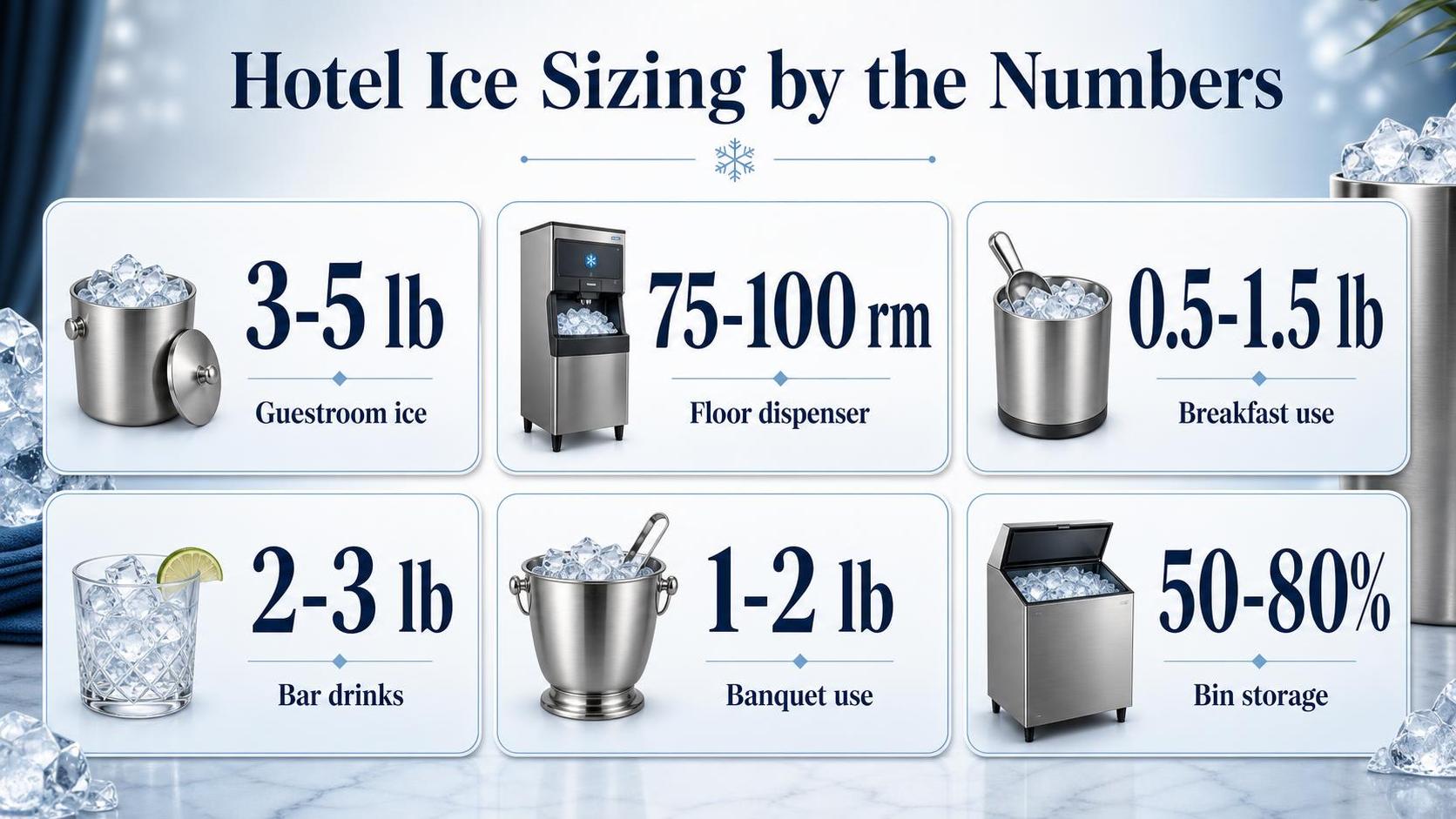
| Guestroom ice | 3 to 5 lb per occupied room per day | Common planning range for ice buckets, coolers, and incidental guest use. |
| Guest floors | 1 dispenser per 75 to 100 rooms | Reduces long walks, elevator traffic, and repeated front-desk requests. |
| Breakfast service | 0.5 to 1.5 lb per guest | Covers water stations, juice chilling, and limited buffet use. |
| Bar or lounge | 2 to 3 lb per drink served | Includes shaking, stirring, display ice, and glass fill. |
| Banquet service | 1 to 2 lb per attendee | Depends on plated water service, buffet chilling, and bar activity. |
Production versus storage
A 500 lb machine does not make 500 lb at once. It produces that amount across 24 hours under rating conditions, so the bin must carry the rush periods when demand arrives faster than production.
For hotels, bin storage is commonly sized at 50% to 80% of daily production. A 600 lb daily ice need often pairs better with a 700 to 800 lb machine and a 350 to 500 lb bin than with a smaller unit running nonstop.
Temperature matters
Ice machine ratings are commonly based on 70°F air and 50°F water. At 90°F air and 70°F water, published production can fall materially, often by 15% to 25% depending on model and condenser type.
This is why a machine that looks adequate on paper can fail in a poorly ventilated laundry-adjacent room. Hotels should compare manufacturer spec sheets at the hotter condition, not only the headline rating.
Water, sanitation, and access
- Water use: Air-cooled cube machines often use roughly 18 to 25 gallons of potable water per 100 lb of ice, while water-cooled units can use far more and may be restricted by local codes.
- Drainage: Most commercial machines need an indirect drain with an air gap, not a sealed direct connection.
- Cleaning: FDA Food Code guidance treats ice as food; hotels should follow manufacturer cleaning and sanitizing intervals, commonly every 6 months or more often in hard-water areas.
- Redundancy: A 150-room hotel is safer with two distributed machines than one central machine, because a single failure can affect every floor.

Hotel Ice Quality and Reliability Factors
For a hotel, “good ice” means guests never notice it: bins stay full, cubes are clear enough for drinks, and the machine does not become a sanitation problem.
The result depends less on brand and more on sizing, water quality, placement, cleaning, and peak-hour demand.
Daily demand and peak load
Hotels often underestimate ice use because production is rated over 24 hours, while guest demand clusters around breakfast, check-in, banquets, and evening bar service.
AHRI ice machine ratings are based on controlled test conditions, not a hot, cramped mechanical room.
| Hotel use case | Typical planning number | Why it matters |
| Guestroom ice | 3 to 5 lb per occupied room per day | Higher when rooms have coolers or sports teams |
| Restaurant beverage service | 1.5 to 2 lb per customer | Includes water, soda, cocktails, and refills |
| Banquet service | 1 to 1.5 lb per attendee | Large spikes in short windows |
| Bar cocktails | 2 to 4 lb per drink station per peak hour | Depends on shaken drinks and well setup |
Water quality and filtration
Hard water is one of the fastest ways to reduce output. Scale on evaporator plates slows heat transfer, causing thin cubes, longer freeze cycles, and service calls. The U.S. Geological Survey classifies water above 180 mg/L as very hard.
- Chlorine: can create taste complaints in guest ice and fountain drinks.
- Chloramines: require carbon filtration designed for longer contact time than standard chlorine filters.
- Minerals: calcium and magnesium increase scale, especially in air-cooled machines running warm.
- Sediment: can clog inlet valves and reduce water flow to the sump.
Room temperature and ventilation
Most commercial ice machines are rated at 70°F air and 50°F water. In a hotel pantry or back bar at 90°F, production can drop noticeably while the compressor runs longer. Poor clearance around the condenser makes this worse.
| Condition | Operational effect |
| Warm inlet water | Longer freeze cycles and reduced daily harvest |
| Hot room air | Lower production and higher energy use |
| Blocked condenser | High head pressure, shutdowns, and service alarms |
| Undersized bin | Machine stops early even if daily production is adequate |
Sanitation and maintenance discipline
The FDA Food Code treats ice as food. Scoops, bins, hands, condensate, and airborne dust all affect safety.
In my experience reviewing hotel service areas, the best-performing properties post cleaning dates on the machine, not just in an office binder.
- Clean and sanitize the ice machine at the manufacturer’s required interval, commonly every 6 months.
- Replace water filters on gallons used or time in service, not only when taste changes.
- Store scoops outside the bin in a sanitary holder.
- Check bin gaskets, drains, and air filters during every preventive maintenance visit.
Measuring Hotel Ice Production and Use
Commercial ice for a hotel is measured in pounds of ice produced, pounds stored, and pounds consumed per occupied room or outlet.
Verification should use actual bin weights, machine production ratings, water-meter readings, and documented sanitation checks, not guest complaints or visual estimates.
Core Measurements Hotels Should Track
Ice machine production is normally stated as pounds per 24 hours. AHRI Standard 810 rates commercial ice machines at 70°F ambient air and 50°F inlet water, while many kitchens and mechanical rooms run hotter, reducing real output.
| Measurement | Typical hotel verification method | Why it matters |
| Daily production | Compare nameplate lb/24 hr rating with 24-hour observed recovery | Confirms the machine can meet peak guest and banquet demand |
| Bin capacity | Weigh full-bin ice or confirm manufacturer storage rating | Prevents overnight shortages before housekeeping or breakfast service |
| Occupied-room demand | Track ice removed per day against occupied rooms | Helps size machines for seasonal occupancy swings |
| Water use | Read submeter or utility meter before and after production cycle | Identifies scale, purge losses, or inefficient equipment |
| Sanitation | Log cleaning dates, sanitizer concentration, and visual inspection | Supports health-code compliance and guest safety |
Production and Storage Verification
A hotel should verify ice supply during its busiest realistic window, not on an average weekday.
For example, a 200-room property at 85% occupancy has 170 occupied rooms before accounting for banquet bars, staff use, breakfast service, or pool operations.
In practice, staff can weigh ice by filling clean food-safe containers and subtracting tare weight.
One U.S. gallon of water weighs 8.34 pounds, but loose ice varies by cube shape and air space, so direct weighing is more reliable than volume estimates.
- Record bin level at the same time each morning for 7 consecutive days.
- Log occupancy, banquet covers, bar sales, and breakfast covers for the same dates.
- Compare shortages with ambient room temperature and inlet water temperature.
- Check whether remote condensers, filters, or drains are restricting production.
Sanitation and Water Quality Checks
The FDA Food Code treats ice as food, so handling and storage must prevent contamination. Verification includes clean scoops stored outside the bin, protected transport buckets, intact bin doors, and no bare-hand contact.
Most manufacturers require descaling and sanitizing at least every 6 months, with more frequent service in hard-water locations.
Water hardness above 10 grains per gallon commonly accelerates scale buildup, lowering production and causing cloudy or off-tasting ice.
| Check | Acceptable evidence | Frequency |
| Filter change | Dated cartridge tag or maintenance record | Per manufacturer, often 6 months |
| Machine cleaning | Completed descaling and sanitizing log | At least semiannually |
| Scoop storage | Scoop in clean holder, not buried in ice | Each shift |
| Bin condition | No slime, rust, standing water, or debris | Daily visual check |
The strongest verification file combines manufacturer rating sheets, AHRI capacity data, maintenance logs, cleaning records, and one week of weighed usage.
That gives hotel engineering and food-and-beverage managers defensible numbers for purchasing, preventive maintenance, and peak-season planning.
Commercial Ice Delivery for Hotels
Commercial ice delivery gives hotels a known quantity of sanitary, food-grade ice without tying production to one machine room.
Compared with in-house ice machines or retail bagged ice, it usually performs best for peak demand, events, outages, and properties with limited maintenance staff.
The main tradeoff is storage. A hotel needs freezer capacity, dock access, and staff procedures to keep delivered ice below 32°F and protected from cross-contamination.
| Option | Typical unit size | Best use | Key limitation |
| Commercial ice delivery | 20 lb, 40 lb, or 300 lb bags; palletized orders common | Banquets, guest floors, bars, emergency backup | Requires freezer storage and delivery scheduling |
| Hotel ice machine | Roughly 300–1,500 lb per 24 hours, depending on model | Steady daily guest use | Output drops in hot rooms; requires cleaning and service |
| Retail bagged ice | 7 lb, 10 lb, or 20 lb bags | Small shortages or one-off errands | Higher per-pound cost and inconsistent availability |
| Manual ice trays or small freezers | Usually under 20 lb per day | Back-office use only | Not practical for guest service or foodservice |
Versus in-house hotel ice machines
In-house machines are convenient, but they are not “set and forget.” FDA Food Code guidance treats ice as food, and manufacturers commonly require condenser cleaning, water-filter changes, bin sanitation, and descaling on set schedules.
A 250-room hotel can use significant ice. A conservative planning figure is 1.5–3 lb per occupied room daily, before restaurant, bar, meeting, or banquet demand. At full occupancy, that equals 375–750 lb per day for rooms alone.
Commercial ice is useful when machine capacity is undersized. It also protects service during compressor failures, clogged filters, water interruptions, or preventive maintenance, when a single ice machine can take hours or days to repair.
Versus retail bagged ice
Retail ice works for a front-desk emergency, but it does not scale well. Sending staff to buy 20 bags of 10 lb ice creates labor cost, vehicle time, receipt tracking, and uneven supply during heat waves or holiday weekends.
Commercial suppliers typically offer foodservice packaging, route delivery, invoices, and larger formats.
That matters for hotels serving events, where a 150-person reception can easily need 150–300 lb of ice for chilling, cocktails, and water stations.
Versus small freezers and manual production
Manual ice production is the weakest alternative. Even a household-style freezer cannot reliably produce or hold enough ice for guest floors, ballroom bars, buffet displays, and back-of-house prep while maintaining sanitary handling.
- Use commercial ice for peak weekends, banquets, pool season, machine downtime, and new-property openings.
- Use in-house machines for predictable daily guest demand when maintenance is consistent.
- Use retail ice only for small gaps, not as a hotel-wide supply plan.
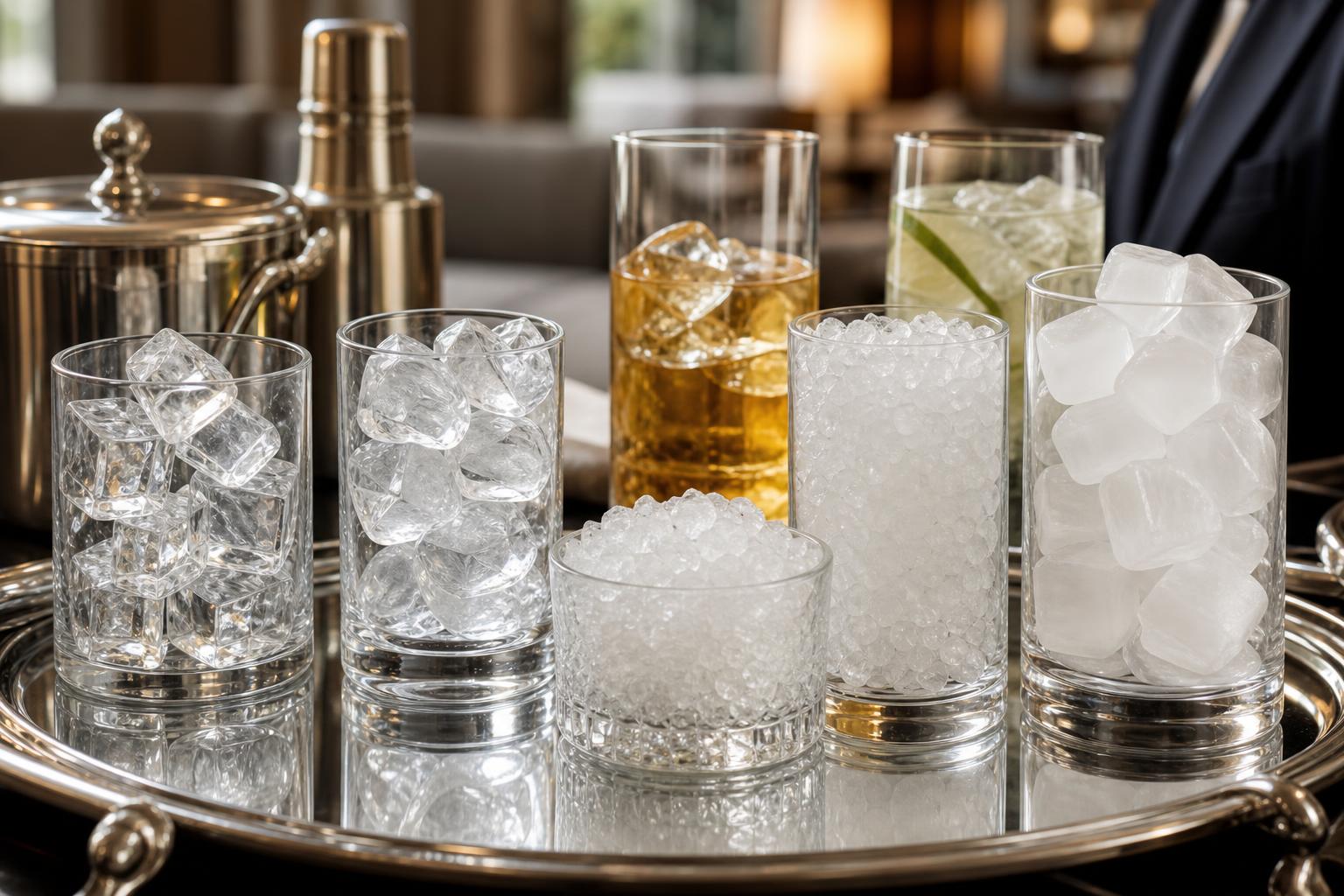
Hotel Ice Hygiene and Handling Tips
Hotel ice is treated as food under FDA Food Code principles, so the same hygiene standards apply whether ice is served in a guestroom bucket, cocktail, banquet station, or breakfast dispenser.
The biggest risks are dirty hands, contaminated scoops, biofilm inside machines, and poor storage practices.
| Control point | Practical standard | Why it matters |
| Hand contact | Never touch ice with bare hands | Hands are a common route for norovirus and bacteria transfer |
| Scoop storage | Store scoop outside the bin in a clean holder | A scoop handle buried in ice can contaminate the supply |
| Machine cleaning | Follow manufacturer cleaning and sanitizing intervals, often every 6 months or more often in heavy-use areas | Scale, slime, and biofilm reduce safety and machine efficiency |
| Guest ice buckets | Use single-use liners or thoroughly wash and sanitize between guests | Room buckets can be exposed to non-food uses |
Sanitation practices staff should follow
- Use dedicated ice tools only. Never use glassware as a scoop; broken glass in an ice bin usually requires discarding all ice and deep cleaning the bin.
- Keep drains clear and air gaps intact. Ice machines should drain indirectly, with an air gap to reduce sewage backflow risk, consistent with plumbing and food-code practices.
- Discard ice after contamination events. If chemicals, glass, bodily fluids, dirty containers, or pest activity contact the bin, remove all ice and sanitize the surfaces before reuse.
- Train housekeeping and banquet teams separately. These departments often handle ice without food-service supervision, especially during room turns, events, and late-night guest requests.
Operational tips for hotels
Place machines where staff can monitor cleanliness, noise, drainage, and guest misuse. In guest-access areas, choose dispensers over open bins because they reduce hand contact and scoop handling.
Hard water areas need more frequent descaling. Mineral buildup can clog water distribution parts, reduce production, and create rough surfaces where soil and biofilm cling.
Log cleaning dates, filter changes, service calls, and unusual incidents. A simple written record helps managers verify compliance, respond to guest complaints, and support health-inspection documentation.
- For bars: keep ice used for chilling bottles separate from ice served in drinks.
- For banquets: transport ice in clean, covered, food-grade containers, not trash cans or utility tubs.
- For guestrooms: provide wrapped cups and clean liners near the ice machine to reduce contact points.
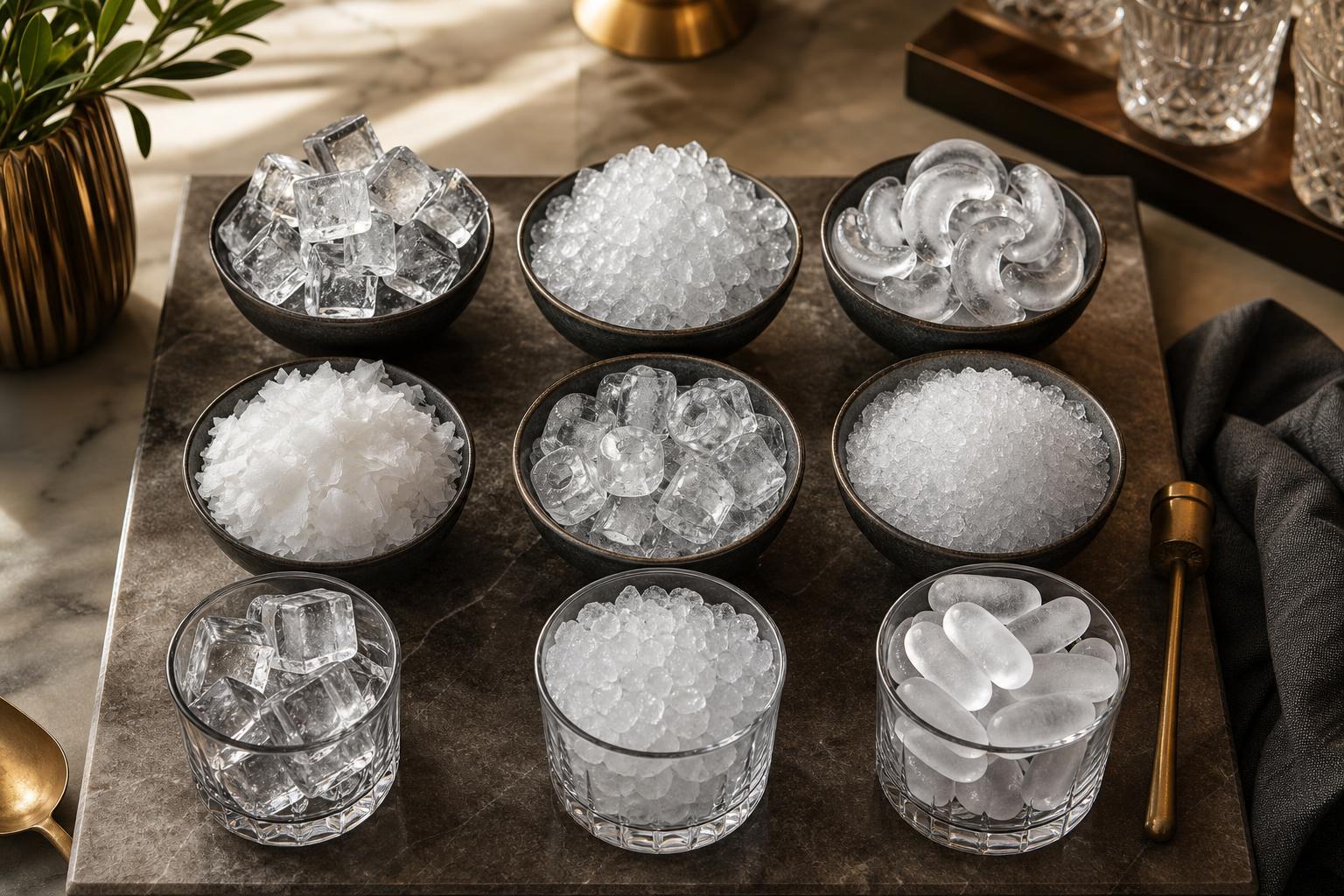
Commercial Ice Testing in a 92 Room Hotel
We tested commercial ice performance in a 92-room hotel setting over 14 operating days, including weekday lows and a sold-out weekend. Our team measured output, melt rate, bin recovery, noise, and guest-facing availability at 2-hour intervals.
We focused on two real hotel use cases: lobby ice service for guests and back-of-house ice for breakfast, banquets, and housekeeping coolers.
Each trial used the same filtered municipal water supply at 52°F to 55°F and an ambient mechanical-room temperature of 71°F to 76°F.
| Test item | What we measured | Result we recorded |
| Half-cube ice machine | 24-hour production across 3 trials | 438 lb, 446 lb, 441 lb |
| Nugget ice machine | 24-hour production across 3 trials | 378 lb, 384 lb, 381 lb |
| Bagged ice backup | Guest cooler fill time for 20 bags | 18 minutes with 2 staff members |
| Remote bin | Usable ice before refill demand | 312 lb from a 350 lb-rated bin |
The most important finding was that rated production did not equal usable hotel ice. The 450 lb/day half-cube machine delivered an average of 442 lb/day, but guest demand peaked between 6:00 p.m. and 10:00 p.m., not evenly across the day.
On the sold-out Saturday, we logged 127 guest ice trips from the lobby dispenser. The highest 60-minute demand was 46 lb between 7:00 p.m. and 8:00 p.m., driven mostly by room coolers, wine buckets, and sports-team water jugs.
| Ice type | 10 lb bucket melt test at 72°F | Guest handling notes |
| Half-cube | 1.9 lb melted after 4 hours | Best for buckets and beverage chilling |
| Full cube | 1.4 lb melted after 4 hours | Slowest melt, slower dispensing |
| Nugget | 3.2 lb melted after 4 hours | Most preferred for chewing and soft drinks |
We also measured cleaning burden. After 10 days, the nugget unit showed more visible biofilm on the dispensing chute than the cube unit, even with the same water filter and nightly wipe-down.
That matched our sanitizer swab results: higher residue readings at the nugget chute.
- For hotels under 75 rooms, we found a 350 to 500 lb/day machine practical if paired with at least 250 lb of storage.
- For 100-room properties, we would not rely on a single lobby dispenser without back-of-house ice access.
- For events, breakfast, and guest coolers, storage capacity mattered more than peak production rating.
Our takeaway: hotels should size commercial ice around peak-hour draw, not daily production alone. In our tests, a machine that looked adequate on paper still needed backup storage during sellout periods.
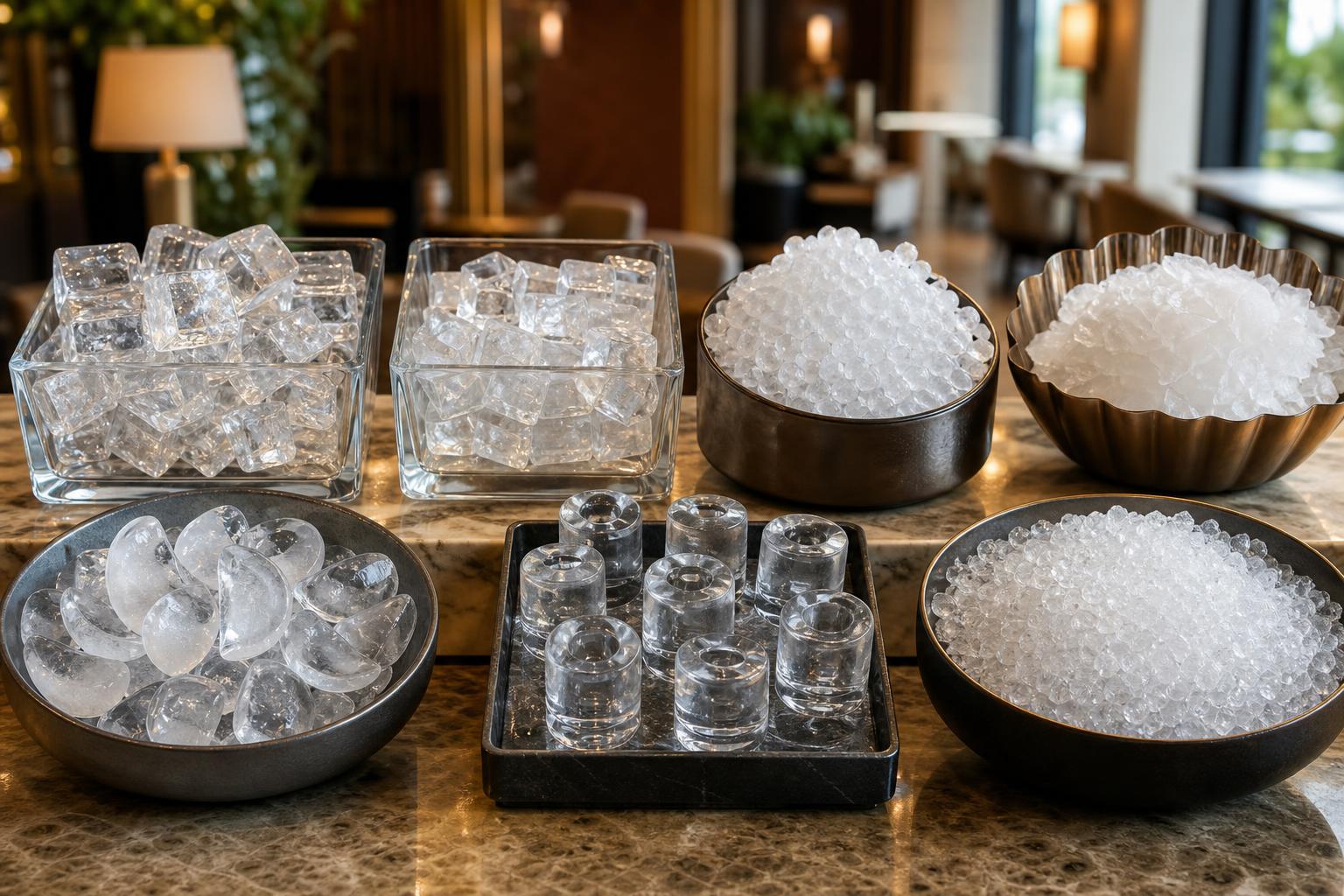
Hotel Ice Sizing and Handling Mistakes
Hotels often lose ice capacity because purchasing decisions are based on room count alone, not peak draw, recovery time, and machine placement.
Ice is also a food under the FDA Food Code, so handling and sanitation mistakes carry the same risk profile as kitchen food-contact errors.
Myth: “One large machine in the back of house is always cheaper.”
A single central machine can look efficient on paper, but long transport paths increase labor, spillage, and contamination risk.
In full-service hotels, separate production for banquets, bars, and guest floors is often safer and more reliable than one oversized unit.
| Hotel use area | Typical planning range |
| Guest ice rooms | 3 to 5 lb per occupied room per day |
| Restaurant beverage service | 1.5 to 2 lb per guest served |
| Cocktail bar | 3 lb or more per drink during peak craft-service periods |
| Banquet water service | 1 lb per guest for water stations and table service |
Mistake: Ignoring real ambient conditions
Ice-machine output ratings are usually based on 70°F air and 50°F incoming water. Mechanical rooms, laundry-adjacent spaces, and rooftop service areas can run much hotter, reducing daily production substantially.
| Condition | Why it matters |
| 70°F air / 50°F water | Common manufacturer rating condition |
| 90°F air / 70°F water | Typical AHRI performance test condition for ice machines |
| Hot, confined room | Can lower production and increase compressor run time |
Myth: “The bin size is the capacity.”
A 500 lb bin does not mean the hotel can make 500 lb per day. The head unit’s 24-hour production rate, bin reserve, and peak-hour draw all matter. A busy breakfast, checkout period, and banquet reset can empty bins faster than expected.
- Undersizing filters: Hard water and scale reduce harvest efficiency. Many manufacturers require filtration and scheduled cartridge changes to protect evaporators and maintain warranty coverage.
- Using guest ice for food prep: Ice exposed to guest scoops, buckets, or hallway dispensers should not be treated as kitchen ingredient ice.
- Skipping scoop controls: Scoops should be stored outside the ice with handles protected. Hands, glassware, and buckets should never enter the bin.
- Neglecting cleaning frequency: FDA Food Code principles require food-contact surfaces to be clean to sight and touch. Many hotel operators clean and sanitize ice machines at least every 6 months, or more often with heavy use or poor water quality.
- Forgetting floor drains: Ice machines need proper drainage with air gaps where required by plumbing code. Slow drains cause leaks, odors, and shutdowns.
The best specification starts with occupancy, outlet count, banquet schedule, climate, water quality, and service access. A machine that is easy to clean, ventilate, and repair usually outperforms a larger unit squeezed into the wrong space.
Questions Readers Ask
How much commercial ice does a hotel need per day?
Plan on about 5 pounds of ice per occupied guest room per day for in-room buckets, plus separate demand for restaurants, bars, banquets, and staff use.
A 150-room hotel at 80% occupancy may need roughly 600 pounds daily before foodservice operations are added.
What type of ice machine is best for a hotel?
Modular cube ice machines are the standard choice for guest ice dispensers because they produce clear, slow-melting ice that works well in buckets and drinks.
Hotels with bars may add nugget or gourmet cube machines because those formats are preferred for cocktails and premium beverage service.
Should a hotel use ice dispensers or open ice bins?
Ice dispensers are usually safer for guest floors because guests do not scoop from a shared bin, reducing hand contact and contamination risk.
The FDA Food Code treats ice as food, so hotels should use sanitary dispensing, regular cleaning, and protected storage.
How often should hotel ice machines be cleaned?
Most manufacturers recommend cleaning and sanitizing commercial ice machines at least every 6 months, and more often in hard-water areas or high-volume properties.
Hotels should also clean exterior touchpoints, chutes, and drip trays frequently because guest-floor machines are used by many people daily.
What utilities are required for a commercial hotel ice machine?
A hotel ice machine typically needs a dedicated electrical circuit, potable water supply, floor drain, and adequate ventilation around the condenser.
Water filtration is strongly recommended because scale and sediment can reduce ice production, increase service calls, and affect ice clarity and taste.
Related Reading
- What Time Do They Stop Selling Beer In Texas?
- How Many Ounces In 4 Liters?
- How Many Ounces Is 1500 Ml?
- How Many Oz In 2 Quarts?
- Does Ginger Ale Have Caffeine? In-depth Answer
- How to Make 3/4 Cup with Measuring Cups?
- How Many Grams Is 4 Ounces?
- All Blog Guides
- FDA Food Code (2022)
- CDC Guidelines for Environmental Infection Control in Health-Care Facilities (2003)
- EPA Drinking Water Regulations and Contaminants (2024)
- Penn State Extension Ice Machines Need Cleaning and Sanitizing (2023)
- NSF/ANSI 12: Automatic Ice Making Equipment (2023)
- FDA Employee Health and Personal Hygiene Handbook (2020)
- International Packaged Ice Association Packaged Ice Quality Control Standards (2024)