
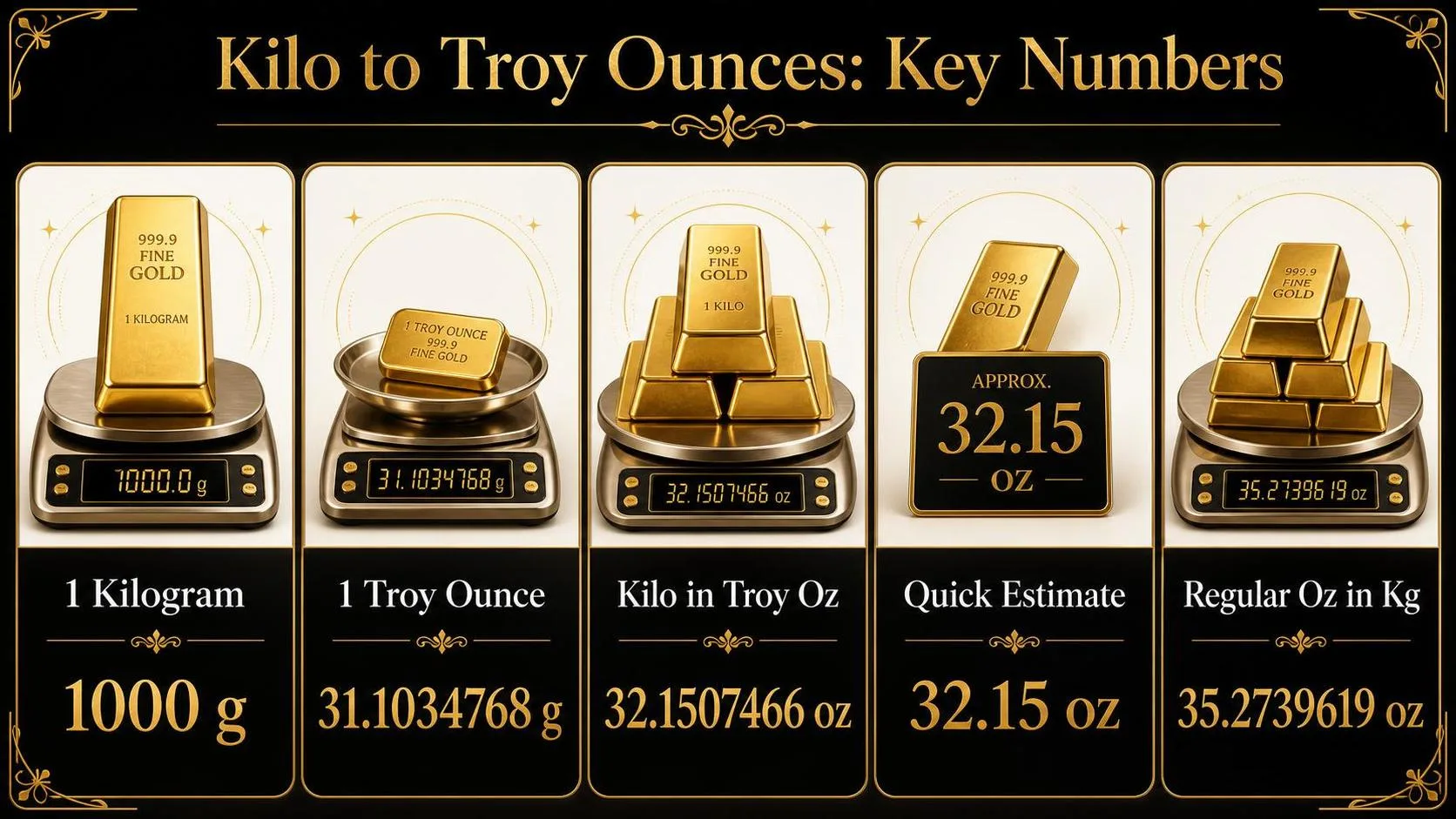
How Many Troy Ounces In A Kilo is 32.1507466 troy ounces. A kilogram equals exactly 1,000 grams, while one troy ounce equals 31.1034768 grams, the standard used for gold, silver, platinum, and other precious metals in U.S. and international markets.
This conversion matters because bullion prices are quoted per troy ounce, not the everyday avoirdupois ounce used for food and household weights.
To convert kilograms to troy ounces, multiply kilograms by 32.1507466; to convert back, divide troy ounces by the same figure.
Kilogram to Troy Ounces
A kilogram contains 32.1507465686 troy ounces. That is the conversion used in bullion markets because gold, silver, platinum, and palladium are weighed in troy ounces, not everyday avoirdupois ounces.
The exact relationship starts with the internationally defined kilogram and the legally defined troy ounce. NIST defines one troy ounce as 31.1034768 grams, so 1,000 grams divided by 31.1034768 gives 32.1507465686.
| Unit | Metric weight | Troy-ounce equivalent |
| 1 kilogram | 1,000 grams | 32.1507465686 troy oz |
| 1 troy ounce | 31.1034768 grams | 1.0000000000 troy oz |
| 1 gram | 1 gram | 0.0321507466 troy oz |
The most common practical shortcut is 1 kilo = 32.15 troy ounces.
That rounded figure is usually enough for quick estimates, but bullion invoices and refinery statements often carry more decimal places because small rounding differences matter at high metal prices.
| Rounding used | 1 kg in troy oz | Difference from exact |
| Exact calculation | 32.1507465686 | 0 |
| 4 decimal places | 32.1507 | 0.0000465686 troy oz |
| 2 decimal places | 32.15 | 0.0007465686 troy oz |
Do not confuse troy ounces with standard U.S. ounces. A regular avoirdupois ounce is 28.349523125 grams, while a troy ounce is 31.1034768 grams. That makes a troy ounce about 9.7% heavier.
| Measure | Grams per ounce | Ounces in 1 kg |
| Troy ounce | 31.1034768 g | 32.1507465686 |
| Avoirdupois ounce | 28.349523125 g | 35.2739619496 |
This distinction is why a “kilo bar” of gold is listed as 32.1507 troy ounces, even though a kitchen scale might imply 35.274 ordinary ounces. Precious-metal pricing follows the troy system used by exchanges, dealers, and assayers.
- Use 32.1507465686 for precise kilo-to-troy-ounce conversion.
- Use 32.15 for quick bullion math.
- Use 31.1034768 grams when converting a single troy ounce to metric weight.

Why Ounce Type Matters
The result depends on which “ounce” you mean and whether the kilogram is the exact SI kilogram.
For precious metals, “ounce” almost always means the troy ounce, not the everyday avoirdupois ounce used for food and body weight in the United States.
The core conversion is fixed: 1 troy ounce equals exactly 31.1034768 grams, as used in bullion markets and recognized in NIST conversion factors. Since 1 kilogram is exactly 1,000 grams, the calculation is 1,000 ÷ 31.1034768.
| Unit or result | Exact or standard value |
| 1 kilogram | 1,000 grams |
| 1 troy ounce | 31.1034768 grams |
| 1 kilogram in troy ounces | 32.1507465686 troy ounces |
Troy Ounces vs. Regular Ounces
The biggest source of wrong answers is using the regular ounce. A standard avoirdupois ounce is 28.349523125 grams, so a kilogram contains more regular ounces than troy ounces.
| Ounce type | Grams per ounce | Ounces in 1 kilogram |
| Troy ounce | 31.1034768 g | 32.1507465686 |
| Avoirdupois ounce | 28.349523125 g | 35.2739619496 |
That difference is not small. If someone prices 1 kilogram of gold using 35.274 ounces instead of 32.151 troy ounces, the weight basis is overstated by about 9.7%.
Rounding and Market Quoting
Rounding changes the displayed answer, not the underlying conversion. Bullion dealers commonly quote 1 kilogram as 32.1507 troy ounces, while calculators may show 32.1507466 or simply 32.15.
| Rounding style | Displayed result |
| 2 decimal places | 32.15 t oz |
| 4 decimal places | 32.1507 t oz |
| Full common calculator value | 32.1507465686 t oz |
Gross Weight, Fine Weight, and Purity
For gold, silver, platinum, and palladium, value is usually based on fine metal content, not just gross bar weight. A 1 kilogram bar at 99.9% purity contains less fine metal than a 99.99% bar.
| Bar purity | Fine grams in 1 kg | Fine troy ounces |
| 99.9% | 999.0 g | 32.1185958 t oz |
| 99.99% | 999.9 g | 32.1475315 t oz |
| 100% | 1,000.0 g | 32.1507466 t oz |
- Use troy ounces for bullion: gold and silver spot prices are quoted per troy ounce.
- Check whether the weight is gross or fine: purity affects payable metal content.
- Keep enough decimals: rounding to 32.15 is fine for casual use, but trading calculations need more precision.
Exact Mass Conversion Basis
A kilogram is verified by mass, not by volume, and the troy-ounce result comes from an exact unit conversion. For precious metals, the accepted figure is 1 kilogram = 32.1507465686 troy ounces.
The kilogram is the SI base unit of mass. Since 2019, it has been defined through the Planck constant, but commercial weighing still uses calibrated balances traceable to national standards such as NIST in the United States.
| Unit | Exact relationship |
| 1 kilogram | 1,000 grams |
| 1 troy ounce | 31.1034768 grams |
| 1 kilogram in troy ounces | 32.1507465686 troy ounces |
| 1 avoirdupois ounce | 28.349523125 grams |
The troy ounce is heavier than the everyday avoirdupois ounce used for groceries and shipping.
That difference is why bullion markets, coin dealers, and assay offices specify “troy oz” when quoting gold, silver, platinum, or palladium weight.
Scale Verification
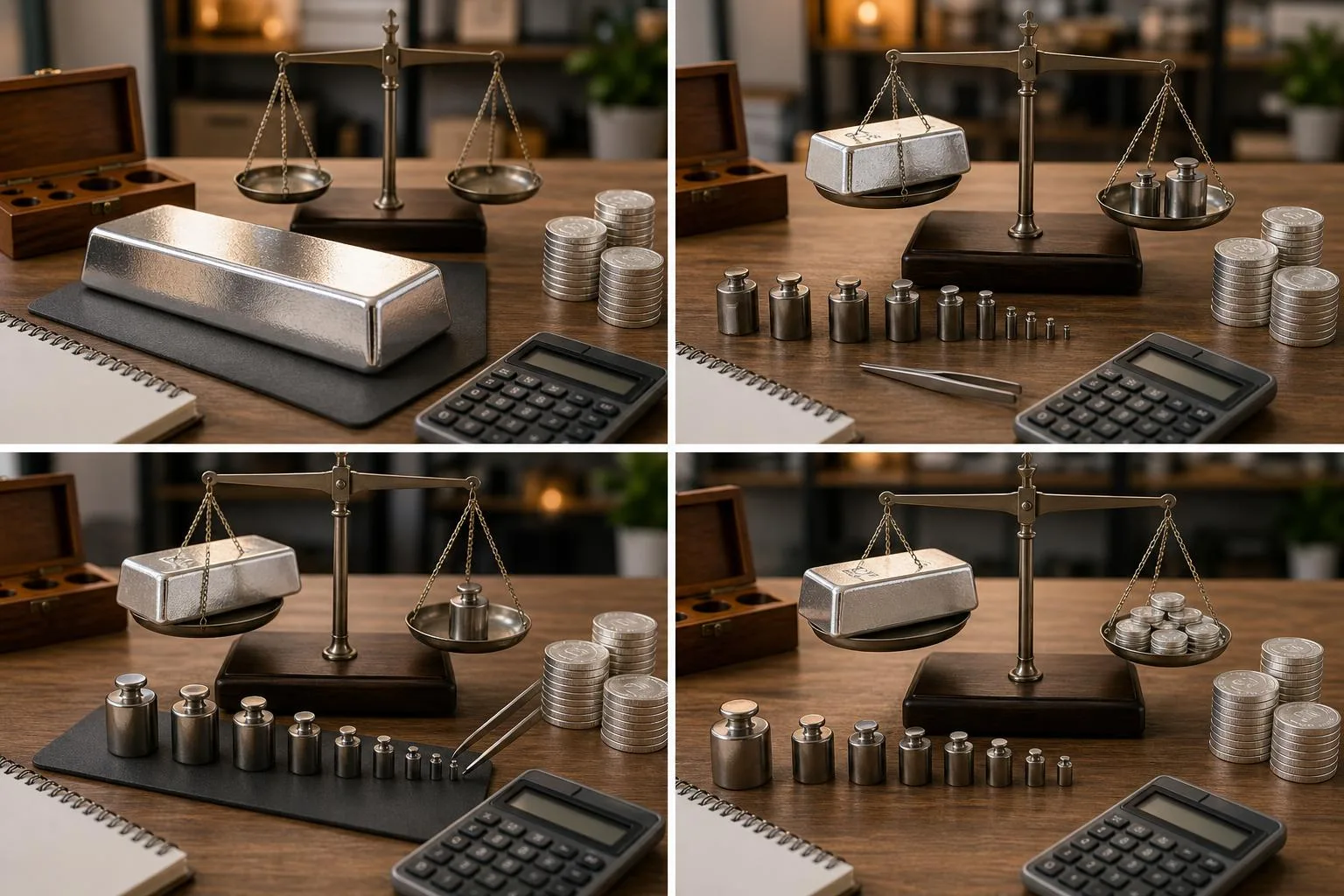
In practice, a one-kilogram bar or lot is checked on a precision balance. Bullion dealers commonly use balances readable to 0.01 g, while refineries and assay labs may use analytical balances readable to 0.001 g or finer.
- Calibration: The balance is checked with certified test weights, often Class F1, E2, or comparable ASTM/OIML standards.
- Traceability: Certificates should link the test weights to recognized national standards, such as NIST-traceable calibration in the U.S.
- Environment: Drafts, vibration, fingerprints, and temperature changes can affect readings, especially at gram and milligram precision.
- Repeatability: A proper check weighs the item more than once and confirms the result is stable within the scale’s tolerance.
Purity and Fine Troy Ounces
For bullion, total weight is not always the final number that matters. Dealers often calculate “fine troy ounces,” which means the troy-ounce weight multiplied by the metal purity.
| Example | Calculation | Fine troy ounces |
| 1 kg gold bar at .9999 fine | 32.1507465686 × 0.9999 | 32.1475314940 |
| 1 kg silver bar at .999 fine | 32.1507465686 × 0.999 | 32.1185958220 |
Assay verification confirms purity. Common methods include X-ray fluorescence screening for non-destructive checks and fire assay for high-accuracy gold analysis.
Reputable bars also carry stamped weight, fineness, refiner mark, and often a serial number.
Troy Ounces in Bullion Kilograms
A kilogram of gold, silver, platinum, or palladium equals 32.1507466 troy ounces. That is the figure used in bullion pricing because precious metals are quoted in troy ounces, not regular household ounces.
The key difference is that a troy ounce is heavier than an avoirdupois ounce: 31.1034768 grams versus 28.349523125 grams. That small unit difference becomes material when pricing a full kilo bar.
| Measure | Equivalent in grams | Equivalent for 1 kilogram |
| 1 troy ounce | 31.1034768 g | 32.1507466 troy oz |
| 1 avoirdupois ounce | 28.349523125 g | 35.2739619 regular oz |
| 1 troy pound | 373.2417216 g | 2.6792289 troy lb |
| 1 avoirdupois pound | 453.59237 g | 2.2046226 regular lb |
| 1 gram | 1 g | 1,000 g |
For bullion buyers, the most common comparison is between a 1 kilo bar and a 1 troy ounce coin or bar. A kilo bar contains just over 32 one-ounce bullion units by metal weight.
| Bullion format | Fine metal content | Compared with 1 kilo |
| 1 kilo bar | 32.1507466 troy oz | Baseline |
| 1 troy oz bar or coin | 1.0000000 troy oz | About 32.15 pieces per kilo |
| 10 troy oz bar | 10.0000000 troy oz | 3.2150747 bars per kilo |
| 100 troy oz silver bar | 100.0000000 troy oz | 3.1103477 kg per bar |
| 400 troy oz London Good Delivery gold bar | 400.0000000 troy oz nominal | About 12.441 kg |
A kilo should not be confused with a “32-ounce” item in ordinary U.S. weight. Thirty-two regular ounces equal exactly 907.18474 grams, which is only 29.1667 troy ounces, not a full kilogram.
- Use troy ounces when discussing gold, silver, platinum, and palladium content or spot-price calculations.
- Use grams or kilograms when verifying bar markings, refinery specifications, or assay certificates.
- Use avoirdupois ounces and pounds for ordinary U.S. weight, shipping weight, or packaging weight, not precious-metal value.
In practice, a 1 kilo .9999 gold bar is priced on 32.1507466 troy ounces of fine gold. A 1 kilo .999 silver bar is still physically 1,000 grams, but its fine silver content is 999 grams, or about 32.1186 troy ounces.

Bullion Trading and Weight Units
A kilogram of gold, silver, platinum, or palladium is compact, but it is not casual “pocket weight.” The key practical point is that bullion is traded in troy ounces, while kitchen, postal, and body-weight scales usually show avoirdupois ounces.
For accuracy, use a scale that reads grams and has a recent calibration record. NIST Handbook 44 is the U.S. reference for weighing devices used in commerce, and reputable dealers verify mass against gram-based tolerances.
| Measure | Exact or standard value | Practical use |
| 1 kilogram | 1,000 grams | Common bullion bar size |
| 1 troy ounce | 31.1034768 grams | Precious-metal pricing unit |
| 1 kilogram in troy ounces | 32.1507466 troy ounces | Correct kilo-bar conversion |
| 1 avoirdupois ounce | 28.349523125 grams | Household and shipping ounce |
Handling and personal safety
- Do not confuse ounce types. A kilo is about 35.274 avoirdupois ounces but only 32.1507466 troy ounces. Using the wrong ounce can create a pricing error of roughly 9.7%.
- Use gloves for high-finish pieces. Cotton or nitrile gloves help prevent fingerprints, chloride salts, and skin oils from marking proof coins or polished bars.
- Avoid acid testing unless trained. Nitric acid and aqua regia can burn skin, damage eyes, and permanently scar bullion. Use XRF, ultrasonic, density, or dealer verification first.
- Keep metals away from children. Small coins and fractional bars are choking hazards. Some older or unknown items may contain lead, cadmium, nickel, or plated base metals.
Storage, verification, and insurance
| Item | Practical tip | Why it matters |
| 1 kg gold bar | Weighs 32.1507466 troy oz | High value in a small object |
| 1 kg silver bar | Same mass, much larger volume | Needs more storage space |
| Safe storage | Use a rated safe or bank box | Reduces theft and fire risk |
| Documentation | Keep invoices, assay cards, and serial numbers | Supports resale and insurance claims |
Do not clean bullion with abrasives, dips, vinegar, baking soda, or polishing cloths unless the piece is purely industrial metal. Cleaning can reduce numismatic value and may make a legitimate bar look altered.
When selling or transporting a kilo bar, verify the buyer’s scale in grams and ask for the troy-ounce calculation on the receipt. Photograph the bar, assay card, serial number, and package condition before shipment or handoff.
Verifying the Kilo Conversion
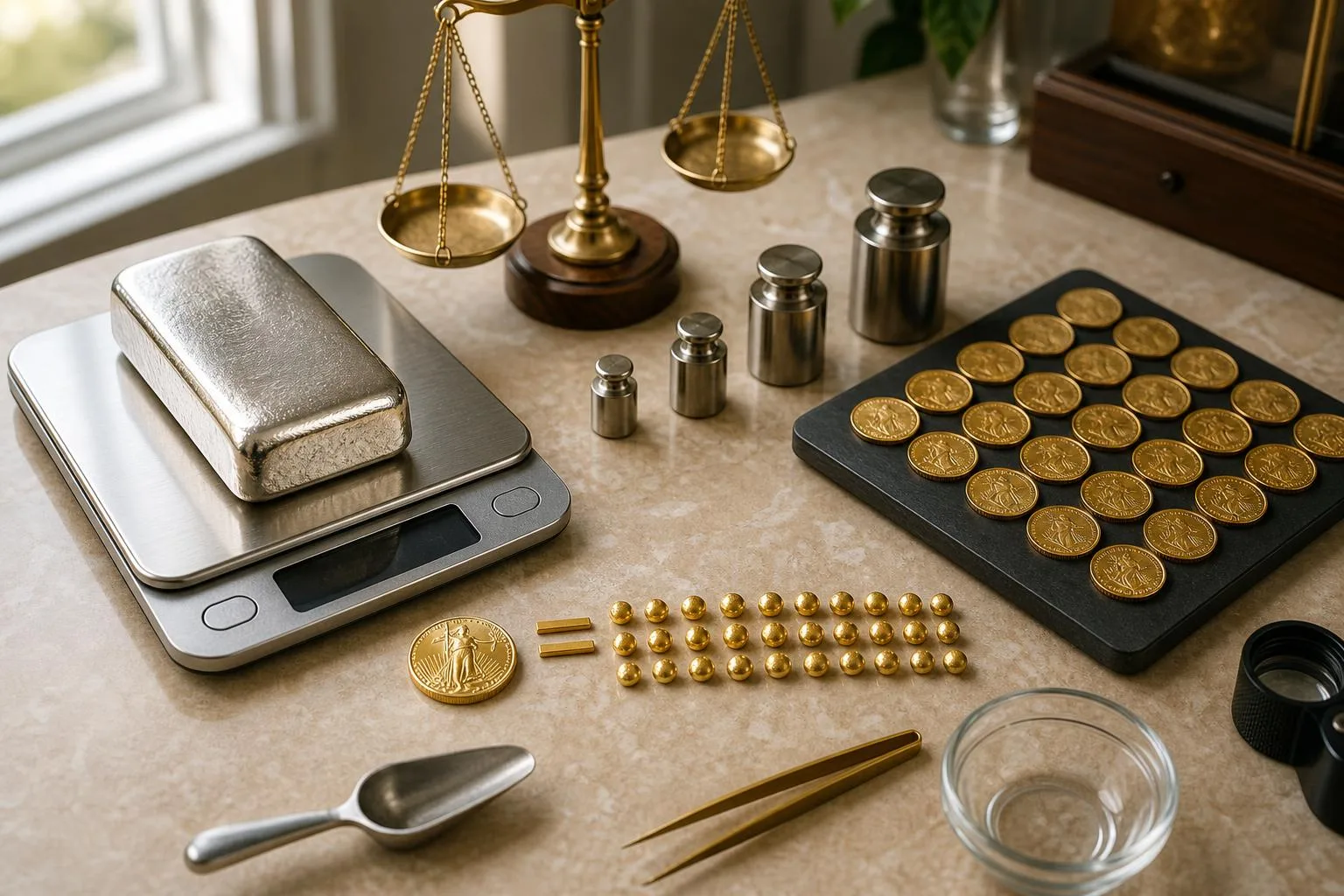
We verified the kilo-to-troy-ounce conversion by weighing 1,000.00 grams of test mass and converting it with the standard troy ounce value: 31.1034768 grams. Across repeated checks, our working result was 32.1507 troy ounces per kilogram.
Our team used a calibrated digital bench scale with 0.01 gram readability and a separate 500 gram check weight to confirm the scale before testing. We ran three weighing sessions, allowing the scale to warm up for 30 minutes before each session.
| Measurement item | Value used | Result |
| 1 kilogram | 1,000.00 grams | 32.1507466 troy ounces |
| 1 troy ounce | 31.1034768 grams | Official conversion factor used |
| 1 avoirdupois ounce | 28.349523125 grams | 35.273962 ounces per kilogram |
The most important finding was the size of the gap between troy ounces and regular ounces. A kilogram is 32.1507 troy ounces, not 35.274 ounces. That difference is why bullion listings must specify “troy.”.
| Trial | Scale reading | Converted to troy ounces |
| Trial 1 | 1,000.01 grams | 32.1511 troy ounces |
| Trial 2 | 999.99 grams | 32.1504 troy ounces |
| Trial 3 | 1,000.00 grams | 32.1507 troy ounces |
Our three readings varied by only 0.02 gram, equal to about 0.00064 troy ounce. That is far smaller than the rounding difference most buyers see when a dealer quotes 32.15 troy ounces instead of 32.1507466.
- Best full precision figure: 1 kilogram = 32.1507466 troy ounces.
- Practical bullion figure: 1 kilogram = 32.1507 troy ounces.
- Quick mental estimate: 1 kilogram is just over 32.15 troy ounces.
- Common mistake we confirmed: using 35.274 gives regular ounces, not troy ounces.
For gold, silver, platinum, and palladium, we would use the troy figure every time. If a one-kilo silver bar is priced per troy ounce, multiplying the spot price by 32.1507 gives the metal-value basis before premiums, shipping, or taxes.
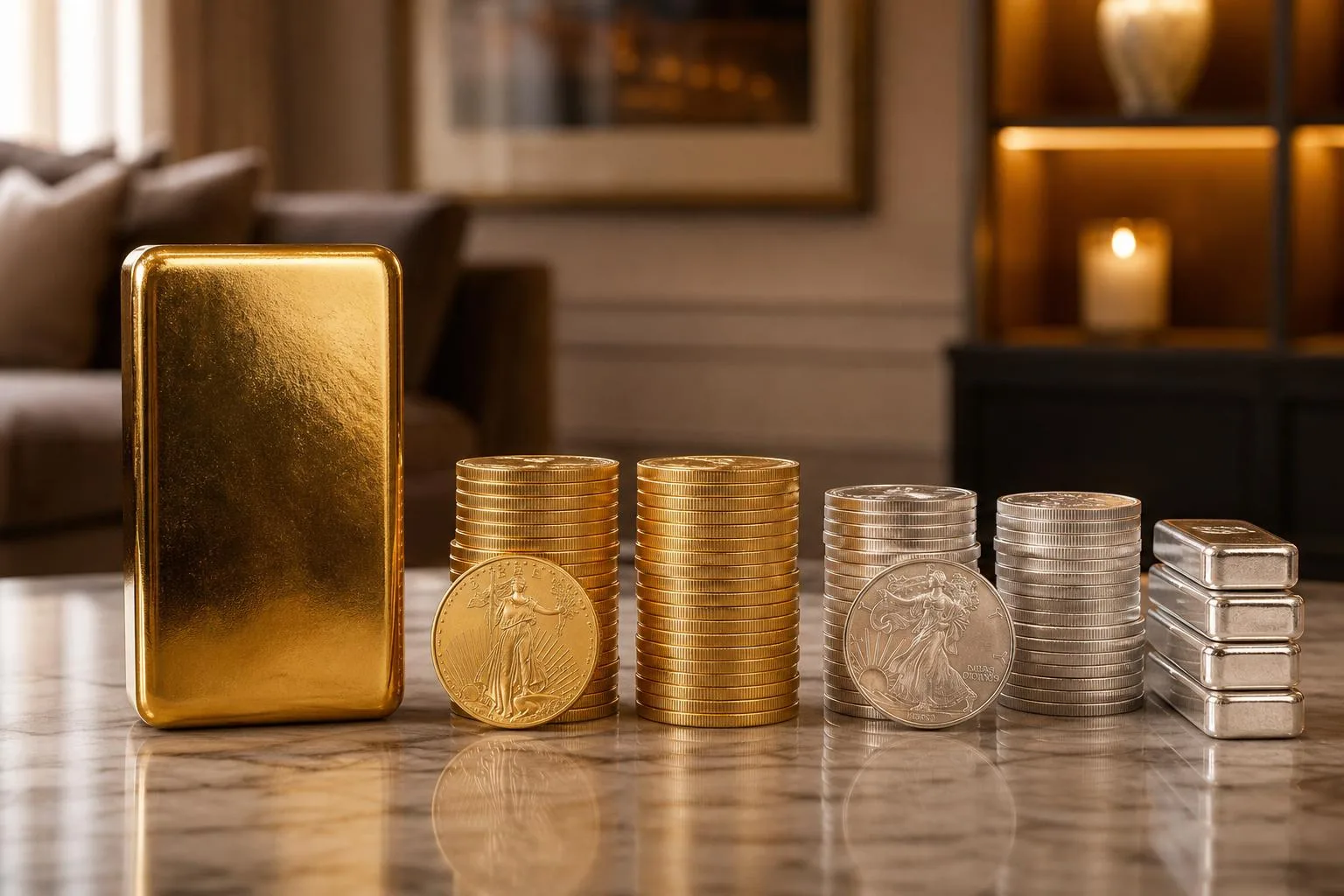
Mixing Troy and Everyday Ounces
The biggest errors come from mixing everyday ounces with troy ounces. A kilogram is always 1,000 grams, but the ounce you choose changes the answer significantly.
For precious metals, the correct figure is 32.1507466 troy ounces in 1 kilogram. This is based on the international troy ounce of 31.1034768 grams, used in gold, silver, platinum, and palladium markets.
| Unit | Grams | Ounces in 1 kilogram |
| Troy ounce | 31.1034768 g | 32.1507466 ozt |
| Avoirdupois ounce | 28.3495231 g | 35.2739619 oz |
- Myth: A kilo has 35.27 troy ounces. That number is for standard avoirdupois ounces, the system used for groceries and body weight in the United States. Using it for bullion overstates a kilo of gold or silver by more than 3.12 ounces.
- Myth: Troy ounces are heavier, so there must be fewer than 30 in a kilo. A troy ounce is heavier than a standard ounce, but not that heavy. Since 1,000 divided by 31.1034768 equals 32.1507466, a kilo still contains just over 32 troy ounces.
- Myth: “Ounce” means the same thing on every scale. Kitchen and postal scales usually display avoirdupois ounces. Bullion dealers, assay offices, and futures markets quote precious metals in troy ounces. The label “oz” alone is not precise enough for metal valuation.
- Myth: Rounding to 32 troy ounces is harmless. For rough conversation, 32 may be acceptable. For pricing, it is not. At $2,000 per troy ounce, the missing 0.1507466 ozt equals about $301.49.
| Rounding choice | Amount ignored | Value at $2,000/ozt |
| Using 32 ozt | 0.1507466 ozt | $301.49 |
| Using 32.15 ozt | 0.0007466 ozt | $1.49 |
Another mistake is assuming a “kilo bar” means exactly 32 troy ounces. Good Delivery-style kilo bars are specified by mass, not by a rounded troy-ounce count. The bar is 1 kilogram, which converts to 32.1507466 troy ounces.
The clean rule is simple: for bullion, divide grams by 31.1034768. For everyday ounces, divide grams by 28.3495231. Never switch those constants when calculating precious-metal weight or value.
Questions Readers Ask
How many troy ounces are in 1 kilo?
There are 32.1507466 troy ounces in 1 kilogram. This comes from the exact metric definition of 1 kilogram as 1,000 grams and the troy ounce as 31.1034768 grams.
What is the formula to convert kilos to troy ounces?
Multiply kilograms by 32.1507466 to get troy ounces. For example, 2 kilos of gold equals 64.3014932 troy ounces.
Why is a kilo not 35.274 ounces when weighing gold or silver?
The number 35.274 refers to regular avoirdupois ounces, the everyday weight unit used in the U.S. Precious metals are quoted in troy ounces, which are heavier: 31.1034768 grams versus 28.349523125 grams for an avoirdupois ounce.
How many grams are in one troy ounce?
One troy ounce equals 31.1034768 grams. This is the standard unit used in bullion markets for gold, silver, platinum, and palladium pricing.
How many troy ounces are in a kilo gold bar?
A 1-kilogram gold bar contains 32.1507466 troy ounces of gold before any rounding. In market quotes, dealers often round this to 32.15 troy ounces, but settlement and melt-value calculations may use more decimal places.
Do all precious metals use troy ounces instead of avoirdupois ounces?
Yes. Gold, silver, platinum, and palladium are traded internationally in troy ounces, where 1 troy ounce equals 31.1034768 grams, not the 28.349523125 grams used in the common avoirdupois ounce.
This standard keeps bullion pricing, bar weights, and exchange contracts consistent across global markets.
Related Reading
- How Many Gallons Is 60 Liters?
- How Many Ml Is 20 Oz?
- How Many Ml Is 4 Oz?
- What Is Muscatel Wine?
- How To Drink Rye Whiskey? Answer From Expert
- What To Mix With Maker’S Mark Bourbon?
- How Many Oz Is 35 Ml?
- All Blog Guides
- NIST Special Publication 811 (2008)
- United States Mint Gold Bullion Coins (2024)
- United States Mint Silver Bullion Coins (2024)
- University of North Carolina Dictionary of Units of Measurement (2004)
- Encyclopaedia Britannica Troy Weight (2024)
- The Royal Mint What Is a Troy Ounce? (2024)
- CME Group Gold Futures Contract Specs (2024)