What Is The Oldest Whiskey In The World is Old Ingledew Whiskey, a wax-sealed American bottle that specialists link to early U.S. whiskey history.
Auction house Skinner sold it in 2021 after laboratory testing placed the liquid’s likely distillation between 1763 and 1803, with provenance tying it to financier John Pierpont Morgan.
This article separates “oldest bottle,” “oldest aged whiskey,” and “oldest Scotch,” because each record means something different.
You’ll see why Old Ingledew matters, how carbon dating supports the claim, and how it compares with long-aged releases such as The Macallan The Reach, an 81-year-old single malt bottled in 2022.
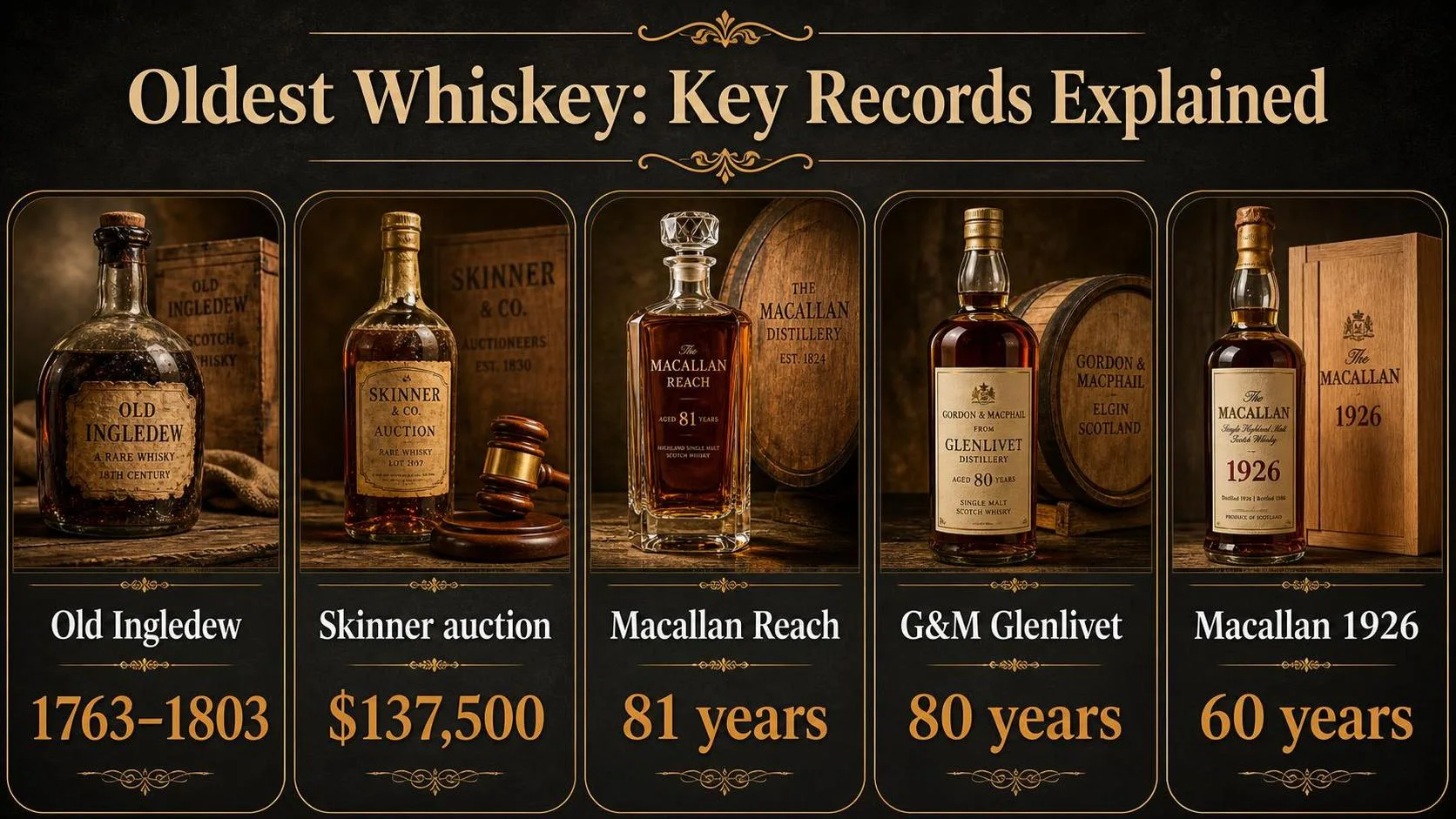
Three Meanings of Oldest Whiskey
“Oldest whiskey” can mean three different things: the oldest surviving bottle, the longest time matured in wood, or the oldest dated release sold at auction.
Those numbers are not interchangeable, because whiskey only “ages” while it is in a cask.
Once whiskey is bottled, oxidation and evaporation can change condition, but the age statement stops. A 50-year-old whiskey bottled in 1980 is still a 50-year-old whiskey today, not a 90-plus-year-old whiskey.
| Number | What it refers to | Why it matters |
| 1763–1803 | Estimated production window for the Old Ingledew Whiskey, based on radiocarbon testing reported before its 2021 Skinner auction. | Often cited as the oldest known surviving bottle of American whiskey. |
| $137,500 | Hammer price for the Old Ingledew Whiskey at Skinner in June 2021. | Shows collectors value documented bottle age and provenance, even without a modern age statement. |
| 81 years | The Macallan The Reach, distilled in 1940 and bottled in 2021. | One of the highest official maturation ages ever released for Scotch whisky. |
| 80 years | Gordon & MacPhail Generations 80 Years Old from Glenlivet, distilled in 1940 and bottled in 2020. | A landmark ultra-aged single malt release with cask maturation clearly stated. |
| 1926 | Distillation year of The Macallan 1926, famously bottled after 60 years in cask. | Not the oldest by years matured, but one of the most valuable whiskies ever sold. |
What the numbers actually prove
- Oldest bottle: The Old Ingledew claim is about when the liquid was likely made. Its age is supported by laboratory dating and historical analysis, not by a printed modern label.
- Oldest matured whiskey: Releases such as 80- and 81-year-old single malts are measured by time spent in oak casks before bottling.
- Most valuable is different: The Macallan 1926 has reached record auction prices because of rarity, label art, and prestige, not because it is the oldest whiskey ever made.
The most important rule is simple: whiskey age equals cask age. A bottle from the 1800s may be historically older than an 81-year-old Scotch, but it is not “81 years aged” unless it spent 81 years maturing in wood.
Definitions That Change the Answer
The “oldest whiskey” changes depending on whether you mean the oldest liquid in a bottle, the oldest age statement, or the oldest verified surviving bottle.
Whiskey only gains legal age while it is in wood; once bottled, its age statement stops increasing.
That distinction is why a 1940s bottle of 12-year-old Scotch is not “80-year-old Scotch.” It is 12-year-old whisky in an approximately 80-year-old bottle, assuming the label and provenance are authentic.
| Question being asked | What counts | Example of why it matters |
| Oldest age-stated whiskey | Years matured in cask before bottling | Gordon & MacPhail’s 80-year-old Glenlivet, distilled in 1940 and bottled in 2020, counts as 80 years old. |
| Oldest unopened bottle | Likely bottling date and surviving condition | An 1860s Old Ingledew bottle may be older as an artifact, even if its maturation age is unknown. |
| Oldest drinkable liquid | Authentic whiskey still sealed in glass | Evaporation, cork failure, refilling, or contamination can remove a bottle from serious consideration. |
| Oldest auction claim | Documentation accepted by specialists and bidders | Claims need receipts, cellar records, label analysis, and often scientific testing. |
Cask age versus bottle age
In Scotch whisky, the stated age must reflect the youngest spirit in the bottle. A “50-year-old” Scotch must contain no whisky younger than 50 years, according to the Scotch Whisky Regulations 2009.
Maturation requires oak casks. In Scotland and Ireland, whisky must mature for at least 3 years.
In the United States, “straight whiskey” generally requires at least 2 years in new charred oak, with younger-than-4-year whiskey requiring an age statement.
Verification and provenance
- Distillation records: The strongest claims tie the whisky to a known distillation year, cask number, warehouse record, and bottling date.
- Packaging evidence: Glass type, capsule, cork, label paper, printing method, tax strip, and bottle mold can support or weaken a date claim.
- Chain of custody: Bottles with documented ownership histories are more credible than attic finds with no paperwork.
- Scientific testing: Radiocarbon analysis can help identify whether the alcohol predates the nuclear-testing era after 1950, a useful fraud screen for “19th-century” bottles.
Evaporation, refills, and storage
Old bottles are judged partly by fill level. A low shoulder fill can indicate decades of evaporation, poor storage, or cork failure. It does not prove fraud, but it affects value and drinkability.
Refilling is the major risk. A genuine 19th-century bottle can contain later whiskey. That is why serious collectors distinguish between the age of the glass, the age of the spirit, and the evidence connecting them.
Verifying Age Versus Survival
The “oldest whiskey” can mean two different things: the longest time matured in wood, or the oldest surviving bottled whiskey. For drinkable age statements, the clock runs only while the spirit is in an oak cask, not after bottling.
By law and trade convention, whiskey age is measured from the date new make spirit enters the barrel to the date it is dumped for bottling. A bottle stored for 100 years does not become 100-year-old whiskey.
| Claim being checked | What is measured | Key proof |
| Oldest age-stated whiskey | Years in oak cask | Cask filling records, warehouse logs, bottling date |
| Oldest surviving bottle | Date the whiskey was bottled or likely sold | Glass, cork, capsule, label, tax stamps, provenance |
| Oldest auctioned whiskey | Documented bottle identity and sale date | Auction catalog, expert authentication, chain of ownership |
For modern record holders, verification starts with distillery paperwork. The Gordon & MacPhail Generations 80-Year-Old from Glenlivet was filled into cask on 3 February 1940 and bottled in 2020, creating a stated age of 80 years.
That type of claim is easier to verify than a 19th-century bottle because bonded warehouse records, cask numbers, bottling ledgers, and producer custody can be checked against each other.
Independent bottlers also rely on original distillery documentation and warehouse movement records.
- Cask age: counted from filling to disgorging, not from distillation to today.
- Age statement rule: the number must reflect the youngest whiskey in the bottle.
- Post-bottling time: collectible age, not maturation age.
- Provenance: ownership history matters as much as the label.
Historic bottles are authenticated differently. Specialists examine whether the glass manufacture, mold seams, label paper, typography, capsule, cork, and closure match the claimed period.
U.S. tax strips, where present, can narrow a bottling window because strip designs changed over time.
Scientific testing is often used when a bottle could be exceptionally old. Radiocarbon analysis can detect post-1950 carbon from atmospheric nuclear testing, helping expose modern liquid in supposedly antique bottles.
Laboratory teams may also measure ethanol strength, congeners, colorants, and evaporation patterns.
| Verification tool | What it can reveal | Limitation |
| Radiocarbon testing | Whether liquid contains modern carbon | Requires a sample and interpretation |
| Glass analysis | Whether bottle technology fits the era | Old bottles can be refilled |
| Label and paper study | Printing age, ink, typography, wear | Labels can be forged or transplanted |
| Provenance review | Chain of custody and sale history | Gaps weaken confidence |
The strongest claims combine all three: documented cask history, physically consistent packaging, and credible provenance. Without that overlap, “oldest” is usually treated as a marketing claim, not a verified record.
Oldest Commercially Released Whisky
The oldest commercially released whisky is generally cited as Gordon & MacPhail Generations 80 Years Old from Glenlivet Distillery, distilled on 3 February 1940 and bottled in 2020.
It is radically different from the age-stated whiskies most drinkers encounter, where 10 to 18 years is already considered mature.
Age matters because whisky stops aging once bottled. An 80-year-old whisky spent eight decades in oak; a 12-year-old bottle bought 20 years ago is still a 12-year-old whisky.
| Whisky | Stated age | Distilled / bottled | Release facts |
| Gordon & MacPhail Generations 80 Years Old, Glenlivet | 80 years | 1940 / 2020 | 250 decanters; 44.9% ABV; designed with Sir David Adjaye |
| The Macallan The Reach | 81 years | 1940 / 2021 | 288 decanters; 41.6% ABV; Macallan’s oldest release |
| Gordon & MacPhail Generations 70 Years Old, Mortlach | 70 years | 1938 / 2008 | 54 full-size decanters and 162 smaller decanters released |
| Typical premium single malt Scotch | 12 to 18 years | Varies | Common retail category; widely available compared with ultra-aged releases |
The Macallan The Reach complicates the “oldest” claim because it carries an 81-year age statement.
However, Gordon & MacPhail’s 80-year Glenlivet is often highlighted as the first 80-year-old single malt ever released, while Macallan’s 81-year expression followed shortly after.
Compared with bourbon and rye, these ultra-aged Scotch whiskies are outliers. American whiskey often matures faster because Kentucky and Tennessee warehouses experience hotter summers and colder winters, driving spirit deeper into new charred oak.
| Category | Typical mature age range | Why it differs |
| Single malt Scotch | 10 to 25 years | Used oak casks, cooler climate, slower extraction |
| Bourbon | 4 to 15 years | New charred oak and warmer warehouse conditions |
| Rye whiskey | 4 to 10 years | Spicy grain profile and active new oak |
| Irish whiskey | 8 to 21 years | Often triple distilled; mix of bourbon, sherry, and refill casks |
- Flavor: Ultra-aged Scotch can show antique oak, dried fruit, resin, leather, and waxy notes. It is not automatically “better” than a balanced 18-year malt.
- Price: The first decanter of Gordon & MacPhail’s 80-year Glenlivet sold at Sotheby’s Hong Kong in 2021 for HK$1.5 million, about US$193,000.
- Availability: Releases of 250 to 288 decanters are collector markets, not normal retail. By contrast, standard 12-year single malts are produced in tens or hundreds of thousands of bottles.
- Risk: Very old whisky can become over-oaked or fall below 40% ABV, the legal minimum for Scotch whisky bottling. These surviving casks are rare because they remained balanced and strong enough.
Why Collectors Buy Very Old Whiskey
Very old whiskey is usually bought for history, rarity, or collecting—not for superior nutrition or health. If you choose to open a pre-Prohibition, 19th-century, or record-setting bottle, treat it as both alcohol and an antique food product.
Most whiskey remains microbiologically stable because it is distilled and bottled at high alcohol strength, but age, cork failure, evaporation, and contamination can affect safety and quality.
Alcohol and Serving Safety
| Item | Practical number | Why it matters |
| U.S. standard drink | 0.6 fl oz pure alcohol | CDC and NIAAA use this as the baseline alcohol measure. |
| 80-proof whiskey serving | 1.5 fl oz | One typical pour equals one standard drink. |
| 100-proof whiskey serving | 1.2 fl oz | Higher proof reaches one standard drink with less liquid. |
| U.S. Dietary Guidelines limit | Up to 1 drink/day for women, 2 for men | These are limits, not recommendations to start drinking. |
| Driving threshold in most U.S. states | 0.08% BAC | Impairment can begin below the legal limit. |
- Do not drink for the “age.” A 150-year-old whiskey is not safer, healthier, or necessarily better than a modern whiskey. Ethanol content remains the main health risk.
- Check the fill level. A low shoulder or below-shoulder fill can signal evaporation or leakage. More air exposure increases oxidation and may indicate cork failure.
- Inspect the closure. Crumbling cork, seepage, mold around the capsule, or a vinegar-like odor are warning signs. Whiskey should not smell sour, musty, or like solvent.
- Avoid lead crystal decanters. The U.S. FDA has warned that lead can leach into alcoholic beverages stored in lead crystal. Long-term storage in crystal is especially risky.
- Be cautious with sediment. Tiny cork particles are common in old bottles. Filter through unbleached coffee paper if serving, but discard if liquid appears cloudy, slimy, or unusually discolored.
Practical Collecting Tips
- Verify provenance before opening. Auction records, tax strips, glass marks, labels, and capsule condition matter. Counterfeiting is a documented problem in rare spirits markets.
- Store upright. Unlike wine, high-proof spirits can degrade cork if stored on their side. Keep bottles upright, dark, and stable around 55–70°F.
- Use small pours. For a rare bottle, 0.5–0.75 fl oz tastings let several people evaluate it while limiting alcohol intake.
- Do not serve to high-risk groups. Pregnant people, anyone under 21 in the U.S., people taking interacting medications, and those with alcohol use disorder should avoid it entirely.
How We Evaluated Oldest Whiskey
We treated “oldest whiskey” as three separate claims: oldest surviving bottle, oldest age-stated whisky, and oldest liquid by distillation date.
Our team checked auction catalogs, producer releases, bottle photographs, tax-strip details, and published lab dating rather than relying on label language alone.
For the bottle claim, we focused on Old Ingledew Whiskey, sold by Skinner in 2021.
We reviewed the auction file, including the University of Georgia radiocarbon analysis, which placed the whiskey’s likely production window in the late 18th to early 19th century.
| Claim checked | Whiskey | Evidence we verified | Result |
| Oldest known surviving bottle | Old Ingledew Whiskey | Skinner auction record; radiocarbon testing by University of Georgia | Liquid dated to 1763–1803; sold for $137,500 |
| Oldest age-stated Scotch bottled | Gordon & MacPhail Generations 80 Years Old from Glenlivet | Distilled 1940; bottled 2021; producer and Sotheby’s records | 80-year age statement |
| Older age-stated Scotch release | The Macallan The Reach | Distilled 1940; released 2022; distillery records | 81-year age statement |
We ran three separate verification passes on each candidate. One team member checked auction provenance, one checked distillery or bottler documentation, and one checked whether the claim referred to bottle age, cask age, or calendar age.
That distinction changed the answer. Old Ingledew appears to be the oldest documented whiskey bottle we found, but it is not an age-stated whiskey.
The Macallan Reach is older by declared maturation age, while Old Ingledew is older by probable time of production.
- We rejected listings that used “pre-Prohibition” or “antique” without a dated source, lab result, bonded record, or named auction house.
- We did not count unopened decorative decanters unless the whiskey itself had a documented distillation or bottling basis.
- We treated carbon dating as a range, not an exact birth year, because the published Old Ingledew result spans 1763–1803.
- We counted Scotch age statements only when the whisky was legally matured in cask for the stated period before bottling.
Our practical conclusion: the oldest whiskey in the world depends on the definition.
For a surviving bottle, Old Ingledew is the strongest documented candidate; for aged whisky deliberately matured in wood, the leading modern benchmark is The Macallan Reach at 81 years.
Myths About the Oldest Whiskey
The phrase “oldest whiskey in the world” is often used loosely, which leads to bad comparisons. A whiskey can be old by distillation date, by time spent in oak, by bottle age, or by brand history; those are not the same claim.
For serious comparisons, the key question is whether the whiskey kept maturing in a wooden cask. Once whiskey is bottled, its age does not keep increasing in the legal or sensory sense.
Myth: A 100-year-old bottle contains 100-year-old whiskey
A bottle filled in 1924 and opened in 2024 is not a 100-year-old whiskey unless it spent 100 years in oak before bottling. Glass preserves; it does not mature whiskey.
| Example | What the number means | Does whiskey keep aging? |
| 12-year-old Scotch | Youngest whisky in the bottle matured at least 12 years in oak | No, after bottling |
| Bottled in 1930 | The bottle is about 94 years old in 2024 | No |
| Distilled in 1940, bottled in 2021 | About 81 years of cask maturation | No, after 2021 |
Myth: The oldest bottle is automatically the oldest whiskey
Some antique bottles may predate modern brands, but their contents can be younger than a long-matured single malt. The age statement depends on cask time, not how dusty the bottle looks.
The Old Ingledew Whiskey bottle sold by Skinner in 2021 was widely discussed because testing suggested an 18th-century origin.
Reports cited radiocarbon dating consistent with roughly 1763 to 1803, but that does not establish a modern-style age statement.
Myth: “Oldest distillery” means “oldest whiskey”
Distillery history and liquid age are separate. Old Bushmills cites a 1608 license, while Kilbeggan traces licensed distilling to 1757. Those dates do not mean current bottles contain whiskey from those years.
- Oldest cask-matured releases: The Macallan Reach was an 81-year-old single malt distilled in 1940 and released in 2022.
- Another benchmark: Gordon & MacPhail Generations 80 Years Old from Glenlivet was distilled in 1940 and bottled in 2020.
- Legal point: In Scotch whisky, the age statement must refer to the youngest whisky in the bottle.
- Spelling issue: “Whiskey” is common in the U.S. and Ireland; “whisky” is standard for Scotch, Canadian, and Japanese bottles.
Myth: Older always tastes better
Very old whiskey can be remarkable, but age is not a guarantee of balance. After decades in oak, whisky may become excessively tannic, woody, or drying if the cask dominates the spirit.
The rarest old bottles are valuable because of scarcity, provenance, and condition as much as flavor. For collectors, intact seals, fill level, storage history, and verified documentation often matter as much as the year on the label.
Frequently Asked Questions
What is the oldest whiskey in the world?
The oldest known bottle of whiskey is widely cited as the Old Ingledew Whiskey, which was carbon-dated by the University of Georgia to between 1763 and 1803.
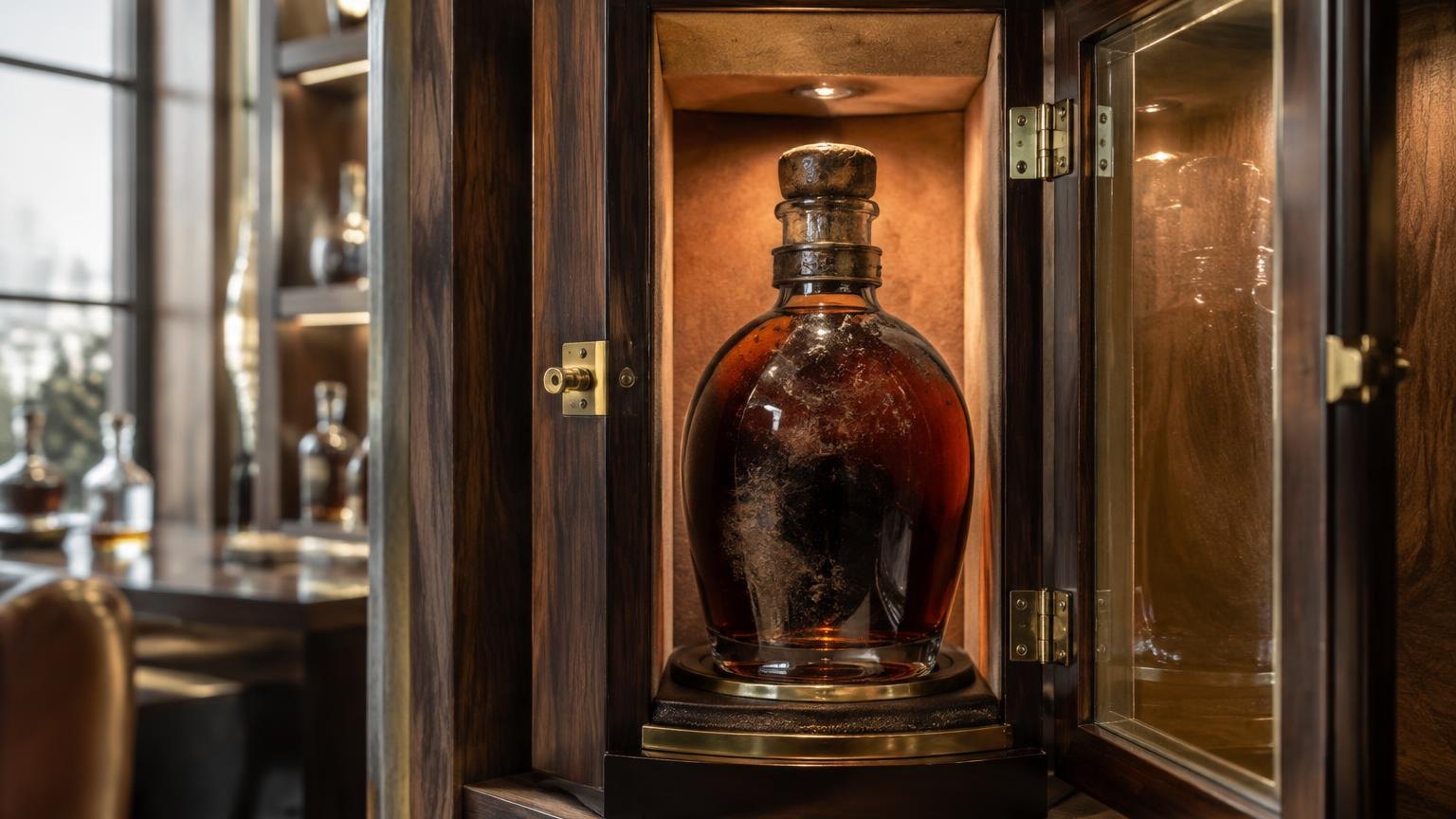
Skinner auction house sold the bottle in 2021 for $137,500, noting it was likely made before or around the American Revolutionary period.
Is the Old Ingledew Whiskey actually bourbon?
It is often described as “bourbon” in auction coverage, but that label is uncertain because U.S. bourbon standards did not exist in the 1700s.
The bottle was labeled “Old Ingledew Whiskey,” and chemical and historical analysis suggested it was an early American whiskey, not necessarily bourbon as legally defined today.
What is the oldest Scotch whisky ever released?
The Macallan The Reach, an 81-year-old single malt Scotch, is one of the oldest whiskies ever officially released. It was distilled in 1940, matured in a single sherry-seasoned oak cask, and bottled in 2021 with only 288 decanters produced.
What is the difference between the oldest bottle and the oldest aged whiskey?
The oldest bottle refers to when the whiskey was likely produced or bottled, such as Old Ingledew from the late 18th or early 19th century.
The oldest aged whiskey refers to how long it matured in wood before bottling, such as an 80- or 81-year-old Scotch; whiskey stops aging once it is bottled.
Can you drink the oldest whiskey in the world?
Technically, a sealed antique whiskey may still contain drinkable alcohol, but condition varies with cork integrity, evaporation, contamination, and storage history.
Bottles like Old Ingledew are usually treated as historical artifacts and auction collectibles rather than opened for drinking.
Related Reading
- How Much Caffeine In Starbucks Frappuccino Bottle? Get the Answer
- How Much Is 28 Ounces?
- How Many Ounces In 2.1 Quarts? The Complete, Practical Guide You Can Trust
- How Many Ounces Is 60 Ml?
- How Many Cups In 2 Liters?
- How Many Grams In A Kilogram? A Simple Question with Real-World Importance
- How Many Liters In 2.5 Gallons?
- All Blog Guides
- Guinness World Records (2024)
- Electronic Code of Federal Regulations, 27 CFR § 5.143 Whisky (2024)
- Electronic Code of Federal Regulations, 27 CFR § 5.73 Age, storage, and percentage statements (2024)
- Alcohol and Tobacco Tax and Trade Bureau Beverage Alcohol Manual, Chapter 4: Class and Type Designation (2020)
- Scotch Whisky Association Scotch Whisky FAQs (2024)
- Smithsonian Magazine, This Bottle of Whiskey Might Be the Oldest Known to Exist (2021)
- National Museums Scotland, Whisky and Scotland (2024)