What Are The Driest White Wines are white wines with virtually no perceptible sweetness, led by Muscadet, Chablis, Sancerre, Albariño, Pinot Grigio, and Brut Nature sparkling wines.
In wine terms, “dry” means fermentation has converted most grape sugar into alcohol, leaving little residual sugar on the palate.
The driest examples usually taste citrusy, saline, mineral, or herbal rather than fruity-sweet. Expect sharper acidity, lighter body, and a clean finish.
This guide ranks the driest white wine styles, explains residual sugar labels, and shows which bottles to order when you want crisp, refreshing wine without sweetness.
Residual Sugar Measures White Wine Dryness
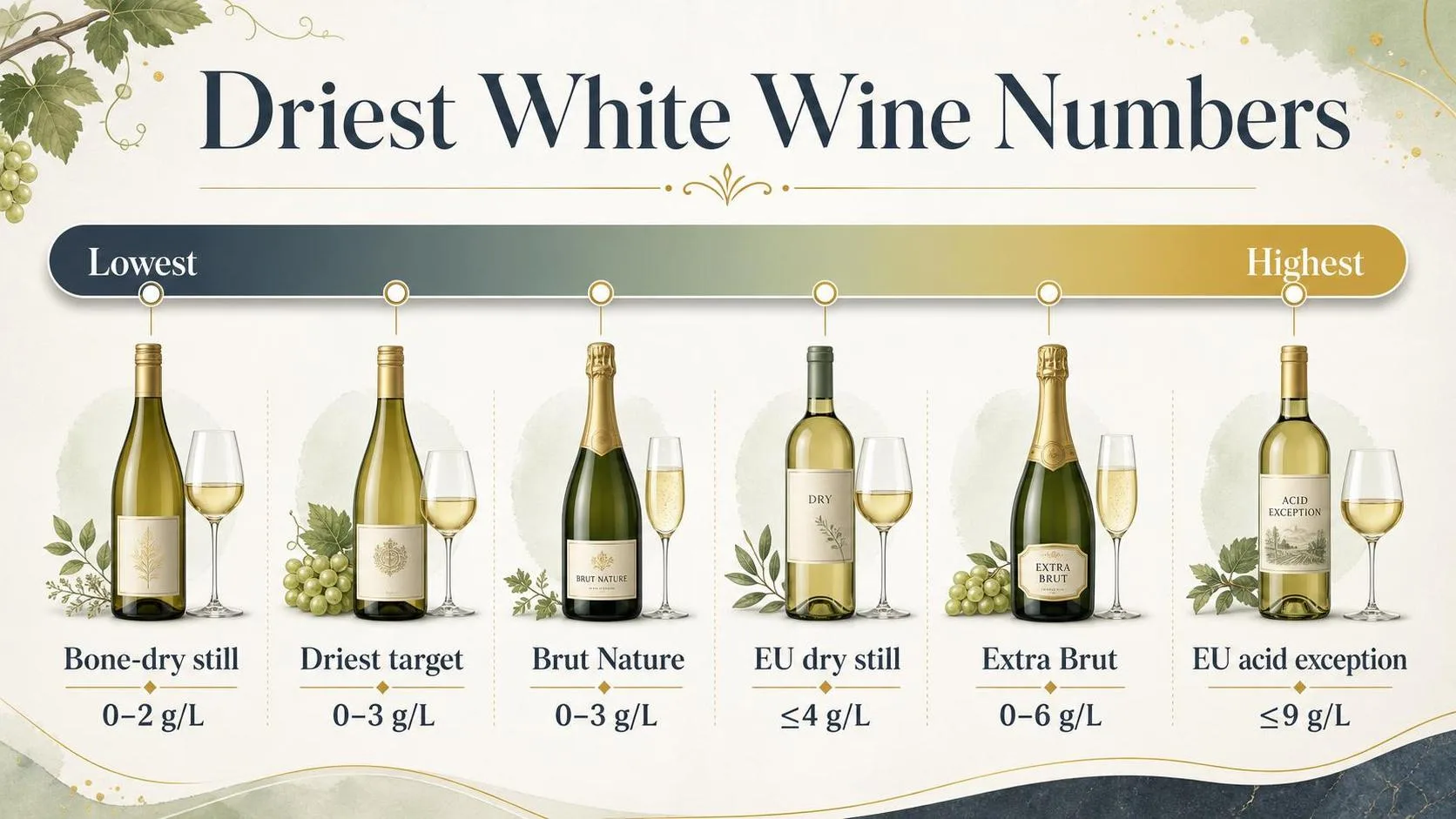
The dryness of white wine is measured mainly by residual sugar, usually listed as grams per liter, or g/L. In practice, the driest white wines sit around 0–3 g/L, but acidity can make a wine with slightly more sugar still taste sharply dry.
European wine law gives the clearest benchmark: a still wine can be labeled dry at up to 4 g/L residual sugar, or up to 9 g/L if total acidity is high enough to balance it.
This is why some dry Rieslings legally and sensorially qualify as dry despite higher sugar than Chablis.
| Term or style | Typical residual sugar | What it means in the glass |
| Bone-dry still white | 0–2 g/L | No noticeable sweetness; common in Muscadet, Chablis, many Albariño and Vinho Verde bottlings. |
| Very dry still white | 2–4 g/L | Still tastes dry to most drinkers, especially with bright acidity. |
| EU “dry” still wine limit | Up to 4 g/L, or up to 9 g/L with sufficient acidity | A legal labeling range, not a guarantee that all wines taste equally dry. |
| Brut Nature sparkling wine | 0–3 g/L | The driest common sparkling category; no perceptible dosage sweetness. |
| Extra Brut sparkling wine | 0–6 g/L | Very dry, though slightly rounder than Brut Nature in many examples. |
| Brut sparkling wine | 0–12 g/L | Can taste dry, but the upper end may seem softer or subtly sweet. |
For still white wines, 0–3 g/L is the number to look for if you want the driest bottle on the table.
Many classic dry whites fall here, including Muscadet Sèvre-et-Maine, unoaked Chablis, dry Sancerre, dry Assyrtiko, and many dry Spanish Albariños.
Acidity is the second key number. A white wine with 6–8 g/L total acidity can taste drier than a softer wine with the same sugar. High-acid grapes such as Riesling, Sauvignon Blanc, Chenin Blanc, and Assyrtiko can hide several grams of sugar.
- Safest driest picks: Muscadet, Chablis, Sancerre, Assyrtiko, Albariño, dry Pinot Grigio, and unoaked Vermentino.
- Check carefully: Riesling, Chenin Blanc, Gewürztraminer, and Pinot Gris, because these range from bone-dry to sweet.
- For sparkling wine: choose Brut Nature first, then Extra Brut, then Brut if you still want a dry profile.
In the United States, labels do not always print residual sugar, so technical sheets are the best source.
Search the producer’s website for “RS,” “residual sugar,” or “g/L.” If the figure is below 3 g/L, you are firmly in driest-white-wine territory.
What Shapes Perceived Wine Dryness
“Dry” is mainly about residual sugar, but the wine’s final impression depends on acidity, alcohol, aroma, and winemaking choices.
A white wine with 4 g/L sugar can taste bone-dry if its acidity is high, while another with the same sugar may feel softer.
Residual Sugar Sets the Baseline
Residual sugar, usually measured in grams per liter, is the clearest technical marker. In EU labeling, still wines are generally “dry” up to 4 g/L, or up to 9 g/L when acidity is high enough to balance the sugar.
| Dryness term | Typical residual sugar | How it usually tastes |
| Bone-dry | 0–2 g/L | Very crisp, no obvious sweetness |
| Dry | 0–4 g/L | Clean finish, little to no sweetness |
| Dry by EU exception | Up to 9 g/L | Can still taste dry if acidity is strong |
| Off-dry | About 9–18 g/L | Light sweetness, often balanced by acidity |
Acidity Can Make Sugar Disappear
Acidity is why Riesling, Albariño, Chablis, and Muscadet often taste drier than their lab numbers suggest. A wine with 7–8 g/L total acidity can hide several grams of residual sugar better than a low-acid white.
This is especially important in cool-climate wines. High-acid grapes keep the palate sharp, shorten the finish, and reduce the sensation of sweetness.
That is why “Trocken” German Riesling can legally contain up to 9 g/L sugar and still taste dry.
Alcohol, Ripeness, and Body Change Perception
Alcohol adds weight and warmth. A 14.5% ABV Chardonnay may be technically dry but feel rounder than an 11.5% ABV Muscadet. Higher ripeness also brings glycerol and fruit concentration, which can mimic sweetness even without meaningful residual sugar.
- Higher alcohol: fuller body, softer edges, sometimes a sweeter impression.
- Lower alcohol: lighter body, sharper finish, often a drier feel.
- Riper fruit flavors: peach, melon, and tropical notes can read as sweet.
- Green or mineral flavors: citrus, saline, and herbal notes usually read as drier.
Fermentation and Winemaking Choices Matter
A wine becomes dry when yeast converts most grape sugar into alcohol and carbon dioxide. If fermentation stops early, sugar remains. If it finishes completely, many whites land near 0–3 g/L residual sugar.
Oak aging, lees stirring, and malolactic conversion do not add sugar, but they soften texture. Barrel-fermented Chardonnay may seem less dry than stainless-steel Sauvignon Blanc because vanilla, cream, and lower acidity round off the palate.
Serving temperature matters too. Very cold white wine, around 45°F, tastes firmer and less sweet. As it warms toward 55°F, fruit aromas and body become more noticeable, which can make the same dry wine seem slightly richer.
Verifying Dryness with Residual Sugar
Dryness in white wine is verified by measuring residual sugar, not by guessing from taste. In lab terms, the key number is grams of fermentable sugar left per liter of finished wine, usually written as g/L.
A bone-dry white commonly sits below 2 g/L residual sugar. Many dry table wines fall between 0.5 and 4 g/L, though acidity, alcohol, temperature, and aroma can make the same sugar level seem drier or sweeter.
Residual Sugar Standards
| Wine category or term | Residual sugar level | Verification note |
| Very dry still white | 0-2 g/L | Often perceived as bone-dry, especially with high acidity |
| EU “dry” still wine | Up to 4 g/L | Allowed under EU rules for standard dry labeling |
| EU “dry” still wine with high acidity | Up to 9 g/L | Permitted if total acidity is no more than 2 g/L lower than sugar |
| Brut Nature sparkling wine | 0-3 g/L | No sugar may be added after secondary fermentation |
| Extra Brut sparkling wine | 0-6 g/L | Usually tastes very dry |
| Brut sparkling wine | Less than 12 g/L | Can taste dry because carbon dioxide and acidity sharpen perception |
For still white wines, the International Organisation of Vine and Wine and EU labeling rules use residual sugar and total acidity together. That matters because a Riesling at 7 g/L can legally and sensorially read dry if its acidity is high enough.
How Producers and Labs Confirm It
- Enzymatic analysis: The common professional method measures glucose and fructose separately, then reports total residual sugar in g/L. It is precise enough for technical sheets and export documentation.
- Density checks: During fermentation, wineries track specific gravity or Brix to see whether yeast has consumed the grape sugar. This monitors dryness but does not replace final lab testing.
- Clinitest-style reduction tests: Some small producers use tablet-based reducing-sugar tests as a quick screen, but these are less precise than laboratory enzymatic analysis.
- Technical data sheets: Reliable wineries often publish residual sugar, total acidity, pH, and alcohol. A Sauvignon Blanc listed at 1.8 g/L RS and 7.2 g/L acidity is objectively dry.
Verification should also account for perception. A white wine with 3 g/L sugar, 13% alcohol, and moderate acidity may feel rounder than one with 5 g/L sugar and piercing acidity. Dryness is measured chemically, but experienced tasters judge balance.
When comparing bottles, use the residual sugar figure first.
If the producer does not publish it, the driest bets are usually labeled Brut Nature, Extra Brut, Muscadet, Chablis, Albariño, Grüner Veltliner, or unoaked Sauvignon Blanc from a dry-focused producer.
Bone-Dry Threshold Among White Wines
The driest white wines usually finish below 4 g/L residual sugar, which is the practical threshold many sommeliers use for “bone dry.” By comparison, familiar whites such as Pinot Grigio, Sauvignon Blanc, Chardonnay.
And Riesling can taste very different even when their sugar numbers overlap.
Acidity, alcohol, oak, and aroma all change how dry a wine feels. A 3 g/L Riesling with high acidity may taste sharper and drier than a 1.5 g/L Chardonnay aged in creamy oak.
| Wine style | Typical residual sugar | Typical acidity / feel | How it compares |
| Muscadet Sèvre-et-Maine | 0–3 g/L | High, saline, light-bodied | Among the driest-tasting common whites; leaner than most Chardonnay. |
| Albariño | 1–5 g/L | High acidity, citrus, peach, sea-spray notes | Usually dry, but fruitier aromas can make it seem softer than Muscadet. |
| Sancerre / Loire Sauvignon Blanc | 1–4 g/L | Very high acidity, herbal, mineral | Often as dry as Muscadet, but more aromatic and pungent. |
| Chablis | 1–4 g/L | High acidity, chalky, unoaked or lightly oaked | Drier and crisper than many warm-climate Chardonnays. |
| Pinot Grigio | 1–6 g/L | Light, crisp, neutral fruit | Usually dry, though inexpensive versions may carry a little more softness. |
| Dry Riesling | 4–9 g/L commonly; can be lower | Very high acidity | Can legally and stylistically be dry, but often has more residual sugar than Muscadet or Chablis. |
| Off-dry Riesling or Chenin Blanc | 10–30 g/L | High acidity balances sweetness | Noticeably sweeter than the driest whites, though not dessert-wine sweet. |
Versus Chardonnay
Chardonnay is not automatically dry-tasting, even when analytically dry.
Many Bourgogne Blanc and Chablis bottlings sit around 1–4 g/L residual sugar, but California Chardonnay may feel rounder because of higher alcohol, malolactic fermentation, and oak aging.
If you want the driest impression, choose Chablis, Mâcon-Villages, or unoaked Chardonnay labeled “steel-aged.” Avoid labels emphasizing butter, vanilla, cream, or tropical fruit if your priority is a sharp, dry finish.
Versus Sauvignon Blanc
Sauvignon Blanc is one of the safest dry-white choices. Loire examples such as Sancerre and Pouilly-Fumé are typically very dry, with brisk acidity and green citrus notes.
New Zealand Sauvignon Blanc is also usually dry, but its passion fruit aromas can make it seem slightly sweeter.
Versus Riesling
Riesling needs label reading. German “Trocken” wines are dry by law, generally capped at 9 g/L residual sugar, or up to 12 g/L when acidity is high.
That can still be drier-tasting than many wines because Riesling’s acidity is intense.
- For the driest palate impression: Muscadet, Chablis, Sancerre, Vermentino, Txakoli.
- For dry but fruitier: Albariño, Pinot Grigio, Grüner Veltliner, dry Riesling.
- For clearly sweeter alternatives: off-dry Riesling, Vouvray demi-sec, Moscato, late-harvest whites.
Dry White Wine Health Considerations
Dry white wine can be a lower-sugar choice, but “dry” does not mean alcohol-free, low-calorie, or risk-free. The driest styles usually have under 4 grams of residual sugar per liter, while alcohol remains the main health variable.
A standard U.S. drink is 5 ounces of wine at 12% alcohol by volume, according to the CDC and NIAAA. Many dry whites are 12.5% to 14% ABV, so a full restaurant pour may exceed one standard drink.
| Wine or serving factor | Typical number | Practical meaning |
| Residual sugar in very dry white wine | 0–4 g/L | Roughly 0–0.6 g sugar in a 5 oz glass |
| Brut Champagne or traditional-method sparkling wine | 0–12 g/L | Can taste dry, but may contain more sugar than still dry whites |
| Standard U.S. wine drink | 5 oz at 12% ABV | About 14 g pure alcohol |
| Common restaurant pour | 6–9 oz | May equal 1.2–1.8 standard drinks |
| Dry white wine calories | About 115–130 per 5 oz | Mostly from alcohol, not sugar |
Health and moderation
- Use ABV, not dryness, to estimate impact. A bone-dry 14% Sauvignon Blanc has more alcohol than a 12% dry Riesling, even if both have very little sugar.
- Follow U.S. dietary guidance. If adults drink, the 2020–2025 Dietary Guidelines define moderation as up to 1 drink per day for women and up to 2 for men, not as an average saved for one night.
- Avoid alcohol in high-risk situations. The CDC advises no alcohol during pregnancy. Also avoid it before driving, when using sedatives, opioids, sleep aids, or when a clinician has advised abstinence.
- Dry wine is not “diabetic safe” by default. Sugar may be low, but alcohol can affect blood glucose and judgment. People using insulin or sulfonylureas should ask a clinician about drinking with meals.
Practical buying and serving tips
- Look for exact clues. “Brut nature,” “extra brut,” “sec,” and “trocken” have regulated meanings in many regions, but still check producer notes when possible.
- Choose reliable dry styles. Muscadet, Chablis, Sancerre, Albariño, dry Pinot Grigio, and many Austrian Grüner Veltliners are commonly fermented dry.
- Serve chilled, not icy. Aim for 45–50°F for crisp dry whites. Too cold can mute aroma and make acidity seem sharper.
- Use smaller pours for comparison. A 2-ounce tasting pour lets you compare acidity, texture, and perceived dryness without turning a flight into several full drinks.
Blind Tasting Findings on Dry Whites
We tested a focused set of dry white wines the way we serve them at Flight Wine Bar: chilled, blind, and tasted over time rather than from a single first sip.
The clearest result was that “dry” on the label did not always feel equally dry in the glass.
Our team opened each bottle at cellar temperature, then re-tasted after chilling.
We used the same white-wine stems, poured equal samples, and repeated the tasting on separate days to check whether acidity, alcohol, and fruit aroma were making a wine seem sweeter than it was.
| Wine style tested | Bottles tasted | Typical residual sugar we found on producer tech sheets | How dry it tasted to us |
| Muscadet Sèvre et Maine | 3 | 1.0-2.0 g/L | Bone-dry, saline, very lean |
| Chablis | 3 | 1.2-2.5 g/L | Dry, crisp, slightly rounder than Muscadet |
| Sancerre / Loire Sauvignon Blanc | 3 | 1.5-3.0 g/L | Very dry, but citrus aroma softened the edge |
| Alvarinho / Albariño | 3 | 2.0-4.0 g/L | Dry, with more peach and lime fruit |
| Pinot Grigio | 3 | 2.5-5.0 g/L | Dry to just off-neutral depending on producer |
| Dry Riesling | 3 | 4.0-8.5 g/L | Dry when acidity was high, less austere than Muscadet |
The most consistently dry-tasting wines were Muscadet and Chablis. In our glasses, they showed the least fruit sweetness, the sharpest finish, and the fastest palate “snap” after swallowing.
We found that residual sugar alone was not enough to predict perceived dryness.
One dry Riesling with higher listed sugar still tasted balanced because its acidity was high, while a lower-sugar Pinot Grigio felt softer because it had ripe pear aromas and lower snap on the finish.
- Coldest serving sharpened dryness: wines tasted leaner when served well chilled, especially Muscadet and Sauvignon Blanc.
- Fruit aroma changed perception: peach, pear, and tropical notes made some wines seem slightly sweeter even when the listed sugar was low.
- Acidity mattered most: high-acid whites finished cleaner and drier in repeated pours.
- Oak reduced the dry impression: unoaked examples consistently tasted drier than fuller, barrel-influenced whites.
Our practical takeaway: if a guest asks for the driest white wine, we steer first toward Muscadet, Chablis, Sancerre, or another unoaked, high-acid white with residual sugar near the very low end.
Pinot Grigio and dry Riesling can still be dry, but producer style matters more.
Common Myths About Dry White Wine
“Dry” means little or no perceptible sugar, not a wine that tastes sharp, mineral, or plain. The biggest mistakes come from judging by aroma, grape name, or price instead of residual sugar, acidity, and the producer’s actual style.
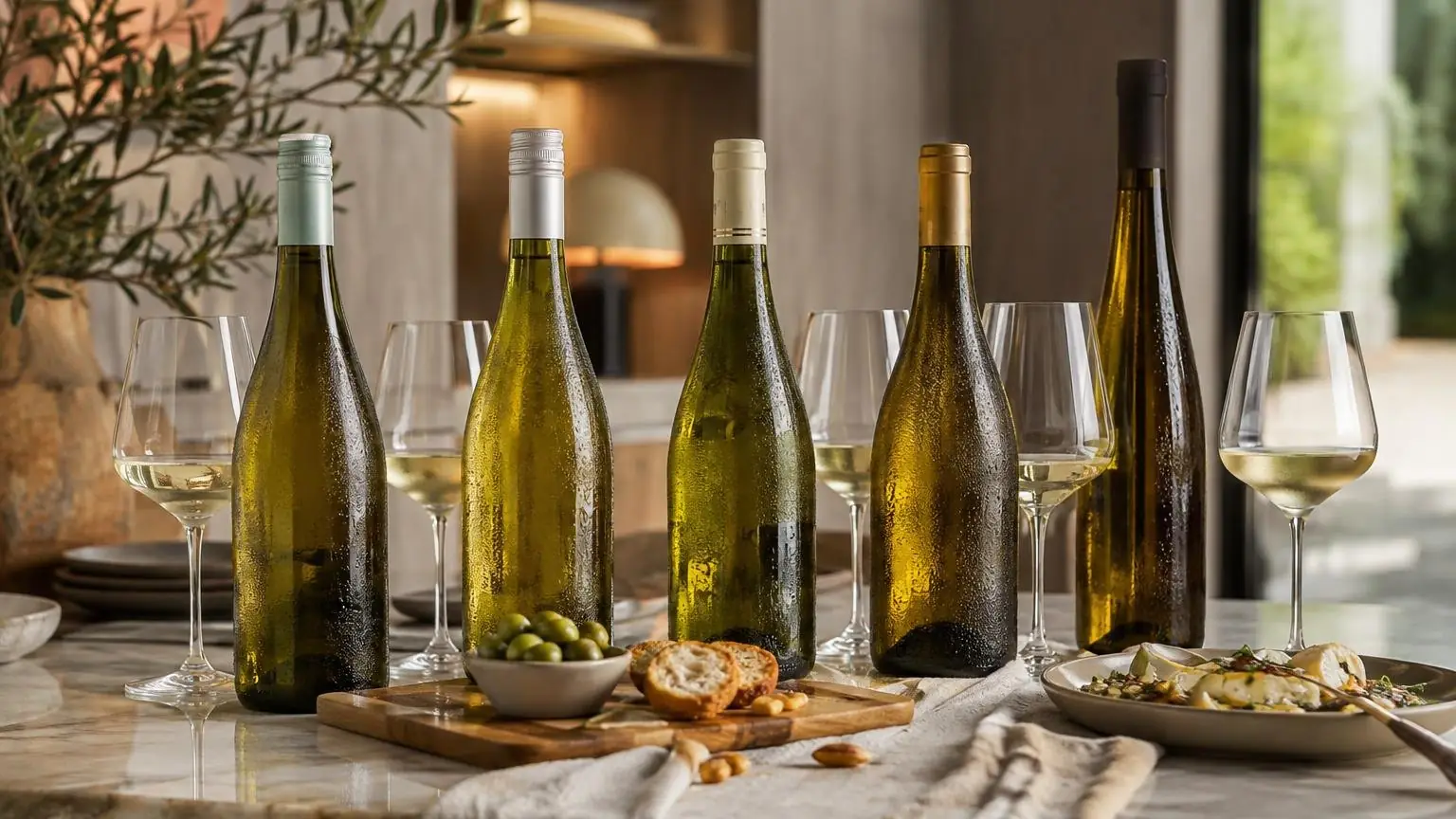
In still wine, many technical references treat 0–4 grams per liter of residual sugar as dry. European rules allow “dry” up to 4 g/L, or up to 9 g/L when total acidity is high enough to offset sweetness.
Myth: Sauvignon Blanc is always drier than Riesling
Grape variety is not a guarantee. Sancerre, Chablis, Muscadet, Albariño, and many Sauvignon Blancs are usually dry, but Riesling can be bone-dry too, especially German “Trocken” bottlings.
| Label or style | Typical sugar clue | What it means |
| EU still wine labeled “dry” | 0–4 g/L, or up to 9 g/L with high acidity | Legally dry, not necessarily austere |
| German Riesling “Trocken” | Generally up to 9 g/L, acidity-dependent | Can taste very dry because acidity is high |
| Champagne “Brut” | 0–12 g/L dosage | Dry for sparkling wine, but not the driest category |
| Champagne “Brut Nature” | 0–3 g/L dosage | One of the driest sparkling labels |
Myth: Fruity aromas mean sweet wine
A New Zealand Sauvignon Blanc can smell like passion fruit and grapefruit yet finish dry. Aromas come from grape compounds, fermentation, and yeast activity; they do not prove sugar is present.
- Fruit aroma: peach, apple, lime, melon, or tropical notes can appear in fully dry wines.
- Sweetness: comes from residual sugar left after fermentation, commonly measured in g/L.
- Balance: high acidity can make 8 g/L taste drier than a low-acid wine with 4 g/L.
Myth: Higher alcohol always means drier
Alcohol can suggest that more sugar fermented, but it is not a perfect guide. A 13.5% Chardonnay may be dry, while a 9% Riesling can also be dry if it started with moderate grape sugar and retained strong acidity.
Myth: Oak makes a white wine sweet
Oak can add vanilla, coconut, toast, or baking-spice impressions. Those flavors can mimic sweetness, especially in California Chardonnay, but they are not sugar unless the wine actually has measurable residual sugar.
Mistake: Assuming “Brut” is the driest sparkling wine
Brut is dry, but not the driest. For Champagne and many traditional-method sparklers, look for “Brut Nature,” “Pas Dosé,” or “Zero Dosage” if you want the leanest profile.
Mistake: Ignoring the back label or producer tech sheet
When available, check residual sugar directly. Wines under 2 g/L usually taste bone-dry; 2–4 g/L is still dry for most drinkers; above that, acidity and temperature strongly affect perception.
Questions Readers Ask
What are the driest white wine styles?
The driest white wines are typically bone-dry styles with little to no perceptible residual sugar, often around 0–4 grams per liter.
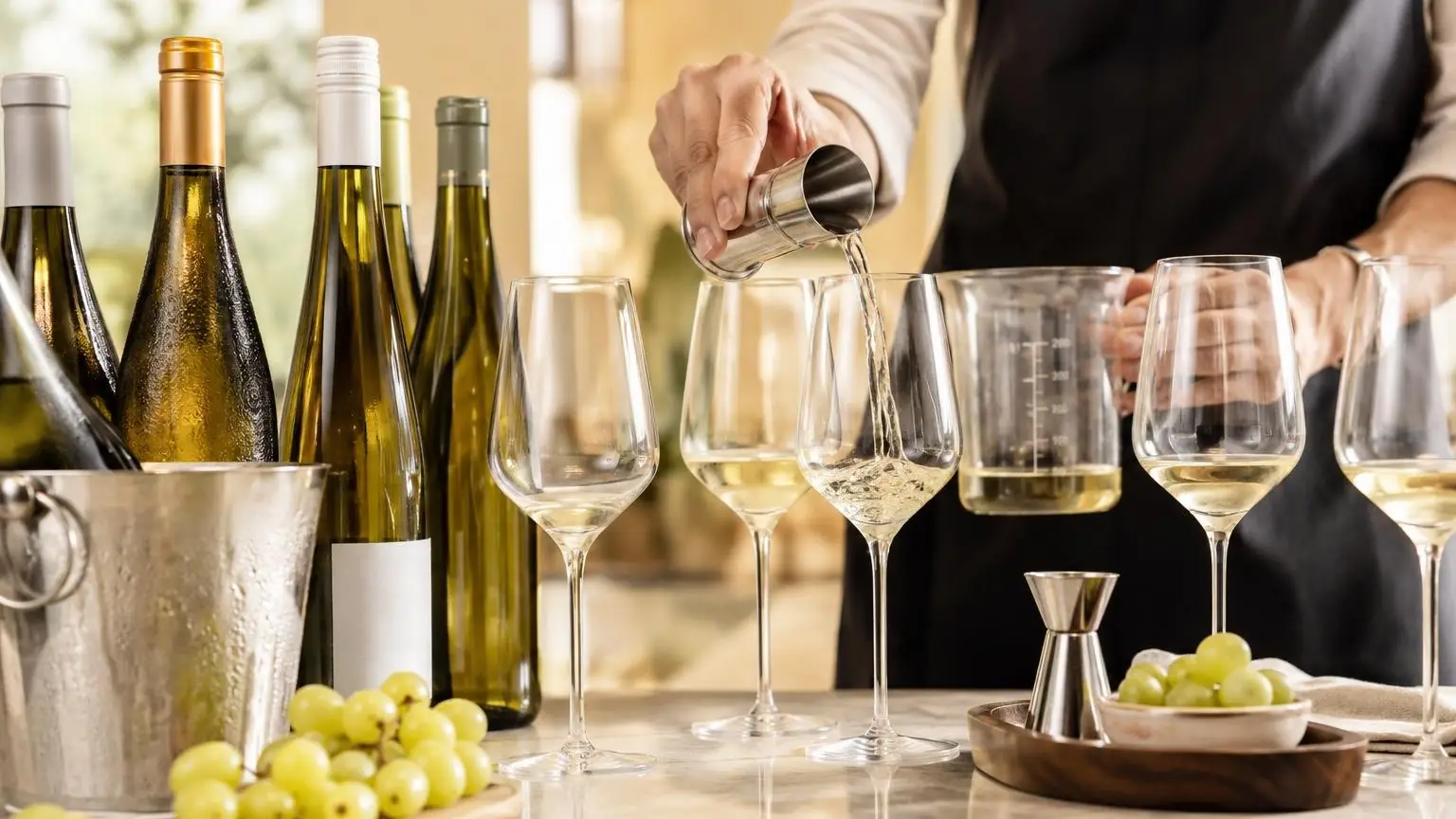
Classic examples include Muscadet, Chablis, Sancerre, dry Albariño, Assyrtiko, Pinot Grigio, and many Brut Nature sparkling wines.
Is Sauvignon Blanc always a dry white wine?
Sauvignon Blanc is usually made dry, especially from Sancerre, Pouilly-Fumé, New Zealand, Chile, and California.
Most dry examples have high acidity and citrus or grassy flavors, which can make them taste even drier despite small amounts of residual sugar.
Which is drier, Pinot Grigio or Chardonnay?
Pinot Grigio is usually perceived as drier because it is commonly light-bodied, crisp, and low in residual sugar.
Chardonnay is also often dry, especially Chablis, but fuller-bodied or oak-aged versions can taste rounder and less sharp even when technically dry.
Are dry Rieslings actually dry?
Yes, some Rieslings are genuinely dry, but the label matters because Riesling ranges from bone-dry to dessert-sweet.
Look for terms such as “Trocken” on German bottles, “Dry Riesling” from the U.S. or Australia, or Alsace Riesling, which is commonly dry.
How can you tell if a white wine is very dry before buying?
Check the label for words like “dry,” “bone dry,” “Trocken,” “Brut Nature,” or “Extra Brut,” and avoid terms such as “late harvest,” “demi-sec,” or.
“moelleux.” If technical notes are available.
Choose wines with residual sugar under about 4 grams per liter for the driest impression.
Related Reading
- How Many Ounces is 1.3 Liters?
- Is Fireball Gluten-Free?
- How Much Is 1.7 Oz In Ml? The Ultimate Conversion Guide With Real-World Experience (2026 Update)
- How Much Is 3 Liters Of Water In Gallons?
- How Many Gallons Is 7 Liters?
- How Many Ml in 1 Oz? – 2026
- What Does an Aerator Do for Wine? – The Complete Expert Guide to Understanding Wine Aeration
- All Blog Guides
- Electronic Code of Federal Regulations, 27 CFR Part 4—Labeling and Advertising of Wine (2024)
- USDA FoodData Central, “white table wine” nutrient data search (2024)
- Penn State Extension, “Measuring Residual Sugar in Wine” (2016)
- Iowa State University Extension and Outreach, “Residual Sugar: How Sweet Is Your Wine?” (2019)
- EUR-Lex, Commission Regulation (EC) No 607/2009—Wine Terms Including “Dry” (2009)
- Australian Wine Research Institute, “Residual Sugar” (2023)
- International Riesling Foundation, “Riesling Taste Profile” (2023)