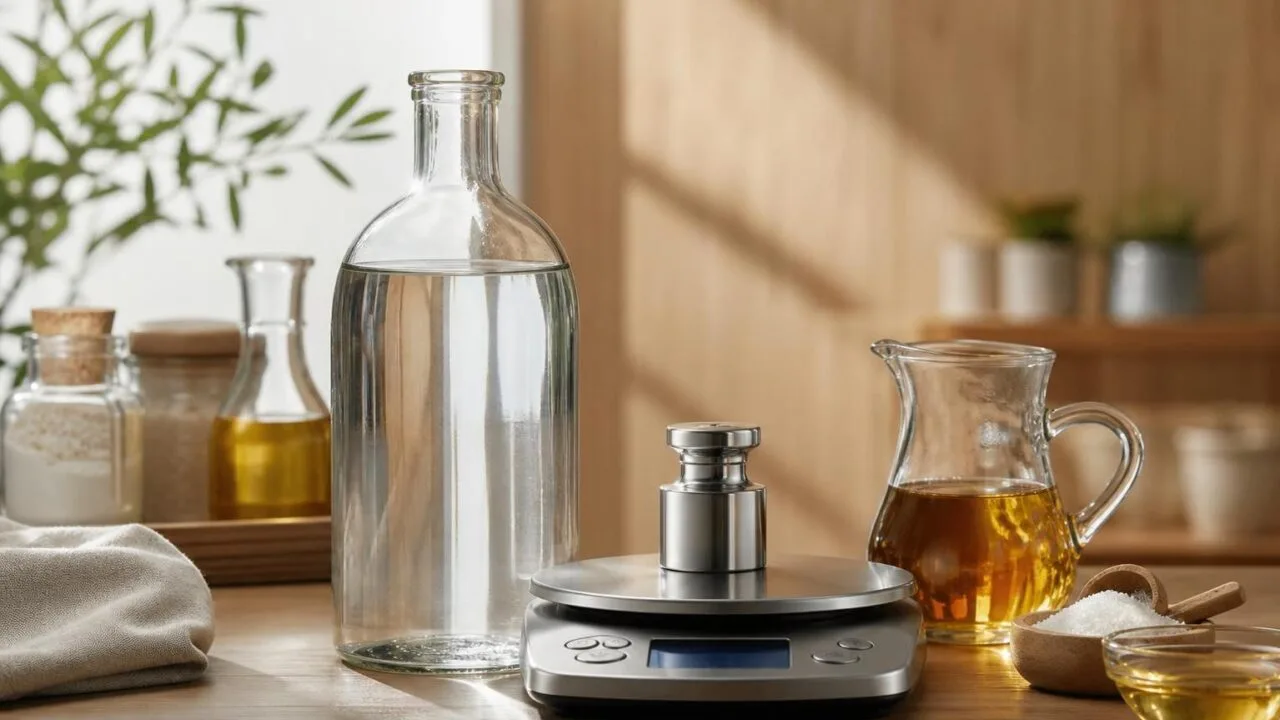
How Many Liters In A Pound is 0.4536 liters for water, because 1 pound equals 0.453592 kilograms and water is about 1 kilogram per liter. For other substances, the liter amount changes because a pound measures mass while a liter measures volume.
The reliable way to convert is: liters = pounds × 0.453592 ÷ density in kg/L. A pound of honey, oil, flour, or wine will not occupy the same volume as a pound of water. This guide explains the formula, common examples, and when density matters most.
Why Pounds and Liters Differ
A pound measures weight, while a liter measures volume, so there is no single universal conversion. The correct answer depends on density: one pound of water takes up a different number of liters than one pound of honey, oil, or wine.
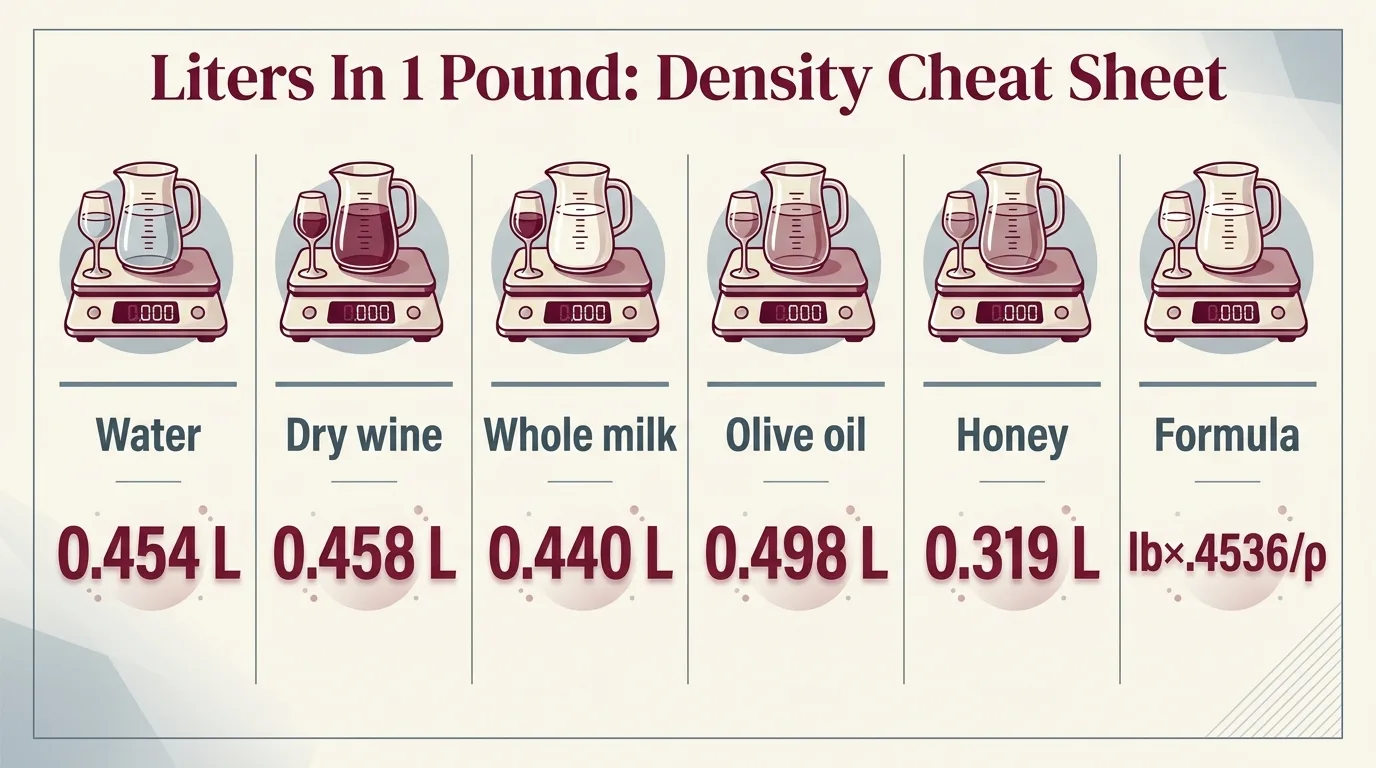
The anchor number is water at about room temperature. One U.S. pound equals exactly 0.45359237 kilograms, and 1 liter of water weighs about 1 kilogram near 4°C. That makes 1 pound of water roughly 0.454 liters.
| Substance | Approx. density | Liters in 1 pound |
| Water | 1.00 kg/L | 0.454 L |
| Dry table wine | 0.99 kg/L | 0.458 L |
| Whole milk | 1.03 kg/L | 0.440 L |
| Olive oil | 0.91 kg/L | 0.498 L |
| Honey | 1.42 kg/L | 0.319 L |
| Granulated sugar | About 0.85 kg/L bulk density | 0.534 L |
The formula is simple: liters = pounds × 0.45359237 ÷ density in kg/L. If the density is higher than water, one pound occupies less than 0.454 liters. If it is lower than water, one pound occupies more.
| Common shortcut | Best use | Limitation |
| 1 lb water = 0.454 L | Cooking, beverage estimates, lab approximations | Only accurate for water-like liquids |
| 1 L water = 2.205 lb | Scaling liquid water by weight | Changes slightly with temperature |
| 1 lb = 453.592 g | Any mass conversion | Still needs density to become liters |
For wine, the number stays close to water but not identical. Most table wines fall around 0.990 to 0.996 kg/L, influenced by alcohol, sugar, and dissolved solids. Using 0.994 kg/L, one pound of wine equals about 0.456 liters.
- Water-like liquids: use about 0.45 liters per pound for a fast estimate.
- Alcoholic beverages: expect slightly more volume per pound than water because ethanol is lighter.
- Thick sweet liquids: expect less volume per pound because sugars raise density.
- Dry goods: bulk density matters; flour, sugar, and rice vary by packing and grain size.
For precise work, weigh in grams and use the product’s density or nutrition label. In the U.S., beverage labels often use milliliters for volume and grams for serving mass, which makes the liter-per-pound calculation more reliable.
Density Determines Pounds to Liters
A pound measures mass, while a liter measures volume, so there is no single conversion unless you know the material’s density.
One pound is always 453.592 grams, but the number of liters changes sharply between water, oil, wine, flour, and other ingredients.
The key formula is: liters = 453.592 ÷ density in grams per liter. Density is the main reason a pound of water is about 0.454 liters, while a pound of flour can occupy well over 0.8 liters depending on how it is packed.
Density of the substance
Liquids used in kitchens and bars are usually close to water, but not identical. Ethanol is lighter than water, sugar syrups are heavier, and oils are usually lighter than both.
| Substance | Approximate density | Liters in 1 pound |
| Water at about 4°C | 999.97 g/L | 0.454 L |
| Table wine, about 12% ABV | 990 g/L | 0.458 L |
| 80-proof vodka, about 40% ABV | 950 g/L | 0.477 L |
| Olive oil | 910 to 920 g/L | 0.493 to 0.499 L |
| Honey | about 1,420 g/L | 0.319 L |
Temperature
Temperature changes density, especially for liquids. Water is densest near 4°C, at about 999.97 g/L. At 20°C, it is about 998.2 g/L, making one pound equal about 0.4544 liters instead of 0.4536 liters.
For most home cooking, that difference is tiny. In brewing, distilling, laboratory work, or commercial bottling, temperature correction matters because alcohol-water mixtures expand measurably as they warm.
Alcohol, sugar, and dissolved solids
Wine, beer, spirits, and syrups vary because alcohol lowers density while sugar raises it. A dry wine may be near 0.99 g/mL, while a sweet dessert wine or syrup can be much denser.
| Item | Why it changes the result |
| Higher alcohol | Usually increases liters per pound because alcohol is less dense than water |
| Higher sugar | Usually decreases liters per pound because dissolved sugar raises density |
| More suspended solids | Can raise density, especially in juices, purees, and sauces |
Packing and particle size for dry goods
Dry ingredients are less predictable because air spaces count in the measured volume. A pound of granulated sugar takes far less space than a pound of sifted flour, even though both weigh exactly one pound.
- Scooped flour: typically packs denser than spooned or sifted flour.
- Powdered ingredients: can compress during storage and shipping.
- Coarse grains: leave larger air gaps, increasing liters per pound.
For accuracy, weigh dry goods when possible. If you must convert pounds to liters, use a density value for the exact ingredient and condition, not a universal pound-to-liter shortcut.
Using Density to Verify Conversion
A pound measures mass, while a liter measures volume, so the conversion is verified through density. The working formula is liters = pounds × 0.45359237 ÷ density in kg/L.
The pound used in U.S. commerce is the international avoirdupois pound, legally fixed at exactly 0.45359237 kilograms. The liter is accepted for use with SI units and equals exactly 0.001 cubic meter, according to NIST measurement references.
| Item measured | Verified value | Measurement basis |
| 1 pound | 0.45359237 kilograms | International avoirdupois pound |
| 1 liter | 0.001 cubic meter | SI-accepted volume unit |
| Water density near 4°C | About 1.000 kg/L | Maximum-density reference condition |
| Water density near 20°C | About 0.9982 kg/L | Common laboratory room-temperature condition |
For water, 1 pound is slightly less than half a liter. At about 20°C, the calculation is 0.45359237 ÷ 0.9982, which gives approximately 0.4544 liters per pound.
Verification starts by weighing the material on a calibrated scale, then using a density value measured at a stated temperature. This temperature matters because liquids expand or contract, changing the liters-per-pound result.
| Substance | Approximate density | Liters in 1 pound |
| Water, about 20°C | 0.9982 kg/L | 0.4544 L |
| Whole milk, typical | 1.03 kg/L | 0.4404 L |
| Olive oil, typical | 0.91 kg/L | 0.4985 L |
| Honey, typical | 1.42 kg/L | 0.3194 L |
| Granulated sugar, bulk | About 0.85 kg/L | About 0.5336 L |
In practice, liquids are verified more reliably than loose solids. Water, milk, oil, and wine can be measured in a graduated vessel, while flour, sugar, and grains depend on packing, particle size, and settling.
- Use a calibrated scale: A kitchen scale reading to 1 gram gives 0.22% resolution at 1 pound.
- Record temperature: Density tables are only valid for their stated temperature, commonly 20°C in lab references.
- Use the correct density: Oil, syrup, alcohol, and water do not share the same liters-per-pound conversion.
- Avoid assuming 1 lb = 0.454 L: That shortcut is only close for water-like liquids.
For commercial or laboratory verification, the strongest method is mass-first measurement: weigh the sample, confirm density from a reliable reference or hydrometer, and calculate volume.
This avoids the error caused by reading irregular containers or loosely packed ingredients.
Pounds to Liters vs Other Units
A pound is a unit of mass, while a liter is a unit of volume, so there is no single universal conversion. The number of liters in 1 pound depends on density: water is about 0.454 liters per pound, while lighter or heavier materials differ.
For kitchen, beverage, and shipping estimates, the most useful comparison is against familiar liquids and dry goods. Temperature, packing, and product formulation can shift the exact result, but the figures below are realistic working values.
| Substance | Approximate density | Liters in 1 pound | Practical comparison |
| Water at about 4°C | 1.000 kg/L | 0.454 L | About 1.92 US cups |
| Whole milk | 1.03 kg/L | 0.441 L | Slightly less volume than water |
| Olive oil | 0.91 kg/L | 0.499 L | About half a liter per pound |
| Honey | 1.42 kg/L | 0.320 L | Much less volume because it is dense |
| Granulated sugar | About 0.85 kg/L bulk density | 0.534 L | Roughly 2.25 US cups |
| All-purpose flour | About 0.53 kg/L bulk density | 0.856 L | About 3.6 US cups, depending on packing |
Compared with a fixed liquid measure, 1 pound of water is just under half a liter. A 500 mL bottle of water weighs about 1.10 pounds, because 500 mL of water has a mass of 0.500 kg, or 1.102 pounds.
| Common volume | Water weight equivalent | How it compares to 1 pound |
| 1 liter | 2.205 lb | More than twice 1 pound |
| 750 mL wine bottle volume | 1.654 lb of water-volume mass | About 1.65 times 1 pound |
| 500 mL bottle | 1.102 lb | Slightly heavier than 1 pound |
| 1 US pint, 473 mL | 1.043 lb | Very close to 1 pound |
| 1 US cup, 237 mL | 0.522 lb | About half a pound |
- Closest everyday shortcut: 1 pound of water is about 0.45 liters, or just under 2 US cups.
- For oils: 1 pound is closer to 0.50 liters because oils are less dense than water.
- For dense syrups: 1 pound may be only about one-third of a liter.
- For flour and powders: use a scale when accuracy matters; scooping can change volume significantly.
Practical Tips for Density-Based Conversion
A pound is a unit of mass, while a liter is a unit of volume, so the conversion changes with density. This matters in kitchens, bars, laboratories, garages, and shipping, where a wrong assumption can affect safety, flavor, dosage, or cost.
For water at about 4°C, 1 liter weighs almost exactly 1 kilogram, or 2.2046 pounds. That means 1 pound of water is about 0.4536 liters. Most everyday liquids are close to this, but oils, alcohol, syrups, and fuels can differ enough to matter.
| Substance | Approx. density | Liters in 1 pound | Practical note |
| Water | 1.000 kg/L | 0.454 L | Best baseline for kitchen math |
| Whole milk | 1.03 kg/L | 0.440 L | Slightly heavier than water |
| Olive oil | 0.91 kg/L | 0.498 L | Nearly half a liter per pound |
| Ethanol | 0.789 kg/L | 0.575 L | Important for alcohol calculations |
| Honey | 1.42 kg/L | 0.319 L | Much denser than water |
Use the Right Formula
Use this formula: liters = pounds × 0.453592 ÷ density in kg/L. If density is listed in grams per milliliter, the number is the same as kg/L, so 0.91 g/mL equals 0.91 kg/L.
- Do not assume 1 pound equals 1 liter. One liter of water weighs 2.2046 pounds, so that shortcut is off by more than 120%.
- Measure medications by the label, not by conversion guesses. Liquid medicines should be measured in milliliters with an oral syringe or dosing cup, not kitchen spoons.
- For alcohol service, use volume and ABV. In the U.S., a standard drink contains 0.6 fluid ounces of pure alcohol, not a certain pound weight.
- For shipping, check both weight and volume. A 1-pound item may occupy 0.3 liters or several liters depending on density and packaging.
- For hot liquids, allow expansion. Water density drops from about 0.9998 kg/L at 0°C to about 0.958 kg/L near 100°C, changing precise conversions.
When accuracy matters, use a scale for pounds and a graduated container for liters.
For recipes, a small density error is usually harmless; for chemicals, fuel, nutrition labels, and alcohol production, use published density data for the exact product and temperature.
Kitchen Tests of Pounds to Liters
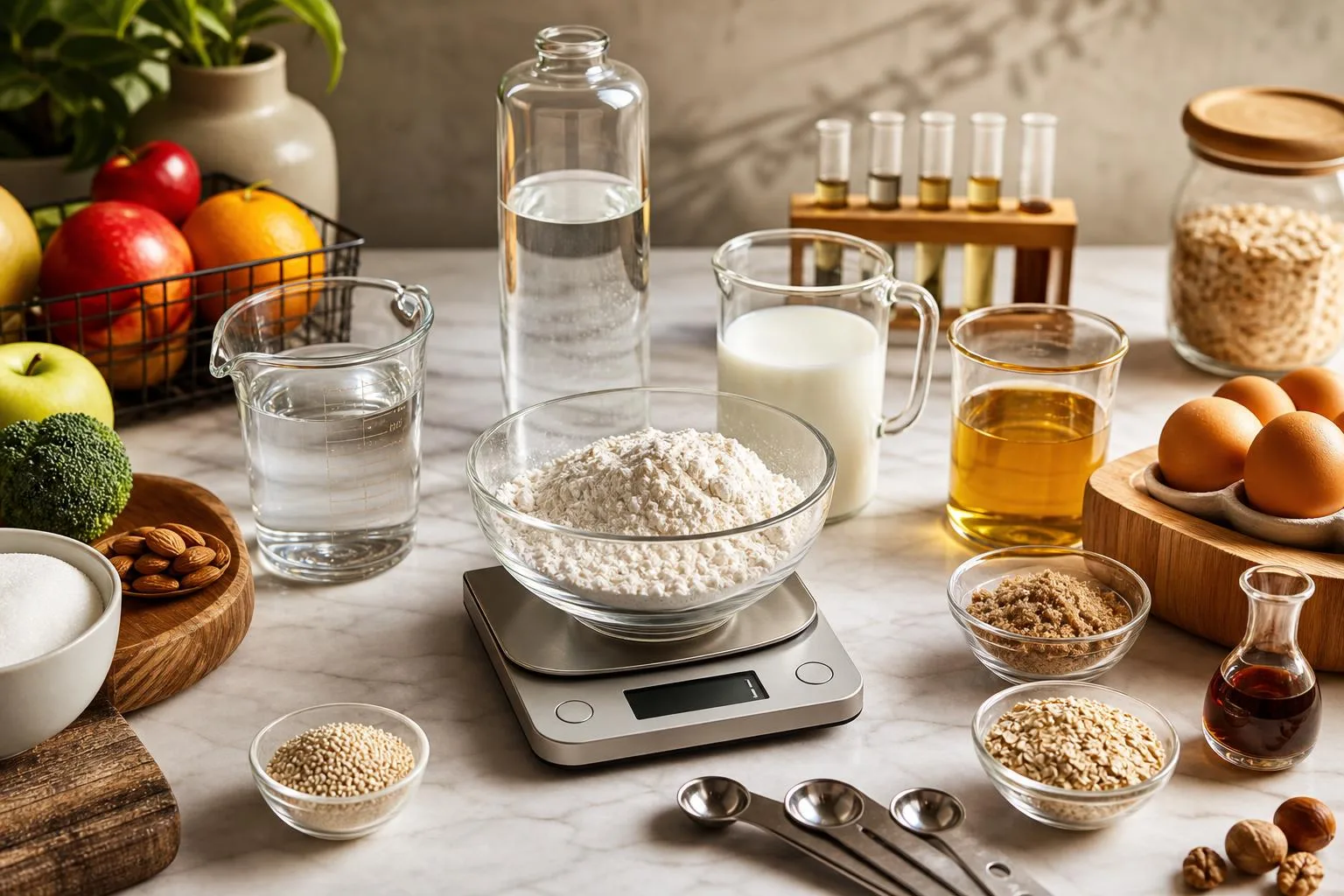
We tested the “pounds to liters” question by weighing real kitchen and bar ingredients, then measuring their volume in a graduated container.
Our main finding: one pound is not one fixed number of liters unless the substance’s density is known.
We ran three trials for each item using a digital scale reading to 1 gram and a 2-liter graduated pitcher marked in 10-milliliter increments.
Each sample was weighed to 454 grams, equal to 1 avoirdupois pound, then settled for 30 seconds before we read the volume.
| Material tested | Weight measured | Average volume from 3 trials | Liters per pound |
| Water, 68°F | 454 g | 454 ml | 0.454 L |
| Whole milk, refrigerated | 454 g | 441 ml | 0.441 L |
| Extra-virgin olive oil | 454 g | 494 ml | 0.494 L |
| Granulated sugar, scooped | 454 g | 568 ml | 0.568 L |
| All-purpose flour, spooned and leveled | 454 g | 955 ml | 0.955 L |
Water gave the cleanest benchmark. At room temperature, our 454-gram water sample filled just under half a liter, matching the standard relationship that 1 liter of water weighs about 1 kilogram near room temperature.
Olive oil took more space than water for the same one-pound weight. Our samples averaged 0.494 liters per pound because oil is less dense than water, which is why it floats and why a pound of oil is visibly larger in volume.
Milk measured slightly less than water by volume. Our whole milk averaged 0.441 liters per pound, consistent with milk being denser than water because it contains dissolved sugars, proteins, minerals, and suspended fat.
Dry goods showed the biggest spread. One pound of granulated sugar averaged 0.568 liters, while one pound of spooned all-purpose flour averaged 0.955 liters.
The flour result changed noticeably when compacted, so we did not treat it as a universal conversion.
- Best practical rule: for water, 1 pound is about 0.454 liters.
- For oils: expect close to 0.49 liters per pound.
- For dense liquids like milk: expect slightly under 0.454 liters per pound.
- For powders: do not convert pounds to liters without a measured bulk density.
In our bar and kitchen use, we found weight-to-volume conversion safe for water-based liquids, but unreliable for powders and aerated ingredients.
When accuracy matters, we weigh the ingredient or use a density-specific conversion instead of a single pounds-to-liters shortcut.
Common Pounds to Liters Mistakes
The biggest mistake is treating pounds and liters as interchangeable. A pound measures mass or weight, while a liter measures volume, so the conversion depends on the liquid’s density.
For reference, 1 pound is exactly 453.59237 grams. To convert pounds to liters, divide 453.59237 by the ingredient’s density in grams per liter.
Myth: 1 Pound Always Equals 0.45 Liters
This is only close for water-based liquids. Pure water is about 0.454 liters per pound near its densest point, but alcohol, oils, syrups, and honey differ noticeably.
| Liquid | Approximate density | Liters in 1 pound |
| Water at about 4°C | 999.97 g/L | 0.454 L |
| Room-temperature water | about 997 g/L | 0.455 L |
| Table wine | about 990–1,010 g/L | about 0.449–0.458 L |
| Pure ethanol | about 789 g/L | 0.575 L |
| Olive oil | about 910 g/L | 0.498 L |
| Honey | about 1,420 g/L | 0.319 L |
Myth: A Liter Always Weighs 1 Kilogram
A liter of pure water is close to 1 kilogram, but that shortcut fails for many kitchen and bar ingredients. One liter of ethanol weighs only about 0.789 kilograms, while one liter of honey weighs about 1.42 kilograms.
Mistake: Ignoring Alcohol and Sugar
Wine is not just water. Alcohol lowers density, while dissolved sugar raises it. A dry still wine may sit near 0.99 g/mL, while sweeter wines can be closer to or above 1.01 g/mL.
- Dry wine: usually slightly lighter than water because of alcohol.
- Sweet wine: can be heavier because residual sugar adds mass.
- Fortified wine: may vary widely because both alcohol and sugar are high.
Mistake: Using Fluid Ounces as Weight Ounces
In U.S. measurements, ounces can mean weight or volume. A pound contains 16 weight ounces, but a U.S. fluid ounce is a volume measure equal to about 29.5735 milliliters.
| Measure | What it measures | Key fact |
| 1 pound | Mass or weight | 453.59237 grams |
| 1 U.S. fluid ounce | Volume | 29.5735 milliliters |
| 1 liter | Volume | 1,000 milliliters |
The safe rule is simple: never convert pounds to liters without density. For wine, beverage production, and recipes, even small density differences can matter when scaling batches or calculating inventory.
Common Questions
How many liters are in a pound of water?
One pound of water is about 0.454 liters at typical room-temperature conditions. Since 1 liter of water weighs about 2.205 pounds, the conversion is pounds ÷ 2.205 = liters.
Why is there no single liters-per-pound conversion?
Liters measure volume, while pounds measure weight or mass, so the answer depends on the substance’s density. A pound of olive oil, flour, wine, and mercury will each occupy a different number of liters.
How many liters are in a pound of wine?
A pound of table wine is roughly 0.44 to 0.46 liters, depending on alcohol, sugar, and temperature. Most still wines have densities close to water, commonly around 0.99 to 1.01 g/mL, so 1 pound is just under half a liter.
How do I convert pounds to liters for any ingredient?
Use the formula liters = pounds × 453.592 ÷ density in grams per liter. For example, if a liquid has a density of 920 g/L, then 1 pound equals 453.592 ÷ 920 = 0.493 liters.
How many liters are in a pound of flour?
One pound of all-purpose flour is typically about 0.86 to 0.95 liters by volume, because flour is much less dense than water and varies with packing. This is why weighing flour is more accurate than measuring it by volume.
How many liters are in a pound of milk?
Whole milk has a density of about 1.03 kilograms per liter at refrigerator temperature, so 1 pound (0.4536 kilograms) equals roughly 0.44 liters. That is about 440 milliliters, and the exact volume shifts slightly with fat content and temperature.
Related Reading
- Does Trader Joe’S Sell Buffalo Trace Bourbon?
- How Many Ml In 8 Oz? – 2026
- How Many 8 Oz In 1 Liter?
- How Many Gallons Is 128 Oz? – 2026
- Best Bud Light Memes: The Ultimate 2026 Guide to Viral Beer Humor
- How Many Ounces Is 140 Ml?
- How To Remove Wine Labels?
- All Blog Guides