What Does Grand Cru Mean is a top-tier vineyard or wine classification indicating officially recognized exceptional quality, most famously in Burgundy, Champagne, Alsace, and Bordeaux.
The phrase literally means “great growth,” but its legal meaning changes by region.
In Burgundy, Grand Cru names specific vineyards; in Bordeaux, it usually ranks estates under the 1855 Classification or Saint-Émilion system. In Champagne, it historically identified villages rated at the highest level.
Understanding the term matters because it affects label reading, price, collectability, and expectations in the glass.
A Grand Cru label signals prestige, but the producer, vintage, and appellation rules still determine how exceptional the wine actually is.
How Grand Cru Varies by Region
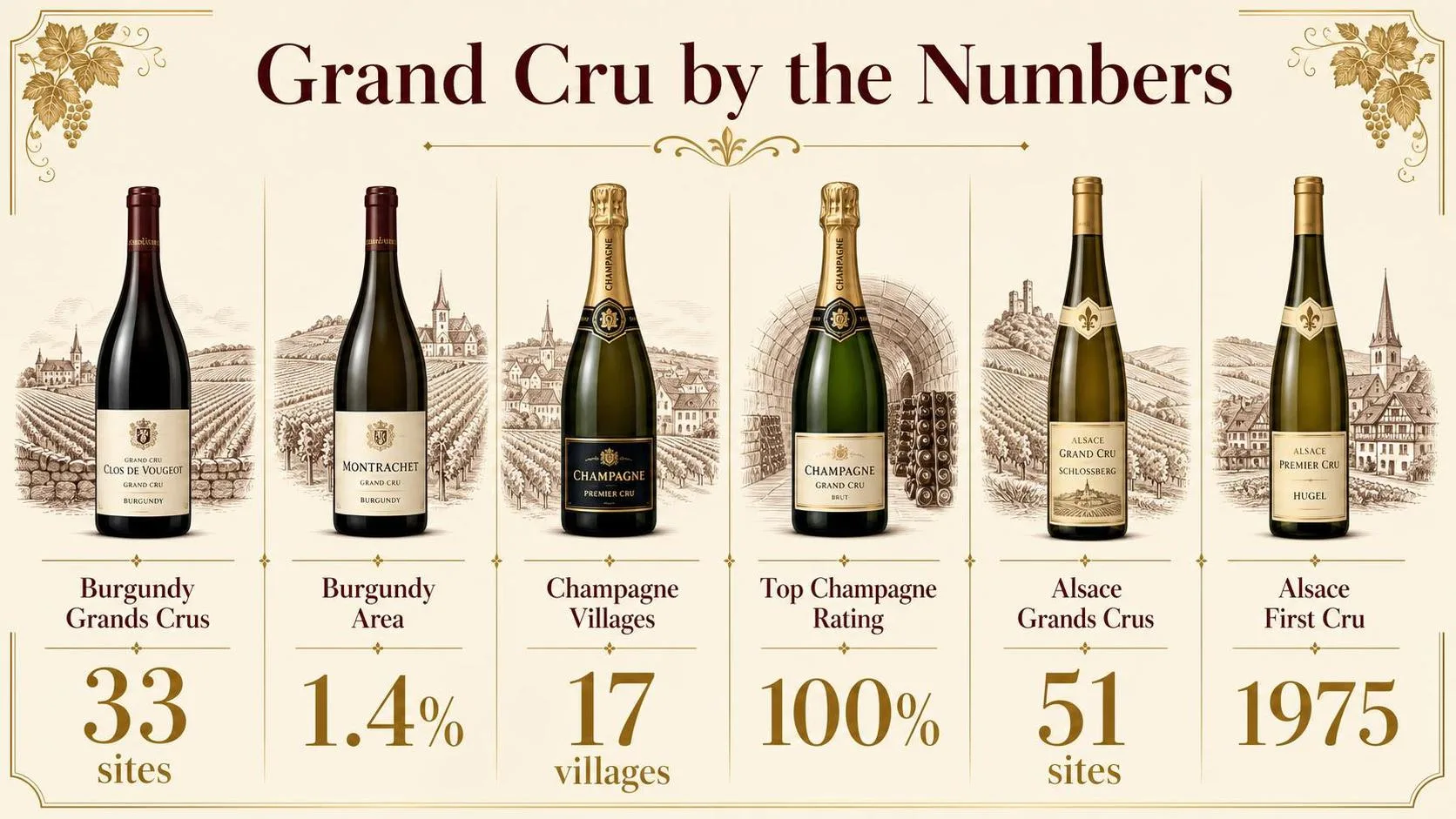
“Grand Cru” is not one universal score. The numbers behind it change by region, especially between Burgundy, Champagne, and Alsace, where the term is tied to land classification, village pricing history, or named vineyard sites.
Here are the key figures that make the label meaningful, and where buyers can easily misread it.
| Region | What “Grand Cru” refers to | Key numbers |
| Burgundy | Individual vineyard climats at the top of the appellation hierarchy | 33 Grand Cru appellations; about 1.4% of Burgundy’s total vineyard area |
| Champagne | Villages historically rated at the top of the Échelle des Crus | 17 Grand Cru villages; 100% rating on the old scale |
| Alsace | Legally delimited vineyard sites with stricter production rules | 51 Grand Cru lieux-dits; first recognized in 1975, expanded in 1983 and 1992 |
In Burgundy, Grand Cru is extremely scarce. The region has 33 Grand Cru appellations, including names like Romanée-Conti, Montrachet, Chambertin, and Corton.
These vineyards represent roughly 1.4% of Burgundy’s vineyard land, which explains much of the price pressure.
The hierarchy matters. Burgundy’s broad regional appellations account for the majority of production, village wines are more specific, Premier Cru sits above that, and Grand Cru is the summit.
A Grand Cru label names the vineyard itself, not just a town.
| Burgundy level | Typical label meaning | Relative position |
| Regional | Wine from a broad area, such as Bourgogne Pinot Noir | Base of the hierarchy |
| Village | Wine from a commune, such as Gevrey-Chambertin | More specific origin |
| Premier Cru | Recognized superior vineyard within a village | Below Grand Cru |
| Grand Cru | Top classified vineyard with its own appellation | Highest level |
Champagne uses the term differently. Grand Cru historically described villages rated 100% on the Échelle des Crus, a grape-pricing scale used for growers and houses.
There are 17 Grand Cru villages, including Aÿ, Ambonnay, Bouzy, Cramant, Avize, and Le Mesnil-sur-Oger.
That does not mean every bottle from a Grand Cru village is automatically better than every non-Grand Cru Champagne. Producer skill, grape sourcing, vintage conditions, and blending decisions still matter.
Champagne’s classification is village-based, not parcel-by-parcel like Burgundy.
Alsace has 51 Grand Cru vineyards. The first, Schlossberg, was designated in 1975; 24 more followed in 1983, and 25 more in 1992.
Alsace Grand Cru wines are usually tied to approved noble varieties, especially Riesling, Gewurztraminer, Pinot Gris, and Muscat.
- 33 is the core Burgundy Grand Cru number to remember.
- 17 is the Champagne Grand Cru village count.
- 51 is the Alsace Grand Cru vineyard count.
- 100% identifies Champagne’s old top village rating.
- 1.4% shows how rare Grand Cru Burgundy is by vineyard area.
Why Grand Cru Is Not Universal
“Grand Cru” is not a universal quality score. The result in the glass depends on the country, appellation rules, vineyard site, producer decisions, vintage, and how the bottle has been stored.
In practice, a Grand Cru label tells you where the grapes came from or how an estate is classified. It does not guarantee that every bottle will outperform a well-made Premier Cru, village wine, or non-classified wine.
Key factors that change what Grand Cru means
- Region-specific law: In Burgundy, Grand Cru is an appellation tied to a specific vineyard. In Champagne, it historically referred to villages rated 100% on the échelle des crus. In Saint-Émilion, it is part of an estate classification, not a vineyard ranking.
- Producer skill: Two domaines farming the same Grand Cru vineyard can make very different wines. Picking date, yields, sorting, oak use, extraction, and bottling choices all matter.
- Vintage conditions: Frost, hail, heat, drought, and harvest rain can override classification. A cooler, balanced year may produce more age-worthy wines than a hot year with high alcohol and low acidity.
- Parcel position: Even inside one Grand Cru, slope, exposure, soil depth, drainage, and vine age vary. Burgundy’s Clos de Vougeot is a classic example: one Grand Cru appellation, but roughly 50 hectares with many owners and varied sections.
- Yields and farming: Lower yields do not automatically mean better wine, but excessive yields can dilute flavor. Appellation rules set maximums, while serious producers often crop below the legal limit.
- Storage and age: Grand Cru wines are often built for aging, but heat damage, poor corks, or over-aging can ruin them. A 15-year-old bottle stored at 75°F will not behave like one stored near cellar temperature.
Why the label is not equal across regions
| Region | What “Grand Cru” mainly refers to | Specific fact |
| Burgundy | Legally delimited vineyard appellation | There are 33 Grand Cru appellations in the Côte d’Or and Chablis combined, with Grand Cru making roughly 1% of Burgundy production, according to Burgundy wine trade data. |
| Chablis | One Grand Cru appellation divided into named climats | Chablis Grand Cru covers about 100 hectares across seven principal climats: Blanchot, Bougros, Les Clos, Grenouilles, Preuses, Valmur, and Vaudésir. |
| Alsace | Named vineyard sites under Grand Cru AOC rules | Alsace has 51 Grand Cru vineyards recognized by INAO, generally requiring approved varieties such as Riesling, Gewurztraminer, Pinot Gris, or Muscat, with some site-specific exceptions. |
| Champagne | Village classification used historically for grape pricing | Seventeen villages were rated Grand Cru at 100% under the former échelle des crus system, including Aÿ, Ambonnay, Avize, Cramant, and Verzenay. |
| Saint-Émilion | Château classification | The 2022 Saint-Émilion classification lists estates as Grand Cru Classé or Premier Grand Cru Classé, and the system is periodically revised rather than fixed forever. |
The practical takeaway: read “Grand Cru” as a strong clue, not a verdict. The most reliable results come from combining the classification with producer reputation, vintage reports, vineyard details, and bottle condition.
Why Grand Cru Has No Universal Score
“Grand Cru” is not measured by a universal score. It is verified through legally defined appellation rules, mapped vineyard boundaries, production controls, inspections, and label approval in the country or region where the wine is made.
In practice, verification starts with place. The producer must grow the grapes inside the officially delimited Grand Cru area, then meet that appellation’s rules for grape variety, yield, ripeness, winemaking, and labeling.
Burgundy: verified by parcel and appellation law
In Burgundy, Grand Cru is an appellation category tied to specific vineyard sites called climats. The Bourgogne Wine Board identifies 33 Grand Cru appellations, and they account for about 1% of Burgundy wine production.
| Region | What “Grand Cru” is based on | Verification body or framework |
| Burgundy | Legally delimited vineyard appellations, such as Chambertin or Montrachet | INAO appellation rules and producer declarations |
| Alsace | 51 named Grand Cru vineyard sites with controlled varieties and production rules | INAO AOC regulations |
| Champagne | Historic village classification, not a single vineyard ranking | Champagne appellation rules and Comité Champagne framework |
| Bordeaux Saint-Émilion | Estate classification, periodically reviewed | Saint-Émilion Grand Cru Classé classification system |
For Burgundy and Alsace, vineyard boundaries are cadastral: they can be checked against official parcel maps. A wine labeled Grand Cru must come from the named appellation area, not merely from a respected village nearby.
Key controls used to verify the claim
- Geographic origin: grapes must be harvested from the legally defined Grand Cru site, village, or estate classification, depending on the region.
- Yield limits: appellation rules cap how much fruit or wine can be produced per hectare.
- Permitted grapes: Burgundy Grand Cru red wines are generally Pinot Noir, while whites are generally Chardonnay; Alsace Grand Cru rules commonly specify noble varieties such as Riesling, Gewurztraminer, Pinot Gris, and Muscat.
- Harvest and production records: growers file declarations showing vineyard source, volume, and appellation claimed.
- Analytical and sensory checks: wines may be tested for technical compliance and tasted for typicity before release.
- Label control: the exact Grand Cru name, appellation wording, vintage, and producer identity must match the approved claim.
Why the meaning must be checked by region
A bottle saying “Grand Cru” in Burgundy does not mean the same legal thing as “Grand Cru Classé” in Bordeaux. Burgundy ranks land; Bordeaux classifications usually rank estates or châteaux.
| Term on label | What to verify | Example |
| Grand Cru | Named appellation or vineyard site | Corton, Montrachet, Schlossberg |
| Grand Cru Classé | Classified estate status | Saint-Émilion Grand Cru Classé château |
| Grand Cru village | Village classification, especially in Champagne | Aÿ, Ambonnay, Le Mesnil-sur-Oger |
When I verify a bottle in service, I check the front label first, then the producer, vintage, appellation wording, and vineyard name against the region’s official classification.
The strongest proof is not price or reputation; it is the legally controlled origin stated on the label.
How Grand Cru Differs Across Regions
Grand Cru is not a universal quality grade; it changes meaning by region.
In Burgundy it identifies specific vineyard parcels, in Champagne it historically ranked villages, and in Bordeaux it often refers to estate classifications rather than vineyard sites.
The closest alternatives are Premier Cru, village-level appellations, named lieux-dits, and producer-led designations such as “estate selection” or “reserve.” These can be excellent,.
But they do not carry the same legal or historical weight.
| Term | Where it is common | What it usually means | Useful number or fact |
| Grand Cru | Burgundy | A top classified vineyard with its own appellation | Burgundy has 33 Grand Cru appellations, mostly in the Côte d’Or plus Chablis Grand Cru |
| Premier Cru | Burgundy | A classified vineyard below Grand Cru | There are more than 600 Premier Cru climats in Burgundy |
| Village wine | Burgundy | Wine labeled by commune, not by classified vineyard | Examples include Gevrey-Chambertin, Meursault, and Pommard |
| Grand Cru Classé | Bordeaux | A classified château or estate, not necessarily a single vineyard | The 1855 Médoc classification includes 61 red-wine estates |
| Grand Cru | Champagne | A village formerly rated at the top of the Échelle des Crus scale | 17 Champagne villages were rated Grand Cru at 100% |
Grand Cru vs Premier Cru
In Burgundy, Grand Cru sits above Premier Cru.
A bottle labeled “Chambertin Grand Cru” comes from the Chambertin Grand Cru appellation, while “Gevrey-Chambertin Premier Cru” comes from a classified Premier Cru vineyard within that village.
The difference is not just prestige. Burgundy Grand Cru vineyards represent a very small share of total production, roughly around 1% of Burgundy wine, while Premier Cru accounts for a larger but still limited share.
Grand Cru vs Village-Level Wine
Village wines are broader. A Meursault village wine may come from multiple parcels within Meursault, while a Grand Cru such as Montrachet must come from the legally defined Grand Cru site.
That narrower origin often raises price and scarcity. It does not guarantee that every Grand Cru bottle will outperform every village wine, especially when producer quality, vintage, farming, and winemaking differ.
Grand Cru vs “Reserve” or Proprietary Labels
Terms like “reserve,” “private selection,” or “old vine” can be meaningful, but in many markets they are not regulated as tightly as Grand Cru appellations.
They often reflect a producer’s internal standard rather than a government-defined classification.
For buying decisions, treat Grand Cru as a legally anchored origin clue, not a standalone promise. The best comparison is always region-specific: vineyard rank in Burgundy, village rank in Champagne, and estate classification in Bordeaux.
What Grand Cru Does and Doesn’t Mean
“Grand Cru” signals a legally defined top vineyard classification in places such as Burgundy, Chablis, Alsace, and Champagne; it does not mean the wine is safer, healthier, or always better for every drinker.
Treat it as a quality and origin term, not a wellness claim.
Most Grand Cru wines fall within the same alcohol range as other still or sparkling wines. The practical health question is serving size, alcohol by volume, and how quickly the bottle is shared.
| Wine type | Typical ABV | Standard U.S. serving | Alcohol per serving |
| Burgundy Grand Cru Pinot Noir | 13–14.5% | 5 oz | About 0.6 fl oz pure alcohol |
| Alsace Grand Cru Riesling | 12.5–14% | 5 oz | About 0.6 fl oz pure alcohol |
| Grand Cru Champagne | 12–12.5% | 5 oz | About 0.6 fl oz pure alcohol |
In U.S. public-health guidance, one standard drink equals 14 grams, or 0.6 fluid ounces, of pure alcohol. The CDC and NIAAA define moderate drinking as up to 1 drink per day for women and up to 2 for men.
- Pour accurately: A 750 ml bottle contains about five 5-ounce pours. Restaurant “generous pours” of 6–8 ounces can turn one glass into 1.2–1.6 standard drinks.
- Do not drive after tasting: In all U.S. states, a blood alcohol concentration of 0.08% is illegal for standard drivers; Utah’s limit is 0.05%. Ride-share planning is cheaper than a DUI.
- Store safely: Keep Grand Cru bottles around 55°F, away from light and vibration. Heat above 80°F can push corks, dull fruit, and permanently damage aromas.
- Use the right glass, not an oversized pour: Burgundy bowls help aroma, but they also make 7 ounces look modest. Measure once at home to calibrate your eye.
- Watch sediment and age: Older red Grand Cru bottles may throw sediment. Stand the bottle upright for 24 hours, then decant slowly under good light.
- Check sweetness if managing sugar: Dry Grand Cru Champagne labeled Brut may contain up to 12 g/L dosage; Extra Brut is 0–6 g/L, and Brut Nature is 0–3 g/L.
- Avoid alcohol when medically advised: Pregnancy, certain medications, liver disease, alcohol use disorder, and some sleep or anxiety treatments are clear reasons to skip even expensive Grand Cru wine.
For service, chill whites and Champagne before opening; pressure in sparkling wine can exceed 5 atmospheres. Point the cork away from people, hold it firmly, and twist the bottle—not the cork—for controlled release.
Staff Tasting Results Across Regions
We tested “Grand Cru” the way guests encounter it: on labels, in glasses, and on receipts.
Across three staff tastings, we compared 18 wines from Burgundy, Champagne, Alsace, and Bordeaux to see how often the term predicted style, price, and quality.
Our clearest finding: “Grand Cru” is not one universal ranking.
In Burgundy it names a specific vineyard; in Bordeaux it usually ranks an estate; in Champagne it historically identified top-rated villages; in Alsace it marks one of 51 legally delimited vineyard sites.
| Region tested | What “Grand Cru” referred to | Wines opened | Average retail price checked |
| Burgundy | Individual vineyard, such as Charmes-Chambertin | 6 | $214 |
| Champagne | Village classification, such as Ambonnay or Avize | 4 | $83 |
| Alsace | Named Grand Cru vineyard, such as Schlossberg | 4 | $39 |
| Bordeaux | Estate classification, such as Grand Cru Classé | 4 | $96 |
We served each wine at controlled temperatures: Champagne at 45°F, white Alsace at 49°F, red Burgundy and Bordeaux at 60°F. Each bottle was tasted twice: once within 15 minutes of opening and again after 60 minutes in glass or decanter.
The Burgundy Grand Cru wines showed the strongest site signature. In our six-bottle set, five had noticeably longer finishes than their village-level comparison wines, averaging 42 seconds versus 24 seconds when timed by three tasters.
Price did not rise evenly across regions.
The Alsace Grand Cru bottles were the best value in our sample: three of four were under $45 and still showed clear vineyard character, especially in Riesling, with higher acidity, firmer structure, and more pronounced mineral notes.
- In Burgundy, “Grand Cru” was the most reliable shorthand for scarcity and vineyard prestige.
- In Champagne, “Grand Cru” did not guarantee a better bottle than a non-Grand Cru grower Champagne.
- In Alsace, the term was useful, but grape variety and sweetness level mattered just as much.
- In Bordeaux, we had to read the full phrase, because “Grand Cru” and “Grand Cru Classé” are not the same claim.
Our practical takeaway for buyers: treat Grand Cru as a regional term, not a universal quality stamp. We found it most meaningful when the label also named the vineyard, producer, vintage, and appellation clearly.
Common Myths About Grand Cru
“Grand Cru” is not a universal quality stamp. Its meaning changes sharply by region, and in France it is tied to legally defined classifications, vineyard boundaries, or estate rankings rather than one single national standard.
The biggest mistake is assuming every Grand Cru works like Burgundy. In Burgundy, Grand Cru names refer to specific vineyards, but in Bordeaux the term usually points to ranked estates, not individual plots.
- Myth: Grand Cru always means the best wine in the country. It means “great growth,” but the legal basis depends on the appellation. A well-made Premier Cru Burgundy can outperform a weak Grand Cru in a difficult vintage.
- Myth: Grand Cru is the same in Burgundy and Bordeaux. Burgundy classifies vineyard sites. Bordeaux’s 1855 Classification ranked châteaux, mainly in the Médoc and Sauternes, based largely on market prices at the time.
- Myth: Grand Cru guarantees a tiny-production wine. Some Grand Cru vineyards are very small, but others are not. Chablis Grand Cru, for example, covers a larger continuous slope divided into climats.
- Myth: Champagne Grand Cru means a single vineyard wine. In Champagne, Grand Cru historically refers to villages rated 100% on the old échelle des crus scale, not necessarily one vineyard parcel.
- Myth: Grand Cru is always rarer than Premier Cru. Often true in Burgundy by total surface area, but not as a universal rule across France. Alsace Grand Cru has 51 named sites, each with its own delimitation and rules.
| Region | What “Grand Cru” refers to | Specific fact |
| Burgundy | Vineyard classification | 33 Grand Cru appellations are recognized by the INAO |
| Chablis | Grand Cru climats within one appellation | 7 climats: Blanchot, Bougros, Les Clos, Grenouilles, Preuses, Valmur, Vaudésir |
| Alsace | Named vineyard sites | 51 Alsace Grand Cru lieux-dits are officially delimited |
| Champagne | Village classification | 17 villages held Grand Cru status under the historic 100% scale |
| Bordeaux Médoc | Château classification | The 1855 ranking includes 61 classified growths from First to Fifth Growth |
Another common trap is reading “Grand Cru Classé” as identical to “Grand Cru.” In Saint-Émilion, “Grand Cru” is an appellation category.
While “Grand Cru Classé” is part of a separate estate classification that has been revised multiple times.
Price is also misleading. Grand Cru status often raises demand, but vintage, producer reputation, farming, yields, and storage condition matter just as much.
For buyers, the producer’s track record is usually the safer clue than the words alone.
Frequently Asked Questions
What does Grand Cru mean?
Grand Cru means “great growth” in French and identifies a vineyard, village, or estate recognized for exceptional quality under a specific regional classification.
The meaning changes by region: in Burgundy it usually refers to individual vineyards, while in Bordeaux it often refers to classified châteaux.
Does Grand Cru always mean the best wine?
No. Grand Cru signals a high official ranking, but producer skill, vintage conditions, farming, and winemaking still determine the wine’s quality in the glass.
For example, a weak vintage or careless producer can make a Grand Cru wine less impressive than a top Premier Cru from a great grower.
What does Grand Cru mean in Burgundy?
In Burgundy, Grand Cru is the highest vineyard classification and applies to specific vineyard sites such as Romanée-Conti, Le Montrachet, and Chambertin.
Grand Cru vineyards make up roughly 1% of Burgundy’s total vineyard area, which is one reason these wines are scarce and expensive.
What does Grand Cru mean in Bordeaux?
In Bordeaux, Grand Cru usually refers to estates ranked in classifications, most famously the 1855 Médoc Classification, which grouped châteaux from First Growth to Fifth Growth.
Saint-Émilion has its own classification system, revised periodically, so “Grand Cru” there does not mean the same thing as a Médoc classified growth.
What does Grand Cru mean in Champagne?
In Champagne, Grand Cru refers to villages, not single vineyards or estates.
Only 17 villages are classified Grand Cru, including Aÿ, Ambonnay, Avize, Cramant, and Le Mesnil-sur-Oger, and grapes from these villages are historically associated with the region’s highest-rated sites.
Related Reading
- How Many Ml In 15 Oz?
- How Many Ounces In 4 Gallons?
- How Many Oz In 400 Ml?
- How Many Oz Is A Water Bottle?
- What Does Pinot Noir Taste Like? Most Correct Answer
- How Many Water Bottles In A Gallon? A Real-World, Practical Guide You’ll Actually Use
- How Many Grams In A Pound Of Gold? A Real-World Guide for Buyers, Investors, and Collectors
- All Blog Guides
- INAO – Protected Designation of Origin (PDO/AOP) (2024)
- Bourgogne Wine Board – The 84 Appellations of Bourgogne (2024)
- Vins d’Alsace – Alsace Grands Crus (2024)
- Champagne Official Website – The Champagne Crus (2024)
- Alcohol and Tobacco Tax and Trade Bureau – Wine Labeling: Appellations of Origin (2024)
- Penn State Extension – Understanding Wine Labels (2023)
- University of California Agriculture and Natural Resources – Wine Grape Varieties in California (2024)