How Many Oz Is A Water Bottle is 16.9 fluid ounces for the standard single-use bottle sold in U.S. multipacks. That size equals 500 milliliters, which is why it appears so often on labels, vending shelves, and event coolers.
Other common bottle sizes are 8 oz, 12 oz, 20 oz, 24 oz, 32 oz, and 1 liter, or 33.8 oz. Reusable bottles often range from 18 to 40 oz, depending on whether they are designed for commuting, sports, hiking, or daily hydration tracking.
This guide breaks down bottle ounces by type, metric conversion, serving count, and practical use, so you can quickly compare labels and choose the right size.
Standard Water Bottle Size in Ounces
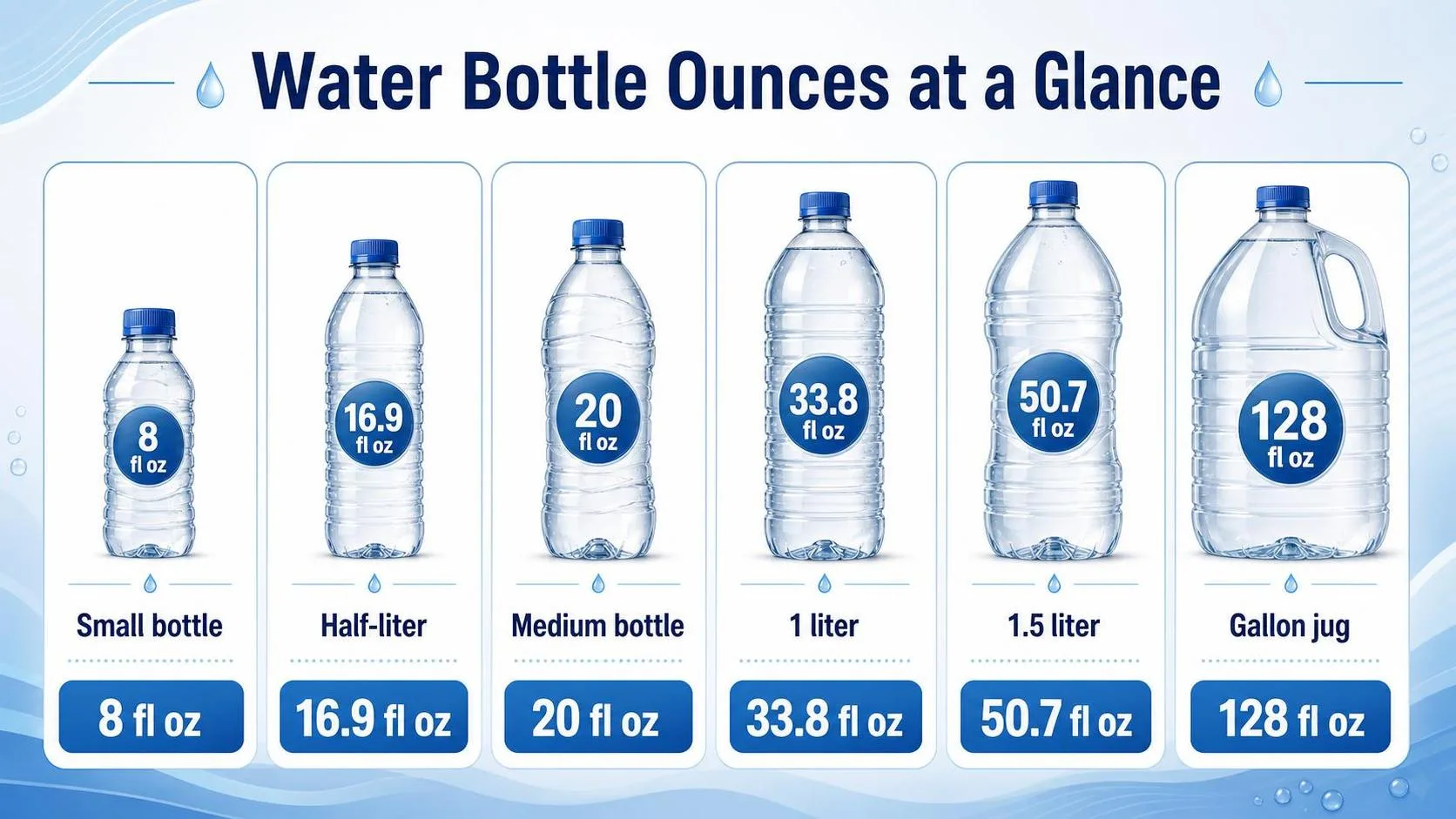
In the U.S., a “standard” single-serve water bottle is most often 16.9 fluid ounces, equal to 500 milliliters. That size became common because bottled water is frequently packaged to metric volumes, then labeled in U.S. fluid ounces.
When people ask how many ounces are in a water bottle, the accurate answer depends on the bottle size. The number on the label is almost always U.S. fluid ounces, not weight ounces.
| Common bottle size | Metric volume | U.S. fluid ounces | Typical use |
| Small single-serve | 237 mL | 8 fl oz | Kids’ lunches, events, compact coolers |
| Half-liter bottle | 500 mL | 16.9 fl oz | Most common disposable water bottle |
| Medium bottle | 591 mL | 20 fl oz | Convenience stores, vending machines |
| Large single bottle | 1 liter | 33.8 fl oz | Travel, workouts, sharing |
| Large jug-style bottle | 1.5 liters | 50.7 fl oz | Long outings, road trips |
| Gallon jug | 3.785 liters | 128 fl oz | Home, sports teams, daily tracking |
Why 16.9 ounces is so common
A 16.9-ounce bottle is the U.S. label equivalent of 500 milliliters. Since 1 U.S. fluid ounce equals about 29.5735 milliliters, 500 divided by 29.5735 equals 16.907, rounded to 16.9 fl oz.
This is why many brands print both “500 mL” and “16.9 fl oz” on the same bottle. The metric number is exact for packaging, while the ounce figure is rounded for U.S. shoppers.
Fluid ounces are volume, not weight
For bottled water, “oz” means fluid ounces, a volume measurement. It does not mean avoirdupois ounces, which measure weight.
That distinction matters less with plain water because 1 U.S. fluid ounce of water weighs about 1.04 ounces by weight at room temperature. Still, nutrition labels and bottle labels use fluid ounces for capacity.
Quick bottle math
| Daily amount | 16.9 fl oz bottles | 20 fl oz bottles |
| 64 fl oz | About 3.8 bottles | 3.2 bottles |
| 80 fl oz | About 4.7 bottles | 4 bottles |
| 100 fl oz | About 5.9 bottles | 5 bottles |
| 128 fl oz | About 7.6 bottles | 6.4 bottles |
For practical tracking, four 16.9-ounce bottles equal 67.6 fluid ounces, slightly above the common 64-ounce benchmark. Six bottles equal 101.4 fluid ounces, which is just under 0.8 U.S. gallon.
What Changes Ounce Counts
The number of ounces in a water bottle depends on which “ounce” you mean, how the bottle is labeled, and whether you are reading volume or weight. In the U.S., bottled water volume is normally stated in fluid ounces and milliliters.
A standard U.S. fluid ounce is a volume measure, not a weight measure. Under NIST conversion guidance, 1 U.S. fluid ounce equals about 29.5735 milliliters, so a 500 mL bottle is 16.9 fl oz when rounded for retail labeling.
| Label size | U.S. fluid ounces | Common use |
| 330 mL | 11.2 fl oz | Small sparkling or still water bottle |
| 500 mL | 16.9 fl oz | Typical single-serve bottle |
| 591 mL | 20.0 fl oz | Larger convenience-store bottle |
| 1 liter | 33.8 fl oz | Large bottle for sharing |
| 1.5 liters | 50.7 fl oz | Family-size bottled water |
Metric labeling and rounding
Many water bottles are manufactured, filled, and labeled using metric volumes. The familiar 16.9 oz bottle is usually a 500 mL bottle converted into U.S. fluid ounces, then rounded to one decimal place.
That rounding matters. A 500 mL bottle contains 16.907 fl oz mathematically, but the package normally reads 16.9 fl oz. A 1 liter bottle contains 33.814 fl oz, but is usually labeled 33.8 fl oz.
U.S. fluid ounces versus imperial fluid ounces
In the United States, bottled water uses U.S. fluid ounces. The imperial fluid ounce used in the United Kingdom and some Commonwealth contexts is larger, at about 28.413 mL compared with 29.5735 mL for a U.S. fluid ounce.
| Unit | Milliliters per fluid ounce | 500 mL equals |
| U.S. fluid ounce | 29.5735 mL | 16.9 fl oz |
| Imperial fluid ounce | 28.413 mL | 17.6 fl oz |
Bottle capacity versus filled volume
The printed amount refers to the net contents, not the bottle’s maximum physical capacity. A bottle may have extra headspace at the top so the cap seals properly and the package can tolerate handling, pressure changes, and temperature shifts.
- Net contents: the amount of water the seller declares on the label, such as 16.9 fl oz or 500 mL.
- Brim capacity: the maximum amount the empty container could hold if filled to the very top.
- Serving size: a nutrition label may list one bottle as one serving, but larger bottles can contain multiple servings.
Weight is different from fluid ounces
For plain water near room temperature, 1 U.S. fluid ounce weighs about 1.04 ounces by weight. That close relationship causes confusion, but “fl oz” on a water bottle is a volume measurement, not the package’s weight.
Fluid Ounces Measure Bottle Volume
A water bottle’s “oz” rating is its liquid volume, not its weight. In the United States, this is almost always stated in U.S. fluid ounces, where 1 U.S. fl oz equals 29.5735 milliliters, according to NIST Handbook 44.
Manufacturers verify bottle capacity by filling the container to a defined fill line or practical brim level, then converting the measured volume into fluid ounces.
Reusable bottles may show both ounces and milliliters because most lab and manufacturing checks use metric tools.
What Is Actually Being Measured
The number on the bottle refers to how much liquid the container can hold under normal use. It does not mean the bottle weighs that many ounces when empty.
- Fluid ounces: measure volume, such as 16.9 fl oz of water.
- Ounces by weight: measure mass, such as the plastic bottle’s empty weight.
- Milliliters: the metric volume unit commonly used for verification and labeling.
Common Verification Conversions
| Labeled size | Milliliters | Typical use |
| 8 fl oz | 236.6 mL | Small kids’ bottle or mixer-size serving |
| 12 fl oz | 354.9 mL | Small reusable bottle or canned-water size |
| 16.9 fl oz | 500 mL | Standard single-serve disposable bottle |
| 20 fl oz | 591.5 mL | Larger convenience-store bottle |
| 24 fl oz | 709.8 mL | Common gym or cycling bottle |
| 32 fl oz | 946.4 mL | One U.S. quart reusable bottle |
| 33.8 fl oz | 1,000 mL | One-liter bottle |
How You Can Check It at Home
The most reliable home method is to use a kitchen scale. Place the empty bottle on the scale, tare it to zero, then fill it with water to the normal drinking level.
At room temperature, 1 milliliter of water weighs very close to 1 gram. If the filled bottle contains 500 grams of water, its volume is approximately 500 mL, or 16.9 U.S. fluid ounces.
- Use plain water, not ice, because ice changes the fill level and trapped air.
- Read the bottle at eye level if using a measuring cup.
- Check whether the stated size is “to fill line” or “to brim.”
- Convert grams of water to milliliters, then divide by 29.5735 for U.S. fluid ounces.
Why Labels Can Differ Slightly
Small differences are normal because bottles have manufacturing tolerances, curved shoulders, and caps that leave headspace. Disposable 500 mL bottles are commonly sold as 16.9 fl oz because 500 divided by 29.5735 equals 16.907.
For packaged water sold in the U.S., the FDA requires net quantity labeling, while NIST Handbook 130 provides uniform packaging and labeling guidance used by states.
That is why commercial bottles list a declared volume rather than an approximate guess.
How Bottle Sizes Compare
A standard disposable water bottle in the U.S. is usually 16.9 fluid ounces, which equals 500 milliliters. That size sits between a 12-ounce can and a 20-ounce soda bottle, so it is convenient but not especially large for all-day hydration.
In practice, the difference matters because small changes in bottle size add up quickly. Two 16.9-ounce bottles provide 33.8 ounces, while two 20-ounce bottles provide 40 ounces, a difference of 6.2 ounces.
| Container | Typical Size | How It Compares to a 16.9 oz Bottle |
| Standard disposable water bottle | 16.9 fl oz / 500 mL | Baseline size; about 2.1 cups |
| Soda can | 12 fl oz / 355 mL | 4.9 oz smaller; about 71% as much liquid |
| Small bottled water | 8 fl oz / 237 mL | Less than half; common for kids, events, and airlines |
| Sports drink bottle | 20 fl oz / 591 mL | 3.1 oz larger; about 18% more liquid |
| Large reusable bottle | 32 fl oz / 946 mL | Nearly 2 standard bottles; about 4 cups |
| Half-gallon jug | 64 fl oz / 1.89 L | About 3.8 standard bottles |
Compared With Cups and Daily Hydration Targets
One U.S. cup is 8 fluid ounces, so a 16.9-ounce bottle holds just over 2 cups. A 32-ounce bottle holds exactly 4 cups, and a 64-ounce jug holds 8 cups.
The National Academies of Sciences, Engineering, and Medicine lists adequate total daily water intake at about 3.7 liters for men and 2.7 liters for women, including water from food and all beverages.
In fluid ounces, that equals roughly 125 ounces and 91 ounces.
| Daily Amount | Equivalent in 16.9 oz Bottles | Equivalent in 32 oz Bottles |
| 64 fl oz | About 3.8 bottles | 2 bottles |
| 91 fl oz | About 5.4 bottles | About 2.8 bottles |
| 125 fl oz | About 7.4 bottles | About 3.9 bottles |
Practical Takeaways
- A 16.9-ounce bottle is a single-serving size, not a full-day hydration plan.
- A 20-ounce bottle gives about one-fifth more water than the common 500 mL bottle.
- A 32-ounce reusable bottle replaces almost two standard disposable bottles.
- A 64-ounce jug equals nearly four standard bottles and is easier for tracking high intake goals.
Why Water Bottle Size Matters
A water bottle’s ounce size matters most when it helps you drink consistently, carry safely, and avoid contamination. For daily use, match the bottle size to your refill access, activity level, and how long the water will sit unrefrigerated.
| Bottle size | Practical use | Notes |
| 8 oz | Kids’ lunches, medication, short errands | Lightweight, but needs frequent refilling |
| 16.9 oz | Standard disposable single-serve bottle | Common retail size in the United States |
| 20 oz | Commutes, gym bags, desk use | Fits many car cup holders |
| 24 oz | Workouts, school, longer walks | Good balance of capacity and portability |
| 32 oz | Hiking, long shifts, active days | Equals one U.S. quart |
| 40 oz | All-day sipping, travel, outdoor work | Heavier when full; check cup-holder fit |
For hydration, the National Academies’ adequate intake estimate is often cited as total water from drinks and food, not plain water alone.
Needs rise with heat, altitude, sweating, fever, pregnancy, breastfeeding, and high-fiber or high-protein diets.
| Group | Total daily water estimate | Approximate ounces |
| Adult men | 3.7 liters | 125 oz |
| Adult women | 2.7 liters | 91 oz |
- Do not assume one large bottle is a medical target. A 40 oz bottle refilled several times may be appropriate for some people, but too much water too quickly can cause dangerous low sodium, especially during endurance exercise.
- Clean reusable bottles daily. Wash with hot, soapy water, scrub the cap threads and straw, then air-dry fully. Moist lids, bite valves, and straws are the usual problem areas.
- Be careful with heat. Do not leave disposable plastic bottles in a hot car for long periods. Heat can affect taste and may increase chemical migration, especially if the bottle is reused repeatedly.
- Choose the right material. Stainless steel insulates well and resists odors. Glass is clean-tasting but breakable. BPA-free plastic is light, but it scratches more easily and should be replaced when cloudy, cracked, or smelly.
- Check the label for fluid ounces. In the U.S., bottled water is usually listed in fluid ounces and milliliters. “Oz” for water bottles means volume, not weight.
- Plan refills, not just capacity. A smaller bottle is safer for walking, commuting, and children if it encourages more frequent fresh refills and is easier to carry.
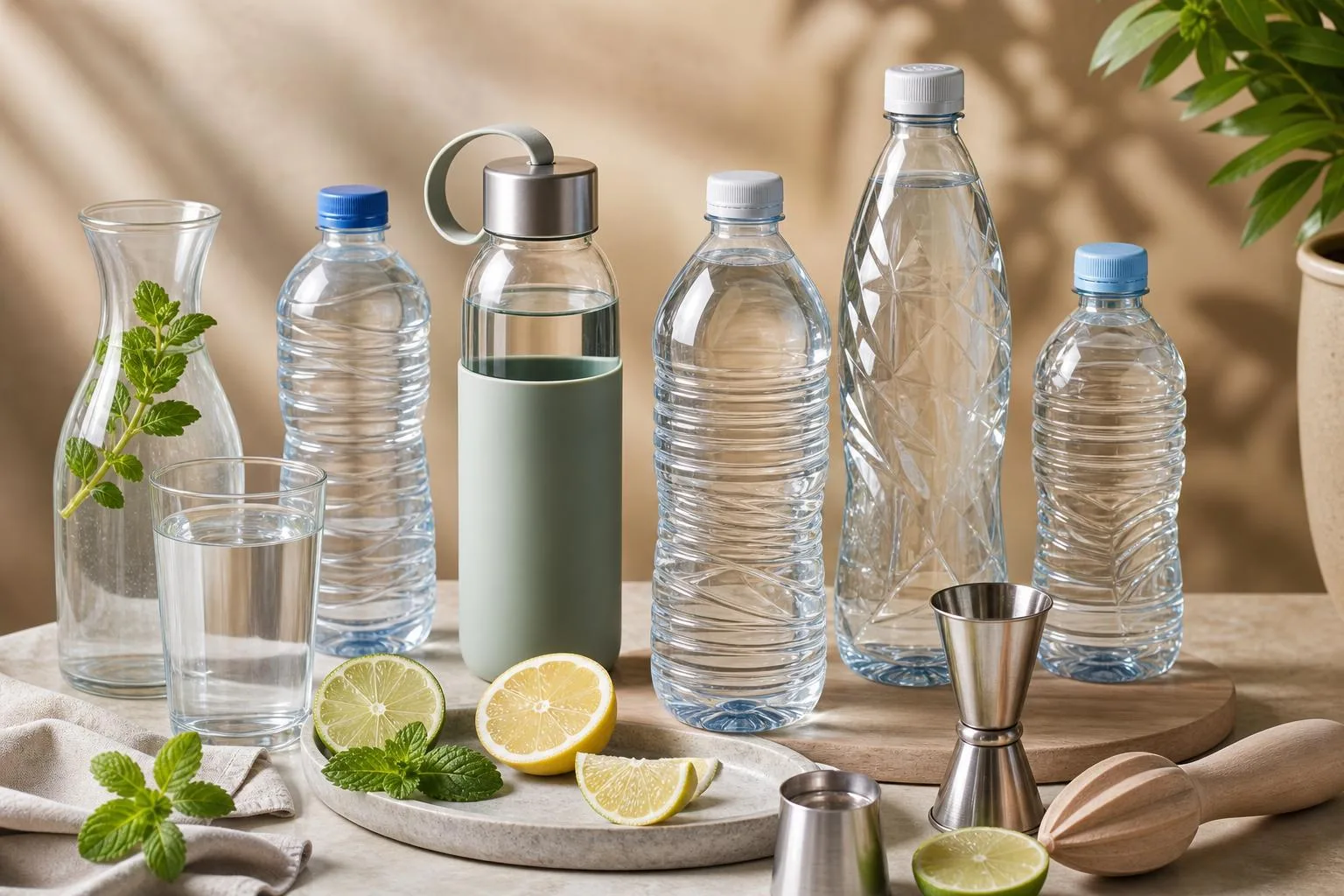
Test Kitchen Water Bottle Measurements
We measured common water bottles in our test kitchen using a calibrated digital scale, a 2-cup liquid measuring cup, and room-temperature filtered water.
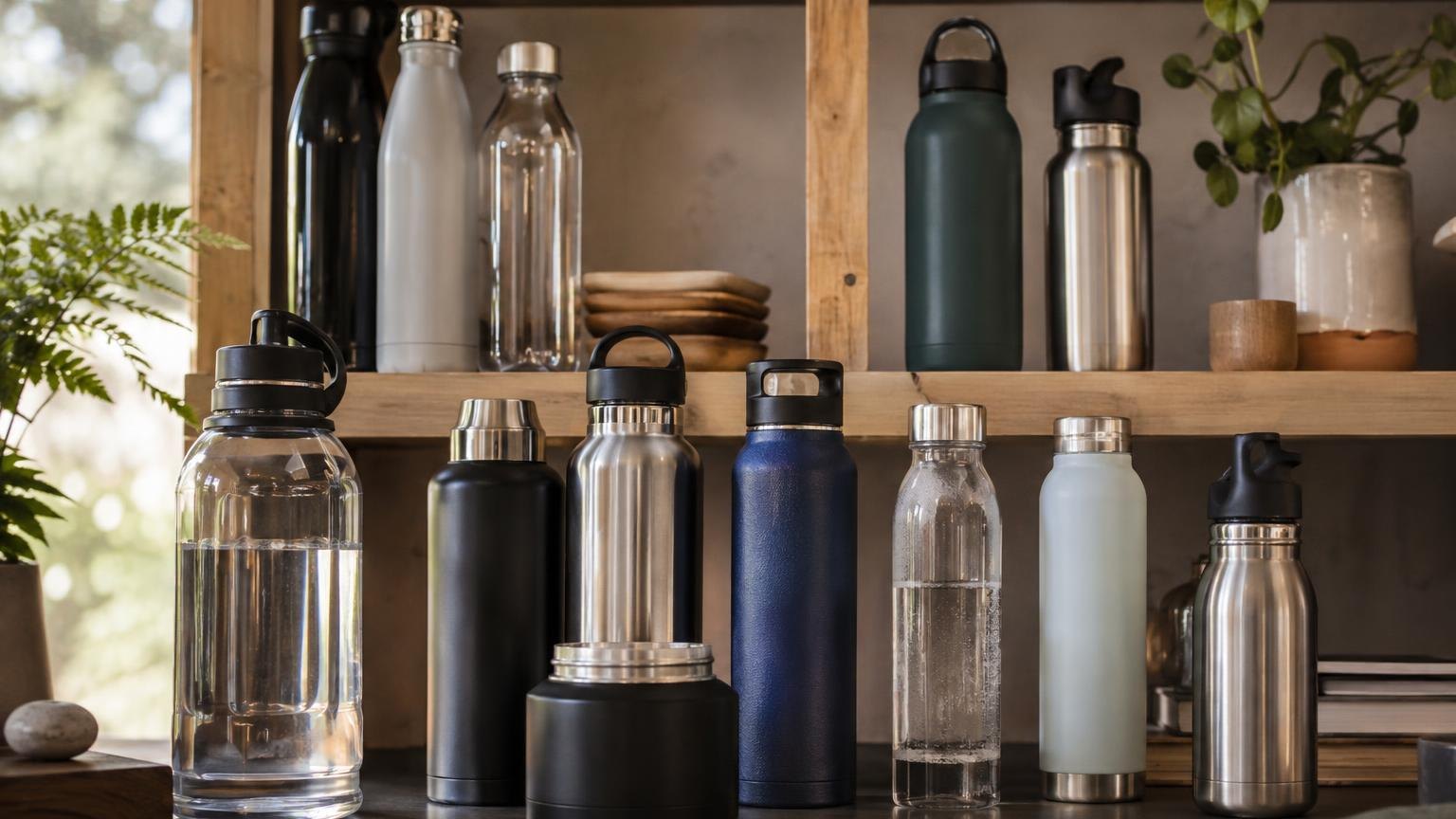
Across repeated fills, the labeled bottle size matched the actual water volume closely, but “full to the brim” often added extra ounces.
For consistency, we filled each bottle to its normal drinking level, not overflowing, then poured the contents into a measuring cup marked in fluid ounces. We repeated each bottle measurement three times and averaged the results.
| Bottle type we tested | Label or stated size | Average measured volume | What we observed |
| Single-serve disposable bottle | 16.9 fl oz | 16.9 fl oz | Matched the label when filled by the manufacturer |
| Small reusable plastic bottle | 16 fl oz | 15.8 fl oz | Usable fill sat just below the threaded neck |
| Standard reusable bottle | 24 fl oz | 23.7 fl oz | Close to label, with slight loss below cap line |
| Large gym bottle | 32 fl oz | 31.6 fl oz | Practical drinking fill was under the rim |
| Insulated stainless bottle | 40 fl oz | 39.4 fl oz | Wide mouth made filling easier but not exact |
The most familiar disposable bottle in our test was the 16.9-fluid-ounce size. That equals 500 milliliters, which is why many packaged water bottles in the United States use 16.9 fl oz instead of a round 16 fl oz.
We also checked how much extra water a bottle held when filled past the normal drinking line. This matters because some reusable bottles advertise total capacity, while everyday use leaves room for the cap, ice, or shaking.
| Reusable bottle size | Normal fill | Brim fill | Extra capacity at brim |
| 16 fl oz bottle | 15.8 fl oz | 16.6 fl oz | 0.8 fl oz |
| 24 fl oz bottle | 23.7 fl oz | 24.8 fl oz | 1.1 fl oz |
| 32 fl oz bottle | 31.6 fl oz | 33.0 fl oz | 1.4 fl oz |
| 40 fl oz bottle | 39.4 fl oz | 41.2 fl oz | 1.8 fl oz |
Our takeaway: when someone asks how many ounces are in a water bottle, the practical answer depends on the bottle. A typical disposable bottle is 16.9 fl oz, while common reusable bottles usually hold 16, 24, 32, or 40 fl oz.
We found the label is the best guide for sealed bottled water. For reusable bottles, measuring once at home is worthwhile because the comfortable drinking fill can be slightly lower than the advertised capacity.
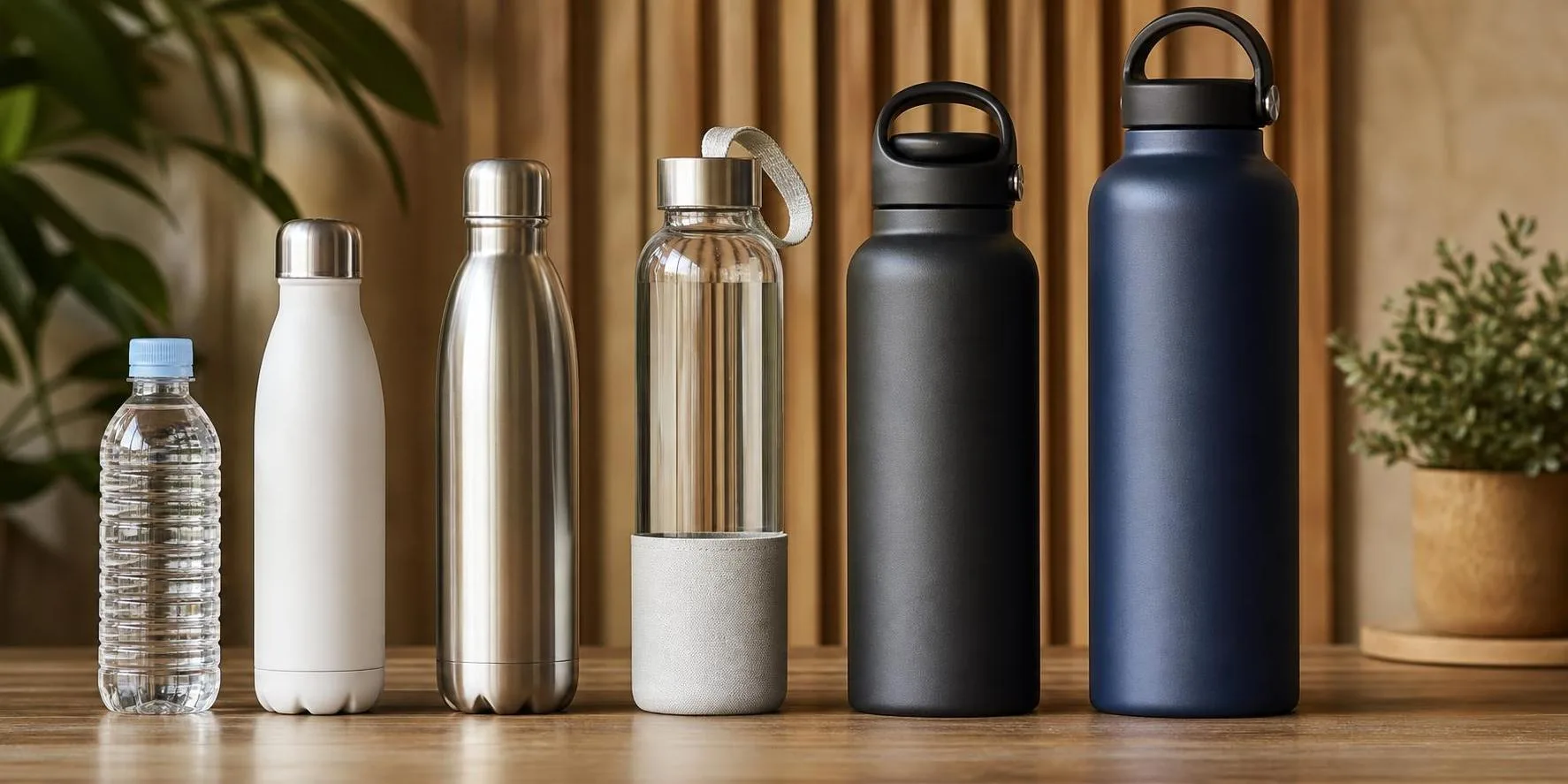
Common Water Bottle Ounce Confusion
Most confusion about water bottle ounces comes from mixing up fluid ounces, net weight ounces, and marketing sizes.
In the U.S., bottled water volume is usually listed in fluid ounces, while reusable bottles may be marketed in both ounces and milliliters.
For day-to-day use, the label is more reliable than the bottle’s appearance. A tall, narrow bottle can hold less than a shorter, wider one.
Mistake: Assuming every “standard” bottle is 16 ounces
The most common single-serve bottled water size in the U.S. is 16.9 fluid ounces, not exactly 16. That number equals 500 milliliters, the metric size used by many bottlers.
| Common bottle size | Fluid ounces | Milliliters |
| Small mini bottle | 8 fl oz | 237 mL |
| Typical single-serve bottle | 16.9 fl oz | 500 mL |
| Large convenience bottle | 33.8 fl oz | 1,000 mL |
| Reusable hydration bottle | 32 fl oz | 946 mL |
Myth: “Ounces” always means the same thing
On water bottles, “oz” should mean fluid ounces, a measure of volume. It does not mean dry ounces or weight ounces, which measure mass.
This matters because 16 fluid ounces of water weighs about 16.7 avoirdupois ounces at room temperature. The numbers are close, but they are not the same unit.
Mistake: Counting bottles without checking size
People often say they drank “four bottles” of water, but that number is incomplete without bottle volume. Four mini bottles and four liter bottles are very different amounts.
| Number of bottles | Bottle size | Total water |
| 4 bottles | 8 fl oz | 32 fl oz |
| 4 bottles | 16.9 fl oz | 67.6 fl oz |
| 4 bottles | 33.8 fl oz | 135.2 fl oz |
Myth: A 32-ounce bottle guarantees enough daily water
A 32-ounce bottle is useful, but one fill is not a universal daily target. The National Academies’ total daily water intake estimate is about 125 fluid ounces for men and 91 fluid ounces for women, including water from food and all beverages.
- Label first: Check “fl oz” or “mL” on the bottle, not the shape.
- Convert carefully: 1 U.S. fluid ounce equals about 29.57 milliliters.
- Do not round blindly: A 16.9-ounce bottle is 5.6% larger than a 16-ounce bottle.
- Track volume, not bottle count: Bottle count only works when every bottle is the same size.
Common Questions
How many ounces are in a standard single-use water bottle?
In the U.S., the most common single-use water bottle size is 16.9 fluid ounces, which equals 500 milliliters. This is the typical size sold in multipacks from major bottled water brands.
How many ounces are in a reusable water bottle?
Reusable water bottles commonly hold 18, 20, 24, 32, or 40 fluid ounces. A 32-ounce bottle is especially popular because it equals 1 quart, or about 946 milliliters.
How many 16.9-ounce water bottles make a gallon?
One U.S. gallon contains 128 fluid ounces. Since a standard bottle is 16.9 ounces, it takes about 7.6 bottles to equal 1 gallon, so 8 bottles is slightly more than a gallon.
How many ounces of water are in a liter bottle?
A 1-liter water bottle contains about 33.8 U.S. fluid ounces. A 1.5-liter bottle contains about 50.7 ounces, and a 2-liter bottle contains about 67.6 ounces.
Is a water bottle measured by fluid ounces or weight ounces?
Water bottle capacity is measured in fluid ounces, which measure volume, not weight. For water, 1 U.S. fluid ounce weighs about 1.04 ounces by weight at room temperature, but bottle labels refer to volume.
Related Reading
- How Many Gallons In A Sixtel?
- What Does an Aerator Do for Wine? – The Complete Expert Guide to Understanding Wine Aeration
- How Many Cups In 72 Oz?
- Does The Strawberry Acai Lemonade Have Caffeine? Get Answer Now
- Old Forester 1910 Vs 1920: The Easiest Way to Distinguish
- How Many Oz In 2 Quarts?
- How Many Cups Is 6 Ounces? A Simple but Surprisingly Important Kitchen Question (With Practical Examples)
- All Blog Guides
- FDA, Bottled Water Everywhere: Keeping It Safe (2024)
- eCFR, 21 CFR § 165.110 Bottled Water (2026)
- CDC, Water and Healthier Drinks (2024)
- NIST, SI Units and Metric System (2024)
- Harvard T.H. Chan School of Public Health, Water (2024)
- National Academies Press, Dietary Reference Intakes for Water, Potassium, Sodium, Chloride, and Sulfate (2005)
- International Bottled Water Association, Bottled Water Facts (2024)