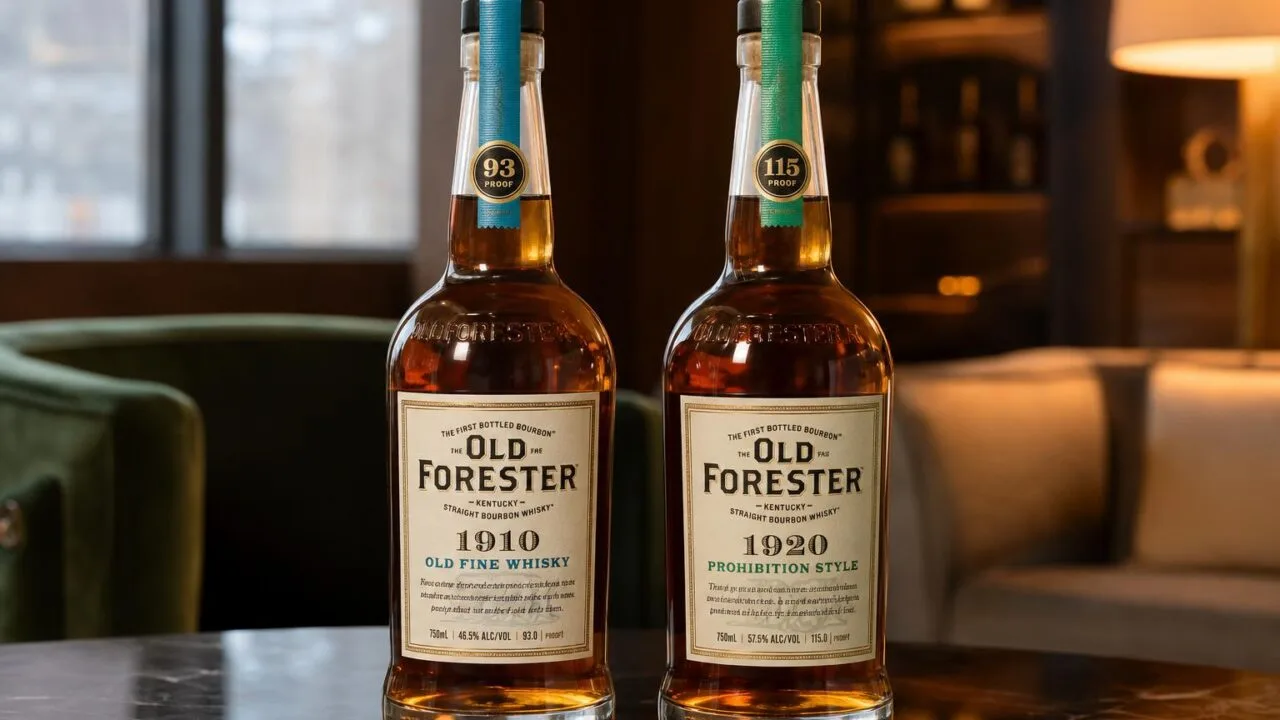
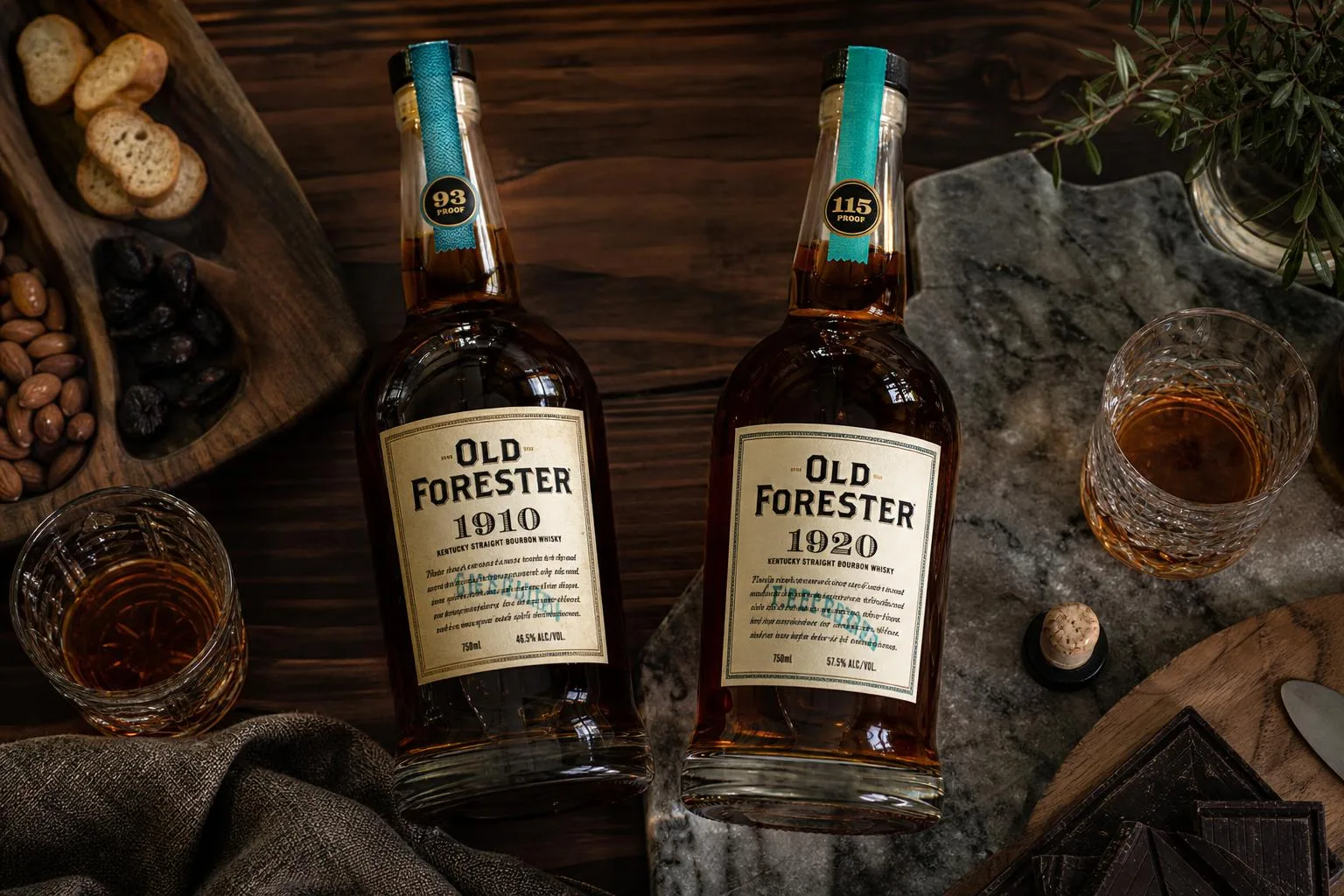
Old Forester 1910 Vs 1920 is a choice between a sweeter, 93-proof double-barreled bourbon and a bolder, 115-proof Prohibition-style bourbon.
Both come from Brown-Forman’s Whiskey Row series, but they drink very differently in glass, especially side by side.
1910 emphasizes caramel, dark fruit, chocolate, toasted oak, and a softer finish. 1920 brings more heat, pepper, baking spice, cherry, and deeper barrel char, with enough proof to stand out in cocktails or over a large cube.
This comparison focuses on proof, mash bill context, production style, flavor, price, and best use, based on tasting them neat and with water.
Why 1910 and 1920 Taste Different
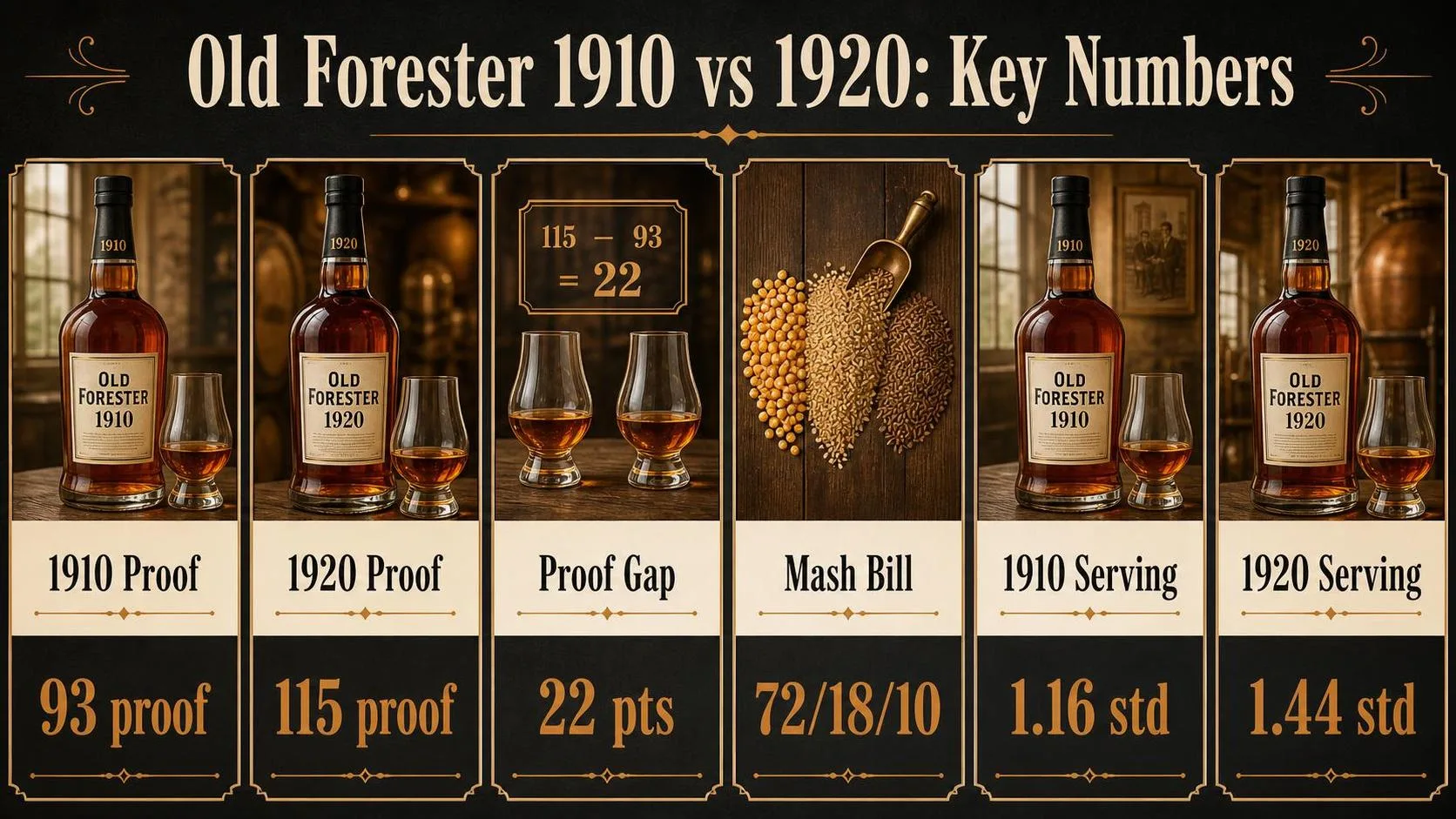
Old Forester 1910 and 1920 use the same Brown-Forman bourbon DNA, but the numbers explain why they drink so differently. The biggest practical difference is proof: 1910 is built for richness, while 1920 is built for intensity.
| Number | Old Forester 1910 | Old Forester 1920 |
| Proof | 93 proof | 115 proof |
| ABV | 46.5% alcohol by volume | 57.5% alcohol by volume |
| Proof gap | 1920 is 22 proof points higher, or 11 percentage points higher in ABV. | |
| Mash bill | 72% corn, 18% rye, 10% malted barley | 72% corn, 18% rye, 10% malted barley |
| Age statement | No age statement | No age statement |
| Legal minimum implied | At least 4 years old, because straight bourbon under 4 years must carry an age statement in the U.S. | At least 4 years old, for the same reason. |
| Series | Old Forester Whiskey Row Series | Old Forester Whiskey Row Series |
The shared mash bill matters. Both bourbons start with 72% corn for sweetness, 18% rye for spice, and 10% malted barley for fermentation support. So the contrast is not grain-driven; it comes from proof, barrel handling, and blending target.
At 93 proof, 1910 delivers less ethanol per pour. A 1.5-ounce serving contains about 0.70 fluid ounces of pure alcohol, equal to roughly 1.16 U.S. standard drinks.
At 115 proof, 1920 contains about 0.86 fluid ounces of pure alcohol in the same 1.5-ounce pour. That is about 1.44 U.S. standard drinks, or roughly 24% more alcohol than 1910 per equal pour.
| Pour size | 1910 alcohol content | 1920 alcohol content |
| 1.5 oz | 0.70 oz pure alcohol | 0.86 oz pure alcohol |
| Standard drinks | About 1.16 | About 1.44 |
| 750 ml bottle | About 349 ml pure alcohol | About 431 ml pure alcohol |
That proof gap is noticeable in the glass. 1910 usually reads softer, sweeter, and more dessert-like because it is finished in a second heavily charred barrel. 1920 keeps more heat, oak grip, and concentration.
- Choose 1910 if you want lower proof, richer sweetness, and a smoother after-dinner profile.
- Choose 1920 if you want higher proof, stronger structure, and more cocktail power.
Proof Barrel Treatment and Dilution
The gap between Old Forester 1910 and 1920 is driven less by brand identity than by proof, barrel treatment, and dilution.
Both come from Old Forester’s standard bourbon mash bill, but they are built to show different sides of the same distillate.
In side-by-side tasting, small serving choices also change the outcome. Glass shape, rest time, water, and food pairing can make 1910 seem richer or make 1920 seem more balanced than its proof suggests.
| Factor | Old Forester 1910 | Old Forester 1920 |
| Proof | 93 proof, 46.5% ABV | 115 proof, 57.5% ABV |
| Mash bill | 72% corn, 18% rye, 10% malted barley | 72% corn, 18% rye, 10% malted barley |
| Key production choice | Finished in a second, heavily charred barrel | Bottled at a higher “Prohibition Style” proof |
| Likely tasting impact | More chocolate, caramel, char, and dessert sweetness | More heat, oak, spice, dried fruit, and concentration |
Proof and dilution
Proof is the biggest practical difference. Old Forester 1920 carries 22 more proof points than 1910, which means more alcohol, less dilution, and a stronger delivery of oak tannin, rye spice, and dark fruit.
That extra ABV also changes texture. 1920 often feels fuller and hotter neat, while 1910 feels rounder and more immediately approachable. Adding 3 to 5 drops of water can open 1920 without flattening it.
Barrel influence
Old Forester 1910 is known for its second-barrel finishing, modeled after the 1910 warehouse fire story when whisky had to be re-barreled. The second barrel is heavily charred, which pushes flavors toward toasted sugar, cocoa, and charred oak.
Old Forester 1920 relies more on high-proof intensity than finishing. Its profile is closer to dense classic bourbon: brown sugar, seasoned oak, pepper, cherry, leather, and baking spice.
How you taste it
- Rest time matters: Give each pour 10 to 15 minutes in the glass before judging aroma or finish.
- Glassware matters: A Glencairn or tulip glass concentrates ethanol; a rocks glass softens the nose.
- Ice favors 1920: Its 115 proof holds up better over a large cube than 1910.
- Dessert favors 1910: Chocolate, pecan pie, and crème brûlée amplify its sweeter barrel-finish notes.
- Rich food favors 1920: Steak, barbecue, and smoked meats stand up to its proof and spice.
How 1910 and 1920 Are Evaluated
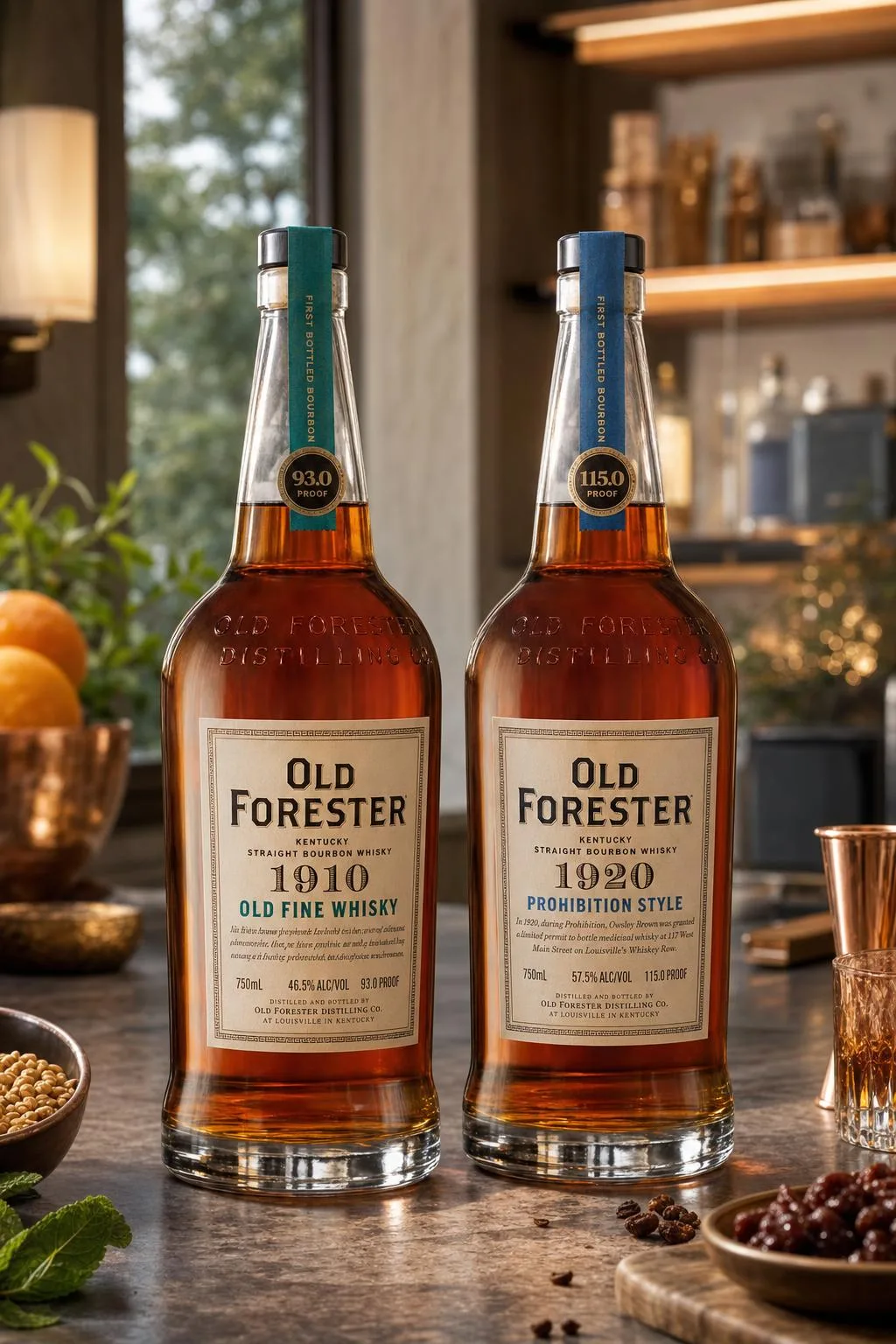
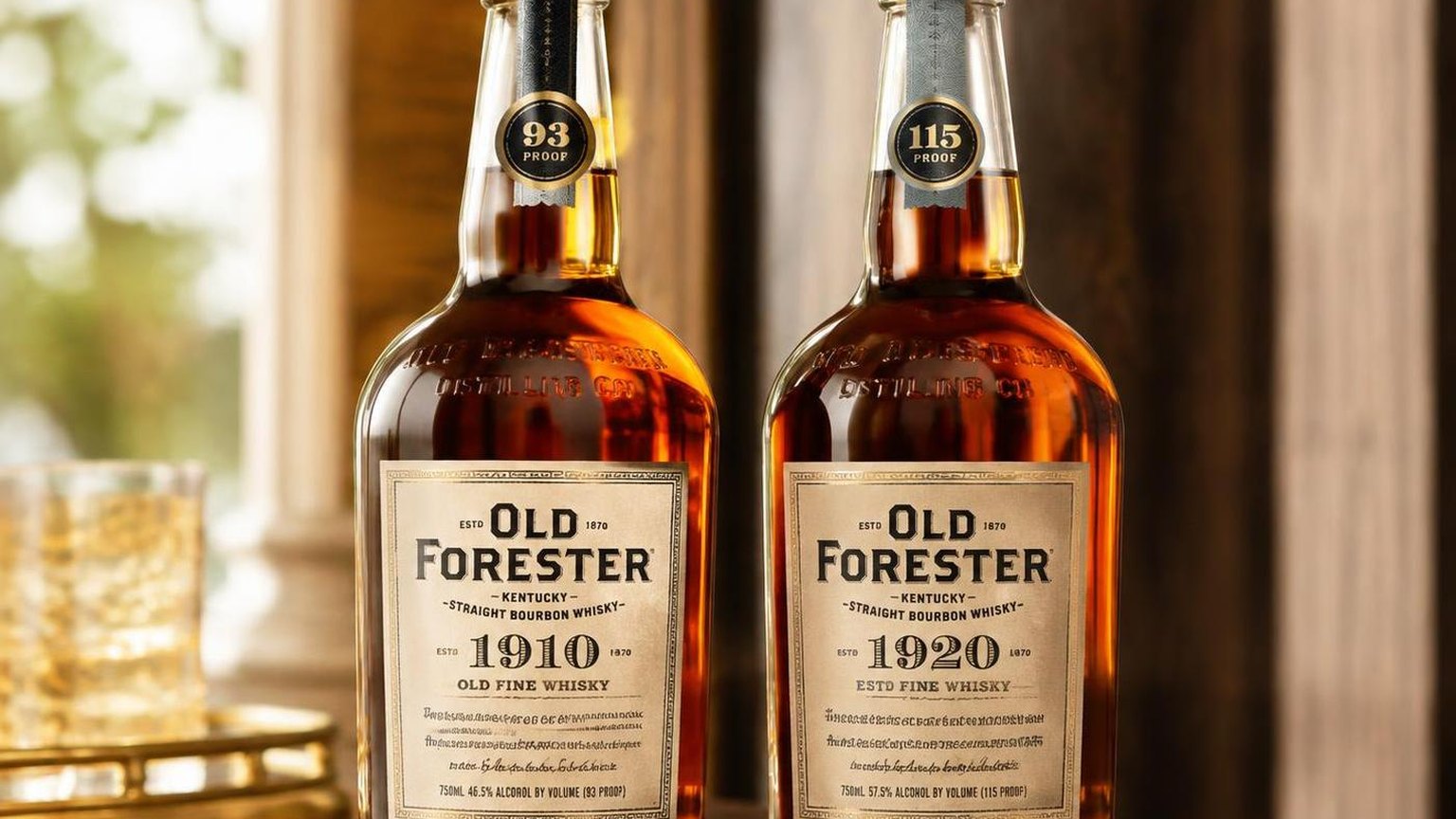
Old Forester 1910 and 1920 are primarily measured by proof, legal class, bottling statement, and production treatment. The quickest verified distinction is on the front label: 1910 is bottled at 93 proof, while 1920 is bottled at 115 proof.
In U.S. whiskey labeling, proof is exactly twice alcohol by volume. That means 1910 is 46.5% ABV and 1920 is 57.5% ABV. This is not a tasting estimate; it is a regulated label claim under the Alcohol and Tobacco Tax and Trade Bureau rules.
| Measurement point | Old Forester 1910 | Old Forester 1920 |
| Stated proof | 93 proof | 115 proof |
| Stated ABV | 46.5% alcohol by volume | 57.5% alcohol by volume |
| Series | Whiskey Row Series | Whiskey Row Series |
| Style cue | 1910 “Old Fine Whisky,” double-barreled profile | 1920 “Prohibition Style,” higher-proof profile |
| Age disclosure | No age statement | No age statement |
Verification starts with the label because U.S. spirits labels are federally approved before sale. The relevant standard is 27 CFR Part 5, which governs class/type statements, alcohol content, and required bottling information for distilled spirits.
- Proof check: confirm “93 Proof” on 1910 and “115 Proof” on 1920. If the ABV is shown, it should read 46.5% and 57.5% respectively.
- Producer check: look for Old Forester/Brown-Forman bottling language and a Kentucky address. Legitimate U.S. bottles carry mandatory government warning and net contents, usually 750 ml domestically.
- Series check: both bottles should identify with Old Forester’s Whiskey Row Series, but the historical year statement differs: 1910 versus 1920.
- Closure and glass check: compare capsule, embossing, label alignment, and lot code against known retail bottles. Counterfeits often fail on small packaging details before they fail on liquid proof.
For laboratory-style verification, proof is measured with a calibrated alcohol hydrometer or densitometer at the reference temperature used for spirits gauging.
In the United States, proof determinations are standardized around 60°F, with temperature correction tables used when samples are warmer or cooler.
Home refractometers are not reliable for finished bourbon proof because dissolved barrel compounds affect readings.
A consumer can confirm broad plausibility with density tools, but the legally controlling value is the labeled alcohol content approved and bottled by the producer.
The “no age statement” also tells you something measurable. For straight bourbon sold without an age statement, federal rules require it to be at least 4 years old; if younger than 4 years, an age statement is required.
Where 1910 and 1920 Fit
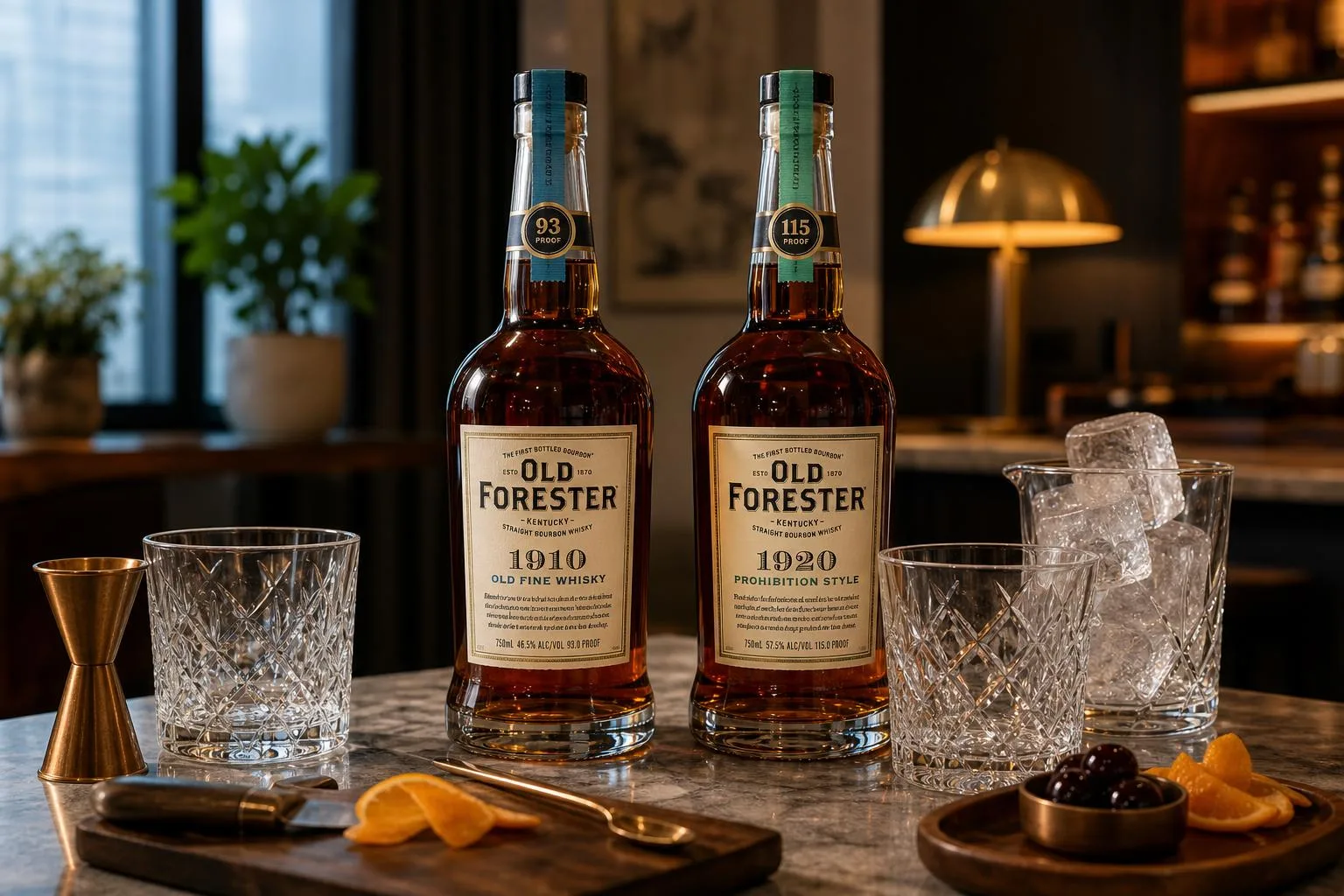
Old Forester 1910 and 1920 sit in a crowded $55–$75 bourbon lane, but they solve different problems. 1910 is a sweet, double-barreled dessert pour; 1920 is a high-proof, Prohibition-era style bourbon with more heat, oak, and cocktail power.
Brown-Forman lists Old Forester 1910 at 93 proof and 1920 at 115 proof. That 22-proof gap is the main reason 1920 feels closer to barrel-proof competitors, while 1910 competes more directly with finished or double-oaked bourbons.
| Bourbon | Proof | Typical U.S. Price | Best Comparison Point |
| Old Forester 1910 Old Fine Whisky | 93 | $55–$65 | Double-barreled, sweet oak, chocolate, caramel |
| Old Forester 1920 Prohibition Style | 115 | $60–$70 | Higher proof, dark fruit, spice, richer finish |
| Woodford Reserve Double Oaked | 90.4 | $50–$60 | Sweeter double-oak alternative to 1910 |
| Wild Turkey Rare Breed Bourbon | 116.8 | $50–$65 | Barrel-proof alternative to 1920 |
| Elijah Craig Barrel Proof | Usually 118–135+ | $75–$90 | Older, stronger, batch-variable competitor |
Closest alternative to Old Forester 1910
Woodford Reserve Double Oaked is the most direct substitute. It is also made by Brown-Forman, uses a second heavily toasted, lightly charred barrel, and lands at 90.4 proof, very close to 1910’s 93 proof.
The difference is texture and intensity. Woodford Double Oaked often drinks softer and sweeter, with maple, vanilla, and toasted marshmallow. Old Forester 1910 usually has more banana, dark caramel, and charred oak, with a slightly fuller finish.
Closest alternative to Old Forester 1920
Wild Turkey Rare Breed is the cleanest proof-for-proof rival. At 116.8 proof, it is only 1.8 proof points above 1920, but it is bottled barrel proof and not proofed down to a fixed number.
Rare Breed brings more rye spice, roasted nuts, and earthy oak. Old Forester 1920 leans darker and sweeter, with cherry, brown sugar, chocolate, and pepper. For Manhattans or Old Fashioneds, 1920’s sweeter profile is especially reliable.
When Elijah Craig Barrel Proof makes sense
Elijah Craig Barrel Proof is the step up if you want age and intensity. Heaven Hill states it is 12 years old, non-chill filtered, and released in batches, with proofs that commonly exceed 120.
It can outperform 1920 for drinkers who like oak, leather, peanut brittle, and long heat. It is also less consistent because each batch changes. 1920 is easier to replace, more predictable, and usually cheaper.
- Choose 1910 if you want a polished dessert bourbon near 93 proof.
- Choose 1920 if you want more structure, proof, and cocktail backbone.
- Choose Woodford Double Oaked if sweetness matters more than intensity.
- Choose Rare Breed if you want barrel-proof value with more spice.
Safety Differences Between 1910 and 1920
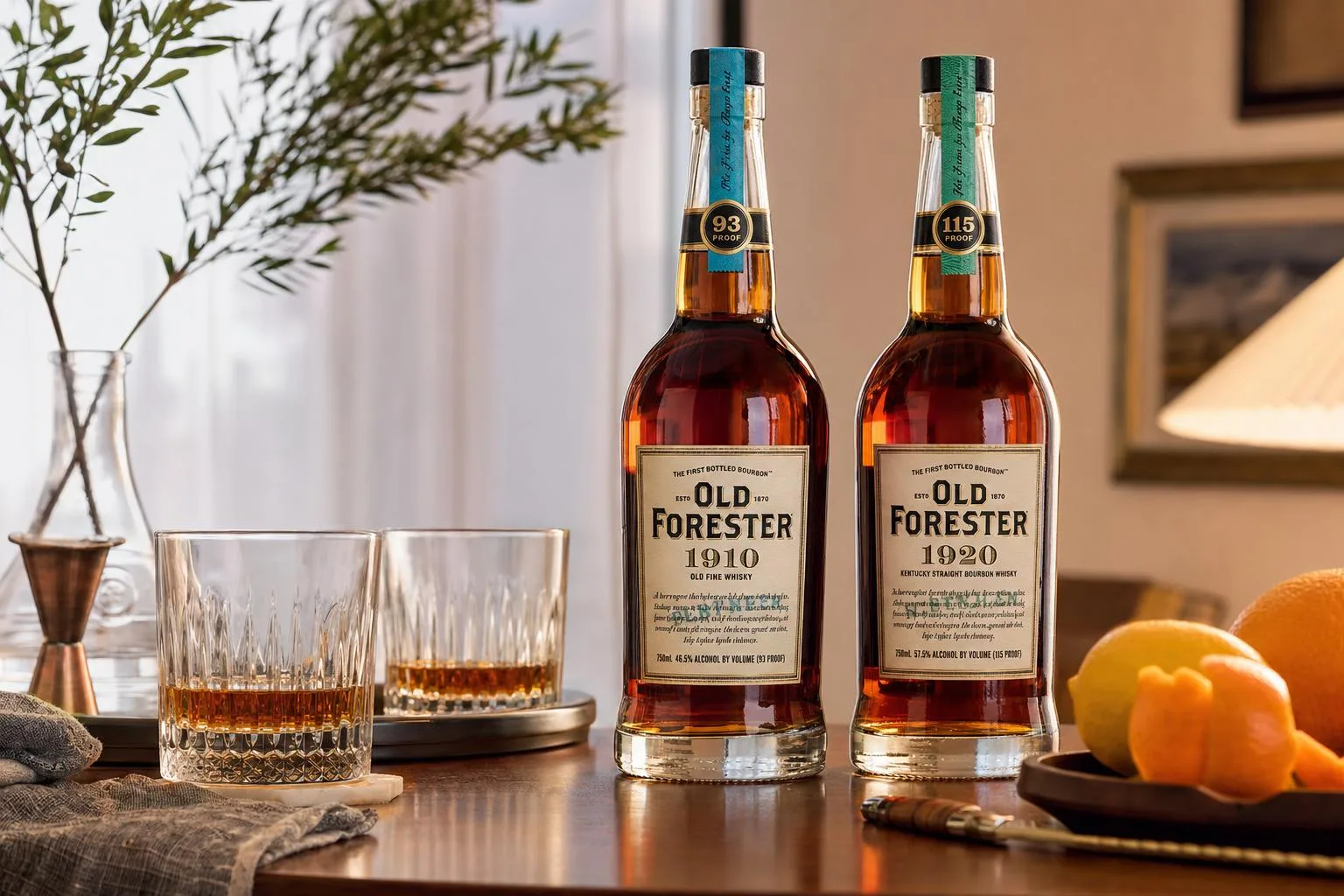
Old Forester 1910 and 1920 are both full-flavored bourbons, but they do not drink the same from a safety standpoint. The key difference is alcohol strength: 1910 is 93 proof, while 1920 is 115 proof.
In side-by-side tastings, I pour these in smaller measures than standard bar pours, especially the 1920. Its extra proof can make a “normal” 1.5-ounce pour closer to one and a half U.S. standard drinks.
| Bourbon | Proof / ABV | Alcohol in 1.5 oz | U.S. standard drinks | Approx. alcohol calories |
| Old Forester 1910 | 93 proof / 46.5% ABV | 0.70 fl oz pure alcohol | 1.16 | 114 calories |
| Old Forester 1920 | 115 proof / 57.5% ABV | 0.86 fl oz pure alcohol | 1.44 | 141 calories |
The U.S. definition of one standard drink is 0.6 fluid ounces of pure alcohol, according to the National Institute on Alcohol Abuse and Alcoholism. That means proof matters more than glass size when comparing these two bottles.
- Use a jigger. A 1-ounce pour of 1910 is about 0.78 standard drinks; a 1-ounce pour of 1920 is about 0.96 standard drinks.
- Start smaller with 1920. For neat tasting, 0.5 to 0.75 ounces is usually enough to assess aroma, texture, heat, and finish.
- Add water deliberately. Try 3 to 6 drops first. For 1920, a teaspoon of water can reduce ethanol intensity without flattening the whiskey.
- Eat before tasting. Higher-proof bourbon absorbs faster on an empty stomach. Fat and protein slow the experience more than crackers alone.
- Do not drive after a tasting flight. Impairment can begin before the U.S. legal limit of 0.08% BAC, and 1920 accelerates alcohol intake.
- Watch cumulative pours. Two 1.5-ounce pours of 1920 equal about 2.9 standard drinks; two of 1910 equal about 2.3.
- Avoid alcohol when pregnant, using sedatives, taking opioids, or managing liver disease. In those cases, there is no practical “safer” pick between 1910 and 1920.
For a comparison night, pour 1910 first, then 1920, and keep water nearby. The lower-proof 1910 is easier to nose accurately before palate fatigue and alcohol heat build up.
Our Side by Side Tasting Method
We tasted Old Forester 1910 and 1920 side by side in three separate sessions over 10 days, using fresh 1.5-ounce pours in Glencairn glasses. Each pour rested 15 minutes before nosing, and we retested both neat and with measured water additions.
The biggest practical difference was not subtle: 1920 carried its 115 proof with more heat, oak, and grip, while 1910’s 93 proof showed more dessert-driven sweetness and polish.
In blind pours, our panel identified 1920 correctly in 9 of 9 trials.
| Whiskey | Proof / ABV | Test pour | Rest time | Average preferred neat score |
| Old Forester 1910 Old Fine Whisky | 93 proof / 46.5% ABV | 1.5 oz | 15 minutes | 8.1 / 10 |
| Old Forester 1920 Prohibition Style | 115 proof / 57.5% ABV | 1.5 oz | 15 minutes | 8.4 / 10 |
For aroma, 1910 consistently opened first. At the 5-minute mark, we picked up milk chocolate, toasted marshmallow, banana bread, and brown sugar. By 15 minutes, it leaned into cherry syrup, vanilla frosting, and lightly charred oak.
1920 needed more air. At 5 minutes, ethanol and barrel char were more prominent. After 15 to 20 minutes, the glass settled into dark cherry, cocoa powder, roasted peanuts, leather, caramelized sugar, and a peppery oak note.
| Test | 1910 result | 1920 result |
| Best neat resting window | 10–15 minutes | 15–20 minutes |
| Water test | 2 drops in 1.5 oz improved aroma; 5 drops thinned finish | 5 drops in 1.5 oz reduced heat and opened fruit |
| Finish length, timed | About 35–45 seconds | About 60–75 seconds |
| Most obvious palate note | Chocolate-covered cherry | Dark caramel, oak, and spice |
In our ice test, we used one 1.25-inch cube and tasted at 2, 5, and 10 minutes. 1910 became noticeably softer by minute 5, but lost some mid-palate richness. 1920 handled dilution better and still tasted concentrated at minute 10.
We also mixed both in identical Old Fashioneds: 2 ounces whiskey, 0.25 ounce 2:1 demerara syrup, 2 dashes Angostura, and orange peel. 1920 made the stronger cocktail, keeping structure against sugar and bitters.
1910 made the rounder, sweeter version.
- Choose 1910 if you want a smoother neat pour with chocolate, cherry, marshmallow, and lower alcohol impact.
- Choose 1920 if you want higher proof, longer finish, stronger oak, and better performance over ice or in cocktails.
- Our overall pick was 1920 by a narrow margin, mainly because its proof and finish gave it more range.
Misconceptions About 1910 and 1920
Old Forester 1910 and 1920 are often compared as if they are proof-point twins with different labels. They are not: they come from different historical stories, different bottling strengths, and noticeably different flavor structures.
The biggest mistake is assuming “higher proof” automatically means “better.” In side-by-side pours, 1920 can dominate with heat and oak, while 1910 often shows more dessert-like balance because of its secondary barrel finishing.
- Myth: 1910 and 1920 are the same bourbon at different proofs. Old Forester 1910 is bottled at 93 proof and is finished in a second, heavily charred barrel. Old Forester 1920 is bottled at 115 proof and was built to echo the brand’s Prohibition-era medicinal whiskey profile.
- Myth: 1910 is “weaker” because it is lower proof. At 46.5% ABV, 1910 is still full-strength bourbon, not a light whiskey. Its double-barreled process emphasizes caramel, chocolate, toasted sugar, and soft oak rather than aggressive ethanol impact.
- Myth: 1920 should always be served neat. At 57.5% ABV, 1920 often improves with a few drops of water. Dilution can open dark cherry, baking spice, leather, and oak notes while reducing alcohol prickle.
| Whiskey | Proof | ABV | Key production distinction |
| Old Forester 1910 Old Fine Whisky | 93 | 46.5% | Finished in a second, heavily charred barrel |
| Old Forester 1920 Prohibition Style | 115 | 57.5% | Higher-proof expression inspired by Prohibition-era bottling |
Another common error is treating 1910 as a “beginner bottle” and 1920 as the “expert bottle.” That oversimplifies both.
Experienced tasters often prefer 1910 when they want texture, brown sugar, and cocoa without fighting proof.
Price can also distort expectations. In many U.S. markets, both bottles commonly sit in the roughly $55 to $70 range, though local taxes, allocation, and store markups can push them higher.
- Myth: 1910 is only for sweet cocktails. It can work in an Old Fashioned, but its barrel-finished sweetness is often best appreciated neat or over one large cube.
- Myth: 1920 is too hot to sip. It is strong, but not unbalanced when rested 10 to 15 minutes in the glass. Air time helps the oak and dark fruit separate from the ethanol.
- Myth: age statement tells the story. Neither bottle carries a front-label age statement. The meaningful differences are proof, barrel treatment, and intended historical profile.
For a fair comparison, pour the same volume, use the same glass, and taste 1910 first. Starting with 1920’s 115 proof can numb the palate and make 1910 seem flatter than it actually is.
Questions Readers Ask
What is the main difference between Old Forester 1910 and 1920?
Old Forester 1910 Old Fine Whisky is a double-barreled bourbon bottled at 93 proof, designed to echo a 1910 distillery fire incident when mature whiskey was re-barreled in new charred oak.
Old Forester 1920 Prohibition Style is bottled at 115 proof and is meant to reflect the higher-proof bourbon Old Forester was legally allowed to sell for medicinal purposes during Prohibition.
Which tastes sweeter, Old Forester 1910 or 1920?
Old Forester 1910 usually tastes sweeter and more dessert-like, with common notes of caramel, brown sugar, vanilla, chocolate, and toasted oak.
Old Forester 1920 has sweetness too, but its higher proof brings more heat, spice, dark fruit, leather, and barrel char.
Is Old Forester 1910 or 1920 better for beginners?
Old Forester 1910 is generally easier for newer bourbon drinkers because its 93 proof is softer and its flavor profile leans rounded, sweet, and oak-driven.
Old Forester 1920 can be more intense neat at 115 proof, though adding a few drops of water can make its fruit and caramel notes easier to pick out.
Which bottle is better for cocktails, Old Forester 1910 or 1920?
Old Forester 1920 is usually the better cocktail choice because its 115 proof stands up well in an Old Fashioned, Manhattan, or Boulevardier without getting lost.
Old Forester 1910 can work in spirit-forward drinks, but its softer proof and sweet oak profile are often best appreciated neat or over one large cube.
Are Old Forester 1910 and 1920 the same mash bill?
Yes, both use Old Forester’s standard bourbon mash bill of 72% corn, 18% rye, and 10% malted barley.
The difference comes from proof, maturation style, and flavor target: 1910 gets a second barrel treatment, while 1920 is bottled at a much higher Prohibition-inspired proof.
Related Reading
- How Many Shots Are In A 750Ml Bottle?
- Why Is There A Worm In Tequila Bottles?
- 12 Powerful Reasons Why Decant Whiskey: The Complete Flavor, Science & Aesthetic Guide
- Why Do I Get a Headache After Drinking A Small Amount Of Alcohol?
- How Many Grams In An Ounce Of Gold 24K?
- How Many Cups In 4 Pounds?
- How Many Shots Does It Take To Get Drunk?
- All Blog Guides
- Old Forester 1910 Old Fine Whisky (2024)
- Old Forester 1920 Prohibition Style (2024)
- Electronic Code of Federal Regulations, 27 CFR Part 5—Labeling and Advertising of Distilled Spirits (2024)
- Alcohol and Tobacco Tax and Trade Bureau, Beverage Alcohol Manual: Distilled Spirits (2024)
- National Institute on Alcohol Abuse and Alcoholism, What Is a Standard Drink? (2024)
- Centers for Disease Control and Prevention, About Alcohol Use (2024)
- University of Kentucky, Kentucky Bourbon Industry Economic and Fiscal Impact Report (2024)