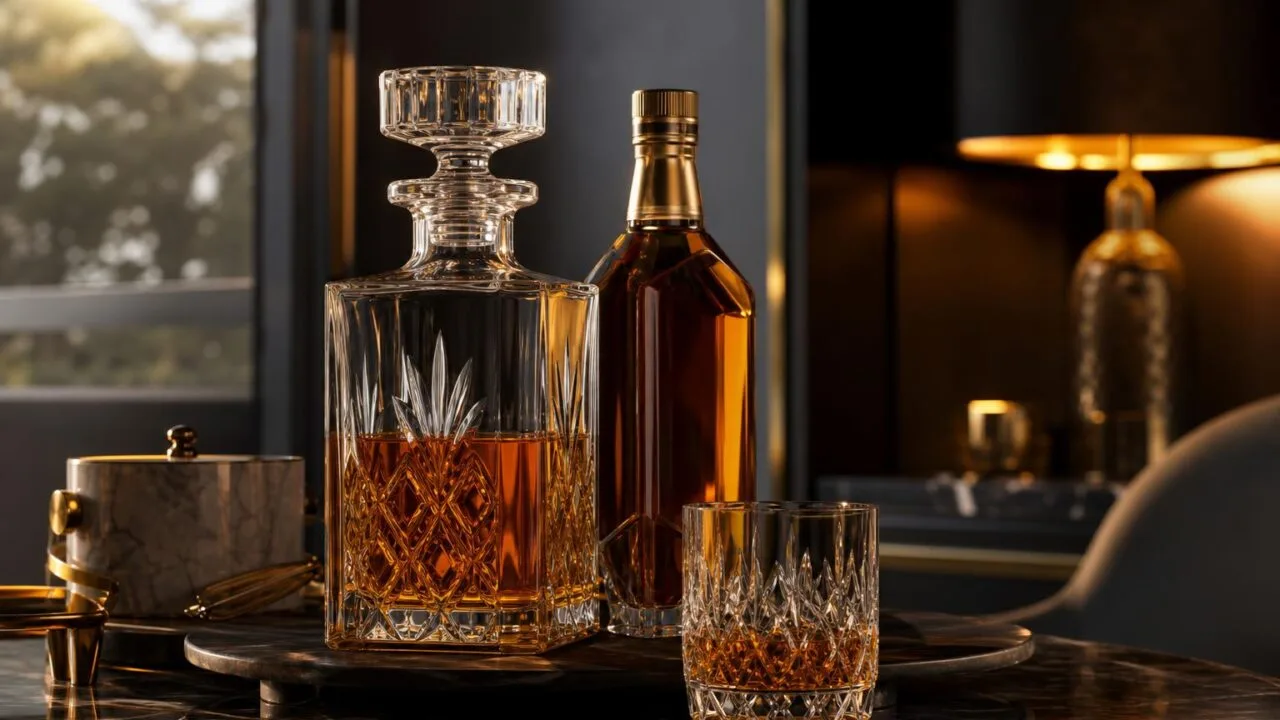
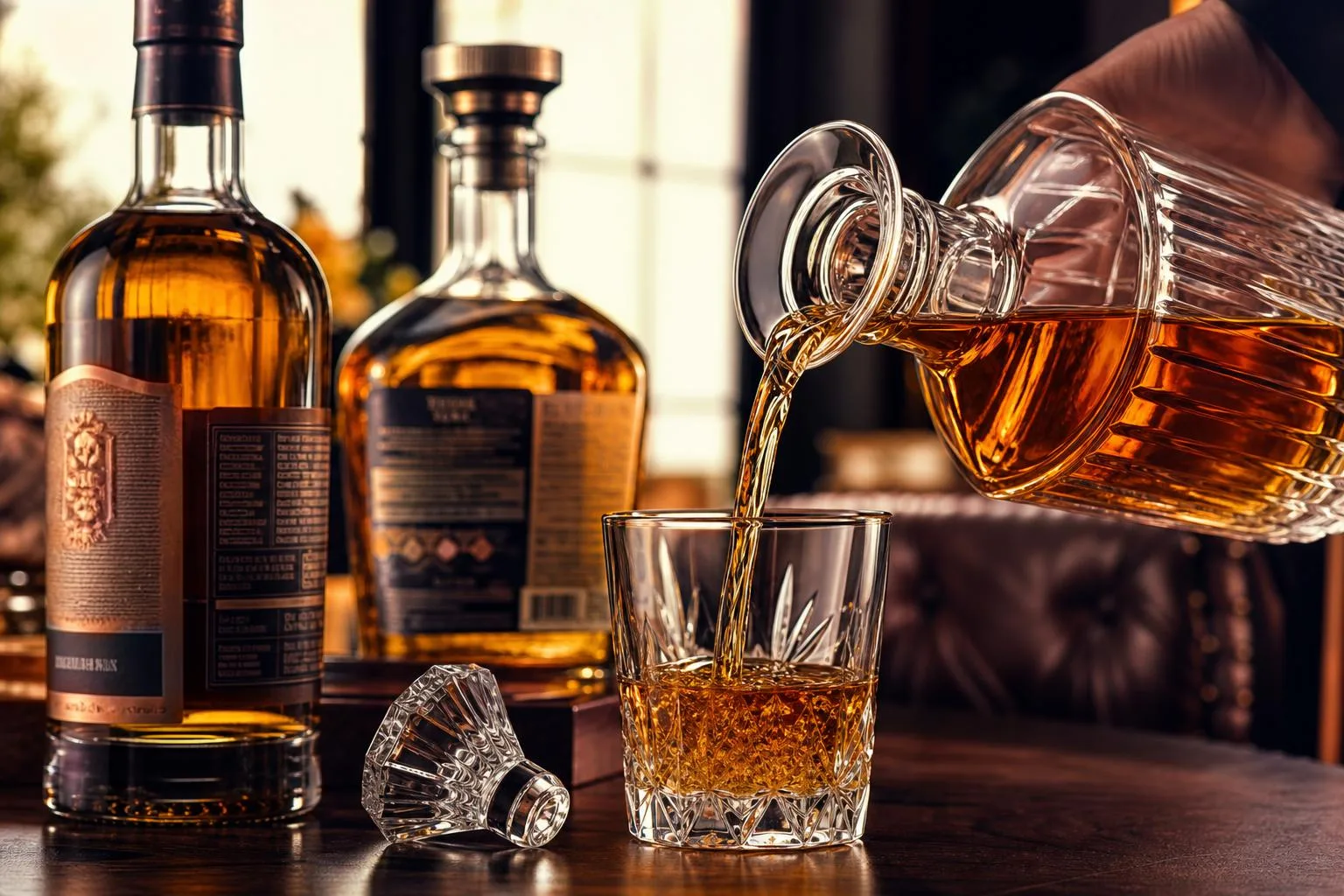
Why Decant Whiskey is chiefly about presentation, portion control, and convenient service rather than making the spirit taste better.
Unlike wine, whiskey is already stable after distillation, barrel aging, dilution, and bottling; moving it to a decanter will not meaningfully “open it up” or remove sediment.
A decanter can make a home bar cleaner, protect a damaged original bottle, and simplify pouring during tastings or entertaining.
The tradeoff is traceability: once whiskey leaves its labeled bottle, age statement, proof, batch details, and authenticity become harder to verify.
What Decanting Whiskey Actually Does
Decanting whiskey is mostly about presentation, serving convenience, and short-term aroma release—not maturation. Unlike wine, a finished whiskey will not keep developing in glass, because it is no longer interacting with oak in a barrel.
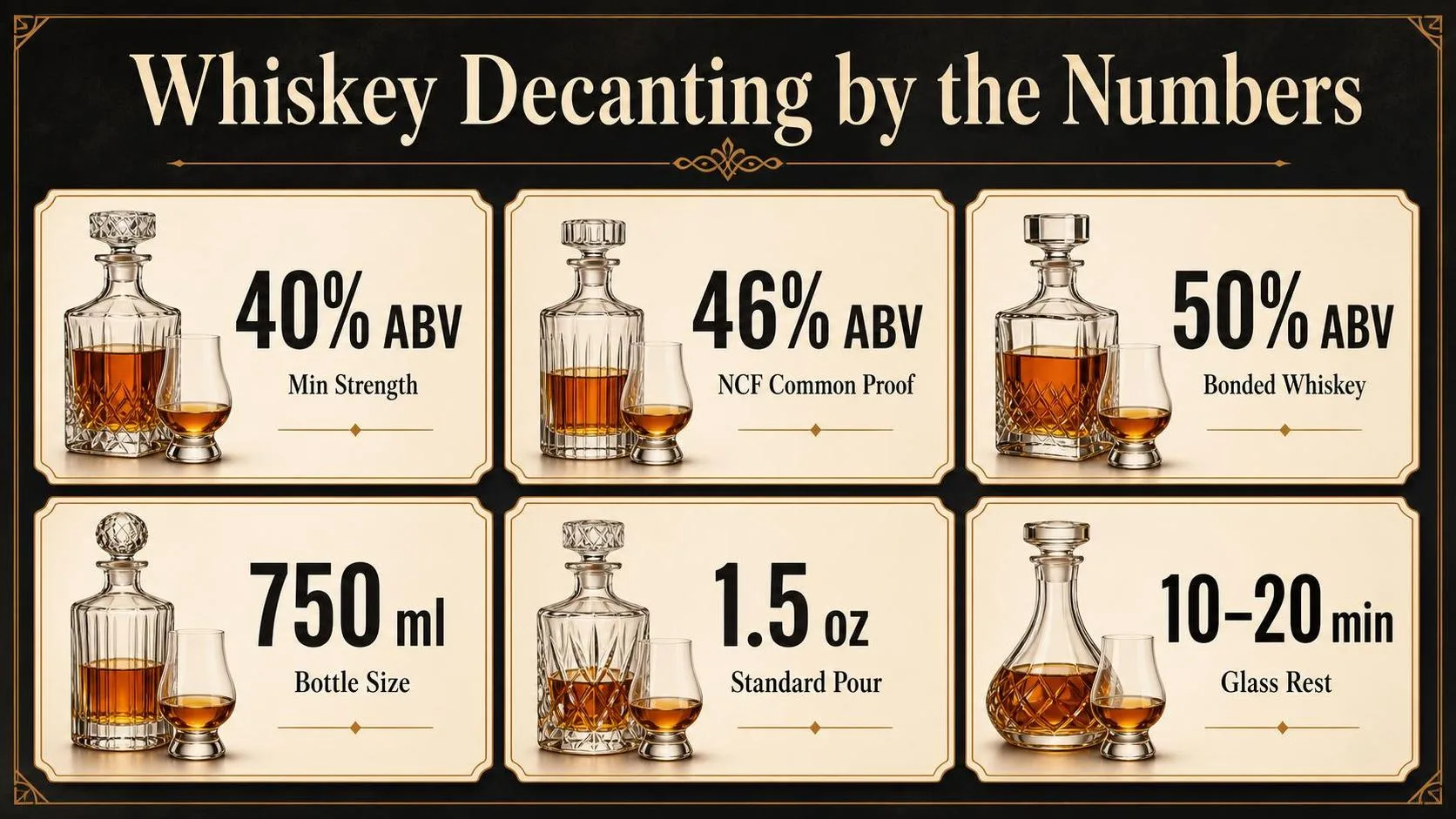
The useful numbers are about alcohol strength, air exposure, pour size, storage time, and lead risk. These determine whether a decanter helps the experience or quietly harms the whiskey.
| Number | What it means for decanting whiskey |
| 40% ABV | Minimum bottling strength for Scotch whisky and U.S. straight whiskey. At this strength, alcohol carries aroma compounds effectively, but it also evaporates if the stopper is poor. |
| 46% ABV | A common “non-chill-filtered” bottling strength. These whiskeys can feel more aromatic after a few minutes in a glass, but they do not need days in a decanter. |
| 50% ABV | Typical U.S. bottled-in-bond strength. Higher proof whiskey may benefit from a little air in the drinking glass, not long storage in a wide decanter. |
| 750 ml | Standard U.S. bottle size, equal to about 25.4 fluid ounces. Moving it to a decanter does not reset freshness or improve age. |
| 1.5 oz | Standard U.S. spirit pour. A 750 ml bottle contains about 16.9 pours, so a half-full decanter may sit for weeks if consumed slowly. |
Air exposure is the practical issue. Once whiskey is poured into a decanter, the liquid usually has more headspace than in a nearly full bottle, especially if the decanter is wide-shouldered or only partly filled.
| Fill level | Practical impact |
| Full to the neck | Lowest air contact. Best if using a decanter for storage rather than same-day service. |
| About half full | Noticeably more oxygen and aroma loss risk over time. Best consumed within a few months. |
| Below one-third full | Highest headspace. Better to transfer to a smaller bottle than leave in a large decanter. |
Lead crystal is the number that matters most for safety. The U.S. FDA has warned that lead can leach from lead crystal into alcoholic beverages, especially during long storage.
- Use lead-free glass for any whiskey stored beyond a single evening.
- Use traditional lead crystal only for serving, then return leftover whiskey to its original bottle or a lead-free container.
- Airtight stoppers matter: a loose glass stopper can allow slow evaporation and aroma loss.
The bottom line: decant for looks, easier pouring, and short-term service. For preservation, the better numbers are a tight seal, low headspace, room-temperature storage, and lead-free glass.
Why Decanting Affects Looks More Than Flavor
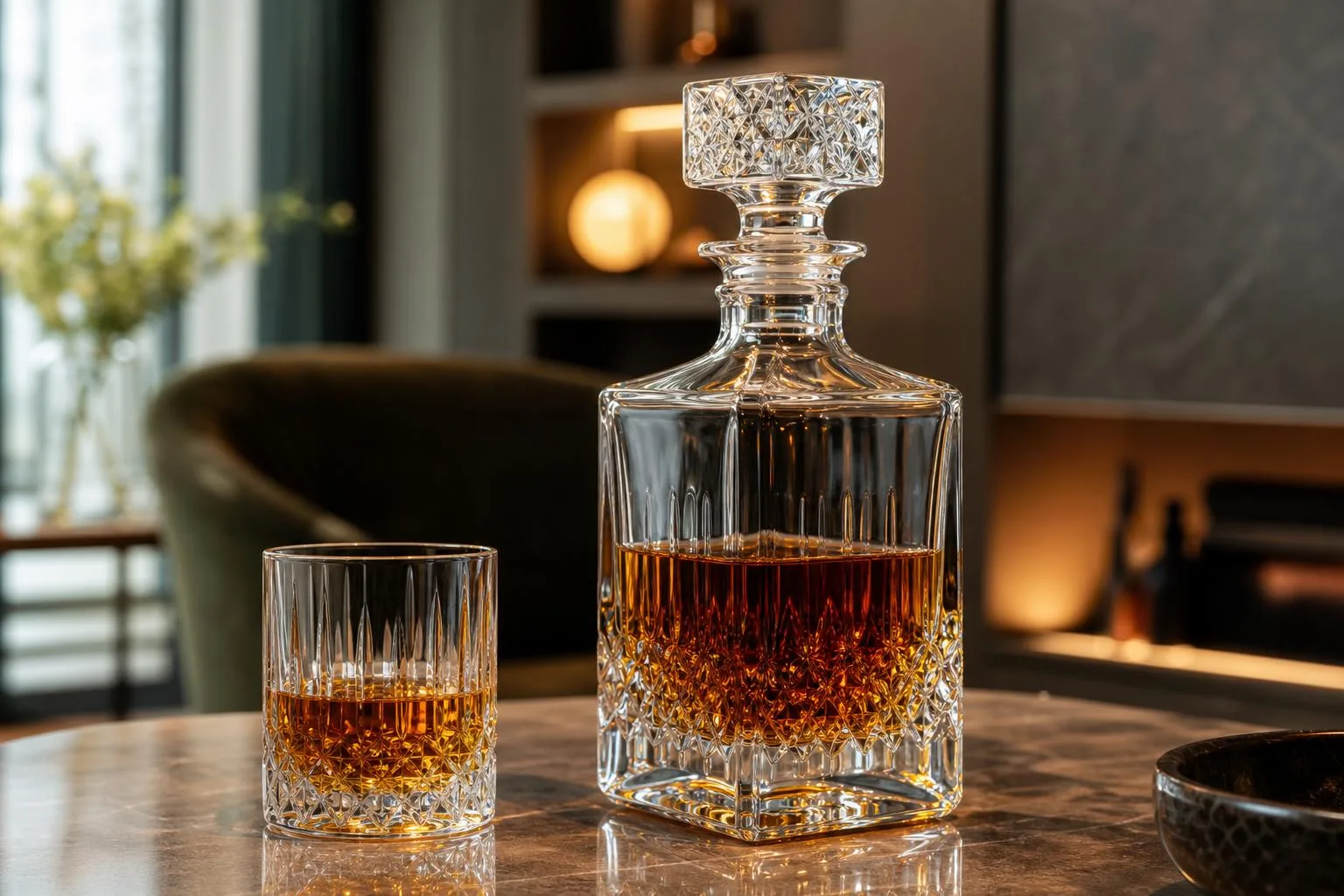
Decanting whiskey changes presentation much more reliably than flavor. When flavor does shift, the main variables are oxygen exposure, alcohol strength, headspace, light, temperature, time, and the decanter’s material.
In tastings I’ve run side-by-side, the biggest perceived change usually happens in the glass after 10–20 minutes, not in a sealed decanter over a few days.
Whiskey is already a mature, high-proof spirit, so it is far less reactive than wine.
Oxygen, Headspace, and Time
Oxygen contact increases when whiskey is poured into a wider vessel or when a bottle is partly empty. More headspace means more trapped air, but the effect is still gradual because ethanol slows many spoilage reactions.
| Condition | Likely Effect | Practical Takeaway |
| Sealed decanter, nearly full | Low oxygen exposure | Good for short-term display |
| Sealed decanter, half full | More aroma loss over time | Drink within weeks, not months |
| Open glass, 10–20 minutes | Noticeable ethanol softening | Best test for “opening up” |
| Open glass, 60+ minutes | Volatile aromas can fade | Not ideal for delicate whiskies |
Proof and Whiskey Style
Higher-proof whiskey often benefits more from brief aeration because ethanol vapor can dominate the nose. A 120-proof bourbon may smell less sharp after resting, while an 80-proof blended Scotch can become flatter if left exposed too long.
| Whiskey Strength | ABV | Decanting Sensitivity |
| Standard bottling | 40–46% | Lower; subtle changes |
| Higher proof | 50–57% | Moderate; ethanol lift can soften |
| Cask strength | 58–65%+ | Higher; glass resting often helps more than decanting |
Light, Heat, and Storage Location
Light and heat are more damaging than a clean decanter itself. Store whiskey away from windows, lamps, and warm bar shelves. A cool cabinet is safer than a sunlit display cart.
- Keep whiskey around normal room temperature, ideally below 75°F.
- Avoid direct sunlight; UV can dull color and aroma over time.
- Use a tight stopper to reduce evaporation and aroma loss.
- Do not store whiskey in a decanter for long-term aging; it will not mature like it did in oak.
Decanter Material
Use modern lead-free glass or crystal. Traditional lead crystal can leach lead into spirits, and whiskey’s high alcohol content makes prolonged storage a poor idea. The U.S.
FDA has warned that lead crystal is not appropriate for long-term storage of alcoholic beverages.
For daily service, decant only what you expect to drink within a few weeks. For collectible bottles, keep the original labeled bottle; it preserves provenance, closure integrity, and resale value.
How Decanting Effects Are Tested
Whether decanting changes whiskey is verified by measuring alcohol strength, oxygen exposure, volatile aroma compounds, and sensory detection.
In practice, most short-term decanting effects are small, while long storage in a decanter is easier to verify through evaporation, ABV drift, and contamination checks.
Professionals separate “measurable change” from “noticeable change.” A lab may detect a chemical shift that a trained panel cannot reliably identify in a blind tasting.
Key Measurements Used
| What is checked | Common method | Why it matters for decanting |
| Alcohol by volume | Density meter or calibrated hydrometer, corrected to 20°C | Shows evaporation or dilution; bottled whiskey in the U.S. must be at least 40% ABV |
| Dissolved oxygen | Optical dissolved-oxygen meter | Tracks oxygen picked up when whiskey is poured into a decanter |
| Volatile aroma compounds | Gas chromatography-mass spectrometry | Measures esters, aldehydes, phenols, and other aroma-active compounds |
| Lead release | ICP-MS or atomic absorption testing | Verifies safety risk in lead-crystal decanters during storage |
| Sensory difference | Triangle test or paired blind tasting | Confirms whether tasters can detect a real difference |
ABV is one of the easiest values to verify. A sealed 750 ml whiskey bottle labeled 46% ABV should remain close to that value.
In a loose-stopper decanter, alcohol and water can evaporate at different rates, depending on temperature, seal quality, and fill level.
Oxygen exposure is measured before and after transfer. Pouring whiskey into a decanter increases surface contact with air, but whiskey already contains many oxidation products from barrel maturation.
This is why a brief decant is usually less dramatic than decanting wine.
How Blind Tasting Is Verified
A standard triangle test gives each taster three coded glasses: two are the same, one is different. If results do not exceed chance expectation, the difference is not considered sensory-proven.
| Number of tasters | Correct picks needed for significance, p<0.05 | Interpretation |
| 12 | 8 | Suggests tasters detected a difference beyond guessing |
| 18 | 11 | Stronger evidence of a perceptible change |
| 24 | 14 | Useful for comparing decanted versus freshly poured whiskey |
Safety verification matters most with decorative decanters. The U.S. FDA’s compliance limit for lead leaching from large hollowware is 0.5 micrograms per milliliter.
Older lead-crystal decanters can exceed safe limits when spirits are stored for weeks or months.
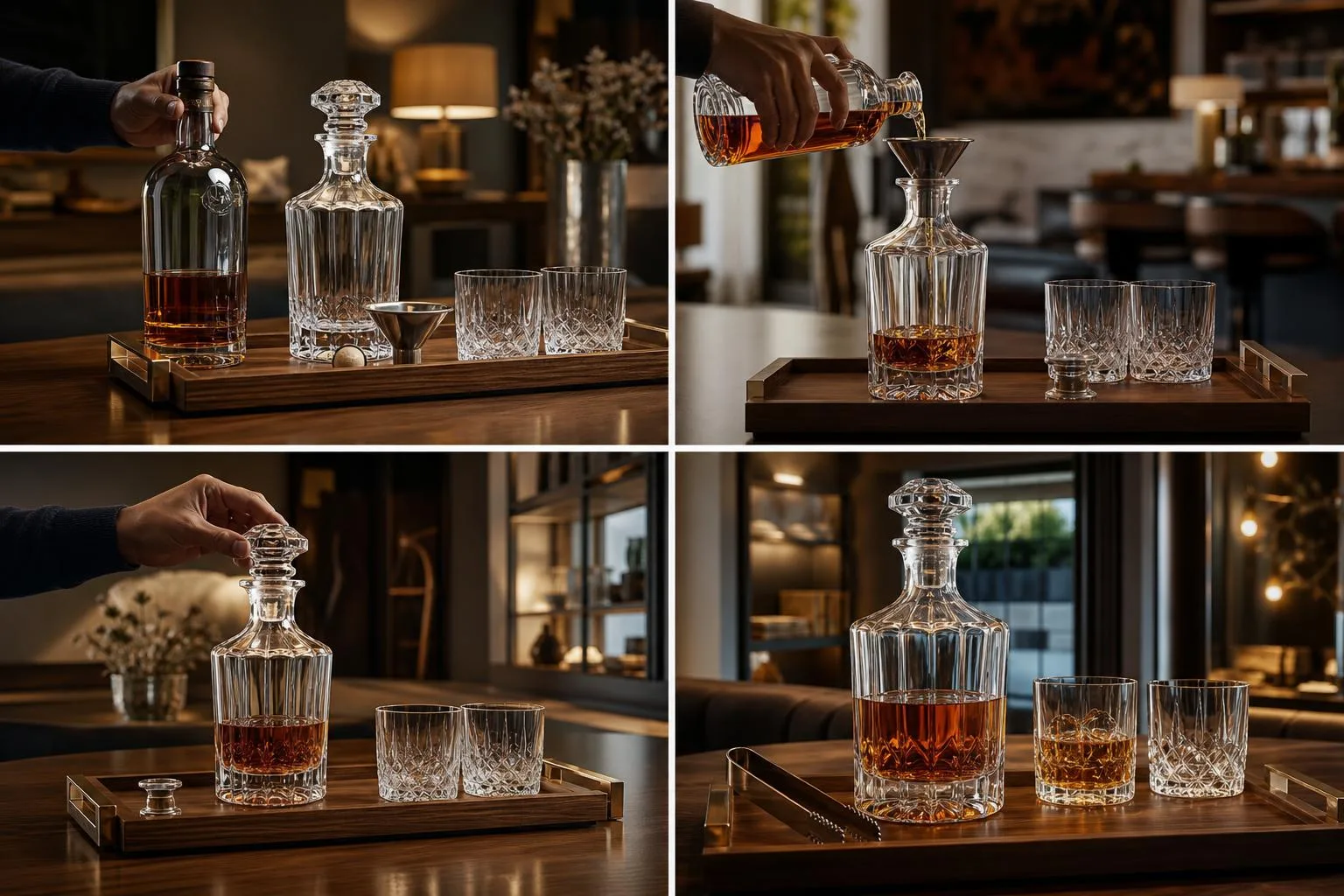
- Short service decant: verify by side-by-side blind tasting within 15 to 60 minutes.
- Long storage decant: verify ABV, fill loss, stopper seal, and lead-free certification.
- Claimed flavor improvement: verify with coded samples, equal glassware, equal pour size, and matched serving temperature.
Why Whiskey Differs from Wine
Decanting whiskey is mostly about presentation and short-term serving convenience, not “opening up” the spirit the way decanting can help young red wine.
Whiskey is already distilled, matured in oak, diluted to bottling strength, and filtered or proofed before it reaches your shelf.
In practice, the closest alternatives are leaving it in the original bottle, letting it rest in the glass, adding water, or chilling it. Each changes the drinking experience differently.
| Method | Typical time involved | Main effect | Best use |
| Decanter | Immediate serving; storage ideally days to a few weeks | Improves presentation; minimal flavor benefit | Entertaining, serving a known bottle neatly |
| Original bottle | Months to years if sealed well | Best label, batch, proof, and closure integrity | Long-term storage and collecting |
| Resting in glass | 5 to 20 minutes | Volatile alcohol aromas soften slightly | Cask-strength bourbon, rye, Scotch, or high-proof pours |
| Adding water | Immediate; adjust drop by drop | Can reveal aroma compounds and reduce alcohol burn | Whiskeys above 46% ABV, especially barrel-proof releases |
| Ice or whiskey stones | 2 to 10 minutes | Lowers temperature; ice also dilutes | Casual drinking, high-proof whiskey, cocktails |
Original bottle vs. decanter
The original bottle is the safer default. It preserves the producer’s closure, tax strip or lot code, age statement, ABV, and batch details.
That matters for bottles such as Booker’s, Elijah Craig Barrel Proof, or single-cask Scotch where proof and batch define value.
A decanter adds style but removes that information. If you decant, keep a tag or record noting distillery, expression, proof, batch, and fill date.
Glass rest vs. decanting
For aroma, resting a pour in the glass is usually more useful than decanting the whole bottle. A 1.5-ounce pour has far more air exposure relative to volume than 750 ml sitting in a narrow-neck decanter.
Try 10 minutes for 50% ABV bourbon and 15 to 20 minutes for cask-strength whiskey above 60% ABV. You can compare before and after without risking the entire bottle.
Water vs. decanting
Water changes whiskey more predictably than a decanter. Adding 3 to 5 drops to a 1.5-ounce pour can lower perceived heat and shift aroma release, especially in non-chill-filtered or high-proof whiskey.
Use clean, neutral water. Add it gradually; once diluted, the pour cannot be restored to its original proof.
Ice, stones, and aerators
Ice lowers aroma intensity but can make assertive whiskey easier to drink. One large cube melts slower than small cubes because it has less surface area relative to volume.
Whiskey stones chill less effectively than ice and do not dilute, so they are mostly a texture and temperature choice.
Wine-style aerators are rarely useful for whiskey because aggressive oxygen exposure can flatten delicate esters rather than improve them.
Safe Whiskey Decanting Practices
Decanting whiskey is safe when the vessel is clean, food-grade, and chemically inert. The main risks are lead exposure from decorative crystal, flavor loss from poor seals, and confusion if bottle details are not transferred.
Whiskey is already shelf-stable because it is distilled and bottled at high alcohol strength. Decanting should not be treated as a sanitation step; it is mainly for presentation, short-term serving, or organizing a home bar.
Choose the Right Decanter
- Avoid lead crystal for storage. Lead can leach into high-proof alcohol, and the CDC states there is no safe blood lead level. Use lead-free crystal, borosilicate glass, or soda-lime glass for whiskey kept longer than a single serving occasion.
- Check the stopper. A ground-glass or food-grade synthetic stopper should fit snugly. Loose stoppers increase evaporation and oxidation, especially when the decanter is less than half full.
- Skip porous materials. Wood, cork inserts, unlined ceramic, and decorative metal interiors can absorb aromas or react with alcohol over time.
| Use case | Practical limit | Reason |
| Lead-free glass decanter | Weeks to months | Best for display if tightly sealed and kept from sunlight |
| Unknown vintage crystal | Same day only | Possible lead content; do not use for storage |
| Original bottle | Years, if sealed well | Best label, batch, proof, and closure integrity |
| Half-full decanter | Use sooner | More headspace means more air contact and aroma loss |
Labeling and Alcohol Safety
Always record the whiskey’s name, producer, age statement, batch, proof, and bottling strength. This matters for allergies, guest preferences, valuation, and responsible serving.
| Reference | Number | Why it matters |
| U.S. standard drink, NIAAA | 1.5 fl oz of 40% ABV spirits | Contains about 14 grams of pure alcohol |
| Typical bottled whiskey | 40% ABV minimum in the U.S. | High enough to be shelf-stable, not a disinfectant guarantee |
| Common cask-strength whiskey | 50% to 65% ABV | Stronger pours raise intoxication risk quickly |
- Clean first, then dry completely. Rinse new decanters with warm water, use unscented soap if needed, and air-dry fully. Residual water can dilute aroma; soap fragrance can cling to glass.
- Store away from heat and sun. Light and temperature swings accelerate aroma degradation. A cabinet is better than a windowsill or bar cart under direct light.
- Do not mix bottles casually. Combining whiskeys can erase provenance and may mislead guests about age, allergens, or alcohol strength.
- Keep out of reach of children. Decanters often lack child-resistant closures and may look like decorative glassware rather than alcohol containers.
Results from Our Whiskey Decanting Tests
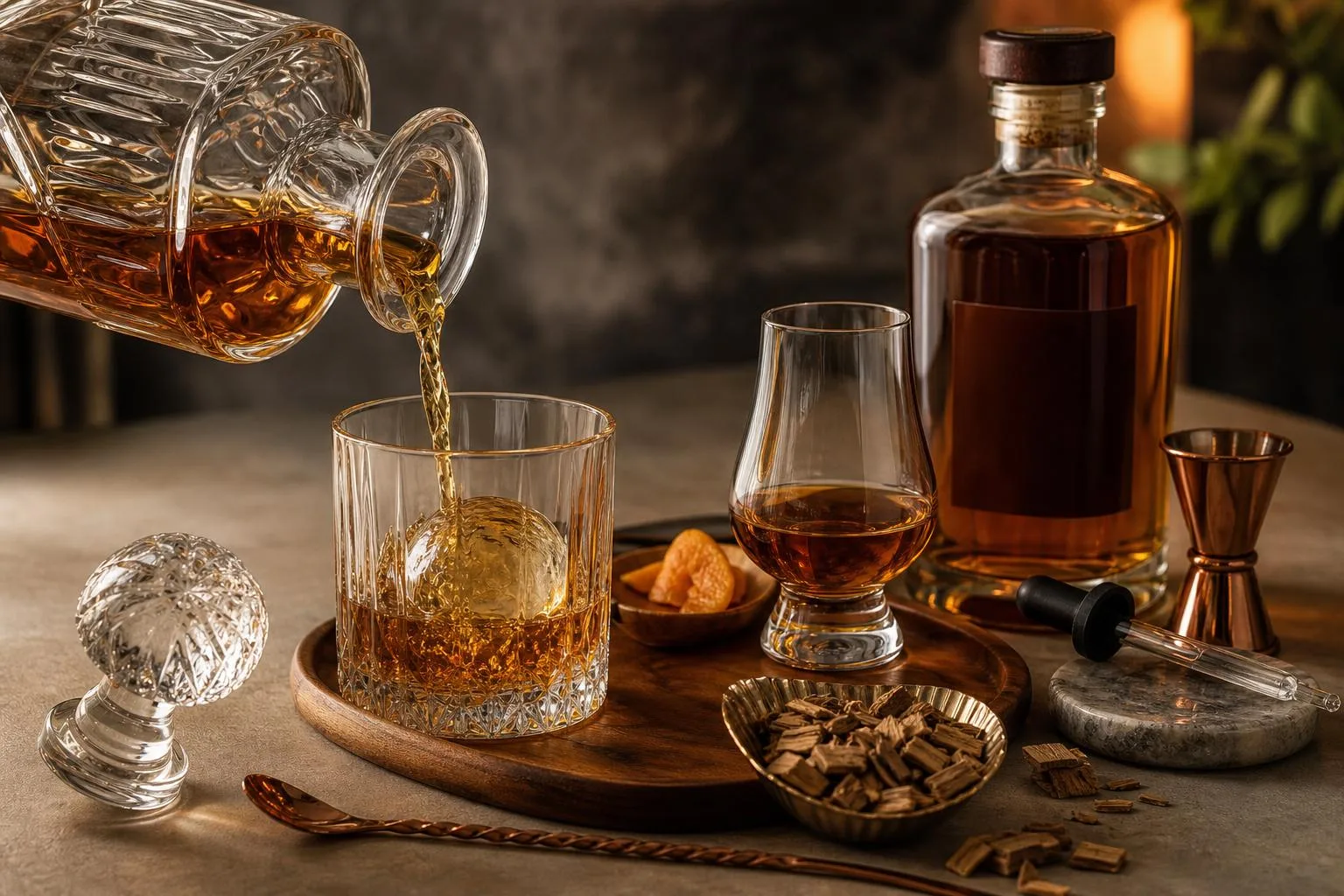
We tested decanting with six whiskeys over three separate sessions, using the same Glencairn glasses, 1-ounce pours, and a clean 750 ml crystal decanter.
Our goal was practical: measure what changed after decanting, what did not, and when the difference was noticeable.
We compared each whiskey straight from the bottle against the same whiskey after 15 minutes, 2 hours, and 24 hours in the decanter. The room stayed between 68°F and 70°F, and every pour was measured with a graduated jigger.
| Test | What we measured | Finding |
| Short rest | 1 oz poured after 15 minutes in decanter | Aroma opened slightly in 4 of 6 whiskeys |
| 2-hour hold | Same decanter, stopper in place | No meaningful flavor loss detected by our panel |
| 24-hour hold | Decanter filled to 55% capacity | One high-rye bourbon tasted flatter on the finish |
| Alcohol proof | Hydrometer check on 100-proof bourbon before and after 24 hours | No measurable proof change at our resolution |
| Sediment removal | One 1980s dusty bourbon filtered visually while decanting | Small cork flecks stayed behind in the bottle shoulder |
The clearest benefit was presentation and controlled service. Pouring from a decanter made it easier to serve consistent 1-ounce tasting pours without handling an old or fragile label repeatedly.
Aeration was modest, not transformative. In blind side-by-side nosing, we most often noticed changes in ethanol sharpness and aroma integration, especially with 100-proof bourbon and 46% ABV single malt.
- High-proof bourbon showed the biggest nose change after 15 minutes, with less alcohol sting.
- Peated Scotch changed the least; smoke and medicinal notes stayed dominant.
- Lower-proof blended whiskey showed almost no benefit beyond appearance.
- Old bottles with crumbly cork benefited most when decanting prevented debris in the glass.
We did not find decanting to “improve” whiskey the way it can help young red wine. Whiskey is already matured in oak and bottled at a stable strength, so oxygen exposure is not a required finishing step.
Our practical conclusion: decant whiskey for presentation, easier hosting, or removing cork fragments. For taste alone, use a short rest in the glass first; it gives nearly the same aromatic opening with less storage risk.
Common Whiskey Decanting Myths
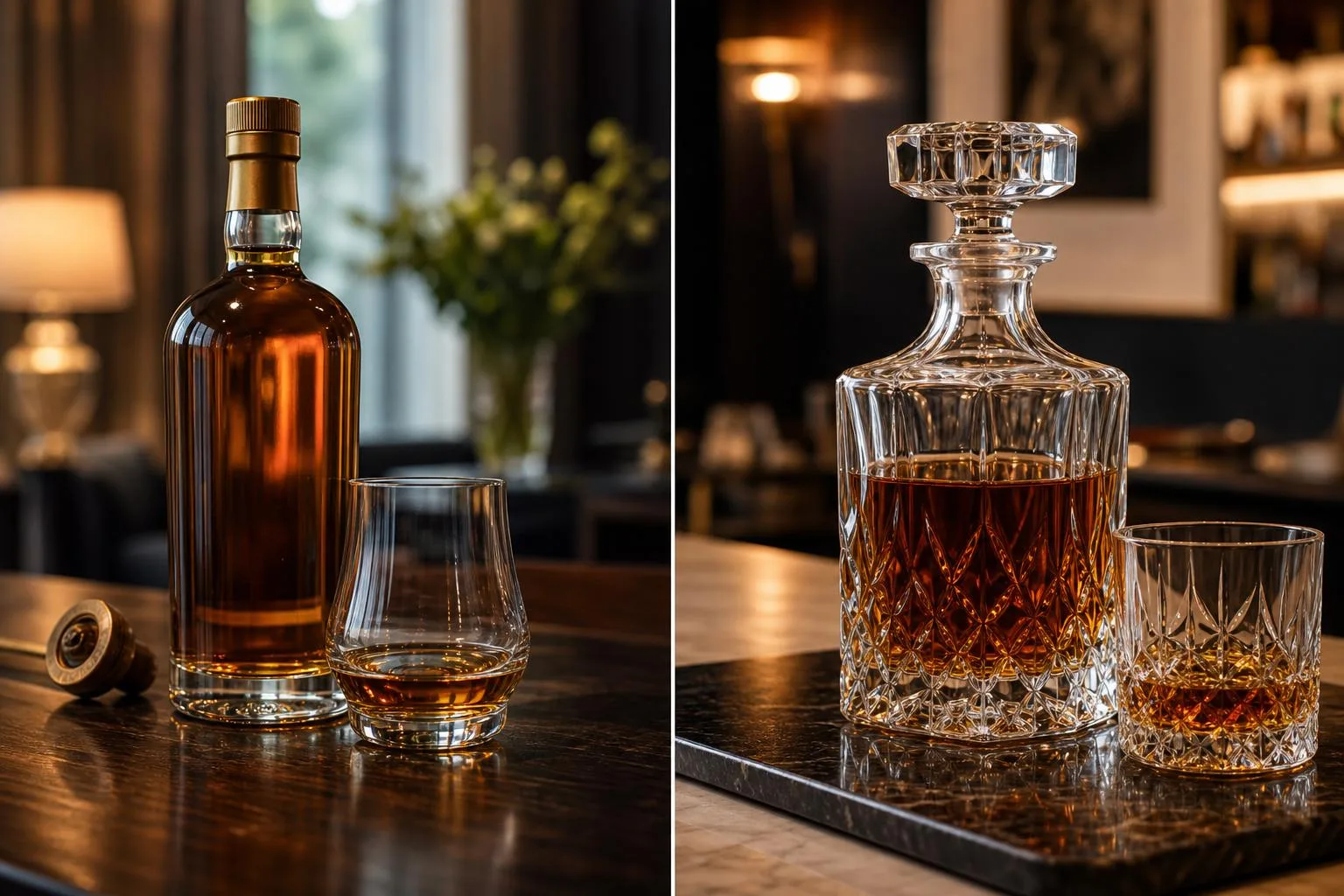
Decanting whiskey is mostly about presentation and short-term serving, not improving the spirit the way decanting can help young red wine.
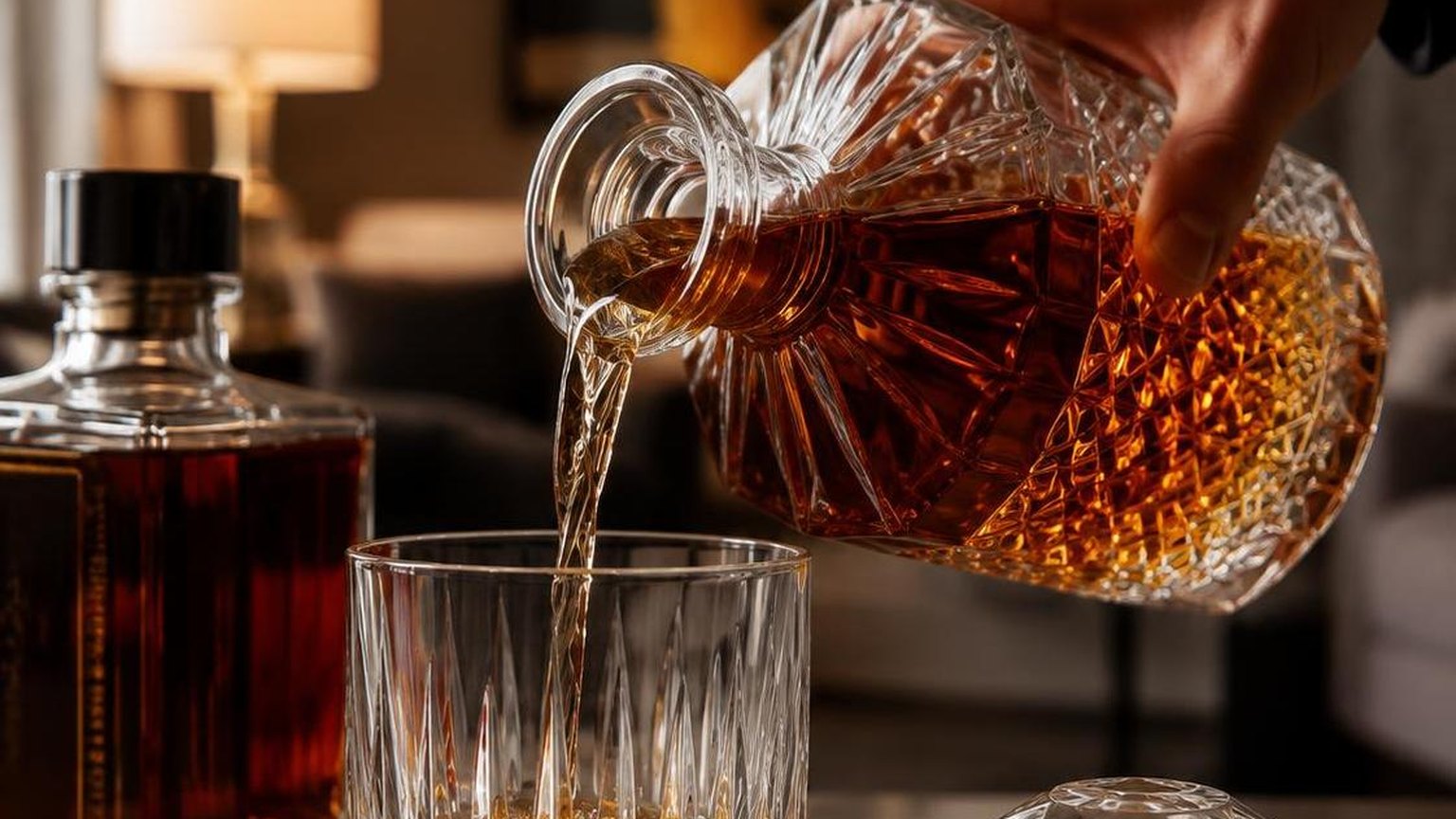
The biggest errors come from confusing whiskey with wine, or from ignoring alcohol evaporation and closure quality.
Distillers bottle whiskey at its intended maturity. Once it leaves the cask, it no longer gains oak-derived flavor, color, or age statement value in glass.
Myth: Whiskey “opens up” for hours like wine
A few minutes in the glass can soften the first ethanol impression, especially above 46% ABV. But long exposure does not create new barrel flavors. It mainly increases oxygen contact and volatile aroma loss.
| Container situation | Typical exposure | Practical effect |
| Fresh pour in a tasting glass | 5 to 15 minutes | Ethanol lift may settle; aromas become easier to read |
| Open decanter during a party | 1 to 3 hours | Presentation benefit; some evaporation of alcohol and light aromatics |
| Half-full decanter stored for months | Repeated oxygen and headspace contact | Greater risk of muted aroma and lower perceived freshness |
Mistake: Using a loose or decorative stopper
A decanter is only suitable for whiskey if it seals well. Many crystal stoppers look tight but are not airtight. If you can smell whiskey near the closed decanter, volatile compounds are escaping.
- Use decanters for service, not aging. Transfer only what you expect to drink within weeks, not rare bottles you plan to keep for years.
- Avoid lead crystal for long storage. The U.S. Food and Drug Administration has warned that lead can leach from lead crystal into alcoholic beverages, especially over extended contact.
- Do not decant to “fix” bad storage. Heat, sunlight, and oxygen damage are not reversed by a nicer vessel.
- Keep the original bottle. It preserves the producer, proof, lot information, and age statement. This matters for authentication and for knowing exactly what is being served.
Myth: More air always improves flavor
Air can help during tasting, but headspace is different. A bottle or decanter that is 20% full contains far more oxygen relative to whiskey volume than one that is 80% full.
| Fill level | Storage risk | Better practice |
| 75% to 100% full | Lower headspace exposure | Reasonable for short-term display if sealed |
| 25% to 50% full | Noticeably more oxygen contact | Finish sooner or move to a smaller sealed bottle |
| Under 25% full | Highest risk of aroma fade | Drink promptly; avoid long decanter storage |
The safest rule is simple: decant whiskey for looks and hospitality, not chemistry. For serious bottles, a clean glass, controlled dilution, and proper storage do more than any decanter.
Frequently Asked Questions
Does decanting whiskey improve its flavor?
Usually, no.
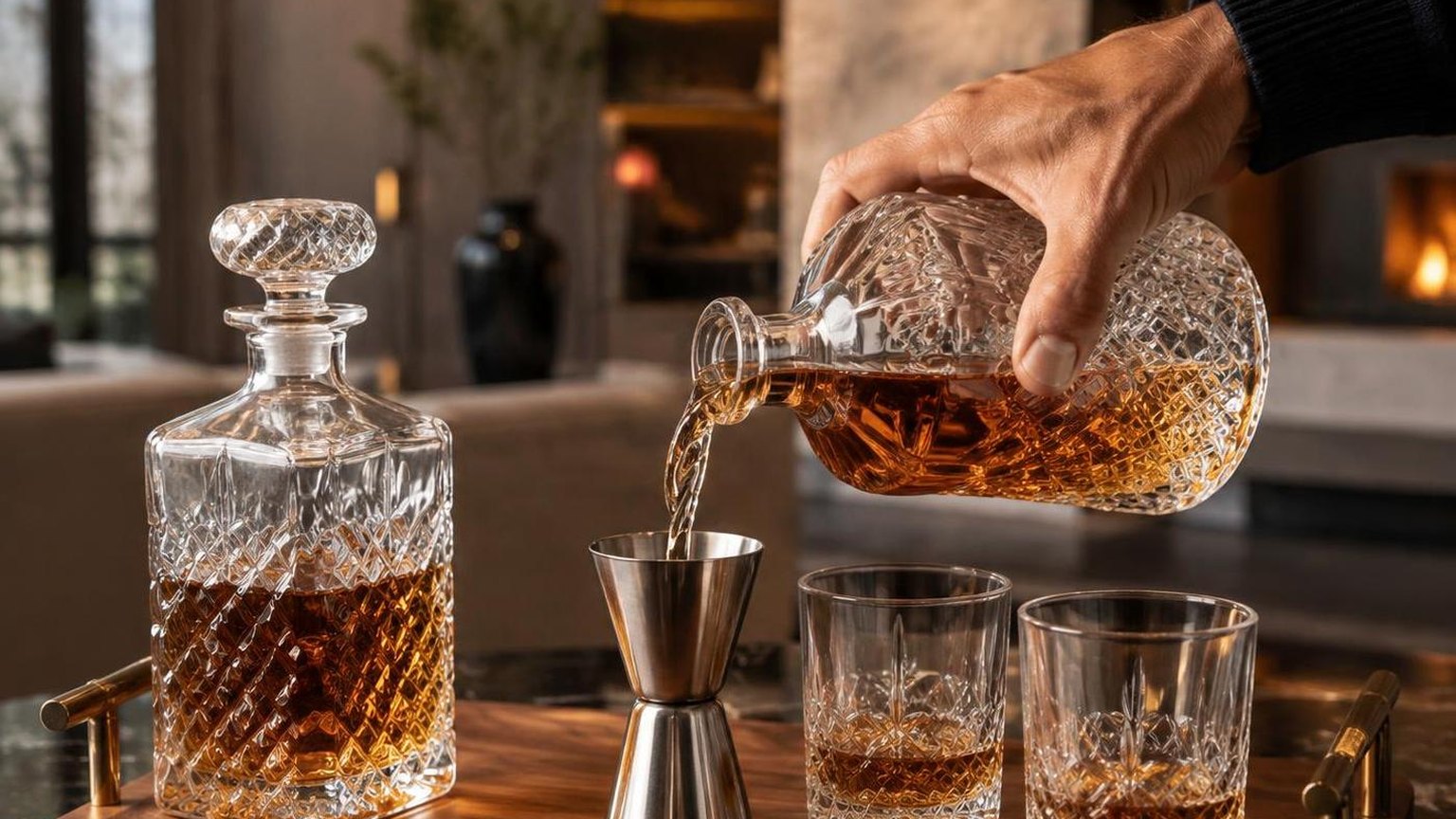
Unlike wine, whiskey is already stable after distillation and barrel aging; transferring it to a decanter does not remove sediment or trigger beneficial aging, though a few minutes of air in the glass can slightly change aroma perception.
Why do people decant whiskey if it does not age in glass?
The main reasons are presentation, easier pouring, and creating a uniform bottle lineup for a bar cart or service station.
In hospitality settings, decanters can also make high-use spirits faster to handle, but they should be labeled clearly to avoid confusing proof, brand, or age statement.
Can a decanter damage whiskey?
Yes, if it has a loose stopper or is made from unsafe materials.
Whiskey stored with too much oxygen exposure can slowly lose volatile aromas, and older lead-crystal decanters can leach lead into high-proof alcohol over time, so lead-free glass is the safer choice.
How long can whiskey stay in a decanter?
In a clean, airtight, lead-free glass decanter kept away from sunlight and heat, whiskey can generally remain in good condition for months.
For best quality, fill the decanter at least halfway and avoid leaving small amounts exposed to a large air space for extended periods.
Should you decant expensive or rare whiskey?
For collectible bottles, it is usually better not to decant because the original bottle, label, tax strip, and fill level help preserve provenance and resale value.
If you plan to drink it, decant only a serving amount or use a clearly labeled lead-free decanter with a tight seal.
Related Reading
- 10 Powerful Reasons Why Do I Smell Like Alcohol After One Drink: A Complete Guide 2026
- How Many Ounces Is 550 Ml?
- Which Gasolina Drink Is The Best? Answer By Expert
- What Alcohol Gets You Drunk Fast And Tastes Good?
- How Many Cups Is 16 Ounces?
- How To Drink Whiskey Without Burn?
- What Does Neat Mean In A Drink?
- All Blog Guides
- FDA — Lead in Food, Foodwares, and Dietary Supplements (2024)
- CDC — About Lead in Consumer Products (2024)
- NIH PubChem — Ethanol (2024)
- Alcohol and Tobacco Tax and Trade Bureau — Beverage Alcohol Manual: Distilled Spirits (2024)
- Scotch Whisky Association — How to Store Scotch Whisky (2024)
- Bourbon Women Association — Bourbon Storage Tips (2023)
- Whisky Advocate — How to Store Whisky (2023)