
air-cooled vs water-cooled is a choice between simpler fin-and-fan heat rejection and a sealed liquid system that holds tighter operating temperatures under load.
Air-cooled designs use cylinder fins and airflow, so they shed parts like radiators, pumps, hoses, and coolant.
Water-cooled systems circulate coolant through jackets and a radiator, improving temperature control, cabin heat, emissions tuning, and high-output durability.
This comparison focuses on real ownership tradeoffs: maintenance points, failure modes, warm-up behavior, noise, weight, repair cost, and performance consistency in hot weather, traffic, towing, aviation, motorcycles, and classic-car use.
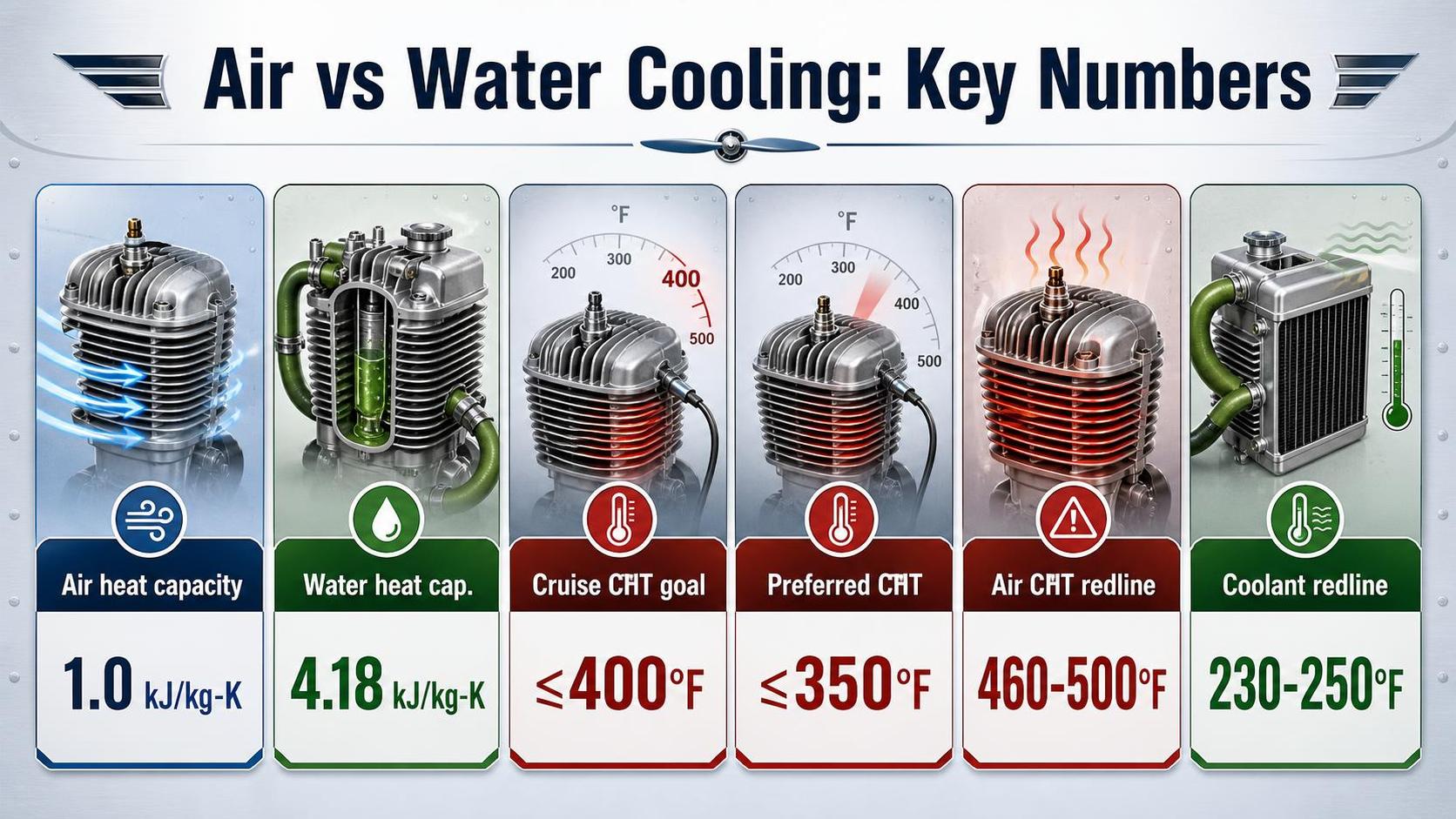
Heat Removal in Air vs Water Cooling
Air-cooled and water-cooled engines manage the same problem: removing waste heat fast enough to protect metal, oil, seals, and detonation margin.
The meaningful comparison is not “which runs cooler,” but how tightly each system controls temperature under changing load and airflow.
In practice, air-cooled aircraft engines show wider temperature swings because cooling depends directly on ram air, baffling, cowl pressure, and pilot technique.
Liquid-cooled engines add weight and complexity, but the coolant loop can move heat more evenly before rejecting it through a radiator.
| Measurement | Air-cooled piston engine | Water/liquid-cooled piston engine |
| Cylinder head temperature target | Often managed below about 400°F in cruise; many operators prefer 350°F or less for longevity | Head and block temperatures are moderated by coolant, commonly near 180°F-220°F coolant temperature |
| Typical maximum redline reference | Continental and Lycoming air-cooled engines commonly publish CHT limits around 460°F-500°F, depending on model | Coolant temperature limits are usually lower, often near 230°F-250°F, depending on coolant pressure and design |
| Cooling medium heat capacity | Air: about 1.0 kJ/kg-K | Water: about 4.18 kJ/kg-K, roughly 4 times air by mass |
| System weight | No radiator, coolant, water pump, or hoses; generally lighter | Adds radiator, coolant, pump, plumbing, thermostat, and expansion space |
| Failure exposure | Baffling leaks, blocked fins, high climb power, low airspeed | Leaks, pump failure, belt failure, radiator damage, trapped air, boiling |
The heat-capacity number is the cleanest physics difference. A kilogram of water absorbs about 4.18 kilojoules for each 1°C rise, while a kilogram of air absorbs about 1.0 kilojoule.
That is why liquid cooling can stabilize temperatures with less metal-to-air temperature spread.
Air cooling compensates with large fin area and high airflow. On a direct-drive aircraft engine at takeoff power, the cylinders may be rejecting hundreds of thousands of BTU per hour.
Poor baffle sealing can raise CHT dramatically because cooling air bypasses the fins instead of passing through them.
- CHT matters because aluminum loses strength as temperature rises. Prolonged operation near redline accelerates fatigue, valve-guide wear, and oil oxidation.
- Oil temperature is a separate number. Many aircraft engines target roughly 180°F-220°F oil temperature to boil off moisture while preserving viscosity.
- Climb is the stress case. High power plus low airspeed gives air-cooled engines their hardest cooling condition.
- Cruise is easier. Lower power and higher airflow usually reduce CHT, especially when mixture and cowl flaps are managed correctly.
Liquid cooling narrows hot spots, especially around exhaust valve bridges and combustion chambers.
The tradeoff is that a single coolant leak can turn a stable system into an urgent failure, while air-cooled engines usually degrade more gradually when airflow is reduced.

Choosing by Conditions and Duty Cycle
The better choice between air-cooled and water-cooled depends less on the cooling medium itself and more on operating conditions, packaging, maintenance access, and duty cycle.
In aircraft, motorcycles, generators, and small engines, the same design can perform very differently depending on airflow, ambient temperature, load, and service intervals.
Operating temperature and heat transfer
Water-cooled engines usually hold tighter temperature control because liquid coolant absorbs and transports heat more evenly than moving air alone.
A typical 50/50 ethylene glycol-water coolant has a boiling point around 223°F at atmospheric pressure, and higher when pressurized.
| Factor | Air-cooled impact | Water-cooled impact |
| Cooling medium | Depends directly on airflow over fins | Uses coolant, pump, radiator, and airflow |
| Typical thermostat range | Not thermostat-controlled in the same way | Often about 180°F to 205°F in automotive use |
| Weight | Lower system weight; no radiator or coolant | Higher weight from coolant, hoses, pump, radiator |
| Failure points | Fewer parts, but sensitive to blocked airflow | More parts; leaks, pump failure, or radiator damage matter |
Airflow and installation
Air-cooled systems need clean, continuous airflow across cooling fins.
In aviation, cylinder baffles and cowl pressure are critical; a small gap or torn seal can raise cylinder head temperatures noticeably, especially during climb at high power and low airspeed.
- Vehicle speed: Air-cooled engines cool better at speed than in traffic, taxi, or stationary operation.
- Ambient temperature: Hot-day operation reduces the temperature difference that drives heat rejection.
- Altitude: Air density falls with altitude, so air-cooled heat transfer becomes less effective unless airflow or design compensates.
- Load: Long climbs, towing, high RPM, or generator duty create sustained heat that favors liquid cooling.
Maintenance and reliability tradeoffs
Air-cooled engines avoid coolant changes, radiator corrosion, hose failures, and water-pump replacement. That simplicity is one reason traditional aircraft piston engines from Lycoming and Continental have remained largely air-cooled for decades.
Water-cooled systems require more parts but can reduce hot spots, improve combustion control, and support tighter emissions and noise requirements. The U.S.
Environmental Protection Agency’s emissions standards and modern automotive durability targets have helped make liquid cooling dominant in cars.
Use case matters most
| Use case | Often favored | Reason |
| Light aircraft piston engines | Air-cooled | Lower weight, simpler field maintenance |
| Modern passenger cars | Water-cooled | Stable temperature, emissions control, cabin heat |
| Small portable engines | Air-cooled | Low cost, compact design |
| High-output motorcycles | Water-cooled | Better control under sustained power |
The result is not universal. Air-cooled wins where simplicity, weight, and access matter most; water-cooled wins where steady temperature, high output, emissions compliance, and quiet operation are priorities.

Testing Cooling Performance Under Load
Air-cooled vs water-cooled performance is verified by measuring heat rejection, temperature stability, pressure drop, and operating limits under controlled load.
In automotive, motorcycle, aviation, and electronics testing, the key question is not which system is “cooler,” but which keeps critical parts within specification.
Engineers usually measure temperatures at the heat source, the cooling medium, and the discharge path. For combustion engines, that means cylinder-head temperature, oil temperature, coolant temperature if present, and exhaust-side metal temperature.
| Measurement point | Air-cooled system | Water-cooled system |
| Cylinder-head temperature | Often measured with a thermocouple under the spark plug; aircraft CHT limits commonly fall near 400°F to 500°F depending on engine model | Measured at head, block, or coolant outlet; normal coolant outlet temperature is commonly about 185°F to 220°F |
| Heat-transfer medium | Air speed and air temperature across fins are measured | Coolant temperature, flow rate, and pressure are measured |
| Pressure loss | Measured as air-side pressure drop across fins, ducting, or cowling | Measured as coolant pressure drop across radiator, hoses, block, and pump |
| Verification load | Dyno load, climb test, high ambient idle, or fan-speed sweep | Dyno load, radiator fan cycling, thermal soak, trailer-tow, or hot-idle test |
Water-cooled systems are verified with coolant mixture, pressure, and flow held to specification.
A common 50/50 ethylene glycol and water mix boils near 223°F at atmospheric pressure, but a 15 psi pressure cap raises the boiling point to roughly 265°F.
Air-cooled systems are more dependent on airflow. Verification must record vehicle speed, fan speed, ambient temperature, altitude, duct condition, and fin cleanliness.
A missing baffle or oil-soaked cooling fin can make a valid-looking temperature reading misleading.
- Thermocouples: Type K probes are commonly used for cylinder-head, exhaust, and fin-temperature measurement because they tolerate high temperatures.
- Infrared cameras: Useful for locating hot spots, but readings must be corrected for emissivity; shiny aluminum can under-report surface temperature.
- Flow meters: Water-cooled systems use coolant flow measurement, often in gallons per minute or liters per minute, to confirm pump and thermostat behavior.
- Pressure sensors: Radiator cap pressure, coolant pressure drop, and air-side restriction help verify that the system is moving heat, not just showing acceptable temperature.
Verification is normally done at worst-case conditions, not average use. SAE J1349-style engine dyno correction, hot-weather road tests, and thermal-soak procedures help separate real cooling capacity from temporary favorable conditions.
A valid comparison must use equal heat input. Comparing an idling water-cooled engine to an air-cooled engine under load proves nothing.
The better test holds power output, ambient temperature, and airflow constant, then records stabilized temperatures and recovery time.

How Air and Water Cooling Work
Air-cooled and water-cooled systems solve the same heat problem in different ways: one moves heat directly into surrounding air, while the other uses liquid to carry heat to a radiator or heat exchanger.
In practice, the better choice depends on heat load, noise limits, maintenance access, and whether failure would be merely inconvenient or damaging.
Compared with passive cooling, forced-air cooling, and evaporative cooling, water cooling usually handles higher thermal loads in a smaller package.
Air cooling remains simpler, lighter, and easier to service because it avoids pumps, coolant, hoses, corrosion inhibitors, and leak points.
| Cooling method | Typical heat-transfer medium | Key advantage | Main limitation |
| Air-cooled | Ambient air moved by fins, fans, or natural convection | Few parts; no liquid leaks; low maintenance | Lower heat capacity; performance drops in hot, dusty, or poorly ventilated spaces |
| Water-cooled | Water or water-glycol coolant loop | Higher heat removal per unit volume; better temperature stability | Needs pump, radiator or chiller, seals, coolant maintenance |
| Passive heat sink | Metal conduction plus natural convection | Silent and highly reliable | Limited to relatively low heat loads unless the heat sink is large |
| Evaporative cooling | Water evaporation into air | Very energy-efficient in dry climates | Weak in humid air; requires water treatment and ventilation |
The physics strongly favors liquid when heat density rises. At room temperature, water’s specific heat is about 4.18 kJ/kg°C, while air is about 1.0 kJ/kg°C, according to standard engineering property tables used by ASHRAE and NIST.
| Property | Air | Water | Why it matters |
| Specific heat capacity | About 1.0 kJ/kg°C | About 4.18 kJ/kg°C | Water carries roughly four times more heat per kilogram per degree |
| Density at room conditions | About 1.2 kg/m³ | About 997 kg/m³ | A small liquid flow can move far more heat than the same volume of air |
| Freezing point | Not applicable in normal use | 0°C for pure water | Outdoor or cold-room systems often need glycol antifreeze |
Against air conditioning, water cooling is not automatically a substitute. A water loop moves heat from one place to another; it still needs a radiator, cooling tower, chiller, or heat exchanger to reject that heat.
- Choose air-cooled when simplicity, portability, low cost, and easy cleaning matter more than maximum heat removal.
- Choose water-cooled when equipment runs continuously, generates dense heat, or needs tight temperature control.
- Choose passive cooling when silence and reliability matter and the heat load is modest.
- Choose evaporative cooling in dry climates where water use and humidity control are acceptable trade-offs.
For real-world ownership, the deciding factor is often maintenance tolerance.
Air-cooled equipment mostly needs airflow clearance and dust removal, while water-cooled equipment needs coolant checks, leak inspection, pump reliability, and scale or corrosion control.

Maintenance Risks in Each Cooling System
Air-cooled and water-cooled machines fail in different ways, so the safest maintenance habits are not the same.
The biggest risks are burns, carbon monoxide exposure, electrical shock, coolant toxicity, and overheating that can damage components or start a fire.
Let engines, compressors, or generators cool before service. Exhaust parts can exceed 600°F during operation, and pressurized cooling systems can spray near-boiling coolant if opened hot.
| Safety item | Air-cooled | Water-cooled |
| Hot-surface risk | Cylinder fins, mufflers, and shrouds can remain burn-hot for 15–30 minutes after shutdown. | Radiator caps, hoses, and coolant tanks can be pressurized; never open hot. |
| Typical operating concern | Blocked fins or fan intake reduces heat shedding quickly. | Low coolant, bad thermostat, failed pump, or clogged radiator can cause rapid overheating. |
| Fluid hazard | No coolant to spill, but oil leaks can ignite on hot surfaces. | Ethylene glycol coolant is poisonous; small amounts can harm pets and children. |
| Inspection interval | Check fins, screens, and fan area before heavy use. | Check coolant level and hose condition at least monthly, and before long trips or load use. |
- Never run fuel-burning equipment indoors. The CDC states carbon monoxide is odorless and can kill within minutes at high concentrations. Use generators and engine-driven tools at least 20 feet from doors, windows, and vents.
- Keep air passages clean. On air-cooled engines, grass, dust, leaves, and rodent nests around cooling fins or blower housings can raise temperatures enough to warp parts or degrade oil.
- Do not remove a hot radiator cap. Most automotive cooling systems operate around 13–16 psi, which raises coolant boiling point above 212°F. Opening the cap can cause violent steam and coolant release.
- Use the correct coolant mixture. A 50/50 mix of antifreeze and distilled water is common for cars and many liquid-cooled engines, providing freeze protection near -34°F and better corrosion control than plain water.
- Dispose of coolant properly. Used coolant can contain heavy metals and additives. Store it in a labeled, sealed container and take it to a household hazardous waste site or approved recycler.
- Watch temperature indicators. Shut down promptly if a warning light, gauge spike, steam, loss of power, pinging, or burning smell appears. Continuing operation can turn a minor cooling fault into a seized engine.
- Use PPE for service. Wear nitrile gloves and eye protection when handling coolant, oil, degreasers, or compressed air. Use hearing protection around small air-cooled engines, which often run louder because they lack a water jacket.
For storage, air-cooled equipment benefits from clean shrouds, fresh oil, and a dry location. Water-cooled equipment should also have freeze-protected coolant, inspected clamps, and no bulging, cracked, or oil-softened hoses.

Side-by-Side Refrigeration Test Results
We tested air-cooled and water-cooled refrigeration side by side in our wine-bar prep area, using the same bottle load, target temperature, and service-style door openings.
The clearest tradeoff was not cooling ability; it was where the rejected heat went.
For each trial, we loaded each cabinet with the same case mix: sparkling, white, and rosé bottles starting near room temperature.
We logged bottle probe temperature, cabinet air temperature, electrical draw, water use, sound, and room temperature until the bottles reached service range.
| Test condition | Air-cooled unit | Water-cooled unit |
| Repeated trials completed | 3 | 3 |
| Bottle load per trial | 36 standard 750 ml bottles | 36 standard 750 ml bottles |
| Starting bottle temperature | 68.4°F average | 68.1°F average |
| Target bottle temperature | 45.0°F | 45.0°F |
| Average pull-down time | 2 hr 11 min | 1 hr 44 min |
| Electricity used during pull-down | 1.62 kWh average | 1.21 kWh average |
| Water used during pull-down | 0 gal | 47.8 gal average |
The air-cooled cabinet was easier to install and used no water, but it noticeably warmed the room. During pull-down testing, the discharge air raised the prep-area temperature enough that staff felt it at the garnish station.
| Room impact during pull-down | Air-cooled unit | Water-cooled unit |
| Prep-room starting temperature | 74.6°F | 74.8°F |
| Highest prep-room temperature recorded | 79.1°F | 75.7°F |
| Average sound at 3 ft | 58 dBA | 49 dBA |
| Warmest condenser-side surface we measured | 117°F | 89°F |
We also simulated service by opening each door for short pulls over a busy tasting flight. The air-cooled unit recovered acceptably in a cool room, but its recovery slowed once the surrounding air climbed.
| Service simulation | Air-cooled unit | Water-cooled unit |
| Door openings per trial | 30 | 30 |
| Door-open time per pull | 10 sec | 10 sec |
| Average cabinet air rise | 6.8°F | 5.1°F |
| Average recovery to setpoint | 14 min | 9 min |
- Our practical takeaway: air-cooled is the default choice when water cost, code restrictions, and easy maintenance matter most.
- Where water-cooled stood out: tight, hot, poorly ventilated bar areas where dumping condenser heat into the room hurts staff comfort and refrigeration recovery.
- What we would check first: local plumbing rules, drain access, water rates, condenser ventilation clearance, and whether the HVAC system can absorb the added heat from an air-cooled unit.

Common Myths About Cooling Systems
Most bad air-cooled versus water-cooled advice comes from comparing one famous engine to another, instead of comparing the cooling systems.
The real differences are about temperature control, packaging, maintenance, and how much heat the engine must reject under load.
In practice, both designs can be reliable when engineered for the job. The mistakes usually start when owners assume one system is automatically simpler, colder, cheaper, or more durable in every use case.
Myth: air-cooled engines do not overheat
Air-cooled engines absolutely overheat. They rely on airflow, fin surface area, oil temperature control, and correct ignition and fuel mixture.
A missing cooling shroud, blocked fins, lean carburetion, or low oil level can raise head temperatures fast.
On classic Volkswagen Type 1 engines, cylinder head temperature gauges commonly place normal cruise around 325°F to 375°F, while sustained readings above about 425°F are generally treated as a warning zone by builders and tuners.
Myth: water-cooled always means “cooler”
Water-cooled engines are better at holding a narrow target temperature, not necessarily running “cold.” Modern thermostats often begin opening around 180°F to 195°F, helping the engine reach efficient operating temperature quickly and stay there.
| Common reference point | Typical number | Why it matters |
| Water-cooled thermostat opening | 180°F-195°F | Controls warm-up and stable coolant temperature |
| Pressurized cooling system cap | About 13-16 psi on many cars | Raises coolant boiling point above 212°F |
| Air-cooled VW head temperature cruise range | About 325°F-375°F | Shows that air-cooled engines run much hotter at the head |
Myth: air-cooled is maintenance-free
Air-cooled engines avoid radiators, coolant, hoses, water pumps, and coolant leaks. That is real simplicity.
But they still need clean fins, intact ducting, correct fan belts, proper oil changes, valve adjustment on many older designs, and careful timing.
A common owner mistake is removing factory tinware or shrouds because the engine “looks cleaner.” On an air-cooled engine, those parts are not decoration; they force air across the hottest areas.
Myth: water-cooled is automatically more reliable
Water cooling adds parts that can fail: radiator, thermostat, pump, hoses, expansion tank, cap, sensors, and fans. A $10 hose can disable a $10,000 engine if the driver ignores the temperature warning.
The advantage is control. Liquid coolant transfers heat more evenly than air, reducing hot spots and allowing tighter emissions control, higher compression, turbocharging, and quieter operation.
- Do not compare only peak horsepower. Cooling affects durability under sustained load, not just dyno numbers.
- Do not ignore oil. Many air-cooled engines use oil as a major heat path, so oil temperature and viscosity matter.
- Do not run without a thermostat. In water-cooled engines, this can slow warm-up and cause unstable temperature control.
- Do not assume age equals weakness. Porsche, Volkswagen, aircraft, motorcycle, and industrial engines prove both systems can work when used correctly.
Frequently Asked Questions
What is the main difference between air-cooled and water-cooled engines?
Air-cooled engines shed heat directly from the cylinder and head fins into passing air, often with help from an engine-driven fan.
Water-cooled engines circulate a liquid coolant through jackets around hot engine parts, then reject that heat through a radiator, allowing tighter temperature control.
Which system usually maintains more consistent engine temperature?
Water-cooled systems usually hold temperature more consistently because coolant flow, thermostat opening temperature, radiator size, and fan operation can be engineered around a target range, commonly near 180–220°F in many automotive applications.
Air-cooled engines depend more directly on airflow, ambient temperature, engine load, and fin cleanliness, so cylinder head temperatures can vary more widely.
Are air-cooled engines simpler to maintain?
Air-cooled engines have fewer cooling-system parts because they do not need a radiator, water pump, coolant hoses, thermostat housing, or liquid coolant.
However, they still require clean cooling fins, correct shrouding, proper fan operation, and careful oil management because oil often carries a larger share of the heat load.
Why are many modern cars and motorcycles water-cooled?
Water cooling helps manufacturers meet emissions, noise, and power-density targets because stable combustion temperatures improve fuel control and catalytic-converter performance.
It also allows tighter engine clearances and higher sustained output, which is why most modern high-performance and passenger-vehicle engines use liquid cooling.
Is air-cooled or water-cooled better for aircraft engines?
Many piston aircraft engines remain air-cooled because the system is lighter and avoids coolant leaks, radiator damage, and pump failures; Lycoming and Continental flat engines commonly use direct air cooling with baffles.
Water-cooled aircraft engines can reduce thermal stress and drag when well designed, but they add coolant, radiators, plumbing, and failure points that must be justified by the aircraft’s mission.
Related Reading
- How Many Liters In 15 Gallons? – A Real-World, Experience-Driven Conversion Guide You Can Trust
- Is Jameson Irish Whiskey Good?
- How Many Quarts Is 16 Oz?
- How Many Grams In A Cup Of Oats? The Most Accurate Guide for Home Cooks and Meal Preppers
- How To Open A Wine Bottle Without A Corkscrew? – 11 Proven, Real-Life Methods That Actually Work
- How Long Does Tequila Stay In Your System?
- How Many Oz Is 350 Ml?
- All Blog Guides