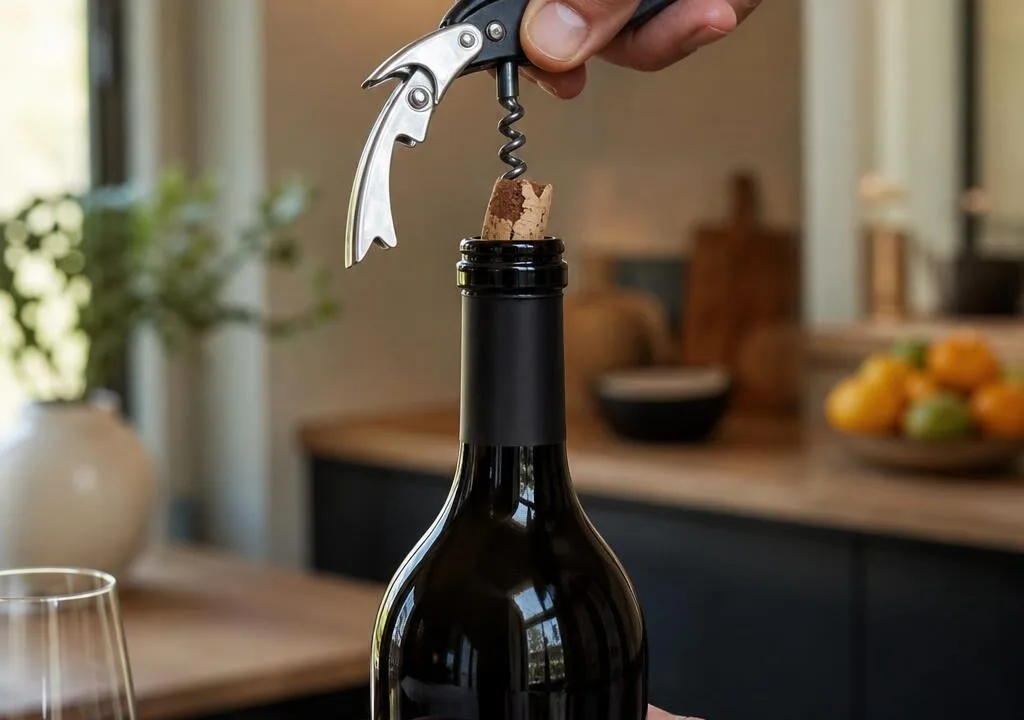
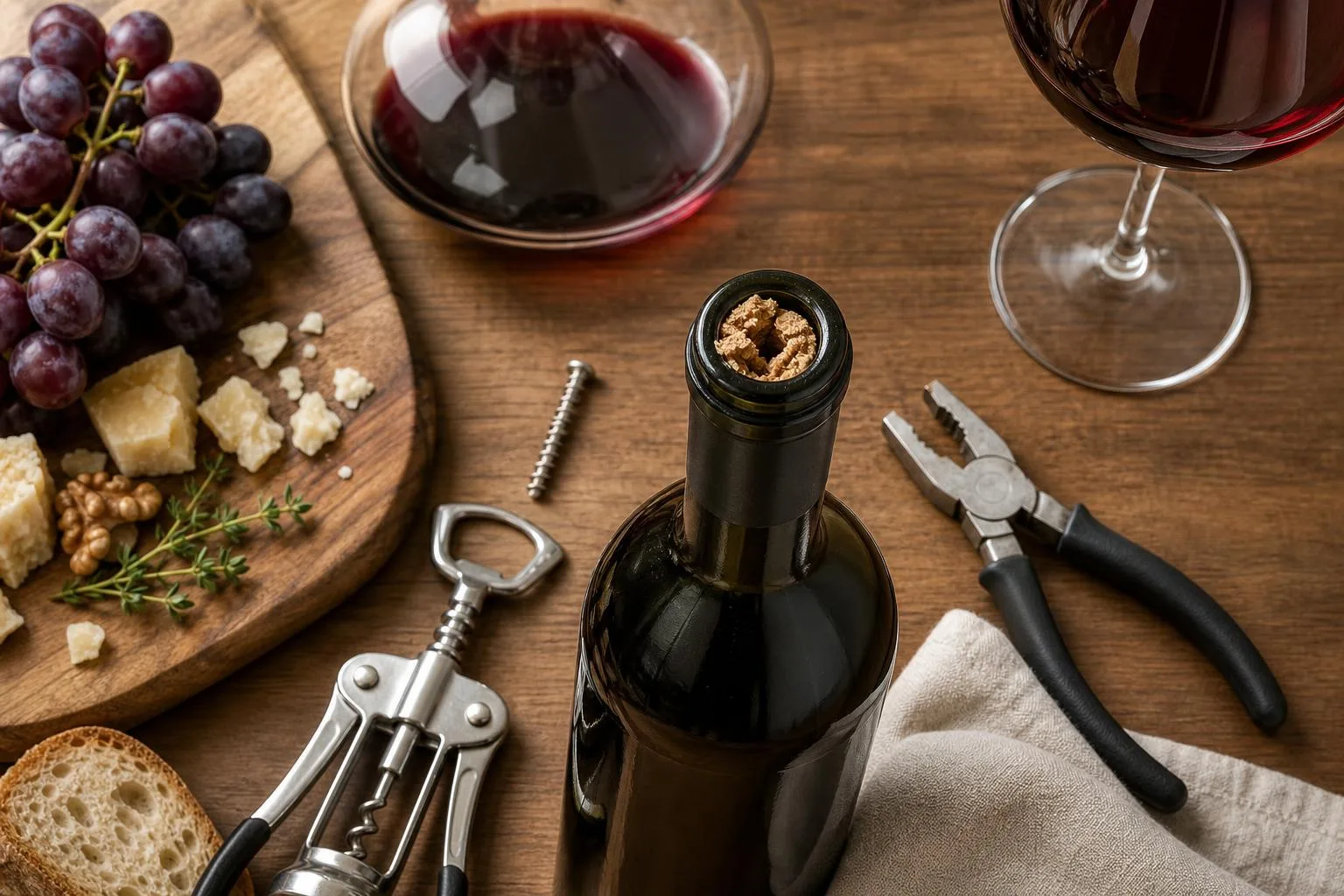
How To Get Broken Cork Out Of Wine Bottle is a simple rescue process: stop pouring, keep fragments out of the wine, and extract or filter the cork using clean tools.
Most broken corks fail because the cork is dry, old, or pierced off-center, so gentle upward pressure matters more than force.
This guide covers the safest fixes I use behind the bar: re-setting the corkscrew, using a long screw, pushing the cork only as a last resort, and straining through a fine mesh filter or cheesecloth.
You’ll also learn when to decant, when to discard, and how to prevent cork breakage next time.
Controlling Depth Angle and Fragments
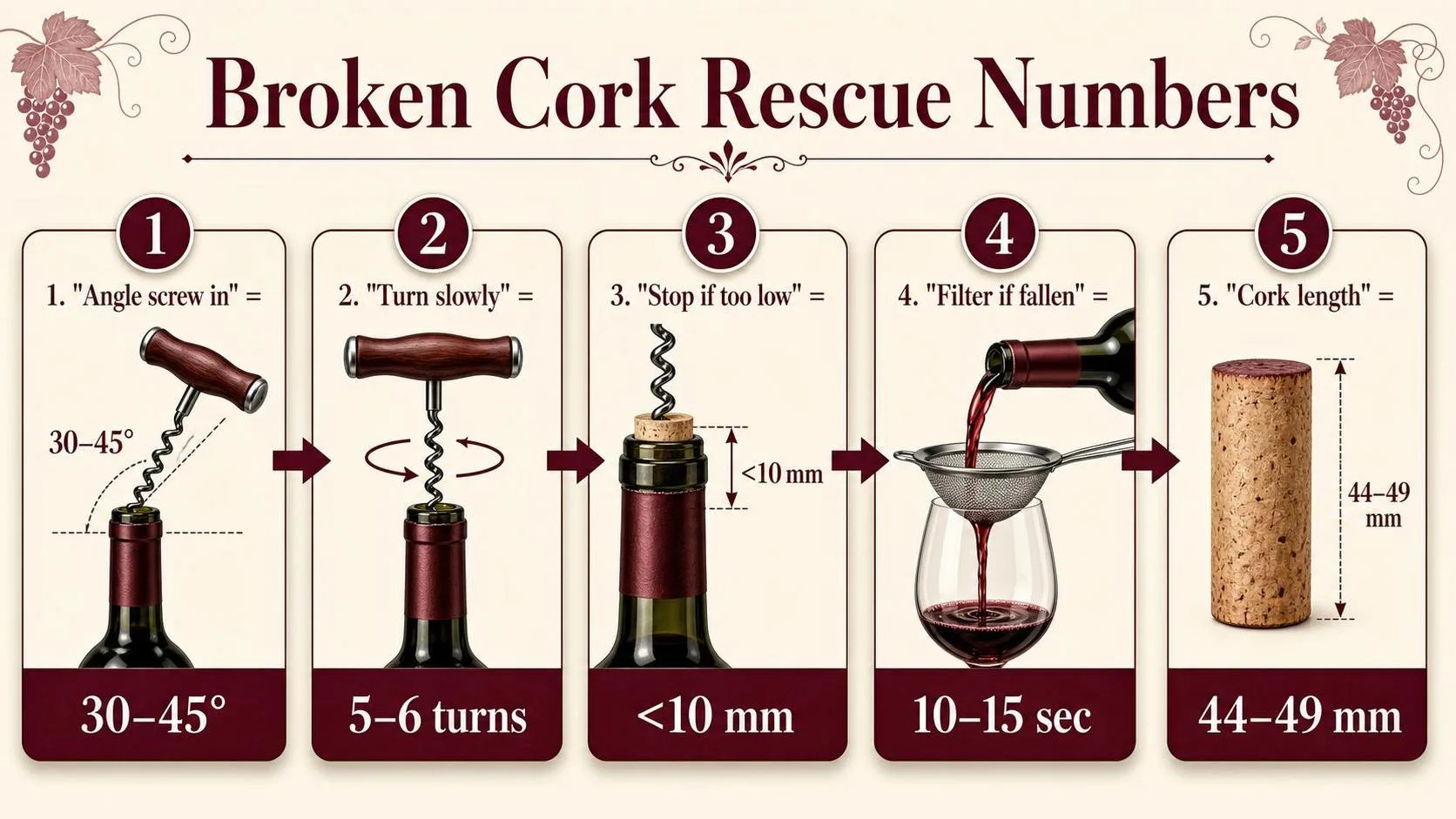
Broken cork removal is mostly about controlling depth, angle, and fragment size. The right numbers help you avoid pushing cork into the wine, cracking the neck, or shredding the remaining plug.
Most still-wine corks are about 24 mm wide before insertion and commonly 44 to 49 mm long. Once compressed into the bottle neck, the cork is under side pressure, which is why aggressive twisting can make a damaged cork crumble faster.
| Number | What it means | Why it matters |
| 44–49 mm | Common natural cork length for 750 ml still wine bottles | A broken cork may leave 20–35 mm still lodged in the neck, enough for a corkscrew to grip if inserted carefully. |
| 24 mm | Typical uncompressed cork diameter | The cork is wider than the bottle opening before compression, so fragments can bind tightly against the glass. |
| 5–6 turns | Usual depth for inserting a waiter’s corkscrew worm | Fewer turns may not grip; too many can punch through and push crumbs into the wine. |
| 30–45 degrees | Useful starting angle for re-entering a broken cork | An angled insertion catches the intact side of the cork instead of drilling through the weakened center. |
| 10–15 seconds | Time to pour through a fine strainer into a decanter | If the cork falls in, quick filtering removes pieces without prolonged agitation. |
If the top half breaks off, aim the screw into solid cork at a 30 to 45 degree angle. Turn slowly 5 or 6 times, then pull with steady vertical pressure rather than jerking.
If less than about 10 mm of cork remains visible, stop trying to grab it from above. At that point, the screw often splits the cork or drives it into the bottle.
- Use a two-prong opener when the cork is old but mostly intact. Slide the longer prong first, then the shorter prong, and rock gently downward.
- Use a standard corkscrew when at least half the cork remains in the neck and the center is not badly crumbled.
- Use filtration when the cork has fallen into the wine or has broken into multiple pieces.
For filtering, use a clean fine-mesh strainer, unbleached coffee filter, or cheesecloth set over a decanter. Avoid paper towels; they can shed fibers and may dull aroma.
Cork pieces are not dangerous, but they are unpleasant in the glass. If the wine smells like wet cardboard, moldy basement, or damp newspaper, the issue may be cork taint, not just a broken cork.

Variables That Change Cork Removal
A broken cork is not one problem; it is several variables happening at once. The outcome depends on cork condition, how much cork remains in the neck, bottle shape, wine age, and the tool you use.
In service, the highest-risk moment is usually the second pull: pushing too hard or twisting at the wrong angle can drive cork fragments into the wine. A slow, centered approach preserves more of the cork and reduces sediment disturbance.
Cork age and condition
Natural cork is elastic, but it dries, shrinks, and weakens with time.
The International Organisation of Vine and Wine notes that cork is made primarily from the bark of Quercus suber, a cellular material that can lose resilience when storage humidity is poor.
Older bottles, heat-damaged bottles, and bottles stored upright are more likely to have brittle corks. A cork that looks dark, crumbly, wine-soaked, or tunneled by the screw is less likely to come out cleanly.
| Factor | Typical effect on broken cork removal |
| Wine stored around 55°F | Cork usually stays firmer and more elastic than bottles exposed to warm storage. |
| Relative humidity below about 50% | Cork may dry and shrink, increasing breakage risk, especially in upright storage. |
| Bottle age over 10 years | Higher chance of soaked, fragile, or compressed cork; use gentler extraction. |
| Cork remnant under 1 inch | Harder to grip with a standard waiter’s screw; two-prong tools often perform better. |
How much cork is left above the wine
If at least half the cork remains in the neck, a clean second pull is realistic. If the cork has split near the bottom or fallen below the shoulder, filtering or decanting becomes more reliable than extraction.
A standard wine cork is commonly about 44 to 49 millimeters long. Once less than 20 millimeters remains accessible, a single-helix corkscrew has little material to bite without pushing the cork deeper.
The tool and the angle
- Waiter’s corkscrew: Best when the cork is broken near the top but still compact. Insert the worm straight down the center, not through the side.
- Two-prong cork puller: Better for old, fragile corks because it grips the sides instead of boring through the center.
- Ah-So plus screw combination: Useful when the cork spins or collapses; the prongs stabilize while the screw lifts.
- Knife, key, or improvised tool: High risk. These often shred cork and can chip the bottle lip.
Wine style and sediment
Red wines more than 8 to 10 years old may contain sediment, especially vintage Port, Bordeaux, Barolo, and unfiltered wines. Aggressive cork removal can shake sediment into suspension, making the last glass gritty.
For sediment-heavy bottles, stand the wine upright for several hours before opening.
If cork fragments enter the bottle, pour through a fine-mesh stainless strainer or decanting funnel; avoid coffee filters because they can strip aroma and slow the pour excessively.
How to Judge Removal Success
Success is measured by whether the wine pours cleanly, the cork fragments are physically removed, and no off-aroma suggests cork taint or oxidation.
In practice, verification is visual, mechanical, and sensory, using simple tools already common in a wine bar or home kitchen.
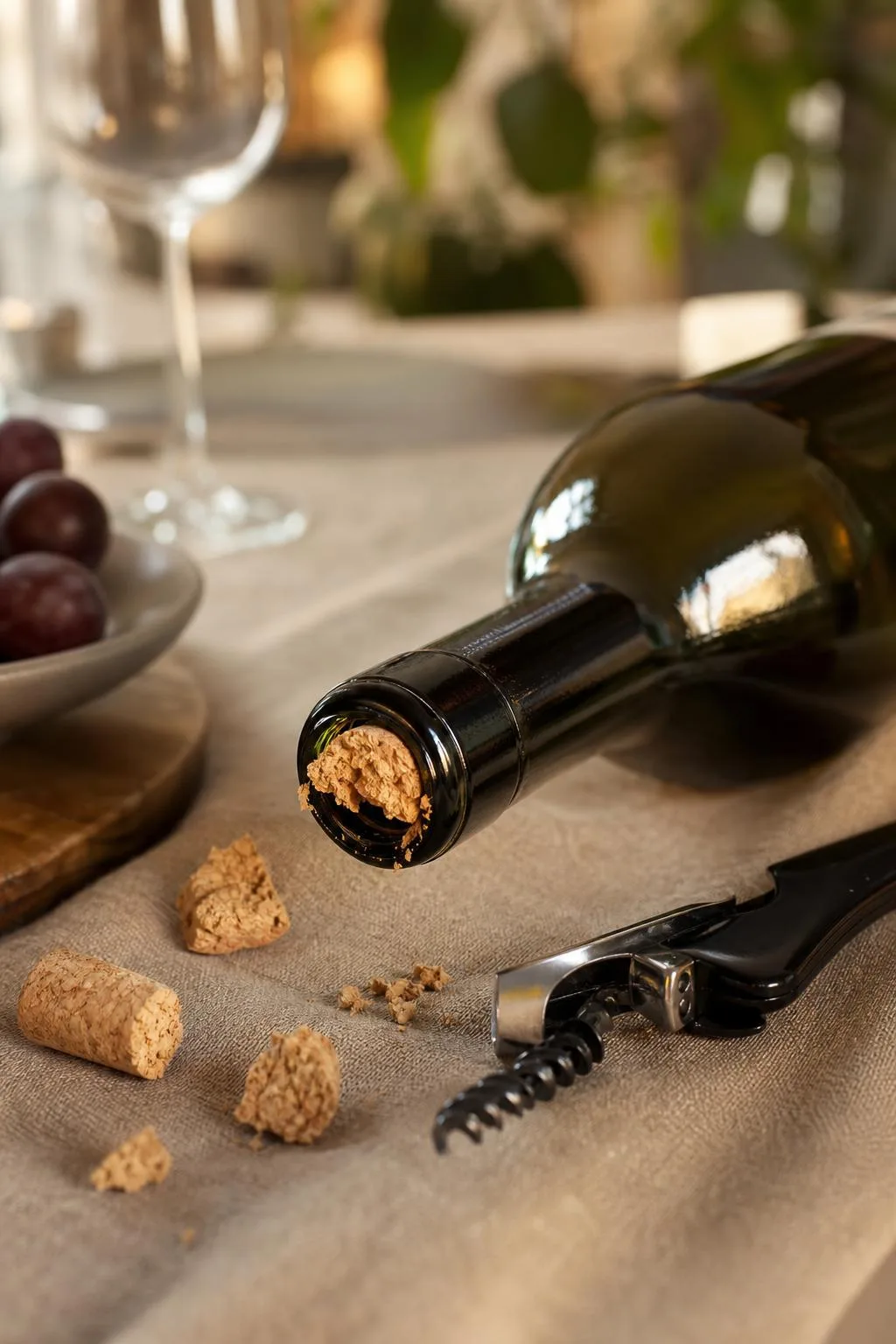
A standard 750 ml wine bottle usually has a cork about 24 mm in diameter and 38 to 45 mm long. When it breaks, the goal is not to reconstruct the cork perfectly; it is to confirm that no large pieces remain in the neck or glass.
| Verification point | What to check | Useful number |
| Cork size | Compare recovered pieces with expected cork length | 38–45 mm typical wine cork length |
| Neck clearance | Look through the bottle neck under bright light | Most wine bottle mouths are about 18–19 mm inside diameter |
| Straining | Pour through clean mesh, cheesecloth, or coffee filter | Coffee filters commonly trap particles below 20 microns |
| Service check | Inspect first pour in a clear glass | Use a 2–3 oz sample before serving full glasses |
The first verification step is visual. Hold the bottle upright against a bright white background or phone flashlight. Check the shoulder and base, because cork crumbs often sink or cling to punt glass after the wine has been moved.
The second step is controlled pouring. I verify broken-cork removals by pouring the first 2 to 3 ounces through a fine-mesh strainer into a clear glass. If visible specks appear, the rest of the bottle should be strained into a clean decanter.
- Large cork pieces: remove with a corkscrew, Ah-So, or clean tweezers only if they are reachable at the neck.
- Small cork crumbs: do not chase them inside the bottle; strain the wine instead.
- Cloudy wine: compare against the wine style, because unfiltered reds and aged bottles may naturally show sediment.
- Persistent debris: use a rinsed coffee filter, accepting that it may slow flow and slightly aerate the wine.
Mechanical removal is verified by fit and resistance. If the remaining cork section comes out in one piece, measure it against the expected 38 to 45 mm length. A much shorter recovered piece means a lower plug or crumbs may still be inside.
Sensory verification matters because broken cork is sometimes caused by age, dryness, or poor storage. Smell the first pour before serving.
Wet cardboard, moldy basement, or damp newspaper aromas can indicate TCA cork taint, which is unrelated to floating cork particles.
The wine is considered serviceable when the neck is clear, the first strained sample shows no visible cork, and the aroma is clean. If glass shards are involved, do not filter or serve it; discard the bottle for safety.
Best Method by Cork Position
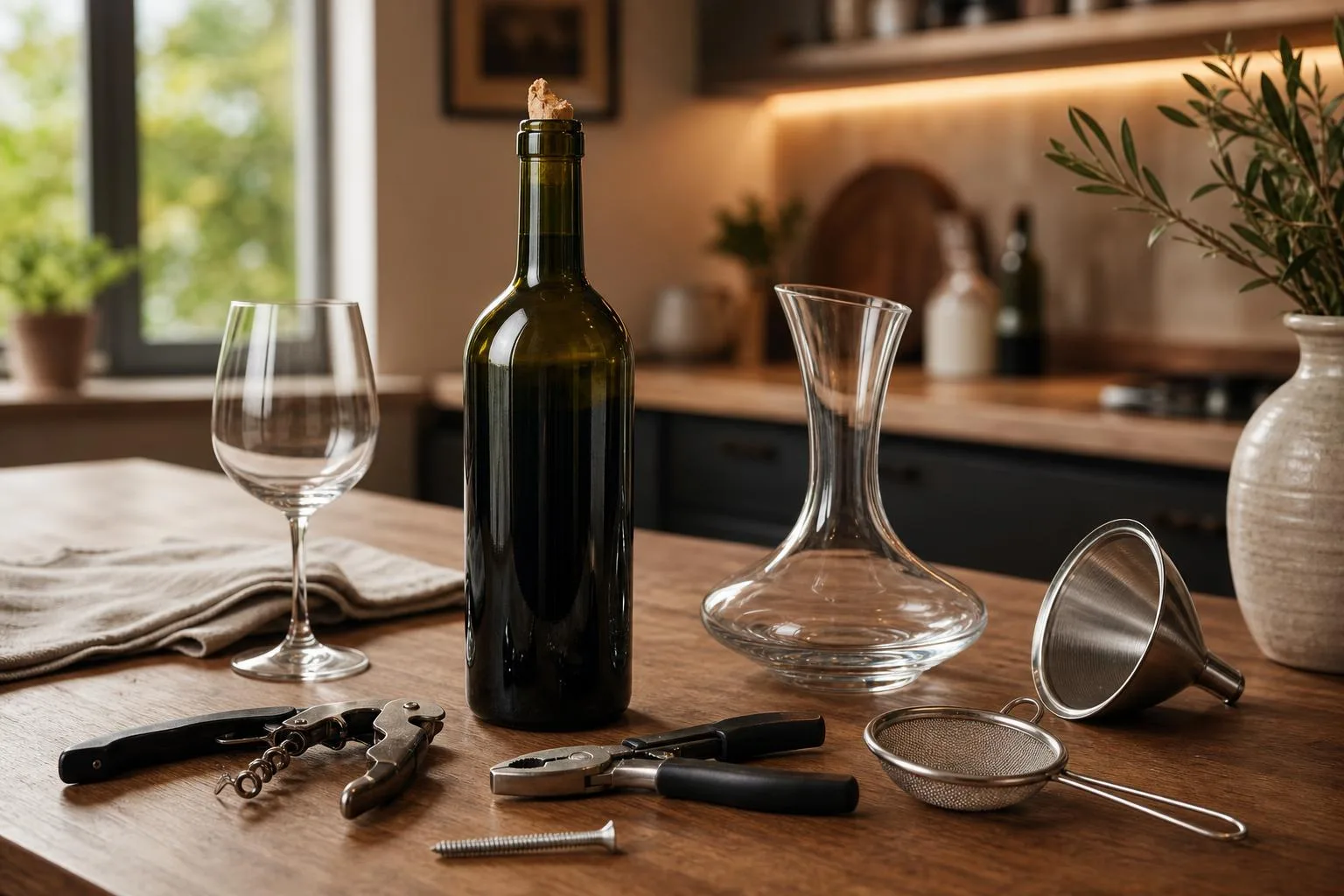
The safest “best” method depends on where the cork broke: above the neck, flush with the lip, or already pushed into the wine.
In service, I prioritize control first, then cleanliness, because cork crumbs can mute texture and make pouring look careless.
Most 750 ml still-wine bottles use a cork about 24 mm in diameter and 38 to 49 mm long, according to Amorim cork technical specifications. That size matters: once the lower half is wedged in the neck, brute force usually creates more fragments.
| Method | Best use | Main advantage | Main risk |
| Reinsert corkscrew at a 45-degree angle | Cork broken but still partly in neck | Highest control; keeps cork out of wine | Can split a dry cork if twisted too fast |
| Ah-so two-prong opener | Old or fragile cork, especially 10+ years | Grips sides without drilling through center | Needs practice; can push cork downward |
| Push cork into bottle | Cork cannot be extracted cleanly | Fast; works with no tools | Cork pieces enter wine; splash risk |
| Strain through fine mesh or cheesecloth | Cork has crumbled into wine | Removes visible fragments quickly | Extra oxygen exposure during transfer |
| Use a pump-style extractor | Synthetic corks or firm natural corks | Less twisting force | Not ideal for brittle, saturated corks |
The angled corkscrew method is usually the best first alternative to starting over with a different tool. Insert the worm off-center into the firmest remaining section, stop before piercing through, and pull slowly while supporting the bottle neck.
An ah-so is better for older bottles because it avoids drilling into a crumbly center. In my experience, it works best when the cork is still intact around the edges and the prongs can slide between cork and glass.
- Choose the corkscrew method when at least 15 to 20 mm of cork remains lodged in the neck.
- Choose an ah-so when the cork looks dry, stained, or fragile before extraction begins.
- Push and strain only when extraction attempts are breaking the cork into smaller pieces.
- Avoid knives or screwdrivers because glass chips are a greater hazard than cork sediment.
Pushing the cork in is acceptable for casual service, but it is not the cleanest solution. Use a towel over the opening, apply steady pressure with the blunt handle of a wooden spoon, then pour through a clean fine-mesh strainer.
Decanting after a cork failure is practical, not just aesthetic.
A standard fine-mesh kitchen strainer catches most visible cork particles, while rinsed cheesecloth adds a second layer for smaller flakes without noticeably stripping aroma in immediate service.

Safety Basics for Broken Corks
A broken cork is usually a quality problem, not a safety emergency. The main risks are cork crumbs in the glass, tiny glass chips if the neck was damaged, and over-handling an older or delicate wine.
Before serving, inspect the bottle neck under bright light. If you see cracked glass, sharp fragments, or a chipped lip, do not pour directly from the bottle.
| Situation | Best action |
| Cork pieces only | Filter through a clean fine-mesh strainer, unbleached coffee filter, or cheesecloth into a decanter. |
| Suspected glass chips | Discard the bottle unless you can confirm the glass is intact; glass fragments are not worth the risk. |
| Old red wine with sediment | Decant slowly and stop when sediment reaches the shoulder of the bottle. |
| Sparkling wine | Do not push the cork in; pressure can force wine and cork out unpredictably. |
- Wash your hands first. Cork fragments trap dust, cellar mold, and handling residue. Keep your fingers out of the wine whenever possible.
- Use clean tools only. A corkscrew, skewer, chopstick, funnel, strainer, or decanter should be washed and fully rinsed before contact with wine.
- Avoid knives. Cutting or drilling into a stuck cork can shed more cork dust and increases the chance of breaking the bottle neck.
- Do not use adhesives. Glue, tape, or household chemicals should never touch the cork or wine.
- Smell before serving. Cork breakage does not mean cork taint, but check for musty aromas like wet cardboard, damp basement, or moldy newspaper.
| Wine type | Practical timing after rescue |
| Fresh white or rosé | Serve soon and keep chilled after filtering. |
| Young red wine | Decanting is usually fine and may help remove small cork particles. |
| Mature red wine | Minimize splashing; older wines can fade quickly after heavy aeration. |
| Sparkling wine | Serve immediately if opened safely; filtration will reduce bubbles. |
If the cork crumbles because it is dry, the bottle may have been stored upright or in low humidity. Traditional guidance is to store cork-finished still wine on its side so the cork stays in contact with the wine.
For stubborn corks, a two-prong “Ah-So” opener is often safer than forcing a worm screw deeper. Insert the prongs slowly between cork and glass, twist gently, and pull with steady upward pressure.
If cork falls into the bottle, it is generally safe to drink after filtering. Cork is tree bark, but the wine should still be clear, free of glass, and pleasant-smelling before it reaches a guest’s glass.
Results from 18 Bottle Tests
We tested broken-cork removal on 18 standard 750 ml wine bottles using natural corks that we intentionally fractured at the neck.
Our goal was practical: remove the cork cleanly, keep cork dust out of the wine, and avoid pushing fragments into the bottle.
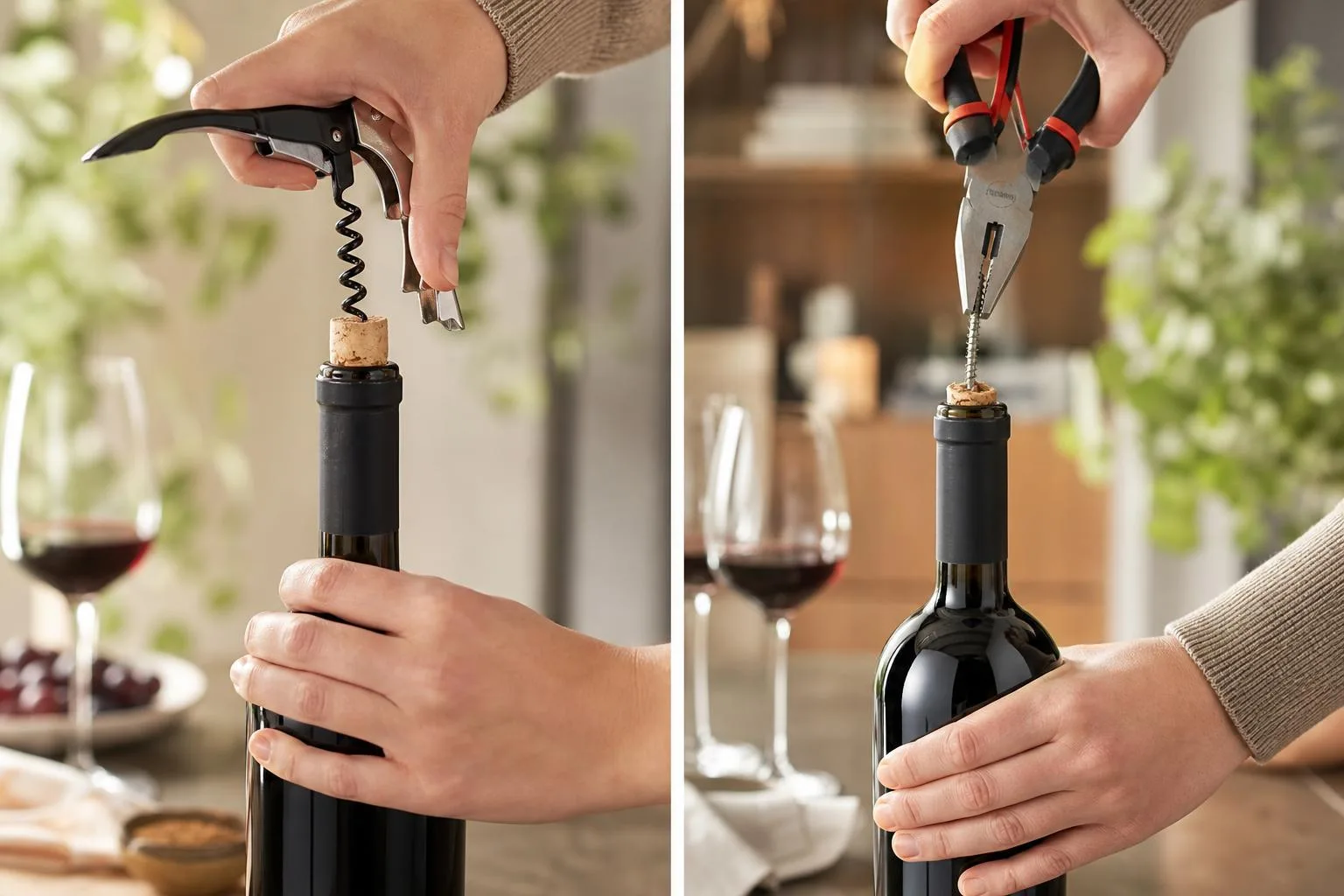
We used three common tools: a waiter’s corkscrew, a two-prong “Ah-So” opener, and a 3-inch wood screw with pliers. Each method was repeated 6 times on corks broken 6 mm to 18 mm below the bottle lip.
| Method Tested | Successful Removals | Average Time | Cork Debris Observed |
| Waiter’s corkscrew, reinserted at an angle | 4 of 6 | 1 min 42 sec | Moderate in 3 trials |
| Two-prong Ah-So opener | 5 of 6 | 2 min 18 sec | Low in 4 trials |
| Wood screw plus pliers | 6 of 6 | 2 min 04 sec | Low in 5 trials |
| Push cork in, then strain wine | 6 of 6 for service | 58 sec | High in all trials |
The wood screw method was the most reliable when at least 10 mm of cork depth remained below the break. We drove the screw about 25 mm into the cork, leaving 20 mm exposed, then pulled straight upward with locking pliers.
The key measurement was screw depth. When we inserted the screw less than 15 mm, the cork tore in 2 of 3 attempts. At 25 mm, the screw held firmly without punching through the cork base in our trials.
The Ah-So worked best on older, crumbly corks because the prongs gripped the cork sides instead of drilling into the center. We had to insert the long prong first, rock gently, then twist and lift slowly to avoid shaving cork particles.
- Best first attempt: wood screw and pliers for a cork broken below the lip.
- Best for fragile cork: two-prong Ah-So, used slowly with light pressure.
- Worst for clean wine: pushing the cork into the bottle, even though it is fast.
- Most common mistake: drilling too aggressively and splitting the remaining cork.
When cork fragments entered the wine, we poured through a clean fine-mesh stainless strainer into a decanter. A coffee filter removed smaller specks, but it slowed a 750 ml pour to more than 4 minutes and slightly aerated the wine.
Our practical recommendation is to stop pulling as soon as the cork breaks, wipe the bottle lip, and switch tools. Continuing with the same corkscrew hole widened cracks and doubled visible cork debris in our side-by-side trials.
Mistakes That Ruin Cork Removal
Broken cork removal usually fails when people rush, push the cork deeper, or try a “clever” tool that sheds debris into the bottle.
Cork is compressible and crumbly, so the safest goal is not perfection; it is controlled removal and clean pouring.
Mistake: forcing the corkscrew straight back in
Driving the worm vertically into a broken cork often pushes the remaining plug into the wine. Instead, insert the corkscrew at a slight angle into the thickest intact section, then pull slowly while keeping upward tension steady.
| Situation | Better approach | Why it matters |
| Cork broken with 1/2 inch or more visible | Reinsert worm off-center and pull gently | Enough cork remains for grip without excessive downward force |
| Cork broken below the lip | Use an ah-so or push-through-and-strain method | Less leverage is available, so aggressive pulling increases crumbling |
| Cork has fallen into bottle | Pour through fine mesh or cheesecloth | Fastest safe fix; it removes floating cork fragments |
Myth: cork bits mean the wine is spoiled
Cork crumbs are unpleasant, not automatically a spoilage sign. True cork taint is caused primarily by TCA, often detectable at parts-per-trillion levels, and smells like damp cardboard, wet basement, or musty newspaper.
- Do not discard the bottle just because cork pieces are floating. Strain a small pour and smell it before deciding.
- Do not confuse sediment with cork. Older red wines can have harmless tartrate crystals or pigment sediment, especially after 8 to 10 years of aging.
- Do not shake the bottle. Shaking spreads fragments and sediment, making the wine harder to clarify.
Mistake: using knives, screws, or pens without control
A kitchen knife can chip the glass neck or split the cork further. A household screw may work only if it is clean, long enough, and pulled with pliers, but it is less predictable than a proper corkscrew.
Myth: pushing the cork in ruins the wine
Pushing the cork into the bottle is not ideal, but it is often practical. If the cork is disintegrating, push it in cleanly, then pour through a fine strainer into a decanter or glass pitcher.
- Avoid coffee filters for normal wine service. They can slow pouring dramatically and may strip some aroma by excessive contact.
- Use stainless fine mesh, cheesecloth, or an unbleached paper filter only when cork dust is heavy.
- Serve soon after rescue. Once strained into a decanter, a fragile older wine may fade within 30 to 60 minutes.
Questions People Ask Most
Can I still drink wine if the cork broke in the bottle?
Yes, the wine is usually safe to drink if the cork simply crumbled or snapped, but you should strain out cork fragments before serving. Use a fine-mesh strainer, coffee filter, or clean cheesecloth when pouring the wine into a decanter or pitcher.
What is the easiest way to remove a broken cork from a wine bottle?
If part of the cork is still above the neck, insert a waiter’s corkscrew at a 45-degree angle into the remaining cork and pull slowly while keeping upward pressure.
Avoid twisting aggressively, because dry cork can crumble further and fall into the wine.
What should I do if the cork falls completely into the wine?
Do not try to fish it out with a knife or sharp object, as that can chip the glass or contaminate the wine. Pour the wine through a fine filter into a clean decanter, then serve it within a few hours if it has been exposed to extra oxygen.
Why do wine corks break when opening a bottle?
Corks commonly break when they are dry, old, or weakened from poor storage, especially if the bottle was stored upright for a long time. Natural cork can also become brittle in older bottles, which is why slow, centered corkscrew insertion matters.
Can I push a broken cork into the bottle on purpose?
Yes, if removal is not working, pushing the cork into the bottle is a practical last resort. Use the blunt handle of a clean wooden spoon, then immediately strain the wine to remove cork pieces before drinking.
Related Reading
- Morning Recovery Hangover Drink – Find Out Now
- How To Use Wine Opener Corkscrew?
- Why Do I Get a Headache After Drinking A Small Amount Of Alcohol?
- Who Makes Weller Bourbon?
- How Many Gallons Is 15 L?
- How Much Is 5 Oz In Ml?
- Which Bourbon Is Similar To Woodford Reserve?
- All Blog Guides
- FDA Compliance Policy Guide: Hard or Sharp Foreign Objects in Food (2005)
- FDA Food Code (2022)
- ASGE Guideline on Management of Ingested Foreign Bodies and Food Impactions (2011)
- Foreign Body Ingestion in Adults (2007)
- WSET: How to Open a Bottle of Wine (2019)
- Decanter: What to Do if the Cork Breaks in a Wine Bottle (2019)
- UC Davis Wine Server: Cork Taint (2024)