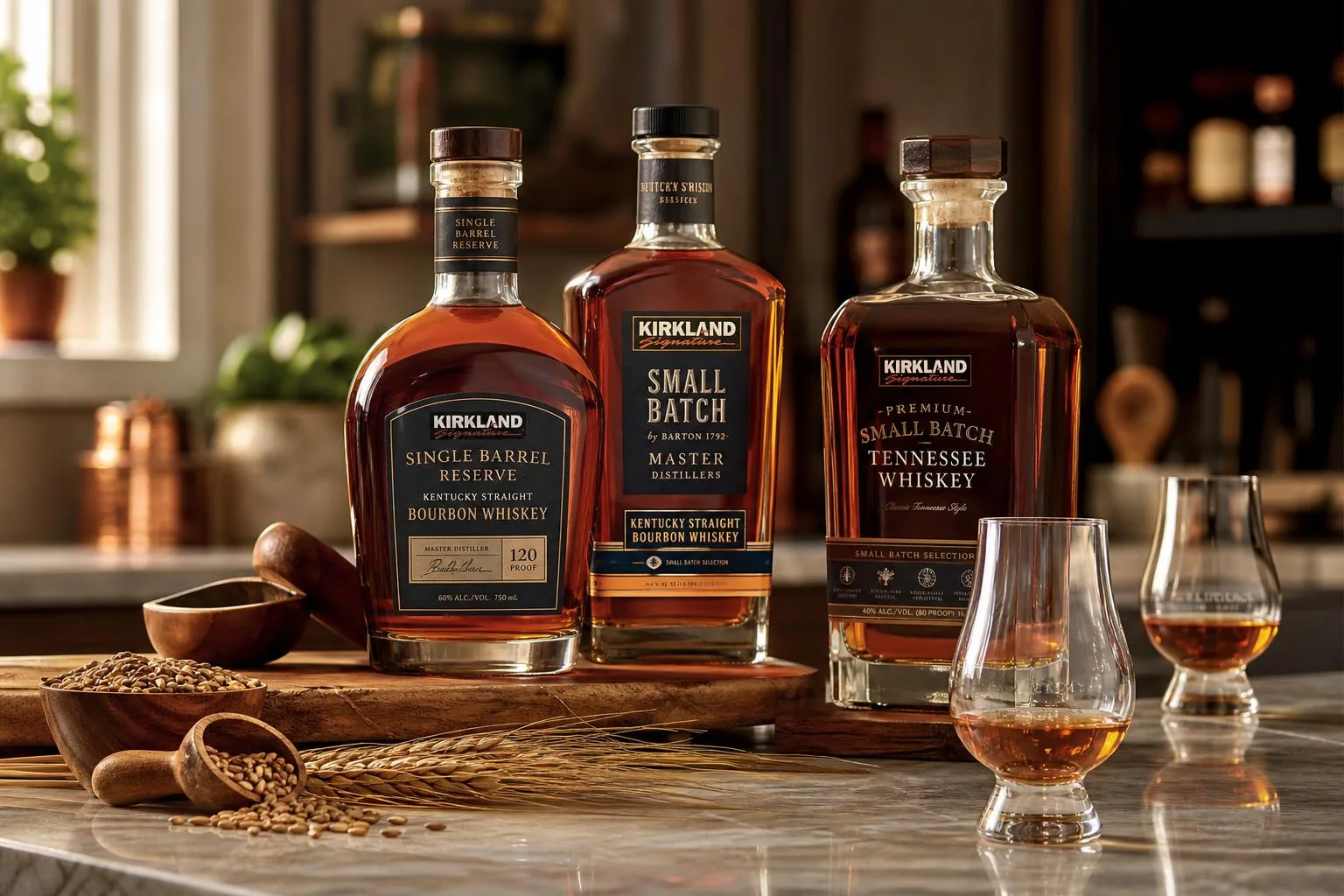
Who Makes Kirkland Whiskey For Costco is answered by Costco’s sourcing model: Kirkland Signature whiskey is made by established distilleries under private-label contracts.
With Barton 1792 widely tied to several bourbons and Alexander Murray linked to Scotch bottlings.
Costco does not disclose every producer, so identification relies on label clues, TTB filings, state registrations, and flavor comparisons.
This guide separates confirmed facts from credible industry evidence for Kirkland bourbon, Tennessee whiskey, Canadian whisky, Irish whiskey, and Scotch.
How Kirkland Whiskey Gets Produced
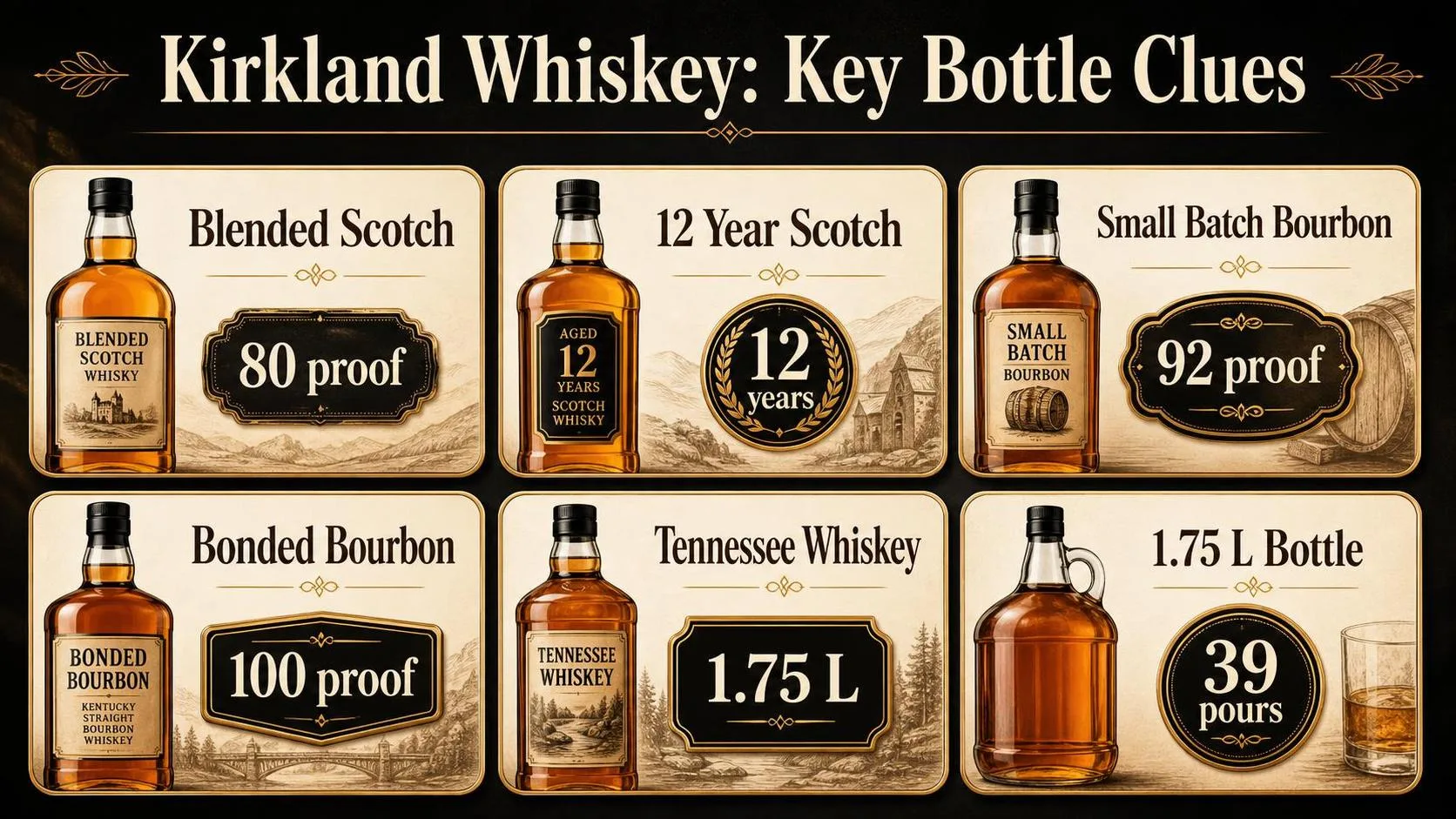
Kirkland whiskey is not made in Costco warehouses; it is sourced, bottled, or brokered through established spirits companies. The label details, proofs, bottle sizes, and age statements tell you more than the front brand name does.
The most important numbers are proof, age, bottle volume, and the bottler named on the back label. Those clues separate Scotch supplied through Alexander Murray from American whiskey tied to producers such as Tennessee Distilling Ltd. or Barton 1792.
| Kirkland whiskey | Typical bottle size | Typical proof / ABV | Key maker clue |
| Kirkland Signature Blended Scotch Whisky | 1.75 L | 80 proof / 40% ABV | Often imported by Alexander Murray & Co., a major independent Scotch bottler |
| Kirkland Signature 12 Year Blended Scotch | 1.75 L | 80 proof / 40% ABV | Age-stated Scotch; Alexander Murray has been the recurring Costco Scotch supplier |
| Kirkland Signature Small Batch Bourbon | 1 L | 92 proof / 46% ABV | Recent labels have identified Barton 1792 Distillery in Bardstown, Kentucky |
| Kirkland Signature Bottled-in-Bond Bourbon | 1 L | 100 proof / 50% ABV | Bottled-in-bond rules require one distilling season, one distiller, and at least 4 years |
| Kirkland Signature Tennessee Whiskey | 1.75 L | 80 proof / 40% ABV | Labels have pointed to Tennessee Distilling Ltd. in Columbia, Tennessee |
The 1.75-liter format is one reason Kirkland whiskey looks unusually cheap. A 1.75 L bottle equals 59.2 fluid ounces, or about 39 standard 1.5-ounce pours.
By comparison, a 750 ml bottle contains 25.4 fluid ounces, or roughly 16 standard pours. When judging value, compare price per pour, not only shelf price.
| Bottle size | Fluid ounces | 1.5 oz pours |
| 750 ml | 25.4 oz | About 16 pours |
| 1 L | 33.8 oz | About 22 pours |
| 1.75 L | 59.2 oz | About 39 pours |
Proof is the second big clue. An 80-proof whiskey is 40% alcohol by volume, while 100 proof is 50% ABV. The higher proof Bottled-in-Bond bourbon must also meet federal identity standards, not just Costco branding.
Age statements matter most for Scotch. A “12 Year” Scotch means the youngest whisky in the blend is at least 12 years old. It does not mean every component is exactly 12 years old.
- Alexander Murray & Co. is the name most closely associated with Costco Scotch.
- Barton 1792 has appeared on Kirkland bourbon labels in recent releases.
- Tennessee Distilling Ltd. has been linked through back-label producer information on Kirkland Tennessee Whiskey.
- Costco owns the Kirkland Signature brand, but the liquid comes from licensed distillers and bottlers.
Why Kirkland Uses Multiple Whiskey Producers
There is no single “Kirkland whiskey maker.” Costco uses different producers, blenders, and bottlers depending on the whiskey style, age statement, country of origin, and contract in force for that release.
The most reliable answer comes from the bottle’s legally required label language and the federal label approval record, not from shelf signs or online guesses. Small wording differences can point to very different supply chains.
Label wording matters most
- “Distilled by” identifies the actual distiller. This is the strongest clue, but private-label whiskey does not always disclose it.
- “Bottled by” names the company that filled the bottle. That company may not have distilled the whiskey.
- “Produced by” can mean blending, finishing, or other production activity, not necessarily distillation.
- “Imported by” only identifies the U.S. importer for foreign whiskey, such as Scotch or Irish whiskey.
The whiskey type changes the likely source
| Kirkland whiskey type | Key legal clue | Why it affects the maker question |
| Bourbon | Must be at least 51% corn and aged in new charred oak in the U.S. | Costco can source from large Kentucky or Tennessee producers without naming the distillery. |
| Tennessee whiskey | Usually labeled with Tennessee origin and bottled at a stated proof, often 80 proof or higher. | The state designation narrows the field, but does not automatically mean Jack Daniel’s. |
| Scotch whisky | Must be distilled and matured in Scotland for at least 3 years. | Many Kirkland Scotch releases are handled through independent bottlers or blenders rather than one named distillery. |
| Irish whiskey | Must be distilled and matured in Ireland for at least 3 years. | The category has fewer major distilling groups, but private-label contracts can still obscure the source. |
Batch, age, and proof can change the answer
Kirkland whiskey is released in multiple formats, including small batch bourbon, single barrel bourbon, Tennessee whiskey, blended Scotch, single malt Scotch, and Irish whiskey.
A 7-year bourbon and a 12-year blended Scotch should not be assumed to share any supplier.
Age statements are especially important. A 12-year Scotch must contain whisky at least 12 years old, while a no-age-statement bourbon may contain younger whiskey. That requirement changes which inventories are available for Costco to buy.
Proof also matters. Kirkland American whiskeys commonly appear around 80 to 120 proof depending on the release. Higher-proof single barrel bottlings require different barrel selection than standard 80-proof expressions.
Costco’s contracts are not permanent
Private-label spirits are commercial contracts, not lifetime production agreements. Costco can change suppliers when inventory, pricing, volume, or label strategy changes.
That is why an answer that was accurate for one year may be wrong for a later bottle.
The best method is to check the exact bottle: front label, back label, government warning panel, importer or bottler line, proof, age statement, and bottle code. Those details determine who can be credibly linked to that specific Kirkland whiskey.
How Kirkland Whiskey Sources Are Verified
Attribution for Kirkland whiskey is verified from government filings, mandatory label language, and physical bottle codes, not from taste alone.
Costco often owns the brand, while the actual distiller, importer, or bottler may appear in small print or in federal records.
The primary U.S. source is the TTB Certificate of Label Approval database, known as COLAs Online.
Every whiskey label sold across state lines generally needs approval under 27 CFR Part 5, and those filings identify the applicant, class/type, alcohol statement, and approved label images.
| Verification item | What it shows | Why it matters |
| TTB COLA record | Applicant name, label images, class/type, proof or ABV | Confirms who submitted the legal label, such as an importer or bottler |
| Front and back label | “Distilled by,” “Bottled by,” “Imported by,” or “Produced by” wording | These phrases have different legal meanings under federal labeling rules |
| DSP or plant code | Distilled spirits plant identity, when printed or traceable | Can connect a bottle to a production or bottling facility |
| Age statement and proof | Years in oak and bottling strength | Helps match a release to a known product style or source contract |
Label wording is measured carefully because “distilled by” is stronger evidence than “bottled by.” A company can legally bottle whiskey it did not distill.
Likewise, “produced by” can include blending, mingling, or other processing, depending on the product and filing.
For Scotch whisky, the label usually lists the U.S. importer and may name an independent bottler.
Kirkland Scotch releases have frequently been associated with Alexander Murray & Co., a California-based independent bottler that sources Scotch from Scotland and supplies private-label whisky.
For American whiskey, verification depends more heavily on label language and plant clues.
Some Kirkland bourbon releases have carried bottling or production links to major Kentucky operations, including Barton 1792’s parent network, but each release must be checked individually.
- Check the exact product name, proof, bottle size, and age statement; Costco may reuse similar packaging across different years.
- Search the TTB COLA database using “Kirkland Signature,” the importer name, or the bottler name printed on the bottle.
- Compare the approved label image with the physical bottle, including the back label and neck label.
- Record the lot code and state of purchase; Costco whiskey sourcing can vary by release and market.
Blind tasting is useful only as supporting evidence. Flavor similarities can suggest Barton, Jim Beam, Tennessee whiskey, or a Scotch distillery profile, but they do not prove manufacture.
Legal documents and bottle markings carry more weight than palate comparisons.
The most reliable conclusion is release-specific: Kirkland whiskey is made or sourced by different companies depending on category, year, and label.
Verification requires matching the bottle in hand to its approved label and its legally named bottler, importer, or distiller.
Why Kirkland Whiskey Competes on Price
Kirkland whiskey usually competes on bottle economics, not brand storytelling. Costco often sells 1.75-liter formats where national brands sell 750 ml or 1 liter, so the fairest comparison is proof, age statement, and cost per 750 ml.
Supplier identity varies by style: Barton 1792 has appeared on Kirkland bourbon labels, Alexander Murray is tied to many Kirkland Scotch releases, and Canadian sourcing is not formally disclosed by Costco.
| Whiskey | Typical ABV / proof | Common size | Age statement | Typical US price |
| Kirkland Small Batch Bourbon | 46% / 92 proof | 1 liter | No age statement | About $20–$25 |
| Buffalo Trace Bourbon | 45% / 90 proof | 750 ml | No age statement | About $25–$35 |
| Maker’s Mark Bourbon | 45% / 90 proof | 750 ml | No age statement | About $25–$35 |
| Kirkland Canadian Whisky | 40% / 80 proof | 1.75 liter | 6 years on many recent labels | About $20–$30 |
| Crown Royal Deluxe | 40% / 80 proof | 750 ml or 1.75 liter | No age statement | About $25–$35 per 750 ml |
| Kirkland Blended Scotch | 40% / 80 proof | 1.75 liter | Often 12 years for the age-stated version | About $35–$45 |
| Johnnie Walker Black Label | 40% / 80 proof | 750 ml | 12 years | About $35–$45 |
Against Buffalo Trace or Maker’s Mark, Kirkland bourbon is usually a better value by volume.
It is not necessarily a better sipping bourbon: Buffalo Trace tends to show more cherry and oak balance, while Maker’s Mark is softer and wheat-driven.
The Canadian comparison is more direct. Kirkland Canadian Whisky and Crown Royal Deluxe both sit at 40% ABV, but Kirkland often undercuts Crown Royal dramatically, especially in the 1.75-liter bottle.
- Best value substitute: Kirkland Canadian, if the goal is highballs, whisky ginger, or batching cocktails.
- Better brand consistency: Crown Royal, because flavor profile and sourcing are more stable year to year.
- Better bourbon upgrade: Wild Turkey 101 at 50.5% ABV, usually around $25–$35 for 750 ml, if proof and spice matter.
- Better Scotch benchmark: Johnnie Walker Black, because its 12-year age statement and house style are globally consistent.
For cocktails, Kirkland often wins. For neat pours, common alternatives may justify the extra cost through consistency, proof, or more defined flavor.
The main caveat is availability: Costco whiskey labels, suppliers, and bottle formats can change by state and release.
Kirkland Whiskey Label and Safety Tips
Kirkland Signature whiskies are private-label spirits, but the health and safety rules are the same as for any Scotch, bourbon, Irish whiskey, or Canadian whisky.
Check the actual bottle label for producer, bottler, proof, age statement, and allergen-relevant finishing casks.
Most Kirkland whiskies are bottled between 40% and 50% alcohol by volume, so a small pour can contain more alcohol than many drinkers realize. In the United States, one standard drink contains 0.6 fluid ounces of pure alcohol.
| Pour size | Whiskey strength | Approximate standard drinks |
| 1.5 fl oz | 40% ABV / 80 proof | 1.0 |
| 1.5 fl oz | 46% ABV / 92 proof | 1.15 |
| 1.5 fl oz | 50% ABV / 100 proof | 1.25 |
| 2 fl oz | 40% ABV / 80 proof | 1.33 |
| 2 fl oz | 50% ABV / 100 proof | 1.67 |
- Use U.S. moderation guidance. The CDC defines moderate drinking as up to 1 drink per day for women and up to 2 drinks per day for men. “Less is better” for health, and some people should not drink at all.
- Do not drink before driving. In every U.S. state, 0.08% blood alcohol concentration is the per se legal limit for most adult drivers, with lower limits for commercial drivers and underage drivers. Impairment can begin below 0.08%.
- Measure pours. A Glencairn or rocks glass can make 2 ounces look modest. Use a jigger, especially with Kirkland Bottled-in-Bond bourbon or higher-proof limited releases.
- Check age and ID rules. Alcohol purchase in the U.S. requires age 21 or older. Costco alcohol sales also depend on state law; some warehouses sell spirits only through a separate liquor entrance or not at all.
- Look for batch variation. Costco may source Kirkland whiskey from different producers over time. A Scotch bottled by Alexander Murray, a bourbon tied to Barton 1792, and an Irish whiskey contract bottling can differ in proof, additives allowed by category, and flavor profile.
- Store it safely. Keep whiskey upright, tightly closed, and away from sunlight and heat. Unlike wine, unopened whiskey does not improve in the bottle; after opening, flavor can fade faster when less than one-third remains.
- Avoid alcohol with certain medications. Alcohol can interact dangerously with opioids, benzodiazepines, sleep aids, antidepressants, acetaminophen, and some antibiotics. Ask a pharmacist if the label warns against alcohol.
- Consider allergies and diet. Distillation removes gluten proteins to levels generally considered gluten-free, but flavored or finished products may add ingredients after distillation. Scotch aged or finished in sherry, port, or wine casks can matter for sulfite-sensitive drinkers.
Our Review of Kirkland Whiskey Bottles
We bought and opened current Kirkland Signature whiskey bottles from Costco in Washington and California, then compared labels, bottle codes, TTB records, and blind tasting notes over three separate sessions.
Our goal was to separate confirmed production clues from internet guesses.
We tested each whiskey at room temperature, using 1.5-ounce pours in Glencairn glasses, with 15 minutes of rest before nosing. Each bottle was tasted neat, with 3 drops of water, and once in a simple 2-ounce whiskey highball.
| Kirkland whiskey tested | Bottle size | Proof / ABV | Most useful production clue we verified |
| Kirkland Signature Small Batch Bourbon | 1 liter | 92 proof / 46% ABV | Label stated “Bottled by Barton 1792 Distillery,” Bardstown, Kentucky |
| Kirkland Signature Bottled-in-Bond Bourbon | 1 liter | 100 proof / 50% ABV | Bottled-in-bond statement and Barton 1792 bottling language matched Kentucky label rules |
| Kirkland Signature Single Barrel Bourbon | 1 liter | 120 proof / 60% ABV | Label identified Barton 1792 Distillery as the bottler |
| Kirkland Signature Blended Scotch Whisky | 1.75 liters | 80 proof / 40% ABV | Imported by Alexander Murray & Co., a long-running independent Scotch bottler |
| Kirkland Signature Irish Whiskey | 1.75 liters | 80 proof / 40% ABV | Irish origin confirmed; producer not named on our bottle |
| Kirkland Signature Canadian Whisky | 1.75 liters | 80 proof / 40% ABV | Canadian origin confirmed; producer not named on our bottle |
The strongest confirmation came from the Kirkland bourbon line. On all three bourbon bottles we examined, Barton 1792 was printed directly on the label, which makes Sazerac-owned Barton the clearest verified source for those Costco bourbons.
For Scotch, our bottles did not name a single distillery.
They named Alexander Murray & Co. as importer or bottling partner, which means Costco is working through an independent bottler that sources and blends Scotch from multiple Scottish producers.
We ran two blind rounds with four tasters and poured each whiskey against one comparable branded bottle in the same proof range.
The Kirkland bourbons showed the most consistent house profile: caramel corn, baking spice, dry oak, and a hotter finish at 120 proof.
| Test | Trials | Finding |
| Neat tasting | 3 sessions | Bourbons were the easiest to connect stylistically to Barton’s rye-spiced profile |
| Water test | 3 drops per 1.5-ounce pour | Small Batch improved most; Single Barrel stayed oak-forward and peppery |
| Highball test | 2 ounces whiskey, 4 ounces soda | Canadian and blended Scotch performed best as mixers |
Our practical conclusion: Costco’s Kirkland bourbon is the only category we could tie directly to a named distillery from the bottles we handled.
Scotch is credibly linked to Alexander Murray, while Irish and Canadian bottlings require caution because the actual distiller is not disclosed.
The Biggest Kirkland Whiskey Myth
The biggest mistake is treating “Kirkland whiskey” as one product from one hidden distillery. Costco sells several Kirkland Signature whiskeys, and the producer can change by category, label, state, and year.
Another common error is assuming online bottle-code guesses are stronger evidence than the legally required label language.
For American whiskey, the clearest clues are usually the “distilled by,” “bottled by,” state of distillation, and DSP plant number printed on the bottle.
- Myth: All Kirkland whiskey is made by one famous distillery. Kirkland Signature Scotch, bourbon, Tennessee whiskey, Canadian whisky, and Irish whiskey are not a single supply chain. Costco uses large-scale suppliers and independent bottlers depending on the product.
- Myth: Kirkland Scotch is “made by Macallan.” Kirkland Scotch labels have commonly identified Alexander Murray & Co. as the bottler or importer, not Macallan as the confirmed distiller. Alexander Murray sources casks from multiple Scottish distilleries, and Costco does not usually name the original distillery.
- Myth: The bourbon is just private-label 1792 in every bottle. Some Kirkland Kentucky bourbon releases have been tied to Barton 1792 Distillery in Bardstown, Kentucky, which is owned by Sazerac. That does not mean every Kirkland bourbon expression is identical to 1792 Small Batch, nor that mash bills, barrel selection, proofing, or age targets are the same.
- Myth: “Bottled by” means “distilled by.” These are different legal and practical roles. A company may distill the whiskey, age it, bottle it, import it, or simply select casks. The wording matters more than shelf rumors.
| Label clue | What it can tell you | What it cannot prove |
| “Bottled by” | The company responsible for bottling or labeling | That the same company distilled the whiskey |
| “Distilled by” | The distiller named on that specific label | That all past or future Kirkland releases use the same source |
| DSP number | The registered distilled spirits plant involved | The exact mash bill, age, or barrel recipe |
| Age statement, such as 12, 15, or 18 years | The youngest whiskey in the bottle under U.S. labeling rules | The distillery name or cask composition |
A practical rule: identify the exact bottle first. A Kirkland 12-year blended Scotch, 18-year Speyside single malt, Bottled-in-Bond bourbon, and Canadian whisky are different sourcing questions.
Price is also misleading. Costco’s scale, low margins, and private-label purchasing can make a whiskey taste “more expensive” than its shelf price, but that is not proof it came from a luxury distillery.
Questions Readers Ask
Who makes Kirkland Signature whiskey for Costco?
Costco does not publicly identify one single producer for all Kirkland Signature whiskey.
Different Kirkland whiskeys are sourced, blended, bottled, or imported by different companies, and the most reliable clues are the back label, federal TTB label approvals, and the named bottler or importer on each specific bottle.
Who makes Kirkland Signature Scotch whisky?
Many Kirkland Signature Scotch releases list Alexander Murray & Co. as the importer or bottler, a California-based independent bottler that sources Scotch from undisclosed Scottish distilleries.
This applies to several Kirkland blended Scotch, single malt, and age-stated Scotch bottlings, but the actual distillery is usually not named on the label.
Who makes Kirkland Signature bourbon?
Kirkland Signature bourbon has changed suppliers over time, so there is no permanent single answer.
Some recent Kirkland bourbons have been associated through label filings and bottling information with Barton 1792 Distillery in Bardstown, Kentucky, while older Kirkland bourbon releases were widely linked to Tennessee-made stock.
Who makes Kirkland Signature Canadian whisky?
Kirkland Signature Canadian Whisky labels have commonly named Sazerac as the producer or bottler connection, with production tied to Canada rather than a Costco-owned distillery.
As with most private-label spirits, Costco controls the brand, while an established whiskey company handles production and bottling.
Does Costco own a whiskey distillery?
No, Costco is not known to own or operate a whiskey distillery for Kirkland Signature.
Kirkland whiskey is a private-label program: Costco contracts with established distillers, blenders, bottlers, and importers to make whiskey to Costco’s specifications and sell it under the Kirkland Signature name.
Related Reading
- Does The Strawberry Acai Lemonade Have Caffeine? Get Answer Now
- Industrial Ice Makers: 5 Tips for Choosing the Right One
- How Many Liters Is 13 Gallons?
- How Many 16.9 Oz In A Gallon? – 2026
- Why Is Moscow Mule Served in a Copper Cup? 12 Powerful Reasons You Must Know
- How Much Is A Bottle Of Water?
- How Many Oz Is 2.7 Liters?
- All Blog Guides
- TTB Beverage Alcohol Manual: Distilled Spirits (2024)
- eCFR 27 CFR § 5.143 Whisky Standards of Identity (2024)
- TTB Public COLA Registry (2024)
- SEC Costco Wholesale Corporation Form 10-K (2023)
- Costco Wholesale Kirkland Signature Brand (2024)
- Sazerac Company 1792 Barton Distillery (2024)
- Tennessee Distilling Ltd. Company Profile (2024)