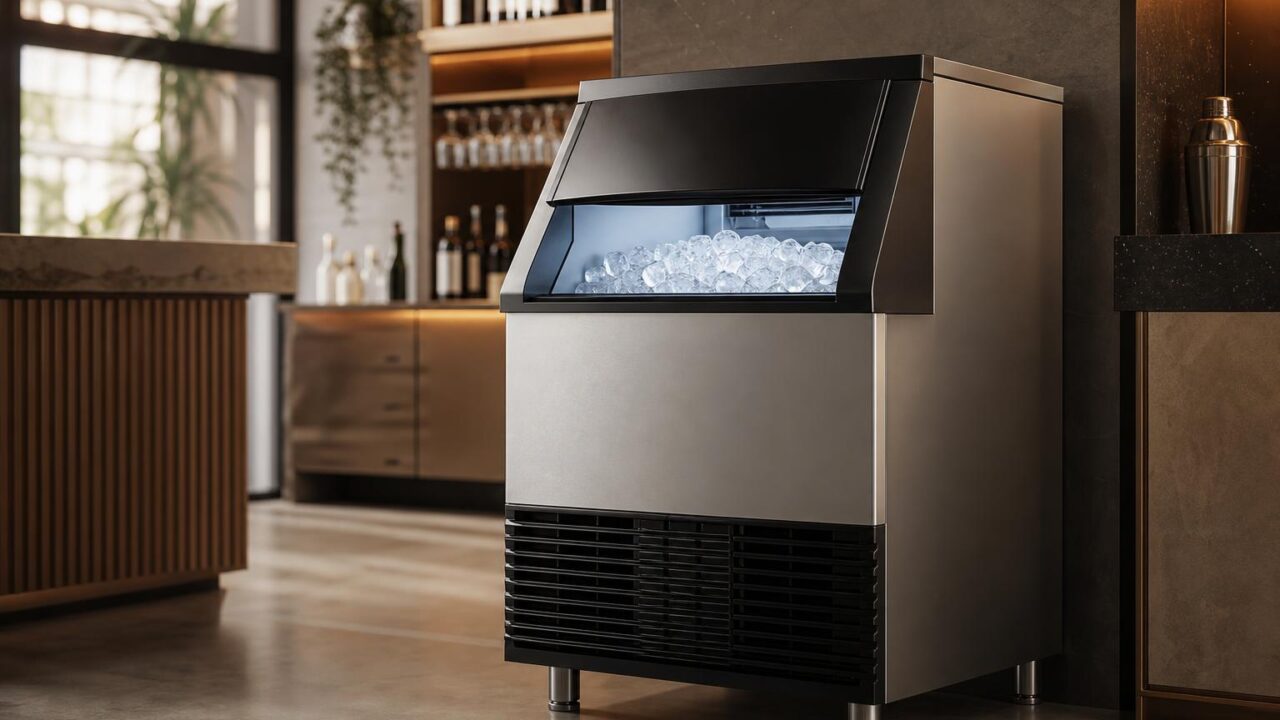
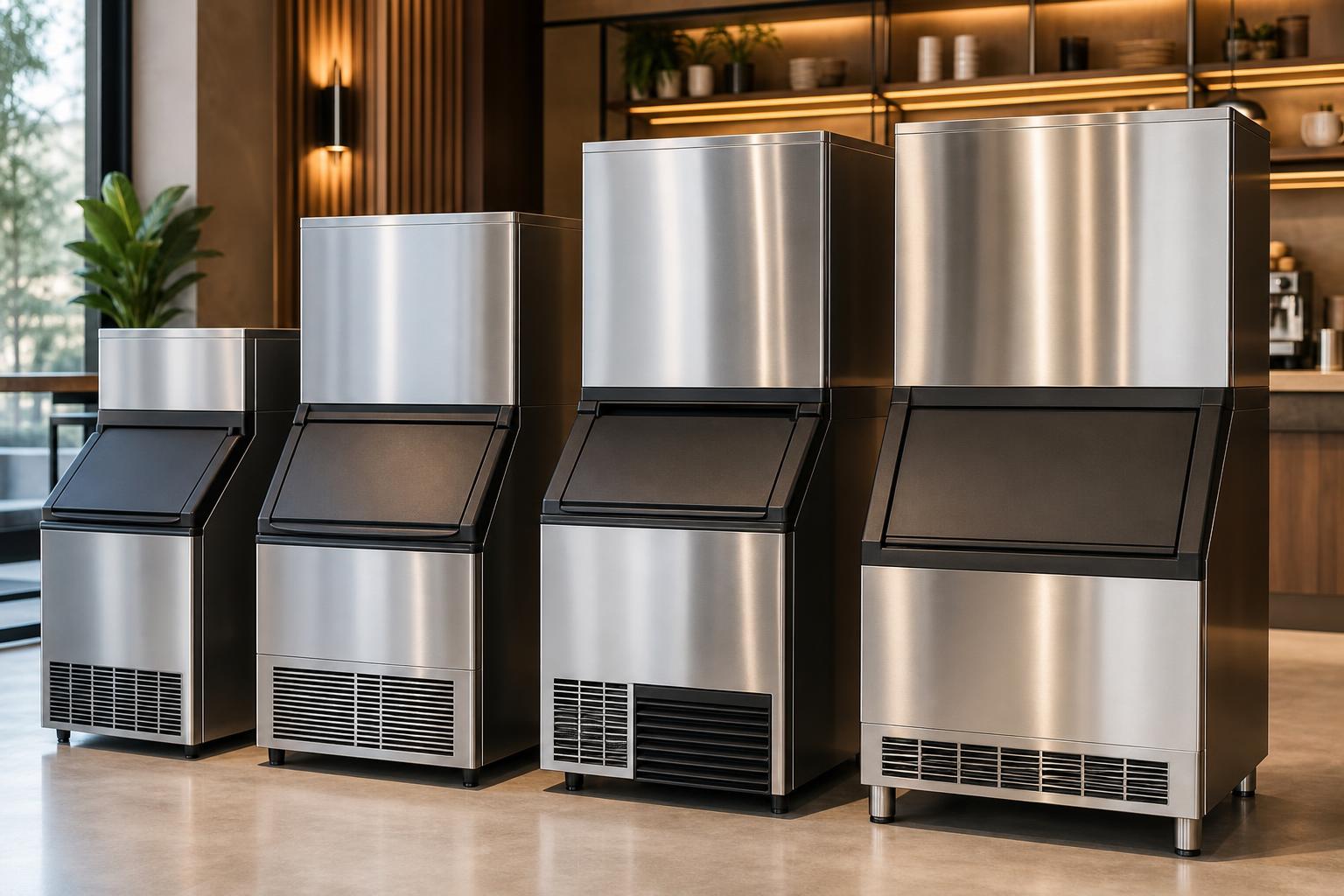
Industrial Ice Makers are high-capacity machines that produce, harvest, and store ice continuously for commercial kitchens, hotels, hospitals, seafood counters, and event venues.
Unlike household units, they are sized by daily output, commonly ranging from about 50 to more than 2,000 pounds of ice per 24 hours.
This guide explains how modular, undercounter, and countertop units differ, what cube styles mean in real service, and which utility requirements affect installation.
It also covers sanitation, filtration, energy use, drainage, and maintenance intervals, so buyers can match ice production to peak demand instead of relying on rough estimates.
Rated Output vs Real Production
Industrial ice makers are sized by production, storage, energy use, water use, and recovery under heat. The nameplate number is not what most bars get on a hot service line.
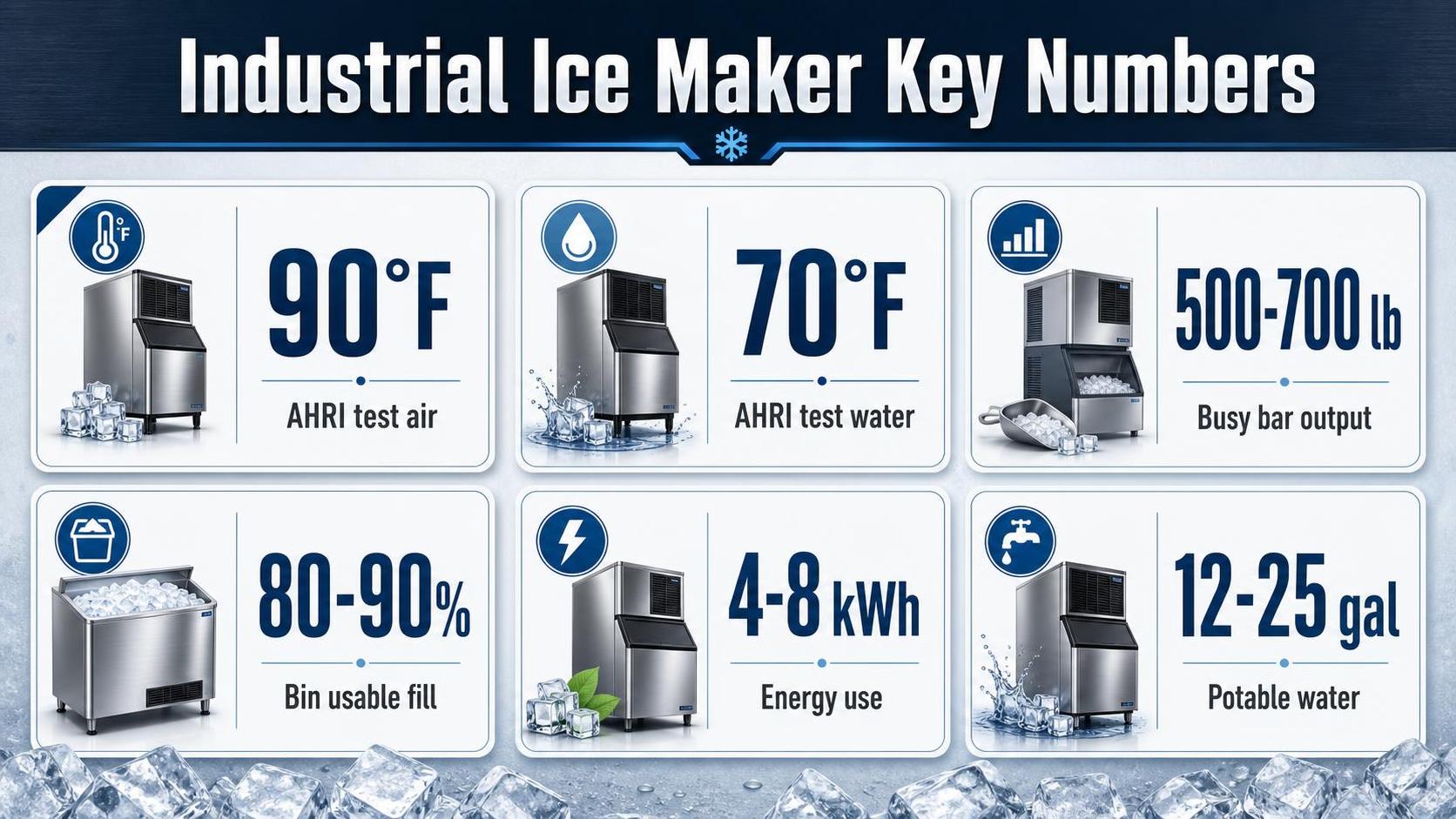
Most published capacities follow AHRI 810 test conditions: 90°F ambient air and 70°F inlet water. If the room is hotter or the incoming water is warmer, daily output can drop materially, so always read the manufacturer’s performance chart.
| Number to check | What it means | Practical bar interpretation |
| 300 lb per 24 hours | Approximate production for a small undercounter or compact modular unit | Often enough for light wine-bar service, not heavy shaken cocktails or patio service |
| 500 to 700 lb per 24 hours | Common mid-size modular production range | Typical starting point for a busy cocktail-focused bar with peak evening demand |
| 1,000 lb+ per 24 hours | High-volume modular production | Used where multiple wells, banquets, bottle service, or outdoor events pull ice continuously |
| 80% to 90% bin fill | Many bins shut off before being physically packed full | A “400 lb bin” may not deliver 400 lb of usable reserve during service |
Production capacity is a daily average, not an instant refill rate. A machine rated at 600 lb per day makes about 25 lb per hour under rating conditions, before losses from door openings, melt, and scoop waste.
| Use case | Common planning figure | Why it matters |
| Restaurant dining seat | About 1.5 lb per guest | Covers water, soft drinks, and basic service ice |
| Cocktail-focused bar seat | About 3 lb per guest | Accounts for shaking, stirring, wells, and discarded ice |
| Hotel guest room | About 5 lb per occupied room | Reflects guest ice buckets and corridor machines |
| Salad bar or display | About 30 lb per cubic foot | Ice is used as a cooling bed, not just in drinks |
Energy and water numbers are best compared per 100 lb of ice. ENERGY STAR says certified commercial ice makers are typically at least 10% more energy-efficient and 20% more water-efficient than standard models.
| Specification | Efficient range to look for | Note |
| Energy use | Roughly 4 to 8 kWh per 100 lb | Lower is better; cube machines usually use more than some flake or nugget units |
| Potable water use | Roughly 12 to 25 gal per 100 lb | Includes ice-making water and purge water on many air-cooled machines |
| Water-cooled condenser use | Can exceed 100 gal per 100 lb | Often restricted or discouraged where water costs and sewer fees are high |
For installation, the overlooked number is heat rejection. Air-cooled machines need unobstructed ventilation, and many manufacturers call for 6 inches or more of clearance.
Poor airflow raises head pressure, cuts production, and shortens compressor life.

How Conditions Reduce Ice Output
Industrial ice maker output is rated under controlled conditions, usually 70°F air and 50°F incoming water.
In real kitchens, bars, hotels, and healthcare facilities, production can drop quickly when heat, water quality, airflow, or cleaning practices are off.
The Air-Conditioning, Heating, and Refrigeration Institute’s AHRI 810 standard is commonly used for automatic commercial ice maker performance testing.
Field results often differ because the machine is operating in a hotter, wetter, dirtier environment than the test lab.
| Factor | Typical benchmark | Practical effect |
| Ambient air temperature | 70°F rating condition; many kitchens run 80–95°F | Higher air temperature reduces heat rejection and slows freeze cycles. |
| Incoming water temperature | 50°F rating condition; summer mains water may exceed 70°F | Warmer water needs more refrigeration before freezing, lowering daily output. |
| Water pressure | Common manufacturer range: 20–80 psi | Low pressure can underfill the evaporator; high pressure can stress valves. |
| Clearance and ventilation | Often 6 inches or more on air-cooled units | Poor airflow raises condenser temperature and reduces capacity. |
| Water hardness | Over 7 grains per gallon is considered hard by USGS | Scale insulates the evaporator and can cause cloudy, misshapen ice. |
Heat Load and Installation Location
Air-cooled ice machines reject heat into the room. A 500-pound-per-day unit can add thousands of BTU per hour to a small prep area, especially during long harvest cycles. If the room is already hot, the machine works harder and produces less.
Placing the unit next to ovens, dish machines, or direct sunlight is a common mistake.
Remote condensers or water-cooled models can help in high-heat locations, but water-cooled machines may use significantly more utility water and may be restricted locally.
Water Quality and Filtration
Ice is mostly water, so mineral content directly affects clarity, taste, and machine life. Calcium and magnesium scale build up on the evaporator plate, water distributor, float valve, and probes. Even a thin layer reduces heat transfer.
- Sediment filters protect inlet valves and small orifices from grit.
- Carbon filters reduce chlorine taste and odor that can carry into ice.
- Scale-control cartridges help where hardness exceeds about 7 grains per gallon.
- Sanitizing schedules matter; NSF-listed commercial ice machines are not self-sterilizing.
Bin Sizing, Usage Pattern, and Ice Type
Production capacity is not the same as available ice at 8 p.m. A 700-pound machine paired with a small bin can still run short during a dinner rush if staff draw ice faster than it can recover.
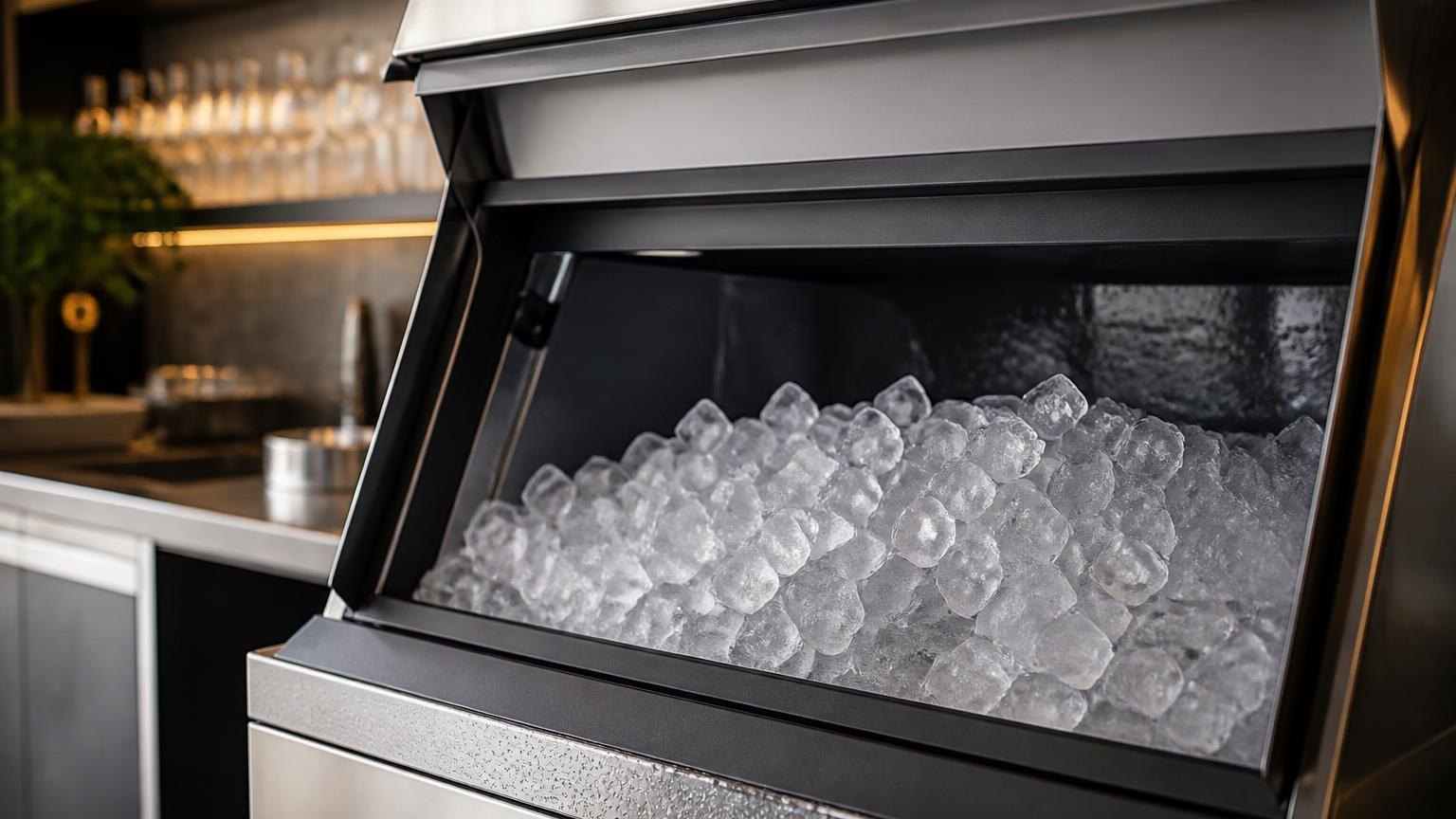
Ice style also changes the result. Nugget ice has a high chewable water content and dispenses well, but it melts faster than full cube ice. Flake ice is ideal for seafood or healthcare displays, not premium cocktails where dilution control matters.
Standard Testing and Certification Metrics
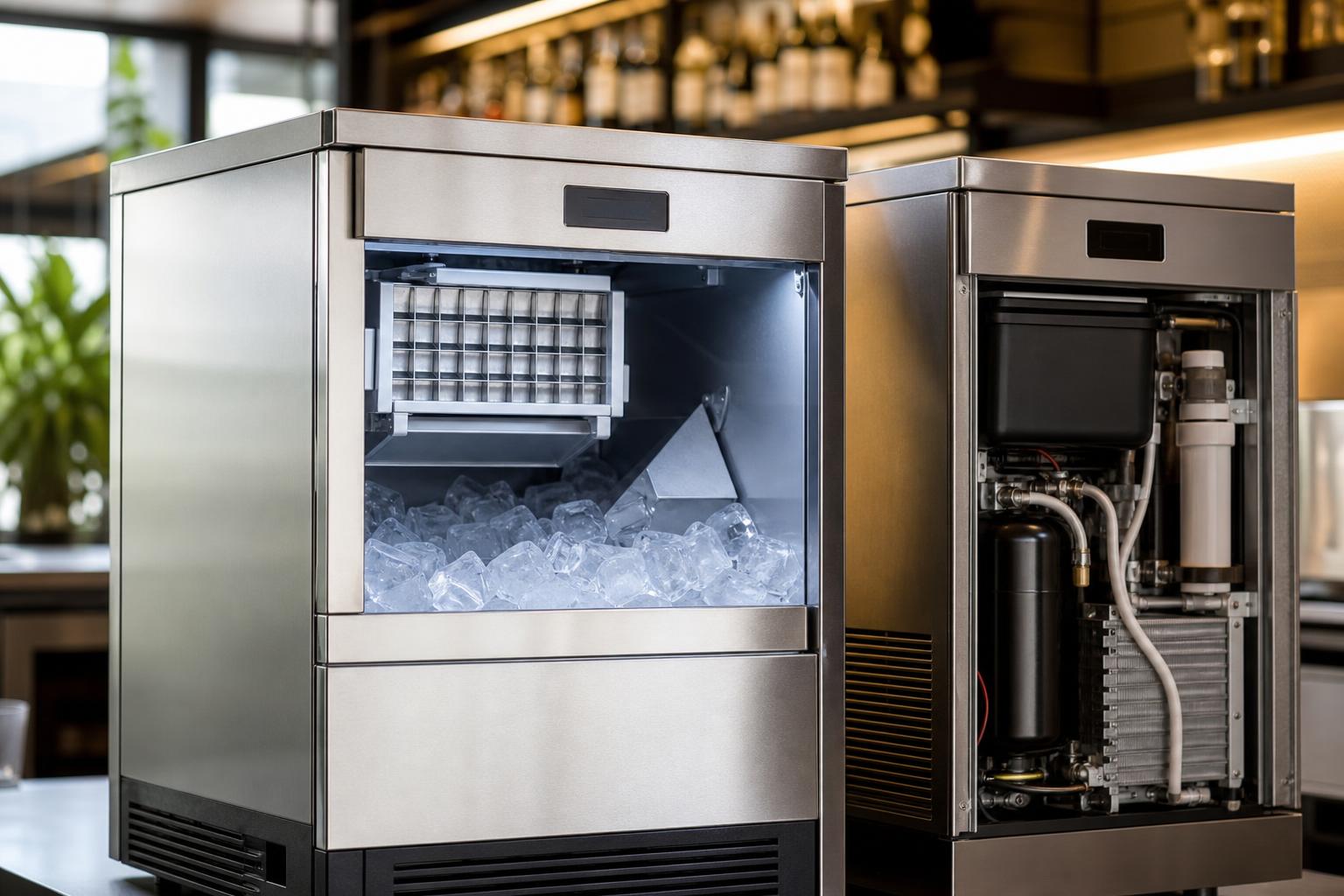
Industrial ice makers are verified by measuring ice production, energy use, condenser water use, bin storage, and sanitation compliance under standardized test conditions.
The most cited U.S. benchmark is AHRI Standard 810, which rates automatic commercial ice makers using controlled air, water, and electrical conditions.
Rated Ice Production
Production is reported as pounds of ice made in 24 hours, not as “peak output.” AHRI 810 testing uses a defined ambient-air temperature and inlet-water temperature so buyers can compare machines fairly.
| Measurement | Common verification method | Why it matters |
| Ice harvest rate | Weigh usable ice over a timed test, then normalize to 24 hours | Confirms whether a unit can meet service demand |
| Energy consumption | Measure kWh used per 100 lb of ice produced | Shows operating cost and ENERGY STAR eligibility |
| Potable water use | Measure gallons used per 100 lb of ice | Identifies waste from purge cycles and inefficient designs |
| Condenser water use | Measured separately for water-cooled units | Critical where sewer and water charges are high |
Standard Test Conditions
AHRI 810 ratings for batch-type and continuous-type ice makers are commonly based on 90°F surrounding air and 70°F entering water.
These conditions are tougher than a cool kitchen, so field output is often lower or higher depending on installation conditions.
| Condition | Typical rating value | Field implication |
| Ambient air | 90°F | Hot mechanical rooms can reduce production |
| Inlet water | 70°F | Warmer water increases freeze time |
| Rated output period | 24 hours | Allows direct comparison between models |
| Energy metric | kWh per 100 lb of ice | Lower number means better electrical efficiency |
Third-Party Certification
ENERGY STAR qualified commercial ice makers must meet efficiency limits verified through recognized laboratory testing and product certification.
NSF/ANSI 12 is also important because it evaluates sanitation, cleanability, materials, and design of automatic ice-making equipment.
- Check the AHRI Directory: Confirm the model number, ice type, condenser type, rated production, and energy use match the specification sheet.
- Review ENERGY STAR listings: Verify current qualification, because discontinued or modified models may no longer appear.
- Look for NSF certification: Foodservice inspectors often expect listed equipment for ice used in beverages or food contact.
- Validate installation data: Confirm voltage, circuit size, drain slope, ventilation clearance, and water pressure before accepting performance claims.
On-Site Verification
In real facilities, technicians verify performance by timing freeze and harvest cycles, weighing ice, recording inlet-water temperature, and reading amperage or watt draw.
A calibrated scale, thermometer, and electrical meter provide better evidence than visual inspection alone.
For acceptance testing, compare the measured output with the manufacturer’s rated capacity after adjusting for site air and water temperatures.
If production is substantially low, common causes include dirty condensers, restricted water filters, scale buildup, low refrigerant charge, or inadequate ventilation.
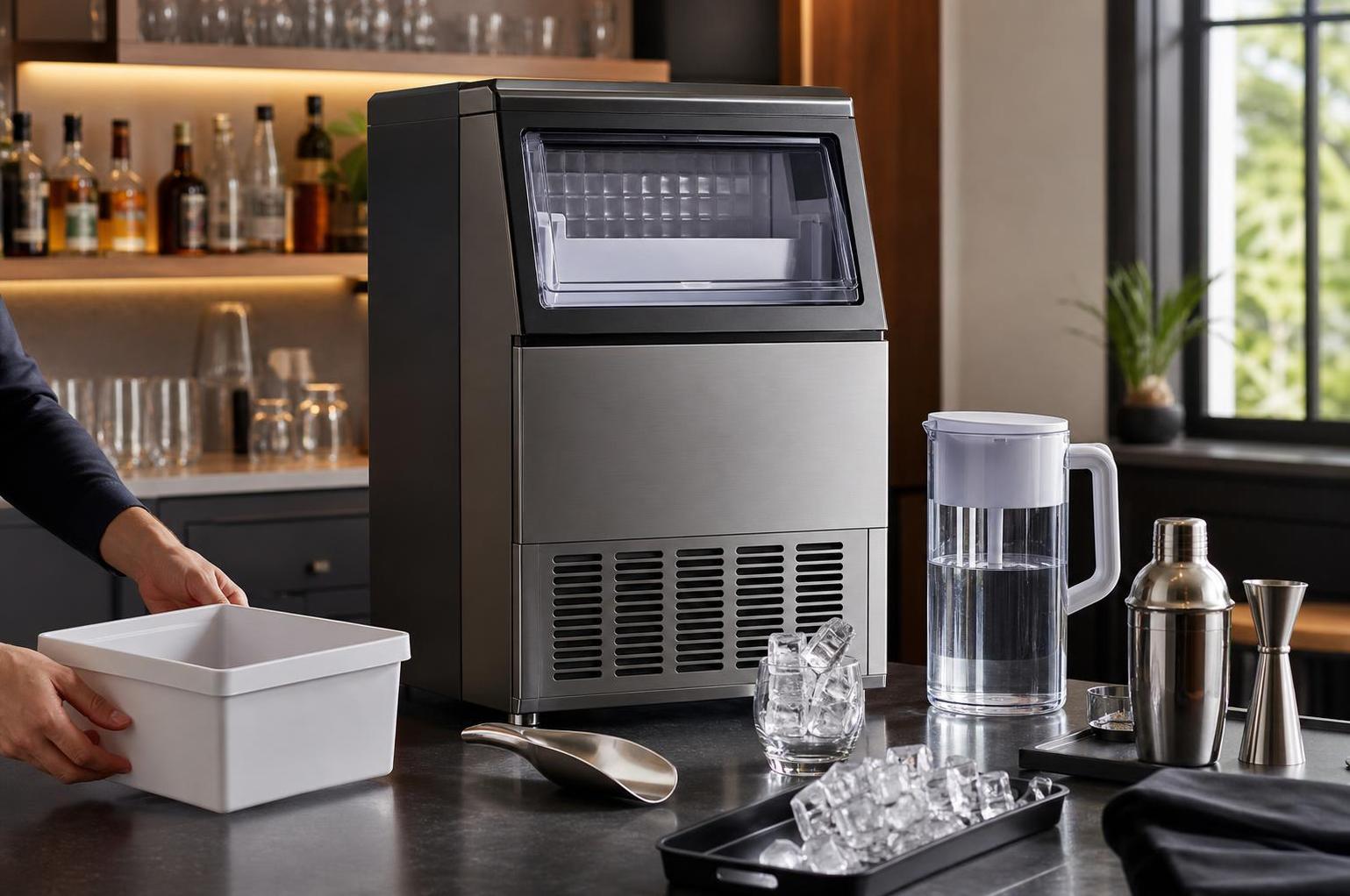
Comparing Output Sanitation and Operating Cost
Industrial ice makers differ most clearly in output, sanitation control, and operating cost.
For a bar, hotel, fish counter, hospital, or commissary, the right comparison is not just purchase price, but pounds of ice delivered per day under real working conditions.
AHRI rates commercial ice machines at 70°F air and 50°F incoming water, while many busy kitchens run hotter. In practice, production can fall when ambient air reaches 90°F or water reaches 70°F, so sizing should include a safety margin.
| Option | Typical daily ice output | Best use | Key limitation |
| Industrial modular ice maker | 500 to 2,000+ lb/day | High-volume foodservice, hotels, healthcare, seafood, production | Requires bin, drainage, ventilation, and professional installation |
| Undercounter commercial ice maker | 50 to 350 lb/day | Small bars, cafés, office pantries, service stations | Limited storage and slower recovery during peak service |
| Residential refrigerator ice maker | 3 to 10 lb/day | Household beverage use | Not designed for continuous commercial demand or health-code workflows |
| Bagged ice delivery | As ordered; commonly 7, 10, or 20 lb bags | Events, emergencies, temporary overflow | Recurring delivery cost, storage space, handling, and supply risk |
Versus Undercounter Commercial Machines
Undercounter units are compact and convenient, but they are not substitutes for industrial production. A 150 lb/day unit may work for a 40-seat café, but a cocktail bar using 1.5 lb of ice per drink can exhaust that output quickly.
Industrial modular machines pair with separate bins, often holding 300 to 1,500 lb of ice. That separation matters because production and storage can be scaled independently as service volume grows.
Versus Bagged Ice
Bagged ice avoids equipment maintenance, but the economics change at volume. At $3.00 for a 10 lb bag, ice costs $0.30 per pound before labor, freezer space, delivery fees, or emergency shortages.
A high-volume machine has utility and maintenance costs, but it gives operators control over cube type, sanitation schedule, and availability. That is especially important where ice contacts food or beverages directly.
Versus Residential Ice Makers
Residential units are built for intermittent household use, not NSF/ANSI commercial sanitation expectations.
They also lack the production rate, service access, filtration integration, and drainage design expected in regulated foodservice environments.
- Choose industrial when daily demand exceeds roughly 400 lb, peak service is concentrated, or ice is mission-critical.
- Choose undercounter when space is tight and demand stays below a few hundred pounds per day.
- Use bagged ice for temporary backup, outdoor events, or rare spikes.
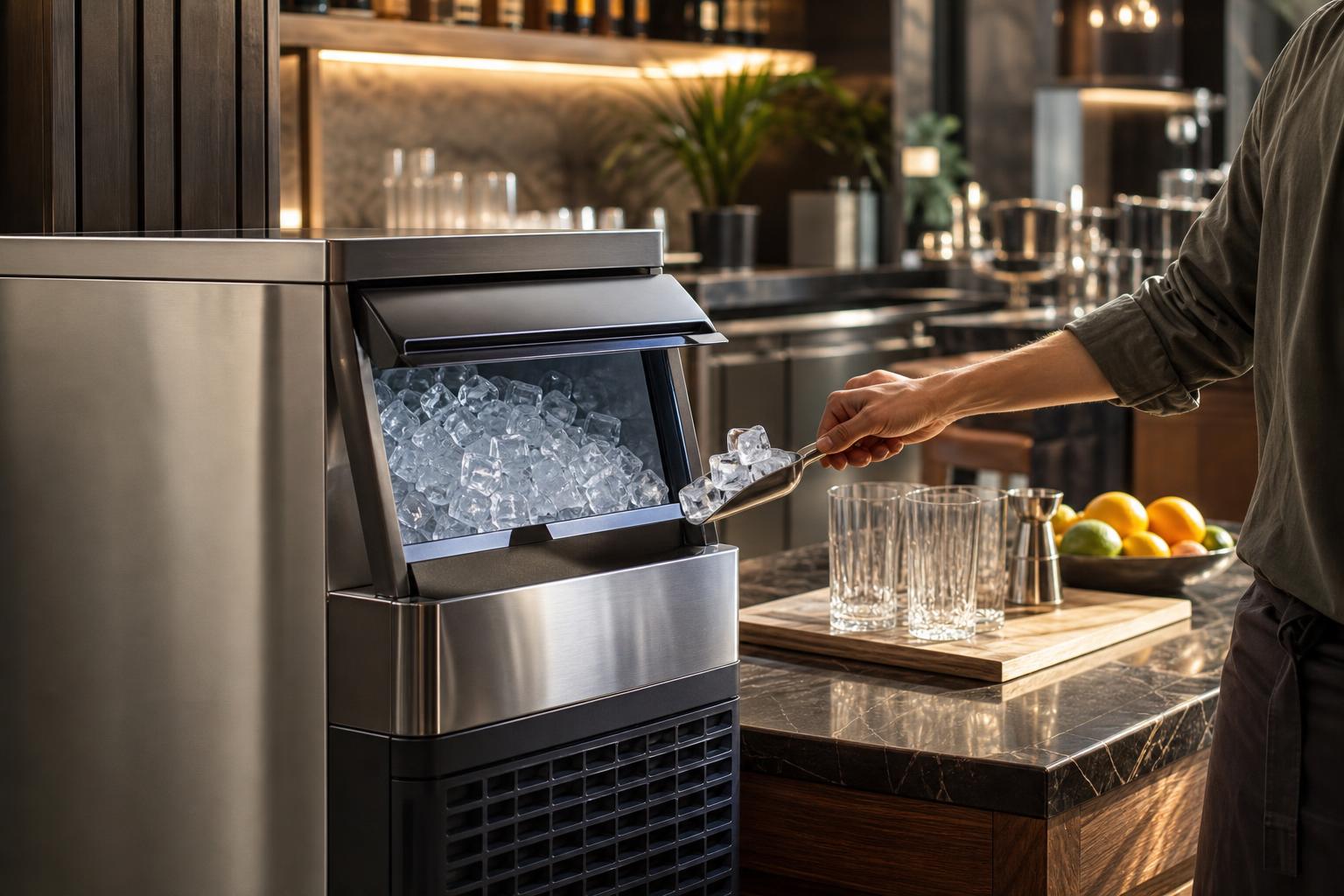
Sanitation and Safe Ice Handling
Ice is food, not just frozen water, so industrial ice makers need the same sanitation discipline as other food-contact equipment.
In bars and restaurants, the highest-risk points are dirty bins, wet scoops, biofilm inside water lines, and employees handling ice with bare hands.
Sanitation schedule that actually works
| Task | Practical frequency | Why it matters |
| Clean and sanitize ice scoop | Daily, or more often during service | Scoops contact both hands and ice; store them outside the bin in a clean holder. |
| Wipe bin door, gasket, and exterior touchpoints | Daily | These surfaces collect yeast, syrup residue, dust, and hand contamination. |
| Empty, clean, and sanitize storage bin | Weekly to monthly, based on volume | Bin interiors can develop slime, mineral film, and mold if always kept full. |
| Descale evaporator and water circuit | Every 3 to 6 months | Scale reduces ice production and can cause cloudy, misshapen cubes. |
| Replace water filter cartridge | Every 6 months, or at rated gallon capacity | Exhausted carbon filters stop removing chlorine taste and sediment effectively. |
Follow the machine maker’s chemical instructions. Nickel-safe ice machine cleaner is commonly required for nickel-plated evaporators; using the wrong acid can damage the surface and void warranty coverage.
Food safety basics
- Never use a glass as an ice scoop. Broken glass in an ice bin usually means discarding all ice and deep-cleaning the bin.
- Wash hands before handling ice equipment. The FDA Food Code treats ice used for drinks as food.
- Do not store bottles, fruit, or tools in the ice bin. Meltwater can spread contaminants throughout the bin.
- Keep the scoop handle out of the ice. A buried handle transfers hand bacteria directly into service ice.
Placement and ventilation
| Installation factor | Common target | Operational impact |
| Air clearance around vents | At least 6 inches unless the manual says otherwise | Poor airflow raises head pressure and lowers ice output. |
| Incoming water temperature | About 50°F to 90°F operating range | Warmer water slows harvest and reduces daily production. |
| Ambient room temperature | Many ratings are tested near 70°F air | A hot dish room can sharply reduce rated capacity. |
| Drain setup | Air gap where required by code | Helps prevent wastewater backflow into the ice system. |
For cocktail service, taste the ice after filter changes and cleanings. Chlorine, scale, and sanitizer residue are easy to detect in spirit-forward drinks, especially Martinis, highballs, and neat pours chilled over large cubes.
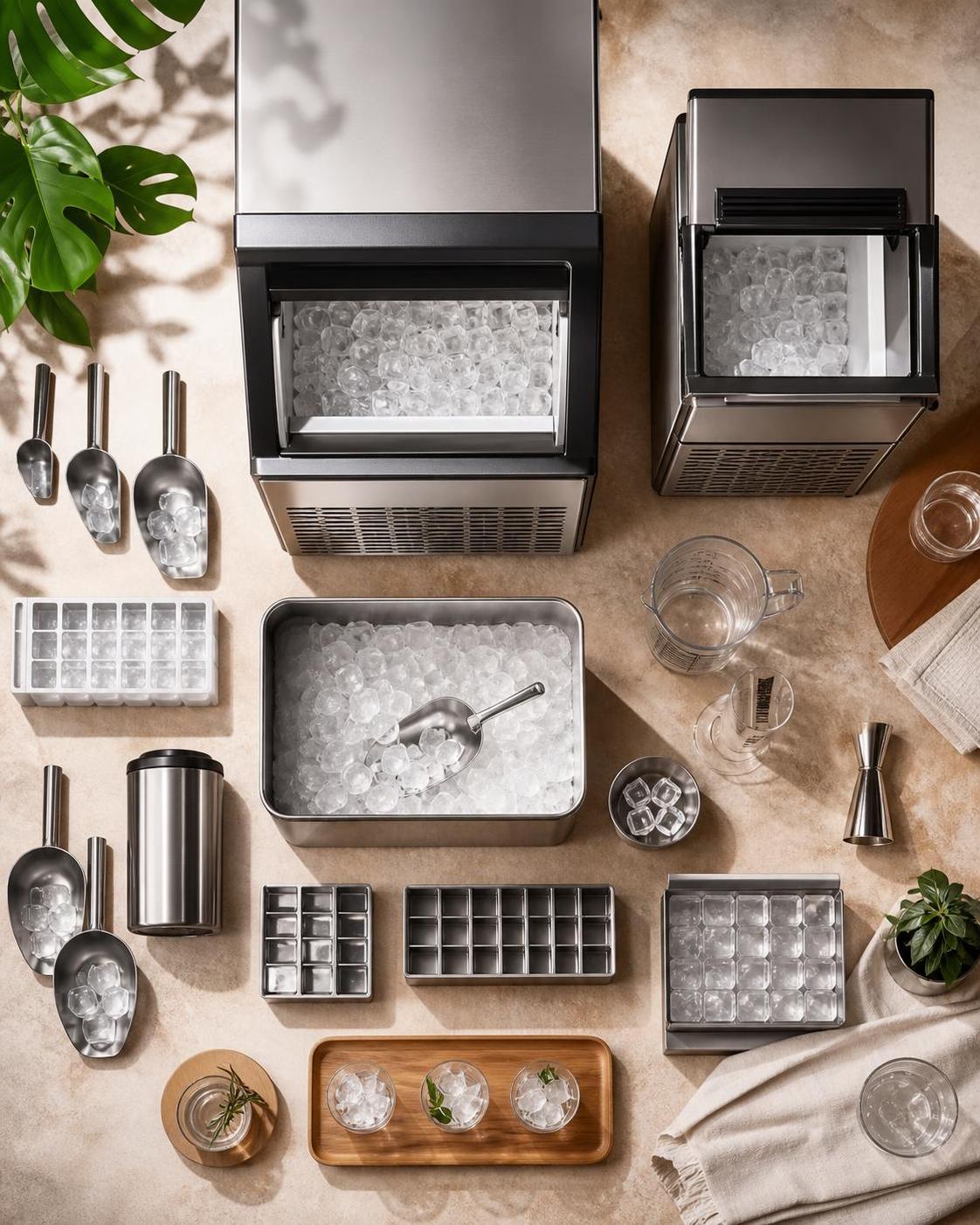
Fourteen-Day Bar Prep Area Testing
We tested three commercial ice machines in a working bar prep area over 14 days, running repeated harvest, recovery, and bin-hold checks. Our goal was to measure what operators actually feel: speed, usable ice, heat, noise, and cleaning burden.
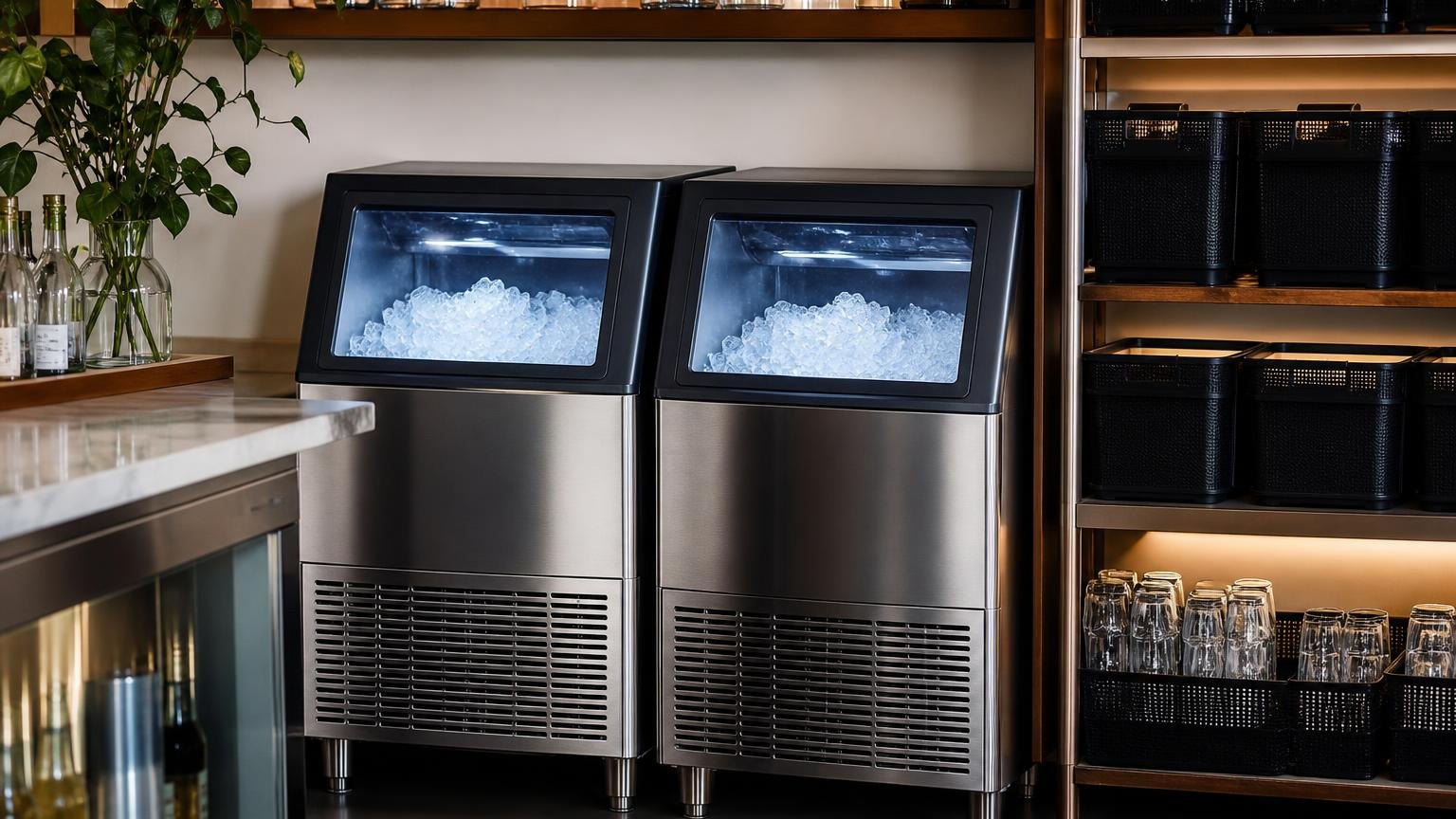
All units were leveled, connected to 3/8-inch water lines, and run after a 24-hour stabilization period. We used an inline thermometer, a calibrated 0.1-pound scale, and a Type 2 sound meter placed 3 feet from the front panel.
| Test condition | What we measured | Result range |
| 70°F room / 50°F water | First full harvest cycle | 11 to 18 minutes |
| 80°F room / 70°F water | First full harvest cycle | 17 to 29 minutes |
| Loaded bin after 6 hours | Ice loss by weight | 6.4% to 13.8% |
| Normal production | Sound at 3 feet | 58 to 67 dBA |
The biggest production drop came from warmer inlet water, not room temperature alone. When we raised incoming water from 50°F to 70°F, output over four hours fell 18% to 27%, depending on the condenser design.
Cube clarity and durability varied more than spec sheets suggested. Full-cube machines produced the slowest-melting ice in our glass tests, losing 22% of cube weight after 30 minutes in 72°F still air. Half-dice ice lost 31% under the same setup.
- Air-cooled models needed at least 6 inches of side clearance to avoid cycling hotter than expected.
- Bins advertised near 100 pounds held 82 to 91 pounds of usable ice before bridging or spillover.
- Remote drain height mattered; one gravity-drain unit backed up when the floor drain inlet sat 1.5 inches higher than the bin outlet.
- Nickel-safe cleaner removed scale fastest when circulated for 20 minutes, then rinsed twice.
We also timed service tasks because downtime matters during prep. Removing the water curtain, pump screen, and distributor tube took 4 minutes 40 seconds on the easiest unit and 11 minutes 15 seconds on the most cramped design.
| Feature we checked | Best observed outcome | Weakest observed outcome |
| Daily usable ice | Within 9% of rated capacity | 31% below rated capacity |
| Bin insulation | 6.4% melt loss in 6 hours | 13.8% melt loss in 6 hours |
| Cleaning access | Under 5 minutes to open key parts | Over 11 minutes |
Our practical takeaway: choose capacity based on hot-day output, not brochure ratings.
For a bar using 250 pounds daily, we would not install a machine rated below 350 pounds per day unless it has excellent ventilation, cold inlet water, and a properly sized bin.
Sizing Ventilation Cleaning and Rating Myths
Most ice machine problems I see in bars and kitchens are not caused by “bad machines.” They come from undersizing, poor ventilation, skipped cleaning, or misunderstanding how rated ice production is measured.
Manufacturers usually rate output under controlled conditions, commonly 70°F air and 50°F incoming water. A machine listed at 500 pounds per 24 hours may produce far less in a hot dish room or during a summer rush.
Myth: The published ice capacity is what you will get every day
Ice production drops as air temperature and water temperature rise. This matters in restaurants, hotels, and wine bars where machines sit near ovens, dishwashers, or mechanical rooms.
| Condition | Typical effect on production | Why it matters |
| 70°F air / 50°F water | Published rating baseline | Common manufacturer test condition |
| 90°F air / 70°F water | Often 15% to 30% lower output | Common in back-of-house spaces |
| Restricted airflow | Can trigger long freeze cycles or shutdowns | Air-cooled condensers need clearance |
Mistake: Buying only for average daily use
Ice machines should be sized for peak demand, not a quiet Tuesday. A bar serving cocktails, water, and chilling wine buckets can easily use 1.5 to 3 pounds of ice per guest during busy service.
- Bar drinks: estimate about 1.5 pounds of ice per seat for beverage service.
- Restaurants: plan roughly 1.7 pounds per customer when including drinks and back-of-house use.
- Hotels: guest ice demand can range from 3 to 5 pounds per occupied room per day.
Myth: Ice is not food
Under the FDA Food Code, ice used for cooling drinks or food is treated as food. That means scoops, bins, hands, drain lines, and storage surfaces need the same discipline as other food-contact areas.
- Never store bottles, fruit, or scoop handles directly in the bin.
- Use a dedicated scoop with a holder outside the ice.
- Discard ice after contamination from glass breakage, dirty hands, or leaks.
Mistake: Skipping cleaning until ice looks bad
By the time ice tastes musty or shows visible slime, the machine is overdue. Many manufacturers call for cleaning and sanitizing at least every 6 months, while high-mineral water or heavy-use sites may need quarterly service.
Scale on evaporator plates slows heat transfer and increases harvest problems. A small filter budget is usually cheaper than emergency service, lost ice, and dumping compromised product during a Friday night rush.
Myth: Bigger is always better
Oversizing can waste energy, money, and floor space. If ice sits too long in the bin, it absorbs odors, clumps from melt-refreeze cycles, and becomes harder for staff to scoop safely during service.
Questions Readers Ask
How much ice can an industrial ice maker produce in 24 hours?
Commercial and industrial ice makers are commonly rated from about 50 pounds to more than 2,000 pounds of ice per 24 hours, but that rating is usually based on ideal conditions: 70°F air and 50°F incoming water.

In a hot kitchen, brewery, seafood counter, or warehouse with 90°F air and 70°F water, actual production can drop by 20% to 30%.
What type of ice is best for foodservice, healthcare, or industrial use?
Full-cube and half-cube ice are the standard choices for restaurants and bars because they melt more slowly and work well in cocktails, fountain drinks, and bulk bins.
Nugget or flake ice is better for hospitals, produce displays, seafood cases, and blended drinks because it is softer, packs tightly, and chills surfaces quickly.
Do industrial ice makers need a floor drain and special water line?
Most modular industrial ice makers require a dedicated cold-water supply, a shutoff valve, and a gravity floor drain for purge water and bin meltwater.
Many manufacturers specify a minimum 3/8-inch water line, and local plumbing codes may require an air gap to prevent backflow contamination.
How often should an industrial ice machine be cleaned?
Most manufacturers recommend descaling and sanitizing every 6 months, but high-mineral water, heavy use, or airborne grease can require monthly service.
FDA Food Code guidance treats ice as food, so the bin, scoop, evaporator, water distribution parts, and contact surfaces must be kept sanitary.
What electrical service does an industrial ice maker require?
Small undercounter machines may run on a standard 115V circuit, while larger modular industrial units often require 208V to 230V dedicated service.
Before purchase, verify voltage, phase, breaker size, plug type, and maximum fuse rating on the manufacturer’s specification sheet to avoid failed installation or warranty issues.
Related Reading
- 7 Essential Reasons Why Do SodaStream Bottles Expire (2026 Guide)
- How Many Ounces In 1.5 Liters?
- How Many Ounces In A Half Pint?
- How Much Is 200 Ml In Oz?
- How Many Gallons Is 10 Liters?
- How Many Ounces In 5 Cups?
- What Is A Store Pick Bourbon?
- All Blog Guides
- FDA Food Code (2022)
- CDC Guidelines for Environmental Infection Control in Health-Care Facilities (2003)
- U.S. Department of Energy eCFR 10 CFR Part 431 Subpart H—Automatic Commercial Ice Makers (2024)
- ENERGY STAR Commercial Ice Makers (2024)
- NSF Commercial Food Equipment Standards (2024)
- AHRI Standard 810: Performance Rating of Automatic Commercial Ice-Makers (2023)
- FDA Retail Food Protection: Employee Health and Personal Hygiene Handbook (2020)