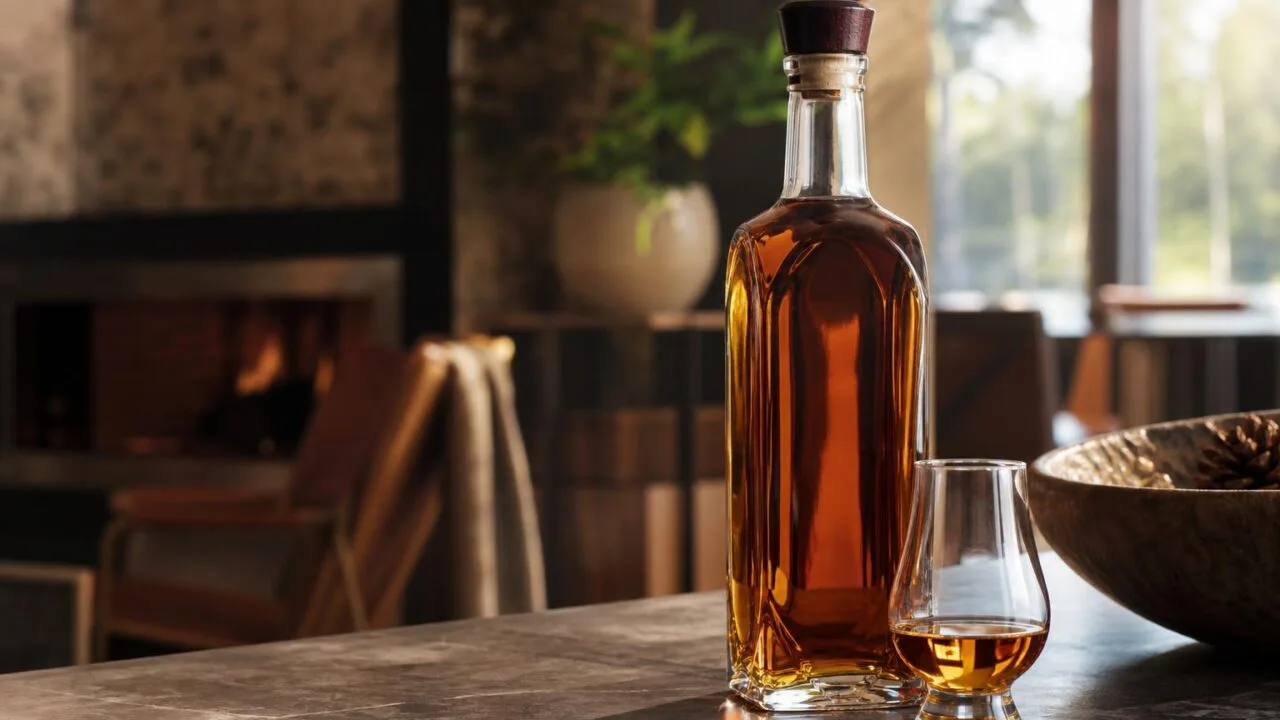
What Is A Rye Whiskey is a whiskey made from a mash containing at least 51% rye grain in the United States. By law, it must be distilled below 160 proof, entered into new charred oak barrels at 125 proof or less.
Compared with bourbon, rye whiskey usually tastes drier, spicier, and more grain-forward, with common notes of black pepper, baking spice, mint, citrus peel, and toasted oak. “Straight rye” means it was aged at least 2 years.
This guide explains how rye whiskey is defined, how it is made, how American and Canadian rye differ, what labels such as “straight” mean, and why rye became essential in classic cocktails like the Manhattan and Old Fashioned.
U.S. Legal Standards for Rye Whiskey
In the United States, “rye whiskey” is a legal category, not just a flavor description.
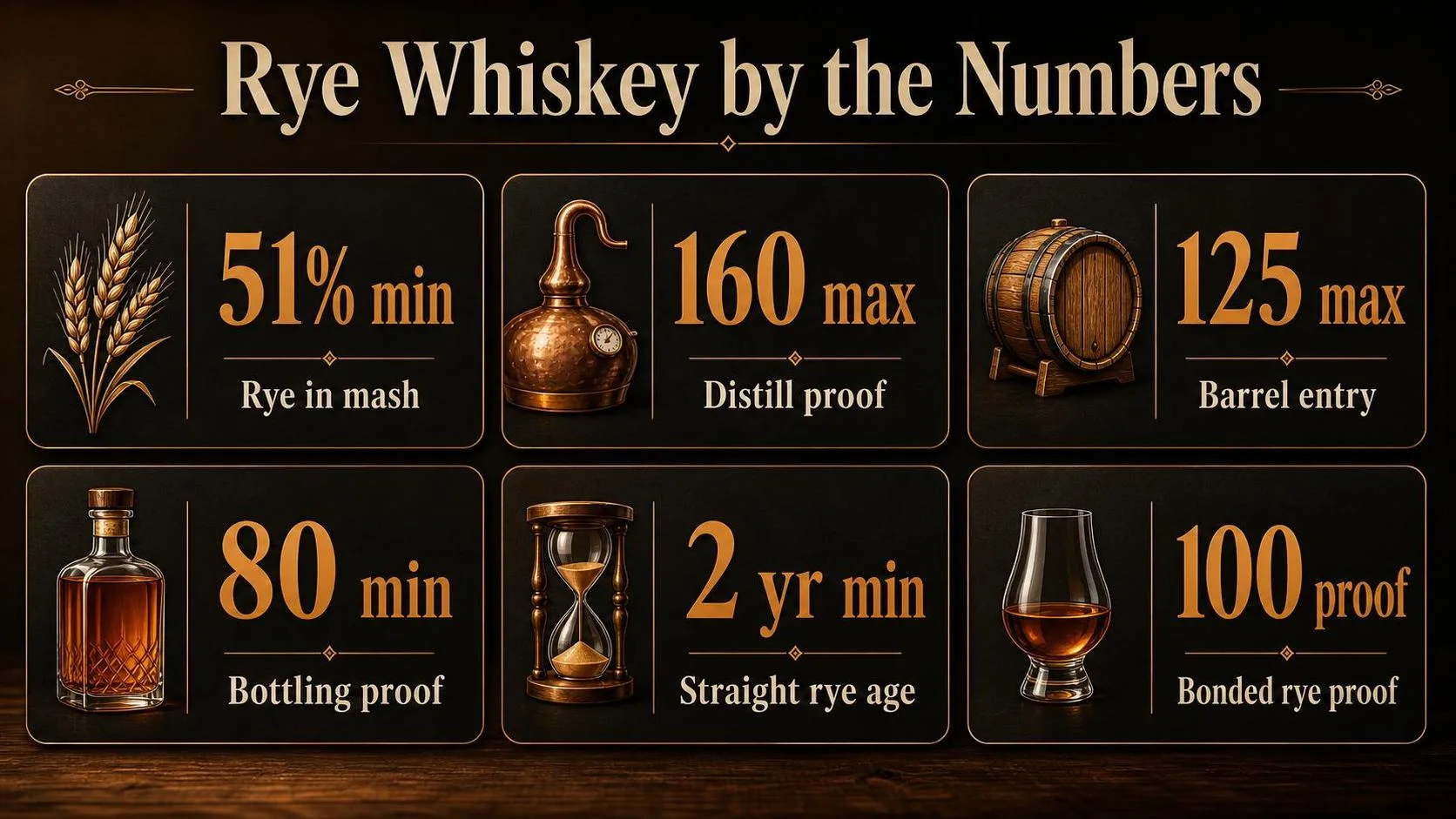
The key numbers come from federal standards of identity: the grain bill, distillation proof, barrel-entry proof, aging vessel, and bottling strength all matter.
| Number | What it means for U.S. rye whiskey |
| 51% rye minimum | The mash bill must be at least 51% rye grain. The remaining 49% can include corn, malted barley, wheat, or other grains. |
| 160 proof maximum | Rye whiskey must be distilled to no more than 160 proof, or 80% ABV. This preserves more grain character than neutral spirits, which are distilled higher. |
| 125 proof maximum | The spirit must enter the barrel at no more than 125 proof, or 62.5% ABV. Water is often added before barreling to reach this limit. |
| New charred oak | U.S. rye whiskey must be aged in new, charred oak containers. The law does not require a specific barrel size. |
| 80 proof minimum | Rye whiskey must be bottled at no less than 80 proof, or 40% ABV. |
The 51% rule is the number drinkers notice most. A “barely legal” rye may use 51% rye with a high corn content, giving a rounder, sweeter profile. A 95% rye mash bill usually tastes drier, spicier, and more herbal.
“Straight rye whiskey” adds another important number: 2 years.
To use the word “straight,” the whiskey must be aged at least 2 years and meet the same production standards, with no added coloring, flavoring, or blending materials.
- Under 4 years old: a straight rye must carry an age statement showing the age of the youngest whiskey in the bottle.
- 4 years or older: an age statement is not required, though many producers still include one.
- Bottled-in-bond rye: must be 100 proof, from one distilling season, one distiller, one distillery, aged at least 4 years in a federally bonded warehouse.
These numbers are U.S.-specific. Canadian whisky labeled “rye” does not have to contain 51% rye grain; historically, “rye” in Canada often described a style of whisky rather than a fixed mash bill requirement.
Production Choices That Shape Rye Flavor
Rye whiskey’s flavor is shaped by grain, fermentation, distillation, barrel, warehouse, and proofing decisions.
In the United States, “rye whiskey” must be made from at least 51% rye grain, distilled below 160 proof, barreled below 125 proof, and aged in new charred oak.
Those legal limits leave plenty of room for style. A peppery, lean rye and a rounded, vanilla-heavy rye can both meet the same federal standard.
Grain Bill
Rye brings black pepper, mint, dill, caraway, citrus peel, and dry spice. Corn adds sweetness and body, while malted barley contributes enzymes for fermentation plus biscuit or cereal notes.
| Component | Typical role | Flavor impact |
| 51% rye minimum | U.S. legal baseline | Spice, dryness, herbal edge |
| 70% to 95% rye | Common high-rye range | Sharper spice, less corn sweetness |
| Corn | Secondary grain in many mash bills | Caramel, roundness, softer finish |
| Malted barley | Often 5% to 15% | Fermentation support, grainy depth |
Fermentation and Distillation
Fermentation length matters. A 48-hour ferment tends to preserve cleaner grain notes, while 72 to 96 hours can build more fruit, acidity, and savory complexity from yeast and bacterial activity.
Distillation proof changes texture. U.S. rye cannot come off the still above 160 proof, or 80% alcohol by volume. Lower distillation proofs usually retain more grain character; higher proofs produce a lighter spirit.
Barrel and Warehouse
New charred oak is mandatory for U.S. rye. Char level affects how quickly oak sugars, smoke, clove, coconut, and vanilla compounds move into the spirit.
| Variable | Typical number | Result in the glass |
| Entry proof | Maximum 125 proof | Lower entry can emphasize wood sugars and texture |
| Barrel size | 53 gallons is standard | Slower, steadier extraction than small barrels |
| Char | Commonly 15 to 55 seconds | More char can add smoke, color, and filtration |
| Age statement | Youngest whiskey in the bottle | Controls the stated maturity, not the average age |
Climate, Proof, and Blending
Warehouse climate strongly affects maturation. Hot upper floors expand whiskey deeper into oak; cooler lower floors slow extraction. Kentucky and Indiana ryes often mature faster than Canadian rye stored in colder conditions.
Bottling proof changes perception. At 80 proof, rye can taste softer and sweeter. At 100 proof or barrel proof, spice, oak, heat, and texture become more intense.
- Straight rye must be aged at least 2 years and contain no added coloring or flavoring.
- Bottled-in-bond rye must be 100 proof, at least 4 years old, from one distilling season, and one distiller.
- Blending balances barrels with different age, warehouse position, proof, and oak intensity.
How Rye Whiskey Is Defined
Rye whiskey is verified through its mash bill, distillation proof, barrel entry proof, aging container, and bottling proof. In the United States, those requirements are defined by the Alcohol and Tobacco Tax and Trade Bureau under 27 CFR §5.143.
The first check is the grain recipe. To be labeled “rye whiskey” in the U.S., the fermented mash must contain at least 51% rye grain. The remaining 49% can include corn, malted barley, wheat, or other cereal grains.
| Requirement | U.S. rye whiskey standard |
| Minimum rye in mash | 51% |
| Maximum distillation proof | 160 proof, or 80% alcohol by volume |
| Maximum barrel entry proof | 125 proof, or 62.5% alcohol by volume |
| Minimum bottling proof | 80 proof, or 40% alcohol by volume |
| Required barrel type | New charred oak containers |
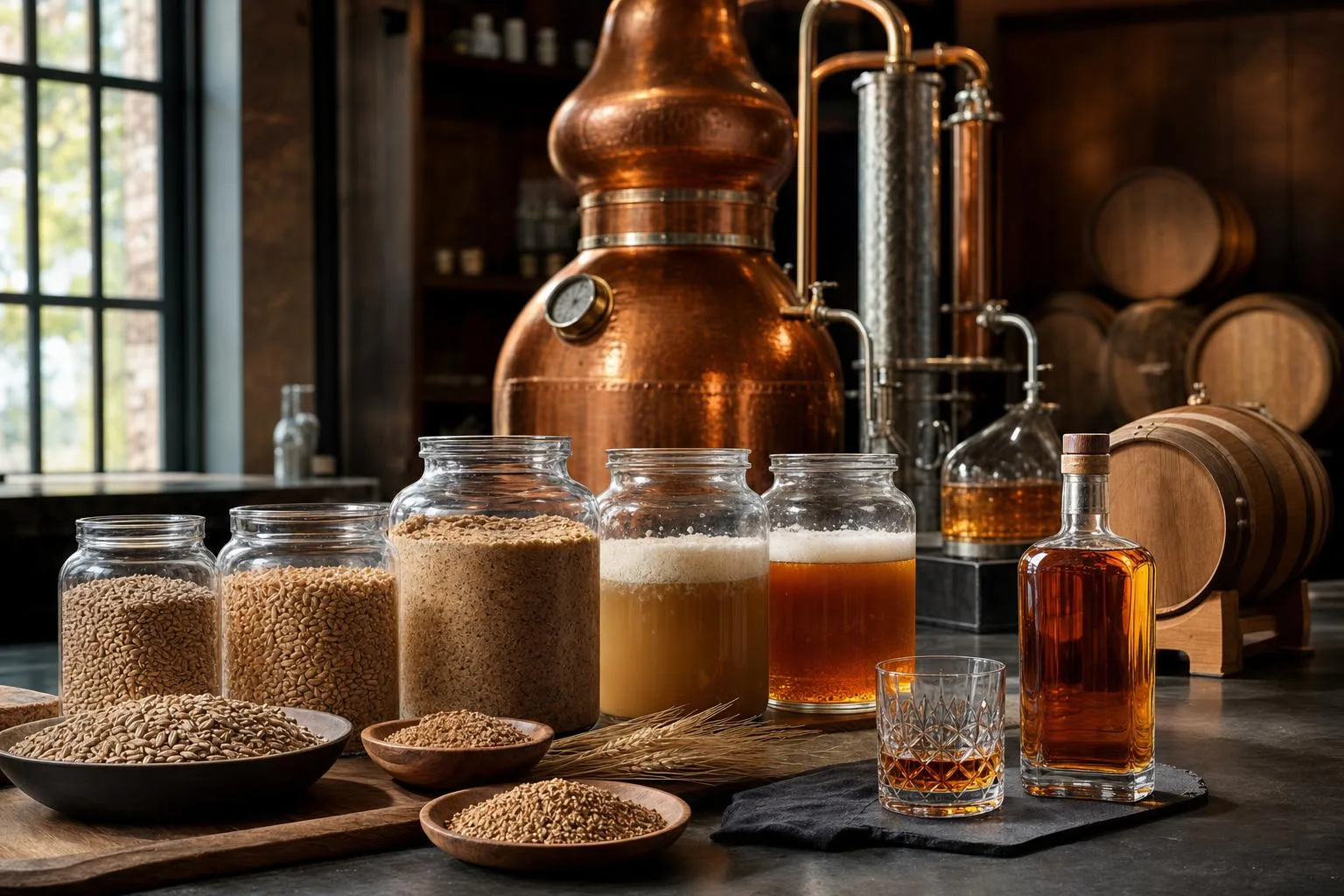
Distillers document the mash bill in production records, including grain weights, water additions, yeast use, fermentation dates, and batch volumes. Regulators can review these records to confirm the spirit was made from a qualifying rye-based mash.
Proof is measured using calibrated hydrometers, densitometers, or digital alcohol meters.
Because alcohol density changes with temperature, proof readings are corrected to the U.S. reference temperature of 60°F before they are recorded for compliance and tax purposes.
- At distillation: the spirit must come off the still at no more than 160 proof, preserving grain-derived flavor.
- At barreling: it must enter new charred oak at no more than 125 proof.
- At bottling: it must be bottled at 80 proof or higher.
Aging is verified through barrel logs, warehouse records, fill dates, dump dates, and gauge reports. Standard rye whiskey has no federal minimum aging period, but “straight rye whiskey” must be aged at least 2 years in new charred oak.
| Label term | Verification point |
| Rye whiskey | At least 51% rye mash and compliance with proof and barrel rules |
| Straight rye whiskey | Meets rye whiskey rules and is aged at least 2 years |
| Age statement required | Straight rye aged less than 4 years must state its age |
| Bottled in bond rye | One distiller, one distilling season, one bonded warehouse, at least 4 years old, bottled at 100 proof |
Labels are also reviewed before sale. Most U.S. rye whiskey labels require a Certificate of Label Approval, commonly called a COLA, from the TTB. The agency checks class, type, proof, age claims, and prohibited misleading statements.
In practice, verification is a chain of evidence: grain receipts, production logs, proof gauges, barrel records, and approved labeling must all align. If one link fails, the whiskey may not legally qualify as rye whiskey.
How Rye Differs from Bourbon
Rye whiskey is defined less by color or age than by grain: in the United States, it must be made from a mash of at least 51% rye grain.
That one requirement usually makes it drier, spicier, and more peppery than bourbon, which must be at least 51% corn.
| Whiskey type | Key legal grain requirement | Typical flavor direction |
| U.S. rye whiskey | At least 51% rye | Pepper, baking spice, dry grain, mint, citrus peel |
| Bourbon | At least 51% corn | Vanilla, caramel, oak, sweet corn, toffee |
| Single malt Scotch | 100% malted barley, from one distillery | Malt, orchard fruit, honey, smoke in peated styles |
| Canadian whisky | No U.S.-style 51% rye rule for “rye” labeling | Often lighter, smooth, grainy, sometimes rye-spiced |
Compared with bourbon, rye usually tastes less sweet even when aged in the same type of new charred oak barrel.
Corn contributes a rounder sweetness, while rye brings sharper spice notes that bartenders prize in Manhattans, Old Fashioneds, and Sazeracs.
Legally, U.S. rye and bourbon share several production rules. Both must be distilled to no more than 160 proof, entered into new charred oak containers at no more than 125 proof, and bottled at a minimum of 80 proof.
| Production point | U.S. rye whiskey | Bourbon |
| Minimum main grain | 51% rye | 51% corn |
| Maximum distillation proof | 160 proof | 160 proof |
| Maximum barrel-entry proof | 125 proof | 125 proof |
| Minimum bottling proof | 80 proof | 80 proof |
Scotch is a different comparison because its identity is built around Scotland, malted barley, and often used oak casks.
Rye’s new charred oak requirement gives it stronger fresh oak, vanilla, and spice extraction than many Scotch whiskies aged in refill bourbon or sherry casks.
Canadian “rye” can confuse U.S. drinkers.
In Canada, the terms “Canadian whisky,” “Canadian rye whisky,” and “Rye Whisky” are broadly interchangeable under Canadian rules, even when rye is not the majority grain.
Some are rye-forward; others are mainly corn-based blends.
- Choose rye for a drier, spicier whiskey that stands up well in stirred cocktails.
- Choose bourbon for a sweeter, fuller profile with caramel and vanilla emphasis.
- Choose Scotch when you want malt character, regional variation, or peat smoke.
- Choose Canadian whisky for a generally lighter, blend-friendly style, but check the mash bill if rye content matters.

Serving Strength and Portion Size
Rye whiskey is typically bottled at a higher alcohol strength than beer or wine, so portion size matters. For health and safety, think in “standard drinks,” pace deliberately, and treat cask-strength rye with extra caution.
In the United States, one standard drink contains 0.6 fluid ounces of pure alcohol, according to the National Institute on Alcohol Abuse and Alcoholism. A standard pour of 80-proof rye is 1.5 fluid ounces.
| Drink | Typical serving | Alcohol content | Approximate standard drinks |
| Rye whiskey, 80 proof | 1.5 fl oz | 40% ABV | 1.0 |
| Rye whiskey, 100 proof | 1.5 fl oz | 50% ABV | 1.25 |
| Cask-strength rye | 1.5 fl oz | 60% ABV | 1.5 |
| Table wine | 5 fl oz | 12% ABV | 1.0 |
| Regular beer | 12 fl oz | 5% ABV | 1.0 |
The CDC advises that adults who choose to drink do so in moderation. That means up to one drink per day for women and up to two drinks per day for men, not as an average to “save up.”.
- Measure your pour: Use a jigger. Free-pouring rye into a rocks glass can easily turn one drink into two, especially with large ice cubes.
- Check the proof: Bottles labeled bottled-in-bond are 100 proof. Barrel-proof rye can exceed 120 proof, so a normal-looking pour may contain much more alcohol.
- Drink water alongside it: A glass of water between pours helps slow consumption, but it does not “sober you up.” Only time reduces blood alcohol concentration.
- Eat first: Food slows alcohol absorption. High-proof rye on an empty stomach can feel deceptively smooth before impairment becomes obvious.
- Do not drive: In every U.S. state, a blood alcohol concentration of 0.08% is illegal for most drivers; impairment can begin below that level.
- Avoid alcohol when pregnant: The CDC states there is no known safe amount of alcohol during pregnancy.
Rye can be intense neat, especially above 50% ABV. If tasting professionally or casually, add a few drops of water, use a tulip-shaped glass, and take small sips rather than full mouthfuls.
Store rye upright, away from heat and sunlight. Unlike wine, whiskey does not improve after opening, but a tightly sealed bottle kept cool and dark can remain enjoyable for years.
How We Tasted Rye Whiskey
We tested rye whiskey the way most guests encounter it: neat, over ice, and in a Manhattan. Across repeated pours, the clearest practical difference was not “spiciness” alone, but how rye held structure when diluted.
For our bench tasting, we used three straight rye whiskeys and two high-rye bourbons as controls. Each sample was poured at 1 ounce into identical Glencairn glasses, rested 10 minutes, and tasted blind by four staff members.
| Test item | Measured setup | What we observed |
| Neat tasting | 1 oz pours, 10-minute rest, room at 70°F | Rye showed more black pepper, mint, dill, dry cocoa, and toasted grain than the bourbon controls. |
| Dilution test | 1 oz whiskey plus 0.25 oz water, repeated twice | Rye aromatics opened quickly, but the finish shortened after the second dilution. |
| Ice test | 1 large cube, tasted at 2, 5, and 10 minutes | Rye stayed drier at 5 minutes; bourbon became sweeter and rounder faster. |
| Manhattan trial | 2 oz whiskey, 1 oz sweet vermouth, 2 dashes bitters | Rye produced a firmer, less sugary cocktail with clearer spice through the vermouth. |
In glass, the rye whiskeys were not automatically harsher. The best-balanced sample, bottled at 100 proof, felt more controlled than a softer 90-proof rye because its oak, grain, and alcohol were better integrated.
We also checked label claims against the legal definition.
In the United States, rye whiskey must be made from a mash of at least 51% rye grain, distilled to no more than 160 proof, entered into new charred oak at no more than 125 proof, and bottled at 80 proof or higher.
- Ryes with mash bills near the legal minimum tasted rounder, with more caramel and vanilla from corn and barrel influence.
- Higher-rye examples showed sharper grain character: pepper, eucalyptus, clove, grass, and dry baking spice.
- At 95 proof and above, rye generally performed better in stirred cocktails because dilution did not erase the grain note.
- Age mattered less than balance in our tasting; a younger rye with clean spice outperformed an older bottle that tasted woody and thin.
Our main takeaway: rye whiskey is defined by grain, but judged by balance. The 51% rye threshold explains the category; the bottle’s proof, mash bill, barrel time, and blending decide whether it tastes bright, spicy, lean, or cocktail-ready.
Common Misunderstandings About Rye Whiskey
Rye whiskey is often misunderstood because “rye” can mean a grain, a U.S. legal whiskey category, or a Canadian style label. The most common mistakes come from assuming all spicy whiskey is rye, or that rye must taste harsh.
| Claim | Accurate rule or fact |
| U.S. rye can be any whiskey with rye flavor | Federal standards require at least 51% rye grain in the mash bill. |
| Rye and bourbon are basically the same | Bourbon requires at least 51% corn; rye requires at least 51% rye. |
| Rye can be aged in used barrels | U.S. straight rye must be aged in new charred oak containers. |
| “Straight rye” means very old | It means at least 2 years of aging, with no added color, flavor, or blending materials. |
Myth: Rye whiskey is always spicy and aggressive
Rye grain often brings pepper, mint, dill, citrus peel, or herbal notes, but the final flavor depends on fermentation, barrel entry proof, warehouse climate, and age.
A 95% rye mash bill can taste lean and snappy; a 51% rye mash bill may taste rounder.
Myth: Canadian whisky labeled “rye” must meet the U.S. 51% rule
In the United States, “rye whiskey” has a specific mash requirement.
In Canada, “Canadian whisky,” “Canadian rye whisky,” and “rye whisky” are traditionally interchangeable terms, and the whisky does not have to contain 51% rye grain.
Myth: High rye bourbon is rye whiskey
High-rye bourbon is still bourbon if corn is at least 51% of the mash bill. Many high-rye bourbons use 20% to 35% rye, which can add spice, but the legal category remains bourbon.
Myth: Older rye is automatically better
Rye can become excellent at 4 to 8 years, especially in new charred oak. Very long aging may add dryness, tannin, and heavy oak. Age matters, but balance matters more than the number on the label.
Myth: “Small batch” or “craft” guarantees higher quality
Those terms are not federal quality grades. A small batch may be excellent, ordinary, or sourced from a large distillery. Check the proof, age statement, producer disclosure, and whether it says “straight rye whiskey.”.
- Look for “straight rye” if you want a whiskey aged at least 2 years with no added flavoring or coloring.
- Do not confuse rye with rye malt whiskey. Rye malt whiskey must be made from at least 51% malted rye, not unmalted rye.
- Proof changes perception. A 100-proof rye can seem drier and spicier than the same whiskey at 80 proof.
Questions Readers Ask
What is a rye whiskey?
Rye whiskey is a grain spirit made with rye as the defining grain, giving it a drier, spicier profile than most corn-heavy bourbons.
In the United States, “rye whiskey” must be made from a mash of at least 51% rye grain, distilled to no more than 160 proof, entered into new charred oak containers at no more than 125 proof, and bottled at a minimum of 80 proof.
How does rye whiskey taste compared with bourbon?
Rye whiskey typically tastes peppery, herbal, grainy, and dry, with notes that can include baking spice, mint, dill, citrus peel, and toasted oak.
Bourbon, which must be made from at least 51% corn, is usually sweeter and rounder, often showing more caramel, vanilla, and corn sweetness.
What does “straight rye whiskey” mean?
“Straight rye whiskey” is U.S. rye whiskey that has been aged in new charred oak containers for at least 2 years and contains no added coloring, flavoring, or blending materials.
If it is aged less than 4 years, the bottle must carry an age statement showing the age of the youngest whiskey in the bottle.
Is Canadian rye whiskey the same as American rye whiskey?
No. In Canada, “rye whisky” is often used as a traditional style name and does not legally require a mash bill of at least 51% rye the way U.S. rye whiskey does.
Canadian whisky labeled “rye” can vary widely in rye content, though many producers do use rye grain for its spicy character.
What cocktails are best with rye whiskey?
Rye whiskey is a classic choice for cocktails that benefit from a dry, spicy backbone, especially the Manhattan, Old Fashioned, Sazerac, and Whiskey Sour.
Its spice helps it stand up to sweet vermouth, bitters, sugar, and citrus without tasting overly sweet.
How much rye grain must a whiskey contain to be labeled rye in the United States?
Under U.S. regulations, rye whiskey must be made from a mash bill containing at least 51% rye grain.
It also must be distilled to no more than 160 proof and entered into new charred oak containers at no more than 125 proof; no minimum aging applies unless it is labeled straight rye whiskey.
Related Reading
- How Many Cups Is 64 Oz?
- How Many Ounces Is 1500 Ml?
- How Many Ounces Is 950 Ml?
- How Much Oz In A Gallon?
- How Many Ml Is 32 Oz?
- How Many Ounces In 2 Gallons? – 2026
- What Does Rose Taste Like? Answer By Expert
- All Blog Guides
- eCFR — 27 CFR § 5.143, Whisky (2024)
- Alcohol and Tobacco Tax and Trade Bureau — Beverage Alcohol Manual, Chapter 4: Class and Type Designation (2024)
- Alcohol and Tobacco Tax and Trade Bureau — Distilled Spirits FAQs (2024)
- Cornell Law School Legal Information Institute — 27 CFR § 5.143, Whisky (2024)
- USDA FoodData Central — Whiskey, 86 Proof (2024)
- Encyclopaedia Britannica — Rye Whiskey (2024)
- Distilled Spirits Council of the United States — Distilled Spirits 101: Whiskey (2024)