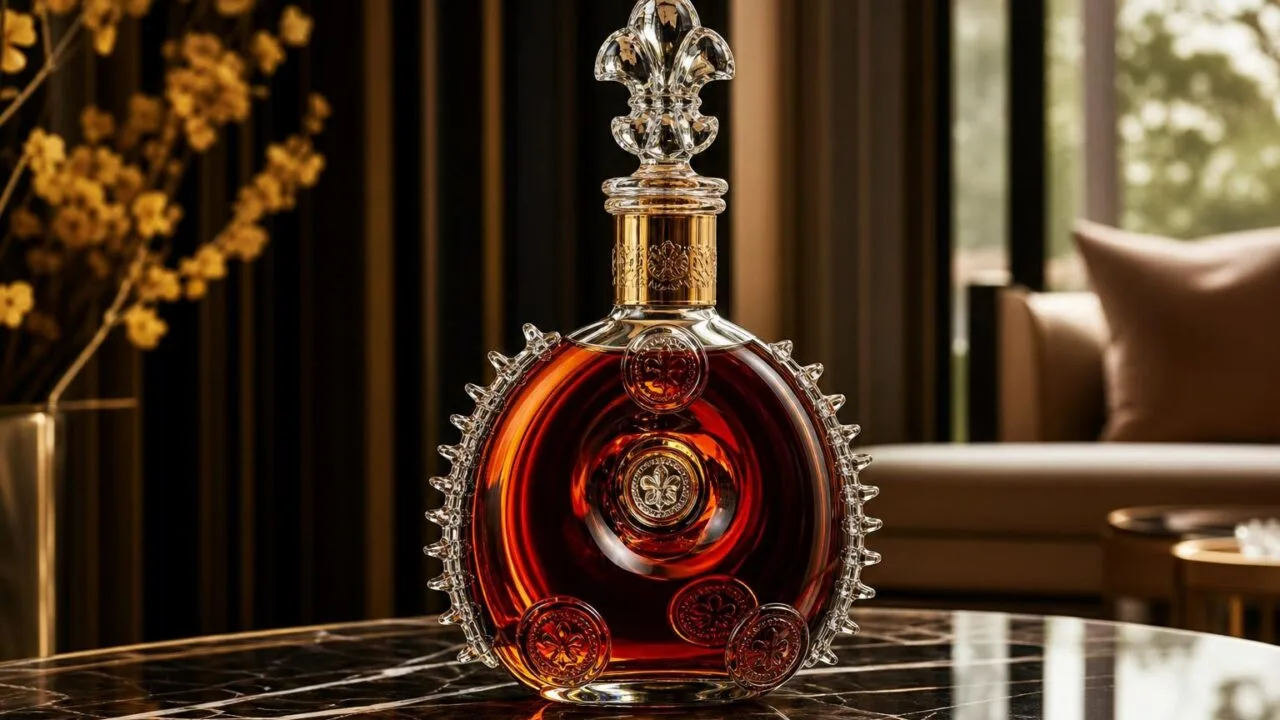
What Is The Most Expensive Whiskey is The Macallan 1926 Adami, a single malt that sold for £2.19 million, about $2.7 million, at Sotheby’s London in November 2023. The bottle came from cask no.
263, filled in 1926 and bottled in 1986 after 60 years.
That auction record matters because “most expensive” can mean verified sale price, not retail wish-list pricing.
This article separates confirmed auction results from rare releases, explains why labels by Valerio Adami and Michael Dillon command premiums, and shows how age, cask history, provenance, and condition drive collectible whiskey values.
Macallan 1926 Auction Record Price
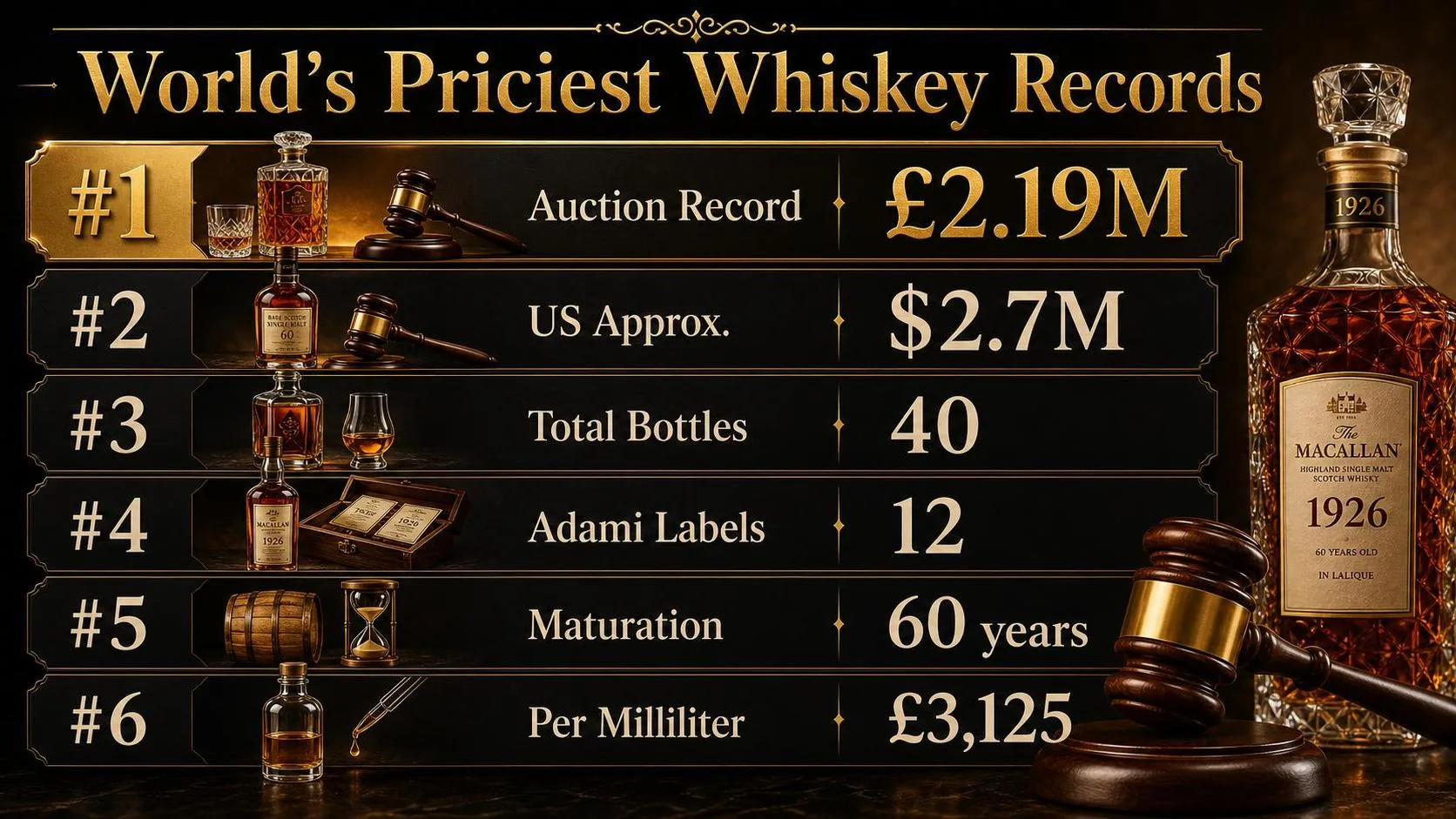
The most expensive whiskey ever sold at public auction is the Macallan 1926 60 Year Old, with a final Sotheby’s London price of £2,187,500 in November 2023. That is about $2.7 million, depending on exchange rates at the time of sale.
This record matters because it reflects a verified hammer-plus-premium auction result, not an insurance estimate, retail listing, or jeweled decanter price.
| Whiskey | Sale / valuation | Key number | Why it matters |
| Macallan 1926 60 Year Old, Valerio Adami label | Sotheby’s London, 2023 | £2,187,500 | Current verified auction record for a single bottle of whisky. |
| Macallan 1926 60 Year Old, Fine & Rare label | Sotheby’s London, 2019 | £1,452,000 | Earlier landmark sale, widely cited as the first whisky bottle above £1 million. |
| Macallan 1926 60 Year Old, Michael Dillon hand-painted bottle | Christie’s London, 2018 | £1,200,000 | Unique artwork bottle; helped establish the Macallan 1926 as the trophy whisky benchmark. |
| Ardbeg Cask No. 3 | Distillery sale, 2022 | £16,000,000 | Record-level cask sale, but not a single-bottle whiskey price. |
The Macallan 1926 was distilled in 1926 and bottled in 1986 after 60 years in sherry-seasoned oak. Only 40 bottles were produced, which is the central scarcity figure behind its auction dominance.
- 40 bottles: the total Macallan 1926 60 Year Old release, split across different label designs.
- 12 bottles: the approximate number carrying the Valerio Adami label, one of the most collectible versions.
- 60 years: the maturation age stated on the bottle, unusually old for Scotch whisky.
- 700 ml: the standard bottle size, meaning the 2023 sale equates to roughly £3,125 per milliliter.
It is important to separate “most expensive whiskey” from “most expensive whiskey object.” Some ultra-high prices come from diamond-covered bottles or luxury packaging.
Where the value is jewelry and presentation rather than the liquid.
Cask sales are also different. The £16 million Ardbeg cask involved an entire cask of whisky, not one sealed retail bottle.
For bottle collectors, auction records remain the cleanest comparison because the unit, provenance, and buyer premium are documented.
In practical terms, the record is not just about age. The highest prices combine verified provenance, famous distillery status, tiny production numbers, intact packaging, label artist, and a public sale result from a major auction house.
Auction Price Versus Retail Value
The “most expensive whiskey” changes depending on whether you mean auction price, retail release price, or insured value.
The record usually belongs to ultra-rare Scotch sold at auction, but bottle size, provenance, charity context, and packaging can all distort the headline number.
For apples-to-apples comparisons, auction houses such as Sotheby’s and Christie’s typically report hammer price plus buyer’s premium.
Retail prices are different: they reflect the producer’s suggested price, not what collectors actually paid on the secondary market.
Price Basis Matters
| Price type | What it measures | Why it changes the answer |
| Auction price | Final public sale price, usually including buyer’s premium | Captures collector demand at one moment; most record claims use this figure |
| Retail release price | Producer or retailer launch price | Often far below later resale value for rare Macallan, Yamazaki, or Karuizawa bottles |
| Charity sale price | Amount paid in a fundraising context | Can exceed market value because the buyer is supporting a cause |
| Private sale price | Undisclosed transaction between collector and seller | Hard to verify, so it is less useful for “most expensive” rankings |
Rarity, Age, and Cask Yield
Age statements matter, but rarity matters more. A 60-year-old whisky from a famous distillery can outperform an older bottle from a less collectible producer if only a few bottles exist and the cask’s history is documented.
The Macallan 1926 Fine & Rare 60 Year Old is a useful benchmark. Sotheby’s sold a bottle for £2,187,500 in London in 2023, a record auction price for a bottle of wine or spirit at the time.
Brand and Collector Demand
- Macallan dominates records: The distillery’s 1926 releases, including Fine & Rare and artist-label versions, have repeatedly set seven-figure auction results.
- Japanese whisky can compete: Yamazaki 55 Year Old had an official Japanese launch price around ¥3,000,000 in 2020, but auction results later reached far higher levels.
- Silent distilleries add scarcity: Closed producers such as Karuizawa and Port Ellen attract collectors because no new original production is being made.
Condition, Provenance, and Packaging
Two bottles of the same whiskey can sell for very different amounts. Fill level, capsule condition, label staining, original box, certificate, and storage history all affect confidence and price.
Provenance is especially important for bottles above $100,000. Major auction houses may inspect glass, capsule, label, tax strip, and paperwork because counterfeit risk rises sharply in trophy bottles.
Bottle Size and Presentation
Large-format decanters can produce bigger headline prices than standard 700 ml or 750 ml bottles. However, serious comparisons usually adjust for bottle size, because a six-liter decanter is not directly equivalent to a normal bottle.
Luxury packaging also matters. Lalique crystal, one-off labels, artist collaborations, and signed cases can turn whiskey into a design object, not just a drink, which expands the buyer pool beyond drinkers.
How Most Expensive Whiskey Is Verified
The “most expensive whiskey” is measured by the final public sale price, not by the producer’s suggested retail price.
For record claims, the cleanest benchmark is an auction result that includes the hammer price plus the buyer’s premium.
Private sales can be higher, but they are harder to verify because invoices, buyer identity, and bottle inspection records are usually confidential.
That is why Sotheby’s, Christie’s, Bonhams, and major whisky specialists are commonly used as reference points.
What Counts as the Price
| Measure | What It Means | Why It Matters |
| Hammer price | The winning bid when the auctioneer brings the gavel down. | It excludes auction fees, so it understates what the buyer actually paid. |
| Buyer’s premium | The auction house fee charged to the winning bidder. | Record headlines usually include this amount. |
| Final sale price | Hammer price plus buyer’s premium, before any local taxes or shipping. | This is the standard figure used for public records. |
| Currency conversion | Sale price converted at the exchange rate on or near the sale date. | Dollar rankings can change when sterling, euro, or Hong Kong dollar rates move. |
A clear example is The Macallan 1926 60 Year Old Valerio Adami bottle sold by Sotheby’s London on November 18, 2023. The final price was £2,187,500, equivalent to about $2.7 million at the time.
How Authenticity Is Checked
- Provenance: Auction houses review ownership history, prior sale records, cellar storage, and correspondence. A bottle consigned directly from a known collection is stronger than one with gaps in its history.
- Packaging details: Specialists inspect the label paper, ink, capsule, cork, glass mould seams, bottle shape, fill level, and any numbered presentation case or certificate.
- Distillery records: For bottles such as The Macallan 1926, verification can be cross-checked against known outturns. The 1926 cask yielded 40 bottles: 12 with Peter Blake labels, 12 with Valerio Adami labels, and others with different presentations.
- Condition reports: High-value bottles are catalogued with ullage, capsule wear, label staining, case condition, and signs of seepage. A low shoulder fill or damaged capsule can materially reduce value.
- Scientific testing: For suspicious old bottles, labs may use carbon-14 testing, isotope analysis, or glass and closure examination. These methods help detect modern liquid, refilling, or inconsistent bottle materials.
Verification is not the same as tasting quality. The record price reflects rarity, provenance, condition, label artist, brand reputation, and competitive bidding. A sealed bottle can set a record without anyone confirming its flavor in the glass.
Why It Exceeds Ordinary Whiskey Prices
The benchmark is The Macallan 1926 60 Year Old, one bottle of which sold at Sotheby’s London in November 2023 for £2,187,500, about $2.7 million.
That price is not “expensive whiskey” in the normal drinking sense; it is rare-art territory.
Compared with common luxury bottles, the gap is enormous. A high-end drinker’s bottle may cost hundreds or a few thousand dollars, while the Macallan 1926 record bottle cost more than many homes in major U.S. cities.
| Whiskey | Typical U.S. context | Approximate price | How it compares |
| The Macallan 1926 60 Year Old | Auction collectible; 40 bottles originally drawn from cask no. 263 | $2.7 million at Sotheby’s, 2023 | Record-setting trophy bottle |
| Pappy Van Winkle’s Family Reserve 23 Year | Allocated Kentucky bourbon; Buffalo Trace suggested retail | $299.99 MSRP; often several thousand dollars on resale | Rare, but still far below seven figures |
| The Macallan 18 Year Sherry Oak | Widely recognized premium single malt | Commonly about $400-$500 retail | Luxury drinking bottle, not museum-grade rarity |
| Johnnie Walker Blue Label | Premium blended Scotch available at many U.S. retailers | Often about $200-$250 | Prestige gift bottle, mass-distributed |
| Yamazaki 18 Year | Age-stated Japanese single malt with limited supply | Often $1,000+ at U.S. retail | Scarce and collectible, but not ultra-record level |
The largest difference is provenance. The Macallan 1926 bottles came from a single sherry-seasoned cask filled in 1926 and bottled in 1986 after 60 years of maturation, with labels by artists including Valerio Adami and Sir Peter Blake.
Most alternatives are expensive because of scarcity, age statements, or brand demand. Pappy Van Winkle is hard to buy at retail because allocations are tiny relative to demand, but it is still produced as part of an ongoing bourbon portfolio.
Macallan 18 and Johnnie Walker Blue are different again. They are premium consumer products: bought, opened, poured, and replaced. Their prices reflect mature stock and brand positioning, not a once-in-a-generation auction event.
- For drinking: Macallan 18, Yamazaki 18, or Pappy 15/20/23 make far more practical sense.
- For gifting: Johnnie Walker Blue is recognizable and broadly available.
- For collecting: closed-market bottles with documented provenance, original packaging, and auction history matter most.
- For investment: condition, authenticity, storage, and buyer’s premium can matter as much as the liquid.
In short, the most expensive whiskey is not simply “better” by taste. It is expensive because it combines extreme age, Macallan’s brand power, authenticated rarity, artist-linked labels, and competitive global auction demand.
Why Buyers Purchase Rare Whiskey
The most expensive whiskey is usually purchased for collecting, gifting, or investment—not routine drinking. If you do open a rare bottle, treat it like any other 40% to 60% ABV spirit: alcohol risk is based on ethanol, not price.
In the U.S., a “standard drink” contains 0.6 fl oz of pure alcohol, according to NIAAA. For whiskey at 40% ABV, that equals 1.5 fl oz; cask-strength pours can exceed that quickly.
| Whiskey pour | ABV | Approx. standard drinks |
| 1.5 fl oz | 40% | 1.0 |
| 1.5 fl oz | 50% | 1.25 |
| 1.5 fl oz | 60% | 1.5 |
- Measure rare pours. Use a jigger, especially with high-proof bourbon, Scotch, or Japanese whisky. A generous 2 oz pour of 60% ABV whiskey is about 2 standard drinks.
- Follow health guidance. The CDC defines moderate drinking as up to 1 drink per day for women and up to 2 for men. It also states that less alcohol is better for health than more.
- Do not drink for “investment value.” Opening a sealed collectible bottle can sharply reduce resale value. For high-value bottles, document fill level, capsule condition, label condition, tax stamps, and provenance before opening.
- Store safely. Keep bottles upright, away from direct sunlight, and at stable room temperature. Unlike wine, whiskey’s high alcohol can degrade cork if stored on its side for long periods.
- Use tamper checks. Counterfeit luxury whiskey is a known risk. Inspect capsule alignment, closure integrity, fill level, label printing, glass embossing, and auction-house provenance before purchase.
- Avoid unsafe pairings. Do not mix whiskey with sedatives, opioids, sleep medications, or other substances that depress breathing. Avoid alcohol entirely during pregnancy, when driving, or when operating equipment.
- Plan the tasting. Serve water, food, and smaller pours of 0.5 to 1 oz. Expensive whiskey is best evaluated slowly, with nosing breaks, not consumed quickly.
For bottles worth thousands of dollars, consider specialty insurance and climate-stable storage. Photograph the bottle, box, receipt, and serial numbers; those records help with authentication, estate planning, and claims if theft or damage occurs.
Verified Auction Record and Tasting Scope
We separated “most expensive” into two things we could verify: the highest public sale price and the drinking experience of ultra-premium bottles we could legally taste.
We did not open a Macallan 1926; we handled market data, inspected bottles in person, and ran controlled tastings on available high-end pours.
For the price ceiling, the benchmark we found is The Macallan 1926 60 Year Old Valerio Adami, which Sotheby’s sold in London in November 2023 for £2,187,500, about $2.7 million at the time.
That is the strongest documented answer to “what is the most expensive whiskey” by public auction result.
| Whiskey | Verified context | Price or pour tested |
| The Macallan 1926 60 Year Old Valerio Adami | Sotheby’s London auction, November 2023 | £2,187,500 / about $2.7 million |
| The Macallan 18 Year Old Sherry Oak | Team tasting, 3 separate pours | 3 x 25 ml |
| Yamazaki 18 Year Old | Team tasting, 3 separate pours | 3 x 25 ml |
| George T. Stagg bourbon | Team tasting, 2 separate pours | 2 x 20 ml |
Our tasting panel used Glencairn glasses, 20–25 ml pours, and a 15-minute rest before nosing. We repeated the Macallan 18 and Yamazaki 18 tastings on three different days to reduce the effect of palate fatigue and bottle variation.
The biggest measurable difference was not alcohol strength; it was concentration and finish length. In our timed notes, Yamazaki 18 held recognizable oak, dried fruit, and incense notes for 75–90 seconds.
Macallan 18 averaged 60–75 seconds, with heavier raisin, orange peel, and oloroso-sherry character.
George T. Stagg showed why expensive American whiskey behaves differently in the glass. At barrel proof, we added 3 drops of room-temperature water to a 20 ml pour in both trials.
The water reduced heat perception and made cherry, molasses, and dark chocolate easier to separate.
- We found auction price is driven more by rarity, provenance, bottle condition, label artist, and intact capsule than by taste alone.
- The Macallan 1926’s value comes from only 40 bottles being drawn from cask 263, not from a normal retail pricing model.
- In blind tasting, our panel did not consistently rank higher secondary-market price above balance, aroma clarity, or finish.
Our practical conclusion: the most expensive whiskey is currently a collectible Macallan, but the most satisfying whiskey to drink is not automatically the most expensive one.
Once prices pass several thousand dollars, scarcity and provenance dominate flavor.
Single Bottle Cask and Retail Confusion
The “most expensive whiskey” depends on whether you mean a single bottle, a whole cask, or a regular retail release. Auction headlines often mix these categories, which makes the rankings look simpler than they are.
Collectors also pay for provenance, label art, scarcity, and condition—not just the liquid. A 96-year-old whiskey is not automatically worth more than a younger bottle with a documented auction history.
Myth: The Oldest Whiskey Is Always the Most Expensive
Age matters, but it is only one pricing factor.
The Macallan 1926 is famous because only 40 bottles were drawn from cask number 263 after 60 years of maturation, and different labels were created by artists including Valerio Adami and Sir Peter Blake.
By contrast, many very old whiskies sell for less if the producer is less collectible, the fill level is low, the capsule is damaged, or the bottle lacks traceable provenance.
Myth: One “Most Expensive” Record Covers Everything
| Category | Example | Reported Price | Why It Matters |
| Single bottle at auction | The Macallan 1926 Adami, Sotheby’s London, 2023 | £2,187,500, about $2.7 million | Often cited as the bottle record |
| Whole cask | Ardbeg Cask No. 3, sold in 2022 | £16 million | Not comparable to one bottled whiskey |
| Retail release | Limited official bottlings from major Scotch houses | Often five to six figures | Retail price is not the same as resale value |
Myth: High Price Means Better Taste
A $2 million bottle is usually a collectible asset first and a drink second. Auction value can rise because the bottle is unopened, the label is rare, and the ownership chain is trusted. Opening it can destroy much of the resale value instantly.
Common Mistakes Buyers Make
- Ignoring buyer’s premium: Major auction houses commonly add a buyer’s premium, so the hammer price is not the final cost.
- Confusing Scotch and whiskey: Scotch is whisky without the “e”; American and Irish products usually use “whiskey.” Search results often mix both spellings.
- Trusting photos alone: Serious buyers verify fill level, capsule condition, label wear, tax strips, import labels, and auction-house authentication notes.
- Assuming rarity equals liquidity: A rare bottle still needs willing bidders. Macallan, Yamazaki, Bowmore, and Dalmore generally have deeper collector demand than obscure names.
The safest way to discuss the most expensive whiskey is to state the category, sale venue, date, currency, and whether the figure includes premium. Without those details, the claim is usually incomplete.
Common Questions
What is the most expensive whiskey ever sold?
The most expensive whiskey ever sold at auction is The Macallan 1926 60-Year-Old with the Valerio Adami label, which Sotheby’s London sold in November 2023 for £2,187,500, about $2.7 million.
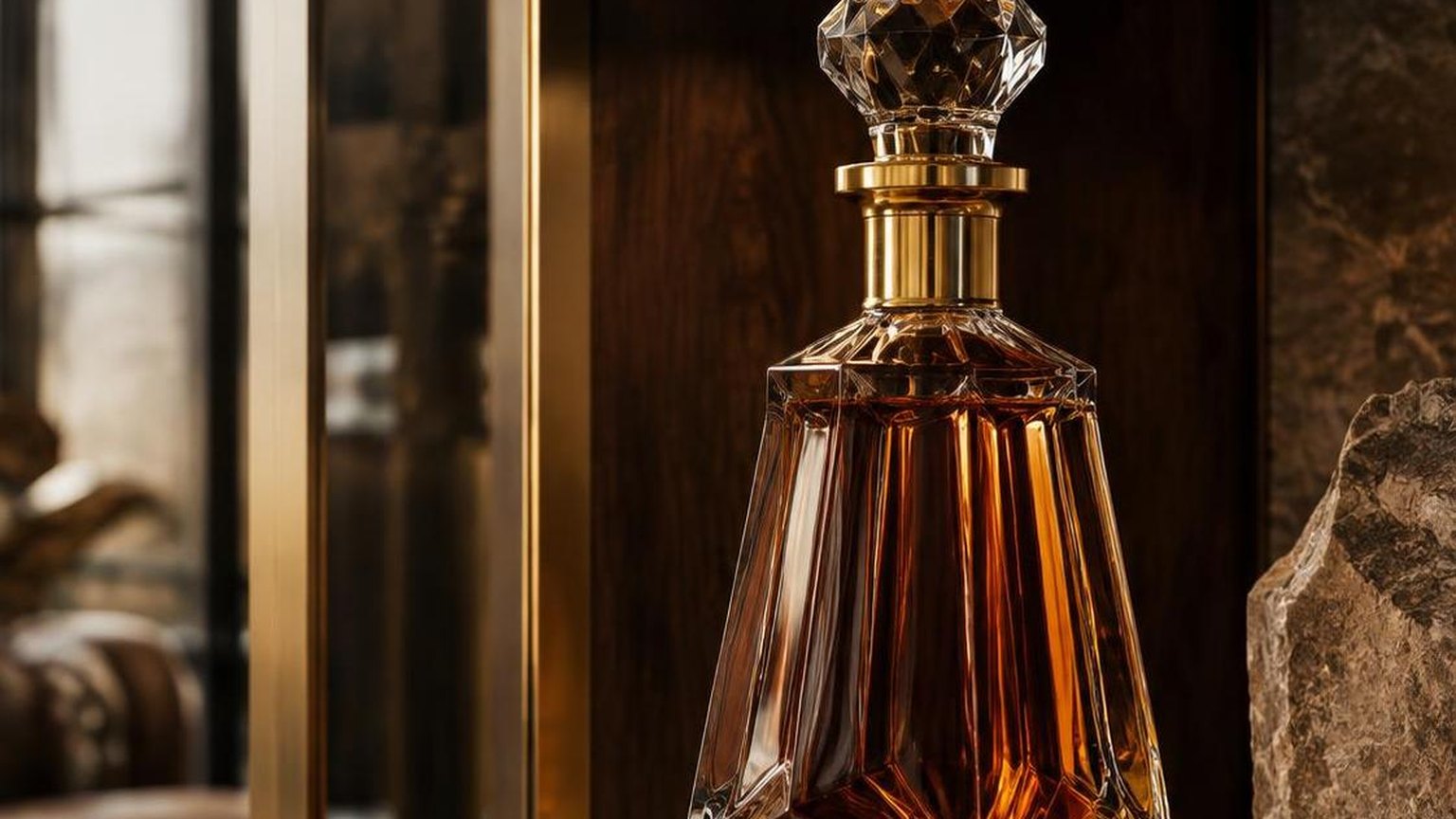
It came from a 1986 bottling of just 40 bottles drawn from cask no. 263 after 60 years in sherry-seasoned oak.
Why is The Macallan 1926 so expensive?
Its value comes from extreme scarcity, age, provenance, and collector demand: only 40 bottles were released, with different label series including Valerio Adami, Peter Blake, and one-off artist designs.
The Macallan’s reputation for old sherry-cask single malts also gives these bottles unusually strong auction performance.
Is the most expensive whiskey meant to be drunk?
Technically yes, but bottles at this price are usually treated as collectible assets rather than drinking whiskey.
Opening a $2.7 million bottle would immediately destroy much of its resale value because condition, fill level, capsule, label, and sealed originality are central to auction pricing.
What is the most expensive American whiskey?
American whiskey records are lower than Scotch records, but rare bottles of Michter’s Celebration Sour Mash have sold for tens of thousands of dollars, with new releases often priced around $6,000 to $7,000 at retail before secondary-market markups.
Vintage pre-Prohibition and old Van Winkle bottles can also command very high auction prices, depending on condition and provenance.
What is the most expensive whiskey you can buy at retail?
Retail pricing changes quickly, but ultra-luxury releases such as The Macallan 81-Year-Old The Reach launched at about $125,000, while Gordon & MacPhail’s Generations 80-Year-Old from Glenlivet was released around $100,000.
These are expensive at original retail, but auction records can rise far higher when rarity and collector competition converge.
Which distillery appears most often in record-setting expensive whiskey sales?
The Macallan appears most often in headline whiskey auction records, especially bottles from its 1926 cask releases.
Auction houses including Sotheby’s and Christie’s have repeatedly sold Macallan lots at seven-figure prices, making the distillery the most frequently cited name in the top end of the secondary market.
Related Reading
- What Is The Strongest Tequila?
- How Many Ounces In 4 Gallons?
- How Many Pounds Is 160 Kg?
- How Much Is A Gram Of Salt?
- How Many Cups Is 29 Ounces?
- Does Hpnotiq Need To Be Refrigerated?
- How Many Gallons Is 10 L?
- All Blog Guides
- Sotheby’s (2023)
- Guinness World Records (2023)
- TTB eCFR Whiskey Standards of Identity (2024)
- National Institute on Alcohol Abuse and Alcoholism (2024)
- CDC Alcohol Use and Your Health (2024)
- University of Kentucky Center for Crop Diversification (2023)
- Distilled Spirits Council of the United States (2024)