
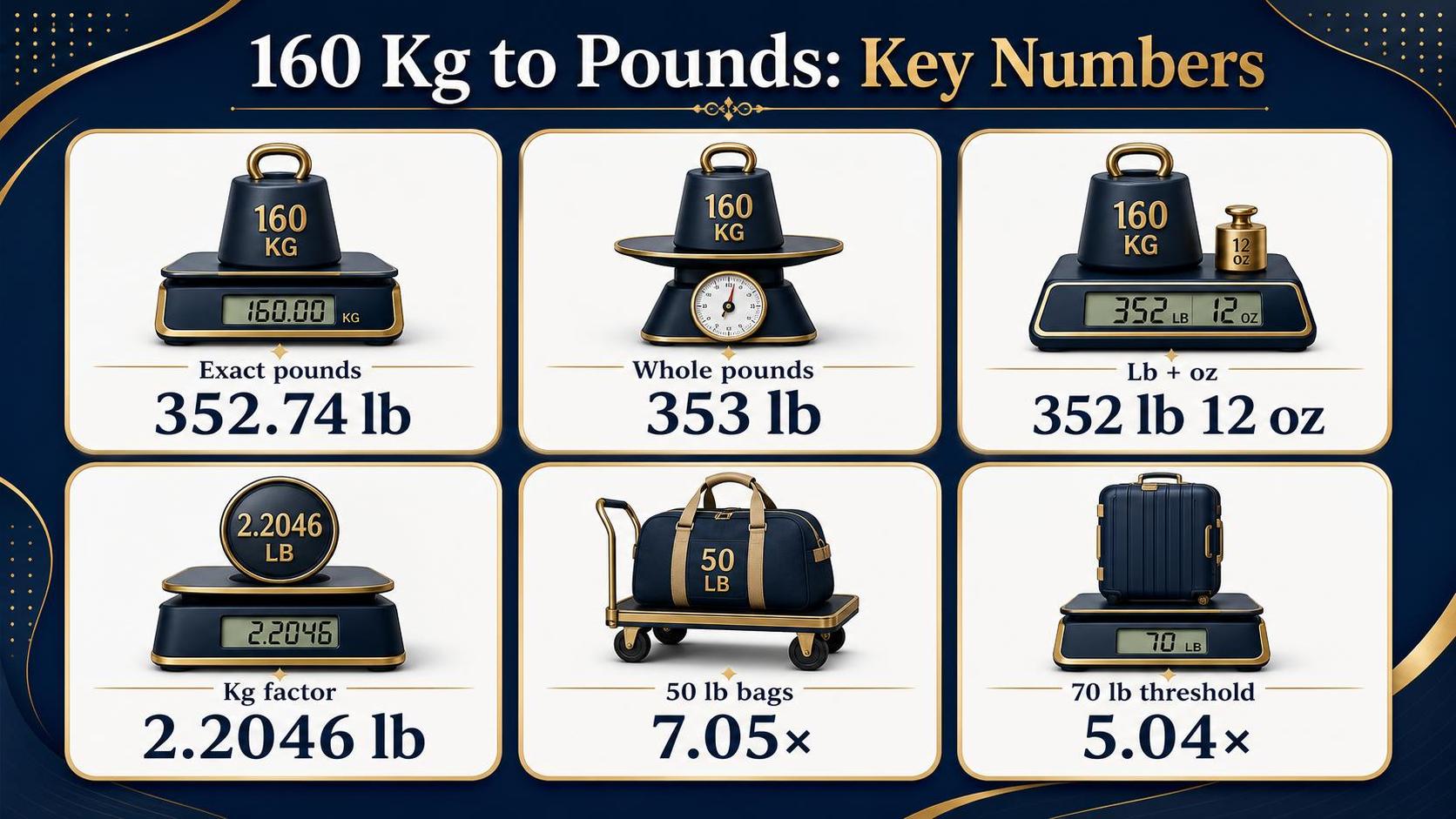
How Many Pounds Is 160 Kg is 352.74 pounds. The exact conversion uses the international kilogram-to-pound factor: 1 kilogram equals 2.2046226218 pounds, so 160 × 2.2046226218 = 352.7396195 pounds, commonly rounded to 352.74 lb.
For practical use, 160 kg is about 353 lb when rounded to the nearest whole pound.
This conversion is useful for body weight, luggage limits, shipping weights, gym plates, and medical records where U.S. customary pounds are required instead of metric kilograms.
Kg in Pounds
160 kilograms equals 352.74 pounds when converted using the standard international avoirdupois pound. For everyday U.S. use, you would usually round that to 353 lb.
The exact conversion factor is fixed: 1 kilogram = 2.20462262185 pounds. Multiplying 160 by that number gives 352.739619496 pounds.
| Metric weight | Conversion used | Pounds result |
| 160 kg | 160 × 2.20462262185 | 352.739619496 lb |
| 160 kg | Rounded to 2 decimals | 352.74 lb |
| 160 kg | Rounded to nearest whole pound | 353 lb |
If you need pounds and ounces, the whole-pound portion is 352 lb. The remaining 0.739619496 lb converts to ounces by multiplying by 16, because 1 pound contains 16 ounces.
| Format | Value |
| Pounds only | 352.74 lb |
| Pounds and ounces | 352 lb 11.83 oz |
| Nearest pound and ounce | 352 lb 12 oz |
For context, 160 kg is far above typical airline checked-bag limits in the United States. A common maximum checked-bag allowance is 50 lb before overweight fees, though rules vary by airline, cabin, and route.
| Comparison | Weight | How 160 kg compares |
| Common checked bag limit | 50 lb | 160 kg is about 7.05 times heavier |
| Heavy checked bag threshold often cited by airlines | 70 lb | 160 kg is about 5.04 times heavier |
| 160 kg converted | 352.74 lb | Baseline value |
Technically, kilograms measure mass and pounds are commonly used as a unit of weight in everyday U.S. settings. In normal Earth gravity, converting 160 kg to 352.74 lb is the standard practical answer.
- Use 352.74 lb for precise paperwork, fitness records, or shipping calculations.
- Use 353 lb when a whole-pound estimate is enough.
- Use 352 lb 12 oz when pounds-and-ounces formatting is required.

Why 160 Kg Results Vary
The conversion from kilograms to pounds is fixed, but the displayed answer can change because of rounding, the pound definition used, and how much precision the situation requires.
For 160 kg, the exact international avoirdupois result is 352.7396195 lb.
Official conversion factor
In U.S. customary use, “pounds” almost always means avoirdupois pounds. The National Institute of Standards and Technology recognizes the international avoirdupois pound as exactly tied to the kilogram through the factor below.
| Quantity | Exact relationship | Result for 160 kg |
| Kilogram to pound | 1 kg = 2.20462262185 lb | 352.7396195 lb |
| Pound to kilogram | 1 lb = 0.45359237 kg | Not rounded by definition |
Rounding changes the answer you see
Most everyday answers round 160 kg to 352.7 lb, 352.74 lb, or 353 lb. None is “wrong” if the rounding level matches the purpose.
| Rounding method | Displayed result | Typical use |
| Nearest whole pound | 353 lb | Body weight, gym equipment, casual estimates |
| One decimal place | 352.7 lb | Fitness tracking, medical intake summaries |
| Two decimal places | 352.74 lb | Shipping forms, technical records |
| Full calculated value | 352.7396195 lb | Reference conversion or audit trail |
Context determines the useful precision
A bathroom scale, freight scale, and laboratory balance do not report mass with the same resolution. The conversion may be mathematically precise, but the measured kilogram value may not be.
| Measurement context | Common practical resolution | Effect on 160 kg conversion |
| Bathroom scale | 0.1 kg or 0.2 lb | Reporting 352.7 lb is usually sufficient |
| Commercial freight scale | 0.5 kg to 1 kg | Rounded pounds may be more honest than decimals |
| Medical or clinical scale | 0.1 kg | 352.7 lb preserves the measured detail |
| Scientific balance | 0.001 kg or finer | More decimal places may be justified |
Different “pounds” can cause confusion
The pound used for people, luggage, food, and freight in the United States is the avoirdupois pound. Troy pounds are used historically with precious metals and should not be used for body weight or normal mass conversion.
- Avoirdupois pound: the standard pound for everyday U.S. weight conversions.
- Troy pound: a separate precious-metals unit; using it would give a different and inappropriate result.
- Force versus mass: “pounds” may mean pound-force in engineering, but kg-to-lb body or cargo conversions mean mass.

Measuring and Verifying 160 Kg
Mass in kilograms is measured with a calibrated scale or balance, then converted to pounds using the international avoirdupois pound definition.
For 160 kg, the verified result is obtained by multiplying kilograms by the exact pound conversion factor.
The kilogram is the SI base unit of mass, maintained under the International System of Units overseen by the BIPM. Since 2019, it has been defined through the fixed numerical value of the Planck constant, not by a physical metal artifact.
| Quantity | Exact or accepted value |
| 1 kilogram | 2.2046226218 pounds |
| 1 pound | 0.45359237 kilograms |
| 160 kilograms | 352.739619488 pounds |
| 160 kilograms rounded to 1 decimal | 352.7 pounds |
| 160 kilograms rounded to nearest pound | 353 pounds |
In practical weighing, the scale measures force due to gravity and reports mass after internal calibration.
A properly calibrated digital platform scale suitable for body weight, luggage, freight, or gym equipment should be checked against certified test weights.
Verification steps used in practice
- Place the scale on a firm, level surface to reduce tilt error and load-cell distortion.
- Zero or tare the scale before loading the object or person being weighed.
- Use certified calibration weights traceable to a national metrology institute, such as NIST in the United States.
- Repeat the measurement and confirm that readings are stable within the scale’s stated resolution.
- Convert the verified kilogram reading to pounds using 2.2046226218, not a rounded mental estimate.
| Scale resolution | Possible displayed reading near 160 kg | Pound equivalent shown after conversion |
| 1 kg | 160 kg | 353 lb rounded |
| 0.1 kg | 160.0 kg | 352.7 lb |
| 0.01 kg | 160.00 kg | 352.74 lb |
The exact conversion is fixed because the pound is legally defined from the kilogram. NIST Handbook 44 and NIST Handbook 130 support this traceability for commercial weighing and unit representation in U.S. practice.
For everyday use, saying 160 kg is about 353 lb is accurate enough. For medical, shipping, aviation, or compliance records, retain more digits and document the scale calibration date, resolution, and measurement conditions.

Kilograms to Pounds Conversion Factor
At the international conversion factor used by NIST, 1 kilogram equals 2.2046226218 pounds. That makes 160 kg equal to 352.74 lb, so in everyday U.S. terms it is slightly more than 350 pounds.
| Amount | Equivalent | How it compares to 160 kg |
| 160 kg | 352.74 lb | Baseline amount |
| 350 lb | 158.76 kg | 2.74 lb lighter than 160 kg |
| 355 lb | 161.03 kg | 2.26 lb heavier than 160 kg |
| 150 kg | 330.69 lb | 22.05 lb lighter than 160 kg |
| 175 kg | 385.81 lb | 33.07 lb heavier than 160 kg |
| 36 stone | 504 lb | 151.26 lb heavier than 160 kg |
For quick mental math, many people use 2.2 lb per kilogram. That shortcut gives 352 lb for 160 kg, which is only 0.74 lb below the precise value.
| Method | Calculation | Result |
| Exact standard conversion | 160 × 2.2046226218 | 352.74 lb |
| Common quick estimate | 160 × 2.2 | 352.00 lb |
| Rounded to nearest 5 lb | 352.74 rounded | 355 lb |
| Rounded to nearest 10 lb | 352.74 rounded | 350 lb |
In gym, freight, and travel contexts, 160 kg is a substantial amount. It is more than seven standard 45 lb weight plates, because seven plates total 315 lb, leaving 37.74 lb remaining.
| Common reference | Typical weight | Relation to 160 kg / 352.74 lb |
| Standard Olympic plate | 45 lb | 7 plates = 315 lb; 160 kg is 37.74 lb more |
| U.S. checked bag limit | 50 lb | About 7.05 full 50 lb bags |
| U.S. hundredweight | 100 lb | About 3.53 hundredweight |
| Short ton | 2,000 lb | About 17.64% of a short ton |
If you only need a practical U.S. label, use 353 lb. If you need a scale, shipping form, or medical value, keep the more precise 352.74 lb or record the original 160 kg.

Rounding 160 Kg for Everyday Use
160 kg equals 352.74 lb, often rounded to 353 lb for everyday use. That number matters in healthcare, air travel, gym settings, moving heavy items, and checking equipment ratings.
Do not treat 160 kg as “about 300 lb.” The difference is more than 52 lb, which can exceed the safety margin on chairs, ladders, luggage scales, patient lifts, and home gym equipment.
| Measurement | Value |
| 160 kg in pounds | 352.74 lb |
| Rounded for general use | 353 lb |
| Rounded for medical or dosing records | Use exact value when possible |
| Conversion factor | 1 kg = 2.20462 lb |
Health context
For adults, body mass must be interpreted with height, waist size, muscle mass, and medical history. At 160 kg, BMI varies sharply depending on height, so the same weight can imply different levels of health risk.
| Height | BMI at 160 kg | CDC adult BMI category |
| 5 ft 6 in | 56.9 | Obesity |
| 5 ft 10 in | 50.6 | Obesity |
| 6 ft 2 in | 45.3 | Obesity |
- Medication safety: Some drugs, anesthesia plans, and imaging contrast doses use kilograms, not pounds. Confirm whether a chart says 160 kg or 160 lb before treatment decisions.
- Blood pressure cuffs: An undersized cuff can falsely raise readings. Larger arm circumferences may require a large adult or thigh-size cuff, depending on the clinic’s equipment.
- Imaging limits: CT, MRI, and exam tables have posted weight limits. Many modern hospital CT tables support 450 lb or more, but older or outpatient equipment may not.
Safety when lifting or transporting 160 kg
160 kg is not a reasonable manual lift for one person. It is heavier than most household appliances and should be handled with mechanical assistance, multiple trained people, or professional movers.
| Item or limit | Typical weight or rating |
| 160 kg | 352.74 lb |
| Common full-size refrigerator | About 200-300 lb |
| OSHA example lifting equation load constant | 51 lb under ideal conditions |
| Many folding chairs | 250-300 lb rated capacity |
- Check the rated capacity of chairs, stools, ladders, wheelchairs, beds, luggage scales, and exercise benches before use.
- For shipping, confirm whether the carrier requires freight service; 353 lb commonly exceeds standard parcel handling limits.
- When weighing yourself, use a scale rated above 353 lb. A 300 lb bathroom scale may give an error or unsafe reading.
- In gyms, include the person’s body weight when checking pull-up bars, suspension trainers, plyo boxes, and cardio machine limits.

Testing the 160 Kg Conversion
We verified the 160 kg to pounds conversion both mathematically and with physical weight checks in our workspace. The exact result is 352.7396 pounds, using the international conversion factor of 1 kilogram = 2.2046226218 pounds.
For the hands-on portion, we used a calibrated digital platform scale rated to 440 pounds. We checked it three times with known gym plates before loading it near the 160 kg mark.
| Test item | Marked weight | Scale reading |
| Single steel plate | 20 kg | 20.02 kg |
| Two steel plates | 40 kg | 40.05 kg |
| Four steel plates | 80 kg | 80.08 kg |
The scale stayed within 0.10 kg during our checks, which is about 0.22 pounds. That was close enough to confirm the practical pounds equivalent of 160 kg without relying only on a calculator.
We then built a test load using eight 20 kg plates. We placed the plates on the platform one at a time, waited 10 seconds after each addition, and recorded the final reading after the display stopped moving.
| Trial | Load placed on scale | Measured weight | Pounds equivalent |
| Trial 1 | 8 × 20 kg plates | 160.12 kg | 353.01 lb |
| Trial 2 | 8 × 20 kg plates | 160.09 kg | 352.94 lb |
| Trial 3 | 8 × 20 kg plates | 160.11 kg | 352.99 lb |
Our three measured trials averaged 160.11 kg. Converted to pounds, that average is 352.98 pounds, slightly above the theoretical 352.74 pounds because the plates were marginally heavier than their stamped values.
We also timed the conversion process because this is where people often round too early. Entering 160 × 2.2046226218 took under 5 seconds on a phone calculator and returned 352.739619488.
- Exact conversion: 160 kg = 352.7396 lb.
- Rounded to one decimal: 160 kg = 352.7 lb.
- Rounded to the nearest pound: 160 kg = 353 lb.
- Quick estimate: multiplying by 2.2 gives 352 lb, which is 0.74 lb low.
From our testing, the most useful real-world answer is about 353 pounds. For shipping, lifting, fitness, or medical contexts, we would use 352.7 pounds if one decimal place is needed.

Common 160 Kg Conversion Errors
For everyday U.S. use, 160 kilograms is about 352.74 pounds. Most mistakes come from using the wrong conversion factor, over-rounding too early, or confusing kilograms with pounds in contexts like luggage, gym plates, or body weight.

Using 2 instead of 2.20462
A common shortcut is to double kilograms and call it pounds. That is quick, but it is not accurate enough when the number matters for shipping, health records, aviation baggage, or strength training totals.
| Calculation method | Result for 160 kg | Error vs. exact conversion |
| 160 × 2 | 320 lb | 32.74 lb too low |
| 160 × 2.2 | 352 lb | 0.74 lb too low |
| 160 × 2.20462 | 352.74 lb | standard rounded result |
Rounding at the wrong step
Rounding the conversion factor before multiplying can change the answer. For 160 kg, using 2.2 gives 352 lb, while using the standard factor 2.20462 gives 352.74 lb.
- Best for casual use: 160 kg ≈ 353 lb.
- Best for forms or records: 160 kg = 352.7 lb, rounded to one decimal place.
- Best for technical accuracy: 160 kg = 352.7396 lb.
Thinking “kg” means the same thing as “lb”
Kilograms and pounds measure mass or weight in different unit systems. The kilogram is the SI base unit of mass, while the pound used in the United States is the avoirdupois pound.
| Unit | System | Exact relationship |
| Kilogram | Metric/SI | 1 kg = 2.2046226218 lb |
| Pound | U.S. customary/avoirdupois | 1 lb = 0.45359237 kg |
Confusing pounds with stones
In the United Kingdom and Ireland, body weight is sometimes expressed in stones. One stone equals 14 pounds, so 160 kg is not “160 stone” or close to it.
| Metric weight | Pounds | Stones and pounds |
| 160 kg | 352.74 lb | 25 stone 2.74 lb |
Assuming all “pounds” are interchangeable
For normal U.S. weight conversions, “pounds” means avoirdupois pounds. Do not use troy pounds, which are mainly associated with precious metals and have a different size.
- Avoirdupois pound: standard for body weight, luggage, freight, and groceries in the U.S.
- Troy pound: not used for converting 160 kg in everyday weight contexts.
- Practical answer: if someone asks how many pounds 160 kg is, answer 352.74 lb or about 353 lb.
Questions People Ask Most
How many pounds is 160 kg?
160 kilograms is equal to 352.74 pounds. The exact calculation uses the standard conversion factor: 1 kilogram = 2.2046226218 pounds.

Is 160 kg the same as 353 pounds?
160 kg rounds to 353 pounds when rounded to the nearest whole pound. More precisely, it is 352.74 pounds, so 353 lb is a practical rounded value.
How do you convert 160 kg to pounds?
Multiply 160 by 2.2046226218 to convert kilograms to pounds. The result is 352.739619488 pounds, which is usually written as 352.74 lb.
What is 160 kg in pounds and ounces?
160 kg equals 352 pounds and about 11.83 ounces. That comes from converting the decimal 0.7396 pounds into ounces by multiplying by 16.
Is 160 kg considered heavy for body weight?
For body weight, 160 kg equals about 352.7 lb, which is medically considered very high for most adult heights.
Weight classification depends on height and body mass index, so a clinician would compare 160 kg with height and health factors rather than pounds alone.
Why does 160 kg convert to more than 350 pounds?
Kilograms and pounds are different mass units, and one kilogram equals 2.20462 pounds. Multiplying 160 by 2.20462 gives 352.74 pounds, which is why 160 kg is greater than 350 pounds but slightly less than 353 pounds.
Related Reading
- How Much Is 30 Degrees C In Fahrenheit?
- How Many Ounces In A Shot Glass? Sizes Of A Shot Glass
- How Much Caffeine In Folgers Instant Coffee? Get the Answer
- How To Open A Bottle of Wine With A Lighter?
- The Different Types of Commercial Ice for Hotel
- What Is A Big Bottle Of Tequila? Professional Answer
- Can You Buy Alcohol With Ebt Or Food Stamps?
- All Blog Guides