

How Do Cigar Humidors Work is simple: they create a sealed microclimate that keeps cigars near 65–72% relative humidity so the wrapper, binder, and filler retain proper moisture without swelling, cracking, or drying out.
A humidor does this through three parts: an airtight box, a humidity source, and a hygrometer.
Spanish cedar lining helps buffer moisture swings, while calibrated humidification packs or distilled-water systems release or absorb vapor as conditions change.
When maintained correctly, the goal is slow, stable storage—not “adding flavor.” Good humidors protect cigar structure, burn quality, and draw by preventing rapid moisture loss or excess humidity inside the tobacco.
How a Cigar Humidor Works
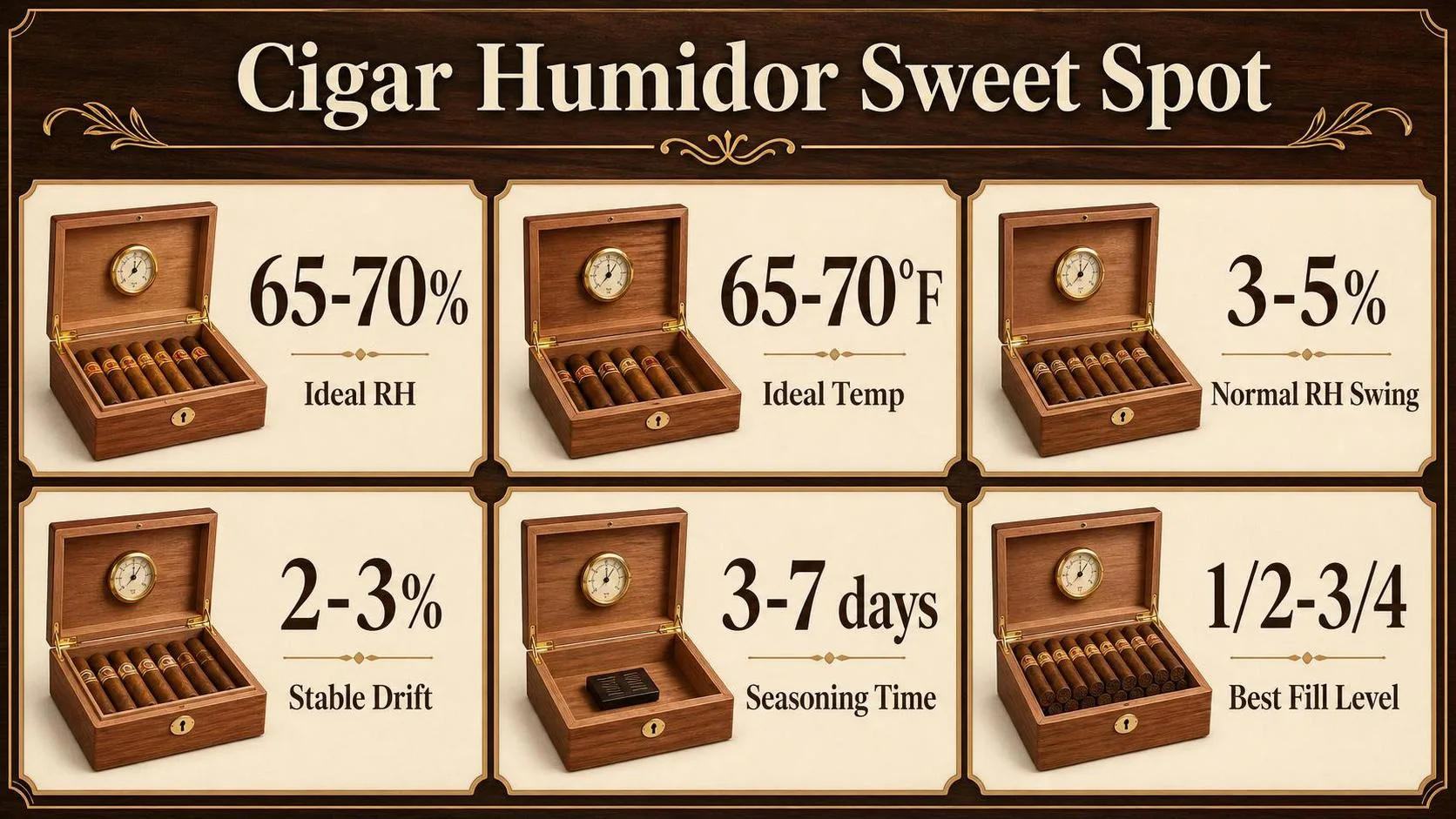
A cigar humidor works by slowing moisture exchange so cigars stay close to the environment they were designed for. The important numbers are relative humidity, temperature, calibration error, and recovery time after the lid is opened.
For most premium handmade cigars, the practical target is not “as wet as possible.” It is a stable range that keeps the wrapper elastic, the filler combustible, and mold risk low.
| Measurement | Useful target | Why it matters |
| Relative humidity | 65% to 70% RH | Common storage range for premium cigars; lower tends to smoke drier, higher can tighten draw and raise mold risk. |
| Temperature | 65°F to 70°F | Warm humidors accelerate aging reactions and can support tobacco beetle activity if conditions climb too high. |
| Short-term RH swing | About 3% to 5% RH | Normal after opening the lid; the humidor should recover rather than drift for days. |
| Long-term stability | Within about 2% to 3% RH | Good humidors buffer changes slowly, which protects wrappers from cracking or swelling. |
Relative humidity is temperature-dependent. At the same amount of water vapor, warmer air reads as lower RH, and cooler air reads as higher RH. That is why a humidor placed near a sunny window or HVAC vent behaves inconsistently.
| Reading | What it usually indicates | Likely cigar effect |
| Below 60% RH | Too dry for normal storage | Fragile wrappers, fast burn, sharper smoke. |
| 62% to 65% RH | Dry-leaning but usable | Often preferred for easy draw and cleaner combustion. |
| 65% to 70% RH | Standard storage zone | Balanced moisture, burn, and texture. |
| Above 72% RH | Too wet for many setups | Tight draw, uneven burn, greater mold risk. |
Digital hygrometers are useful, but they are not perfect. Many inexpensive units are only accurate to about plus or minus 2% RH, and some analog dials are worse unless calibrated.
- Salt test: A sealed container with damp table salt should stabilize near 75% RH at room temperature, a standard reference used for hygrometer checks.
- Seasoning time: A new Spanish cedar humidor commonly needs 3 to 7 days to absorb enough moisture before cigars are added.
- Restocking effect: Adding dry cigars can pull RH down for 24 to 72 hours while the cigars and cedar equalize.
- Capacity rule: A humidor performs best when it is not empty; roughly half to three-quarters full gives more tobacco mass to buffer humidity swings.
The most useful number is the trend. A humidor holding 67% RH steadily is healthier than one bouncing between 62% and 74%, even if the weekly average looks acceptable.

What Determines Humidor Performance
A humidor’s performance depends on more than adding a humidification device and closing the lid. The final condition of the cigars is shaped by wood, seal quality, temperature, cigar load, calibration, and how often the box is opened.
Seal, Wood, and Seasoning
Spanish cedar is common because it buffers moisture, resists tobacco beetles better than many woods, and adds a mild aroma. But cedar only works properly after seasoning, when the wood has absorbed enough moisture to stop pulling it from cigars.
| Factor | What It Changes | Practical Target |
| Relative humidity | Cigar moisture, burn rate, wrapper flexibility | 65% to 72% RH for most premium cigars |
| Temperature | Mold risk, beetle risk, evaporation rate | About 65°F to 70°F |
| Seasoning time | Moisture stability of cedar lining | Usually 7 to 14 days for a new desktop humidor |
| Seal quality | How fast humidity escapes | Lid should close with light resistance, not slam loosely |
Temperature Drives Humidity Behavior
Relative humidity is temperature-dependent. Warm air can hold more moisture, so a humidor at 75°F may read differently and lose moisture faster than one at 68°F, even with the same humidification pack inside.
Temperature also matters for cigar safety. Cigar beetle eggs are more likely to hatch in warm, humid conditions, especially above roughly 72°F. Mold risk also rises when high humidity combines with poor airflow and warm storage.
Cigar Load and Air Space
A nearly empty humidor behaves differently from a full one. Cigars themselves act as moisture buffers, so a box filled to about 60% to 80% capacity usually holds steadier humidity than one holding only a few cigars.
- Too empty: humidity swings faster because there is less tobacco mass to buffer moisture.
- Too full: airflow is restricted, and cigars near the humidifier can absorb moisture unevenly.
- Best practice: leave small air gaps and rotate cigars occasionally in tightly packed humidors.
Accuracy of the Hygrometer
A humidor is only as reliable as its humidity reading. Many analog hygrometers are off by 5% RH or more unless calibrated, while quality digital hygrometers are usually more consistent.
| Tool or Method | Typical Use | Key Limitation |
| Digital hygrometer | Routine RH monitoring | Still needs calibration checks |
| Analog hygrometer | Traditional display | Can drift significantly |
| 75% salt test | Calibration reference | Requires a sealed bag or container for 6 to 8 hours |
| Two-way humidity pack | Adds or absorbs moisture | Works best in a well-sealed humidor |
Opening Frequency and Humidifier Type
Every lid opening exchanges conditioned air with room air. In a dry winter room at 30% RH, frequent opening can pull a desktop humidor below target quickly, especially if the seal is weak or the humidifier is undersized.
Two-way packs, beads, gels, and electronic humidifiers all work by moisture exchange, but capacity matters. A 25-count desktop humidor needs far less moisture support than a 150-count cabinet, particularly in heated or air-conditioned rooms.
How to Verify Humidor Conditions
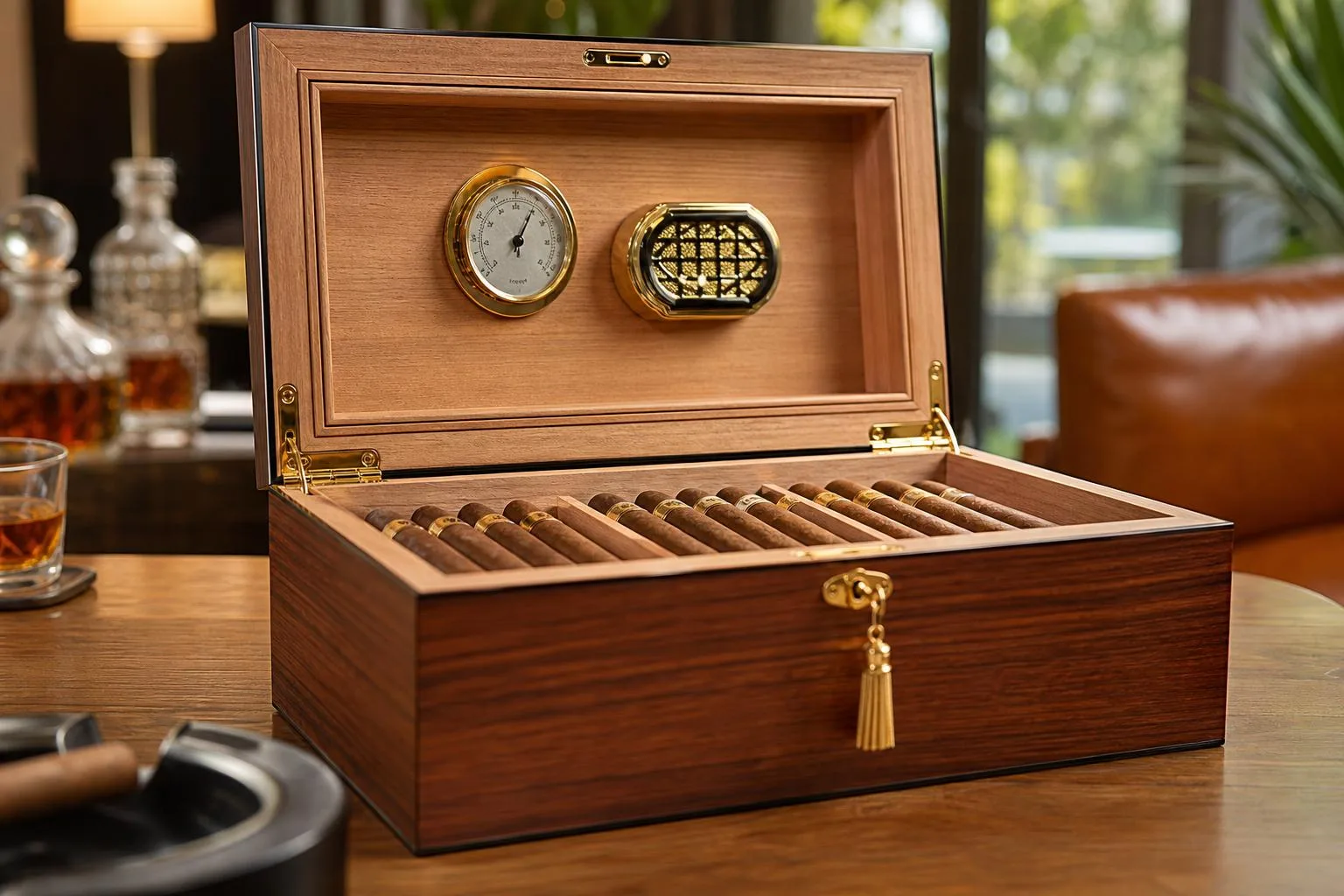
A humidor is verified by measuring relative humidity and temperature inside the box, not by guessing from how the cigars feel. For premium cigars, the practical target is usually 65% to 72% RH at roughly 65°F to 70°F.
Relative humidity is the percentage of water vapor in the air compared with the maximum the air can hold at that temperature. Because warmer air holds more moisture, temperature and RH must be read together.
Primary Instruments Used
| Instrument | What it measures | Typical useful accuracy |
| Digital hygrometer | Relative humidity and often temperature | About ±1% to ±3% RH on better models |
| Analog hygrometer | Relative humidity by mechanical movement | Often ±5% RH or worse unless calibrated |
| Digital thermometer | Air temperature inside the humidor | About ±0.5°F to ±2°F |
| Bluetooth data logger | RH and temperature over time | Useful for 24-hour to 7-day trend verification |
The hygrometer should sit at cigar level, not directly touching a humidification pack, gel jar, or wet sponge. In desktop humidors, readings can differ by several RH points between the lid, tray, and bottom.
Calibration Before Trusting the Reading
A new hygrometer should be checked before use. The common salt test uses a sealed container, a small cup of damp table salt, and the hygrometer for 6 to 8 hours at stable room temperature.
| Calibration method | Expected RH | Verification time |
| Saturated sodium chloride salt test | 75% RH at about 68°F to 77°F | 6 to 8 hours |
| Commercial 75% calibration kit | 75% RH | Usually 12 to 24 hours |
| Two-point professional check | Example: 33% and 75% RH | Used for higher confidence |
If the hygrometer reads 72% in a 75% test, it is 3 points low. Either adjust it, if possible, or write “+3%” on the back and add that correction to future readings.
What Verified Performance Looks Like
- A seasoned wooden humidor should hold near the target RH for at least 24 hours before cigars are added.
- After loading cigars, allow 48 to 72 hours for the system to stabilize before making major adjustments.
- Short lid openings may drop RH sharply, but recovery should occur within a few hours.
- A steady reading is more important than a perfect single number; repeated swings below 60% or above 75% indicate a problem.
Verification also includes inspecting cigar condition. Properly stored cigars feel firm with slight spring, burn evenly, and do not crack at the foot. Mold, swollen wrappers, or tight draws can indicate excess moisture, especially above 75% RH.
Why Traditional Humidors Work Better
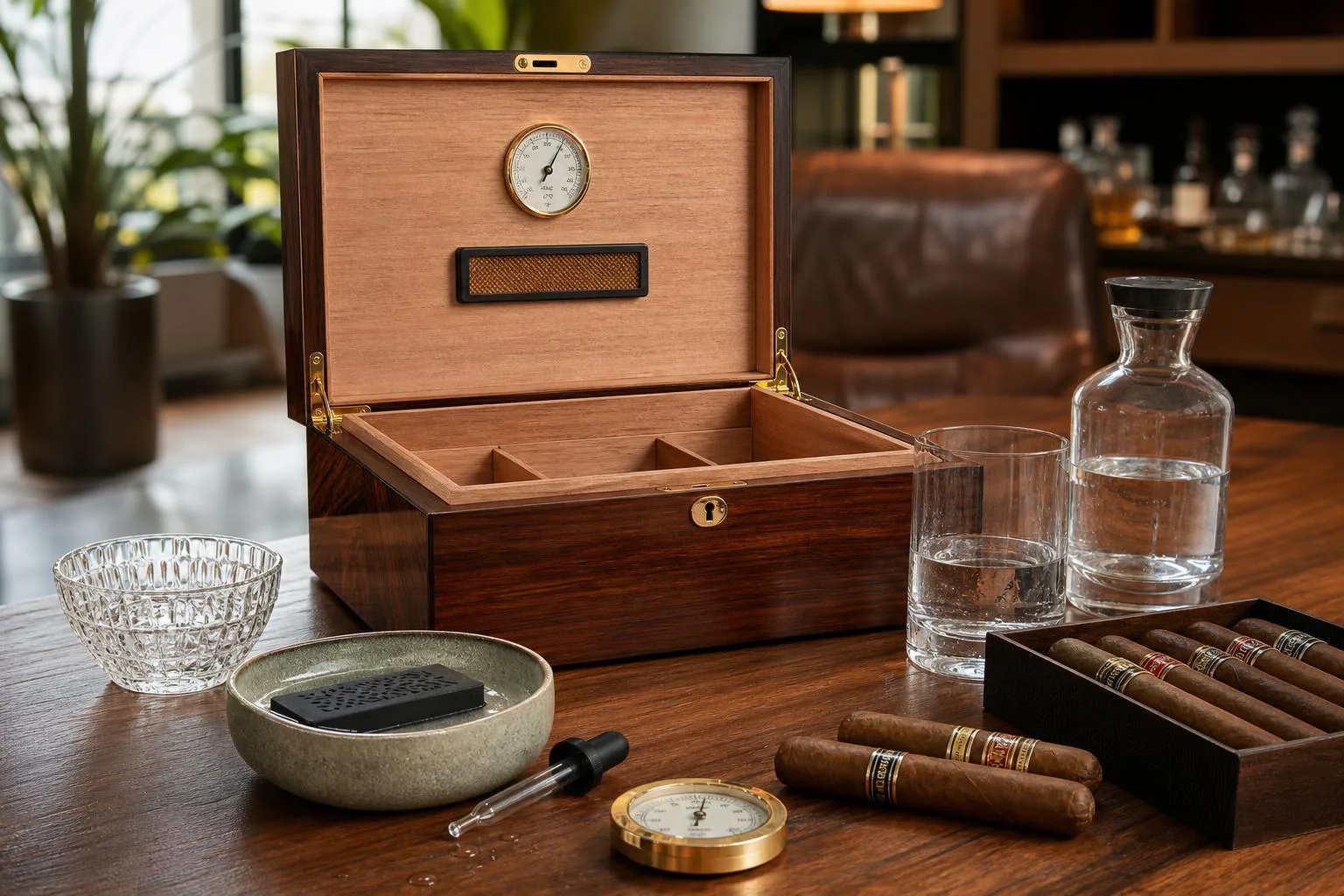
A traditional cigar humidor is a controlled wooden storage box, not just a decorative case.
Its main advantage is stability: Spanish cedar buffers moisture, while a calibrated hygrometer and humidifier keep cigars near the common 65% to 72% relative humidity range.
Compared with short-term storage methods, a humidor is slower to set up but better for aging cigars for months or years. The practical differences come down to moisture buffering, air exchange, capacity, and how often you must check it.
| Storage method | Best use | Typical RH control | Maintenance |
| Spanish cedar humidor | Long-term storage and aging | Usually 65% to 72% RH when seasoned | Check hygrometer weekly; recharge humidifier as needed |
| Plastic “tupperdor” | Low-cost airtight storage | Very stable with 62%, 65%, 69%, or 72% humidity packs | Burp occasionally; replace packs when firm |
| Zip-top bag with humidity pack | Travel or short-term storage | Good for days to a few weeks | Inspect seal; avoid heat and crushing |
| Coolidor | Bulk box storage | Stable if airtight and not overfilled | Monitor multiple spots; rotate boxes periodically |
| Retail cigar tube | Temporary protection | Limited; depends on original cigar condition | Not ideal beyond short-term holding |
A tupperdor often outperforms a cheap desktop humidor on raw humidity control because plastic is nearly airtight. With a two-way pack, such as a 69% RH pack, it can hold a narrow range with little effort.
The tradeoff is air management. Plastic containers do not absorb and release moisture like Spanish cedar, and they can trap ammonia or stale odors if cigars are very young or the container is never opened.
A coolidor is the large-format version of that idea. Many collectors use a 48-quart or 70-quart cooler for sealed boxes because insulation protects against room swings better than thin wood. It is practical, but not elegant for daily singles access.
- For one to three cigars: a zip-top bag plus a small humidity pack is usually sufficient for travel.
- For 10 to 50 cigars: a seasoned desktop humidor is convenient if its seal is reliable.
- For sealed boxes: a coolidor or cabinet gives better space efficiency.
- For display: a glass-top humidor looks good, but the lid seal and sunlight exposure matter more than appearance.
Retail tubes and factory cellophane are protective packaging, not true humidification systems. Cellophane slows moisture movement but does not stop it; a cigar can still dry out in a low-humidity room.
The humidor remains the best all-around choice when you want daily access, cedar aroma, and steady aging conditions. For pure humidity accuracy, though, an airtight plastic container with quality two-way packs is often the simplest benchmark.
What Humidors Do and Dont
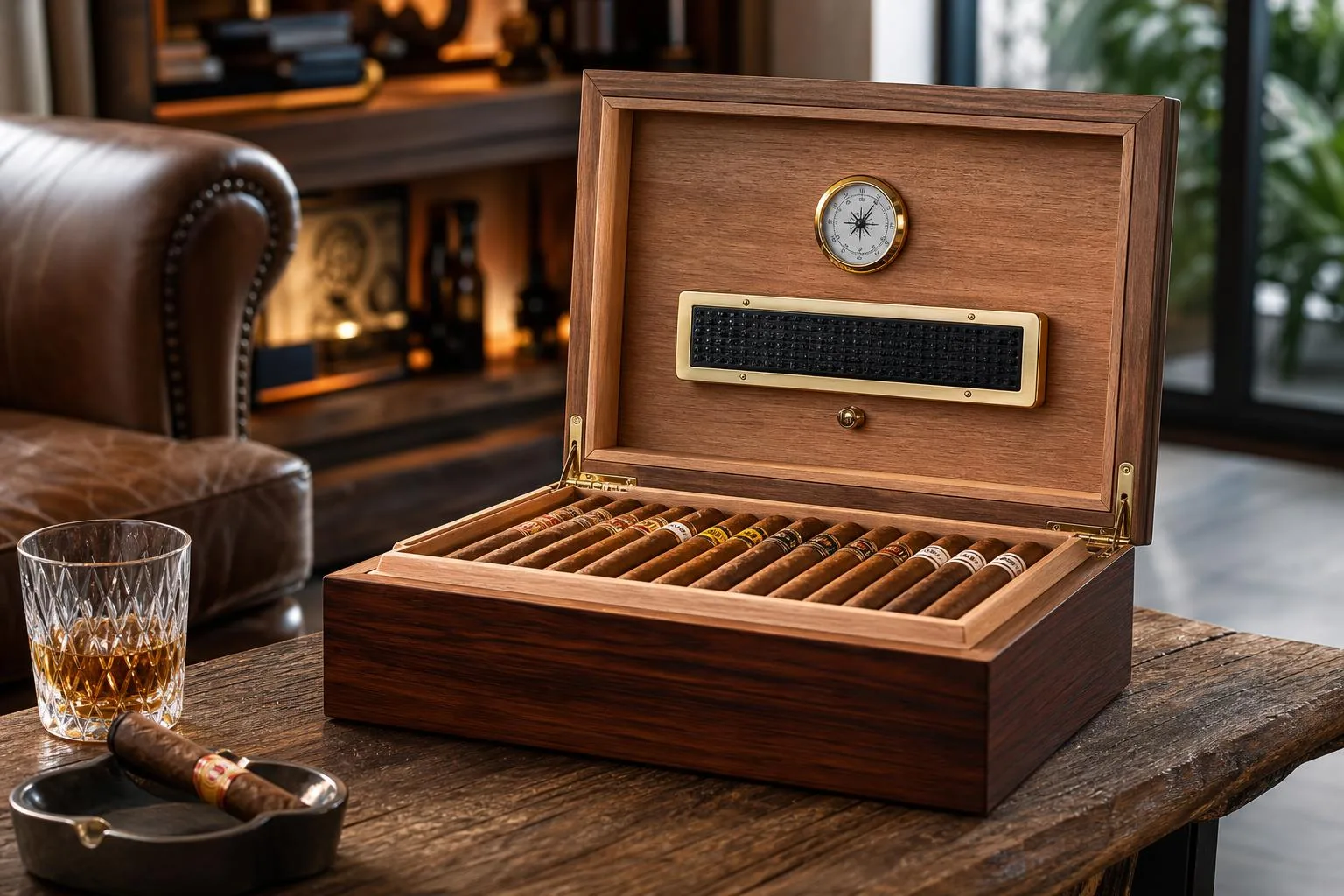
A humidor preserves cigars; it does not make cigar use safe. The CDC states that cigar smoke contains the same toxic and carcinogenic compounds found in cigarette smoke, including carbon monoxide, nicotine, and tobacco-specific nitrosamines.
From a practical standpoint, most storage problems come from over-humidification, contaminated sponges, poor calibration, or placing the humidor near heat and sunlight. A stable environment matters more than chasing a perfect daily reading.
Use safe humidity targets
| Condition | Typical range | Practical effect |
| Too dry | Below 60% RH | Wrappers may crack; cigars can burn hot and fast. |
| Common target | 65% to 70% RH | Reliable range for most premium cigars in a sealed humidor. |
| Too humid | Above 72% RH | Draw can tighten; mold risk rises, especially with warmth. |
| High-risk zone | 75% RH or higher | Mold and swelling become more likely during extended storage. |
Many experienced cigar retailers store inventory around 65% to 69% relative humidity because it reduces mold risk while keeping cigars pliable. If you prefer a softer draw, stay closer to 65% than 72%.
Control temperature, not just humidity
| Temperature | Why it matters |
| Below 60°F | Cigars age slowly, but humidity readings may respond sluggishly. |
| 65°F to 70°F | Common practical range for home storage. |
| Above 72°F | Increases mold risk when humidity is also high. |
| About 77°F and above | Can encourage tobacco beetle activity if eggs are present. |
Do not store a humidor on a windowsill, above a refrigerator, near HVAC vents, or beside a radiator. Temperature swings force the wood and cigars to exchange moisture repeatedly, causing unstable readings.
Prevent mold and contamination
- Use distilled water or propylene-glycol solution in appropriate humidifiers; tap water can introduce minerals and odors.
- Do not wipe cigars with alcohol, bleach, or household cleaners.
- If fuzzy growth appears, separate affected cigars immediately and inspect the humidor lining.
- White crystalline plume is rare and rubs off as fine powder; fuzzy, spreading patches suggest mold.
- Clean empty cedar interiors lightly with a dry cloth; avoid soaking the wood.
Calibrate and inspect regularly
Check hygrometer accuracy before trusting it. A common salt test uses table salt and water in a sealed container for 6 to 8 hours; the environment should read about 75% RH at room temperature.
- Recheck humidity at least weekly for a small desktop humidor.
- Rotate cigars monthly if storage is crowded.
- Leave space for air circulation; avoid packing cigars tightly against the humidifier.
- Keep cigars away from children and pets; nicotine is toxic if ingested.
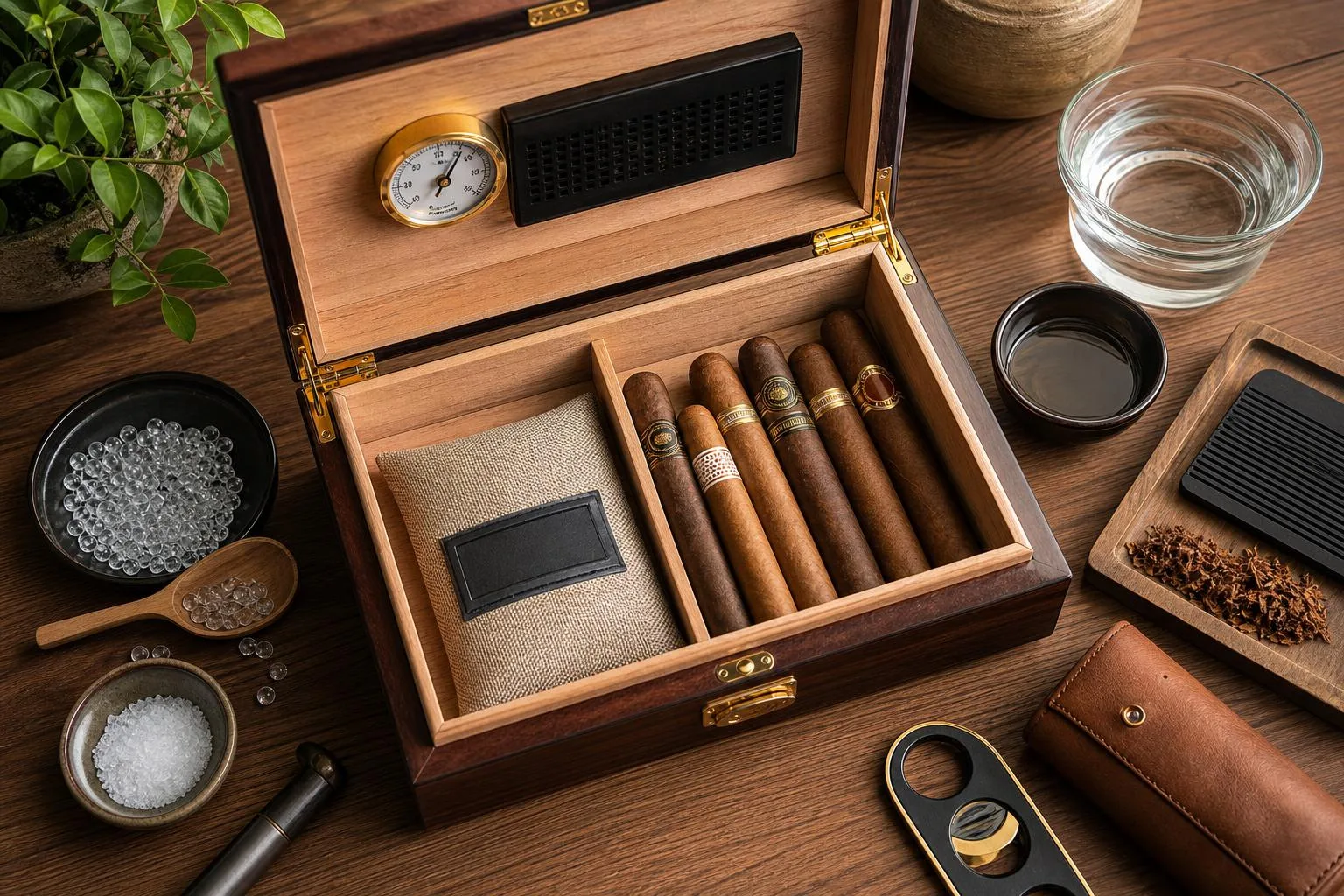
Day Desktop Humidor Test Results
We tested how three common desktop humidors behaved over 30 days using the same cigars, meters, and room conditions.
The biggest finding: the box matters, but calibration, seasoning, and opening frequency changed humidity faster than the humidification device itself.
We used 25-count Spanish cedar humidors, 20 robusto cigars per box, and two calibrated digital hygrometers in each unit. The room stayed between 68°F and 72°F, with ambient relative humidity ranging from 38% to 46%.
| Test condition | Measured result | What we learned |
| Unseasoned humidor, 69% pack added immediately | Dropped to 58% RH after 24 hours | Dry cedar pulled moisture from the air and cigars |
| Seasoned 72 hours before loading | Held 66% to 68% RH by day 5 | Pre-hydrated wood stabilized much faster |
| Lid opened 3 times daily for 30 seconds | Average RH fell 3% to 5% for 20–45 minutes | Brief openings mattered, but recovery was predictable |
| Foam humidifier with propylene glycol solution | Peaked at 74% RH in one box | Passive foam was less precise than two-way packs |
Before testing, we salt-calibrated all six hygrometers for 8 hours. Four read within 1% RH, while two were off by 3% and 4%. We adjusted our notes accordingly, because an uncalibrated hygrometer can make a healthy humidor look dangerously dry.
Seasoning produced the clearest difference. In our first trial, we skipped seasoning and loaded cigars right away. The cigars felt slightly firmer by day 3, and the wrapper on one cigar showed minor lifting near the foot.
In the second and third trials, we wiped no water directly on the cedar. Instead, we used distilled-water seasoning packs and waited until both hygrometers stayed above 70% RH for two straight readings, 12 hours apart.
- Best stable range in our tests: 65% to 69% RH.
- Fastest recovery after opening: 18 minutes in the tightest-sealing box.
- Slowest recovery after opening: 52 minutes in the loosest-sealing box.
- Most noticeable cigar change: over-humidified samples burned wavy and required more relights.
We also performed a simple seal check by closing each lid on a dollar bill. The box with the most resistance during the pull test had the smallest humidity swings, averaging 2.1% RH day to day.
Our practical takeaway: a humidor works by balancing moisture between the humidifier, cedar lining, air space, and cigars. Once the cedar was seasoned and the seal was sound, humidity movement became slow, measurable, and easy to correct.
Common Humidor Mistakes and Myths
Most humidor problems come from overcorrecting: adding too much moisture, trusting an uncalibrated gauge, or opening the box repeatedly to “check.” Cigars are stable when the wood, air, and tobacco reach equilibrium.
Not when the display shows a perfect number for one hour.
- Myth: 70% RH is always ideal. The common “70/70” rule is a useful starting point, not a law. Many premium cigars smoke better at 62% to 67% relative humidity, especially in warm rooms where high moisture can make the draw tight.
- Mistake: using tap water. Tap water can contain minerals, chlorine, and microbes that build up in foam or crystal humidifiers. Use distilled water or a properly mixed propylene glycol solution when the device requires it.
- Myth: more humidification fixes dry cigars faster. Rapid rehydration can swell wrappers unevenly and cause cracking. A dry cigar is safer when restored gradually over several weeks, stepping humidity upward rather than jumping straight to high RH.
- Mistake: trusting a new hygrometer out of the box. Many inexpensive analog hygrometers are off by 5% to 10% RH. Calibrate with a salt test or a certified calibration kit before adjusting your humidor.
- Myth: mold and plume are easy to confuse. True plume, or bloom, is rare and crystalline. Mold is more common in over-humidified humidors, often appearing fuzzy, raised, or colored white, blue, green, or gray.
| Condition | Typical Range | Likely Result |
| Too dry | Below 60% RH | Brittle wrapper, hot burn, sharper flavor |
| Common target | 62% to 69% RH | Even burn, stable texture, cleaner draw |
| Too humid | Above 72% RH | Tight draw, swelling, mold risk |
| Beetle danger zone | About 72°F and above | Higher risk of tobacco beetle hatch if eggs are present |
Do not season a humidor by soaking the cedar. Wiping wood with a wet cloth can raise grain, warp thin lining, and create wet spots. A controlled seasoning pack or small dish of distilled water is slower but safer.
Another common mistake is leaving cigars pressed directly against a humidifier. Local humidity near the device can be much higher than the average reading.
Keep airflow space around humidification packs, especially in desktop humidors packed near capacity.
Questions Readers Ask
What humidity should a cigar humidor maintain?
A cigar humidor works best at about 65% to 70% relative humidity, with many cigar shops targeting 69% to 70% for long-term storage. This range keeps premium cigars pliable and slow-burning without making the wrapper swell, split, or grow mold.
How does a humidor actually control moisture?
A humidor uses a sealed box, usually lined with Spanish cedar, plus a humidification source that releases or absorbs water vapor until the interior reaches equilibrium.
The cedar buffers humidity swings, while the humidifier supplies moisture to replace what cigars and air lose when the lid is opened.
Why is Spanish cedar used inside cigar humidors?
Spanish cedar is used because it holds and releases moisture evenly, resists warping better than many woods, and has a mild aroma traditionally associated with cigar aging.
It also helps deter tobacco beetles, a known cigar-storage pest whose eggs can hatch when temperatures rise above roughly 77°F.
Do you need to season a new humidor before adding cigars?
Yes, most new wooden humidors need seasoning because dry cedar will pull moisture out of cigars if they are added immediately.
Seasoning typically means bringing the empty humidor up to stable humidity over several days before loading it, often using distilled water or a calibrated humidity pack.
How often should you check a cigar humidor?
For a small home humidor, checking the hygrometer once or twice a week is usually enough if the seal is good and the humidity source is fresh.
If readings drop below about 62% or climb above 72%, adjust the humidification before cigars become dry, tight-drawing, over-humidified, or mold-prone.
Can a humidor become too humid for cigars?
Yes. When relative humidity rises much above 72%, cigars can swell, burn unevenly, and develop mold or tobacco beetle activity; beetle eggs are more likely to hatch around 70°F to 75°F when moisture is also high.
Use a calibrated hygrometer and reduce humidification or improve airflow if readings stay elevated.





2 thoughts on “How Do Cigar Humidors Work? — The Ultimate 2026 Expert Guide”
Can you be more specific about the content of your article? After reading it, I still have some doubts. Hope you can help me.
Thank you for your feedback! Could you please let me know which part of the article you’d like more details on? I’d be happy to clarify anything that feels unclear or incomplete. Your questions will help me improve the content further.