
What Are The Types Of Bourbon are standard bourbon, straight bourbon, bottled-in-bond bourbon, single-barrel bourbon, small-batch bourbon, barrel-proof bourbon, wheated bourbon, high-rye bourbon, and finished bourbon.
Legally, all bourbon must be made in the United States from at least 51% corn and aged in new charred oak containers.
Those labels describe proof, aging rules, mash bill, barrel selection, or post-maturation handling.
For example, “straight” requires at least 2 years of aging, while “bottled-in-bond” must be 100 proof, from one distillation season, one distiller, and aged at least 4 years in a federally bonded warehouse.
Legal Requirements for Bourbon Types
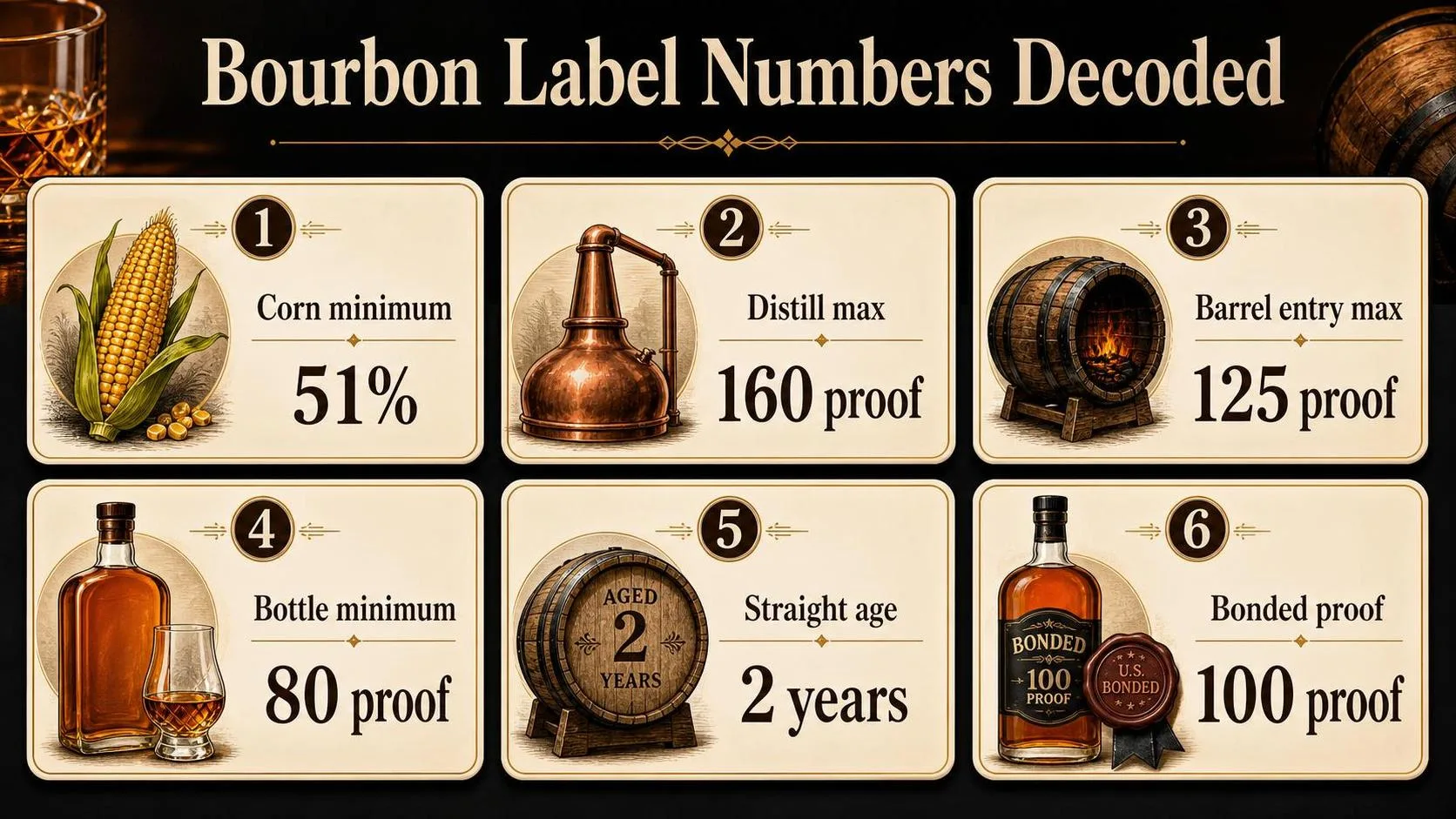
Bourbon categories make more sense once you know the legal thresholds behind the label. The numbers below separate standard bourbon, straight bourbon, bottled-in-bond bourbon, wheated bourbon, high-rye bourbon, and barrel-proof releases.
These rules come from U.S. federal standards of identity for whiskey, mainly 27 CFR §5.143, plus the Bottled-in-Bond Act framework.
| Number | What it means | Why it matters for bourbon types |
| 51% | Minimum corn in the mash bill | Every bourbon must be made from at least 51% corn. Above that, the remaining grains shape style: rye for spice, wheat for softness, malted barley for enzymes and texture. |
| 160 proof | Maximum distillation proof | Bourbon cannot be distilled above 160 proof, or 80% alcohol by volume. This keeps more grain character than a neutral spirit distilled to higher proof. |
| 125 proof | Maximum barrel-entry proof | The new whiskey must enter new charred oak containers at no more than 125 proof. Lower entry proofs often extract oak differently and can feel richer or softer. |
| 80 proof | Minimum bottling proof | Bourbon sold in the U.S. must be bottled at 80 proof or higher. Many standard bourbons sit at 80 to 95 proof; premium labels often run 100 proof or more. |
| 2 years | Minimum aging for “straight bourbon” | Straight bourbon must be aged at least 2 years in new charred oak. If it is younger than 4 years, the label must carry an age statement. |
| 4 years | Minimum age for bottled-in-bond bourbon | Bottled-in-bond bourbon must be at least 4 years old, made by one distiller at one distillery in one distilling season, and bottled at 100 proof. |
| 100 proof | Required proof for bottled-in-bond | This is a fixed proof, not a marketing choice. It gives bottled-in-bond bourbon a consistent legal identity across brands. |
Mash bill numbers are style clues, not legal subtypes
“High-rye” and “wheated” are common bourbon styles, but federal law does not define exact percentages for those terms.
In practice, high-rye bourbons often use roughly 20% to 35% rye, while wheated bourbons replace rye with wheat.
- Traditional bourbon: commonly around 70% to 78% corn, with rye and malted barley making up the balance.
- High-rye bourbon: usually tastes drier, spicier, and more peppery because rye takes a larger share of the mash bill.
- Wheated bourbon: often tastes rounder and softer, with wheat contributing bread, honey, and pastry-like notes.
- Barrel-proof bourbon: bottled without dilution to a standard proof, often landing anywhere from about 110 to 140 proof depending on age, warehouse conditions, and evaporation.
Age statements also need context. A 6-year bourbon is not automatically better than a 10-year bourbon, but the number tells you how long the youngest whiskey in the bottle spent in oak.
Production Choices That Shape Bourbon Flavor
Bourbon type is shaped by law, but flavor is shaped by decisions before, during, and after aging. The biggest variables are mash bill, proof, barrel treatment, warehouse conditions, age, and blending choices.
Federal rules require bourbon to be made in the United States from at least 51% corn, distilled at no more than 160 proof, entered into new charred oak at no more than 125 proof, and bottled at 80 proof or higher.
Mash Bill
Corn brings sweetness and body, but the “flavoring grain” often separates one style from another. Rye tends to add pepper and mint; wheat usually softens the profile with bread, honey, and caramel notes.
| Mash bill style | Common grain pattern | Typical effect |
| Traditional bourbon | 51%+ corn, rye, malted barley | Caramel, spice, oak balance |
| High-rye bourbon | Often 20%+ rye | Pepper, clove, dry finish |
| Wheated bourbon | Wheat replaces rye | Softer texture, honey, pastry notes |
| High-corn bourbon | Well above 51% corn | Sweeter, rounder, sometimes lighter spice |
Proof and Dilution
Proof changes texture, aroma intensity, and heat. A barrel-proof bourbon is bottled with little or no dilution, while standard bottlings are reduced with water for consistency and approachability.
| Proof category | Legal or common range | What it changes |
| Minimum bourbon bottling proof | 80 proof | Lighter body, less alcohol heat |
| Bottled-in-bond | Exactly 100 proof | Structured, consistent, legally defined |
| Barrel proof | Often 110-135 proof | Fuller texture, stronger aroma, more heat |
Barrel, Warehouse, and Age
New charred oak is mandatory, so every bourbon gains color and flavor from a fresh barrel. Char level, stave seasoning, entry proof, and warehouse location all influence extraction of vanilla, tannin, smoke, coconut, and spice.
Kentucky rickhouses can swing from hot summers to cold winters, pushing whiskey in and out of oak. Barrels stored higher in the warehouse often age faster because heat increases evaporation and wood interaction.
| Age statement rule | Requirement |
| Straight bourbon | Aged at least 2 years |
| Straight bourbon under 4 years | Must state age on label |
| Bottled-in-bond bourbon | Aged at least 4 years |
Blending and Barrel Selection
Small batch, single barrel, and standard bourbon can come from the same distillery but taste different because of selection. A blender may combine many barrels for consistency or isolate one barrel for individuality.
- Single barrel: one barrel, more variation bottle to bottle.
- Small batch: selected barrels blended for a targeted profile.
- Finished bourbon: bourbon moved to a secondary cask, such as port or sherry, after meeting bourbon requirements.
How Bourbon Classification Is Verified
Bourbon is verified through federal identity standards, production records, lab measurements, and label approvals. In the United States, the Alcohol and Tobacco Tax and Trade Bureau, or TTB, enforces the legal definition in 27 CFR §5.143.
Every major bourbon type starts with the same measurable baseline: it must be made in the U.S., use at least 51% corn, be distilled below 160 proof, enter new charred oak below 125 proof, and be bottled at 80 proof or higher.
| Requirement | Federal bourbon standard |
| Corn in mash bill | Minimum 51% |
| Distillation strength | Less than 160 proof, or 80% ABV |
| Barrel entry proof | No more than 125 proof, or 62.5% ABV |
| Barrel type | New, charred oak container |
| Bottling strength | Minimum 80 proof, or 40% ABV |
| Allowed additives | No coloring, flavoring, or blending materials for straight bourbon |
Producers verify mash bill percentages with grain receipts, cook sheets, and fermentation records.
If a brand claims “wheated bourbon” or “high-rye bourbon,” those terms are not separately defined by federal law, but the underlying bourbon requirements still apply.
Alcohol strength is measured with calibrated hydrometers, density meters, or distillation-based lab methods. Proof is twice the alcohol by volume, so a 50% ABV bourbon is 100 proof.
TTB regulations allow only specific tolerances between tested proof and labeled proof.
| Label term | How it is verified |
| Straight bourbon | At least 2 years in new charred oak; no added color, flavor, or spirits |
| Age statement | Must reflect the youngest whiskey in the bottle |
| Bottled in bond | One distiller, one distilling season, one bonded warehouse, at least 4 years old, exactly 100 proof |
| Kentucky bourbon | Produced in Kentucky; aging location must support any specific geographic claim |
| Single barrel | Bottled from one barrel, supported by dumping and bottling records |
Age is verified by barrel fill dates, warehouse logs, dump records, and tank records. Bourbon younger than 4 years must carry an age statement. If multiple barrels are mingled, the stated age is the age of the youngest component.
Before sale, most bourbon labels require a TTB Certificate of Label Approval, commonly called a COLA. The agency reviews mandatory items such as class, type, alcohol content, net contents, producer identity, health warning, and any special claims.
In practice, verification is both paperwork and chemistry.
At a distillery, I have seen barrel-entry proof checked before filling and dump dates matched against warehouse records before bottling, because a single error can make a label claim noncompliant.
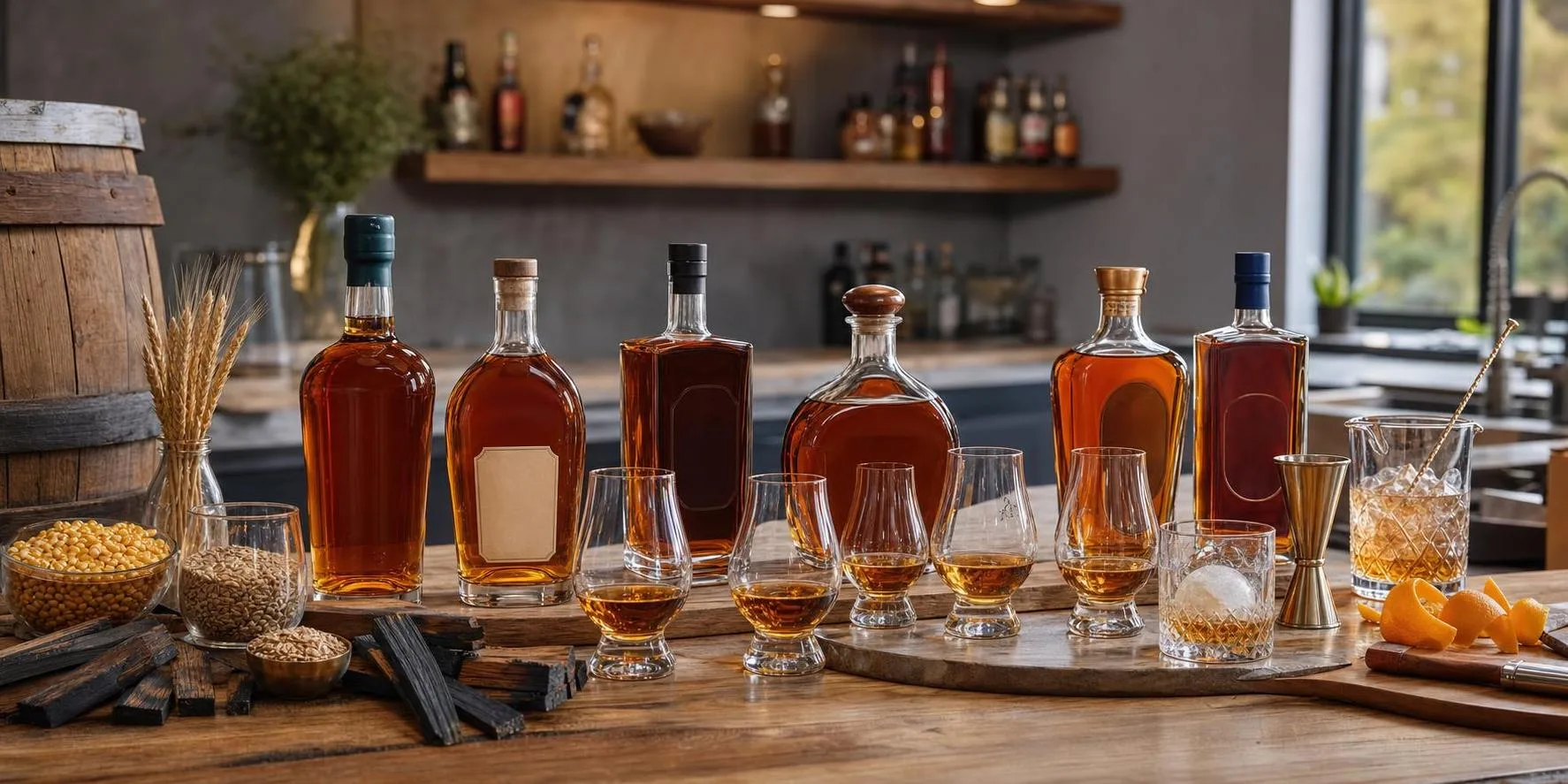
How Bourbon Differs from Other Whiskeys
Bourbon is not just “American whiskey”; it is a legally defined style with tighter production rules than many drinkers realize.
Under 27 CFR §5.143, bourbon must be made in the United States from at least 51% corn, distilled below 160 proof, entered into new charred oak below 125 proof, and bottled at 80 proof or higher.
Those rules explain why bourbon usually tastes sweeter, fuller, and more oak-driven than rye, Scotch, Irish whiskey, or Canadian whisky.
In tasting flights, the biggest practical differences are grain bill, barrel type, proof rules, and whether additives are allowed.
| Spirit | Key grain rule | Barrel rule | Typical flavor contrast vs. bourbon |
| Bourbon | Minimum 51% corn | New charred oak required | Vanilla, caramel, toasted oak, corn sweetness |
| Rye whiskey | Minimum 51% rye in the U.S. | New charred oak for U.S. straight rye | Drier, spicier, more herbal or peppery |
| Tennessee whiskey | Usually bourbon-style mash bill | New charred oak required | Often softer; charcoal mellowing is the signature step |
| Scotch whisky | Malted barley or other cereals, made in Scotland | Oak casks; often used barrels | Less corn sweetness; may show malt, smoke, dried fruit |
| Irish whiskey | Cereal grains, made in Ireland | Wooden casks, minimum 3 years | Often lighter, fruitier, less char-heavy |
| Canadian whisky | No 51% corn requirement | Small wood, minimum 3 years | Frequently lighter, smoother, sometimes blended with flavoring whisky |
Bourbon vs. Rye
Rye is bourbon’s closest bar-counter rival. U.S. rye whiskey must contain at least 51% rye grain, while bourbon must contain at least 51% corn.
That single grain difference usually shifts the profile from sweet caramel and vanilla toward baking spice, mint, dill, black pepper, or dry cocoa.
Bourbon vs. Tennessee Whiskey
Tennessee whiskey is commonly bourbon in structure, but with an added regional requirement.
Tennessee law recognizes the Lincoln County Process, where new-make whiskey is filtered through sugar maple charcoal before aging, except for certain grandfathered producers. Jack Daniel’s and George Dickel are the best-known examples.
Bourbon vs. Scotch and Irish Whiskey
Scotch and Irish whiskey must age at least 3 years, while bourbon has no general minimum age unless labeled “straight,” which requires at least 2 years.
However, bourbon’s mandatory new charred oak gives even younger bottles stronger vanilla, coconut, caramel, and char notes than many refill-cask Scotch or Irish whiskeys.
Bourbon vs. Canadian Whisky
Canadian whisky must be mashed, distilled, and aged in Canada for at least 3 years in wood containers of 700 liters or less.
Compared with bourbon, it is often lighter in body because Canadian regulations allow broader blending practices and do not require a majority-corn mash bill or new charred barrels.
- Choose bourbon for Old Fashioneds, richer Manhattans, neat pours, and caramel-oak depth.
- Choose rye when you want a drier, spicier cocktail with more bite.
- Choose Scotch for malt, smoke, maritime, sherry-cask, or regional character.
- Choose Irish whiskey for a lighter, approachable, fruit-and-honey profile.
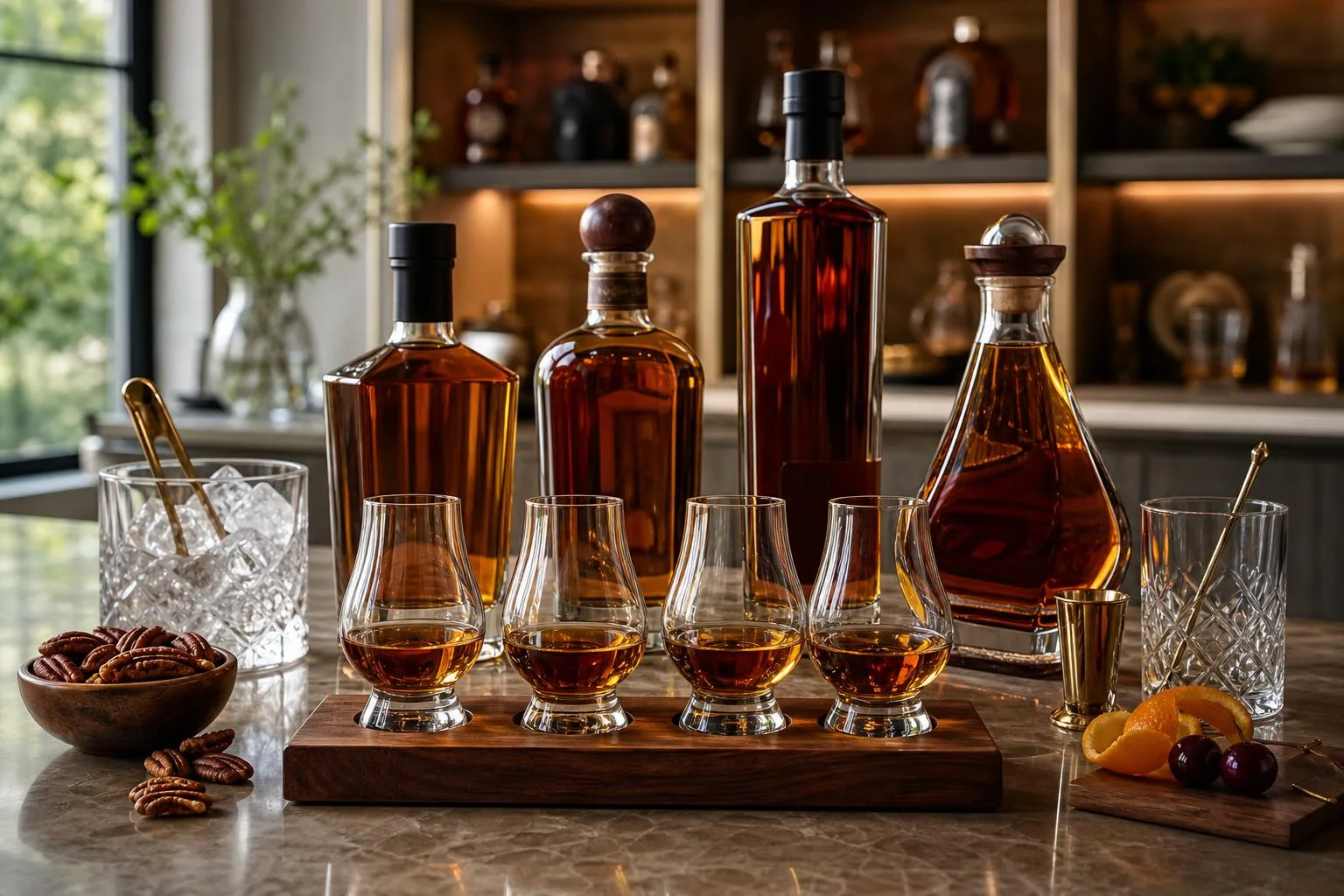
Bourbon Type and Alcohol Safety
Bourbon styles differ in proof, age, mash bill, and flavor intensity, but alcohol safety does not change by type. Whether it is wheated bourbon, high-rye bourbon, bottled-in-bond, or barrel proof, serving size and alcohol by volume matter most.
| Bourbon format | Typical ABV | Practical serving note |
| Standard straight bourbon | 40% to 50% | Use a 1.5 oz pour as the baseline serving |
| Bottled-in-bond bourbon | 50% | Always 100 proof under U.S. law |
| Barrel proof bourbon | 55% to 70% is common | Measure carefully; a “small” pour can equal multiple drinks |
| Bourbon in cocktails | Varies by recipe | Count the whiskey volume, not the glass size |
In the United States, the National Institute on Alcohol Abuse and Alcoholism defines one standard drink as 14 grams of pure alcohol. That equals 1.5 fluid ounces of 40% ABV distilled spirits.
Higher-proof bourbon changes the math. A 1.5 oz pour of 60% ABV barrel proof bourbon contains about 1.5 standard drinks, not one. At 66% ABV, that same pour is about 1.65 standard drinks.
| Pour | ABV | Approximate standard drinks |
| 1.5 oz | 40% | 1.0 |
| 1.5 oz | 50% | 1.25 |
| 1.5 oz | 60% | 1.5 |
| 2.0 oz | 50% | 1.67 |
- Measure pours. Use a jigger, especially with cask-strength bourbon. Free-pouring often turns a 1.5 oz serving into 2 oz or more.
- Add water intentionally. A few drops can open aroma in high-proof bourbon. It also reduces burn, but it does not reduce the total alcohol consumed.
- Do not drive. The CDC states impairment begins before obvious intoxication. Plan a designated driver, rideshare, or public transit before tasting.
- Eat before tasting. Food slows alcohol absorption. Protein, fat, and complex carbohydrates are more useful than salty snacks alone.
- Compare styles in small pours. For flights, use 0.5 oz to 0.75 oz samples. Four 0.75 oz pours at 50% ABV equal about 2.5 standard drinks.
- Store bourbon safely. Keep bottles upright, tightly closed, away from direct sunlight, and out of reach of children. Unlike wine, bourbon does not improve after opening.
- Avoid alcohol in pregnancy. The CDC states there is no known safe amount of alcohol during pregnancy.
For tasting accuracy, use a tulip-shaped glass, room-temperature bourbon, and a neutral palate cleanser. Taste lower-proof or softer wheated bourbons before high-rye, high-proof, or heavily oaked bottles to avoid palate fatigue.
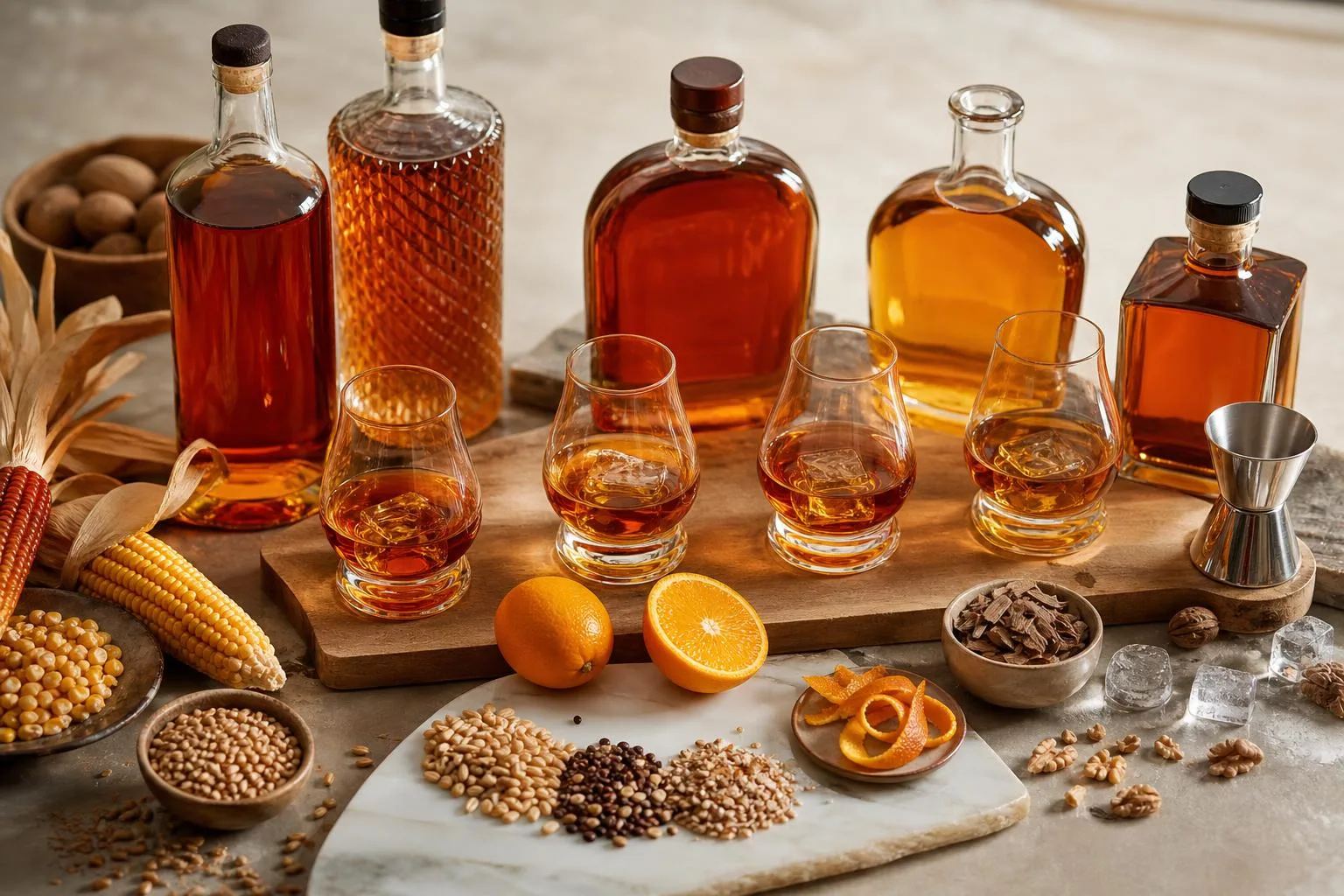
Blind Tasting Across Bourbon Types
We tasted 18 bourbons across 6 common types over two blind sessions, using 1-ounce pours in Glencairn glasses. Each sample rested 12 minutes, and we retasted every bourbon once with 4 drops of room-temperature water.
We grouped bottles by production style, not brand reputation: straight bourbon, wheated bourbon, high-rye bourbon, bottled-in-bond, single barrel, and barrel proof.
All met the federal bourbon baseline: at least 51% corn, new charred oak, distilled at no more than 160 proof, and bottled at 80 proof or higher.
| Type tested | Bottles | Proof range | What we consistently measured |
| Straight bourbon | 4 | 86–100 | Most balanced sweetness, oak, and spice after 2+ years aging |
| Wheated bourbon | 3 | 90–107 | Softer finish; lower perceived spice in 3 of 3 samples |
| High-rye bourbon | 3 | 90–101 | More pepper and dry baking spice in 3 of 3 samples |
| Bottled-in-bond | 3 | 100 | Best proof-to-price consistency; all were at least 4 years old |
| Single barrel | 3 | 93–115 | Widest bottle-to-bottle variation, especially oak and heat |
| Barrel proof | 2 | 118.4–126.6 | Most concentrated aroma; needed water to show fruit clearly |
Our clearest finding was that “type” changed the drinking experience more reliably than age alone.
In blind scoring, wheated bourbons averaged the lowest heat rating, while high-rye bourbons showed the most consistent clove, cinnamon, and black-pepper notes.
Bottled-in-bond stood out for predictability. Because the category must be one distillation season, one distiller, one bonded warehouse, at least 4 years old, and exactly 100 proof, the three we tested had fewer surprises than single-barrel pours.
- Best neat: wheated and 90–100 proof straight bourbons showed the cleanest caramel and vanilla without dilution.
- Best with water: barrel-proof samples improved most after 4 drops, reducing alcohol prickle while increasing cherry and oak aromas.
- Best for cocktails: high-rye and bottled-in-bond bourbons held spice and structure in an Old Fashioned test using 2 ounces bourbon, 0.25 ounce rich syrup, and 2 dashes bitters.
- Most variable: single barrels differed enough that we would not describe them as one flavor style.
Our practical takeaway: straight bourbon is the umbrella, while wheated, high-rye, bottled-in-bond, single barrel, small batch, and barrel proof describe useful buying differences.
For most drinkers, proof and secondary grain predicted flavor faster than label prestige.
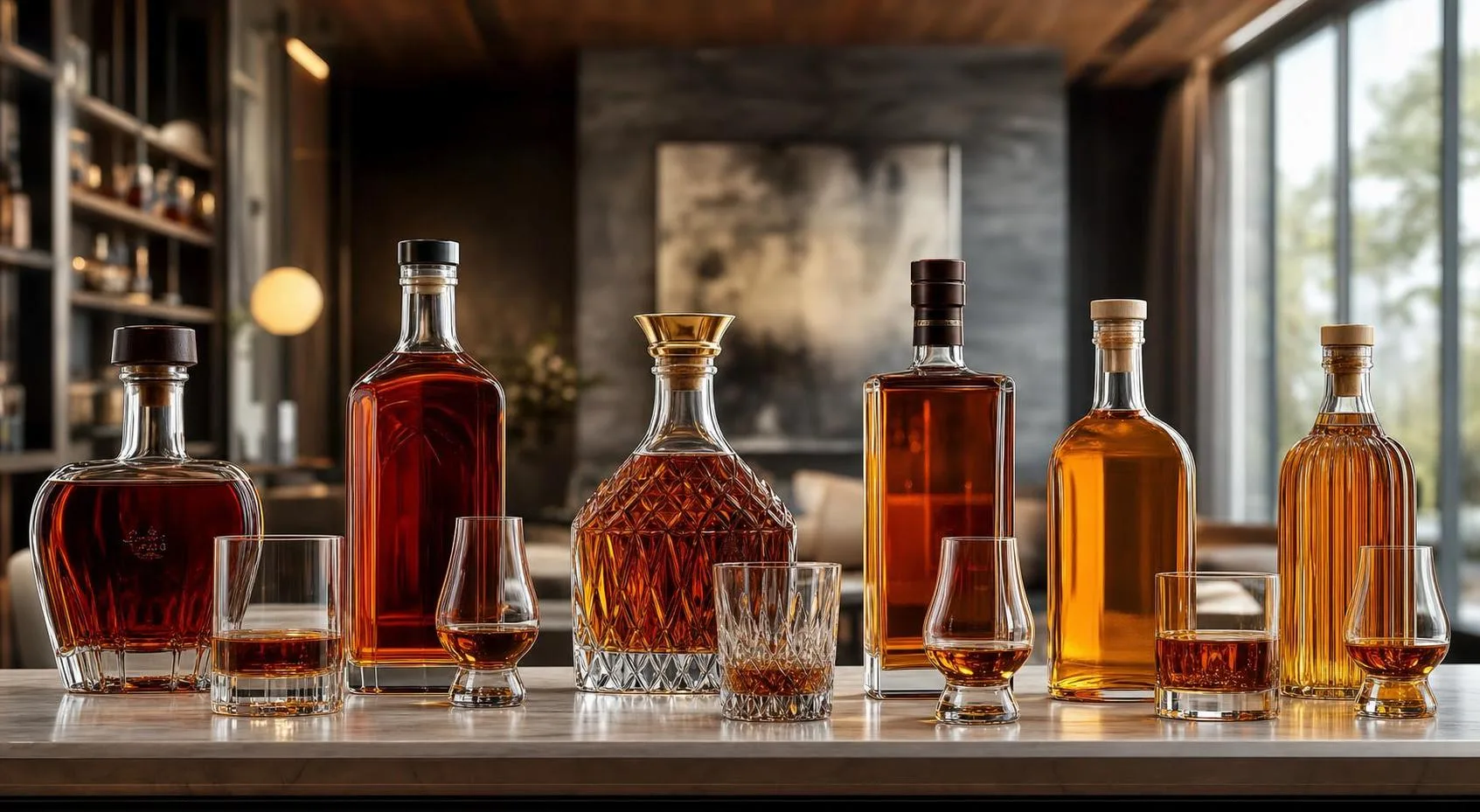
Common Confusion About Bourbon Labels
Bourbon categories are often confused because labels mix legal terms, marketing language, and producer-specific recipes. The clearest way to sort them is to separate federal requirements from optional style claims.
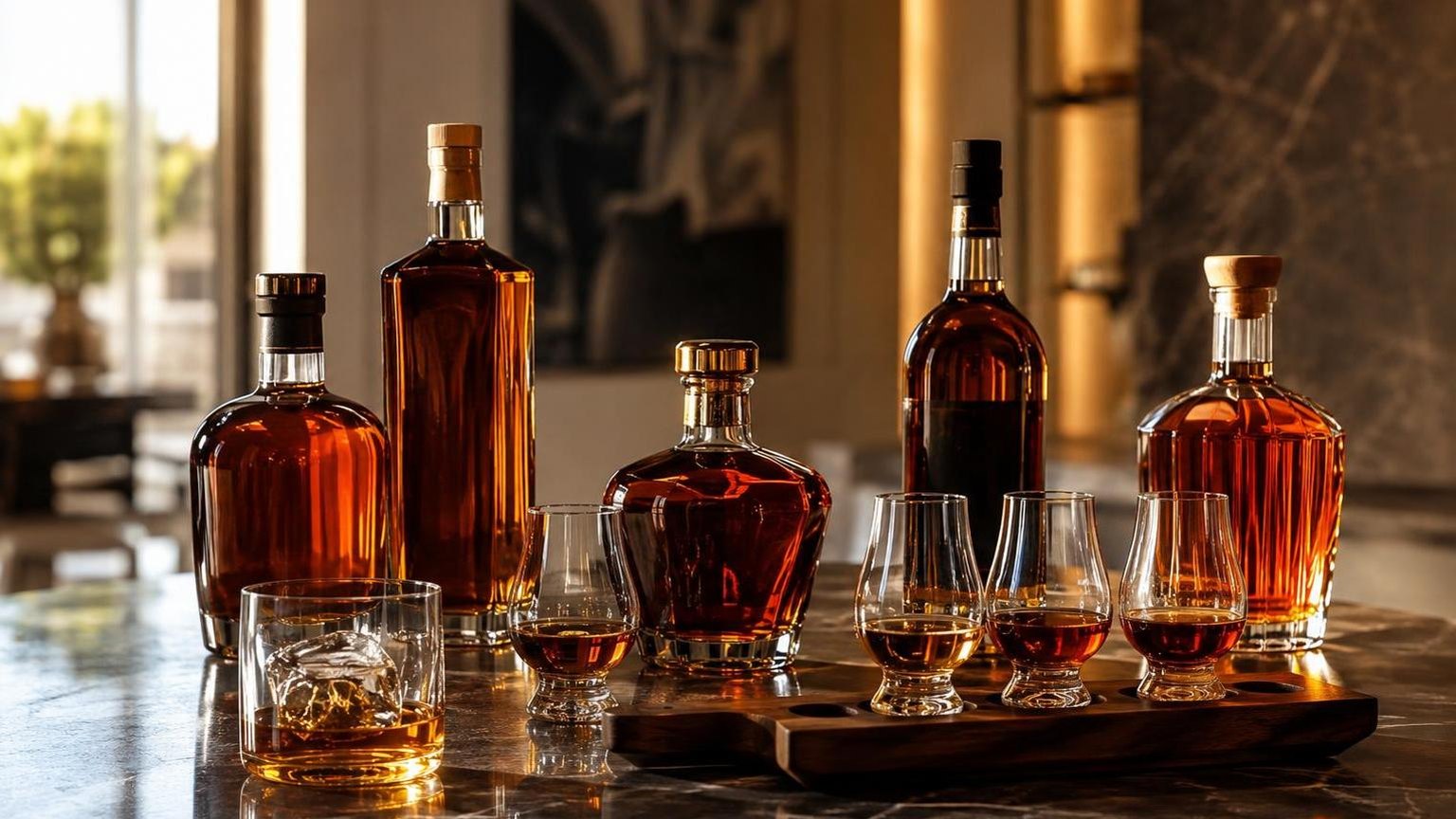
Under U.S. law, bourbon must be made in the United States from at least 51% corn, distilled to no more than 160 proof, entered into new charred oak containers at no more than 125 proof, and bottled at 80 proof or higher.
Myth: Bourbon Has To Be Made In Kentucky
Kentucky dominates bourbon production, but it does not own the legal definition. The Alcohol and Tobacco Tax and Trade Bureau’s bourbon standard applies to the United States, not one state.
A bourbon made in New York, Texas, Indiana, Tennessee, or Colorado can legally be bourbon if it meets the federal standard. “Kentucky bourbon” is a geographic claim, not a separate whiskey type.
Myth: “Straight Bourbon” Means Stronger Bourbon
“Straight” does not mean higher alcohol. It means the bourbon was aged at least 2 years in new charred oak and contains no added coloring, flavoring, or blending materials other than other straight bourbon.
If straight bourbon is aged less than 4 years, the label must carry an age statement. A 2-year straight bourbon and a 10-year straight bourbon can both be bottled at 90 proof.
| Label term | Key legal meaning |
| Bourbon | At least 51% corn; new charred oak; bottled at 80 proof or higher |
| Straight bourbon | Bourbon aged at least 2 years; no added flavor or color |
| Bottled-in-bond bourbon | One distiller, one season, one bonded warehouse, at least 4 years old, bottled at 100 proof |
Myth: Small Batch Has A Fixed Definition
“Small batch” is not federally defined for bourbon. One distillery may batch 20 barrels, while a large producer may use far more. The term can signal selection, but it is not a regulated size guarantee.
Myth: Single Barrel Is Always Better
Single barrel bourbon comes from one barrel, so it can show distinctive oak, spice, or proof variation. That uniqueness is not automatically quality. A well-blended small batch can be more balanced and consistent.
Myth: Wheated Bourbon Is A Different Legal Category
Wheated bourbon is still bourbon. It simply uses wheat as the main flavoring grain instead of rye after the required corn. The law regulates the minimum corn content, not whether the secondary grain is wheat or rye.
Myth: Darker Bourbon Is Always Older
Color can suggest oak influence, but it is not a reliable age meter. Barrel char level, warehouse temperature, entry proof, evaporation, and filtration all affect color. A hot-climate 4-year bourbon may look darker than an older whiskey aged cooler.
- Proof is not age: A 120-proof bourbon may be young or old.
- Age is not quality: Older bourbon can become overly tannic or dry.
- “Reserve” is usually marketing: It has no fixed federal meaning for bourbon.
Questions Readers Ask
What are the main types of bourbon?
The main types include straight bourbon, Kentucky bourbon, wheated bourbon, high-rye bourbon, bottled-in-bond bourbon, single barrel bourbon, small batch bourbon, cask strength bourbon, and finished bourbon.
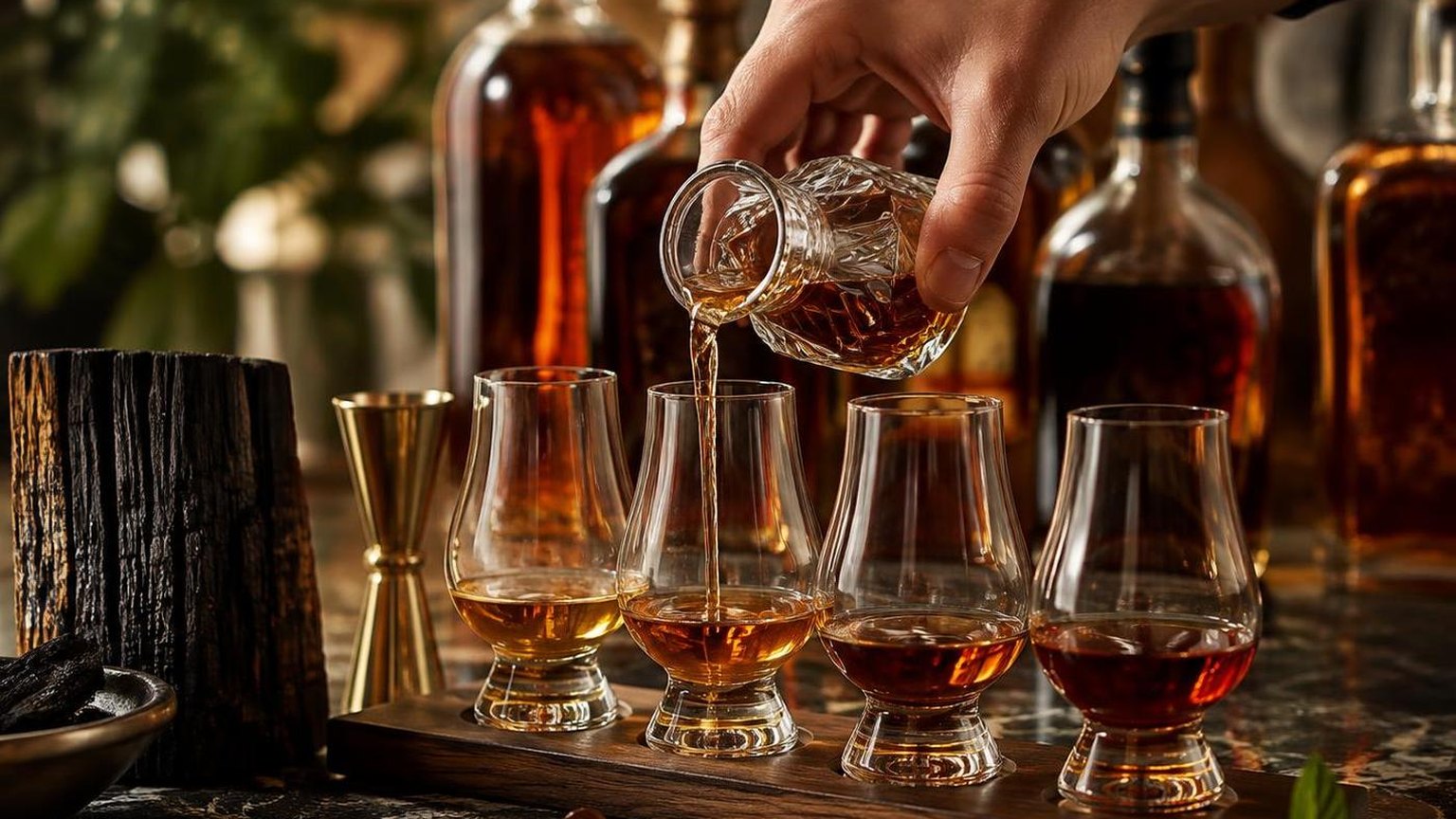
All bourbon sold in the U.S. must be made from at least 51% corn, distilled to no more than 160 proof, entered into new charred oak barrels at no more than 125 proof, and bottled at 80 proof or higher.
What is straight bourbon?
Straight bourbon is bourbon aged for at least 2 years in new charred oak containers with no added coloring, flavoring, or blending materials. If it is aged less than 4 years, the bottle must carry an age statement under U.S. labeling rules.
What is bottled-in-bond bourbon?
Bottled-in-bond bourbon must be the product of one distilling season, one distiller, and one distillery, aged at least 4 years in a federally bonded warehouse, and bottled at exactly 100 proof.
The designation comes from the Bottled-in-Bond Act of 1897, which was created to give drinkers a reliable marker of authenticity and production standards.
What is the difference between wheated bourbon and high-rye bourbon?
Wheated bourbon uses wheat as the main secondary grain after corn, often producing a softer, rounder profile; Maker’s Mark is a well-known example.
High-rye bourbon uses a larger share of rye in the mash bill, commonly creating drier, spicier flavors, as seen in brands such as Four Roses or Bulleit Bourbon.
Is Tennessee whiskey a type of bourbon?
Tennessee whiskey usually meets the federal production standards for bourbon, including the 51% corn mash bill and new charred oak aging requirement, but it is labeled separately under Tennessee law.
Most Tennessee whiskey also uses the Lincoln County Process, filtering the new make spirit through sugar maple charcoal before barrel aging.
Related Reading
- How Many Oz Is 70 Ml?
- Why Does Wine Make Me Sleepy?
- How Much Is 5 Oz In Ml?
- How Many Ounces In A 2 Liter Bottle?
- Who Makes Kirkland Whiskey For Costco?
- How Much Is A Half Oz?
- How Many Pounds in A Cup? – 2026
- All Blog Guides
- Electronic Code of Federal Regulations, 27 CFR § 5.143 (2024)
- Alcohol and Tobacco Tax and Trade Bureau, Beverage Alcohol Manual: Distilled Spirits Chapter 4 (2024)
- Cornell Law School Legal Information Institute, 27 CFR § 5.143 (2024)
- Kentucky Distillers’ Association, What Is Bourbon? (2024)
- Encyclopaedia Britannica, Bourbon Whiskey (2024)
- Distilled Spirits Council of the United States, Bourbon (2024)
- Bourbon Women Association, Bourbon 101 (2024)





