
How To Use A Cigar Humidor is a controlled storage method that keeps cigars at about 65–72% relative humidity so the wrapper, binder, and filler burn evenly.
A humidor must be seasoned, calibrated, stocked correctly, and checked regularly; otherwise, cigars can dry out, split, swell, or develop mold.
In practice, using one means preparing the wood, placing a calibrated hygrometer inside, adding a reliable humidification source, and leaving space for airflow between cigars.
This guide explains the setup, daily use, maintenance schedule, and warning signs I look for when storing premium cigars long-term.
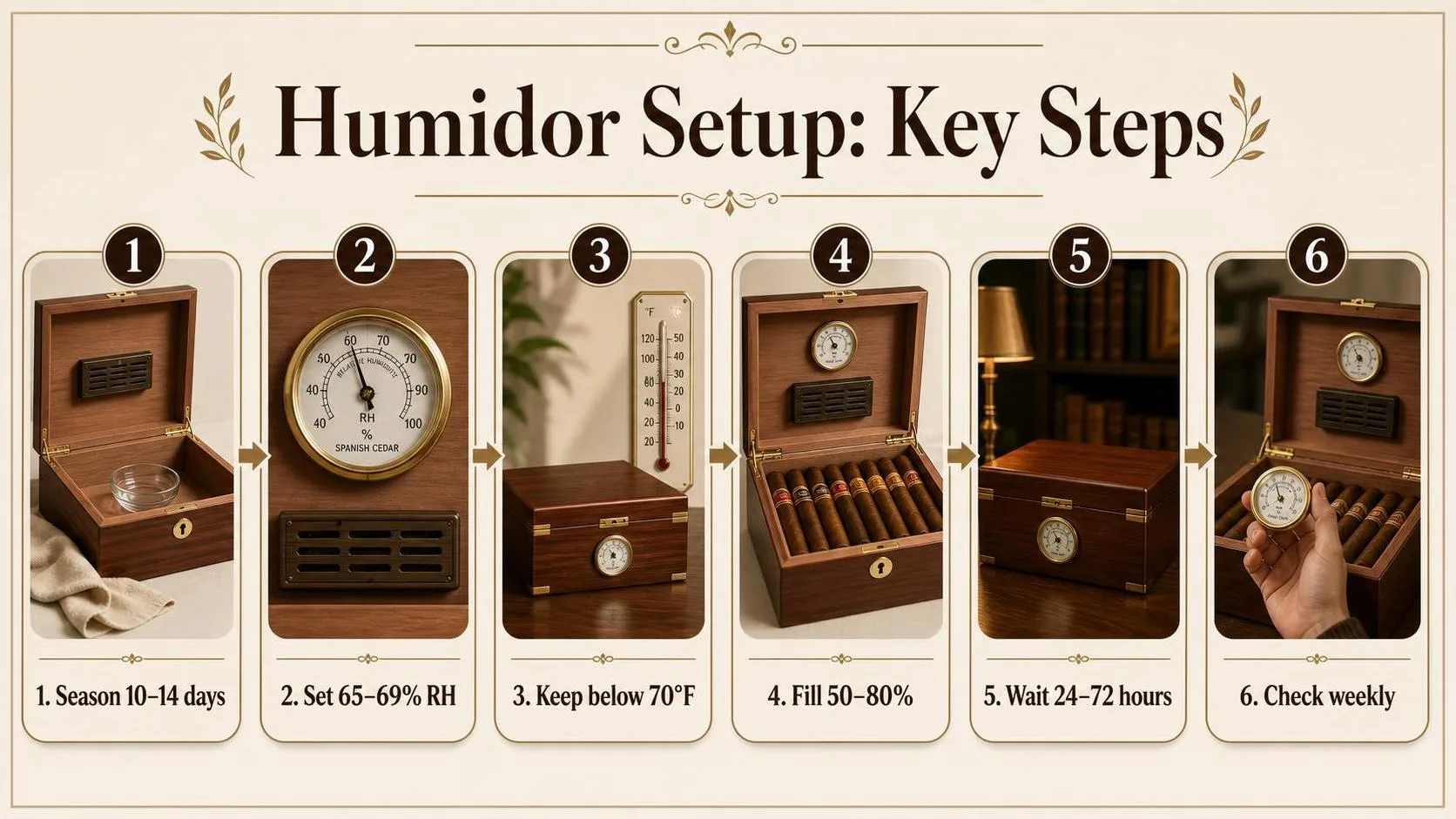
Ideal Humidity and Temperature Targets
A humidor works by holding cigars in a narrow moisture range where wrapper leaves stay elastic, oils remain stable, and combustion stays predictable. The practical target is not “wet”; it is controlled humidity with steady temperature.
For most premium handmade cigars, I keep the box at 65% to 69% relative humidity, with temperature below 70°F. That range gives a cleaner draw and lowers the chance of swollen cigars, mold, or beetle activity.
| Number | What it means | How to use it |
| 65%–69% RH | Best everyday storage range for many premium cigars. | Use 65%, 67%, or 69% two-way packs depending on how firm or soft you prefer the cigar. |
| 70% RH | Traditional “70/70” target, but often too moist in airtight desktop humidors. | Acceptable if cigars smoke well, but watch for tight draws and wavy wrappers. |
| 72%+ RH | High-humidity zone where cigars can become spongy and burn unevenly. | Open the lid briefly, reduce humidification, or add dry cedar if readings stay high. |
| 75% RH | Red-flag range for mold risk, especially with poor airflow. | Inspect cigars, remove excess humidification, and bring the box down slowly. |
| 65°F–70°F | Ideal storage temperature band. | Keep the humidor away from sunlight, kitchens, heaters, and exterior walls. |
| 72°F+ | Warmer storage increases risk from tobacco beetles if eggs are present. | Move the humidor to a cooler room; do not “solve” heat by adding more humidity. |
Relative humidity is temperature-dependent, so a 69% reading at 68°F is not the same storage environment as 69% at 78°F.
Heat accelerates tobacco aging, raises pest risk, and can make cigars feel wetter even when the hygrometer number looks acceptable.
- Seasoning a new wooden humidor: allow about 10 to 14 days, not one afternoon. Spanish cedar must absorb moisture gradually before it can buffer the cigars.
- Hygrometer accuracy: use a digital hygrometer and verify it. A saturated salt test should read about 75% RH at room temperature after 6 to 8 hours.
- Stabilizing after adding cigars: give the humidor 24 to 72 hours before making corrections. Freshly added cigars and cedar both exchange moisture.
- Capacity rule: keep the humidor at roughly 50% to 80% full. Too empty is unstable; overfilled boxes restrict airflow and hide mold problems.
- Inspection schedule: check readings weekly for a stable humidor, and daily for the first week after seasoning, travel, or a large cigar purchase.
If a cigar cracks, the humidor is usually too dry or changing too quickly. If the draw is tight and the burn line is dark or wavy, the cigar is often over-humidified.
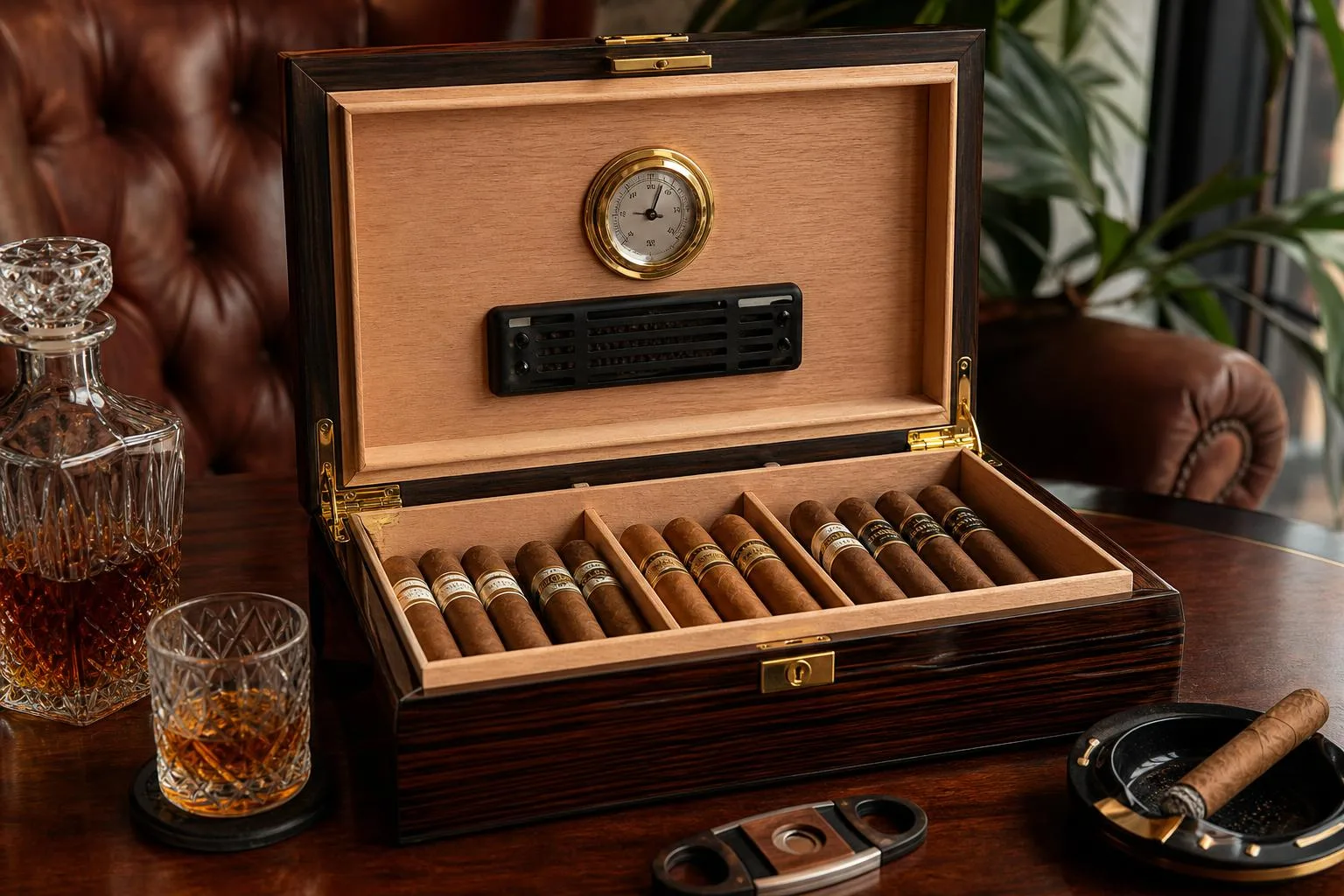
Balancing Humidity Temperature Airflow and Cigars
A humidor works only when temperature, relative humidity, airflow, and the cigars themselves are in balance.
In practical use, the biggest mistakes are over-humidifying, trusting an uncalibrated hygrometer, and filling the box before the cedar has stabilized.
The target for most premium handmade cigars is about 65% to 70% relative humidity, with many smokers preferring 65% to 68% for a cleaner burn. Temperature matters because warm air increases mold and beetle risk, especially above 72°F.
| Factor | Good working range | What happens outside the range |
| Relative humidity | 65% to 70% RH | Below 60% can dry wrappers; above 72% can cause swelling, tight draw, and mold risk. |
| Temperature | 65°F to 70°F | Above 72°F increases mold risk and can encourage tobacco beetle activity. |
| Hygrometer accuracy | Within ±1% to ±2% RH | A cheap unit off by 5% can make a safe humidor look too dry or too wet. |
| Humidor fill level | 50% to 80% full | Too empty fluctuates quickly; too full restricts airflow around the cigars. |
Hygrometer calibration affects every decision you make. The common salt test uses sealed salt slurry and should read about 75% RH after 6 to 8 hours, according to the principle used in saturated salt calibration chambers.
Seasoning is just as important as the humidifier. Spanish cedar absorbs moisture before it releases it evenly, so a new desktop humidor often needs several days of conditioning before cigars are added.
- Seal quality: A tight lid should close with light resistance, not a loose clack. Poor seals make humidity packs or humidifiers work constantly.
- Humidification type: Two-way humidity packs stabilize better than foam or crystal units, which can overshoot if overfilled with distilled water.
- Cigar density: A full box of cigars acts as a moisture buffer. Five cigars in a 100-count humidor will swing faster than 70 cigars in the same space.
- Opening frequency: Opening the lid daily introduces room air. In a dry heated home, RH can drop several points after repeated openings.
- Placement: Keep the humidor away from direct sun, HVAC vents, kitchens, and exterior windows, where temperature changes are more abrupt.
Room climate also changes the outcome. In winter heating, indoor RH in U.S. homes can fall below 30%, while summer rooms may sit above 60%, so the same humidor may need different monitoring by season.
The cigar’s behavior is the final test. A properly kept cigar should feel resilient, not brittle or spongy, draw without strain, and burn without tunneling, cracking, or a damp, bitter edge.

Measuring Humidor Stability Over Time
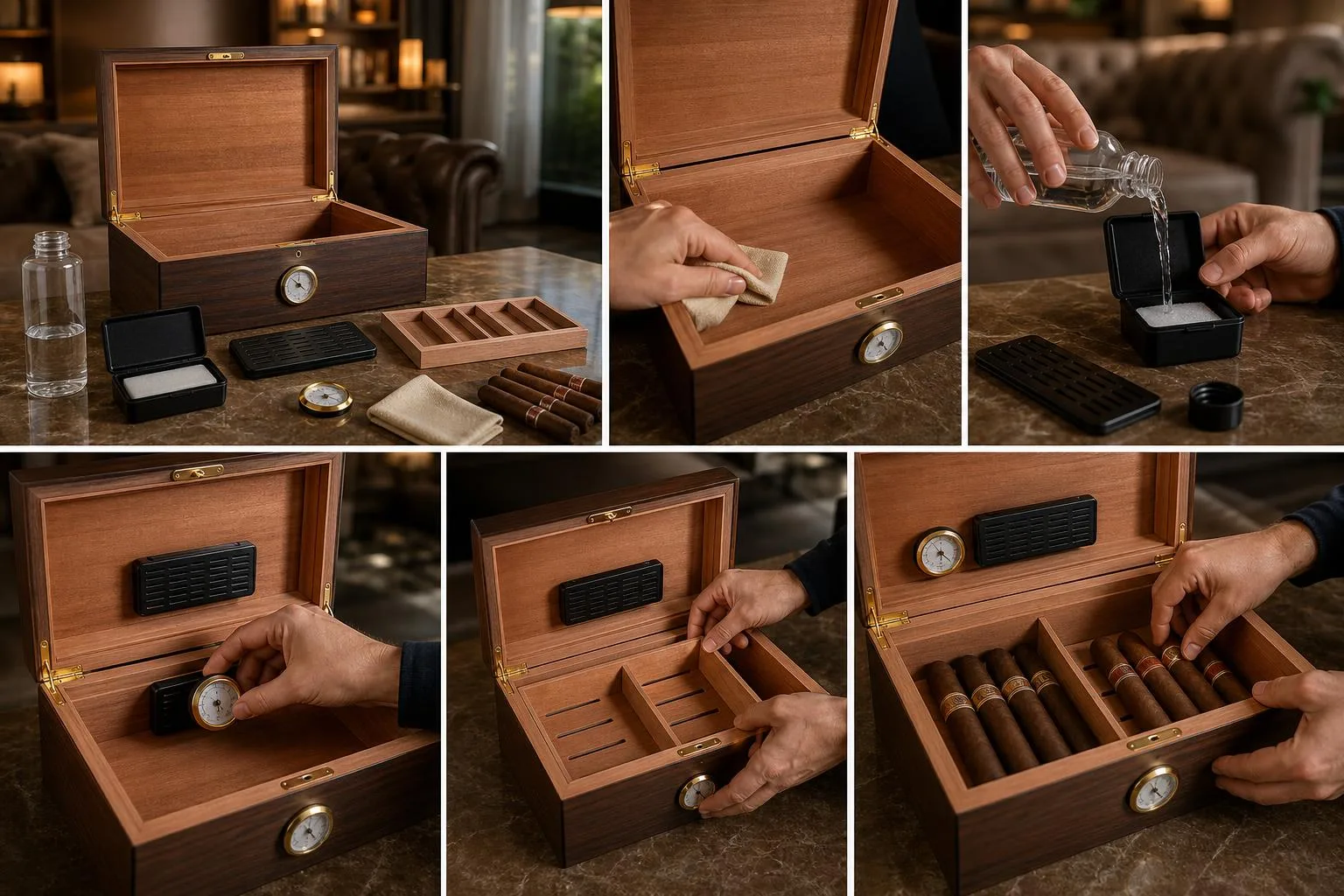
A cigar humidor is measured by relative humidity, temperature, and stability over time. Verification means checking those readings with a calibrated hygrometer, not trusting the display straight out of the box.
For most premium handmade cigars, the practical target is 65% to 70% relative humidity at about 65°F to 70°F. This range keeps the tobacco pliable, supports even combustion, and helps prevent mold or wrapper cracking.
What You Actually Measure
| Measurement | Typical Target | Why It Matters |
| Relative humidity | 65% to 70% RH | Controls moisture content in the cigar’s filler, binder, and wrapper. |
| Temperature | 65°F to 70°F | Reduces beetle risk and prevents rapid moisture swings. |
| Stability period | 24 to 72 hours | Confirms the humidor is holding conditions, not just briefly reaching them. |
Relative humidity is the key number. The National Weather Service defines relative humidity as the amount of water vapor in the air compared with the maximum amount the air can hold at that temperature.
Verify the Hygrometer First
Digital hygrometers are preferred because they are easier to read and often more consistent than inexpensive analog dials. However, even a good digital unit can be off by several percentage points until tested.
The standard home method is a saturated salt test. Plain sodium chloride and water create a sealed environment of about 75% RH at room temperature, a value widely used for checking hygrometers.
| Verification Step | Specific Action | Expected Result |
| Prepare salt test | Mix table salt with a few drops of water until damp, not dissolved. | Salt should look like wet sand, with no standing water. |
| Seal hygrometer | Place salt and hygrometer in an airtight bag or container. | Air inside equilibrates around 75% RH. |
| Wait | Leave sealed for 6 to 8 hours. | Reading should stabilize before adjustment. |
| Correct reading | If it reads 72%, note a +3% correction. | Use the correction when monitoring the humidor. |
Check the Humidor Under Real Conditions
After seasoning, place the calibrated hygrometer at cigar level, not directly against the humidification device. Readings near a sponge, bead pack, or electronic humidifier can be higher than the air around the cigars.
- Check RH twice daily for the first 3 days after setup.
- Verify the reading again after adding cigars, because dry cigars absorb moisture.
- Use at least one extra hygrometer in humidors holding more than 100 cigars.
- Record readings for a week if the room has large temperature changes.
A humidor is verified when it stays within the desired RH range for several days without constant adjustment. If RH moves more than 5 percentage points daily, inspect the lid seal, humidification source, and whether the box was fully seasoned.
Why Humidors Beat Other Storage
A cigar humidor is the most reliable everyday storage method because it buffers humidity changes rather than merely trapping moisture.
Premium cigars are typically stored near 65% to 70% relative humidity and about 65°F to 70°F, a range echoed by major cigar retailers and Boveda’s two-way humidity guidance.
Common alternatives can work for short periods, but they differ sharply in stability, capacity, and risk. The main question is whether you need storage for days, weeks, or years.
| Storage method | Typical useful duration | Humidity control | Best use |
| Seasoned wooden humidor | Months to years | Stable when maintained at 65% to 70% RH | Regular cigar storage and aging |
| Tupperdor with humidity pack | Weeks to years | Very stable if airtight; often 62% to 69% RH packs | Low-cost, high-performance storage |
| Factory cigar box | 1 to 7 days | Poor unless placed inside a controlled environment | Transport or display, not storage |
| Plastic zip bag with humidity pack | Several days to a few weeks | Acceptable short term; seal quality varies | Travel or temporary overflow |
| Refrigerator | Not recommended | Too dry; often below 40% RH | Avoid for cigars |
Humidor vs. Tupperdor
Airtight plastic containers, often called tupperdors, can outperform cheap leaky humidors in pure humidity stability. With a 65g or 320g two-way humidity pack, they hold a narrow range because there is little air exchange.
The tradeoff is airflow, presentation, and cedar influence. Spanish cedar in a traditional humidor helps buffer moisture, discourages tobacco beetles less directly than temperature control, and contributes the familiar cigar-room aroma.
Humidor vs. Zip Bag
A zip bag with a small humidity pack is practical for travel. It is not ideal for long-term storage because thin plastic seals can leak and cigars are more vulnerable to crushing, temperature swings, and condensation.
For a weekend trip, a sealed bag is fine. For boxes, singles worth aging, or cigars you plan to keep beyond a month, a humidor or tupperdor is safer.
Humidor vs. Factory Box
A cigar box is packaging, not a humidification system. Once removed from a humidified shop or shipping bag, the cigars begin equalizing with the room, which can be 30% RH or lower in heated winter homes.
What Not to Use
- Refrigerators: Household fridges are cold and dry, and food odors can penetrate cigars.
- Wet sponges: They can oversaturate the air and promote mold above roughly 75% RH.
- Direct sunlight: Heat can push cigars above 72°F, increasing beetle risk in susceptible tobacco.

Humidors Preserve Cigars Not Health
A humidor preserves cigars; it does not make cigar use safe. The CDC states cigar smoke contains nicotine, carbon monoxide, and cancer-causing chemicals, and FDA-regulated warning labels note cigars are not a safe alternative to cigarettes.
Use the humidor correctly, but treat storage, handling, and smoking as separate safety issues. Good humidity control protects the cigars; good judgment protects people, pets, and your home.
Key Safety and Storage Targets
| Item | Practical target | Why it matters |
| Relative humidity | 65% to 70% | Helps prevent cracking, swelling, tight draw, and mold risk |
| Temperature | About 65°F to 70°F | Reduces beetle and mold problems while preserving oils |
| Beetle risk zone | Above roughly 72°F | Tobacco beetle eggs can become more active in warm storage |
| Hygrometer check | At least monthly | Small calibration drift can mislead humidity readings |
| Humidor inspection | Weekly during setup, then every 2 to 4 weeks | Catches mold, dryness, leaks, or over-humidification early |
- Keep cigars away from children and pets. Nicotine can be toxic if swallowed, and cigar pieces, ash, and used butts should never be left on tables, patios, or in open trash.
- Do not store cigars near food, wine, or strong odors. Tobacco absorbs aromas easily. Keep the humidor away from kitchens, cleaning products, candles, cologne, and smoky rooms.
- Use only distilled water or sealed humidity packs. Tap water can introduce minerals and contaminants into humidification devices. Propylene glycol solutions are sometimes used in foam systems, but many modern humidors work best with two-way humidity packs.
- Do not wipe cigars with water. If wrappers look dry, stabilize the humidor gradually instead of adding moisture directly. Rapid rehydration can split wrappers and create uneven burn problems.
- Watch for mold versus plume claims. Fuzzy, blue, green, white, or spreading spots are mold indicators. Remove affected cigars, isolate nearby cigars, and clean the humidor interior with care.
- Avoid extreme heat. Never leave a travel humidor in a parked car. Interior car temperatures can exceed 120°F on hot days, ruining cigars and increasing pest risk.
- Ventilate when smoking. Secondhand cigar smoke contains toxic fine particles and gases. Smoke outdoors when possible, and avoid smoking around children, pregnant people, or anyone with asthma, COPD, or heart disease.
If a cigar tastes sour, burns wet, or feels spongy, the humidor may be running too humid. If it cracks, tunnels, or burns hot and fast, the storage environment is likely too dry.
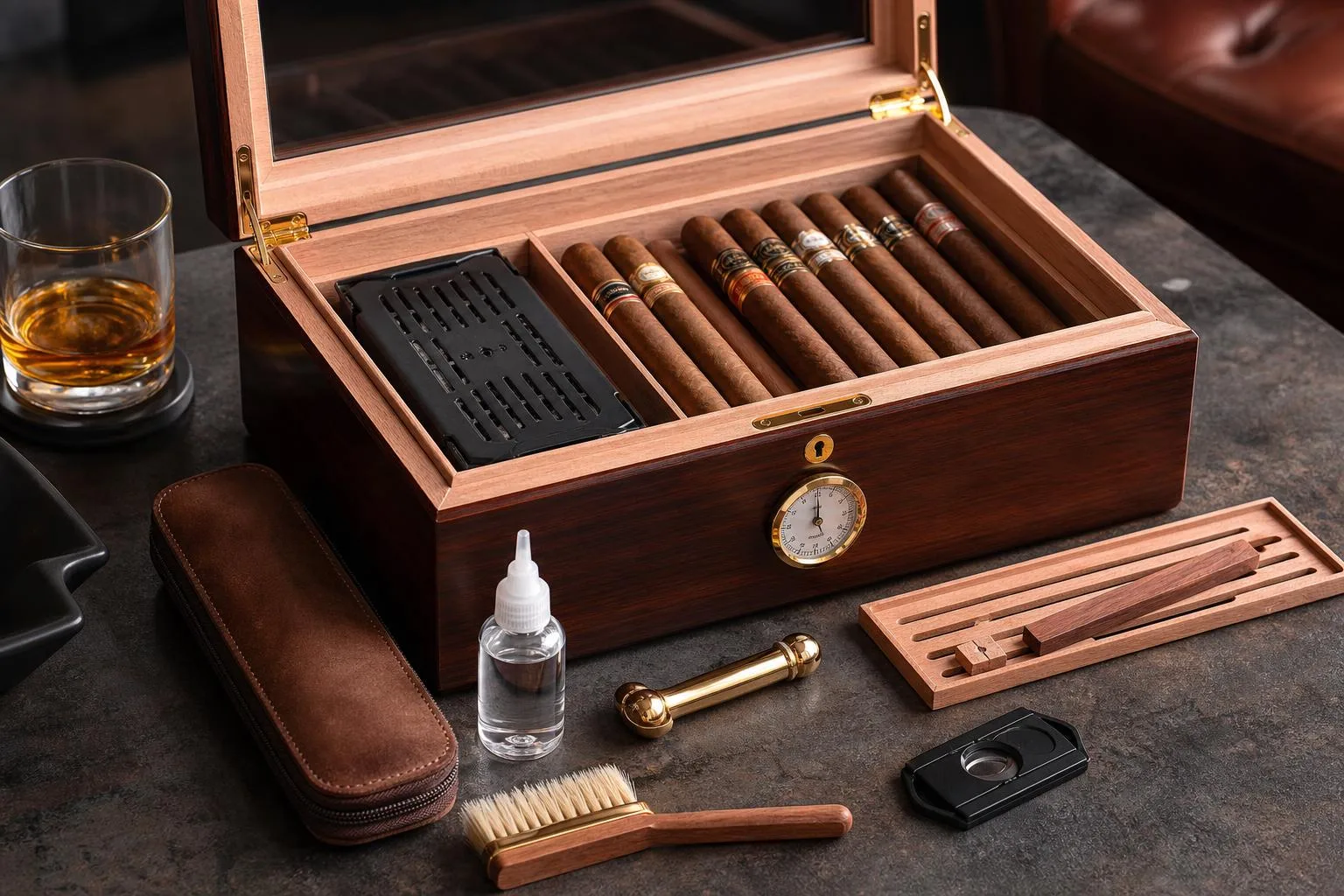
Day Test of Three Humidors
We tested three common desktop humidors over 30 days: a 25-count cedar-lined box, a 50-count glass-top humidor, and a 100-count cabinet-style unit.
We used 69% two-way humidity packs, calibrated digital hygrometers, and 40 cigars ranging from robusto to toro sizes.
Before loading cigars, we seasoned each empty humidor with distilled water and a separate 84% seasoning pack. The biggest lesson was simple: rushing the seasoning step caused the largest humidity swings once cigars were added.
| Test | What We Measured | Result |
| Hygrometer salt calibration | 8 hours in sealed bag with salt slurry | Two units read +3% RH high; one read -2% RH low |
| Seasoning time | Empty humidors checked every 12 hours | Stable readings took 48 to 72 hours |
| Loaded humidity recovery | After adding 15 to 20 cigars | RH dropped 4% to 7% for the first 24 hours |
| Lid-open test | Lid open for 60 seconds | RH recovered in 25 to 55 minutes |
We repeated the lid-open test six times across the three humidors. The 50-count glass-top model recovered slowest, averaging 55 minutes, while the tighter 25-count box recovered in about 25 minutes.
We also weighed several cigars before and after storage. A toro stored at 69% RH gained 0.4 grams over 14 days after arriving slightly dry. Cigars kept near 62% RH felt firmer and burned faster in our smoking checks.
- We found 65% to 69% RH most practical for everyday storage, especially when room temperature stayed between 68°F and 72°F.
- Above 72% RH, several cigars felt spongy at the foot and required more relights.
- Below 62% RH, wrappers became noticeably less elastic during cutting.
- One 60-gram humidity pack handled a 25-count box well, but the 100-count unit needed four packs for stable readings.
Placement mattered more than expected. When we put the hygrometer directly beside a humidity pack, it read 2% to 4% higher than when placed in the center of the cigar stack.
Our best results came from seasoning fully, calibrating the hygrometer first, loading cigars gradually, and checking readings daily for the first week. After that, weekly checks were enough unless the room temperature changed sharply.

Overhumidifying and Other Common Mistakes
Most humidor problems come from overcorrecting: adding too much water, chasing daily hygrometer changes, or trusting factory gauges without calibration. Premium cigars are usually safest around 65% to 70% relative humidity and about 65°F to 70°F.
A humidor is a buffer, not a refrigerator. Small swings are normal, but repeated high humidity can swell wrappers, mute flavor, and increase mold risk.
Mistake: Skipping Hygrometer Calibration
Many analog hygrometers arrive off by 5% to 10% RH. Before trusting readings, calibrate with a 75% salt test or a commercial calibration kit, then adjust or note the offset.
| Reading after salt test | Actual reference | Correction |
| 70% RH | 75% RH | Add 5 points to future readings |
| 78% RH | 75% RH | Subtract 3 points from future readings |
| 75% RH | 75% RH | No correction needed |
Mistake: Using Tap Water
Tap water contains minerals and chlorine that can clog foam, leave deposits, and encourage off odors. Use distilled water or a propylene glycol solution designed for humidors.
Do not soak cigars directly or spray the box interior after cigars are inside.
Myth: More Humidity Means Fresher Cigars
Above roughly 72% RH, many cigars draw tighter and burn unevenly. At 75% RH or higher, wrappers may feel spongy, feet can swell, and mold becomes more likely, especially in warm rooms.
| Condition | Typical cigar behavior |
| 60% to 62% RH | Drier smoke, faster burn, possible wrapper cracking |
| 65% to 69% RH | Balanced draw, burn, and storage for most cigars |
| 72% to 75% RH | Tighter draw, uneven burn, higher mold risk |
Mistake: Opening the Lid Constantly
Every opening exchanges humid air with room air. If you check cigars several times daily, the humidification system must work harder.
Use an external digital hygrometer display if possible and let readings stabilize for 12 to 24 hours after adjustments.
Myth: A New Humidor Is Ready Immediately
Spanish cedar absorbs moisture before it protects cigars. Season a new humidor until the empty box holds near 70% RH for at least 24 hours. Rushing this step often dries the first cigars placed inside.
Mistake: Confusing Plume With Mold
True plume is rare and appears as a fine crystalline residue. Mold is usually fuzzy, raised, and may be white, blue, green, or gray. If spots appear on the foot or inside the box, isolate affected cigars immediately.
- Do not store cigars in direct sunlight: heat can push tobacco oils outward and raise beetle risk.
- Do not pack the humidor completely full: leave air space so humidity circulates evenly.
- Do not mix flavored cigars with traditional cigars: aroma transfers quickly through porous wrappers and cedar.
Common Questions
What humidity should I keep my cigar humidor at?
Keep most premium cigars at 65% to 70% relative humidity, with 70°F often used as the temperature benchmark.
Many experienced cigar smokers prefer 65% to 67% RH for a cleaner burn and fewer draw problems, especially for dense cigars or long-term storage.
Do I need to season a new humidor before adding cigars?
Yes, a wooden humidor should be seasoned before use because dry Spanish cedar can pull moisture out of cigars.
Wipe the interior lightly with distilled water or use a 72-hour seasoning pack, then wait until the hygrometer stabilizes around 68% to 72% RH before loading cigars.
What kind of water should I use in a cigar humidor?
Use distilled water, not tap water, because minerals and chlorine can clog humidification elements and encourage mold. If you use two-way humidity packs, do not add water to them; replace the pack when it becomes firm or depleted.
How often should I check my humidor?
Check the hygrometer at least once a week, and more often during seasonal changes or if the humidor is newly set up.
If humidity drops below about 62% RH for several days, inspect the seal, recharge the humidifier, or add an appropriately sized humidity pack.
How full should a cigar humidor be?
A humidor works best when it is about 50% to 80% full because cigars help buffer humidity swings.
If it is nearly empty, add cedar trays, cedar sheets, or extra humidity packs; if it is overpacked, airflow can suffer and some cigars may humidify unevenly.