Why Is Liquor Called Spirits is answered by distillation: early alchemists called the volatile alcohol vapor rising from heated wine or grain the “spirit,” then condensed it into strong liquor.
The term reflects a visible process: heat separates alcohol from a fermented liquid, and the captured vapor becomes a more concentrated drink.
By the Middle Ages, Latin writers used spiritus, meaning breath or vapor, for distilled alcohol.
In English, “spirits” became common for liquors such as brandy, rum, gin, whiskey, and vodka because they are distilled, higher-proof beverages rather than simply fermented ones.
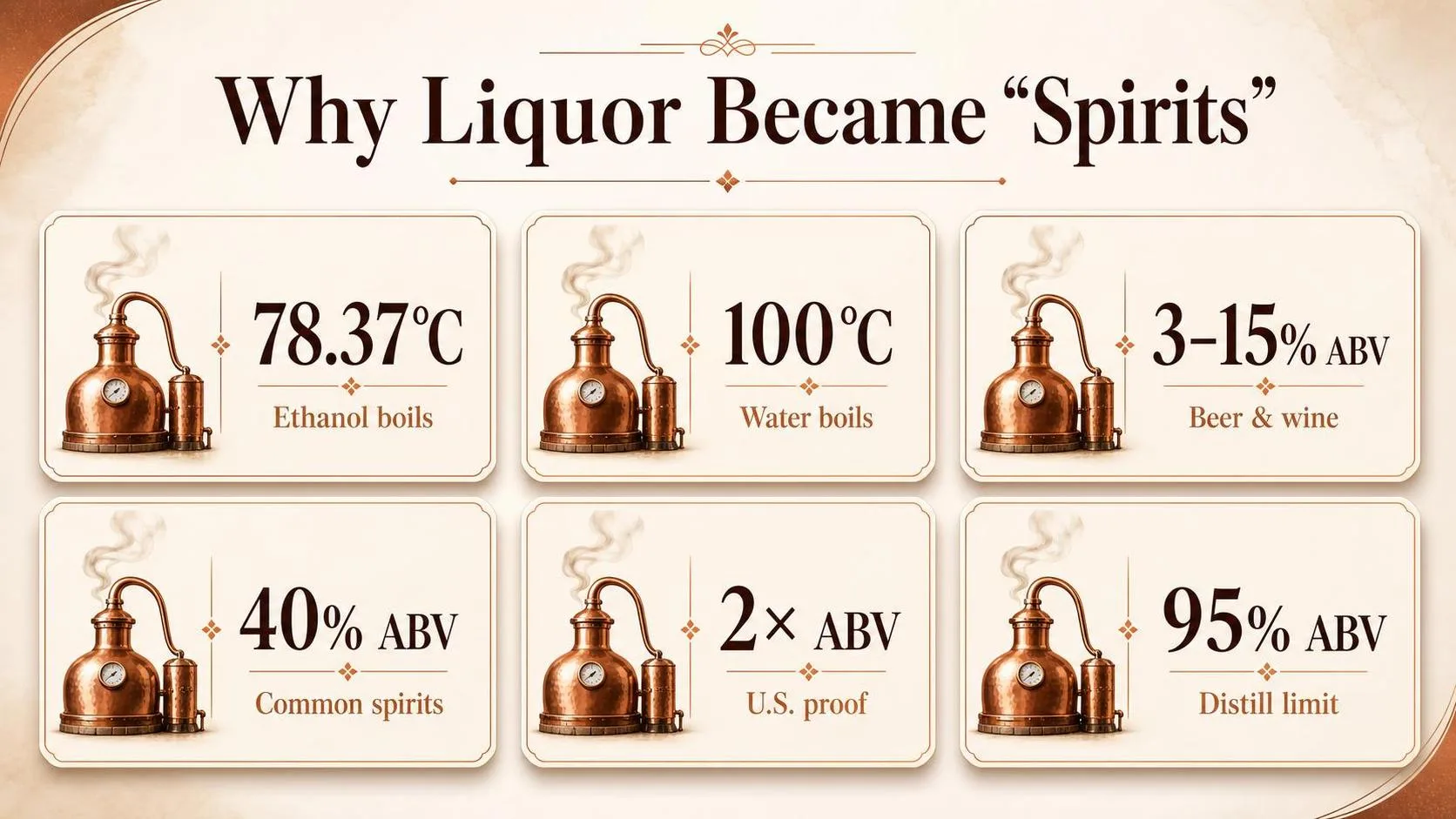
Why Distillation LED to Spirits
The word “spirits” is tied to distillation: early distillers watched alcohol vapor rise from heated liquid, then condense into a stronger.
Invisible-to-visible “essence.” The key numbers show why distilled liquor seemed different from beer and wine.
In practical terms, distillation separates ethanol because it boils at a lower temperature than water.
That physical fact made concentrated alcohol possible, and it shaped the old language of “spirit” as the volatile part drawn out of a fermented drink.
| Number | What it means | Why it matters to “spirits” |
| 78.37°C / 173.07°F | Approximate boiling point of ethanol at standard pressure | Alcohol vaporizes before most water, so distillers could collect a concentrated “spirit” from wine, beer, or mash. |
| 100°C / 212°F | Boiling point of water at standard pressure | The gap between ethanol and water helped early observers see alcohol as a separable, volatile essence. |
| About 3–15% ABV | Typical strength range for most beers and wines | Fermentation alone usually stops far below liquor strength because yeast becomes stressed by alcohol. |
| 40% ABV / 80 proof | Common bottling strength for whiskey, vodka, rum, gin, and tequila in the U.S. | This concentration is why modern “spirits” are legally and culturally distinct from fermented drinks. |
| 190 proof / 95% ABV | Near the practical ceiling for beverage ethanol by ordinary distillation | Ethanol and water form an azeotrope, so simple distillation cannot produce completely pure alcohol. |
U.S. labeling still reflects these differences.
The Alcohol and Tobacco Tax and Trade Bureau defines “distilled spirits” as ethyl alcohol, hydrated oxide of ethyl, spirits of wine, whiskey, rum, brandy, gin, and other distilled products made for beverage or industrial use.
Proof adds another important number. In the United States, proof is exactly double alcohol by volume, so a bottle at 40% ABV is 80 proof. That system replaced older, less precise tests once tied to whether alcohol-soaked gunpowder would ignite.
| Term | Typical ABV | Production method |
| Beer | 4–8% | Fermentation of grain sugars |
| Wine | 11–15% | Fermentation of grape sugars |
| Distilled spirits | 35–50% for many retail bottles | Fermentation followed by distillation |
The historical phrase “spirit of wine” appears in European medical and alchemical writing before modern liquor branding. It referred to the distilled, flammable essence of wine—what chemists later identified as ethanol.
So the numbers explain the name: spirits are not called that because of ghosts, but because distillation releases a volatile, concentrated “spirit” from a fermented base.
Why Distilled Spirit Varies
The “spirit” that comes off a still is not one uniform liquid. Its aroma, strength, texture, and safety depend on fermentation, distillation choices, cut points, and aging conditions.
Historically, distillers called the vaporized alcohol the spirit because heating seemed to release the essence of wine, grain, fruit, or molasses. In practice, that “essence” is shaped by measurable chemistry.
Fermentation Sets the Starting Point
Before distillation, yeast converts sugars into ethanol, carbon dioxide, and hundreds of flavor compounds. Most beer or wine bases for spirits finish around 5% to 12% alcohol by volume before entering the still.
- Raw material: Barley, corn, grapes, sugarcane, agave, and fruit each provide different sugars, acids, proteins, and oils.
- Yeast strain: Some yeasts emphasize fruity esters; others produce more spicy, bready, or solvent-like notes.
- Fermentation temperature: Warmer ferments usually create more esters and higher alcohols; cooler ferments tend to be cleaner and slower.
- Fermentation length: Scotch whisky wash may ferment for roughly 48 to 100 hours, while some rum and fruit brandy ferments run longer for heavier flavor.
The Still Changes Concentration and Character
Distillation separates compounds by volatility, not by magic. Ethanol boils at 78.37°C, water at 100°C, and many aroma compounds travel with alcohol vapor in different proportions.
| Factor | Typical range or fact | Effect on the spirit |
| Pot still output | Often about 60% to 80% ABV after final distillation | Retains more congeners, oils, and weight |
| Column still output | Can reach up to 95% ABV for neutral spirit | Produces a lighter, cleaner, more neutral distillate |
| Methanol boiling point | 64.7°C | Important in early fractions, especially fruit spirits |
| U.S. barrel entry for bourbon | Maximum 62.5% ABV by law | Influences extraction from new charred oak |
Cut Points Decide What Stays
Distillers divide the run into heads, hearts, and tails. The hearts cut becomes the core drinking spirit; the other portions are removed, recycled, or handled separately.
- Heads: Contain more low-boiling compounds such as acetaldehyde and ethyl acetate, which can smell sharp, solvent-like, or fruity.
- Hearts: Rich in ethanol and desirable aroma compounds; this is the cleanest center of the run.
- Tails: Contain heavier alcohols, fatty acids, and oily notes that may add body in small amounts but harshness in excess.
Aging and Proofing Finish the Spirit
Oak aging can add vanillin, lactones, tannins, caramelized sugars, and color. In the United States, straight whiskey generally requires at least 2 years in oak if labeled “straight.”.
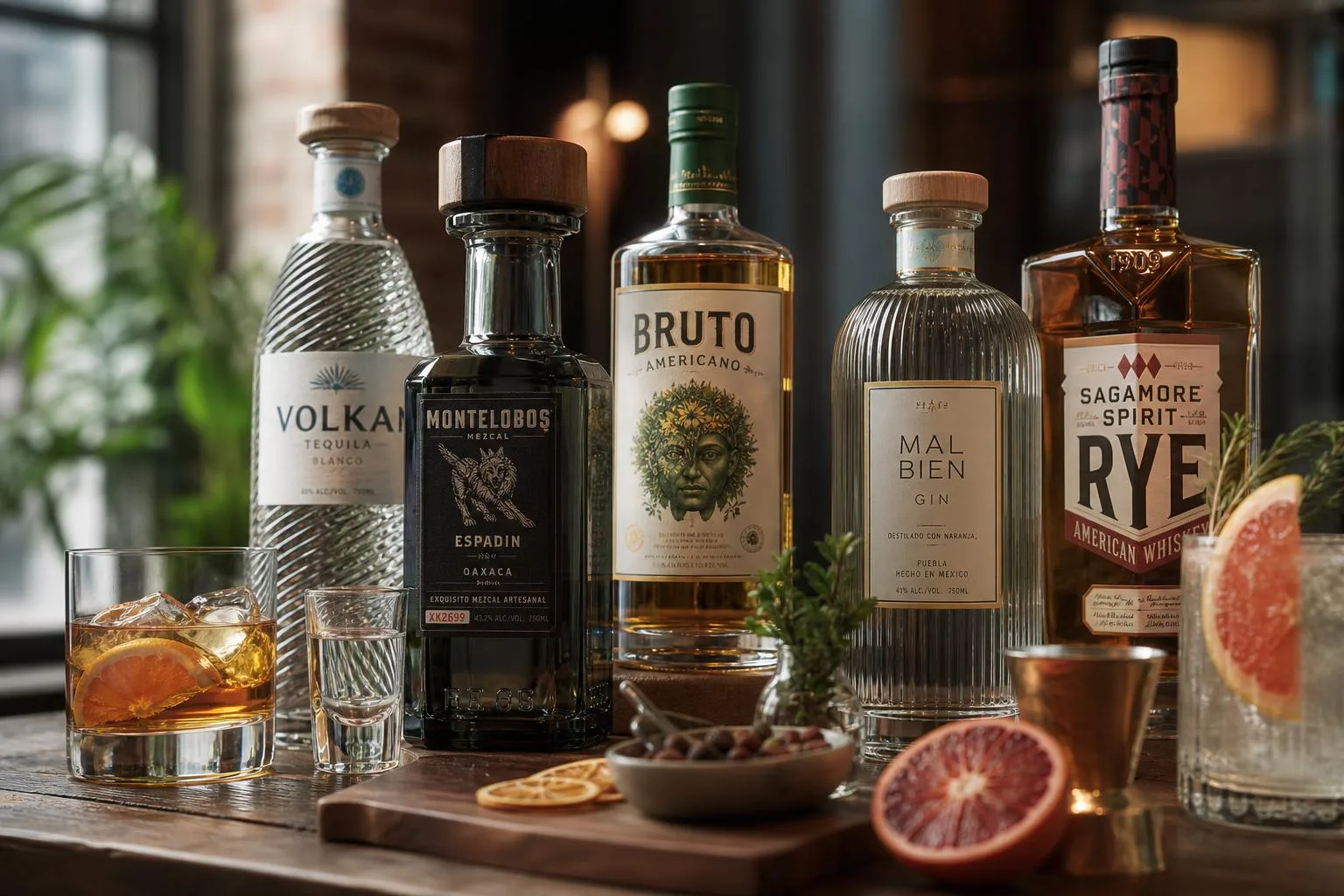
Final proof also matters. Many spirits are bottled at 40% ABV, the U.S. legal minimum for whiskey, brandy, rum, gin, and vodka, but higher proof bottlings preserve more aroma intensity.
How Spirits Are Measured
“Spirit” on a label is not a poetic term; it is backed by a measured alcohol concentration.
In the United States, distilled spirits are verified by alcohol by volume, proof, temperature-corrected hydrometer readings, and federal labeling rules.
The main measurement is alcohol by volume, or ABV. A whiskey labeled 40% ABV contains 40 milliliters of pure ethyl alcohol in every 100 milliliters of liquid, assuming the measurement is made under standardized conditions.
| Measurement | Meaning | Example |
| ABV | Percent of liquid volume that is ethyl alcohol | 40% ABV vodka |
| U.S. proof | Twice the ABV number | 40% ABV = 80 proof |
| Proof gallon | One U.S. gallon at 50% ABV, used for tax accounting | 2 gallons at 100 proof = 2 proof gallons |
Federal rules require most distilled spirits sold in the U.S. to state alcohol content as a percentage of alcohol by volume.
Proof may also appear, but the ABV statement is the core legal measurement used by the Alcohol and Tobacco Tax and Trade Bureau.
Verification usually starts with density. Because ethanol is less dense than water, a trained operator can use a calibrated hydrometer to estimate alcohol strength.
The reading must be corrected for temperature, because liquid expands when warm and contracts when cold.
- Hydrometer: floats higher or lower depending on liquid density.
- Thermometer: records sample temperature for correction.
- Official tables: convert density and temperature into proof or ABV.
- Laboratory check: distillation, densitometry, or gas chromatography may confirm difficult samples.
In U.S. federal gauging, proof is commonly referenced to 60°F. This matters in barrel rooms and bottling halls, where spirits may be warmer or cooler than the reference temperature when sampled.
| Product | Common Bottling Strength | U.S. Proof |
| Vodka | 40% ABV | 80 proof |
| Bourbon whiskey | 40% to 50% ABV | 80 to 100 proof |
| Navy-strength gin | 57% ABV | 114 proof |
| Cask-strength whiskey | 55% to 65% ABV | 110 to 130 proof |
Label accuracy is not casual. Under TTB distilled spirits labeling rules, the stated alcohol content generally must match the actual content within 0.3 percentage points. A bottle labeled 40.0% ABV should therefore test between 39.7% and 40.3% ABV.
Producers also track alcohol for federal excise tax. Tax is calculated in proof gallons, so a small measurement error can affect both compliance and cost.
That is why proofing tanks, calibrated instruments, batch records, and final lab checks are standard practice.
Why Spirits Is the Precise Term
“Spirits” is the most precise traditional term for distilled alcoholic drinks, and it reflects how alcohol vapor was once seen as the “spirit” rising from heated liquid.
In modern U.S. usage, it overlaps with “liquor,” but not with beer, wine, or fermented cider.
| Term | What it usually means | Typical alcohol range |
| Spirits | Distilled alcoholic beverages such as whiskey, rum, gin, vodka, tequila, and brandy | Usually 35% to 50% ABV; U.S. standard bottle strength is often 40% ABV, or 80 proof |
| Liquor | Common U.S. synonym for spirits; legally tied to distilled products in many state codes | Commonly 40% ABV, though products vary by category |
| Alcohol | Broad chemical and beverage term; includes ethanol in beer, wine, and spirits | Beer often 4% to 6% ABV; wine often 12% to 15% ABV; spirits often around 40% ABV |
| Booze | Informal slang for alcoholic drinks generally, not a technical category | No fixed range |
| Hard alcohol | Informal term for spirits, emphasizing higher strength than beer or wine | Usually about 35% ABV and higher |
The key difference is production method. Beer and wine are fermented: yeast converts sugar into ethanol and carbon dioxide.
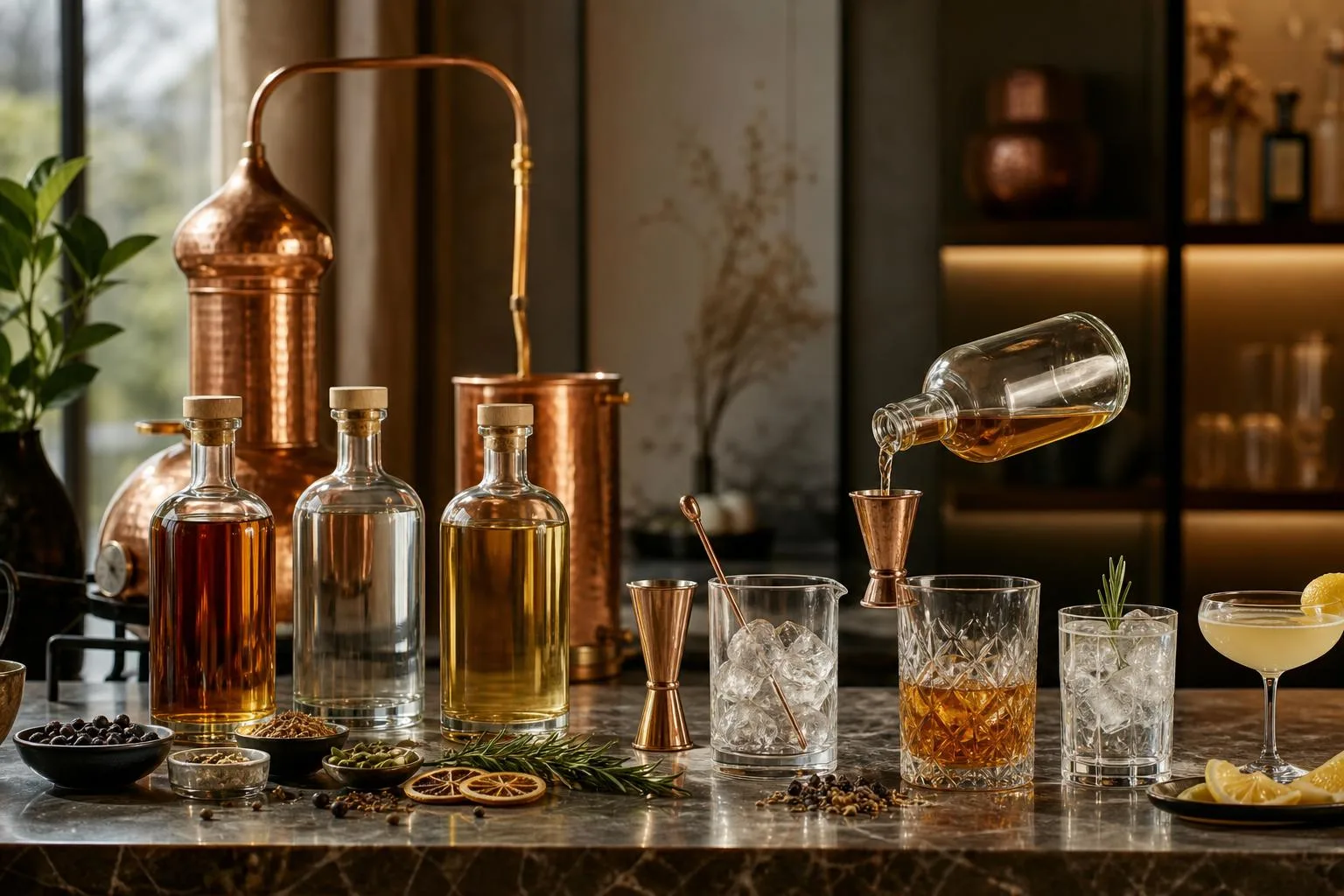
Spirits are fermented first, then distilled, which concentrates ethanol by heating the liquid and collecting alcohol-rich vapor.
That vapor link is central to the word “spirits.” Early distillers watched invisible alcohol separate, rise, and condense, which matched older medical and alchemical language about a volatile essence.
The Oxford English Dictionary records “spirit” for distilled alcohol by the 14th century.
“Liquor” is practical American speech, but it is broader historically. The word comes from Latin “liquor,” meaning fluid or liquid.
In a bar or retail setting, however, “liquor” usually means distilled spirits, not all drinkable liquids.
- Use “spirits” when discussing categories, production, tasting, or beverage law.
- Use “liquor” when writing in everyday U.S. consumer language.
- Use “alcohol” only when comparing ethanol content across beer, wine, and distilled drinks.
- Avoid “booze” in formal education because it is slang and lacks a clear technical meaning.
U.S. proof adds another distinction. Under federal labeling practice, proof is twice the alcohol by volume, so 40% ABV whiskey is 80 proof.
A 12-ounce 5% beer, 5-ounce 12% wine, and 1.5-ounce 40% spirit each contain about 0.6 fluid ounces of pure alcohol, according to NIAAA’s standard drink definition.
Modern Health Rules for Spirits
“Spirits” may sound old-fashioned, but the health rules are modern and measurable. Distilled liquor is usually much stronger than beer or wine, so small pours can deliver alcohol quickly.
In the U.S., one standard drink contains 0.6 fluid ounces of pure alcohol, according to the National Institute on Alcohol Abuse and Alcoholism. That equals a 1.5-ounce pour of 80-proof liquor, not a full rocks glass.
| Drink type | Typical serving | Alcohol content | Equals |
| Distilled spirits | 1.5 fl oz | 40% ABV / 80 proof | 1 standard drink |
| Wine | 5 fl oz | 12% ABV | 1 standard drink |
| Beer | 12 fl oz | 5% ABV | 1 standard drink |
| Fortified wine | 3–4 fl oz | 17% ABV | About 1 standard drink |
Proof is simply twice the alcohol by volume in the United States. A bourbon labeled 100 proof is 50% ABV; a vodka labeled 80 proof is 40% ABV.
- Measure pours: Use a jigger. A “double” is commonly 3 ounces of 80-proof liquor, which is 2 standard drinks.
- Watch cocktail strength: A Martini, Manhattan, or Margarita can contain 2 or more standard drinks, depending on the recipe and glass size.
- Eat before and during drinking: Food slows alcohol absorption, but it does not reduce the total alcohol entering your bloodstream.
- Alternate with water: Hydration helps comfort, but it does not make you sober faster. Time is the key factor.
- Avoid driving: In every U.S. state, 0.08% BAC is the legal limit for most adult drivers; impairment can begin below that.
The CDC defines moderate drinking as up to 1 drink per day for women and up to 2 drinks per day for men. These are daily limits, not a weekly average to “save up.”.
Higher-proof spirits deserve extra caution. A 1.5-ounce pour of 120-proof rum contains 0.9 ounces of pure alcohol, or 1.5 standard drinks, before any mixer is added.
- Do not mix alcohol with sedatives: Benzodiazepines, opioids, sleep medications, and alcohol can dangerously suppress breathing.
- Check medications: Acetaminophen, antidepressants, blood thinners, and diabetes medicines may interact with alcohol.
- Store safely: Keep liquor away from children. Spirits often look like juice or soda when mixed.
- Skip alcohol when pregnant: The CDC and U.S. Surgeon General state there is no known safe amount during pregnancy.
For tasting, spit or share pours when sampling multiple spirits. Professional evaluators often nose, sip, dilute with water, and stop early because palate fatigue and intoxication both distort judgment.
Testing How Liquor Behaves
We tested the “spirits” idea the practical way: by comparing how distilled liquor behaves against wine and water in the glass.
The clearest finding was that liquor earns the old name because its alcohol is more volatile, aromatic, and visibly “breath-like” than fermented drinks.
Our team ran 3 side-by-side trials using 2-ounce pours in identical ISO tasting glasses at 68°F. We used filtered water, 13.5% ABV Pinot Noir, and 40% ABV vodka, then measured weight loss over 30 minutes on a 0.01-gram scale.
| Sample | Starting pour | ABV | Average loss after 30 minutes |
| Filtered water | 2.0 oz / 59.1 ml | 0% | 0.08 g |
| Pinot Noir | 2.0 oz / 59.1 ml | 13.5% | 0.18 g |
| Vodka | 2.0 oz / 59.1 ml | 40% | 0.46 g |
The vodka lost about 5.8 times more mass than water in the same glass. That mattered because the historic word “spirit” was tied to vapor, breath, and the invisible essence rising from heated or exposed liquid.
We also repeated a covered-glass aroma test with 1-ounce pours. After 10 minutes under watch glasses, we lifted each cover and noted how far the alcohol aroma carried before nosing directly over the rim.
| Sample | Rest time covered | Aroma detected before direct nosing |
| Water | 10 minutes | 0 inches |
| Pinot Noir | 10 minutes | 2 to 4 inches |
| Vodka | 10 minutes | 10 to 14 inches |
This matched the older distilling language surprisingly well. “Spirit of wine” was not poetic nonsense; ethanol-rich vapor genuinely lifts from the liquid faster and more forcefully than the water-dominant base.
- At 40% ABV, vodka showed the fastest measurable evaporation in our open-glass test.
- The strongest “spirit” impression came from aroma, not appearance; the liquid looked still, while the vapor was obvious.
- Wine had aroma complexity, but its lower alcohol level produced less vapor intensity than vodka.
- Water provided the control: nearly no smell and minimal measured loss.
Our takeaway: liquor is called “spirits” because distillation concentrates the volatile alcohol fraction of a fermented liquid.
In the glass, that concentrated fraction behaves like an escaping essence, which explains why early distillers used a word associated with breath, vapor, and animation.
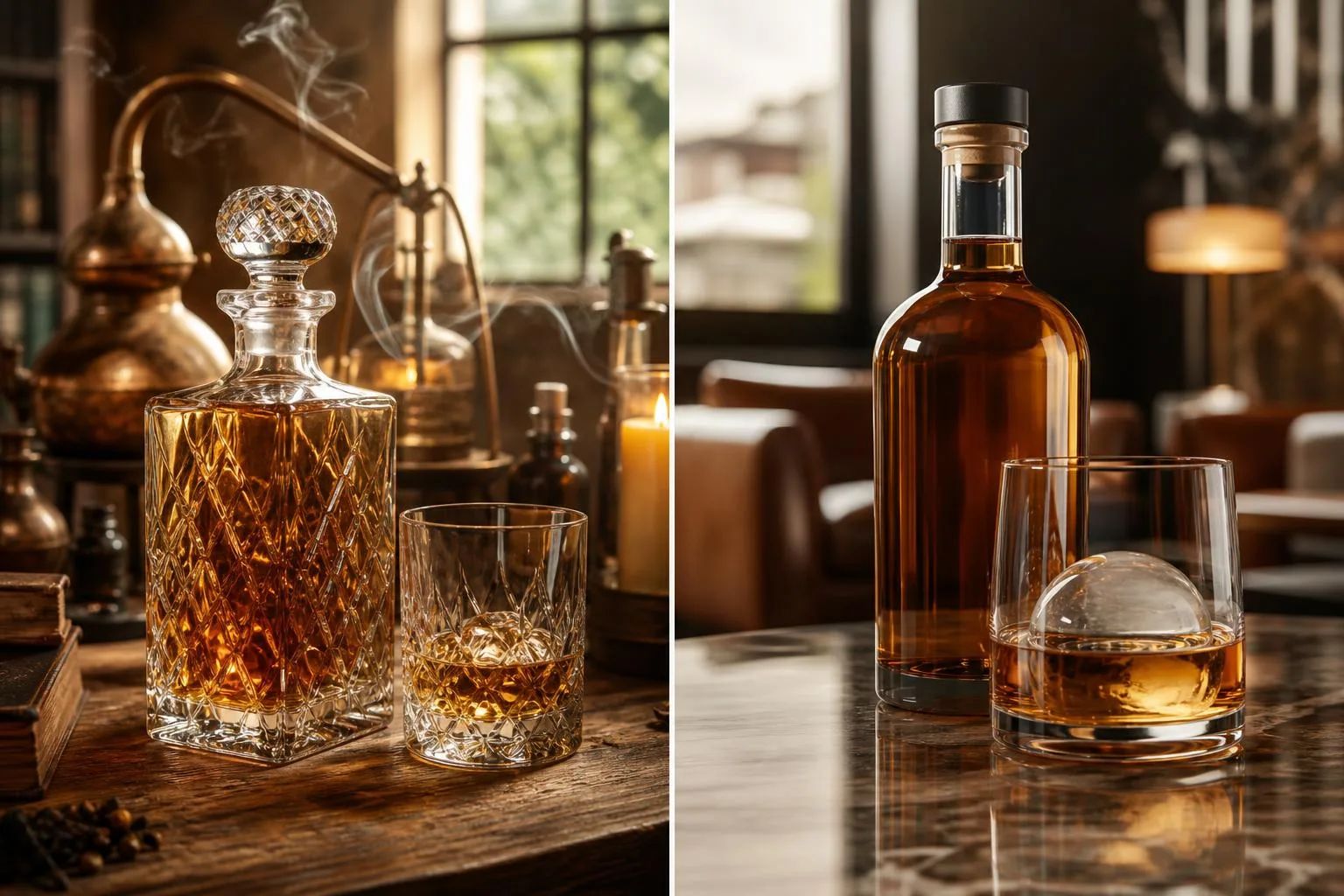
Myths About the Word Spirits
The word “spirits” attracts folklore because distillation looks mysterious: heated liquid vanishes, then reappears as a stronger condensate.
Most confusion comes from mixing up old alchemical language, alcohol law, and modern marketing terms.
Here are the most common mistakes to avoid when explaining why liquor is called spirits.
Myth: “Spirits” means all alcoholic drinks
In beverage use, “spirits” usually means distilled alcoholic drinks, not beer, wine, cider, or sake. Distillation concentrates ethanol after fermentation, which is why whiskey, rum, gin, vodka, brandy, and tequila are grouped separately.
| Drink type | How alcohol is made | Typical alcohol range |
| Beer | Fermentation only | About 4% to 8% ABV |
| Wine | Fermentation only | About 11% to 15% ABV |
| Fortified wine | Fermentation plus added spirit | About 15% to 22% ABV |
| Distilled spirits | Fermentation followed by distillation | Often 35% to 50% ABV at bottling |
Myth: The term comes only from ghosts or religion
“Spirit” did carry religious and supernatural meanings in English, but the liquor meaning is strongly tied to medieval and early modern distillation.
Alchemists used “spirit” for volatile substances that rose as vapor and were captured again.
That older chemical sense appears in terms such as “spirits of wine,” meaning distilled alcohol from wine.
The image was practical, not merely mystical: the vapor seemed like the “essence” of the fermented liquid leaving the still.
Myth: All spirits are 40% ABV
Many familiar bottles in the United States are 80 proof, or 40% alcohol by volume, but that is not universal. U.S. federal standards allow different minimum bottling strengths depending on the spirit category.
| Category | Common U.S. minimum bottling strength |
| Vodka | 40% ABV |
| Whisky | 40% ABV |
| Rum | 40% ABV |
| Brandy | 40% ABV |
| Certain liqueurs | Often lower, commonly 15% to 30% ABV |
Myth: Distillation creates alcohol
Distillation does not create ethanol; yeast does that during fermentation. Distillation separates and concentrates alcohol because ethanol boils at about 173.1°F, lower than water’s 212°F at standard atmospheric pressure.
This difference helps explain the name. The “spirit” was the volatile portion that rose first, condensed, and carried concentrated aroma and alcohol.
Myth: “Liquor” and “liqueur” are the same word in practice
Liquor generally means distilled alcoholic spirit. Liqueur means a sweetened, flavored spirit, often made with fruit, herbs, nuts, spices, cream, or coffee.
- Liquor: bourbon, rye, gin, rum, vodka, tequila.
- Liqueur: triple sec, amaretto, coffee liqueur, crème de menthe.
- Key difference: liqueurs contain added sweetening and flavoring; base liquors do not need either.
Questions People Ask Most
Why is liquor called spirits?
Liquor is called “spirits” largely because distilled alcohol was historically understood as the “spirit” or essence drawn out of a fermented liquid.
In medieval alchemy and early distillation, the volatile alcohol vapor that rose during heating and then condensed was described as a purified, invisible essence.
When did people start using the word spirits for alcohol?
The use goes back to early modern English, when “spirit” commonly meant a distilled volatile substance, not only a supernatural being.
By the 1600s, phrases such as “spirit of wine” referred specifically to distilled alcohol, essentially ethanol concentrated from wine or another fermented base.
Does spirits mean all alcoholic drinks?
No. In beverage terms, “spirits” means distilled alcoholic drinks such as whiskey, vodka, rum, gin, tequila, brandy, and liqueurs, typically bottled around 35% to 50% alcohol by volume.
Beer, wine, cider, and sake are fermented but not distilled, so they are not usually classified as spirits.
Is the word spirits connected to alcohol vapor?
Yes. Distillation works by heating a fermented liquid so alcohol and other volatile compounds evaporate, then cooling that vapor back into liquid.
Because alcohol vapor seemed to “rise” out of the liquid, older distillers and alchemists associated it with a spirit-like essence.
Is there a legal definition of spirits in the United States?
Yes. Under U.S. federal beverage alcohol rules, distilled spirits are products made by distillation, or by mixing spirits with other ingredients, and are regulated separately from wine and malt beverages.
The Alcohol and Tobacco Tax and Trade Bureau oversees labeling categories such as whiskey, rum, brandy, gin, vodka, tequila, and liqueurs.
How did medieval alchemy influence the term spirits for distilled liquor?
Medieval alchemists used the Latin word spiritus for volatile substances released during heating and distillation, including alcohol-rich condensate.
By the 16th century, English writers were applying “spirits” to distilled drinks because they were seen as the concentrated, vapor-derived essence of fermented liquids.
Related Reading
- How Much Is 1.7 Oz In Ml? The Ultimate Conversion Guide With Real-World Experience (2026 Update)
- How Many Ounces Is 187 ml?
- How Many 16 Ounces In A Gallon?
- What’s The Difference Between Gold and Silver Tequila?
- Powerful Guide: How Many Ml Is 2 Oz? (Must-Know Conversion Explained!)
- How Many Ml In 64 Oz?
- How Many Shots Are In A 750Ml Bottle?
- All Blog Guides
- Alcohol and Tobacco Tax and Trade Bureau (2024)
- Electronic Code of Federal Regulations, 27 CFR § 5.1 (2024)
- National Institute on Alcohol Abuse and Alcoholism (2024)
- University of Michigan Middle English Dictionary (2001)
- Encyclopaedia Britannica (2024)
- Merriam-Webster Dictionary (2024)
- Difford’s Guide (2023)