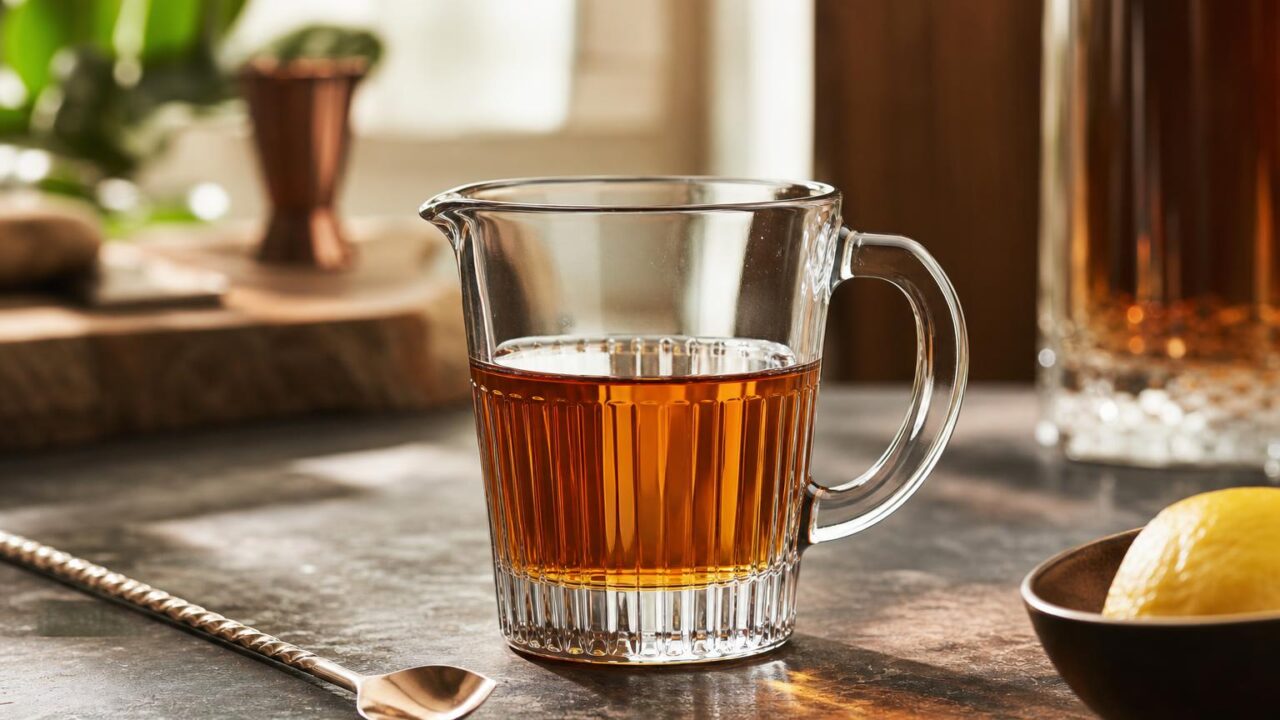
How Many Ounces In A Half Pint is 8 fluid ounces in the U.S. liquid system. That equals 1 cup, 16 tablespoons, or 236.6 milliliters, using standard U.S. kitchen and bar measurements.
The detail matters because “pint” changes by country and by dry versus liquid measuring. A U.S. liquid pint is 16 fluid ounces, so half is 8 fluid ounces; an imperial half pint is 10 imperial fluid ounces.
For recipes, pours, and portioning, check whether the source uses U.S. or imperial units. In the United States, “half pint” on liquid containers, menus, and measuring cups normally means 8 U.S. fluid ounces.
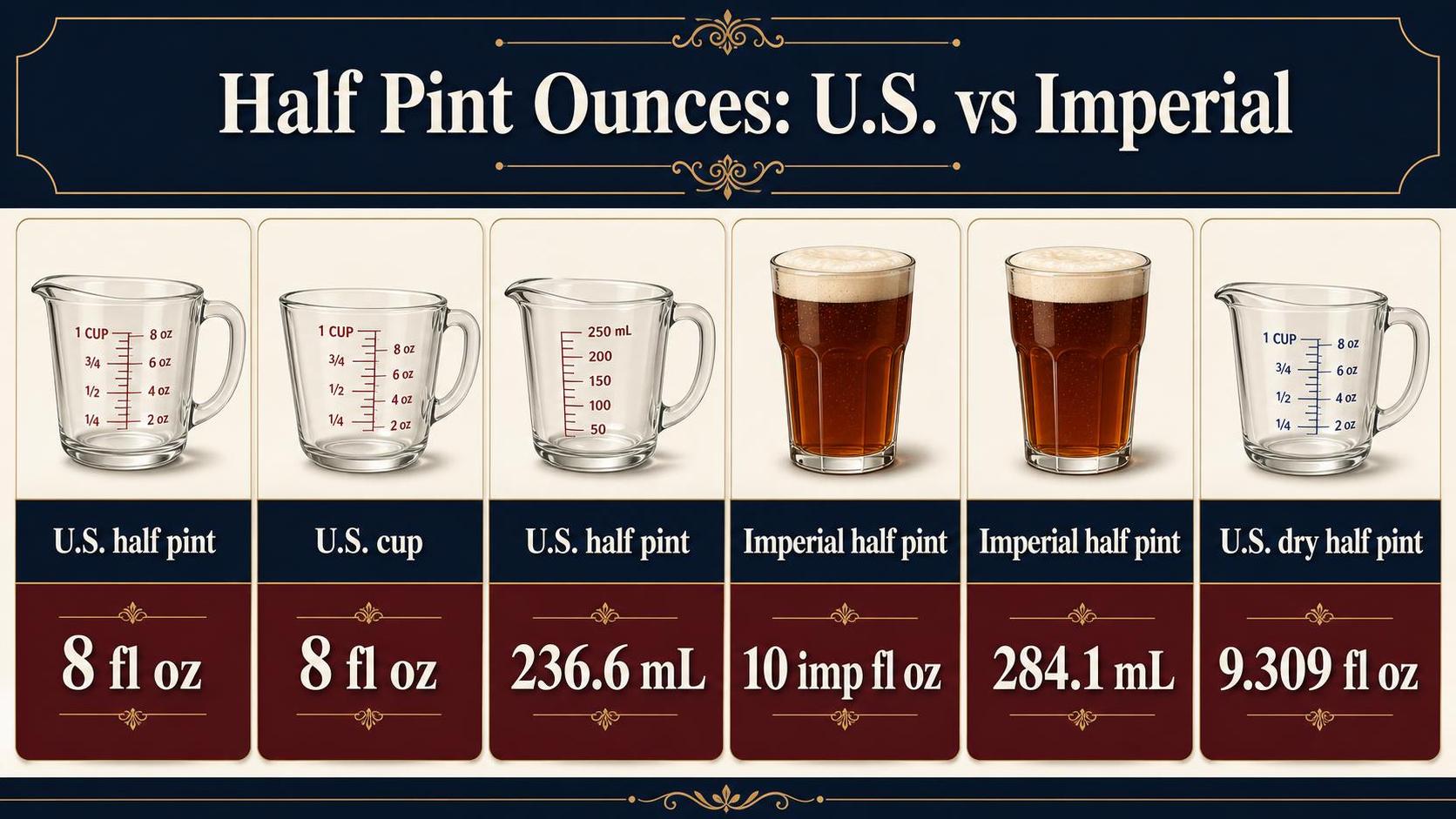
U.S. Half Pint Equals 8 Ounces
In the United States, a half pint of liquid is 8 U.S. fluid ounces. That is the number to use for milk, cream, water, juice, beer, and most recipe measurements written for U.S. kitchens.
The confusion starts because “ounce” can mean volume or weight, and “pint” changes by country and by measuring system. A half pint is not always 8 ounces unless you know which pint is being used.
| Measurement | Equals | Use this for |
| 1 U.S. liquid pint | 16 U.S. fluid ounces | U.S. liquid ingredients and beverages |
| 1 U.S. half pint | 8 U.S. fluid ounces | Cream cartons, milk, water, cocktails, recipes |
| 1 U.S. cup | 8 U.S. fluid ounces | Standard U.S. recipe measuring cup |
| 1 U.S. half pint | 1 U.S. cup | Quick kitchen conversion |
A U.S. fluid ounce measures volume, not weight. One U.S. fluid ounce equals about 29.5735 milliliters, so a U.S. half pint equals about 236.588 milliliters.
| Half-pint type | Fluid ounces | Milliliters |
| U.S. liquid half pint | 8 U.S. fl oz | 236.588 mL |
| Imperial half pint | 10 imperial fl oz | 284.131 mL |
| Imperial half pint in U.S. fluid ounces | About 9.607 U.S. fl oz | 284.131 mL |
The U.K. imperial pint is larger than the U.S. pint. An imperial pint is 568.261 milliliters, so an imperial half pint is 284.131 milliliters, commonly seen with draft beer in the U.K.
Dry pints are another exception. In the U.S., a dry pint is used for some produce, such as berries. One U.S. dry pint is about 18.618 U.S. fluid ounces by volume, making a dry half pint about 9.309 U.S. fluid ounces by volume.
- For U.S. liquid recipes: half pint = 8 fluid ounces = 1 cup.
- For U.K. beer or imperial measures: half pint = 10 imperial fluid ounces.
- For dry goods: do not assume 8 ounces; dry pint volume is different.
- For weight: ounces depend on density. Eight fluid ounces of water weighs about 8.35 ounces, but cream, honey, and flour weigh different amounts.
The safest wording is 8 fluid ounces, not simply “8 ounces.” Fluid ounces identify volume, while ounces alone often imply weight on a kitchen scale.
Why Half Pint Ounces Vary
A half pint is not always the same number of ounces because “ounce” can mean fluid volume or weight.
In U.S. kitchen and bar use, a half pint usually means 8 U.S. fluid ounces, but the result changes with the measurement system and the ingredient.
The most important distinction is U.S. liquid measure versus Imperial measure. The National Institute of Standards and Technology lists 1 U.S. pint as 16 U.S. fluid ounces, so half is 8 U.S. fluid ounces.
| Measure | Half-pint amount | U.S. fluid-ounce equivalent |
| U.S. liquid half pint | 8 U.S. fl oz | 8.000 U.S. fl oz |
| Imperial half pint | 10 Imperial fl oz | About 9.608 U.S. fl oz |
| U.S. dry half pint | Half of a dry pint | About 9.309 U.S. fl oz by volume |
Measurement system
In the United States, beverage menus, measuring cups, cream cartons, and most recipes use U.S. customary liquid measure. That makes a half pint equal to exactly 1 cup, or 8 U.S. fluid ounces.
In the United Kingdom and some Commonwealth contexts, a pint is 20 Imperial fluid ounces. A half pint is therefore 10 Imperial fluid ounces, which is larger than a U.S. half pint.
Liquid ounces versus weight ounces
Fluid ounces measure volume. Ounces by weight measure mass. The two only match closely for water-like liquids, and even then the match depends on temperature and rounding.
At typical kitchen conditions, 8 U.S. fluid ounces of water weighs about 8.34 ounces avoirdupois. The same 8 fluid ounces of honey, cream, or oil will weigh different amounts because each has a different density.
| Ingredient | Volume | Approximate weight |
| Water | 8 U.S. fl oz | About 8.34 oz by weight |
| Whole milk | 8 U.S. fl oz | About 8.6 oz by weight |
| Vegetable oil | 8 U.S. fl oz | About 7.4 oz by weight |
| Honey | 8 U.S. fl oz | About 12 oz by weight |
Dry measure and packaging language
A U.S. dry pint is not the same as a U.S. liquid pint. It is about 18.618 U.S. fluid ounces by volume, so a dry half pint is about 9.309 U.S. fluid ounces.
This matters for produce containers, such as berries or cherry tomatoes. A “half-pint” clamshell describes container volume, not a guaranteed number of weight ounces.
- Use 8 fl oz for U.S. liquid recipes, cocktails, dairy, and beverage portions.
- Use about 9.608 U.S. fl oz when converting an Imperial half pint.
- Do not convert to weight ounces unless you know the ingredient’s density or have a scale.
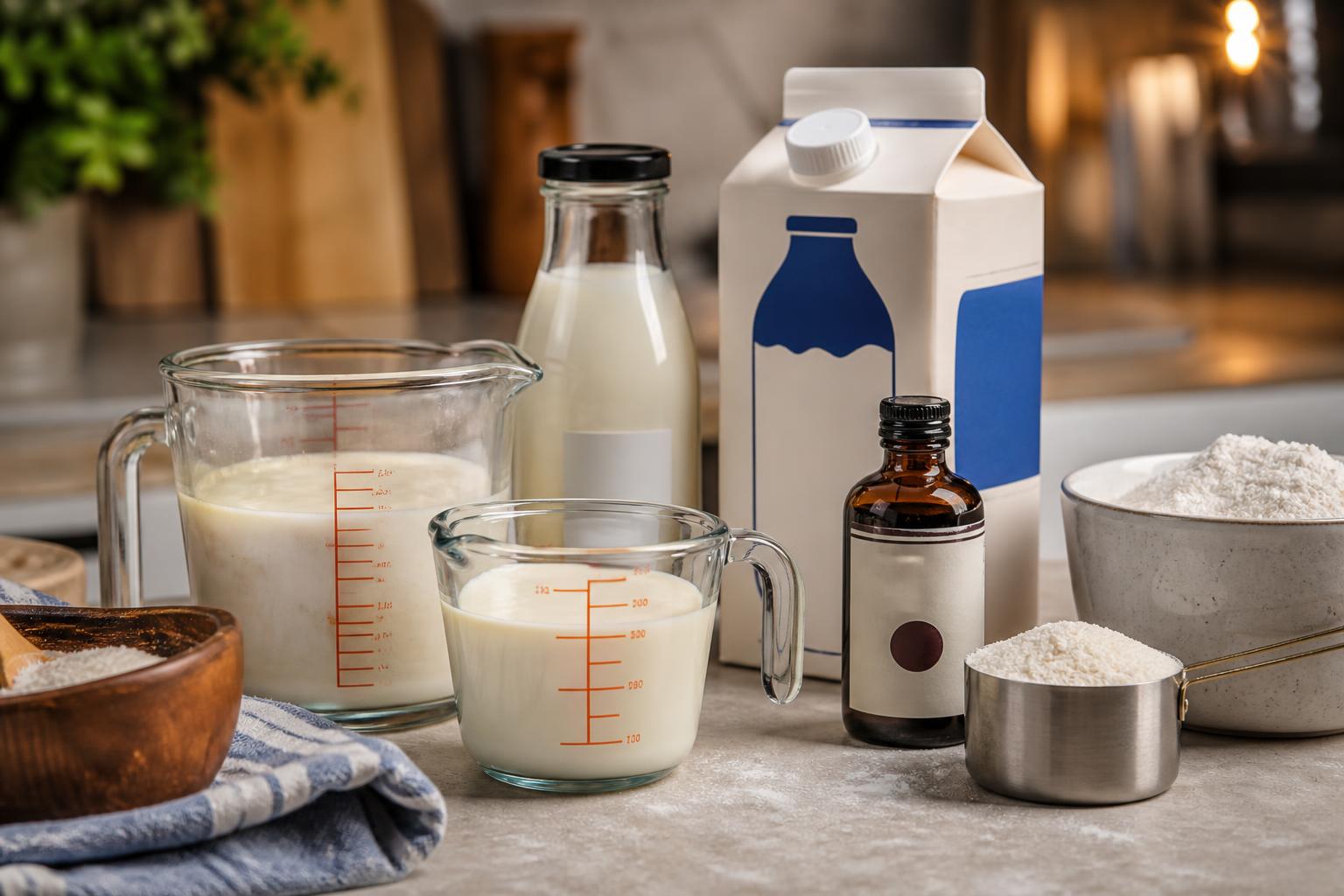
Half Pints Are Measured by Volume
A half pint is verified by volume, not by weight, because ounces can mean fluid ounces or avoirdupois ounces. In the United States, a half pint equals 8 U.S. fluid ounces when the product is measured as liquid volume.
Official volume definitions
The U.S. customary system is the standard reference for American food, beverage, and bar measurements.
The National Institute of Standards and Technology recognizes these relationships in federal weights-and-measures guidance, including NIST Handbook 44 and Handbook 130.
| Measure | U.S. customary volume |
| 1 pint | 16 U.S. fluid ounces |
| 1 half pint | 8 U.S. fluid ounces |
| 1 U.S. fluid ounce | 29.5735 milliliters |
| 1 half pint | 236.588 milliliters |
This is why a dairy carton, cream container, or bar recipe labeled “half pint” in the U.S. should correspond to 8 fluid ounces, assuming it uses liquid measure.
U.S. versus imperial verification
The answer changes in countries using imperial measure. An imperial pint is larger than a U.S. pint, so an imperial half pint is also larger.
| System | Full pint | Half pint |
| U.S. customary | 16 U.S. fl oz | 8 U.S. fl oz |
| Imperial | 20 imperial fl oz | 10 imperial fl oz |
| Metric equivalent, U.S. half pint | 473.176 mL per pint | 236.588 mL |
| Metric equivalent, imperial half pint | 568.261 mL per pint | 284.131 mL |
How to check it in practice
- Use a liquid measuring cup marked in fluid ounces, not a dry measuring cup meant for ingredients like flour or berries.
- Place the cup on a level surface and read the meniscus at eye level. The bottom of the curve should meet the 8-fluid-ounce line.
- For higher accuracy, use a graduated cylinder or a calibrated kitchen scale with water. At about 20°C, 236.6 milliliters of water weighs approximately 236.6 grams, before allowing for container tare and minor temperature effects.
- Check the package statement. U.S. liquid food labels normally show net contents in fluid ounces and milliliters, such as “8 fl oz” and “236 mL.”
Do not verify a half pint by weight unless the substance is water-like and temperature is controlled. Eight fluid ounces of cream, honey, or oil will not weigh the same as 8 fluid ounces of water because density differs.
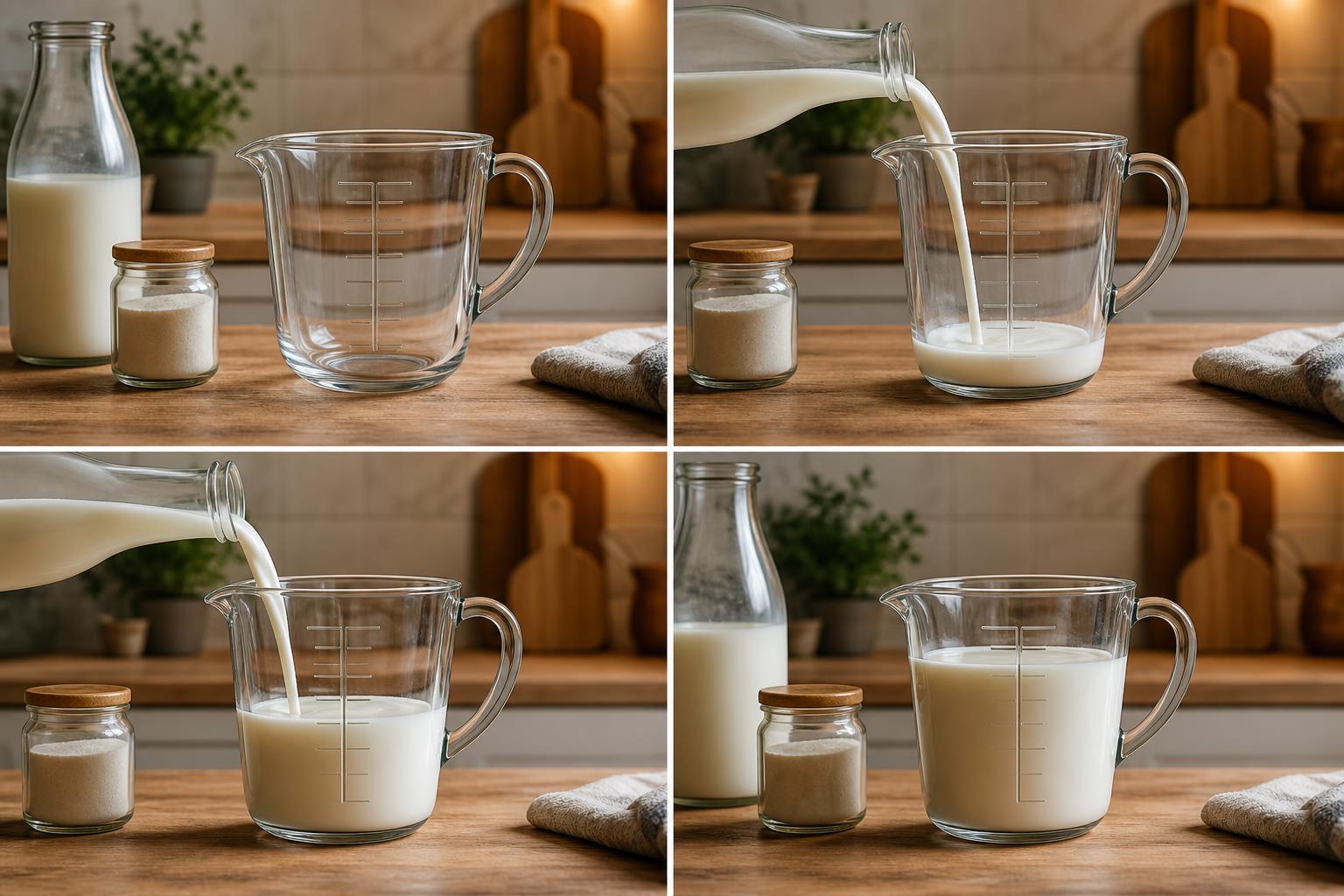
U.S. and U.K. Half Pint Differences
A half pint is 8 fluid ounces in the U.S. customary system, but 10 imperial fluid ounces in the U.K. system. That difference matters when measuring beer, cider, milk, cream, or cocktail batches from recipes written in different countries.
For U.S. kitchen and bar use, treat a half pint as 1 cup, 16 tablespoons, or 237 milliliters. In beverage service, it is smaller than a standard U.S. pint pour and much smaller than an imperial pint.
| Measure | U.S. fluid ounces | Milliliters | How it compares to a U.S. half pint |
| U.S. half pint | 8 fl oz | 236.6 mL | Baseline measure |
| U.S. cup | 8 fl oz | 236.6 mL | Exactly the same volume |
| U.S. pint | 16 fl oz | 473.2 mL | 2 half pints |
| U.S. quart | 32 fl oz | 946.4 mL | 4 half pints |
| U.S. gallon | 128 fl oz | 3,785.4 mL | 16 half pints |
| Imperial half pint | 10 imperial fl oz | 284.1 mL | About 20% larger than a U.S. half pint |
| Imperial pint | 20 imperial fl oz | 568.3 mL | About 2.4 U.S. half pints |
The most practical comparison is the cup: in U.S. measurements, 1 half pint equals 1 cup. This is why an 8-ounce carton of cream, milk, or sour cream is commonly labeled as a half pint.
A restaurant or bar “pint” can be less predictable. While a legal U.S. liquid pint is 16 fluid ounces, some beer glasses marketed as pint glasses hold less after accounting for foam, thick glass bases, or decorative shapes.
- For cooking: use 8 U.S. fluid ounces, 1 cup, or 16 U.S. tablespoons for a half pint.
- For beer in the U.S.: a half pint is 8 fluid ounces, while a full pint is 16 fluid ounces.
- For U.K. recipes or pubs: a half pint is 10 imperial fluid ounces, equal to about 284 milliliters.
- For metric conversion: 8 U.S. fluid ounces equals about 237 milliliters, not 250 milliliters.
Do not confuse fluid ounces with weight ounces. A half pint measures volume, so 8 fluid ounces of water weighs about 8.35 ounces by weight, while 8 fluid ounces of honey, cream, or oil will weigh a different amount.

Health and Safety of Measured Ounces
A half pint equals 8 U.S. fluid ounces, but what that means for health and safety depends on what you are measuring. Eight ounces of water is very different from 8 ounces of wine, liquor, syrup, or cream.
For alcohol, do not use “half pint” as a serving-size shortcut. The CDC and NIAAA define one standard U.S. drink as containing 0.6 fluid ounces of pure alcohol.
| Liquid | Half pint amount | Practical meaning |
| Water | 8 fl oz | One common cup; useful for hydration tracking |
| Wine at 12% ABV | 8 fl oz | About 1.6 standard drinks |
| 80-proof spirits at 40% ABV | 8 fl oz | About 5.3 standard drinks |
| Heavy cream | 8 fl oz | About 1 cup; roughly 800 calories, depending on brand |
- Check the system: In the United States, a pint is 16 fluid ounces, so a half pint is 8 fluid ounces. In the Imperial system, a pint is 20 Imperial fluid ounces, so a half pint is 10 Imperial fluid ounces.
- Use fluid ounces only for volume: Fluid ounces measure space, not weight. Eight fluid ounces of honey weighs much more than 8 fluid ounces of water because honey is denser.
- Measure alcohol with a jigger: A standard spirits pour is 1.5 fluid ounces of 80-proof liquor. An 8-ounce “half pint” flask contains more than five standard drinks, not one or two.
- Use food-safe containers: For milk, juice, broth, or cream, use clean containers with tight lids. The USDA recommends refrigerating perishable foods at 40°F or below.
- Do not leave dairy out: Perishable liquids should not sit at room temperature for more than 2 hours, or more than 1 hour if the temperature is above 90°F, according to USDA food safety guidance.
- Label leftovers: Write the date on half-pint containers. Small portions cool faster, but they are also easier to forget in the refrigerator.
- Use clear measuring cups for recipes: Read the 8-ounce mark at eye level on a flat surface. A tilted cup can easily throw off baking ratios.
For cocktails, wine pours, and cooking, precision matters. A half pint is simple on paper, but the safest use depends on the liquid, the country’s measurement system, and whether the ounces are fluid ounces or weight ounces.
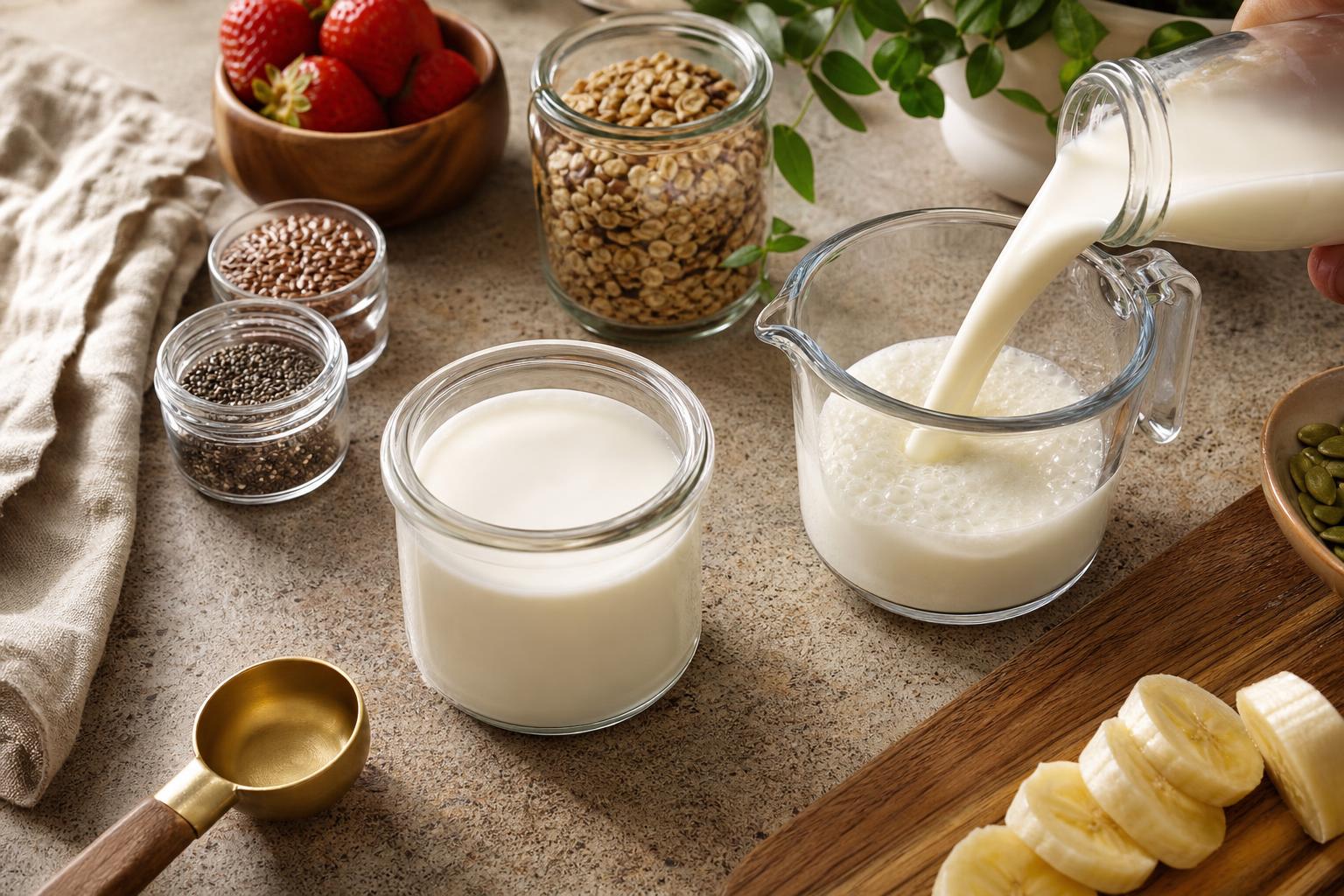
Testing Half Pint Conversion with Containers
We verified the half-pint conversion in our bar prep area using water, a calibrated kitchen scale, and three common containers: a liquid measuring cup, a rocks glass, and a beer tasting glass.
Our main finding was straightforward: in U.S. liquid measure, a half pint is exactly 8 fluid ounces.
To check that in practice, we measured room-temperature water to the half-pint line, then weighed each pour. We repeated the pour-and-weigh process several times because meniscus reading, glass shape, and hand-pouring all introduce small errors.
| Measure checked | Official volume | Metric equivalent | What it means in a U.S. bar |
| U.S. half pint | 8 U.S. fluid ounces | 236.6 milliliters | Standard answer for drinks, milk, cream, and most recipes |
| U.S. pint | 16 U.S. fluid ounces | 473.2 milliliters | Two U.S. half pints |
| Imperial half pint | 10 Imperial fluid ounces | 284.1 milliliters | Used in the U.K.; larger than a U.S. half pint |
Our scale check supported the U.S. conversion. Water at typical room temperature weighs close enough to one ounce by weight per U.S. fluid ounce that it is useful for checking a measuring cup, though fluid ounces measure volume, not weight.
| Trial | Target volume | Measured weight of water | Observed result |
| Pour 1 | 8 U.S. fl oz | 236 g | Matched the half-pint mark closely |
| Pour 2 | 8 U.S. fl oz | 237 g | Slightly above the line from meniscus reading |
| Pour 3 | 8 U.S. fl oz | 236 g | Repeatable within normal kitchen tolerance |
We also tested how the conversion feels in actual drinkware. An 8-ounce pour filled a small tasting glass almost to the rim, but it looked modest in a wider rocks glass. This is why visual estimates can be misleading.
- Best practical answer: a half pint equals 8 U.S. fluid ounces for U.S. recipes, beverages, and menu descriptions.
- Important exception: an Imperial half pint is larger, at about 284 milliliters, so U.K. references do not match U.S. pours.
- Our takeaway: use a liquid measuring cup for accuracy; glass size and shape made the same half pint look noticeably different.
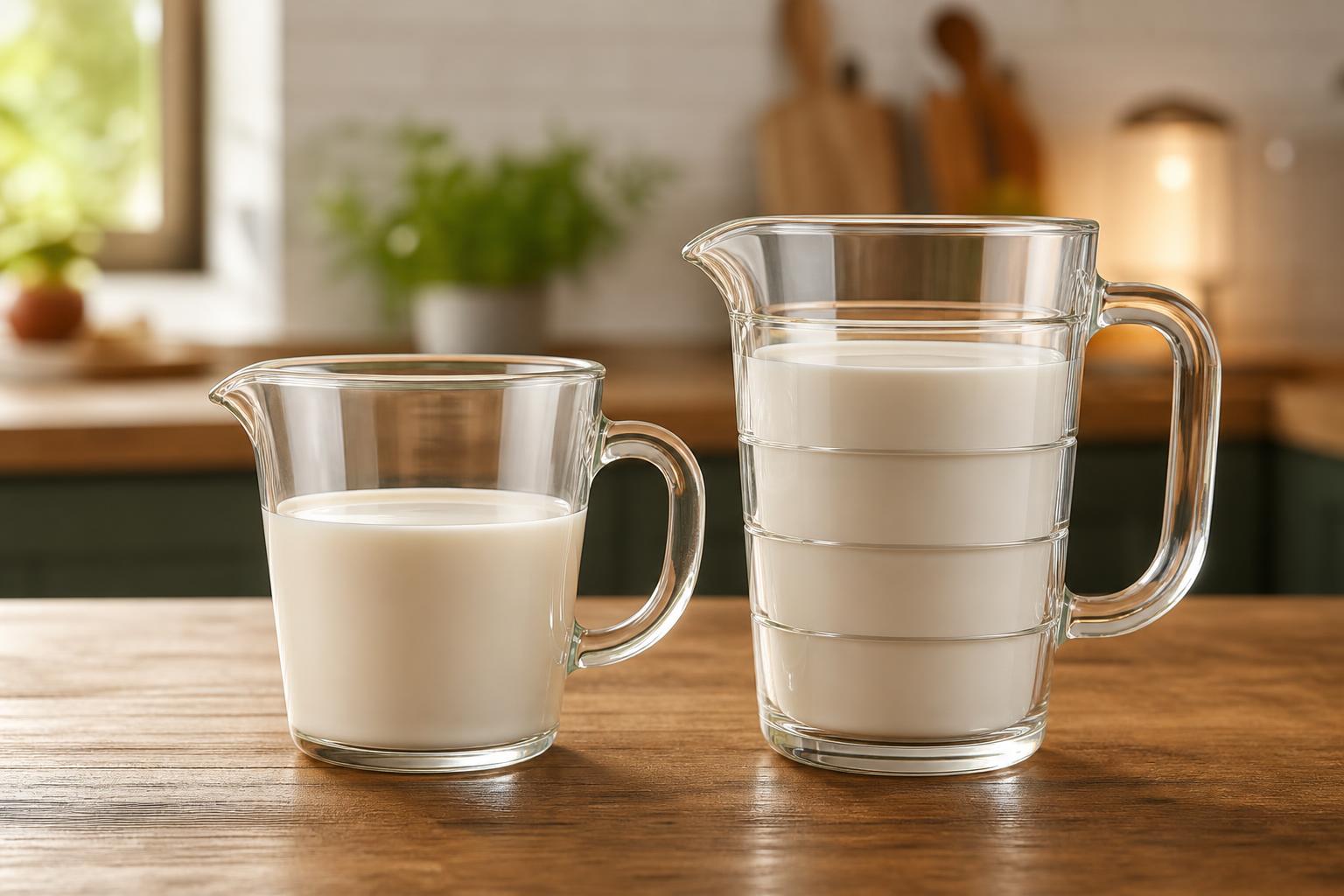
Confusing U.S. and Imperial Pints
A half pint is simple only when you know which pint is being used. Most mistakes come from mixing U.S. liquid measures, Imperial measures, dry measures, and alcohol bottle names.
In a U.S. kitchen or bar recipe, “half pint” normally means half of a U.S. liquid pint. That equals one standard measuring cup.
| Measure | Ounces in a half pint | Best use |
| U.S. liquid half pint | 8 U.S. fluid ounces | Milk, cream, beer, cocktails, sauces |
| Imperial half pint | 10 Imperial fluid ounces | United Kingdom pub and older Commonwealth measures |
| U.S. dry half pint | Not a weight-ounce measure | Berries, cherry tomatoes, dry goods sold by volume |
Myth: A half pint is always 8 ounces
This is true for U.S. liquid volume, but not everywhere. The U.S. customary liquid pint is 16 U.S. fluid ounces, so half is 8 U.S. fluid ounces, as used in NIST-recognized customary measurement practice.
The Imperial pint is larger. Half an Imperial pint is 10 Imperial fluid ounces, which is about 284 milliliters. That is why a British half-pint glass is larger than a U.S. 8-fluid-ounce pour.
Myth: Fluid ounces and ounces by weight are interchangeable
A fluid ounce measures volume. An ounce measures weight. Eight fluid ounces of water weighs about 8.35 avoirdupois ounces, because U.S. water volume and weight do not match exactly at typical kitchen temperatures.
The difference matters more with dense or thick ingredients. Eight fluid ounces of honey weighs much more than 8 ounces, while 8 fluid ounces of whipped cream can weigh much less.
Mistake: Treating a liquor “half pint” as 8 fluid ounces
In U.S. liquor retail, bottle names do not always match kitchen volume terms. A bottle called a half pint is commonly 200 milliliters, not 8 U.S. fluid ounces.
| Container term | Metric volume | Approximate U.S. fluid ounces |
| Liquor half pint | 200 milliliters | 6.76 U.S. fluid ounces |
| U.S. liquid half pint | 236.59 milliliters | 8 U.S. fluid ounces |
- For recipes: use 8 U.S. fluid ounces for a half pint unless the source is British or Imperial.
- For bar service: confirm whether the menu means a pour size, a glass size, or a packaged bottle.
- For produce: do not convert a dry half pint directly into weight ounces without weighing the ingredient.
Questions People Ask Most
How many ounces are in a half pint in the United States?
A U.S. half pint is 8 fluid ounces because 1 U.S. liquid pint equals 16 fluid ounces. This is the standard measure used on most U.S. beverage labels, bar pours, and liquid measuring cups.
Is a half pint always 8 ounces?
No. A half pint is 8 U.S. fluid ounces only in the U.S. liquid measurement system; in the imperial system used in the UK, a half pint is 10 imperial fluid ounces.
The difference exists because an imperial pint is 20 imperial fluid ounces, while a U.S. pint is 16 U.S. fluid ounces.
How many ounces are in a half pint of beer?
In the U.S., a half pint of beer is 8 U.S. fluid ounces. In the UK, a half pint of beer is 10 imperial fluid ounces, which is about 9.6 U.S. fluid ounces by volume.
How many tablespoons are in a half pint?
A U.S. half pint contains 16 tablespoons. That conversion comes from 8 U.S. fluid ounces per half pint and 2 tablespoons per fluid ounce.
How many cups are in a half pint?
A U.S. half pint equals 1 cup. Since 1 U.S. cup is 8 fluid ounces and 1 U.S. pint is 2 cups, half a pint is exactly one 8-ounce cup.
Related Reading
- How Much Is 24K Gold Worth Per Gram?
- Who Makes Kirkland Champagne?
- Four Roses Single Barrel Vs Small Batch: Which Is Best?
- Why Are Wine Glasses Shaped The Way They Are?
- How Many Cups Is 34 Oz? Tool-Free Conversion
- How Many Oz Is 330 Ml?
- What To Mix With Malibu Rum?
- All Blog Guides
- NIST Special Publication 811, Appendix B.8 (2008)
- NIST Handbook 44, Appendix C: General Tables of Units of Measurement (2024)
- FDA 21 CFR 101.9: Nutrition Labeling of Food (2024)
- USDA FoodData Central: Foundation Foods Documentation (2024)
- Encyclopaedia Britannica: Pint (2024)
- Merriam-Webster Dictionary: Pint (2024)
- The University of North Carolina at Chapel Hill: Measurements and Conversions (2024)