
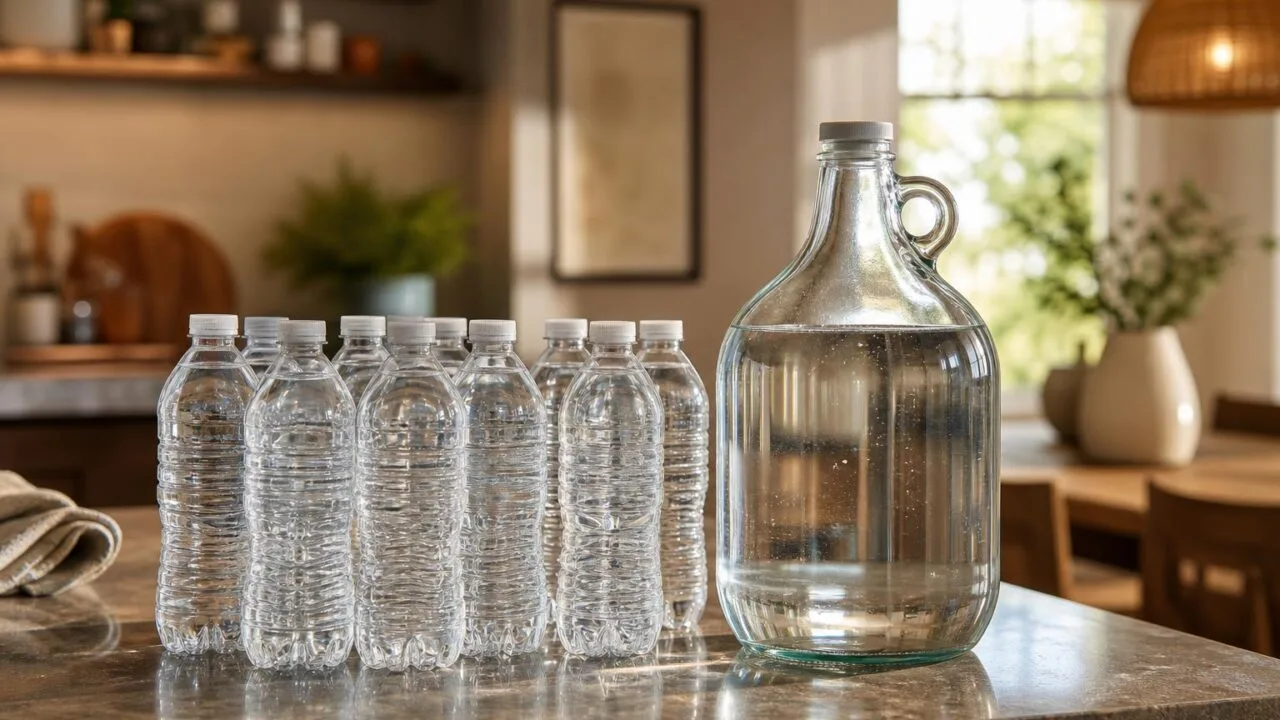
How Many Water Bottles In A Gallon is 8 bottles at 16.9 ounces each, or about 4 bottles at 32 ounces. Since 1 US gallon equals 128 fluid ounces, the exact bottle count depends on the bottle size printed on the label, not on the brand or bottle shape.
For quick math, divide 128 by the bottle’s ounces: 128 ÷ 16.9 = 7.57, so you need 8 full standard single-serve bottles to slightly exceed a gallon. With 12-ounce bottles, it takes 10.67, meaning 11 bottles.
With 20-ounce bottles, 6.4 means 7 bottles if you want at least a full gallon.
U.S. Gallon Conversion Basics
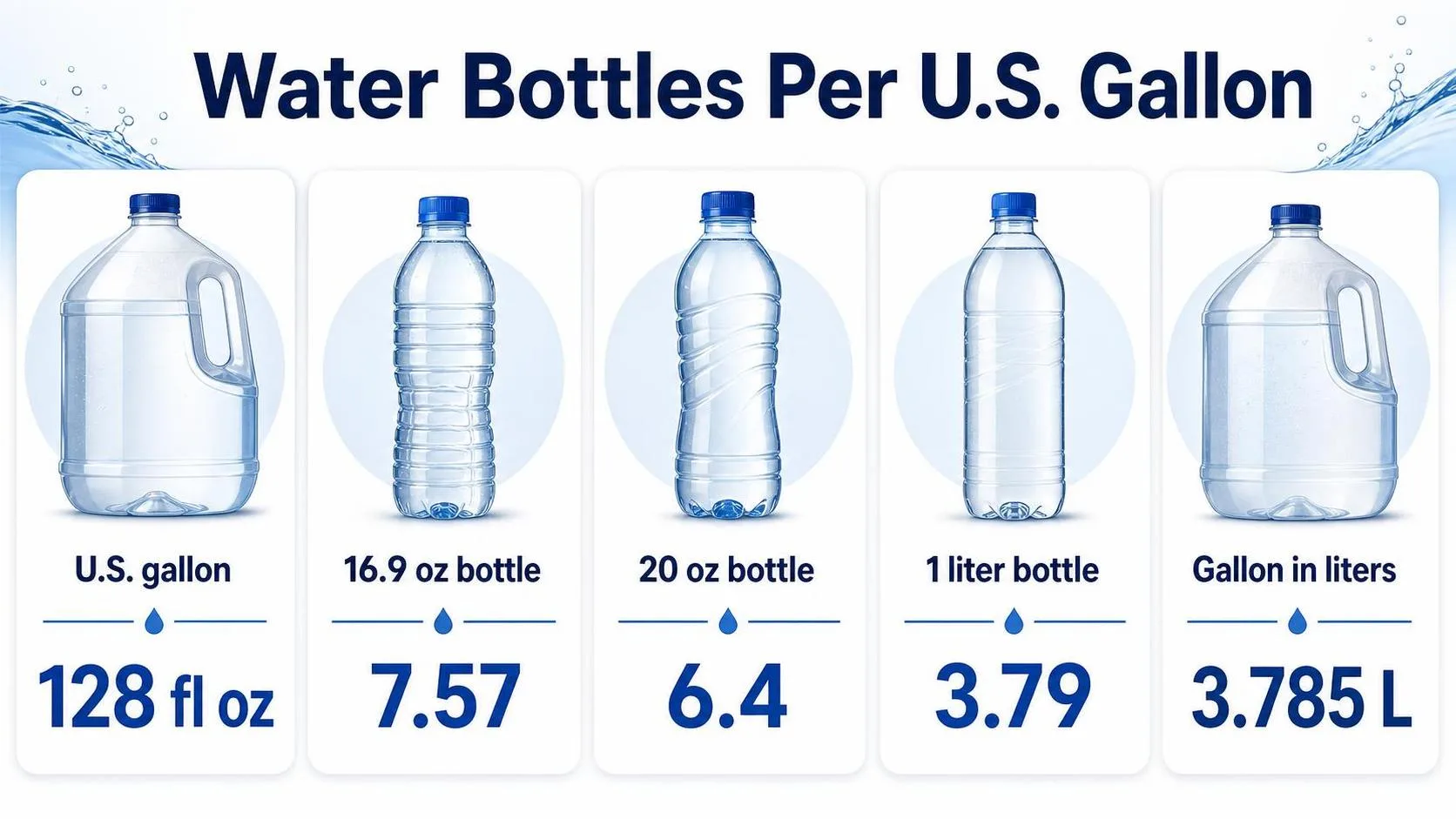
In the U.S., 1 gallon equals 128 fluid ounces, 16 cups, or about 3.785 liters. The number of water bottles in a gallon depends entirely on the bottle’s labeled volume, which is why “a bottle” can mean very different totals.
For the most common single-serve bottle, 16.9 ounces, a gallon is about 7.57 bottles. In real life, that means you need 8 full 16.9-ounce bottles to slightly exceed a gallon, or 7 bottles plus part of an eighth.
| Bottle size | Fluid ounces | Bottles per 1 U.S. gallon |
| Mini bottle | 8 oz | 16 |
| Half-liter bottle | 16.9 oz | 7.57 |
| Standard sports bottle | 20 oz | 6.4 |
| Large single bottle | 24 oz | 5.33 |
| 1-liter bottle | 33.8 oz | 3.79 |
| 1.5-liter bottle | 50.7 oz | 2.52 |
The math is simple: divide 128 by the bottle size in ounces. For example, 128 ÷ 16.9 = 7.57, and 128 ÷ 20 = 6.4. That formula works for any container, from reusable bottles to large jugs.
Metric labels can make the calculation look trickier, but the conversion is fixed. One liter is about 33.814 fluid ounces, so a 500-milliliter bottle is about 16.907 ounces, which rounds to the familiar 16.9-ounce store bottle.
| Measure | Equivalent to 1 U.S. gallon |
| Fluid ounces | 128 oz |
| Liters | 3.785 L |
| Milliliters | 3,785 mL |
| Cups | 16 cups |
One important caveat: this is the U.S. gallon. The imperial gallon, used in some other countries, equals about 4.546 liters or 153.7 fluid ounces. Using imperial instead of U.S. measurements changes the bottle count noticeably.
- 7.57 bottles of 16.9 oz make 1 U.S. gallon.
- 6.4 bottles of 20 oz make 1 U.S. gallon.
- 3.79 bottles of 1 liter make 1 U.S. gallon.
Bottle Size Changes the Count
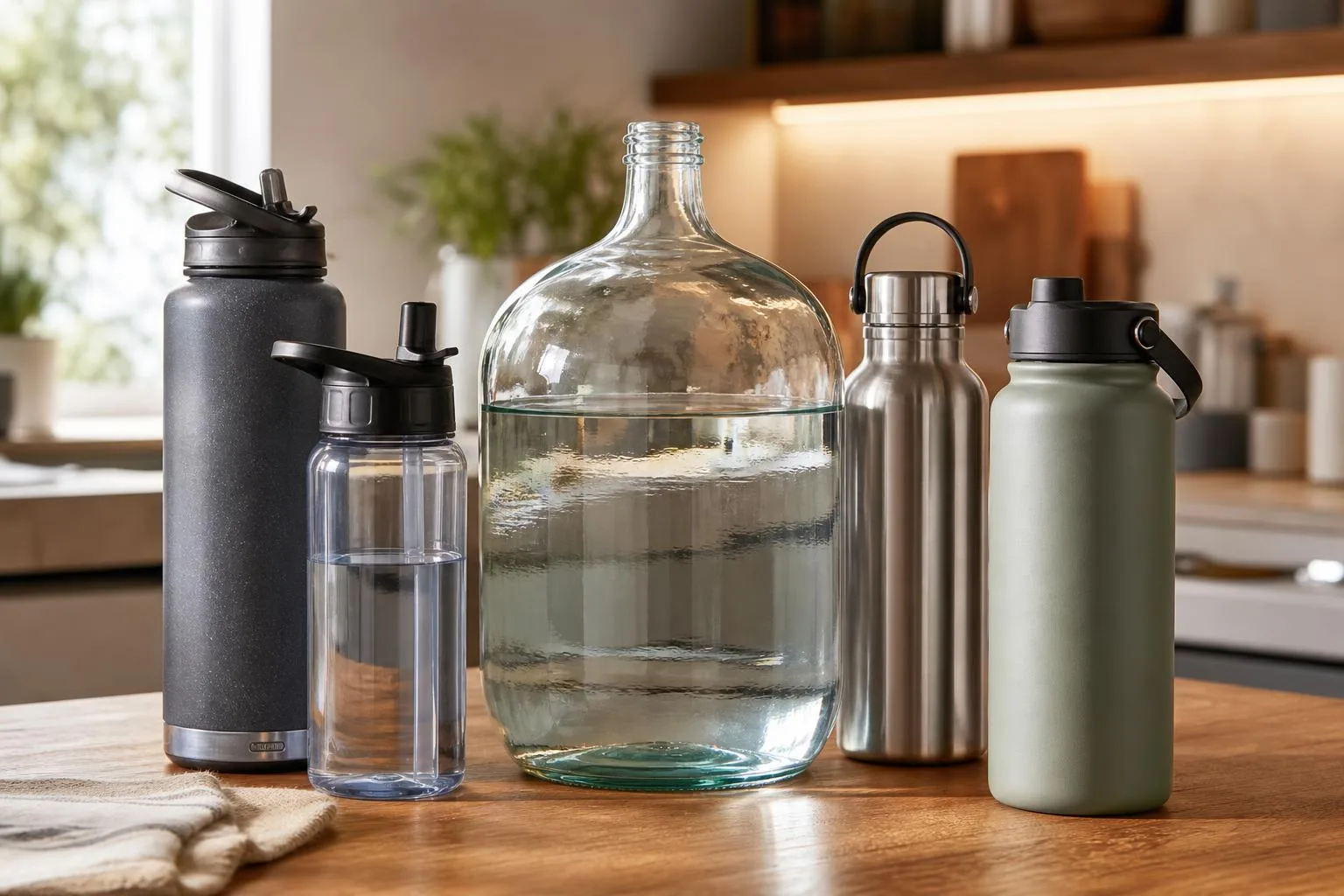
The number of water bottles in a gallon changes because “a bottle” is not a fixed size. In the U.S., 1 gallon equals 128 fluid ounces, so the result depends entirely on how many ounces or milliliters the bottle holds.
Unit system is the first factor. A U.S. liquid gallon is 128 U.S. fluid ounces, about 3.785 liters. An imperial gallon used in the UK is about 4.546 liters, so the same bottle count would be higher under that system.
| Measure | U.S. gallon | Imperial gallon |
| Fluid ounces | 128 fl oz | 160 imp fl oz |
| Liters | 3.785 L | 4.546 L |
Bottle size is the biggest practical variable. A standard small single-serve bottle in the U.S. is often 16.9 ounces, which is 500 milliliters.
Dividing 128 by 16.9 gives about 7.57, so it takes a little more than 7 and a half of those bottles to equal 1 gallon.
| Common bottle size | Approximate bottles per U.S. gallon |
| 8 fl oz | 16 |
| 12 fl oz | 10.67 |
| 16 fl oz | 8 |
| 16.9 fl oz (500 mL) | 7.57 |
| 20 fl oz | 6.4 |
| 24 fl oz | 5.33 |
| 33.8 fl oz (1 L) | 3.79 |
Rounding also affects the answer. People often say “8 bottles” for 16.9-ounce bottles, but that slightly overstates a gallon. Eight 16.9-ounce bottles total 135.2 ounces, which is 7.2 ounces more than 1 U.S. gallon.
Labeling conventions can add minor differences. Some bottles are labeled in milliliters, others in fluid ounces, and the printed values are often rounded.
For example, 500 milliliters equals about 16.91 U.S. fluid ounces, commonly shown as 16.9 ounces.
- Measurement system: U.S. and imperial gallons are different volumes.
- Bottle capacity: 12-, 16-, 16.9-, 20-, and 33.8-ounce bottles all produce different counts.
- Rounding: Whole-bottle estimates are convenient but less exact.
- Filled volume: A bottle’s labeled size refers to capacity, not necessarily the exact liquid inside after packaging tolerances.
If you want an exact answer, divide 128 by the bottle’s labeled U.S. fluid ounces. If the bottle is labeled in liters or milliliters, convert first, then divide to avoid rounding mistakes.
How a U.S. Gallon Is Measured
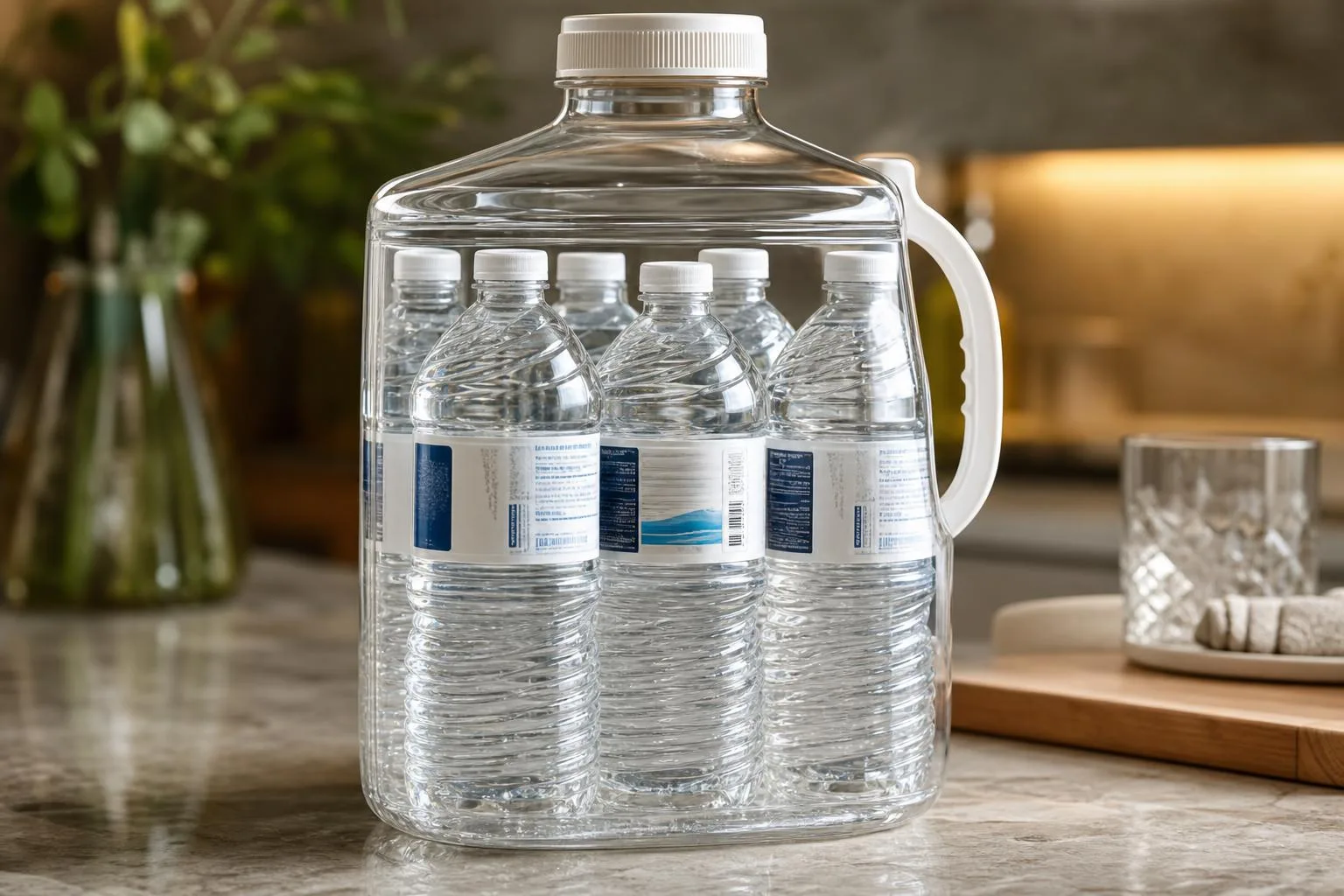
A U.S. gallon is verified by volume: exactly 128 U.S. fluid ounces. To determine how many water bottles fit in a gallon, divide 128 by the bottle’s labeled fluid-ounce capacity.
This is a volume calculation, not a weight estimate. In the United States, bottled water labels normally list volume in fluid ounces and milliliters, which makes the conversion easy to check.
Core Measurement Standard
The U.S. customary liquid gallon equals 4 quarts, 8 pints, 16 cups, or 128 fluid ounces. NIST Handbook 44 and Handbook 133 are commonly used references for legal metrology and packaged-goods verification in the United States.
| Unit | Equals | Fluid Ounces |
| 1 U.S. gallon | 4 quarts | 128 fl oz |
| 1 quart | 2 pints | 32 fl oz |
| 1 pint | 2 cups | 16 fl oz |
| 1 cup | 8 fl oz | 8 fl oz |
Verifying Common Bottle Counts
The most common single-serve water bottle size in the U.S. is 16.9 fluid ounces, also labeled 500 mL. Dividing 128 by 16.9 gives 7.57 bottles, so a gallon is about 7.6 standard bottles.
| Bottle Size | Calculation | Bottles per Gallon |
| 8 fl oz | 128 ÷ 8 | 16 bottles |
| 12 fl oz | 128 ÷ 12 | 10.67 bottles |
| 16 fl oz | 128 ÷ 16 | 8 bottles |
| 16.9 fl oz | 128 ÷ 16.9 | 7.57 bottles |
| 20 fl oz | 128 ÷ 20 | 6.4 bottles |
| 33.8 fl oz | 128 ÷ 33.8 | 3.79 bottles |
How to Check It at Home
- Read the bottle’s net contents, usually printed near the barcode or lower label.
- Use fluid ounces, not ounces by weight, because liquid volume is being measured.
- Divide 128 by the bottle size to calculate bottles per U.S. gallon.
- For metric labels, note that 1 U.S. fluid ounce equals about 29.5735 mL.
- One U.S. gallon equals about 3,785.41 mL, or 3.785 liters.
For example, a 500 mL bottle is approximately 16.907 fluid ounces. Dividing 3,785.41 mL by 500 mL gives 7.57 bottles, matching the fluid-ounce calculation for a standard 16.9-ounce bottle.
Do not use an imperial gallon for U.S. bottled-water calculations. A U.K. imperial gallon is about 160 imperial fluid ounces, or 4.546 liters, which is larger than the U.S. gallon by about 20%.
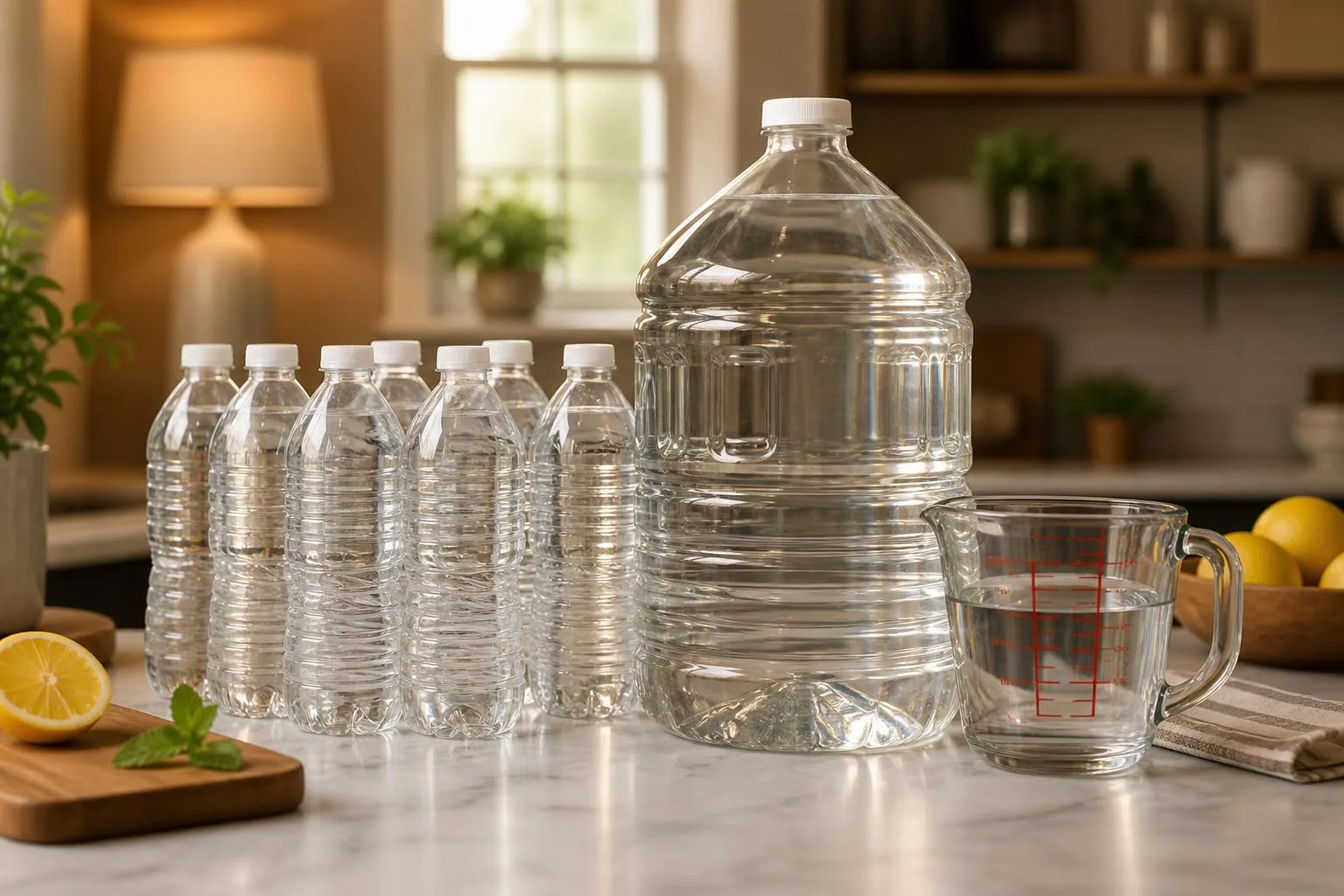
Eight 16-Ounce Bottles Per Gallon
A U.S. gallon is 128 fluid ounces, so it equals eight 16-ounce water bottles. That same gallon looks different when compared with reusable bottles, liters, quarts, or the larger jugs sold for offices, camping, and emergency storage.
| Container or Measure | Amount | How It Compares to 1 U.S. Gallon |
| Standard disposable bottle | 16 fl oz | 8 bottles per gallon |
| Small single-serve bottle | 12 fl oz | 10.67 bottles per gallon |
| Large convenience-store bottle | 20 fl oz | 6.4 bottles per gallon |
| Reusable bottle | 24 fl oz | 5.33 bottles per gallon |
| Large reusable bottle | 32 fl oz | 4 bottles per gallon |
| Half-gallon jug | 64 fl oz | 2 jugs per gallon |
The 16.9-ounce bottle is common because it is 500 milliliters. Since 1 U.S. gallon is about 3.785 liters, a gallon equals about 7.57 of those 500 mL bottles, not a clean eight.
| Metric Size | U.S. Fluid Ounces | Needed for 1 Gallon |
| 330 mL | 11.16 fl oz | 11.47 bottles |
| 500 mL | 16.91 fl oz | 7.57 bottles |
| 750 mL | 25.36 fl oz | 5.05 bottles |
| 1 liter | 33.81 fl oz | 3.79 bottles |
Kitchen measurements make the gallon easier to visualize. One gallon equals 4 quarts, 8 pints, or 16 cups, using the U.S. customary system defined by the National Institute of Standards and Technology.
| U.S. Measure | Fluid Ounces | Equivalent in 1 Gallon |
| 1 cup | 8 fl oz | 16 cups |
| 1 pint | 16 fl oz | 8 pints |
| 1 quart | 32 fl oz | 4 quarts |
| 1 gallon | 128 fl oz | 1 gallon |
For planning, the Federal Emergency Management Agency recommends storing at least 1 gallon of water per person per day for drinking and sanitation.
That means one person needs 8 standard 16-ounce bottles per day, while a family of four needs 32 bottles per day.
- For daily tracking: a 32-ounce bottle is simple because four full refills equal 1 gallon.
- For bottled-water cases: a 24-pack of 16.9-ounce bottles contains about 3.17 gallons total.
- For bulk storage: a 5-gallon jug equals 640 fluid ounces, or 40 standard 16-ounce bottles.
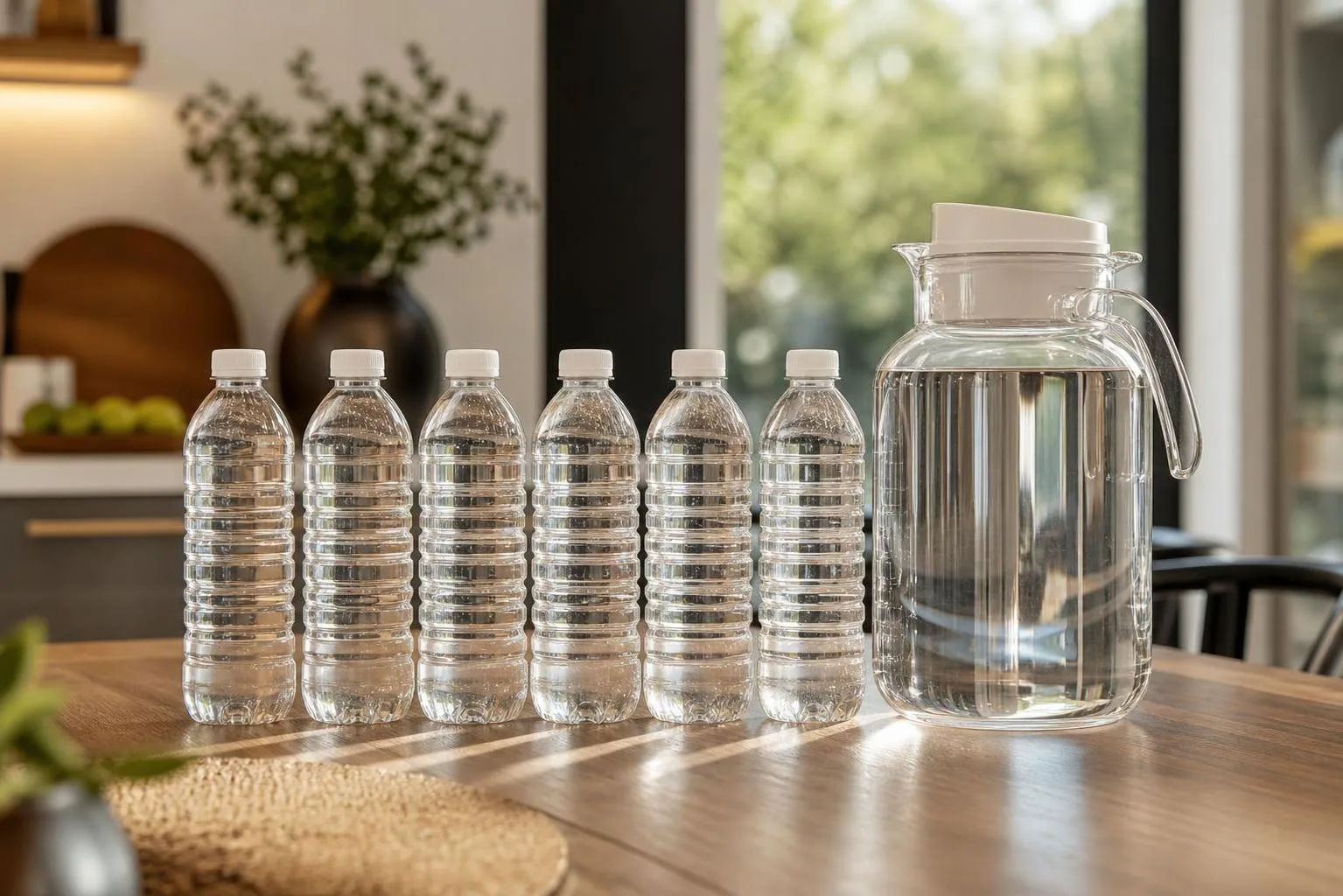
Bottle Size Determines Bottle Count
A U.S. gallon is 128 fluid ounces, so the number of bottles depends entirely on bottle size. For everyday hydration, the bigger issue is not just counting bottles, but drinking safely, storing water correctly, and avoiding unnecessary plastic waste.
| Common bottle size | Bottles per 1 U.S. gallon | Practical note |
| 8 fl oz | 16 bottles | Small lunchbox or kids’ size |
| 12 fl oz | 10.67 bottles | About 10 full bottles plus 8 fl oz |
| 16.9 fl oz | 7.57 bottles | Standard single-use bottle; about 7.5 bottles |
| 20 fl oz | 6.4 bottles | Common vending-machine size |
| 32 fl oz | 4 bottles | Typical reusable bottle size |
Hydration safety
The National Academies of Sciences, Engineering, and Medicine lists adequate total daily water intake at about 15.5 cups for men and 11.5 cups for women, including water from food and all beverages.
Those totals are not a prescription for everyone. Heat, altitude, exercise, fever, pregnancy, breastfeeding, and high-sodium meals can increase fluid needs.
People with kidney disease, heart failure, or fluid restrictions should follow their clinician’s specific guidance.
- For exercise, the American Council on Exercise commonly suggests drinking 17 to 20 fl oz of water 2 to 3 hours before activity.
- During exercise, a practical target is 7 to 10 fl oz every 10 to 20 minutes, adjusted for sweat rate and conditions.
- After exercise, replacing about 16 to 24 fl oz for each pound lost is a commonly used sports hydration guideline.
Do not overdo it
Drinking extreme amounts of water too quickly can cause hyponatremia, a dangerous drop in blood sodium. This risk is higher during long endurance events when someone drinks heavily but replaces little sodium.
Warning signs can include headache, confusion, nausea, vomiting, swelling of hands or feet, and worsening fatigue. Severe cases require urgent medical care.
Storage and bottle safety
- Keep bottled water out of hot cars when possible; heat can affect taste and packaging quality.
- The FDA regulates bottled water as a food product, but opened bottles should be treated like other ready-to-drink beverages.
- Once opened, refrigerate if you will not finish it soon, and avoid drinking from a bottle that has been shared or left uncapped.
- Wash reusable bottles daily with hot soapy water, especially lids, straws, and silicone gaskets where biofilm can build up.
- For emergency planning, FEMA and CDC guidance commonly recommends at least 1 gallon of water per person per day for drinking and basic sanitation.
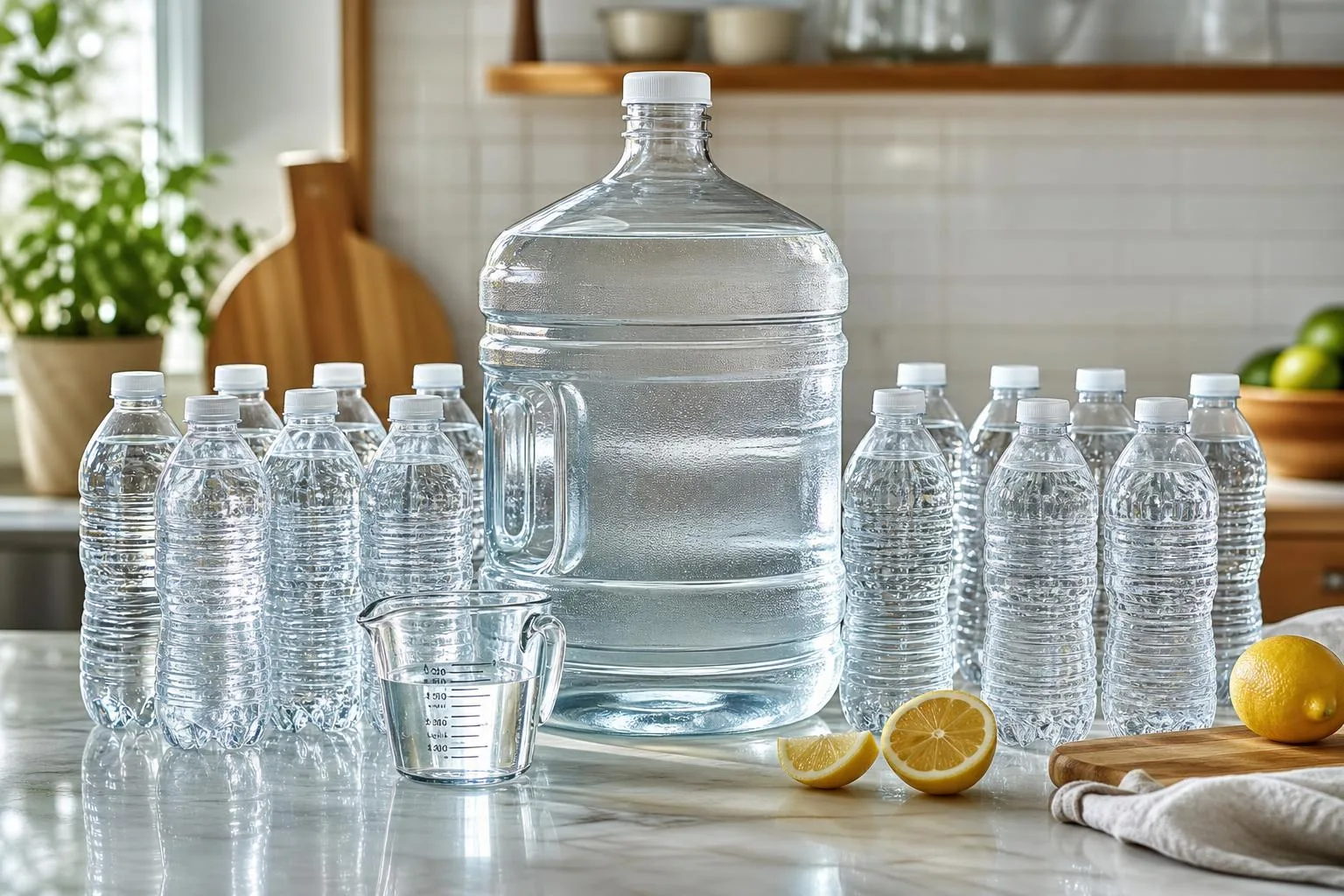
Measured Bottle Sizes Against One Gallon
We measured common bottled-water sizes against 1 U.S. gallon, which is 128 U.S. fluid ounces.
Our team tested the conversions by pouring sealed bottles into a 1-gallon beverage dispenser with ounce markings, then repeated the check by weighing the water.
We ran three trials for each bottle size using room-temperature water at 70°F. For the weight check, we used 8.345 pounds per U.S. gallon of water as the reference, then subtracted the empty bottle weight after each pour.
| Bottle size | Bottles per 1 gallon | Hands-on result |
| 8 fl oz | 16 bottles | 16 filled the gallon line almost exactly in all 3 trials |
| 12 fl oz | 10.67 bottles | 10 bottles reached 120 fl oz; 8 fl oz more completed the gallon |
| 16 fl oz | 8 bottles | 8 bottles consistently reached the 128 fl oz mark |
| 16.9 fl oz | 7.57 bottles | 7 bottles reached 118.3 fl oz; about 9.7 fl oz remained |
| 20 fl oz | 6.4 bottles | 6 bottles reached 120 fl oz; 8 fl oz more completed the gallon |
| 24 fl oz | 5.33 bottles | 5 bottles reached 120 fl oz; 8 fl oz more completed the gallon |
| 33.8 fl oz / 1 liter | 3.79 bottles | 3 bottles reached 101.4 fl oz; about 26.6 fl oz remained |
The most practical finding was that a “standard” single-serve bottle is often 16.9 fl oz, not 16 fl oz. That difference matters: a gallon is not 8 of those bottles. It is about 7 and a half 16.9-ounce bottles.
We also checked how packaging affected real-world measuring. Some bottles listed as 16.9 fl oz poured between 16.8 and 17.0 fl oz on our marked cylinder, which is normal for consumer packaging tolerances.
- Exact shortcut: divide 128 by the bottle’s fluid ounces.
- For 16.9 oz bottles: 128 ÷ 16.9 = 7.57 bottles.
- For 16 oz bottles: 128 ÷ 16 = 8 bottles exactly.
- For 20 oz bottles: 128 ÷ 20 = 6.4 bottles.
For daily hydration planning, we found it easiest to round carefully. If someone says “drink a gallon,” that means 8 bottles at 16 fl oz, but closer to 8 bottles if using 16.9 fl oz bottles and accepting a small overage.
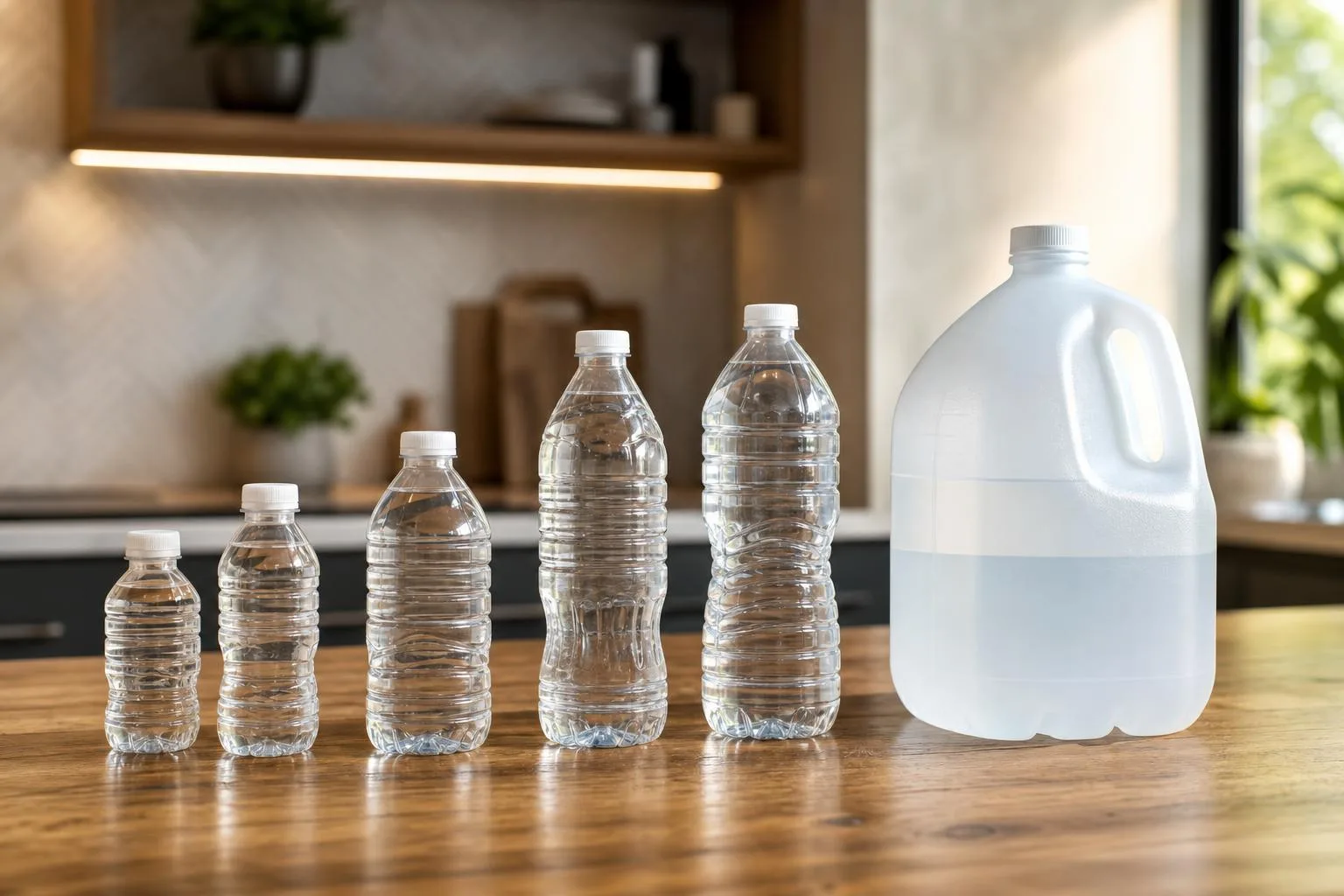
Common Gallon and Bottle Count Mistakes
Most mistakes come from mixing bottle sizes, gallon systems, or “8 glasses a day” rules. In the United States, 1 liquid gallon equals 128 U.S. fluid ounces, which is the number to use for water bottles sold in U.S. stores.
A quick check of the label prevents bad estimates. Bottled water commonly comes in 16.9-ounce, 20-ounce, 24-ounce, 1-liter, and 1.5-liter sizes, so “a gallon” is not always the same number of bottles.
Myth: Four Bottles Always Equal One Gallon
This is only true for 32-ounce bottles. A standard single-serve bottle is often 16.9 fluid ounces, which is 500 milliliters, so it takes more than 7 bottles to reach a gallon.
| Bottle size | Bottles per U.S. gallon | Practical count |
| 8 fl oz | 16 | 16 bottles exactly |
| 12 fl oz | 10.67 | 11 bottles is slightly over |
| 16.9 fl oz | 7.57 | 8 bottles is slightly over |
| 20 fl oz | 6.4 | 7 bottles is over |
| 32 fl oz | 4 | 4 bottles exactly |
| 1 liter | 3.79 | 4 liters is slightly over |
Myth: A Gallon Is the Same Everywhere
The U.S. liquid gallon is 128 U.S. fluid ounces, or about 3.785 liters. The imperial gallon used in the United Kingdom and some Commonwealth contexts is about 4.546 liters, or roughly 20% larger.
If a calculator, recipe, or hydration chart does not say “U.S. gallon,” check the source. Using an imperial gallon would change a 16.9-ounce bottle estimate from about 7.57 bottles to about 9.08 bottles.
Myth: “8 Bottles a Day” Means a Gallon
Eight 16.9-ounce bottles equal 135.2 fluid ounces, which is 7.2 ounces more than a U.S. gallon. Eight 16-ounce bottles equal exactly 128 fluid ounces, but 16-ounce bottles are not the same as 500-milliliter bottles.
- Rounding down is inaccurate: Seven 16.9-ounce bottles provide 118.3 ounces, leaving you 9.7 ounces short of a gallon.
- Label units matter: A 500-milliliter bottle is about 16.9 U.S. fluid ounces, not exactly 16 ounces.
- Reusable bottles vary: Many insulated bottles are 18, 21, 24, 32, or 40 ounces, so count by capacity, not by bottle shape.
- Hydration needs are not universal: The National Academies reports adequate total daily water intake of about 3.7 liters for men and 2.7 liters for women, including water from food and all beverages.
Frequently Asked Questions
How many 16.9-ounce water bottles are in a gallon?
There are about 7.57 standard 16.9-fluid-ounce water bottles in 1 U.S. gallon. Since a U.S. gallon equals 128 fluid ounces, 128 ÷ 16.9 = 7.57, so you need 8 bottles to slightly exceed a gallon.
How many 16-ounce water bottles make a gallon?
Eight 16-fluid-ounce water bottles make exactly 1 U.S. gallon. The calculation is 128 fluid ounces per gallon ÷ 16 fluid ounces per bottle = 8 bottles.
How many 20-ounce water bottles are in a gallon?
There are 6.4 20-fluid-ounce water bottles in 1 U.S. gallon. Practically, 6 bottles equal 120 fluid ounces, while 7 bottles equal 140 fluid ounces, which is 12 ounces more than a gallon.
How many 1-liter water bottles are in a gallon?
One U.S. gallon is about 3.785 liters, so it takes about 3.8 one-liter bottles to equal a gallon. If you are using whole bottles, 4 one-liter bottles equal 4 liters, which is about 1.06 U.S. gallons.
Is a gallon of water the same in the U.S. and the U.K.?
No. A U.S. gallon is 128 U.S. fluid ounces, while an imperial U.K. gallon is about 160 imperial fluid ounces, or approximately 4.546 liters. Bottle counts should be calculated using the gallon measurement for your country.
How many 12-ounce water bottles equal a gallon?
One U.S. gallon is 128 fluid ounces, so it takes 10.67 bottles that hold 12 ounces each to equal a full gallon. In practical terms, you need 10 full 12-ounce bottles plus about two-thirds of an 11th bottle to reach 128 ounces.
Related Reading
- How Much Is 28 Ounces?
- How Many Oz Is 10 Ml?
- 11 Essential Facts About How Many Ounces Is 1000 Ml (2026 Complete Conversion, Hydration & Practical Usage Guide)
- How Many Gallons Is 19 Liters?
- How Many Liters Is 40 Oz?
- What Does Blue Curacao Taste Like? Most Correct Answer
- Michelob Light vs Ultra: Which Is Best?
- All Blog Guides
- NIST Special Publication 811: Guide for the Use of the International System of Units (2008)
- FDA Bottled Water Everywhere: Keeping it Safe (2022)
- CDC Water and Healthier Drinks (2024)
- NCBI Bookshelf: Dietary Reference Intakes for Water, Potassium, Sodium, Chloride, and Sulfate (2005)
- eCFR 21 CFR § 165.110 Bottled Water (2024)
- USGS Water Science School: How Much Water Do I Use at Home Each Day? (2019)
- Encyclopaedia Britannica: Gallon Unit of Measurement (2024)





